
Life, 1907-07-11 · page 11 of 24
Life — July 11, 1907 — page 11: what you’re looking at
What you’re looking at
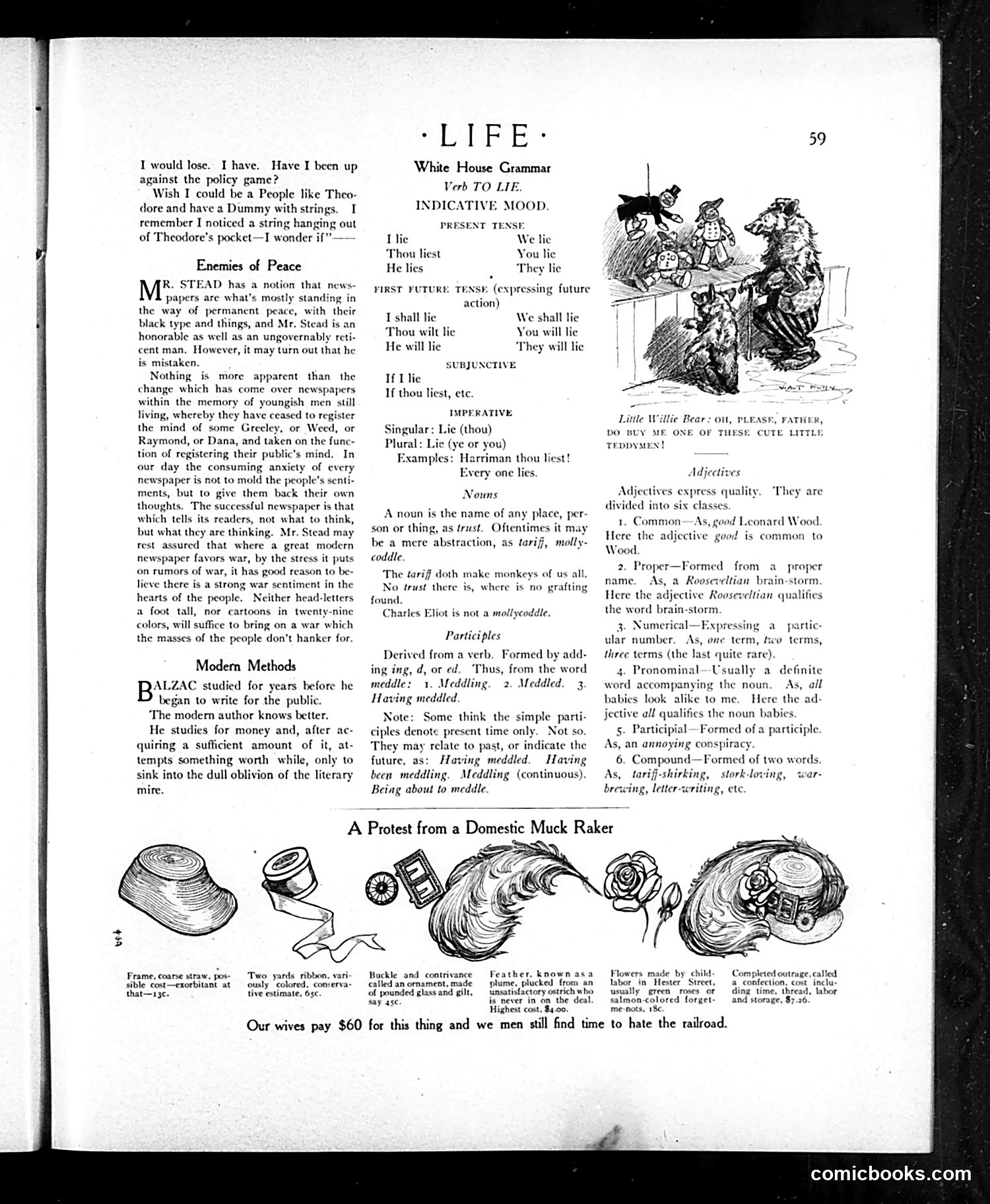
This cartoon satirizes women's complaints about the cost of elaborate hats. The illustrated items—straw frames, ribbons, buckles, feathers, and flowers—represent the expensive decorative elements fashionable women's hats required in this era. The caption's bitter complaint—"Our wives pay $60 for this thing and we men still find time to hate the railroad"—mocks husbands' dual grievances: the extravagant expense of women's fashion and their separate political complaints about railroad companies (likely monopolistic practices, a contemporary reform issue). The satire targets both the frivolous spending on women's accessories and the idea that men have time to complain about multiple issues simultaneously. "Muck raker" refers to investigative journalists exposing corruption.
📄 Transcribed text from this page (OCR, searchable)
Machine-transcribed from the original scan — historical spelling and the odd misread are preserved.
I would lose. Ihave. Have I been up against the policy game? h I could be a People like Theo: dore and have a Dummy with strings. I remember I noticed a string hanging out of Theodore’s pocket—I wonder if”—— Enemies of Peace R. STEAD has a notion that news- papers are what’s mostly standing in the way of permanent peace, with their black type and things, and Mr. Stead is an honorable as well as an ungovernably reti- cent man, However, it may turn out that he is mistaken. Nothing is more apparent than the change which has come over newspapers within the memory of youngish men still living, whereby they have ceased to register the mind of some Greeley, or Weed, or Raymond, or Dana, and taken on the func- tion of registering their public's mind. In our day the consuming anxiety of every newspaper is not to mold the people's senti- ments, but to give them back their own thoughts. The successful newspaper is that which tells its readers, not what to think, but what they are thinking. Mr. Stead may rest assured that where a great modern newspaper favors war, by the stress it puts on rumors of war, it has good reason to be- lieve there is a strong war sentiment in the hearts of the people. Neither head-letters a foot tall, nor cartoons in twenty-nine colors, will suffice to bring on a war which the masses of the people don’t hanker for. Modern Methods ALZAC studied for years before he began to write for the public. ‘The modern author knows better. He studies for money and, after ac- quiring a sufficient amount of it, at- tempts something worth while, only to sink into the dull oblivion of the literary Z SY “a Two yards ribbon, vari ously colored, conerva- tive estimate, 6sc. Frame, coarse straw, pos: sible cost—exorbitant at that—1 3c. Our wives pay $60 for this thing and we men still find time SPE White House Grammar Verb TO LIE. INDICATIVE MOOD. PRESENT TENSE We lic You lie They lie Tlic Thou liest He lies . FIRST FUTURE TENSE (expressing future action) We shall lie You will lie They will lie I shall lie Thou wilt lic He will lie SUBJUNCTIVE If Llie If thou liest, ete IMPERATIVE Singular: Lie (thou) Plural: Lie (ye or you) Examples: Harriman thou liest! Every one lies. Nouns A noun is the name of any place, per- son or thing, as trust. Oftentimes it may be a mere abstraction, as tariff, molly- coddle. The tari doth make monkeys of us all No trust there is, where is no grafting found. Charles Eliot is not a mollycoddle, Partici ples Derived from a verb. Formed by add- ing ing, d, or ed. ‘Thus, from the word meddle: 1. Meddling. 2. Meddled. 3 Having meddled. Note: Some think the simple parti- ciples denote present time only. Not so. They may relate to past, or indicate the future, as: Having meddled. Having been meddling. Meddling (continuous). Being about to meddle. N Feather, known asa plume, plucked from an unsatisfactory ostrich who is never in on the deal Highest cost, $4.00. Buckle and contrivance called an ornament, made ‘of pounded glass and gilt, say ase Little Willie Bear : 0, PLEASE, FATHER, DO BUY ME ONE OF THESE CUTE LITTLE TEDDYMEN! Adjectives Adjectives express quality. divided into six classes 1. Common—As, good Leonard Wood. Here the adjective good is common to Wood 2. Proper—Formed from a proper name. As, a Rooseveltian brain-storm Here the adjective Rooseveltian qualifies the word brain-storm ‘They are 3. Numerical—Expressing a ular number. As, ove term, ¢ three terms (the last quite rare) 4. Pronominal—Usually a definite word accompanying the noun. As, all babies look alike to me. Here the ad jective all qualifies the noun babies. partic- ‘0 terms, Formed of a participle. As, an annoying conspiracy. 6. Compound—Formed of two words hirking, stork-loving, war- brewing, letter-writing, etc. A Protest from a Domestic Muck Raker Completed outrage, called. @ confection, cost "inclu- ding time, thread, labor and storage, $7.26. Flowers made by child. labor in Hester Street, usually green roses or salmon-colored forget: me-nots, 18¢ to hate the railroad. comicbooks.com