
Life, 1907-07-11 · page 16 of 24
Life — July 11, 1907 — page 16: what you’re looking at
What you’re looking at
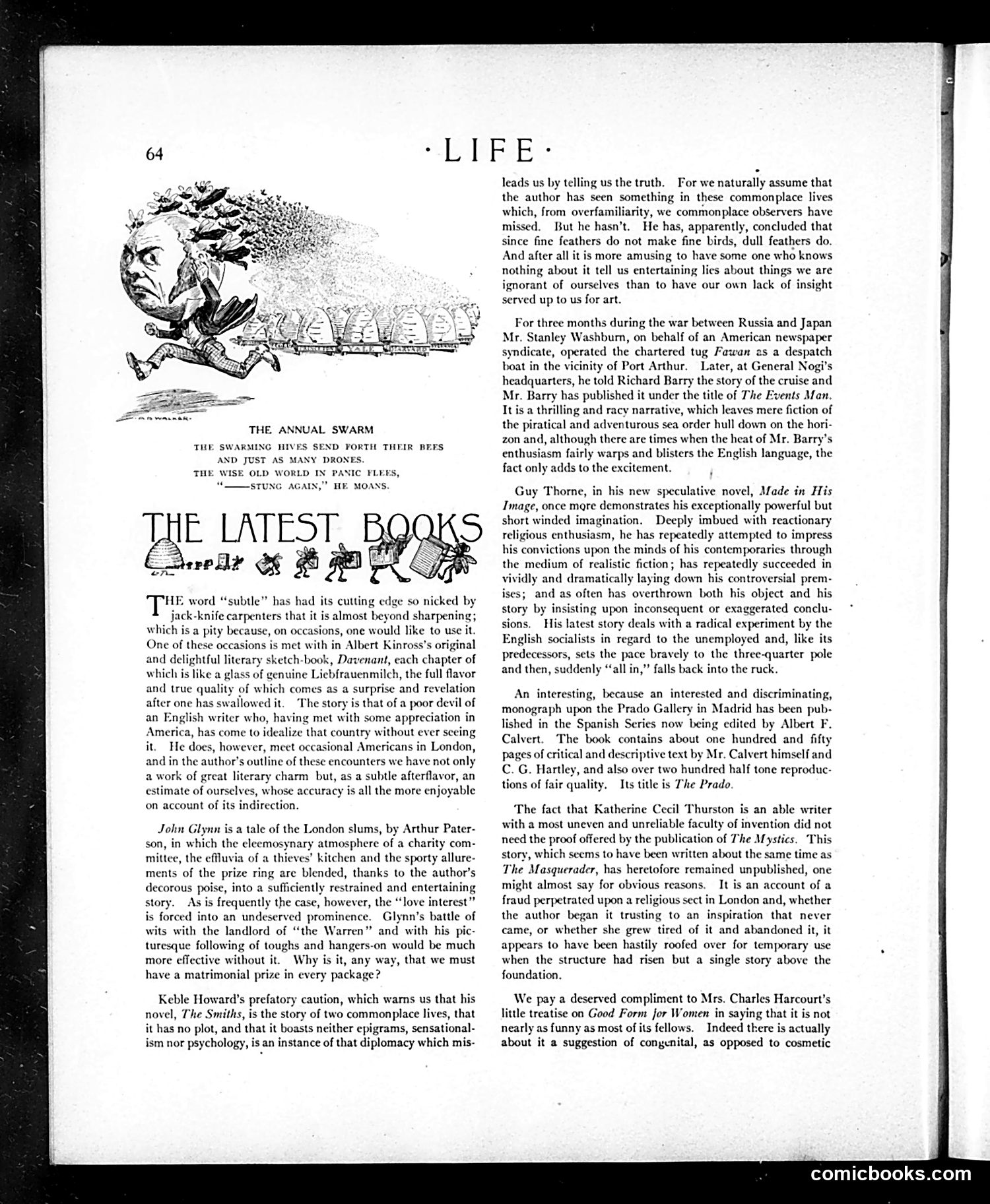
This political cartoon depicts a caricatured figure with exaggerated features being chased or overwhelmed by a swarm of bees, with accompanying text about "drones" returning annually. The accompanying caption suggests this is satirizing recurring social or political problems that return seasonally or cyclically. The cartoon appears to reference anxieties about immigration or population surges—"the wise old world in panic flees"—depicting outsiders as an invasive swarm. The emphasis on "drones" (non-productive members) suggests critique of perceived parasitic elements in society. The page itself is primarily a book review section titled "The Latest Books," discussing contemporary novels including works about London slums and international conflicts. The cartoon functions as visual satire commenting on social conditions discussed in the literary reviews that follow, likely reflecting early 20th-century anxieties about social mobility, immigration, or labor issues that were popular subjects in period fiction.
📄 Transcribed text from this page (OCR, searchable)
Machine-transcribed from the original scan — historical spelling and the odd misread are preserved.
*[5 ERVE = THE ANNUAL SWARM THE SWARMING HIVES SEND PORTH THEIR BEES AND JUST AS MANY DRONES. THE WISE OLD WORLD IN PANIC FLEES, AGAIN," HE MOANS. HE word “subtle” has had its cutting edge so nicked by jack-knife carpenters that it is almost beyond sharpening; which is a pity because, on occasions, one would like to use it One of these occasions is met wit Albert Kinross’s original and delightful literary sketch-book, Davenant, each chapter of which is like a glass of genuine Liebfrauenmilch, the full flavor and true quality of which comes as a surprise and revelation after one has swallowed it. The story is that of a poor devil of an English writer who, having met with some appreciation in America, has come to idealize that country without ever sceing it. He does, however, meet occasional Americans in London, and in the author's outline of these encounters we have not only a work of great literary charm but, as a subtle afterflavor, an estimate of ourselves, whose accuracy is all the more enjoyable on account of its indirection. John Glynn is a tale of the London slums, by Arthur Pater- son, in which the eleemosynary atmosphere of a charity com- mittee, the effluvia of a thieves’ kitchen and the sporty allure- ments of the prize ring are blended, thanks to the author’s decorous poise, into a sufficiently restrained and entertaining story. As is frequently the case, however, the “love interest” is forced into an undeserved prominence. Glynn’s battle of wits with the landlord of “the Warren” and h his pic- turesque following of toughs and hangers-on would be much more effective without it. Why is it, any way, that we must have a matrimonial prize in every package? Keble Howard’s prefatory caution, which warms us that his novel, The Smiths, is the story of two commonplace lives, that it has no plot, and that it boasts neither epigrams, sensational- ism nor psychology, is an instance of that diplomacy which mis- leads us by telling us the truth. For we naturally assume that the author has seen something in these commonplace lives which, from overfamiliarity, we commonplace observers have missed. But he hasn’t. He has, apparently, concluded that since fine feathers do not make fine birds, dull feathers do. And after all it is more amusing to have some one who knows nothing about it tell us entertaining lics about things we are ignorant of ourselves than to have our own lack of insight served up to us for art. For three months during the war between Russia and Japan Mr. Stanley Washburn, on behalf of an American newspaper syndicate, operated the chartered tug Fawan as a despatch boat in the vicinity of Port Arthur. Later, at General Nogi’s headquarters, he told Richard Barry the story of the cruise and Mr. Barry has published it under the title of The Events Man. It isa thrilling and racy narrative, which leaves mere fiction of the piratical and adventurous sea order hull down on the hot zon and, although there are times when the heat of Mr. Ban enthusiasm fairly warps and blisters the English language, the fact only adds to the excitement. Guy Thorne, in his new speculative novel, Made in His Image, once more demonstrates his exceptionally powerful but short winded imagination. Deeply imbued with reactionary m, he has repeatedly attempted to impress his convictions upon the minds of his contemporaries through the medium of realistic fiction; has repeatedly succeeded in vividly and dramatically laying down his controversial prem- ises; and as often has overthrown both his object and his story by ing upon inconsequent or exaggerated conclu- siot His latest story deals with a radical experiment by the English socialists in regard to the unemployed and, like its predecessors, sets the pace bravely to the three-quarter pole and then, suddenly “all in,” falls back into the ruck. An interesting, because an interested and discriminating, monograph upon the Prado Gallery in Madrid has been pub- lished in the Spanish Series now being edited by Albert F. Calvert. The book contains about one hundred and fifty pages of critical and descriptive text by Mr. Calvert himself and C. G. Hartley, and also over two hundred half tone reproduc- ns of fair quality. Its title is The Prado. ‘The fact that Katherine Cecil Thurston is an able writer with a most uneven and unreliable faculty of invention did not need the proof offered by the publication of The Mystics, This story, which seems to have been written about the same time as The Masquerader, has heretofore remained unpublished, one might almost say for obvious reaso' It is an account of a fraud perpetrated upon a religious sect in London and, whether the author began it trusting to an inspiration that never came, or whether she grew tired of it and abandoned it, it appears to have been hastily roofed over for temporary use when the structure had risen but a single story above the foundation, We pay a deserved compliment to Mrs. Charles Harcourt’s little treatise on Good Form Jor Women in saying that it is not nearly as funny as most of its fellows. Indeed there is actually about it a suggestion of congenital, as opposed to cosmetic comicbooks.com