
A complete issue · 24 pages · 1907
Life — June 13, 1907
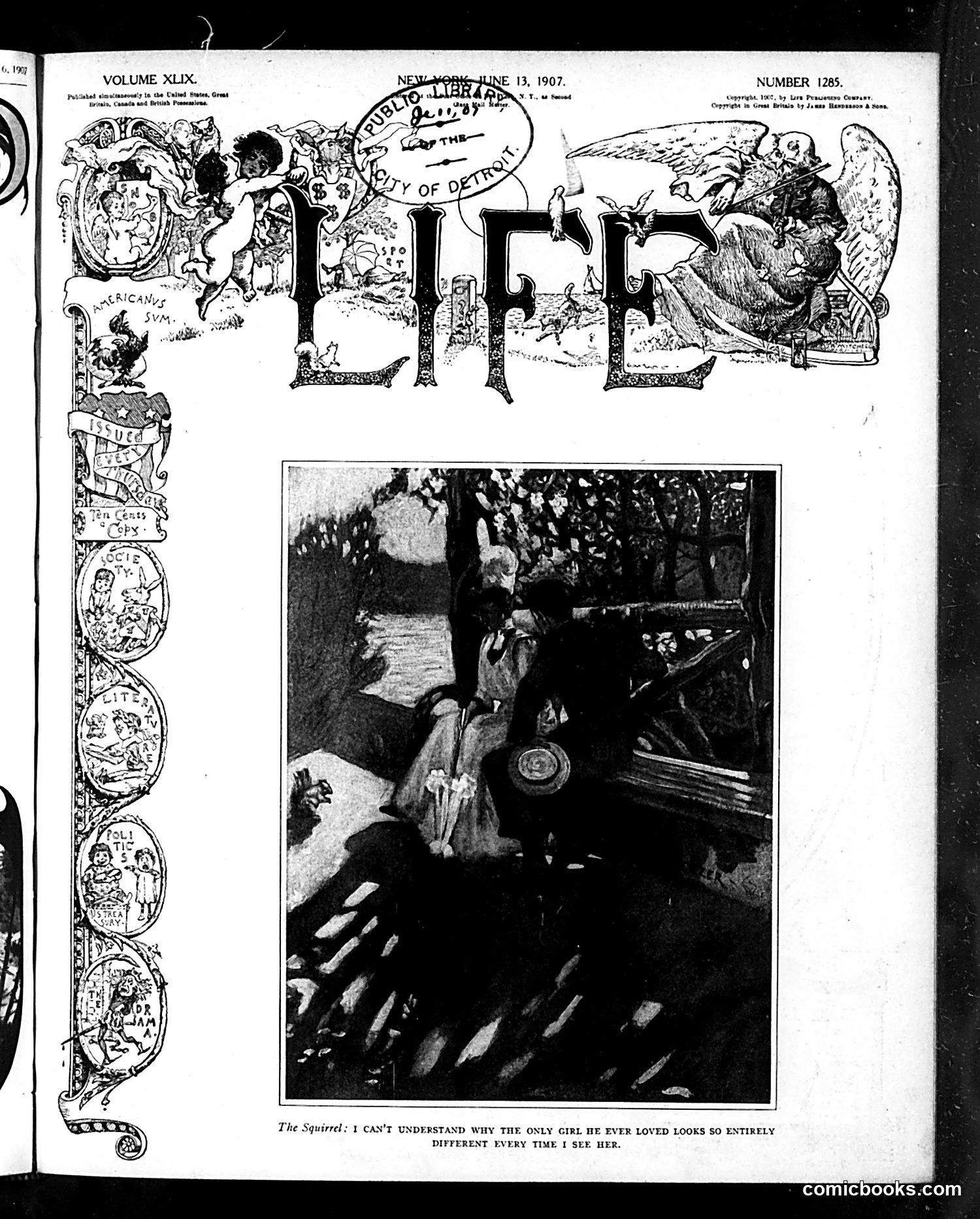
This is the cover of Life magazine's humor section titled "LIFE," featuring decorative Art Nouveau borders and a black-and-white photograph. The photograph's caption reads: "The Squirrel: I CAN'T UNDERSTAND WHY THE ONLY GIRL HE EVER LOVED LOOKS SO ENTIRELY DIFFERENT EVERY TIME I SEE HER." This is a romantic comedy joke about male perception. The humor suggests a man's idealization of a woman he loves causes him to see her differently each time they meet—his romantic feelings distort his perception rather than her appearance changing. A squirrel observing this contradiction finds it puzzling. The joke mocks both romantic delusion and the gap between objective reality and subjective experience, typical of Life's satirical approach to contemporary social behavior and relationships.
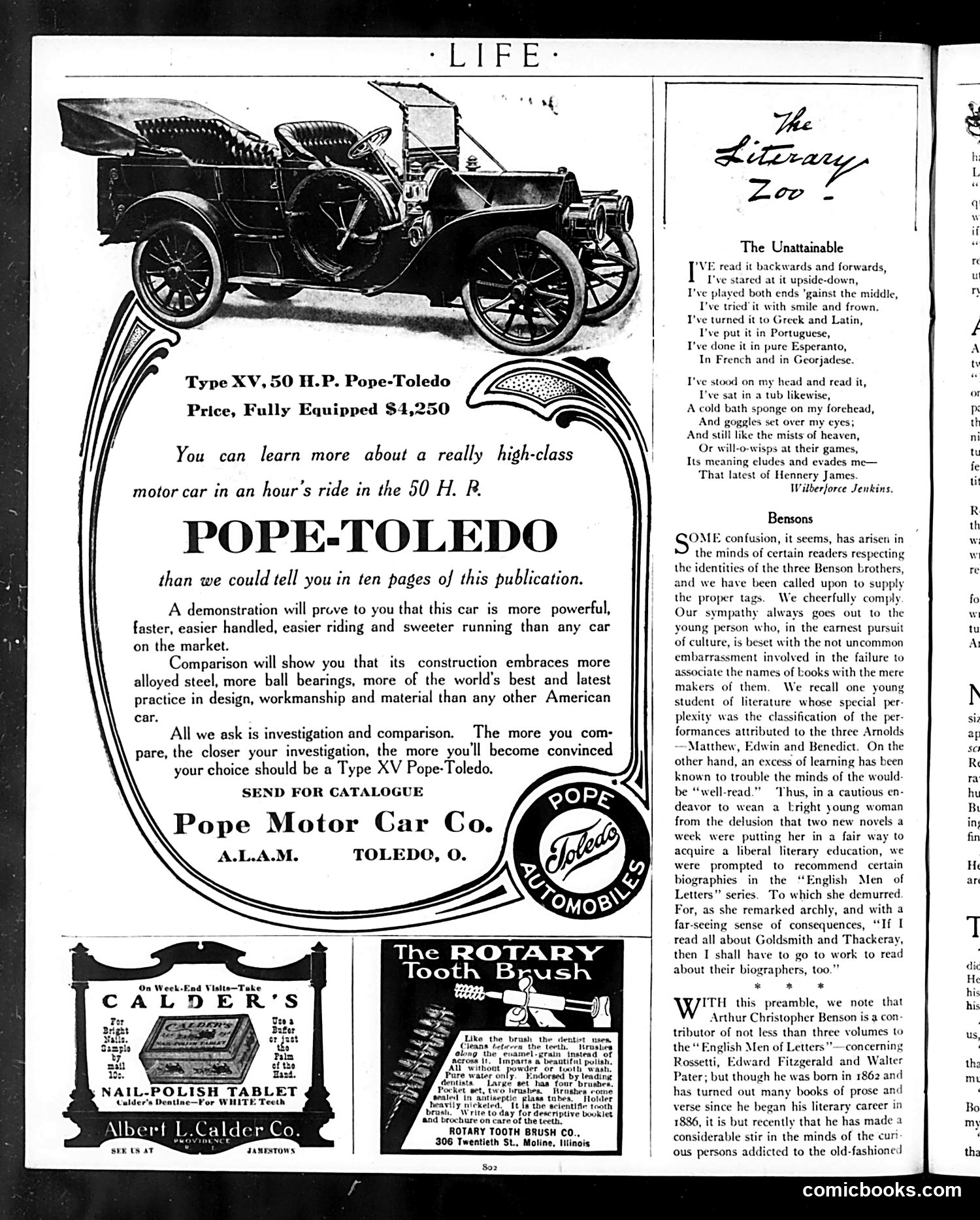
This page is primarily **advertising**, not satire or political commentary. The dominant content is a full-page advertisement for the **Pope-Toledo automobile** (Type XV, 50 H.P., priced at $1,250), manufactured by Pope Motor Car Co. in Toledo, Ohio. The ad uses typical early 20th-century marketing language, emphasizing the car's power, construction quality, and superiority to competitors, and invites potential buyers to request a catalogue or arrange a demonstration. The right side contains "The Literary Zoo," a humorous poem by Willadene Jenkins about attempting to read difficult literature, followed by a brief essay titled "Bensons" discussing the three Benson brothers and their literary achievements. Below are smaller advertisements for nail polish and a rotary toothbrush—standard commercial content for the period.
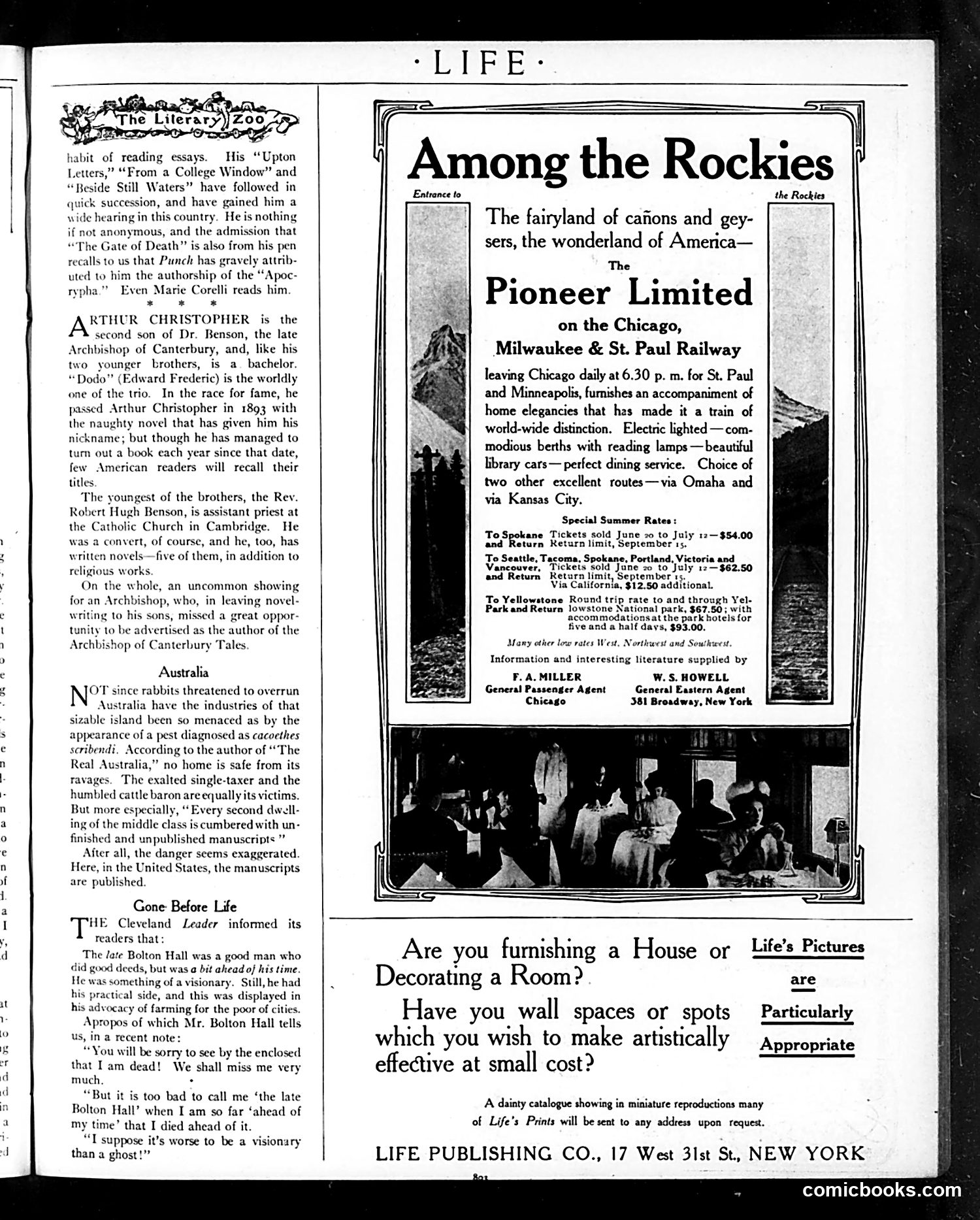
This page is primarily **advertising and literary content**, not political satire or comics. The main feature is a large advertisement for the "Pioneer Limited" train on the Chicago, Milwaukee & St. Paul Railway, promoting travel to the Rocky Mountains with details about summer rates to Spokane, Seattle, Vancouver, and Yellowstone. Below that is a Life Publishing Co. advertisement for decorative prints. The left column contains literary discussion under "The Literary Zoo" about writers including Arthur Christopher Benson, and a section titled "Gone Before Life" discussing Bolton Hall and the Cleveland *Leader*. There is **no political cartoon or satirical content** on this page. It represents Life magazine's mixed approach of combining editorial content with substantial advertising.
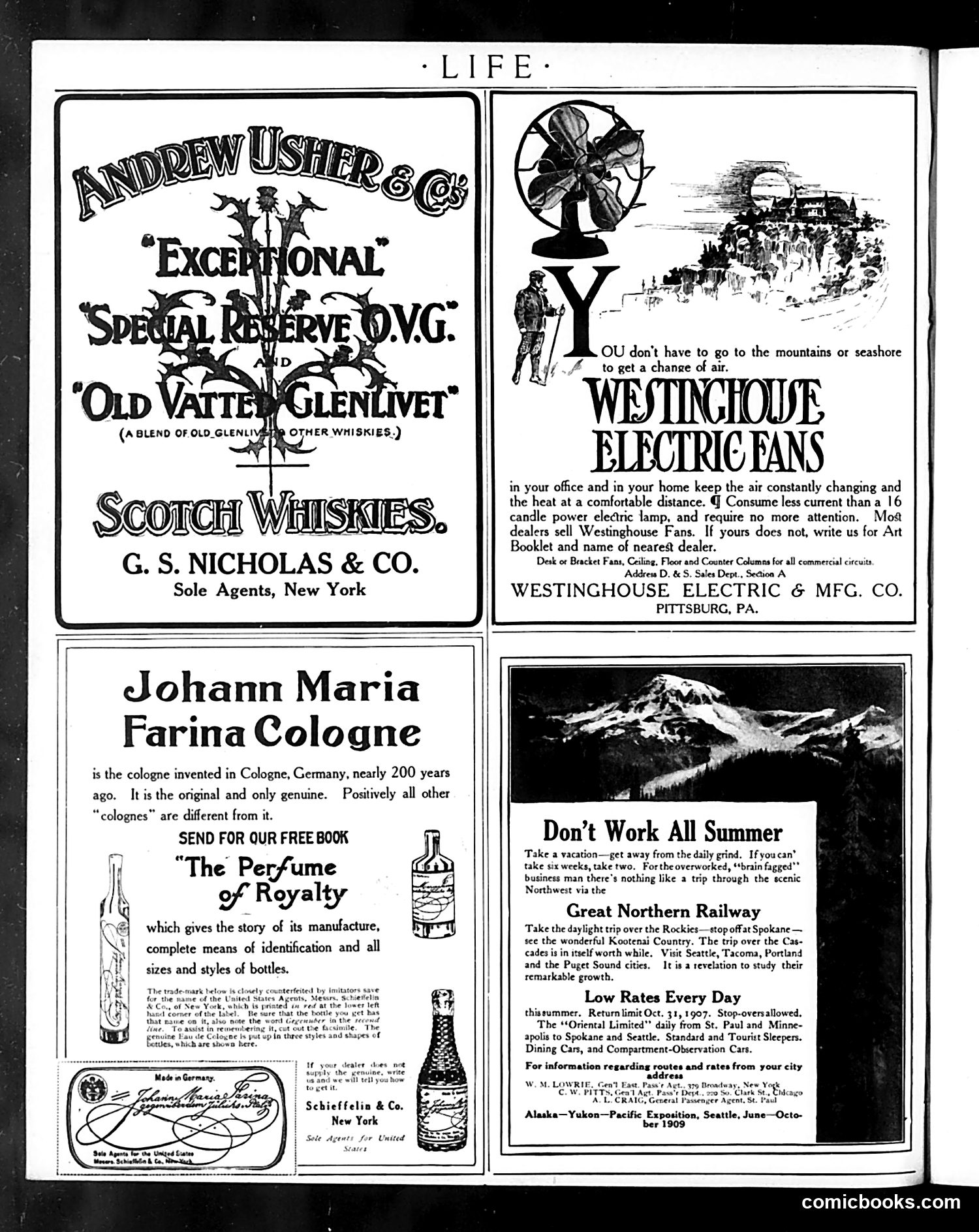
This page is primarily **advertising**, not political satire or editorial content. It contains four advertisements from the early 1900s: 1. **Andrew Usher Scotch Whiskies** - promoting branded alcohol 2. **Westinghouse Electric Fans** - highlighting modern electric appliances as a convenience for staying cool indoors 3. **Johann Maria Farina Cologne** - marketing a German perfume as "original and only genuine" 4. **Great Northern Railway** - advertising vacation travel to the Pacific Northwest There are no political cartoons or satirical commentary visible. The page reflects early 20th-century consumer culture, emphasizing modern conveniences (electric fans), luxury goods (whisky, cologne), and leisure travel—typical of *Life* magazine's advertising revenue model during this period.
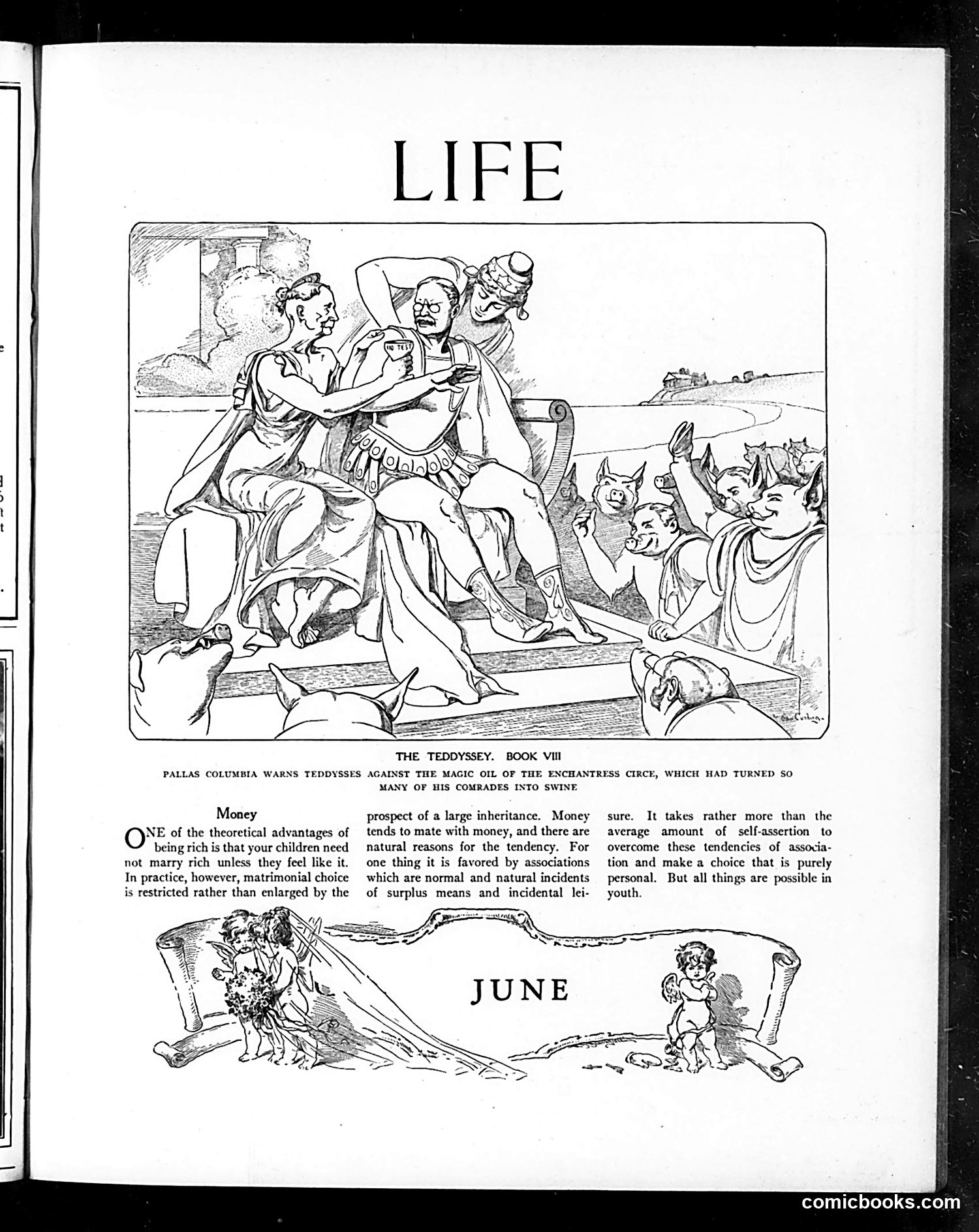
**Upper Illustration:** References Book VIII of "The Teddysey" (a satirical parody of Homer's *Odyssey*). The caption describes Pallas Columba warning Teddysses (President Theodore Roosevelt) against "the magic oil of the Enchantress Circe, which had turned so many of his comrades into swine." This is political satire comparing Roosevelt to Odysseus, mocking his policies or leadership by suggesting they've transformed his political allies into degraded creatures. **"Money" Article:** Discusses wealth inheritance and matrimonial choice, arguing that while money is theoretically advantageous, it should not be the primary basis for marriage decisions—a common moral position in early 20th-century commentary. **June Illustration:** Decorative seasonal imagery with cherubs, unrelated to political content.
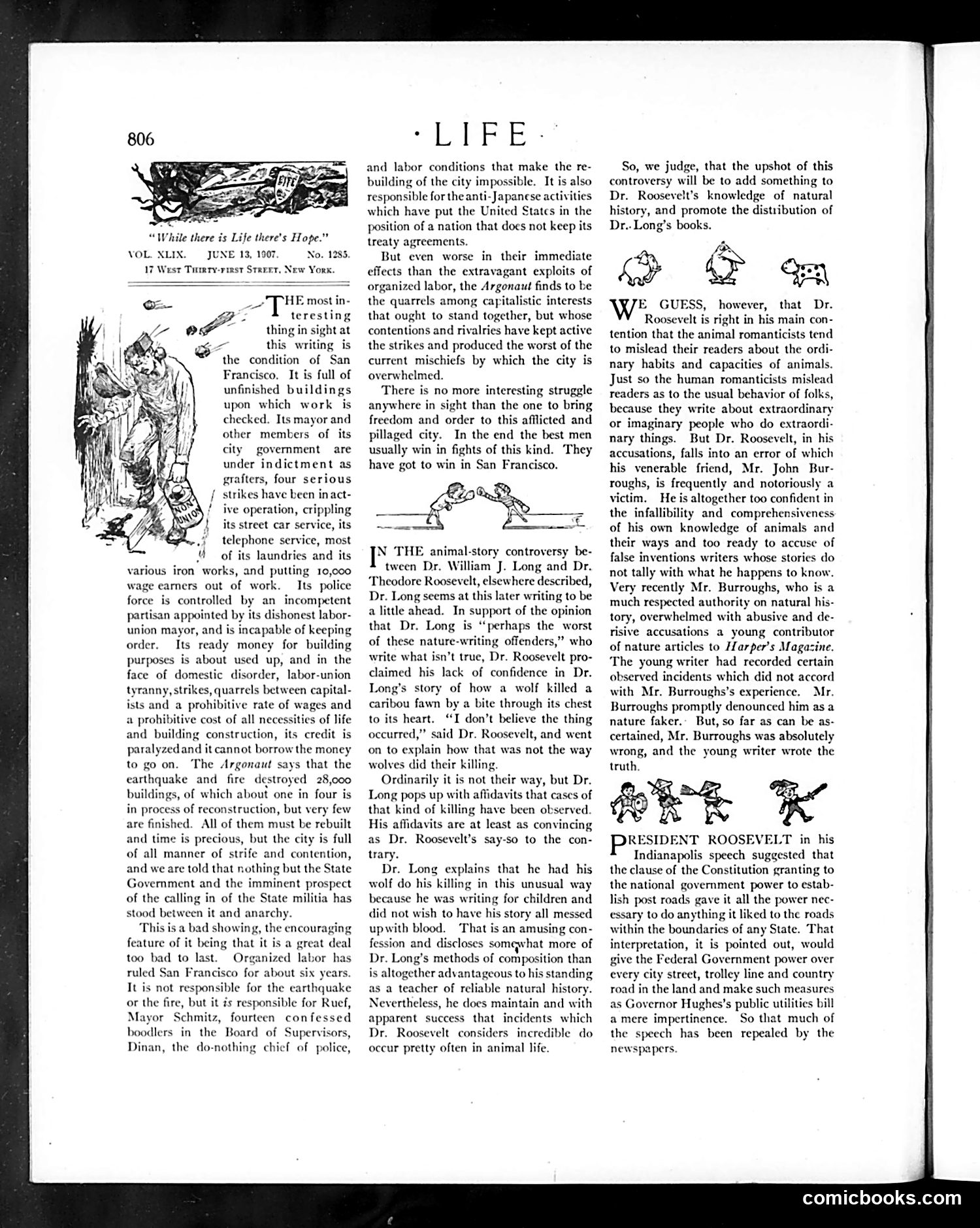
This page discusses a controversy between **Dr. William J. Long** and **President Theodore Roosevelt** over animal behavior stories. The left illustration shows a caricatured figure (likely Long) amid urban decay in San Francisco, critiquing his credibility. The central debate concerns Long's nature writing, which Roosevelt deemed unreliable and misleading to readers. Roosevelt accused Long of fabricating animal incidents—specifically claiming a wolf story was false. Long defended himself by citing his intent to write for children without graphic violence. The satire targets Long's pretensions as a "nature writer" while supporting Roosevelt's skepticism. The page argues Long is too confident in promoting false animal behaviors, making him an unreliable authority despite his popular appeal.
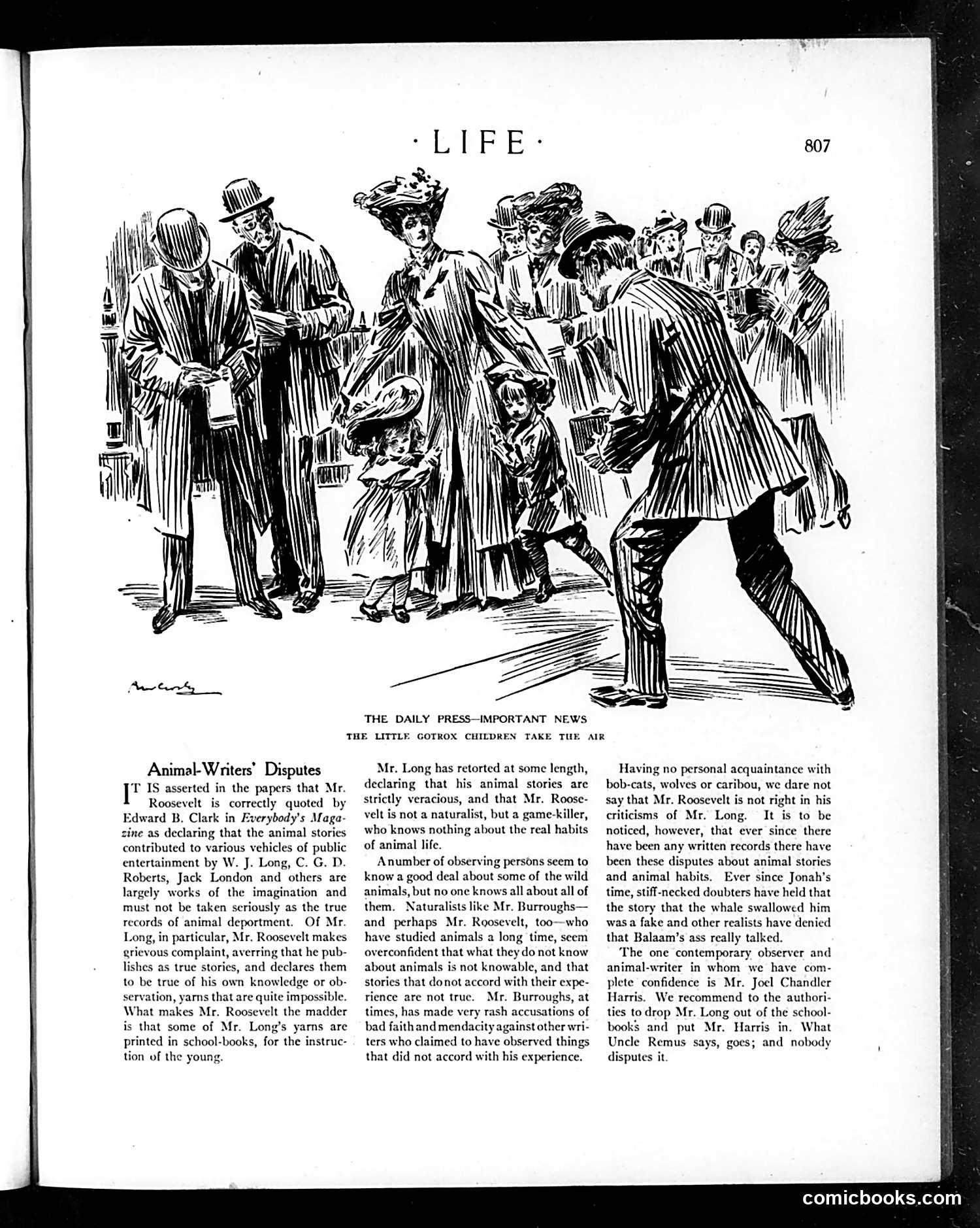
**The Cartoon:** The ink sketch depicts well-dressed adults and children on a street, with the caption "THE DAILY PRESS—IMPORTANT NEWS: THE LITTLE GOTROX CHILDREN TAKE THE AIR." **The Satire:** This appears to mock sensationalist newspaper coverage of trivial events involving minor celebrities or notable families. The exaggerated formality and crowd gathering around children simply taking a walk suggests newspapers treating mundane activities as significant news. **The Article:** "Animal-Writers' Disputes" critiques Theodore Roosevelt and Jack London for publishing animal stories presented as factual natural history, when they lack genuine zoological expertise. The writer argues such works shouldn't be treated as authoritative records of animal behavior, and defends naturalists like John Burroughs against accusations of fabrication. The piece advocates for accuracy in nature writing.
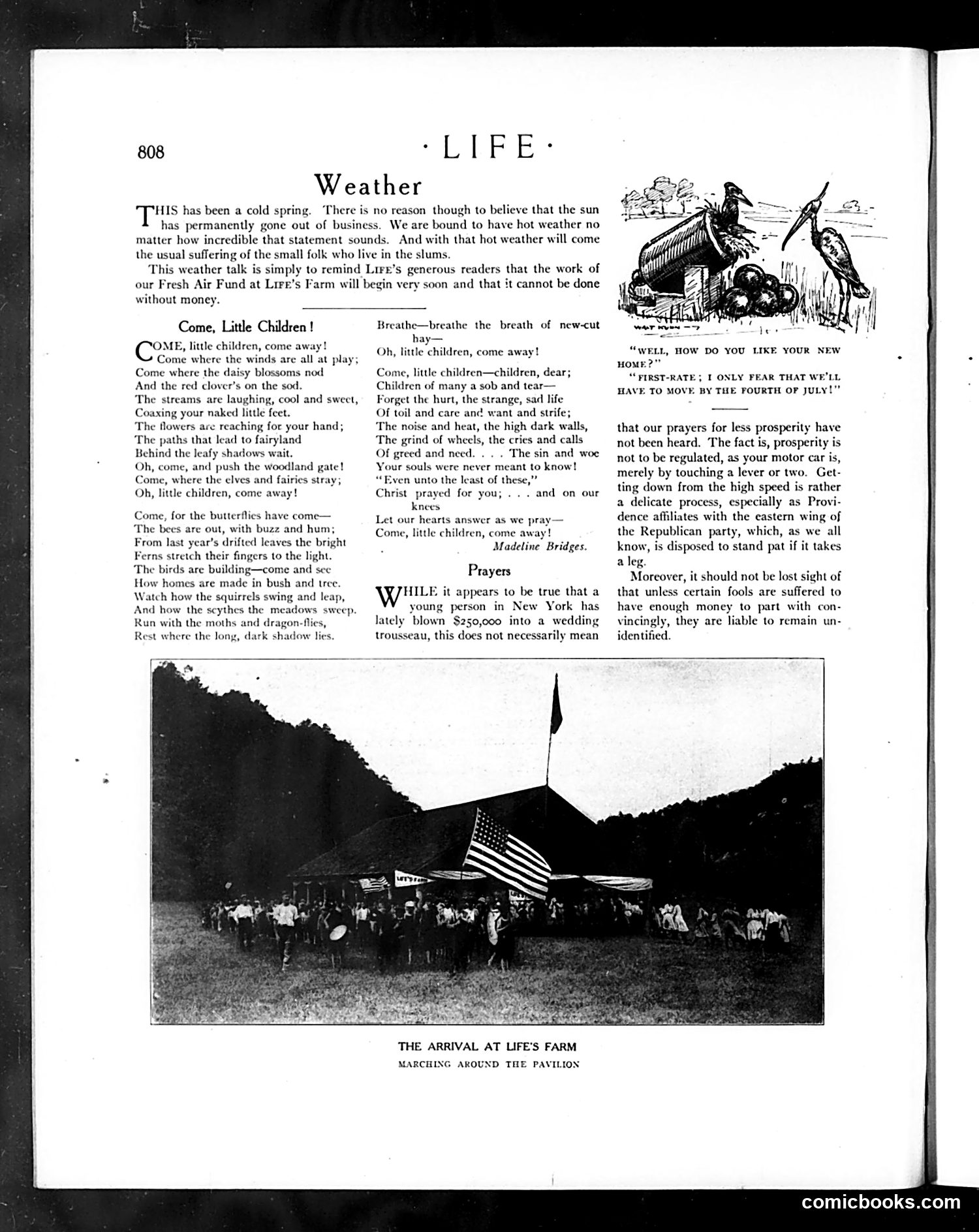
This page contains three distinct sections: **"Weather"** and **"Come, Little Children!"** are poems encouraging outdoor activities and escaping urban slums—typical turn-of-century progressive rhetoric about fresh air and nature's benefits. **"Prayers"** is a brief satirical commentary mocking wealthy New Yorkers. It ridicules a young person who "blew $250,000 into a wedding trousseau," suggesting that having substantial money doesn't prevent people from being foolish with it. The satire implies such wealthy individuals deserve no sympathy for poor financial decisions. The photograph shows a large gathering at "Life's Farm" with an American flag, appearing to document an actual event or property associated with the magazine itself—likely a promotional or social gathering.
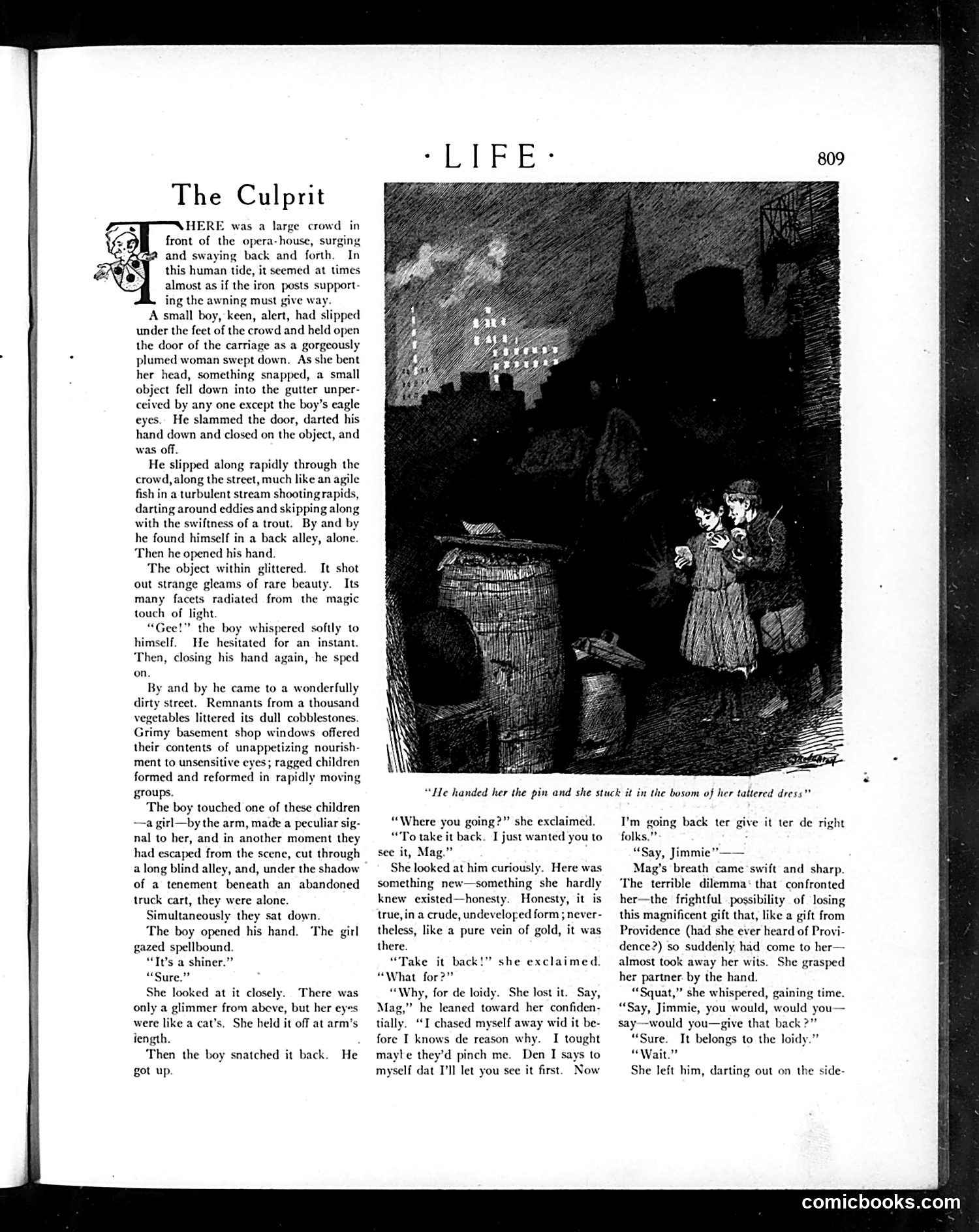
This is a narrative short story illustrated with a wood-engraving, not political satire. The story depicts a street scene where a poor boy finds a shiny object dropped by a well-dressed woman outside an opera house. The object appears to be a pin or brooch. The narrative explores class conflict and moral choice: the boy must decide whether to keep the item or return it. The dialogue reveals the boy's internal struggle—he initially rationalizes keeping it ("I chased myself away wid it before I knows de reason why"), but his partner Mag encourages honesty, ultimately persuading him to return it. The "culprit" refers to the boy's temptation toward theft, not any political figure. This reflects Progressive-era interest in urban poverty, childhood morality, and working-class virtue.
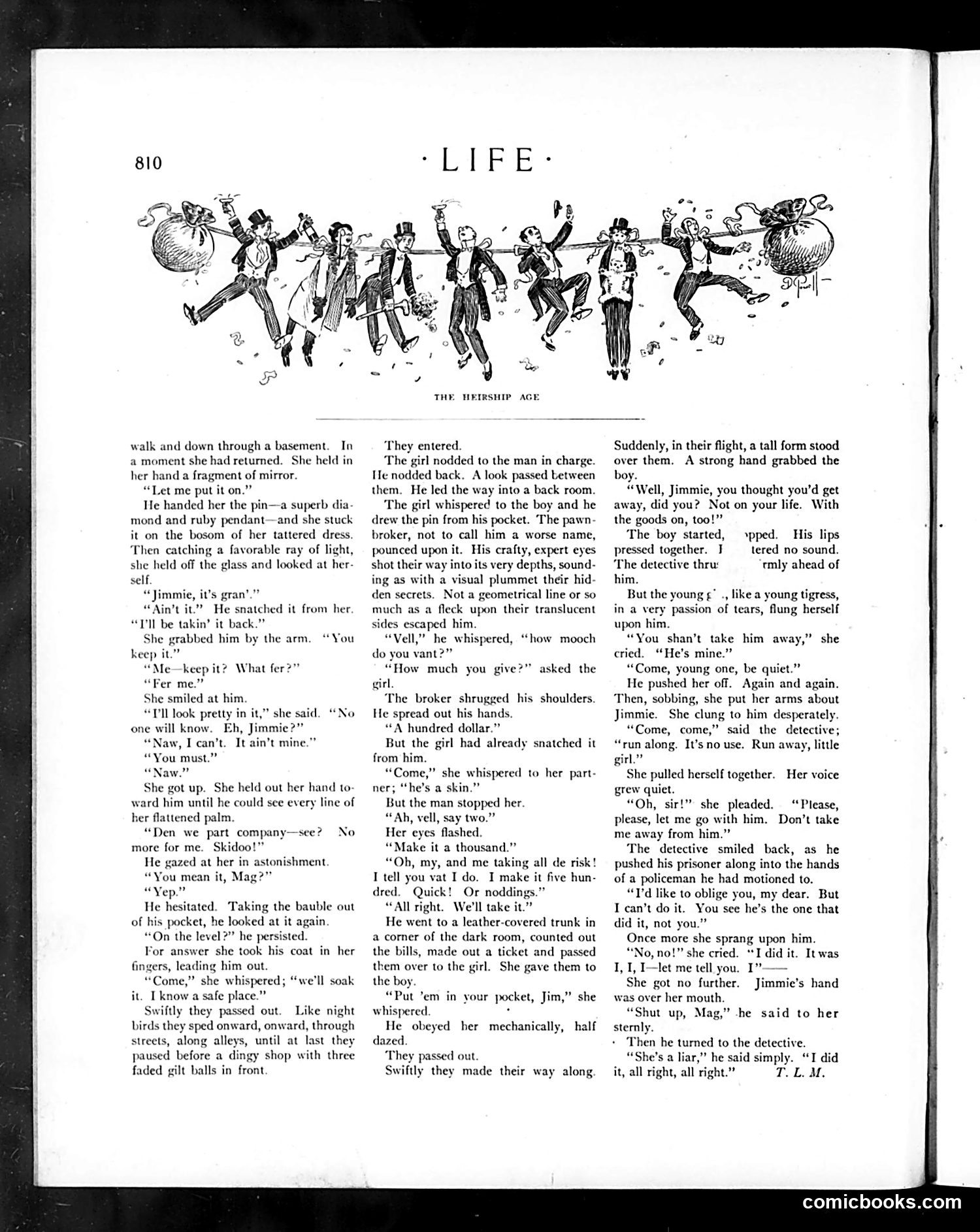
This satirical cartoon depicts men in formal dress celebrating wildly while holding large money bags. The illustration accompanies a narrative story about theft and deception. The cartoon appears to satirize **inheritance and wealth acquisition through dishonest means**. The exuberant figures suggest people rejoicing over obtaining money—possibly illegally or through fraud, as the accompanying story involves a pawn broker, stolen goods, and criminal activity. The title "The Heirship Age" likely mocks the idea that in modern times, people achieve wealth not through legitimate inheritance or honest work, but through criminal schemes, con artistry, and deception. The story's plot—involving a girl, a detective, and a stolen pin—reinforces themes of crime and moral corruption in pursuit of money. This reflects turn-of-century anxieties about urban crime and fraud.
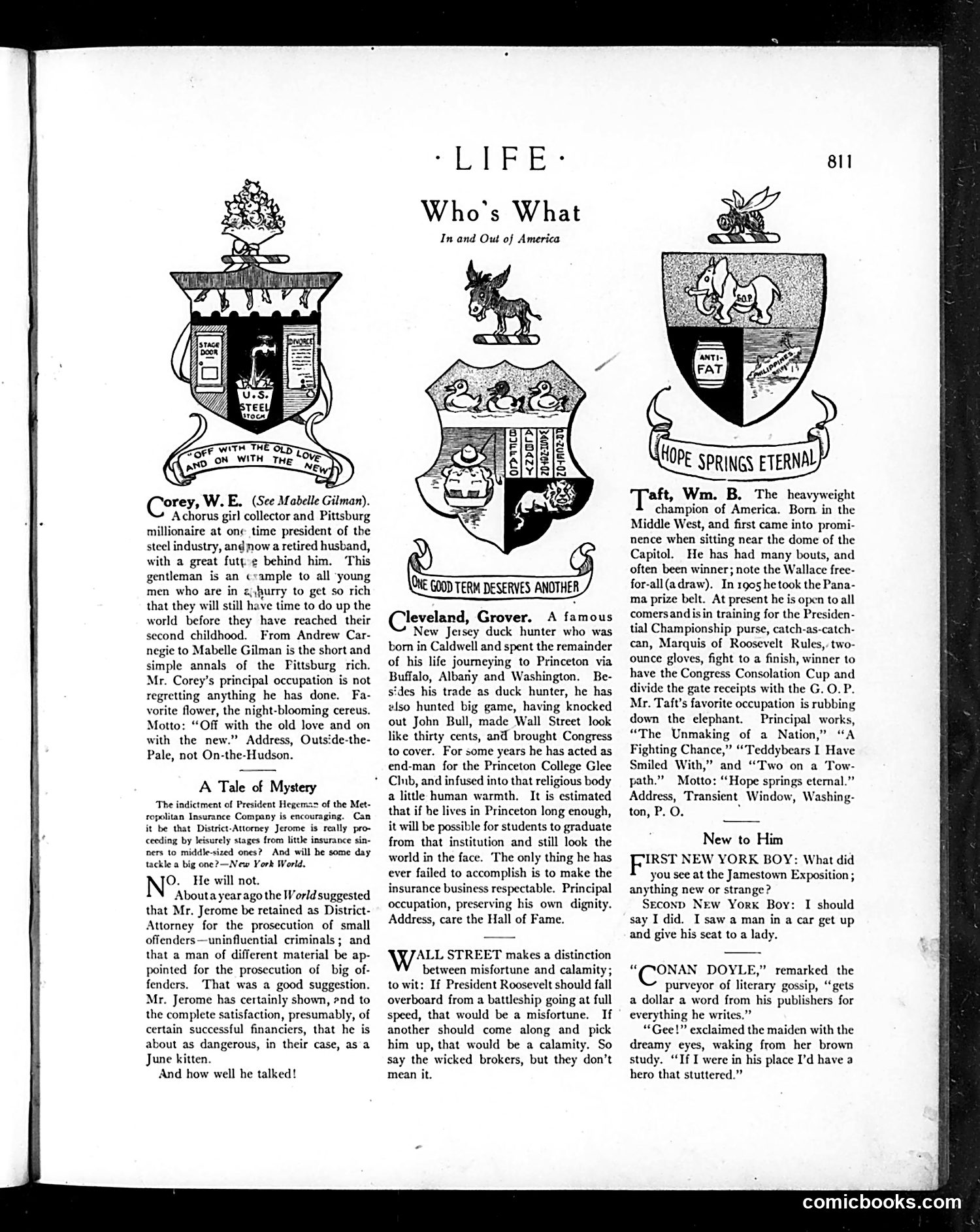
This page features "Who's What: In and Out of America," a satirical section profiling public figures through heraldic coat-of-arms designs. **Corey, W.E.** is mocked as a steel industry millionaire and "gilded" husband—the heraldry jokes about wealth and shallow marriage. **Cleveland, Grover** appears as a duck hunter from New Jersey, satirizing his reputation for hunting and outdoor pursuits rather than serious governance. **Taft, Wm. B.** is depicted as a heavyweight boxing champion, mocking his physical size and suggesting he's unfit for the presidency—a common criticism of President William Howard Taft. The lower sections contain brief anecdotes mocking insurance companies, Wall Street financiers, and literary gossip—typical Life magazine satire targeting American institutions and celebrities of the early 20th century.
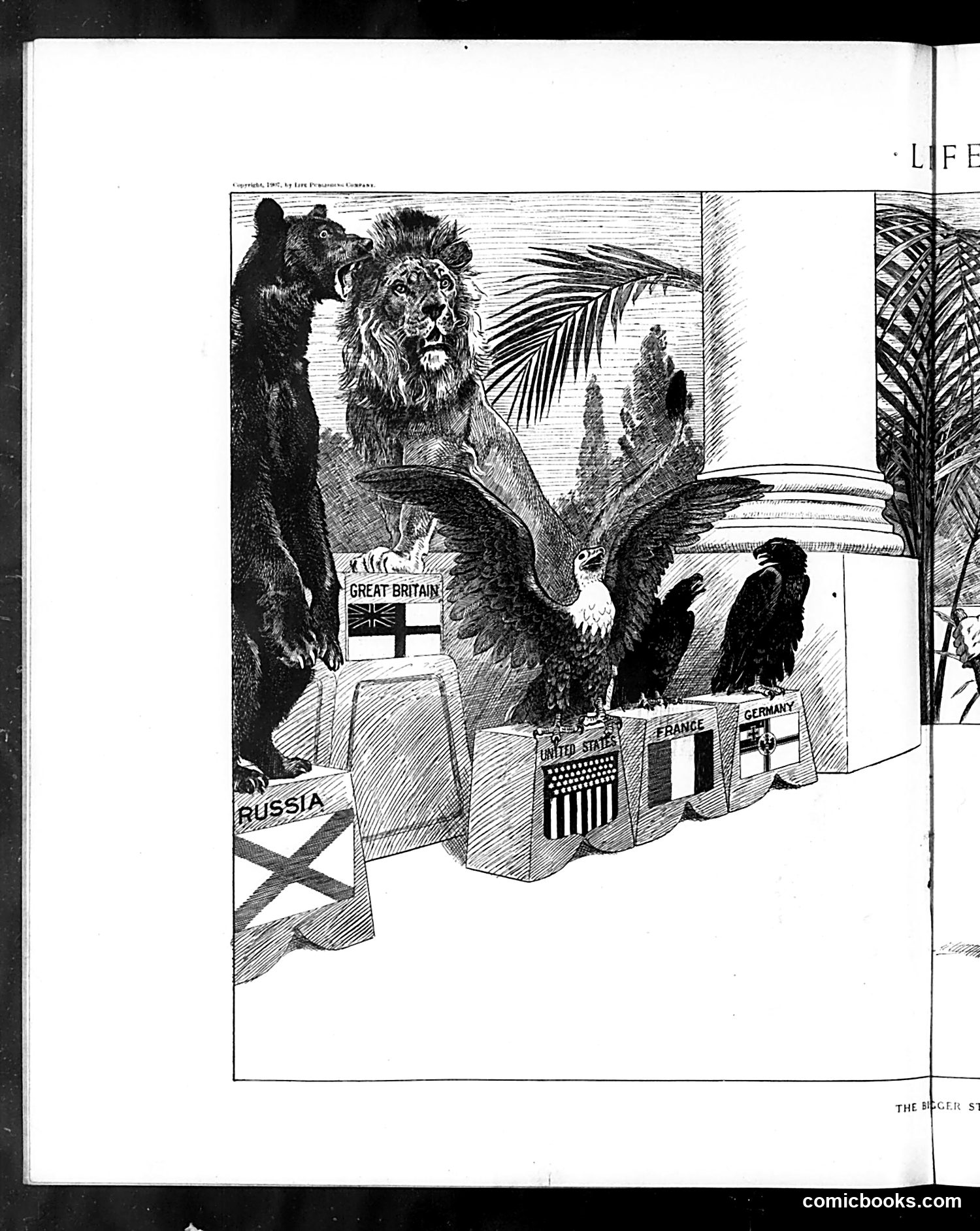
This editorial cartoon depicts an allegorical scene where a large lion (labeled "Great Britain") presides over smaller figures representing other Allied powers during what appears to be World War I or its aftermath. The countries shown—Russia, United States, France, and Germany—are depicted as smaller animals or figures positioned below, suggesting a hierarchy of power or influence. The lion's dominant posture and the architectural setting with palm fronds suggest a colonial or imperial context. The cartoon likely critiques either British imperial dominance among the Allies or commentary on post-war power dynamics and treaty negotiations. The specific arrangement and relative sizes of the national symbols convey satirical commentary on how these nations were positioned relative to each other during this historical period.
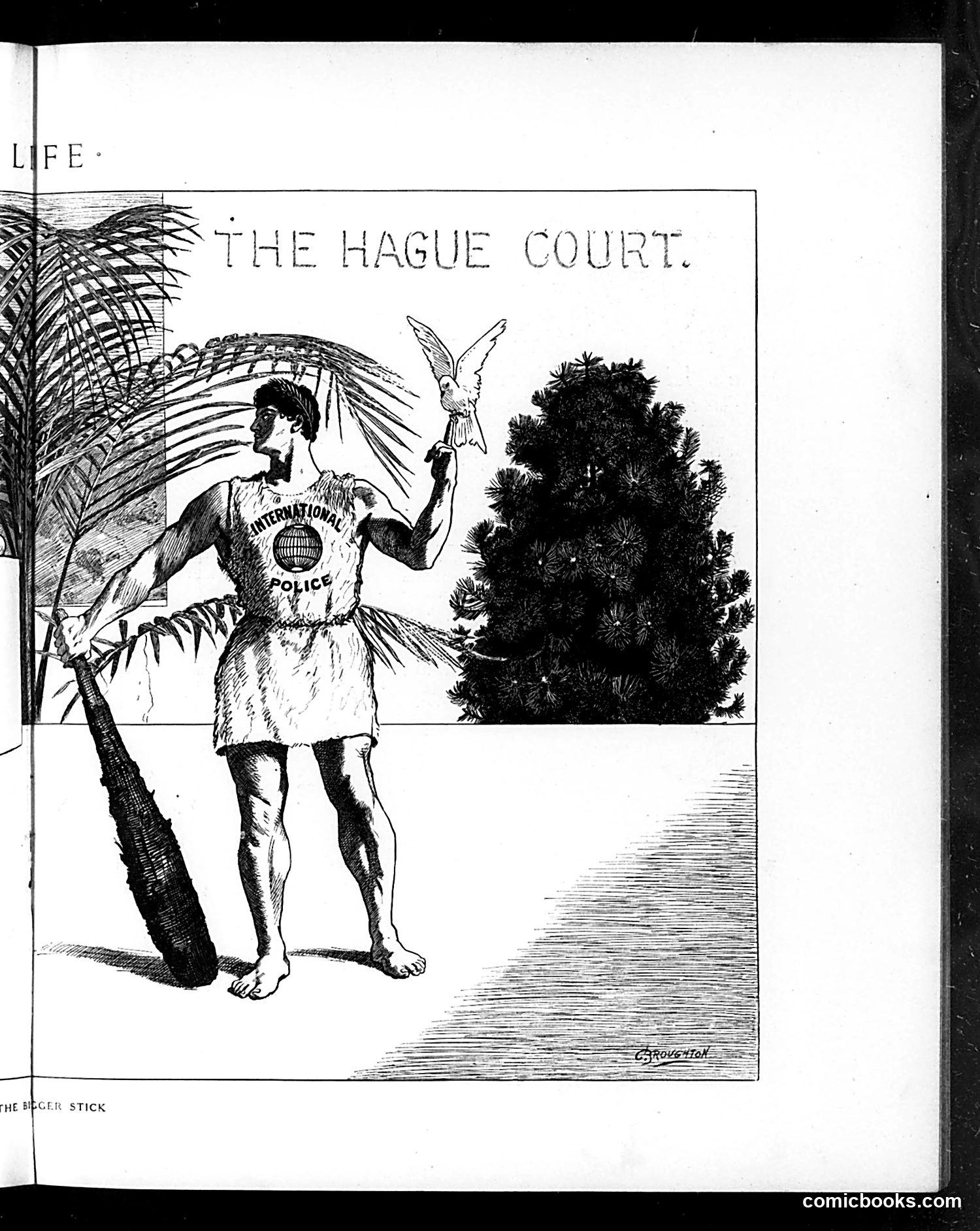
This cartoon depicts an allegorical female figure wearing a sash labeled "INTERNATIONAL POLICE," holding aloft a dove of peace. She stands barefoot in a tropical setting with palm trees and water, suggesting an idealized, peaceful world. The satire likely mocks the optimism surrounding the Hague Peace Conferences (early 1900s), which aimed to establish international courts and arbitration to prevent war. The figure's somewhat naive, idealistic pose—combined with the artist's (Cesare) portrayal of her as vulnerable and isolated in nature—suggests skepticism about whether such institutions could realistically maintain peace in a world driven by nationalist interests and power politics. The cartoon expresses doubt about international law's practical effectiveness.
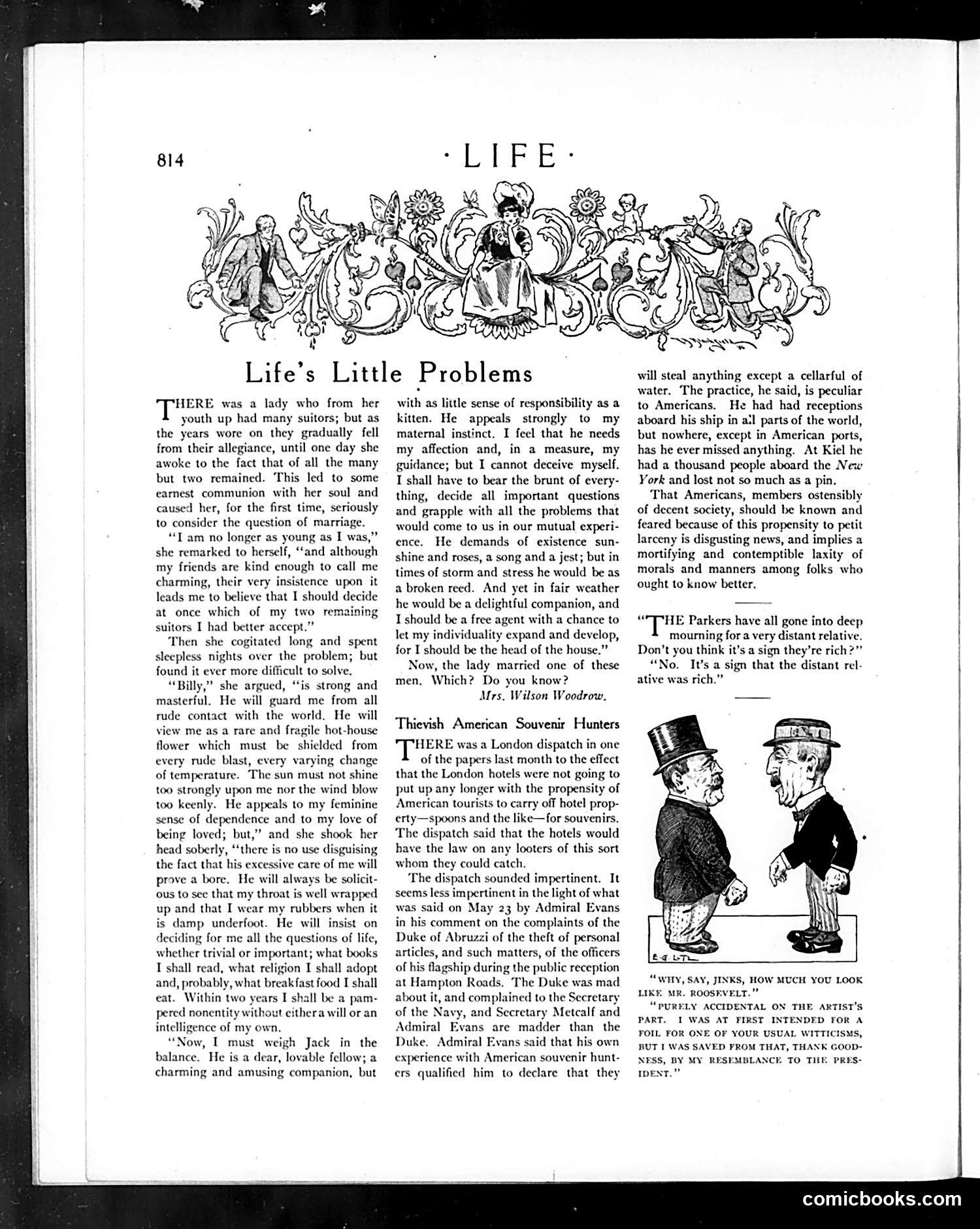
This page contains two satirical pieces typical of *Life* magazine's social commentary. **"Life's Little Problems"** presents a woman choosing between two suitors, personifying contrasting marital archetypes: "Billy" (overprotective, controlling) versus "Jack" (irresponsible but freeing). The satire critiques both traditional masculine roles—one that infantilizes women through excessive care, the other that demands maternal caregiving. The author (bylined "Mrs. Wilson Woodrow," likely a pseudonym) leaves the choice ambiguous, highlighting that neither option offers genuine partnership or female autonomy. This reflects early-20th-century anxieties about women's limited marital choices. **"Thievish American Souvenir Hunters"** mocks American tourists' reputation for petty theft abroad. It references a 1909 incident where Admiral Evans's officers stole souvenirs from Italian nobility during a Hampton Roads reception. The piece sarcastically notes that American souvenir-hunters "will steal anything except a cellarful of water"—suggesting their theft is both shameless and absurdly comprehensive. The satire criticizes American behavior damaging national reputation internationally.
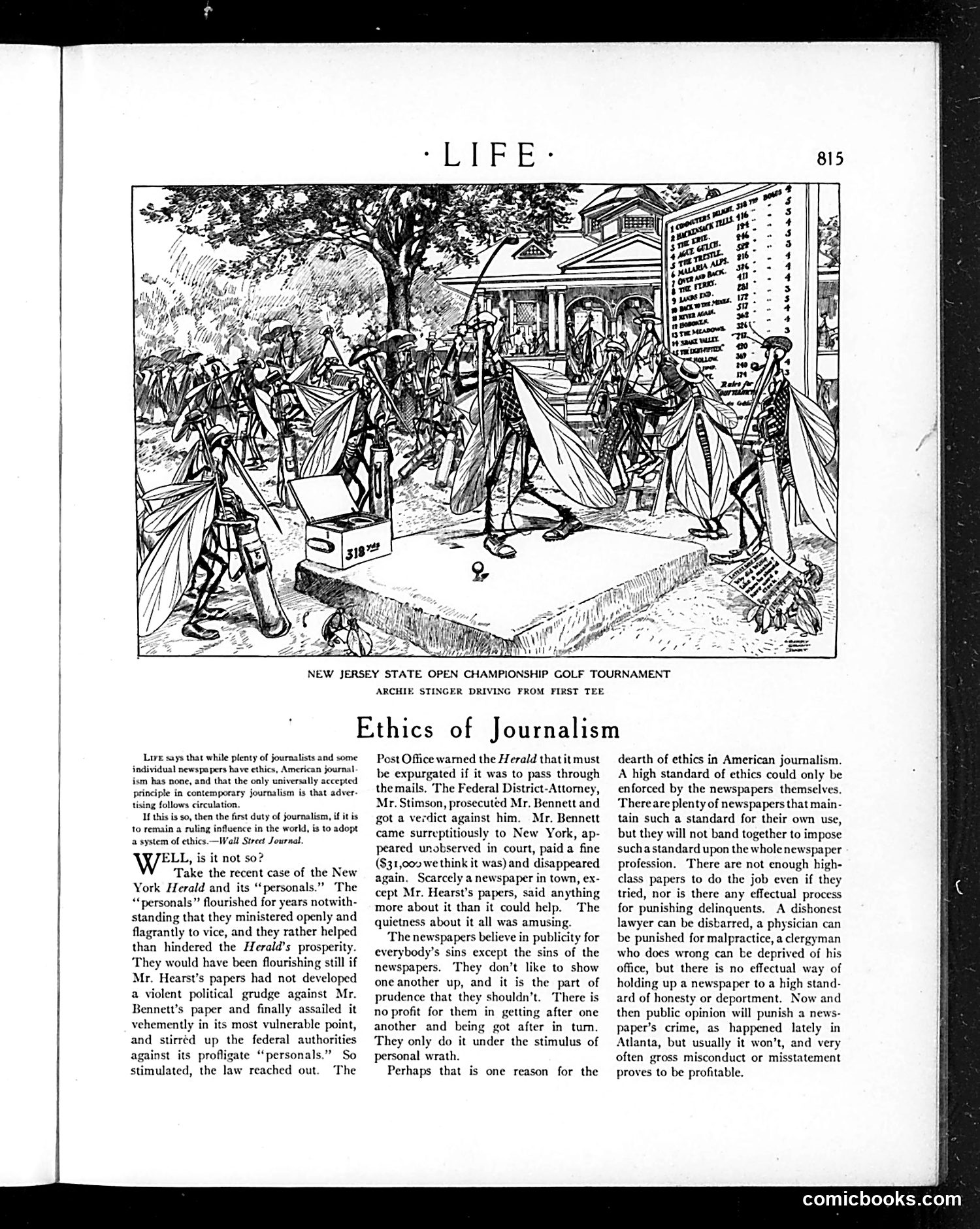
This page satirizes American newspaper hypocrisy through the Herald-Bennett scandal. The cartoon depicts a golf tournament (likely a social event where newspaper editors gather), illustrating the clubby, interconnected world of journalism. The article criticizes the *New York Herald* for running profitable "personals" ads that facilitated vice for years. Only when rival William Randolph Hearst's papers attacked Bennett's *Herald* politically did authorities intervene—revealing that newspapers police each other through personal grudges, not principle. Life's satirical point: American journalism lacks enforceable ethics because newspapers won't self-regulate. Unlike lawyers (who face disbarring) or clergy, dishonest papers face no professional consequences. Misconduct often proves profitable. The piece argues newspapers demand public accountability for others while protecting their own, making unified ethical standards impossible.
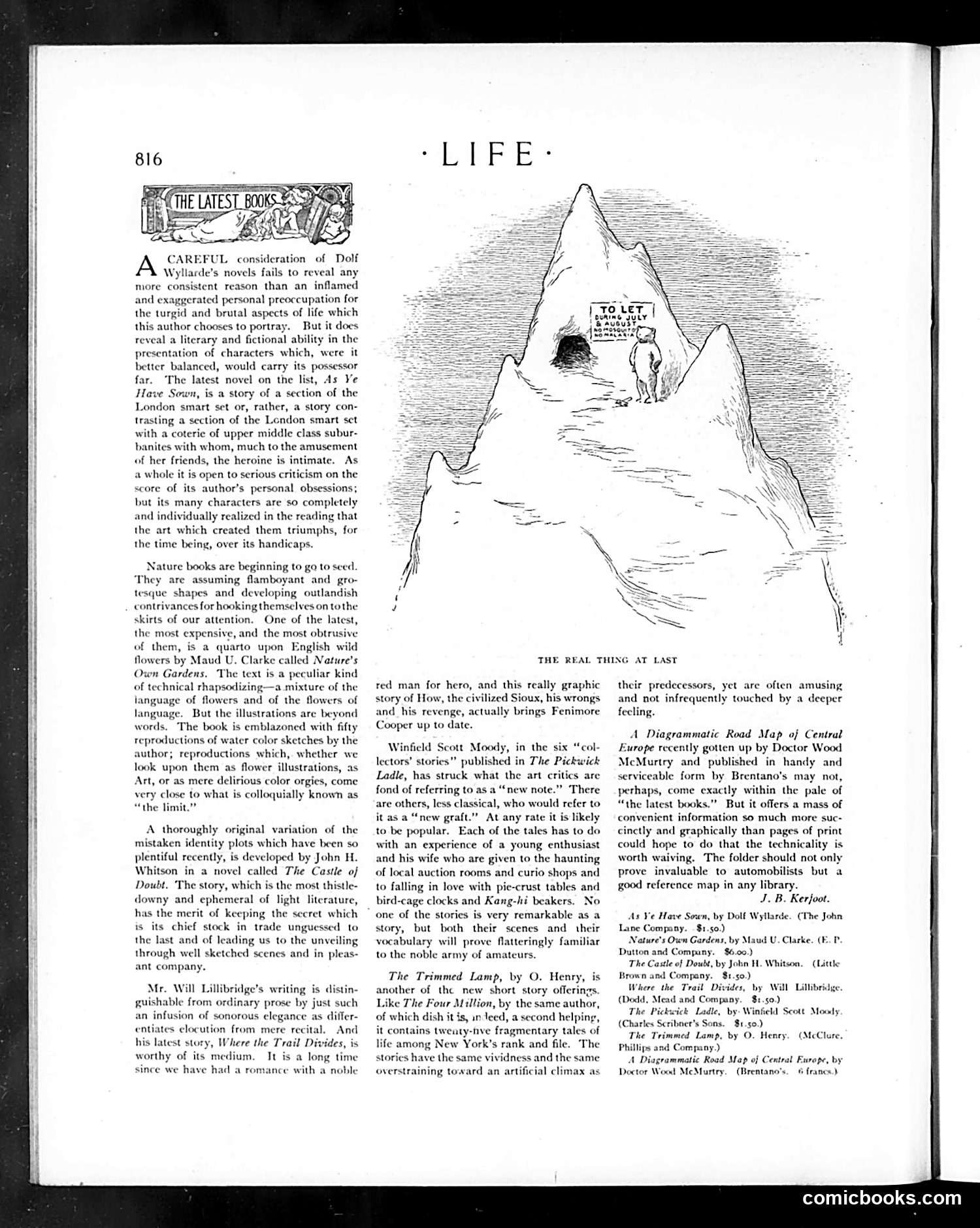
This page from *Life* magazine reviews recent novels. The cartoon shows a figure standing before a large cave or hollow in a mountain, with a sign reading "TO LET" — a British term for rental property. The cartoon illustrates the review's opening discussion of Dolf Wyllarde's novel *As Ye Have Sown*, which depicts London's wealthy "smart set" contrasting with suburban middle-class characters. The crude, empty cave dwelling serves as satirical commentary: it mocks the pretentious social climbing and superficial character conflicts in Wyllarde's work. Rather than presenting meaningful human drama, the novel amounts to hollow social posturing — represented here as literally an empty cavern, available for rent to anyone seeking shelter. The satire suggests Wyllarde prioritizes depicting brutal, turgid aspects of life over creating substantive narratives, resulting in work that's architecturally impressive but fundamentally vacant.
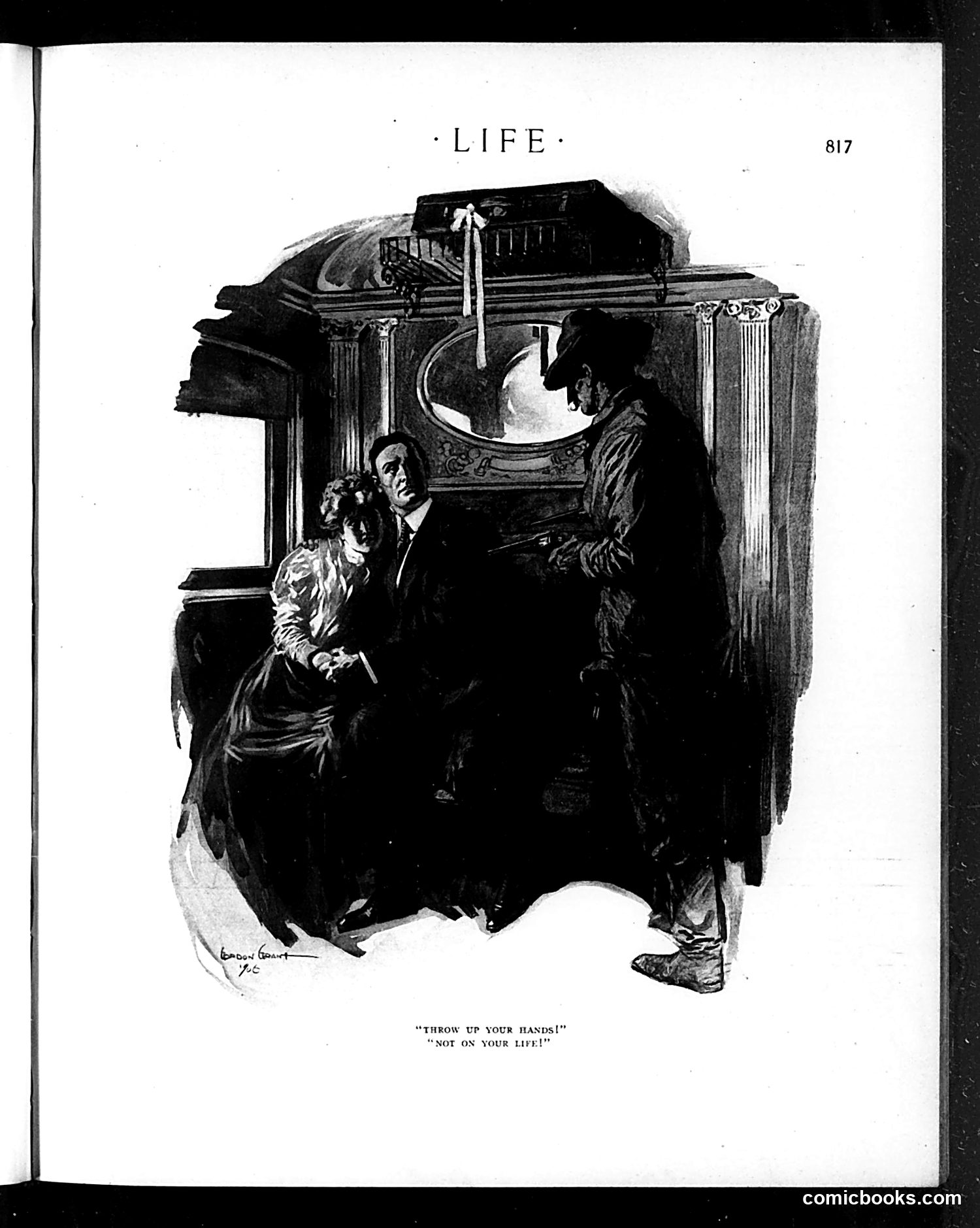
This cartoon depicts a tense domestic scene in what appears to be an elegant interior, likely a bedroom or dressing room. A man in formal attire holds a child while a woman in an elaborate dress stands nearby. The caption suggests a dramatic confrontation: one figure demands "Throw up your hands!" while another protests "Not on your life!" The joke appears to satirize marital conflict or domestic tension, possibly playing on the double meaning of "throw up your hands" (surrender/despair) versus the literal interpretation. The elegantly furnished setting and period clothing suggest this is social satire about upper-class life, though the specific historical or political context remains unclear without additional information about when this LIFE magazine issue was published.
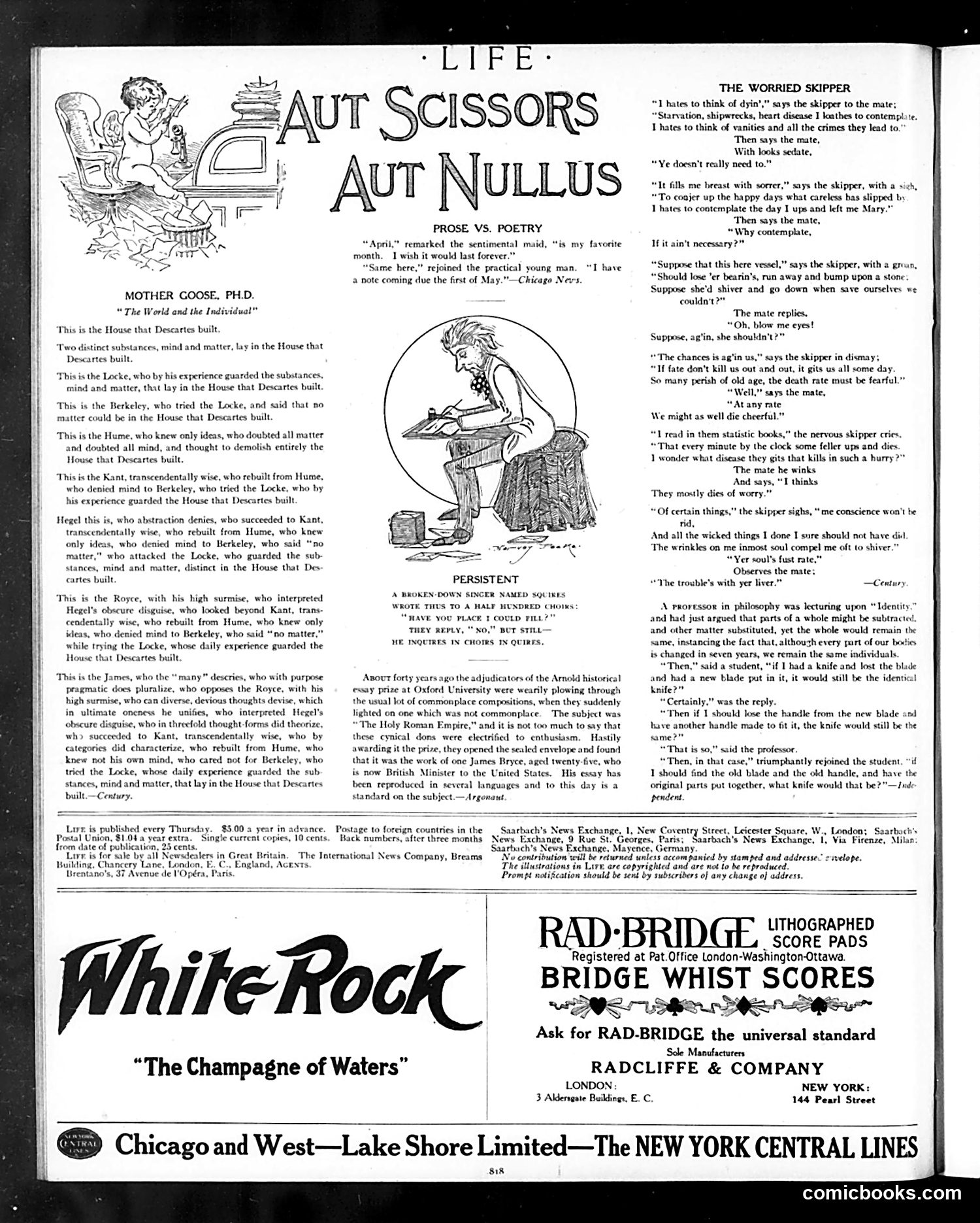
This page contains several satirical pieces from *Life* magazine: **"Mother Goose, Ph.D."** parodies the nursery rhyme "This Is the House That Jack Built" to mock academic philosophy. It traces Western philosophy from Descartes through contemporary thinkers (Locke, Berkeley, Hume, Kant, Hegel, Royce, and William James), presenting each philosopher's ideas as building upon or contradicting predecessors. The satire suggests philosophy has become an endless, circular debate where each theorist deconstructs the last—a pointed critique of late 19th/early 20th-century idealism. **"Prose vs. Poetry"** is a brief joke contrasting romantic and practical attitudes toward April. **"Persistent"** mocks a mediocre singer named Squires who repeatedly inquires about choir positions despite consistent rejection. **"The Worried Skipper"** features a sailor worrying about death and past mistakes, with his mate pragmatically suggesting he stop dwelling on unavoidable problems. The page satirizes both intellectual pretension and human anxiety.
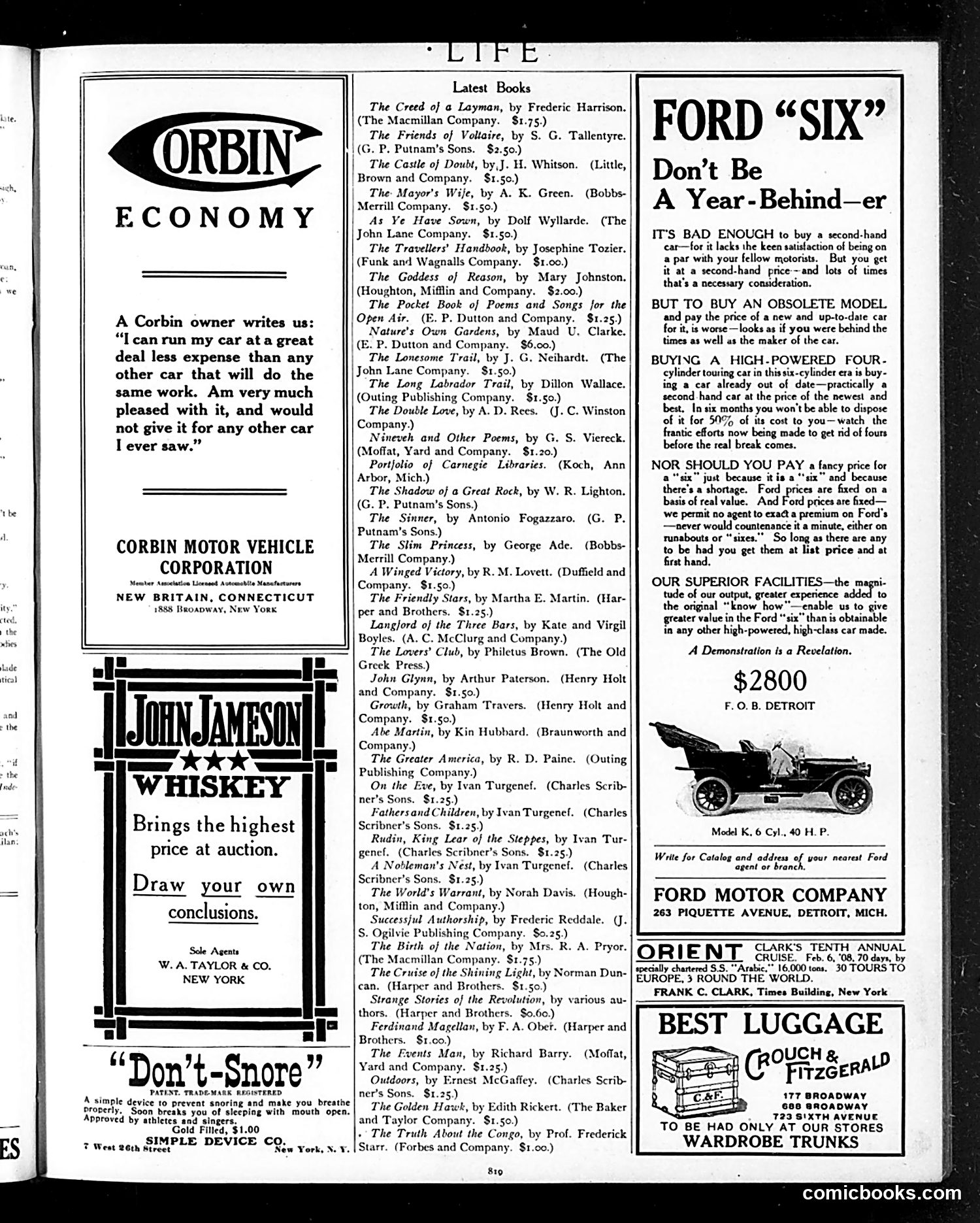
This page is primarily **advertising and book listings**, not political satire. The "satire" here is subtle: the **Corbin Motor Vehicle ad** includes a testimonial claiming the car runs economically, followed by an ad for **John Jameson Whiskey** stating it "brings the highest price at auction" with the line "Draw your own conclusions." The implicit joke: Life is sarcastically juxtaposing these ads to suggest that while one car owner boasts about saving money, whiskey brings higher prices at auction—implying the reader's priorities (or American consumer behavior) may be questionable. It's gentle mockery of advertising claims and consumer values. The rest of the page contains book advertisements, a Ford automobile ad, and the "Don't-Snore" device—typical early 1900s magazine filler and commercial content. No specific political figures or events are referenced.
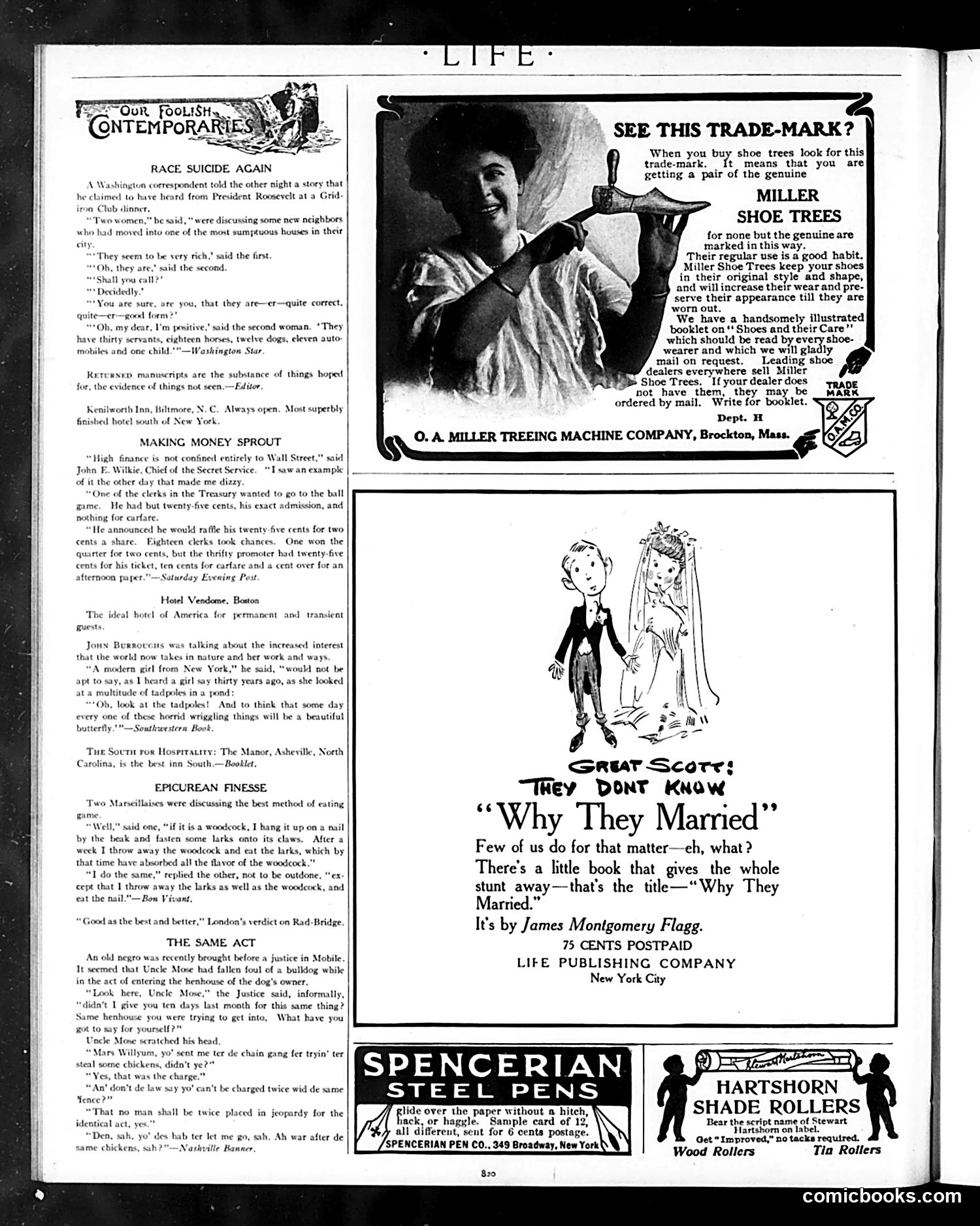
This page contains several short humorous anecdotes mocking early 20th-century American society, plus period advertisements. The lead piece, "Race Suicide Again," attributes a story to President Roosevelt about wealthy neighbors with "thirty servants, eighteen horses, twelve dogs, eleven automobiles and one child." The joke satirizes both the wealthy's conspicuous consumption and anxieties about declining birth rates among the upper classes—a genuine concern of the era labeled "race suicide." Other pieces mock: pretentious French dining customs; a Treasury clerk's get-rich-quick scheme raffling his bus fare; and a Black man's (Uncle Mose's) attempted logic exploiting legal protections against double jeopardy to escape punishment for repeat theft. This last item reflects period racism in depicting an African American character as unintelligent. The advertisements (Miller Shoe Trees, Spencerian Steel Pens, Hartshorn Shade Rollers) are typical early-1900s product promotions. The cartoon showing a wedding couple relates to a book advertisement for "Why They Married" by James Montgomery Flagg.
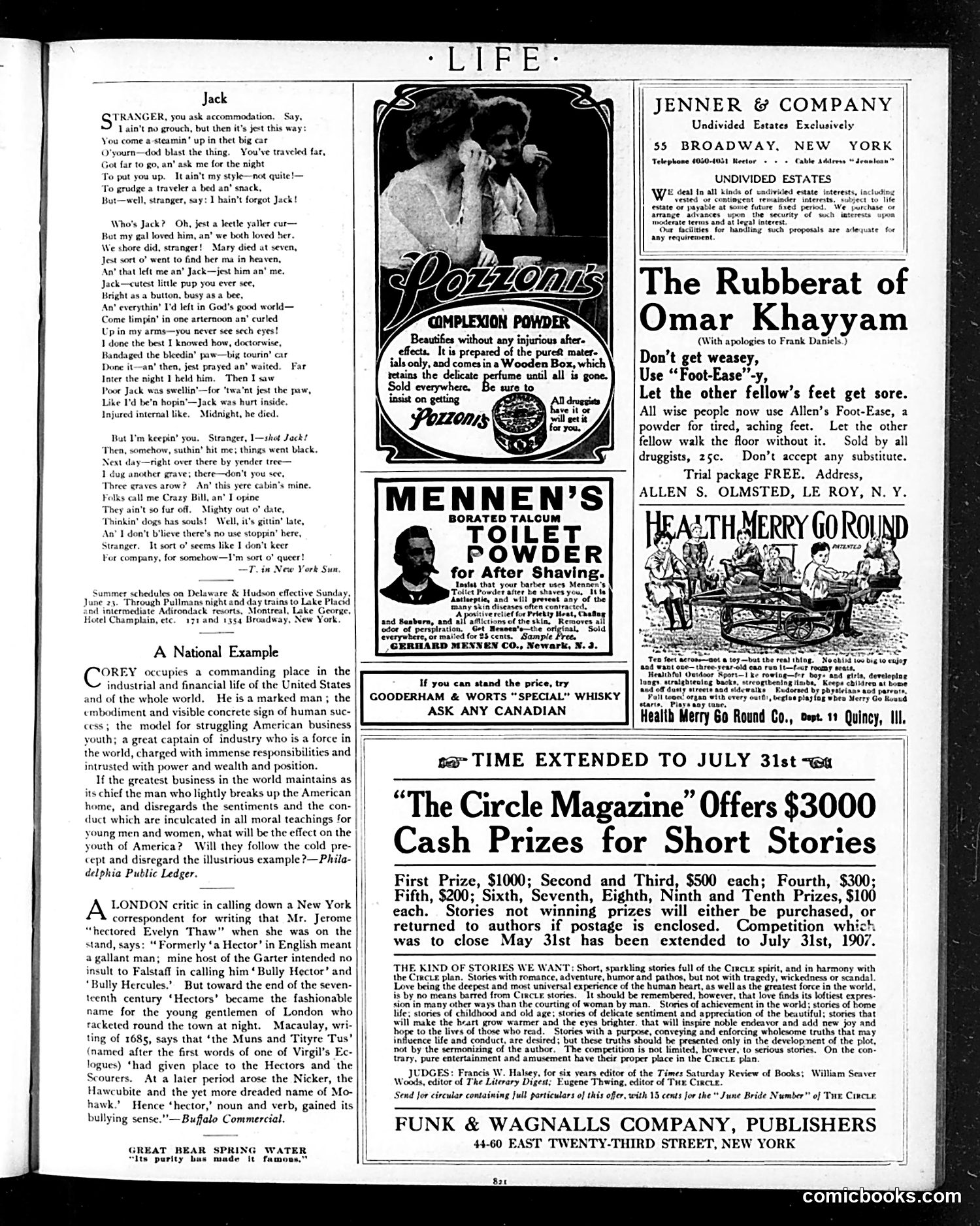
This page mixes editorial content with advertising typical of early 20th-century *Life* magazine. The main narrative poem titled "Jack" is a sentimental story about a frontier cabin-dweller who befriends a wounded dog named Jack. When the dog dies from injuries, the narrator buries him alongside his deceased daughter Mary and her mother—three graves in a row. The "stranger" in the opening dialogue is the poem's listener. This appears to be touching rural Americana rather than satire, reflecting *Life*'s occasional venture into serious sentiment. The "National Example" section praises a wealthy industrialist named Corey as embodying American success and virtue—though the context suggests this may be ironic commentary on capitalism's moral claims. The page is otherwise dominated by period advertisements for talcum powder, foot powder, real estate services, and whisky—standard commercial content for the magazine. No overt political cartoon or caricature appears prominently visible.
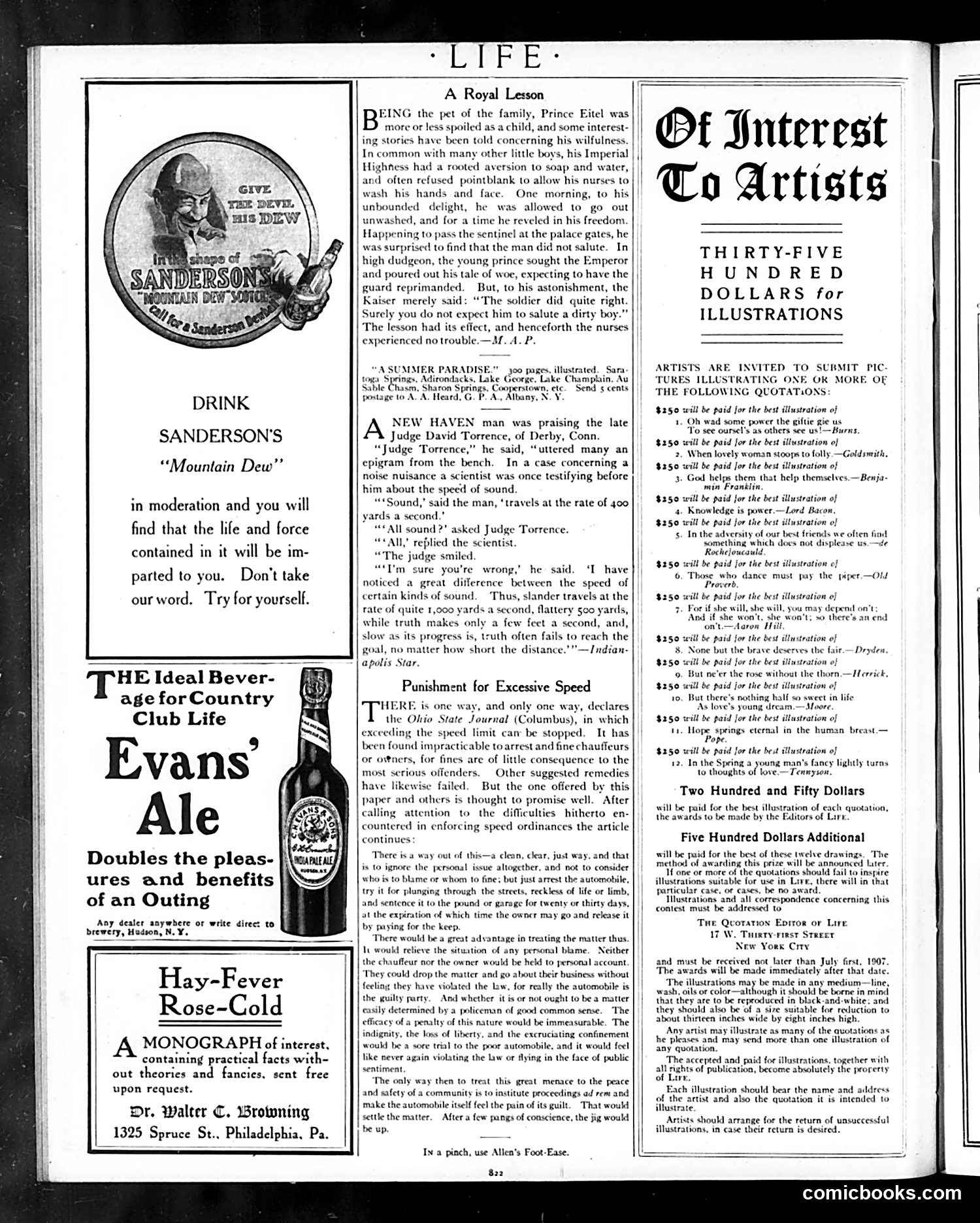
This page is primarily **advertising and miscellaneous content** rather than political satire. The notable item is "A Royal Lesson," a brief anecdote about Prince Eitel (apparently a young German royal, likely from the early 1900s). The story illustrates a moral lesson: the prince refuses to wash, meets a palace guard who won't salute him because he's dirty, complains to the Kaiser, who responds that the soldier was correct—one cannot expect a salute from "a dirty boy." The narrative conveys a lesson about cleanliness and proper conduct. The remainder consists of advertisements (Sanderson's Mountain Dew, Evans' Ale, hay-fever remedies) and brief humorous anecdotes about Judge Torrence's witticisms regarding the relative speeds of slander versus truth, and an editorial piece about enforcing speed limits on automobiles. No significant political satire or caricature appears here—this is essentially filler content typical of early 20th-century magazines.
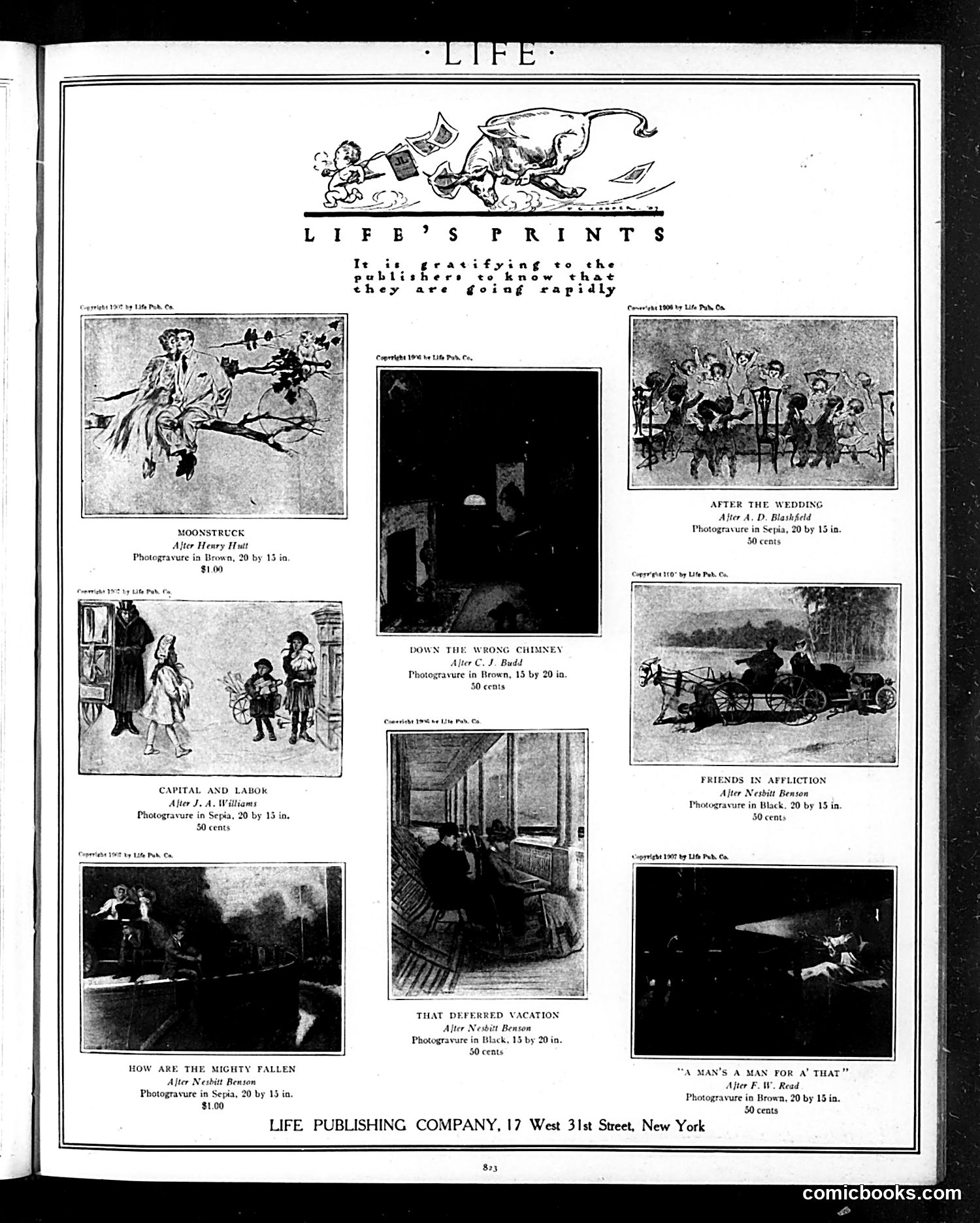
This page advertises satirical prints sold by *Life* magazine, featuring works by contemporary cartoonists like Henry Hutt and Nesbitt Benson. Rather than political cartoons, these appear to be humorous social commentary illustrations available for purchase as photogravures. The titles suggest domestic and social humor typical of the era: "Moonstruck" (romantic folly), "How Are the Mighty Fallen" (comeuppance), "Down the Wrong Chimney" (mistaken identity/Christmas humor), and "That Deferred Vacation" (postponed leisure). The final print, "A Man's a Man for A' That" (quoting Robert Burns), likely addresses class commentary. These were marketed as affordable home decorations—prints cost 30-50 cents, with larger formats at $1.00—targeting middle-class readers of *Life*'s satirical humor. The page itself functions as advertising rather than editorial content, showcasing the magazine's commercial print business.
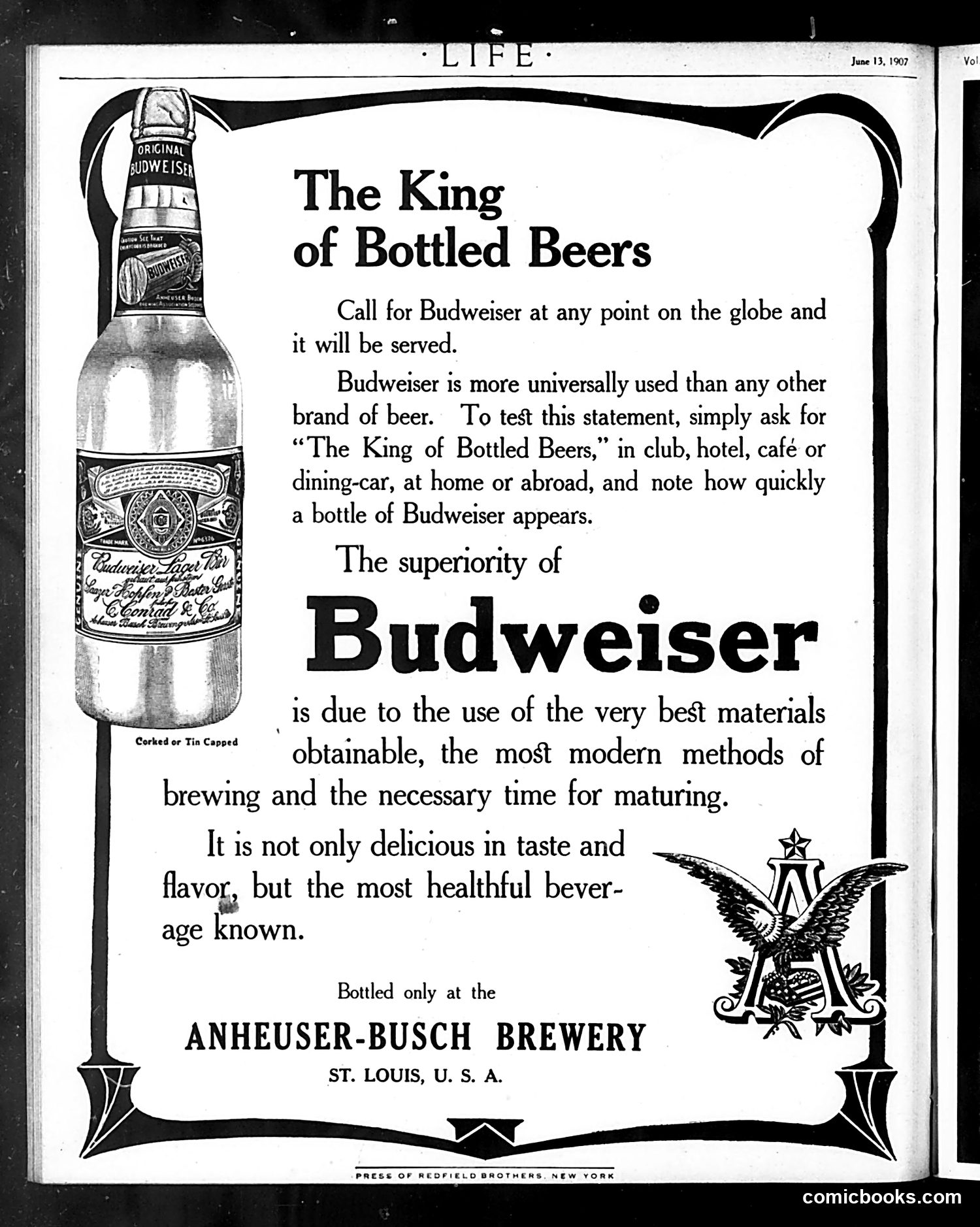
This page is **not a political cartoon or satire**—it's a straightforward **advertisement for Budweiser beer** from the Anheuser-Busch Brewery in St. Louis, published in *Life* magazine on June 13, 1907. The ad employs marketing language typical of the era, claiming Budweiser is "The King of Bottled Beers" and the most universally available brand globally. It emphasizes quality through "best materials," "modern methods," and proper maturation time, and makes a health claim—calling it "the most healthful beverage known," a common pitch for beer in early 1900s advertising when beverages were sometimes promoted as tonics. The decorative bottle image and eagle emblem are branding elements. There is no satire or political commentary present—this is simply period advertising designed to promote brand prestige and ubiquity.