
Life, 1907-06-13 · page 15 of 24
Life — June 13, 1907 — page 15: what you’re looking at
What you’re looking at
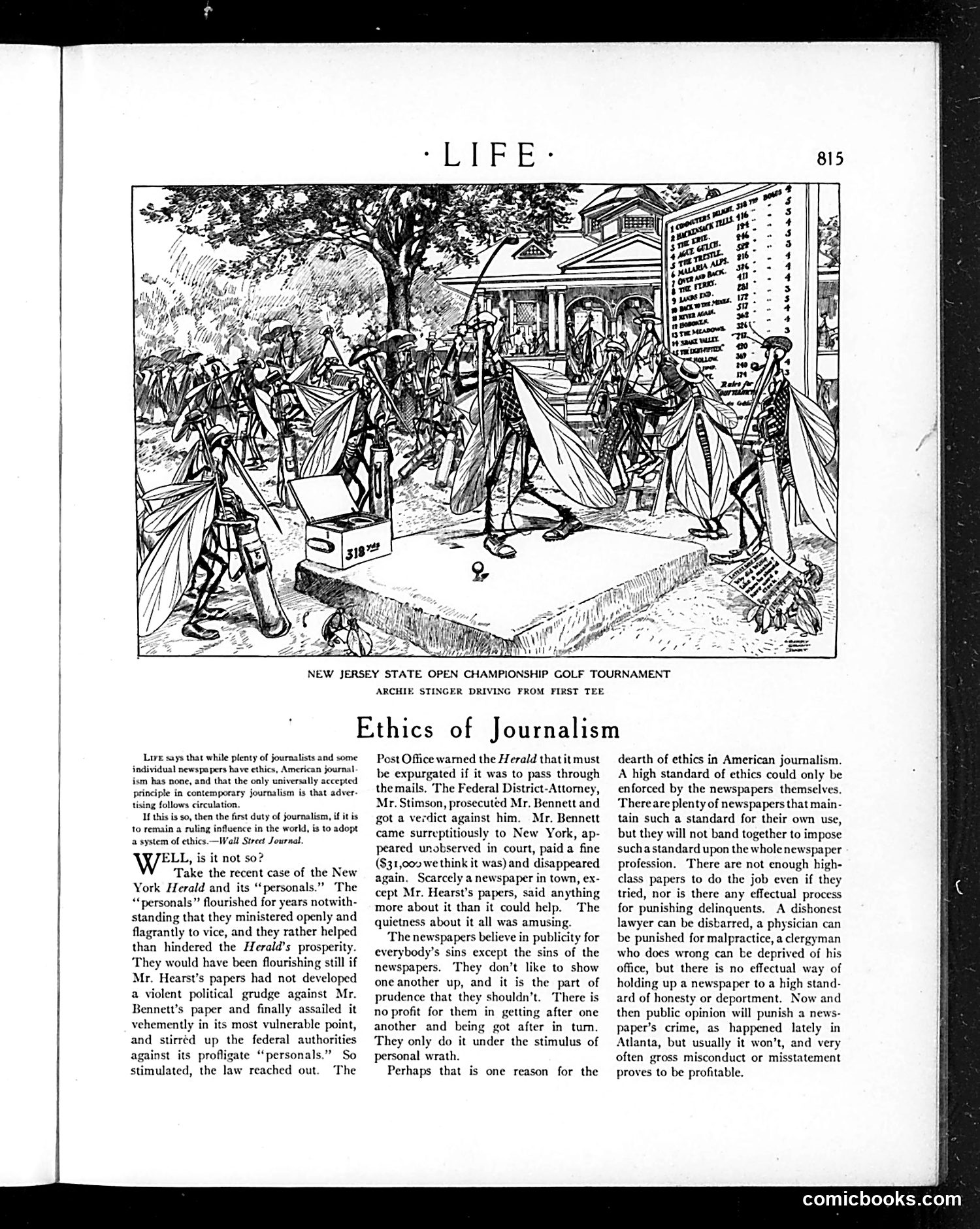
This page satirizes American newspaper hypocrisy through the Herald-Bennett scandal. The cartoon depicts a golf tournament (likely a social event where newspaper editors gather), illustrating the clubby, interconnected world of journalism. The article criticizes the *New York Herald* for running profitable "personals" ads that facilitated vice for years. Only when rival William Randolph Hearst's papers attacked Bennett's *Herald* politically did authorities intervene—revealing that newspapers police each other through personal grudges, not principle. Life's satirical point: American journalism lacks enforceable ethics because newspapers won't self-regulate. Unlike lawyers (who face disbarring) or clergy, dishonest papers face no professional consequences. Misconduct often proves profitable. The piece argues newspapers demand public accountability for others while protecting their own, making unified ethical standards impossible.
📄 Transcribed text from this page (OCR, searchable)
Machine-transcribed from the original scan — historical spelling and the odd misread are preserved.
We ae HN z NEW JERSEY STATE OPEN CHAMPIONSHIP COLF TOURNAMENT ARCHIE STINGER DRIVING FROM FIRST TEE Ethics of Journalism Lire says that while plenty of journalists and some individual newspapers have ethics, American journal ism has none, and that the only universally accepted principle in contemporary journalism is that adver- tising follows circulation. If this is so, then the first duty of journalism, if it is to remain a ruling influence in the world, is to adopt a system of ethics.—IWall Street Journal. ELL, is it not so? Take the recent case of the New York Herald and its “personals.” The “personals” flourished for years notwith- standing that they ministered openly and flagrantly to vice, and they rather helped than hindered the Herald’s prosperity. They would have been flourishing still if Mr. Hearst’s papers had not developed a violent political grudge against Mr. Bennett’s paper and finally assailed it vehemently in its most vulnerable point, and stirréd up the federal authorities against its profligate “personals.” So stimulated, the law reached out. The Post Office warned the Herald that itmust be expurgated if it was to pass through the mails. The Federal District-Attorney, Mr. Stimson, prosecuted Mr, Bennett and got a verdict against him. Mr. Bennett came surreptitiously to New York, ap- peared unobserved in court, paid a fine ($31,009 we think it was) and disappeared again. Scarcely a newspaper in town cept Mr. Hearst’s papers, said anything more about it than it could help. The quietness about it all was amusing. ‘The newspapers believe in publicity for everybody's sins except the sins of the newspapers. They don’t like to show one another up, and it is the part of prudence that they shouldn’t.. There is no profit for them in getting after one another and being got after in tum. They only do it under the stimulus of personal wrath. Perhaps that is one reason for the dearth of ethics in American journalism. A high standard of ethics could only be enforced by the newspapers themselves. Thereare plenty of newspapers that main- tain such a standard for their own use, but they will not band together to impose sucha standard upon the whole newspaper profession. ‘There are not enough high- class papers to do the job even if they tried, nor is there any effectual process for punishing delinquents. A dishonest lawyer can be disbarred, a physician can be punished for malpractice, a clergyman who does wrong can be deprived of his office, but there is no effectual way of holding up a newspaper to a high stand- ard of honesty or deportment. Now and then public opinion will punish a news- paper’s crime, as happened lately in Atlanta, but usually it won’t, and very often gross misconduct or misstatement proves to be profitable. comicbooks.com