
Life, 1907-06-13 · page 14 of 24
Life — June 13, 1907 — page 14: what you’re looking at
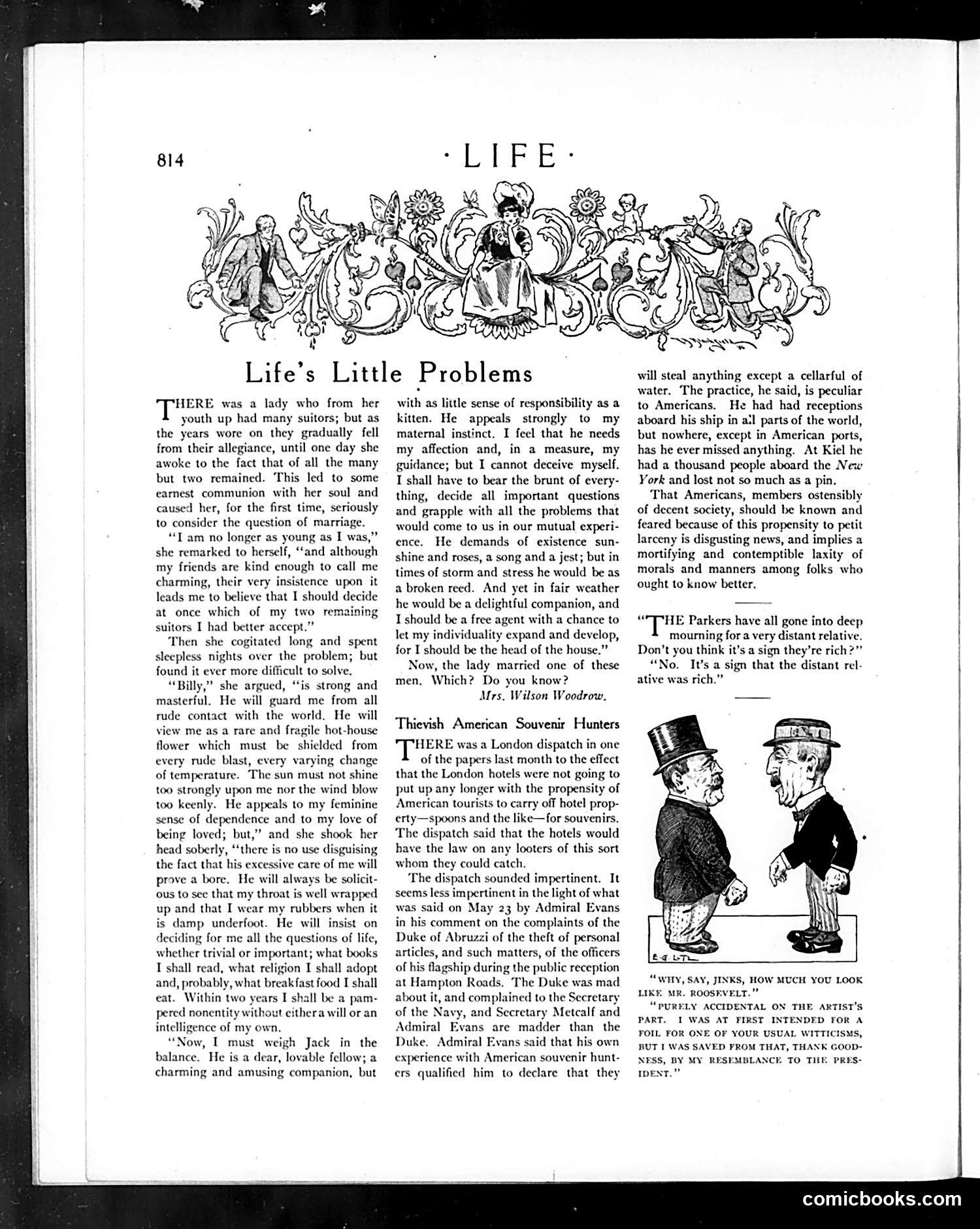
What you’re looking at
This page contains two satirical pieces typical of *Life* magazine's social commentary. **"Life's Little Problems"** presents a woman choosing between two suitors, personifying contrasting marital archetypes: "Billy" (overprotective, controlling) versus "Jack" (irresponsible but freeing). The satire critiques both traditional masculine roles—one that infantilizes women through excessive care, the other that demands maternal caregiving. The author (bylined "Mrs. Wilson Woodrow," likely a pseudonym) leaves the choice ambiguous, highlighting that neither option offers genuine partnership or female autonomy. This reflects early-20th-century anxieties about women's limited marital choices. **"Thievish American Souvenir Hunters"** mocks American tourists' reputation for petty theft abroad. It references a 1909 incident where Admiral Evans's officers stole souvenirs from Italian nobility during a Hampton Roads reception. The piece sarcastically notes that American souvenir-hunters "will steal anything except a cellarful of water"—suggesting their theft is both shameless and absurdly comprehensive. The satire criticizes American behavior damaging national reputation internationally.
📄 Transcribed text from this page (OCR, searchable)
Machine-transcribed from the original scan — historical spelling and the odd misread are preserved.
OT HERE was a lady who from her youth up had many suitors; but as the years wore on they gradually fell from their allegiance, until one day she awoke to the fact that of all the many but two remained. This led to some earnest communion with her soul and caused her, for the first time, seriously to consider the question of marriage. “Tam no longer as young as I was,” she remarked to herself, ‘‘and although my friends are kind enough to call me charming, their very insistence upon it leads me to believe that I should decide at once which of my two remaining suitors I had better accept.” Then she cogitated long and spent sleepless nights over the problem; but found it ever more difficult to solve. “Billy,” she argued, ‘‘is strong and masterful. He will guard me from all rude contact with the world, He will view me as a rare and fragile hot-house flower which must be shielded from every rude blast, every varying change of temperature. The sun must not shine too strongly upon me nor the wind blow too keenly. He appeals to my feminine sense of dependence and to my love of being loved; but,” and she shook her head soberly, “there is no use disguising the fact that his excessive care of me prove a bore. He will always be solicit- ous to see that my throat is well wrapped up and that I wear my rubbers when it is damp underfoot. He will insist on deciding for me all the questions of life, whether trivial or important; what books I shall read, what religion I shall adopt and, probably, what breakfast food I shall eat. Within two years I shall be a pam- pered nonentity without cithera will or an intelligence of my own. “Now, I must weigh Jack in the balance. He is a dear, lovable fellow; a charming and amusing companion, but Life’s Little Problems with as little sense of responsibility as a kitten. He appeals strongly to my maternal instinct. I feel that he needs my affection and, in a measure, my guidance; but I cannot deceive myself. I shall have to bear the brunt of every- thing, decide all important questions and grapple with all the problems that would come to us in our mutual experi- ence. He demands of existence sun- shine and roses, a song and a jest; but in times of storm and stress he would be as a broken reed. And yet in fair weather he would be a delightful companion, and I should be a free agent with a chance to let my individuality expand and develop, for I should be the head of the house.” Now, the lady married one of these men. Which? Do you know? Mrs, Wilson Woodrow, Thievish American Souvenir Hunters 'HERE was a London dispatch in one of the papers last month to the effect that the London hotels were not going to put up any longer with the propensity of American tourists to carry off hotel prop- erty—spoons and the like—for souvenirs. The dispatch said that the hotels would have the law on any looters of this sort whom they could catch. ‘The dispatch sounded impertinent. It seems less impertinent in the light of what was said on May 23 by Admiral Evans in his comment on the complaints of the Duke of Abruzzi of the theft of personal articles, and such matters, of the officers of his flagship during the public reception at Hampton Roads. The Duke was mad about it, and complained to the Secretary of the Navy, and Secretary Metcalf and Admiral Evans are madder than the Duke. Admiral Evans said that his own experience with American souvenir hunt- ers qualified him to declare that they will steal anything except a cellarful of water. The practice, he said, is peculiar to Americans. He had had receptions aboard his ship in ail parts of the world, but nowhere, except in American ports, has he ever missed anything. At Kiel he had a thousand people aboard the New York and lost not so much as a pin. That Americans, members ostensibly of decent society, should be known and feared because of this propensity to petit larceny is disgusting news, and implies a mortifying and contemptible laxity of morals and manners among folks who ought to know better. “SpE Parkers have all gone into deep mourning for a very distant relative. Don’t you think it’s a sign they’re rich?” “No. It’s a sign that the distant rel- ative was rich.” fq oT “WHY, SAY, JINKS, HOW MUCH YOU LOOK LIKE MR. ROSE “PURELY ACCIDENTAL ON THE ARTIST'S PART. I WAS AT FIRST INTENDED FOR A FOIL FOR ONE OF YOUR s comicbooks.com