
Life, 1907-06-13 · page 16 of 24
Life — June 13, 1907 — page 16: what you’re looking at
What you’re looking at
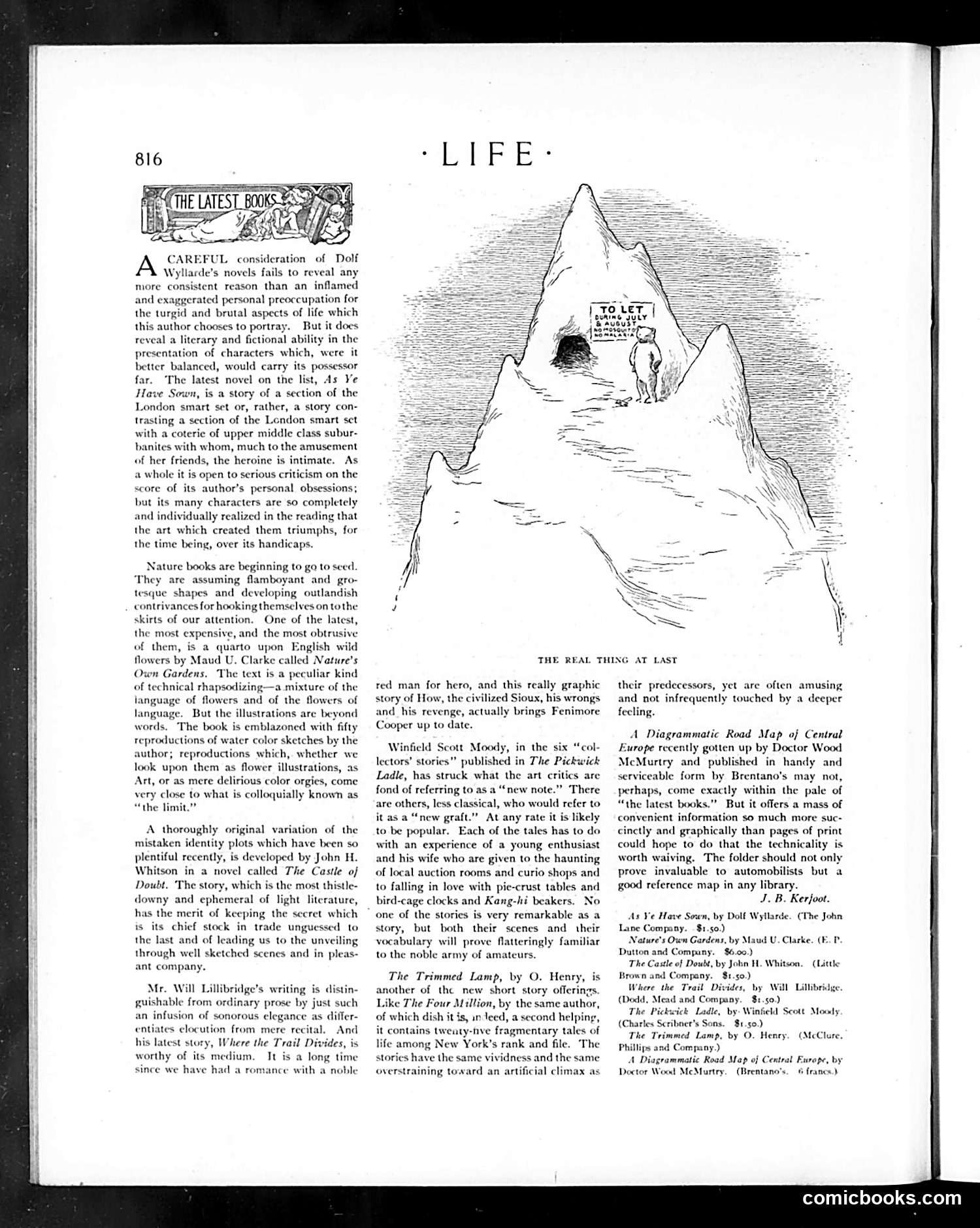
This page from *Life* magazine reviews recent novels. The cartoon shows a figure standing before a large cave or hollow in a mountain, with a sign reading "TO LET" — a British term for rental property. The cartoon illustrates the review's opening discussion of Dolf Wyllarde's novel *As Ye Have Sown*, which depicts London's wealthy "smart set" contrasting with suburban middle-class characters. The crude, empty cave dwelling serves as satirical commentary: it mocks the pretentious social climbing and superficial character conflicts in Wyllarde's work. Rather than presenting meaningful human drama, the novel amounts to hollow social posturing — represented here as literally an empty cavern, available for rent to anyone seeking shelter. The satire suggests Wyllarde prioritizes depicting brutal, turgid aspects of life over creating substantive narratives, resulting in work that's architecturally impressive but fundamentally vacant.
📄 Transcribed text from this page (OCR, searchable)
Machine-transcribed from the original scan — historical spelling and the odd misread are preserved.
CAREFUL consideration of Dolf Wyllarde’s novels fails to reveal any more consistent reason than an inflamed and exaggerated personal preoccupation for the turgid and brutal aspects of life which this author chooses to portray. But it does reveal a literary and fictional ability in the presentation of characters which, were it better balanced, would carry its possessor far. The latest novel on the list, As Ye Have Sown, is a story of a section of the London smart set or, rather, a story con- trasting a section of the London smart sct with a coterie of upper middle class subur- banites with whom, much to the amusement of her friends, the heroine is intimate. As a whole it is open to serious criticism on the score of its author’s personal obsessions; but its many characters are so completely and individually realized in the reading that the art which created them triumphs, for the time being, over its handicaps. Nature books are beginning to go to seed. They are assuming flamboyant and gro- tesque shapes and developing outlandish contrivances for hooking themselves on tothe skirts of our attention. One of the latest, the most expensive, and the most obtrusive of them, is a quarto upon English wild flowers by Maud U. Clarke called Nature’s Own Gardens. The text is a peculiar kind of technical rhapsodizing—a mixture of the language of flowers and of the flowers of language. But the illustrations are beyond word: ‘he book is emblazoned with fifty reproductions of water color sketches by the author; reproductions which, whether we look upon them as flower illustrations, as Art, or as mere delirious color orgies, come very close to what is colloquially known as “the limit A thoroughly original variation of the mistaken identity plots which have been so plentiful recently, is developed by John H. Whitson in a novel called The Castle oj Doubt. ‘The story, which is the most thistle- downy and ephemeral of light literature, has the merit of keeping the secret which is its chief stock in trade unguessed to the last and of leading us to the unveiling through well sketched scenes and in pleas- ant company. Mr. Will Lillibridge’s writing is distin- guishable from ordinary prose by just such an infusion of sonorous elegance as diffe tes elocution from mere recital. And his latest story, Where the Trail Divides, is worthy of its medium. It is a long time since we have had a romance with a noble THE REAL THING AT LAST red man for hero, and this really graphic story of How, the civilized Sioux, his wrongs and his revenge, actually brings Fenimore Cooper up to date. Winfield Scott Moody, in the six “‘col- lectors’ stories” published in The Pickwick Ladle, has struck what the art critics are fond of referring to as a “new note.” There are others, less classical, who would refer to it as a “new graft.” At any rate it is likely to be popular. Each of the tales has to do with an experience of a young enthusiast and his wife who are given to the haunting of local auction rooms and curio shops and to falling in love with pie-crust tables and bird-cage clocks and Kang-hi beakers. No one of the stories is very remarkable as a story, but both their scenes and their vocabulary will prove flatteringly familiar to the noble army of amateurs. The Trimmed Lamp, by O. Henr another of the new short story offerings. Like The Four Million, by the same author, of which dish its, in leed, a second helpi it contains twenty-hve fragmentary tal life among New York's rank and file. ‘The stories have the same vividness and the same overstraining toward an artificial climax as their predecessors, yet are often amusing d not infrequently touched by a deeper fecling. A Diagrammatic Road Map oj Centrat Europe recently gotten up by Doctor Wood McMurtry and published in handy and serviceable form by Brentano's may not, perhaps, come exactly within the pale of “the latest books.” But it offers a mass of convenient information so much more suc- cinctly and graphically than pages of print could hope to do that the technicality is worth waiving. The folder should not only prove invaluable to automobilists but a good reference map in any library. J.B. Kerjoot. As Ve Have Sown, by Dolf Wyllarde. (The John pe Company. $1.50.) Nature's Own Gardens, by Maud U. Clarke. (EP. Dutton and Company. $6.00.) The Castle of Doubt, by Jobn H. Whitson. Brown and Company. $1.50.) Where the Trail Divides, by Will (Dodd, Mead and Company. $1.50.) The Pickwick Ladle, by: Winfield Scott Mooly (Charles Scribner's Sons. $1.50.) The Trimmed Lamp, by O. Henry. Phillips and Company.) A Diagrammatic Road Map of Central Europe, by Doctor \ i McMurtry. (Brentano's. (Little Lillibridge. (McClure, 6 francs.) comicbooks.com