
Life, 1907-06-13 · page 9 of 24
Life — June 13, 1907 — page 9: what you’re looking at
What you’re looking at
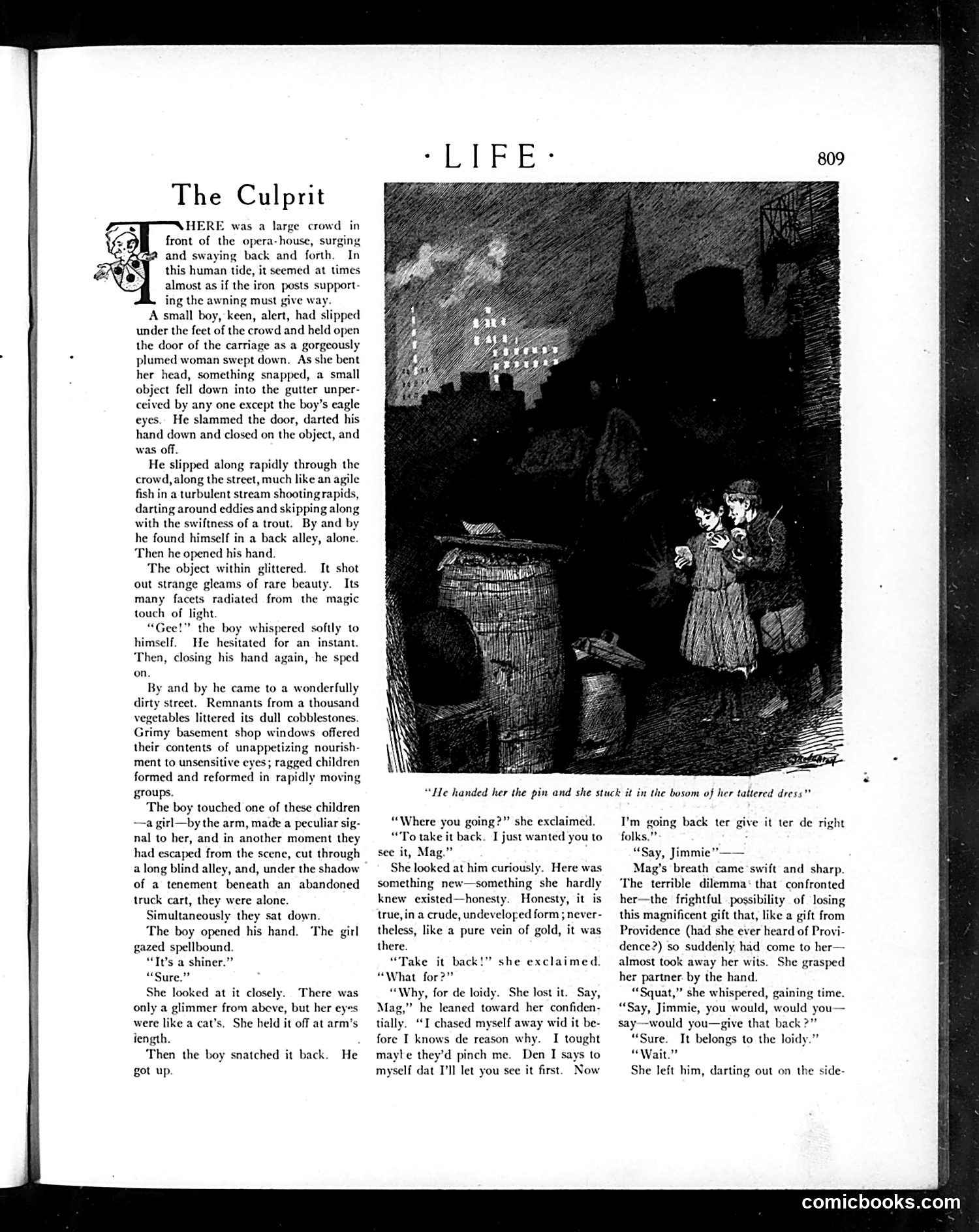
This is a narrative short story illustrated with a wood-engraving, not political satire. The story depicts a street scene where a poor boy finds a shiny object dropped by a well-dressed woman outside an opera house. The object appears to be a pin or brooch. The narrative explores class conflict and moral choice: the boy must decide whether to keep the item or return it. The dialogue reveals the boy's internal struggle—he initially rationalizes keeping it ("I chased myself away wid it before I knows de reason why"), but his partner Mag encourages honesty, ultimately persuading him to return it. The "culprit" refers to the boy's temptation toward theft, not any political figure. This reflects Progressive-era interest in urban poverty, childhood morality, and working-class virtue.
📄 Transcribed text from this page (OCR, searchable)
Machine-transcribed from the original scan — historical spelling and the odd misread are preserved.
The Culprit HERE was a large crowd in front of the opera-house, surging and swaying back and forth. In this human tide, it seemed at times almost as if the iron posts support- ing the awning must give way A small boy, keen, alert, had slipped under the feet of the crowd and held open the door of the carriage as a gorgeously plumed woman swept down, As she bent her head, something snapped, a small object fell down into the gutter unper- ceived by any one except the boy’s eagle eyes. He slammed the door, darted his hand down and closed on the object, and was off. He slipped along rapidly through the crowd, along the street, much like an agile fish in a turbulent stream shooting rapids, darting around eddies and skipping along with the swiftness of a trout. By and by he found himself in a back alley, alone. Then he opened his hand. The object within glittered. It shot out strange gleams of rare beauty. Its many facets radiated from the magic touch of light “Gee!” the boy whispered softly to himself. He hesitated for an instant. Then, closing his hand again, he sped on. By and by he came to a wonderfully dirty street. Remnants from a thousand vegetables littered its dull cobblestones. Grimy basement shop windows offered their contents of unappetizing nourish- ment to unsensitive cyes; ragged children formed and reformed in rapidly moving groups. The boy touched one of these children ~—a girl—by the arm, made a peculiar sig- nal to her, and in another moment they had escaped from the scene, cut through a long blind alley, and, under the shadow of a tenement beneath an abandoned truck cart, they were alone. Simultaneously they sat down. The boy opened his hand. The girl gazed spellbound “It’s a shiner.” “Sure.”” She looked at it closely. There was only a glimmer from above, but her eyes were like a cat’s. She held it off at arm’s length. Then the boy snatched it back. He got up. Sa Betts “He handed her the pin and she stuck it in the bosom of her tattered dress” “Where you going?” she exclaimed. “To take it back. I just wanted you to see it, Mag.” She looked at him curiously. Here was something new—something she hardly knew existed—honesty. Honesty, it is true, in a crude, undeveloped form ; never- theless, like a pure vein of gold, it was there. “Take it back!” she exclaimed. “What for?” “Why, for de loidy. She lost it. Sa Mag,” he leaned toward her confide: tially. “I chased myself away wid it be- fore I knows de reason why. I tought mayte they’d pinch me. Den I says to myself dat I'll let you see it first. Now I’m going back ter give it ter de right folks.” “Say, Jimmie”—— Mag’s breath came swift and sharp. ‘The terrible dilemma‘ that confronted her—the frightful possibility of losing this magnificent gift that, like a gift from Providence (had she ever heard of Provi- dence?) so suddenly had come to her— almost took away her wits. She grasped her partner by the hand. “Squat,” she whispered, gaining time. “Say, Jimmie, you would, would you— say—would you—give that back ?” “Sure. It belongs to the loidy.” “Wait.” She left him, darting out on the side- comicbooks.com