
Life, 1907-06-13 · page 18 of 24
Life — June 13, 1907 — page 18: what you’re looking at
What you’re looking at
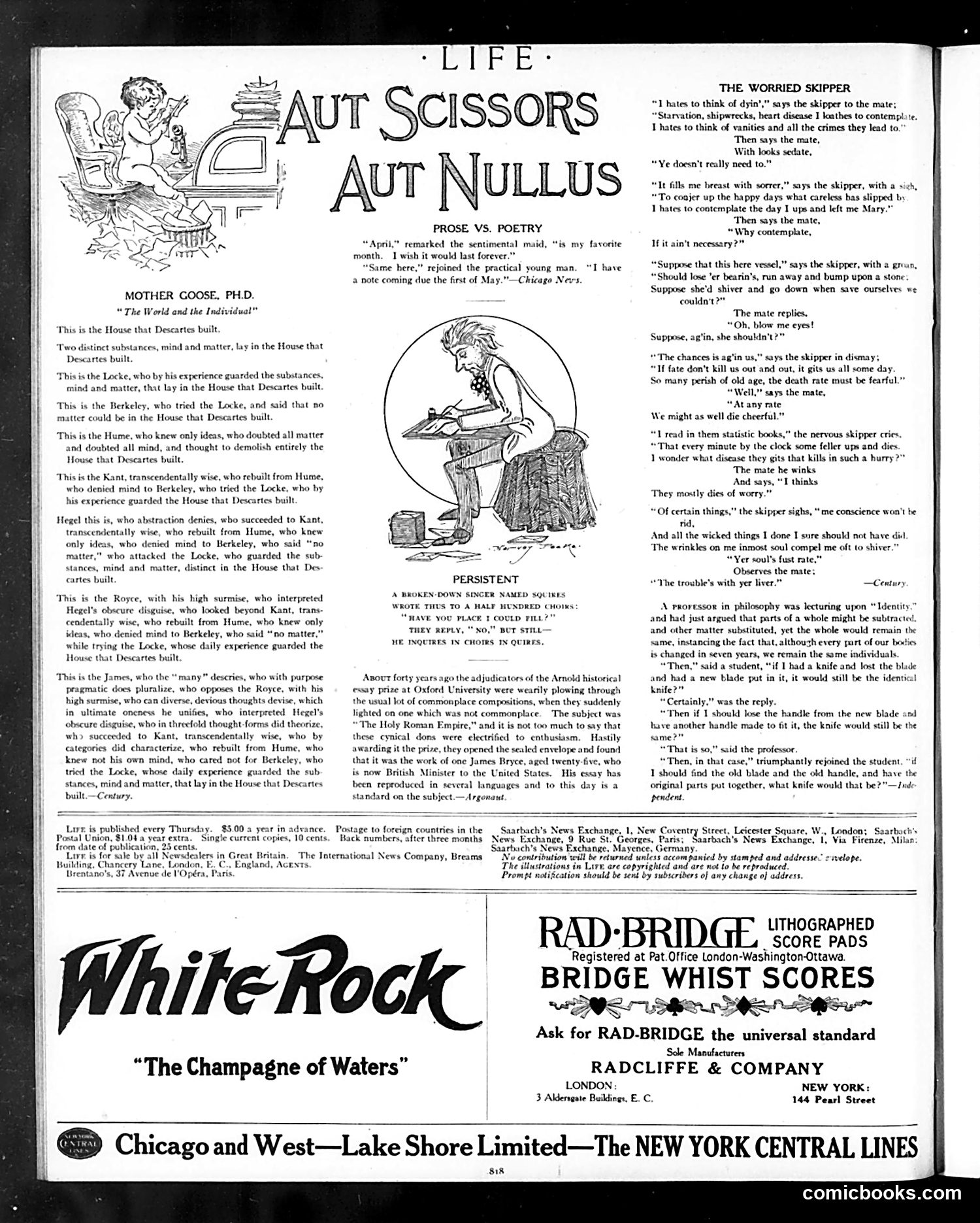
This page contains several satirical pieces from *Life* magazine: **"Mother Goose, Ph.D."** parodies the nursery rhyme "This Is the House That Jack Built" to mock academic philosophy. It traces Western philosophy from Descartes through contemporary thinkers (Locke, Berkeley, Hume, Kant, Hegel, Royce, and William James), presenting each philosopher's ideas as building upon or contradicting predecessors. The satire suggests philosophy has become an endless, circular debate where each theorist deconstructs the last—a pointed critique of late 19th/early 20th-century idealism. **"Prose vs. Poetry"** is a brief joke contrasting romantic and practical attitudes toward April. **"Persistent"** mocks a mediocre singer named Squires who repeatedly inquires about choir positions despite consistent rejection. **"The Worried Skipper"** features a sailor worrying about death and past mistakes, with his mate pragmatically suggesting he stop dwelling on unavoidable problems. The page satirizes both intellectual pretension and human anxiety.
📄 Transcribed text from this page (OCR, searchable)
Machine-transcribed from the original scan — historical spelling and the odd misread are preserved.
MOTHER GOOSE, PH.D. “ The World and the Individual” This is the House that Descartes built. ‘Two distinct substances, mind and matter, lay in the House that Descartes built. ‘This is the Locke, who by his experience guarded the substances, mind and matter, that lay in the House that Descartes built ‘This is the Berkeley, who tried the Locke, and said that no matter could be in the House that Descartes built. knew only ideas, who doubted alll matter molish entirely the ‘This is the Hume, v and doubted all mind, and thought to House that Descartes built. ‘This is the Kant, transcendentally wise, who rebuilt from Hume, who denied mind to Berkeley, who tried the Locke, who by his experience guarded the House that Descartes built Hegel this is, who abstraction denies, who succeeded to Kant, transcendentally wise, who rebuilt from Hume, who knew ‘only ideas, who denied mind to Berkeley, who said “no matter,” who attacked the Locke, who guarded the sub- stances, mind and matter, distinct in the House that Des cartes built This is the Royce, with his high surmise, who interpreted Hegel's obscur isguise, who looked beyond Kant, trans- cendentally wise, who rebuilt from Hume, who knew only ideas, who denied mind to Berkeley, who said “no matter,” while trying the Locke, whose daily experience guarded the House that Descartes built. ‘This is the James, who the “many” descries, who with purpose pragmatic does pluralize, who opposes the Royce, with his high surmise, who can diverse, devious thoughts devise, which in ultimate oneness he unifies, who interpreted Hegel's obscure disguise, who in threcfold thought-forms did theorize, wh> succeeded to Kant, transcendentally wise, who by categories did characterize, who rebuilt from Hume, who knew not his own mind, who cared not for Berkeley, who tried the Locke, whose daily experience guarded the sub stances, mind and matter, that lay in the House that Descartes built. —Century. PEE PROSE VS. POETRY “April,” remarked the sentimental maid, month. I wish it would last forever.” ame here," rejoined the practical young man a note coming due the first of May."—Chicago News. “is my favorite “T have PERSISTENT A BROKEN-DOWN SINGER NAMED SQUIRES WROTE THUS TO A HALE MUNDRED CHOIKS “WAVE YOU PLACE COULD FILL?” THEY REPLY, “NO,” BUT STILL— MME INQUIRES IN CHOIRS IN QUIRES, Anovt forty years ago the adjudicators of the Arnold historical eway prize at Oxford University were wearily plowing through the usual lot of commonplace compositions, when they suddenly lighted on one which was not commonplace. The subject was rhe Holy Roman Empire,” and it is not too much to say that these cynical dons were electrified to enthusiasm. Hastily awarding it the prize, they opened the sealed envelope and found that it was the work of one James Bryce, aged twenty-five, who is now British Minister to the United States. His essay has been reproduced in several languages and to this day is a standard on the subject — THE WORRIED SKIPPER “I hates to think of dyin’,” says the skipper to the mate; “Starvation, shipwrecks, heart disease I loathes to contempl T hates to think of vanities and all the crimes they lead to.” ‘Then says the mate, With looks sedate, “Ye doesn't really need to.” “It fills me breast with sorrer,” says the skipper, with a sich, “To coajer up the happy days what careless bas slipped by 1 hates to contemplate the day I ups and left me Mary.” ‘Then says the mate, “Why contemplate, If it ain't necessary?” ‘Suppose that this here vessel,” says the skipper, with a gran, jould lose ‘er bearin’s, run away and bump upon a stone; Suppose she'd shiver and go down when save ourselves we couldn't?" The mate replies. “Oh, blow me eyes! Suppose, ag'in, she shouldn't?” “The chances is ag'in us,” says the skipper in dismay; “If fate don't kill us out and out, it gits us all some day. ‘So many perish of old age, the death rate must be fearful.” “Well,” says the mate, “Atany rate We might as well die cheerful.” “read in them statistic books," the nervous skipper cries, “That every minute by the clock some feller ups and dies 1 wonder what disease they gits that kills in such a hurry?" ‘The mate he winks And says, “I thinks They mostly dies of worn “Of certain things,” the skipper sighs, “me conscience won't be tid, And all the wicked things I done I sure should not have dit ‘The wrinkles on me inmost soul compel me oft to shiver.” “Yer soul's fust rate," Observes the mate: “The trouble’s with yer liver.” —Century \ rroressor in philosophy was lecturing upon “Identity.” and had just argued that parts of a whole might be subtracted. and other matter substituted, yet the whole would remain the same, instancing the fact that, although every gurt of our bosties is changed in seven years, we remain the some individuals “Then,” said a student, “if I had a knife and lost the blade and had a new blade pat in it, it would still be the identical knife?” ‘ertainly,”” was the reply. hen if 1 should lose the handle from the new blade and have another handle made to fit it, the knife would still be the same?" “That is 30," said the professor. “Then, in that case,” triumphantly rejoined the student 1 should find the old blade and the old handle, and have original parts put together, what knife would that be?”— pendent, Lire. is published every Thursday. Postal Union, $1.04 a year extr from date of publication, 25 cents. Lire is for sale by all Newsdealers in Great Britain $5.00 a year in advance. Single current copies, 10 cents. The International News Company, Breams Postage to foreign countries in the Saarbach’s News Exchange, 1, New Coventry Street, Leicester Square, W. Back numbers, after three months News Exchange, 9 Rue St. Georges, Paris; London; Saarbach’s Saarbach’s News Exchange, 1, Via Firenze, Milan Saarbach’s News Exchange, Mayence, Germany. No contribution will be returned unless accom panied by stamped and addresse. vivelope. Building, Chancery Lane, London, E. C., England, Acexts. The illustrations in Live. are copyrighted and are not to be reproduced. Brentano's, 37 Avenue de VOpér. Prompt notification should be sent by subscribers of any change o} address. SCORE PADS “Registered at Pat.Office London-Washington-Ottawa. pce WHIST SCORES Ask for RADIERITGE the universal standard Sole Manufacturers RADCLIFFE & COMPANY | LONDON : NEW YORK: While Rock “The Champagne of Waters” 3 Aldersgate Buildings, E. C. 144 Pearl Street 6 Chicago and West—Lake Shore Limited—The NEW YORK CENTRAL LINES 818 comicbooks.com