
Life, 1907-06-13 · page 6 of 24
Life — June 13, 1907 — page 6: what you’re looking at
What you’re looking at
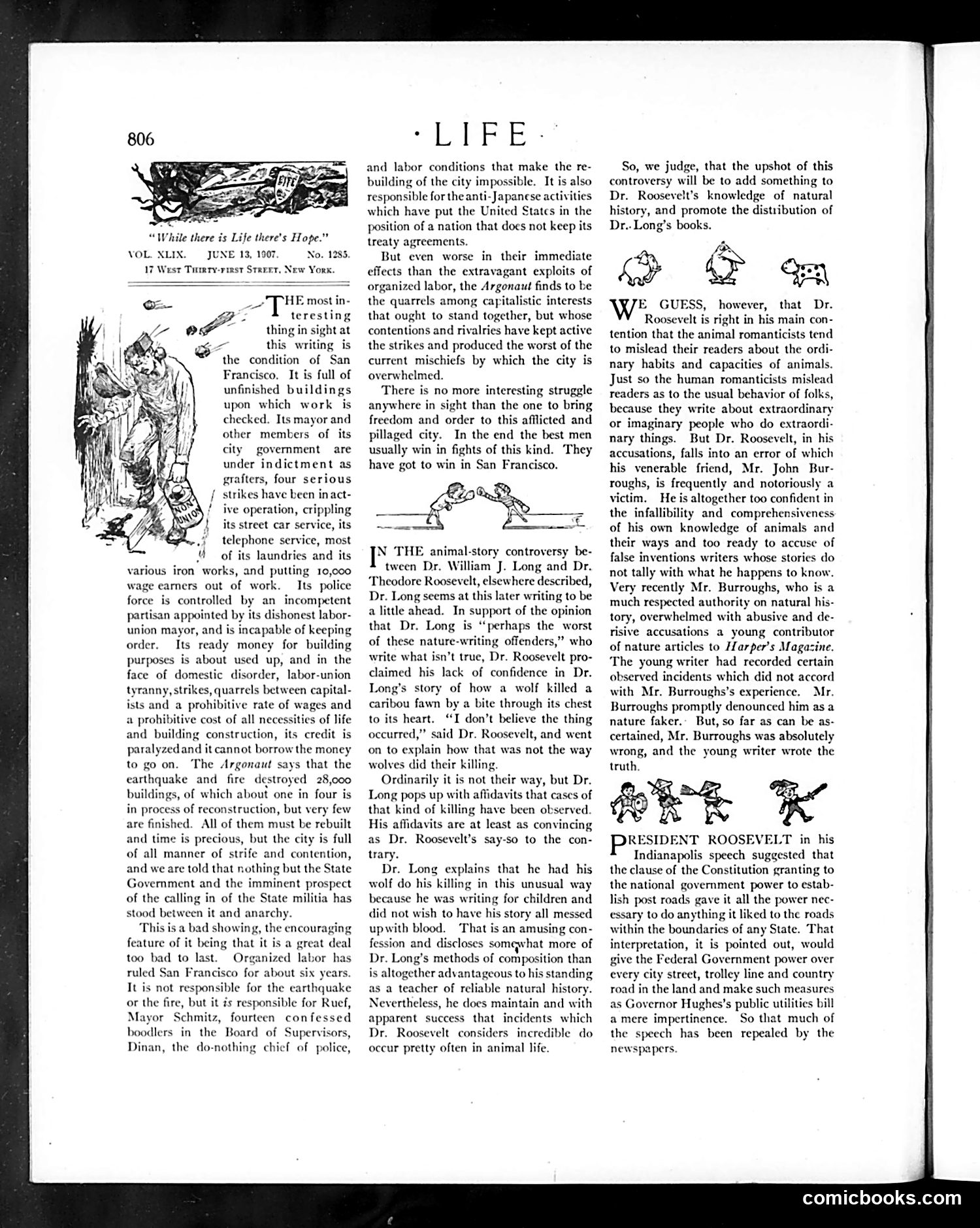
This page discusses a controversy between **Dr. William J. Long** and **President Theodore Roosevelt** over animal behavior stories. The left illustration shows a caricatured figure (likely Long) amid urban decay in San Francisco, critiquing his credibility. The central debate concerns Long's nature writing, which Roosevelt deemed unreliable and misleading to readers. Roosevelt accused Long of fabricating animal incidents—specifically claiming a wolf story was false. Long defended himself by citing his intent to write for children without graphic violence. The satire targets Long's pretensions as a "nature writer" while supporting Roosevelt's skepticism. The page argues Long is too confident in promoting false animal behaviors, making him an unreliable authority despite his popular appeal.
📄 Transcribed text from this page (OCR, searchable)
Machine-transcribed from the original scan — historical spelling and the odd misread are preserved.
“While there is Life there’s Hope.” VOL. XLIX. 13, 1907, HE most in- teresting thing in sight at this writing is the condition of San Francisco. It is full of unfinished buildings upon which work is checked. Its mayor and other members of its city government are under indictment as grafters, four serious { strikes have been inact- ¢ operation, crippling its street car service, its telephone se of its laundries and its various iron works, and putting 10,000 Its_ police wage earners out of work. force is controlled by an incompetent partisan appointed by its dishonest labor- union mayor, and is incapable of keeping order. Its ready money for building purposes is about used up, and in the face of domestic disorder, labor-union tyranny, strikes, quarrels between capital- ts and a prohibitive rate of wages and prohibitive cost of all necessities of life and building construction, its credit is paralyzedand it cannot borrow the money to go on. The Argonaut says that the earthquake and fire destroyed 28,000 buildings, of which about one in four is in process of reconstruction, but very few are finished. All of them must be rebuilt and time is precious, but the city is full of all manner of strife and contention, and we are told that nothing but the State Government and the imminent prospect of the calling in of the State militia has stood between it and anarchy. This is a bad showing, the encouraging feature of it being that it is a great deal too bad to last. Organized labor has ruled San Francisco for about six years. It is not responsible for the earthquake or the fire, but it ¢s responsible for Ruef, Mayor Schmitz, fourteen confessed boodlers in the Board of Supervisors, Dinan, the do-nothing chief of police, “LEE : and labor conditions that make the re- building of the city impossible. It is also responsible for the anti- Japanese activities which have put the United States in the position of a nation that does not keep its treaty agreements. But even worse in their immediate effects than the extravagant exploits of organized labor, the Argonaut finds to be the quarrels among capitalistic interests that ought to stand together, but whose contentions and rivalries have kept active the strikes and produced the worst of the current mischiefs by which the city is overwhelmed. There is no more interesting struggle anywhere in sight than the one to bring freedom and order to this afflicted and pillaged city. In the end the best men usually win in fights of this kind. They have got to win in San Francisco. IS THE animal-story controversy be- tween Dr. William J. Long and Dr. ‘Theodore Roosevelt, elsewhere described, Dr. Long seems at this later writing to be a little ahead. In support of the opinion that Dr. Long is “perhaps the worst of these nature-writing offenders,” who write what isn’t true, Dr. Roosevelt pro- claimed his lack of confidence in Dr. Long's story of how a wolf killed a caribou fawn by a bite through its chest to its heart. “I don’t believe the thing occurred,” said Dr. Roosevelt, and went on to explain how that was not the way wolves did their killing. Ordinarily it is not their way, but Dr. Long pops up with affidavits that cases of that kind of killing have been observed. His affidavits are at least as convincing as Dr. Roosevelt’s say-so to the con- trary. Dr. Long explains that he had his wolf do his killing in this unusual way because he was writing for children and did not wish to have his story all messed upwith blood. That is an amusing con- fession and discloses somqwhat more of Dr. Long’s methods of composition than is altogether advantageous to his standing as a teacher of reliable natural history. Nevertheless, he does maintain and with apparent success that incidents which Dr. Roosevelt considers incredible do occur pretty often in animal life. So, we judge, that the upshot of this controversy will be to add something to 's knowledge of natural ‘omote the distribution of Dr.. Long’s books. E GUESS, however, that Dr. Roosevelt is right in his main con- tention that the animal romanticists tend to mislead their readers about the ordi- nary habits and capacities of animals. Just so the human romanticists mislead readers as to the usual behavior of folks, because they write about extraordina: or imaginary people who do extraordi- nary things. But Dr. Roosevelt, in his accusations, falls into an error of which his venerable friend, Mr. John Bur- roughs, is frequently and notoriously a victim. He is altogether too confident in the infallibility and comprehensiveness of his own knowledge of animals and their ways and too ready to accuse of false inventions writers whose stories do not tally with what he happens to know. Very recently Mr. Burroughs, who is a much respected authority on natural h tory, overwhelmed with abusive and de- risive accusations a young contributor of nature articles to Harper's Magazine. The young writer had recorded certain observed incidents which did not accord with Mr. Burroughs’s experience. Mr. Burroughs promptly denounced him as a nature faker.- But, so far as can be as- certained, Mr. Burroughs was absolutely wrong, and the young writer wrote the truth, ORE K RESIDENT ROOSEVELT in his Indianapolis speech suggested that the clause of the Constitution granting to the national government power to estab- lish post roads gave it all the power nec- essary to do anything it liked to the roads within the boundaries of any State. That interpretation, it is pointed out, would give the Federal Government power over every city street, trolley line and country road in the land and make such measures as Governor Hughes's public utilities bill a mere impertinence. So that much of speech has been repealed by the comicbooks.com