
A complete issue · 24 pages · 1907
Life — May 9, 1907
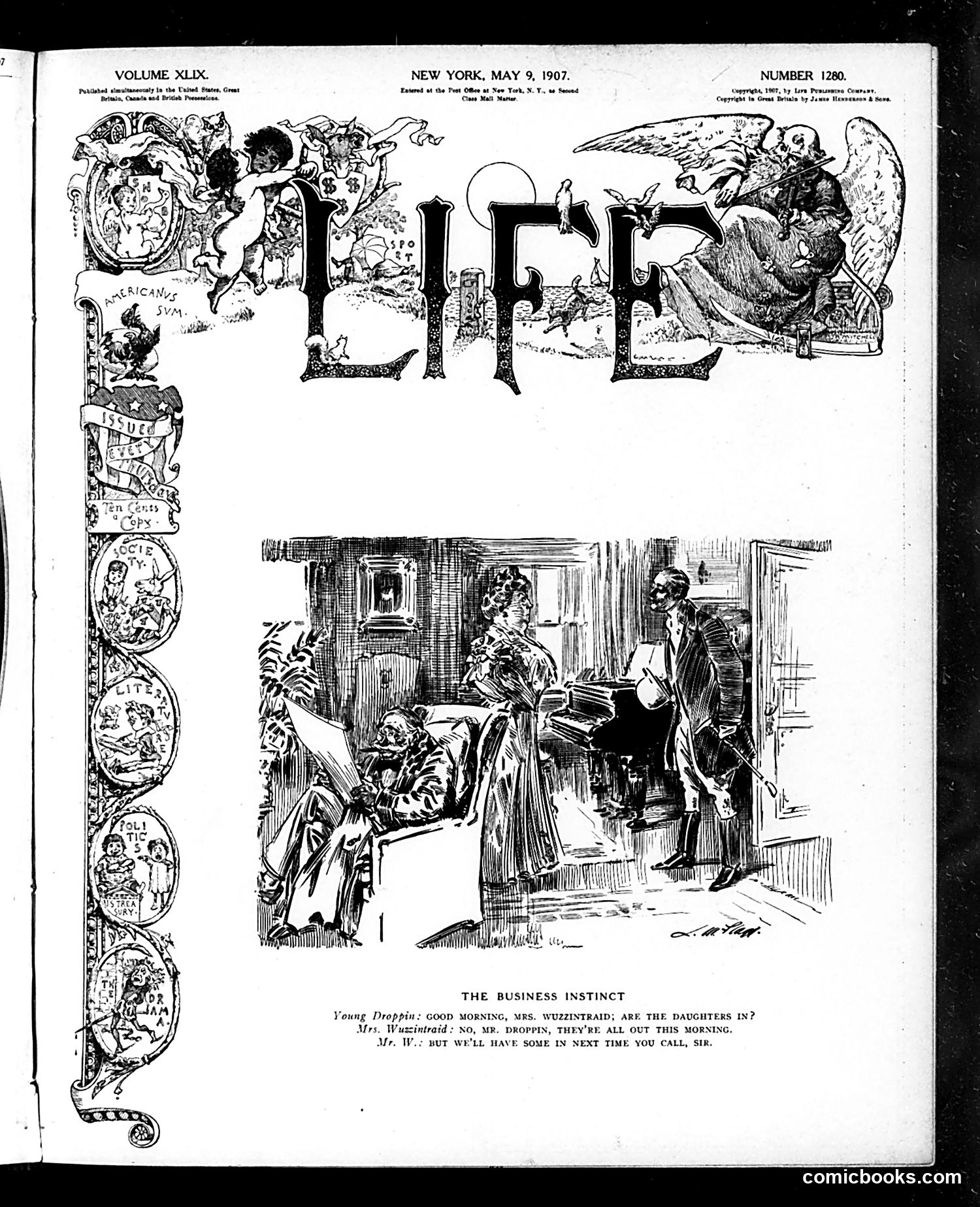
This cartoon satirizes a businessman's priorities regarding his household. A young maid greets Mr. Wuzzintraid in the morning, but Mrs. Wuzzintraid is absent—"the daughters are all out this morning," the maid explains. Mr. W. dismisses this casually, saying they'll "have some in next time you call." The joke targets the "business instinct" of wealthy men who treat their wives and daughters as commodities or possessions to be displayed for social advantage, rather than as family members. The casual, transactional language—"have some in"—mockingly equates managing a household to managing business inventory. The satire criticizes how turn-of-the-century upper-class men prioritized financial and social performance over genuine family relationships.
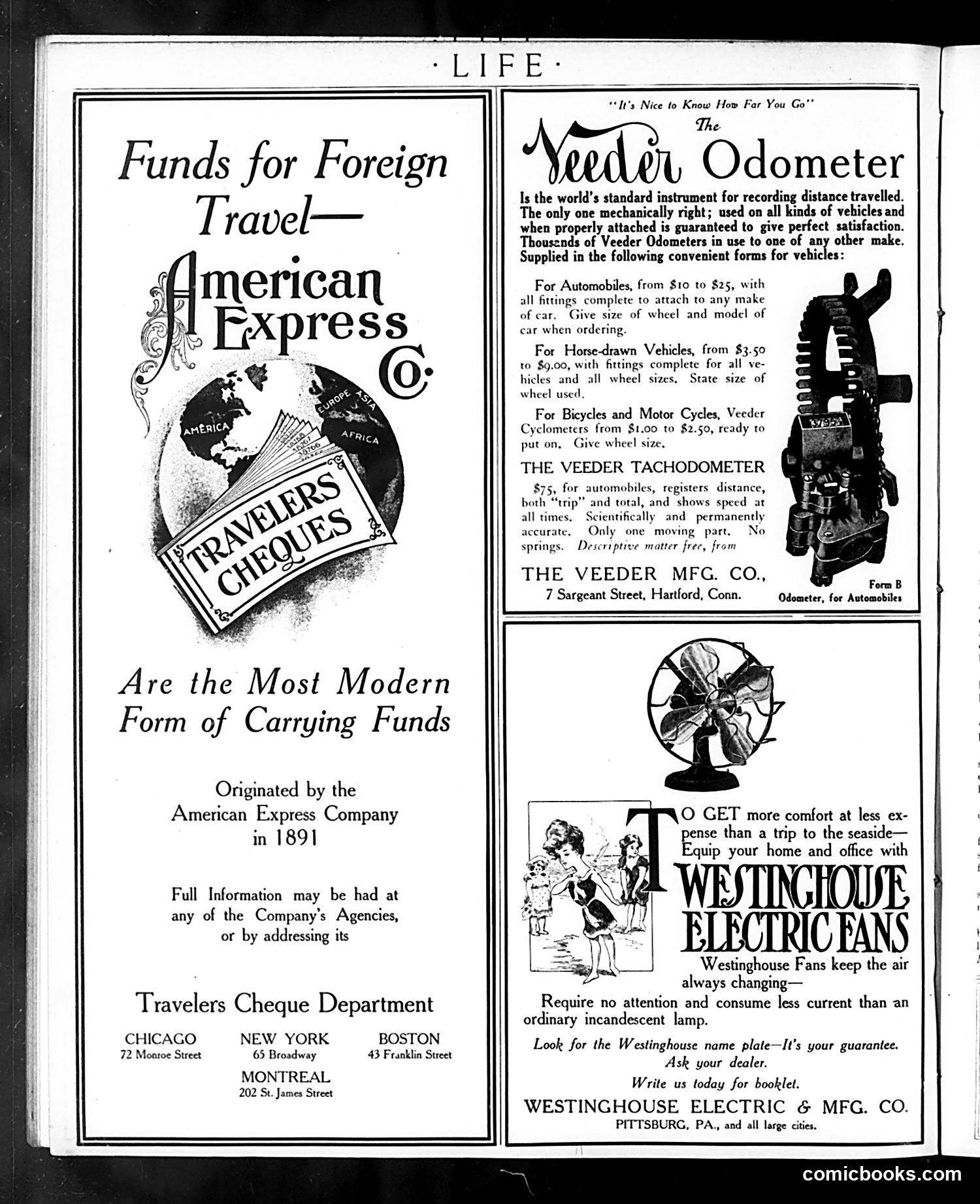
This page contains **no political cartoons or satire**—it's primarily **early 20th-century advertising**. The left half advertises American Express Travelers Cheques, established in 1891, positioning them as a "modern form of carrying funds" for foreign travel. The globe imagery emphasizes international reach. The right half features three product advertisements: 1. **Veeder Odometer** (distance-measuring device for vehicles) 2. **Veeder Tachometer** (speed recorder for automobiles) 3. **Westinghouse Electric Fans** (for home comfort) All advertisements reflect the era's technological optimism—automobiles, electric appliances, and international travel as markers of modernity. The "Life" masthead indicates this is a lifestyle/humor magazine that, like today's publications, relied heavily on advertising revenue.
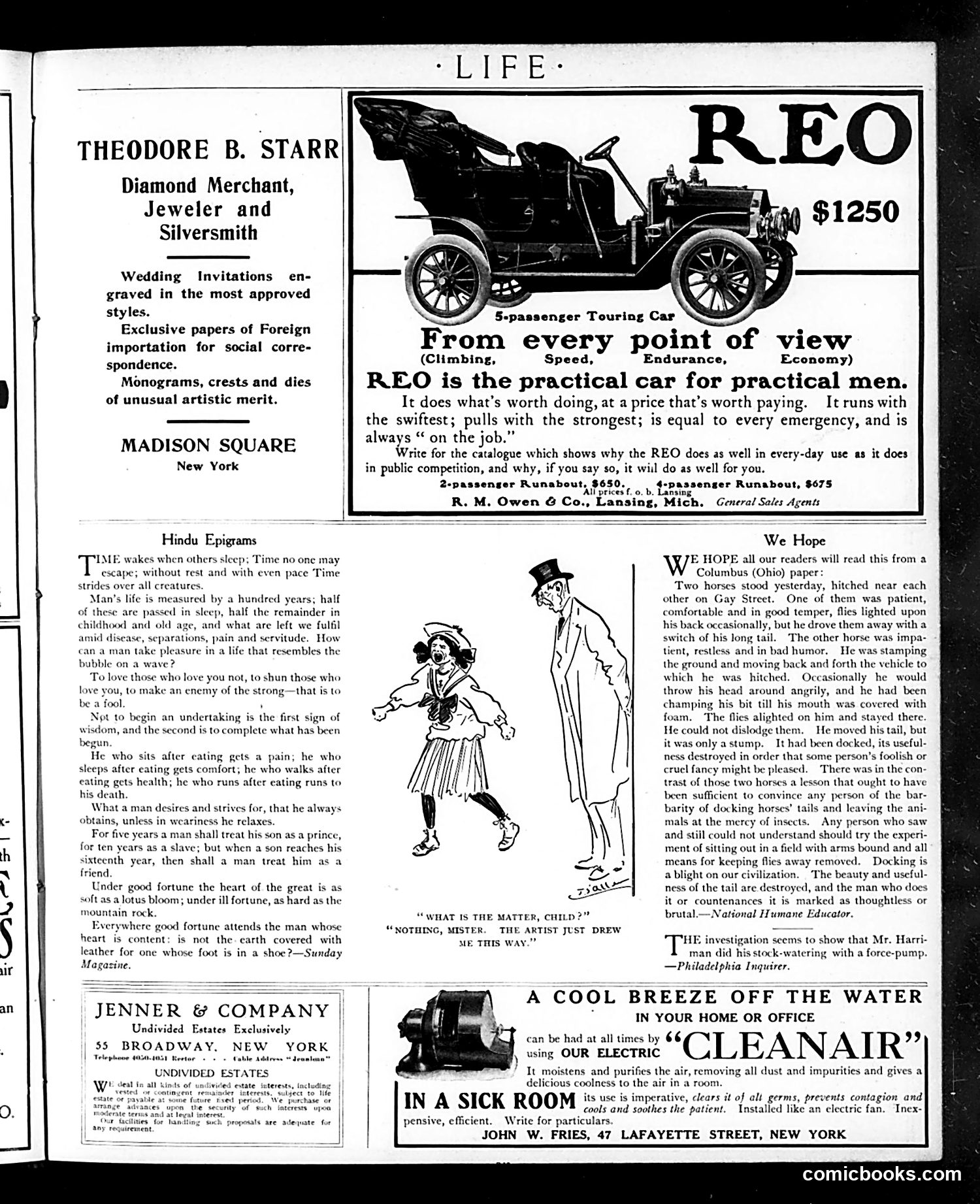
This page is primarily **advertising and editorial content** rather than political satire. The main elements include: **Advertisements:** - REO automobile ($1,250 touring car) - Theodore B. Starr (jeweler/silversmith services) - Jenner & Company (real estate) - Cleanair electric fan **Editorial Content:** The "Hindu Epigrams" section and "We Hope" column appear to be general-interest philosophical pieces about life wisdom and morality—not political commentary. The cartoon titled "What is the Matter, Child?" depicts a generic child and artist figure, illustrating a lighthearted joke about artistic creation. **Overall Assessment:** This is a typical early 20th-century Life magazine page mixing commercial advertisements with light humor and inspirational essays. There is no evident political satire or specific historical references requiring specialized knowledge to understand.
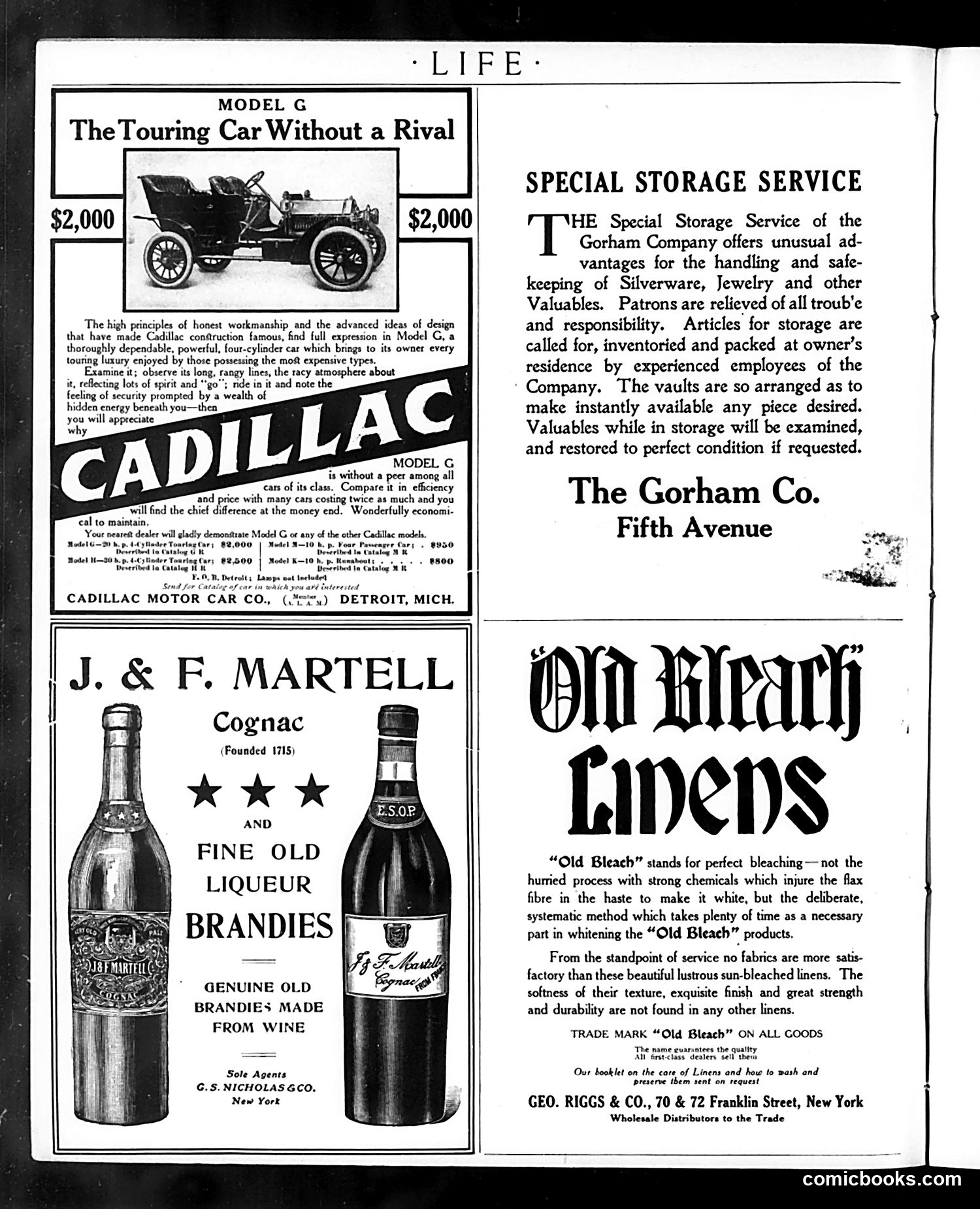
This page contains **primarily advertisements with no political cartoons or satire**. The ads showcase luxury goods circa early 1900s: 1. **Cadillac Model G** ($2,000)—emphasizing honest workmanship and advanced design as superior to competitors 2. **J. & F. Martell Cognac**—featuring brandy bottles, founded 1715, sold by Nicholas & Co. in New York 3. **The Gorham Co.**—offering special storage services for silverware and jewelry on Fifth Avenue 4. **"Old Bleach" Linens**—explaining their bleaching process as superior to chemical methods, distributed by Geo. Riggs & Co. in New York These are straightforward product advertisements targeting wealthy consumers, not satirical commentary. The page reflects Life magazine's business model of combining luxury advertising with editorial content.
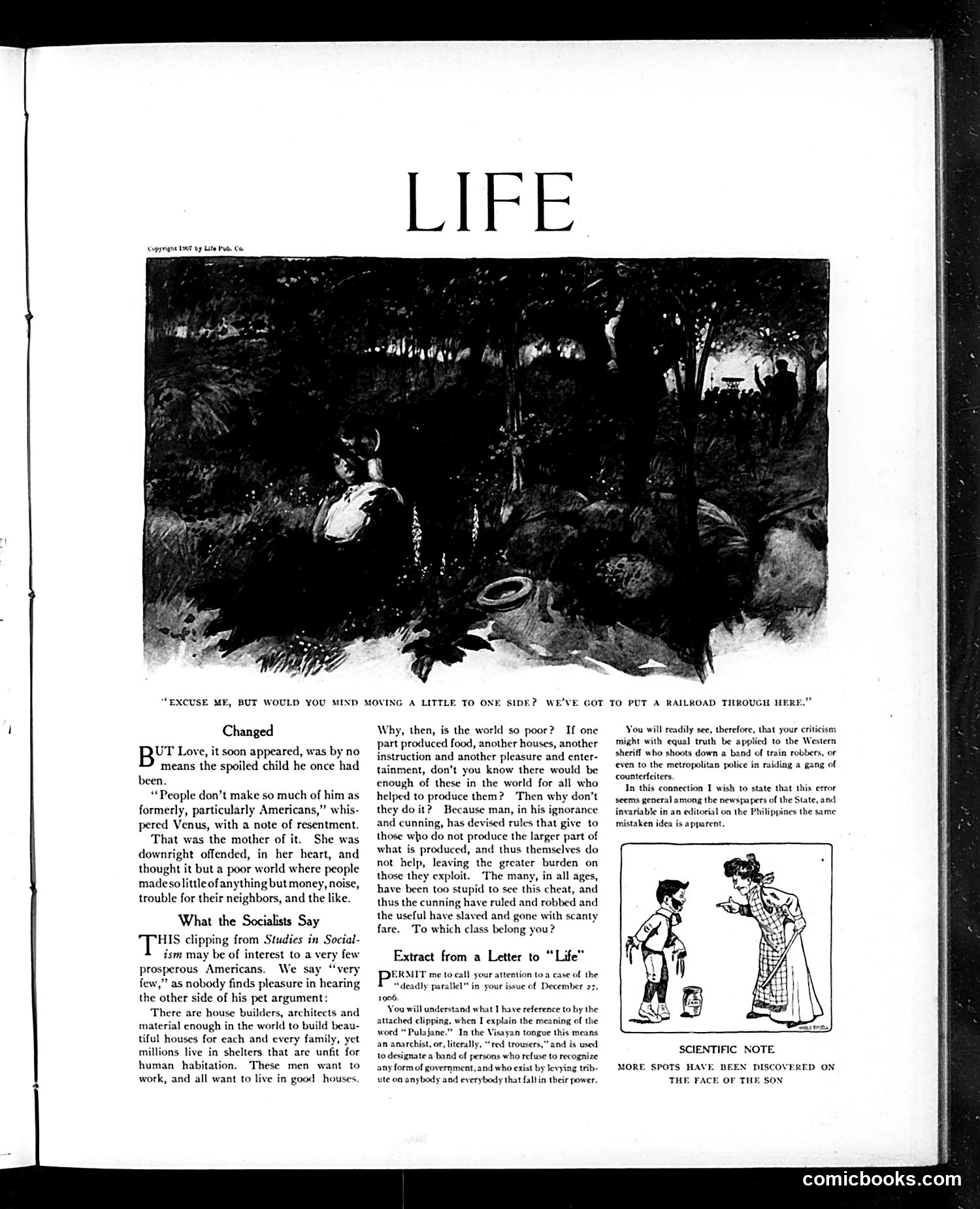
The main illustration shows a forest scene where someone asks to move a railroad through the area. The accompanying articles critique social inequality and poor living conditions. The "Changed" section mocks the idea that poverty results from laziness, arguing instead that wealthy classes have deliberately created systems benefiting themselves while exploiting workers. It questions which class the reader belongs to. "What the Socialists Say" references a pamphlet called *Studies in Socialism*, presenting socialist arguments that despite sufficient resources and builders, millions live in inadequate housing because wealth is concentrated among the few. The small cartoon illustrations appear to satirize class differences or social hierarchy, though specific figures are unclear. Overall, the page presents socialist critiques of capitalism and wealth inequality, characteristic of early 20th-century American progressive journalism.
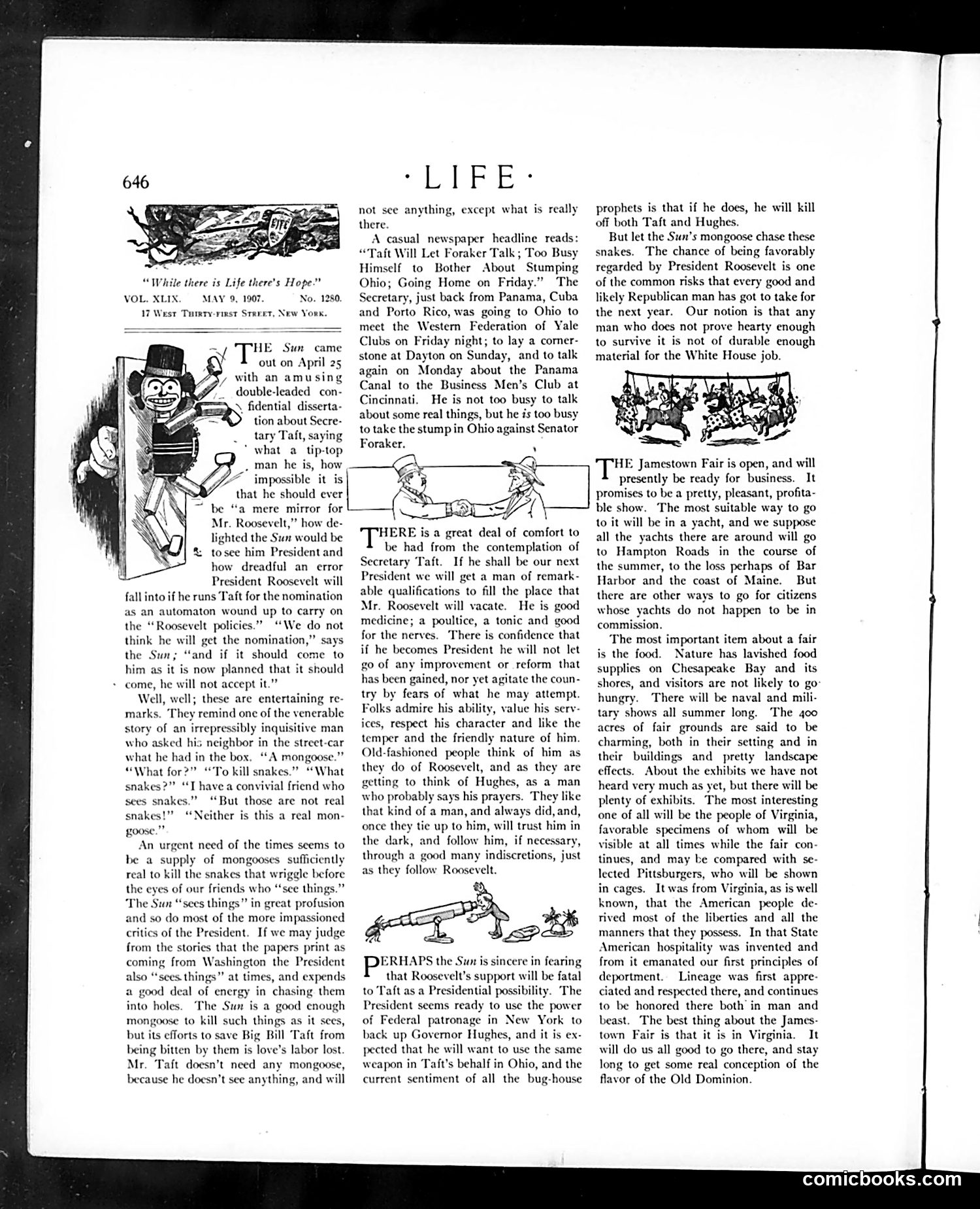
This page contains political commentary on Secretary of State William Howard Taft as a potential presidential successor to Roosevelt. The left cartoon depicts a caricatured figure (likely Taft) as a "mere mirror" or puppet of Roosevelt, suggesting he lacks independent judgment. The text satirizes the Sun newspaper's enthusiasm for Taft, mocking how busy Taft claims to be with various commitments while supposedly considering a presidential run. The article suggests Taft is merely reflecting Roosevelt's policies rather than offering genuine leadership. The central cartoon shows two figures (likely representing competing political interests) shaking hands over what appears to be a political arrangement or deal. The overall thrust: Life ridicules both Taft's perceived lack of autonomy and newspaper coverage promoting him as Roosevelt's natural heir.
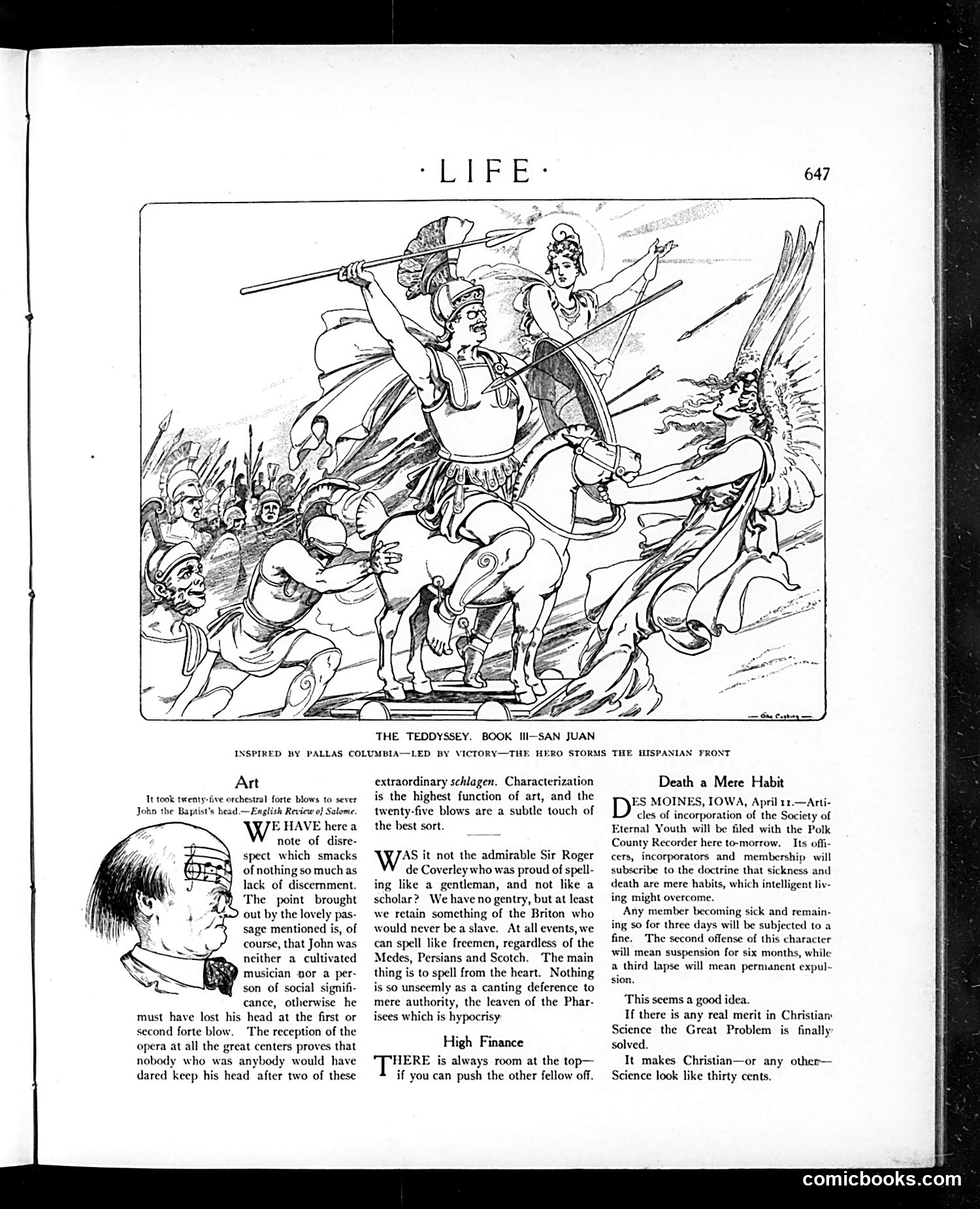
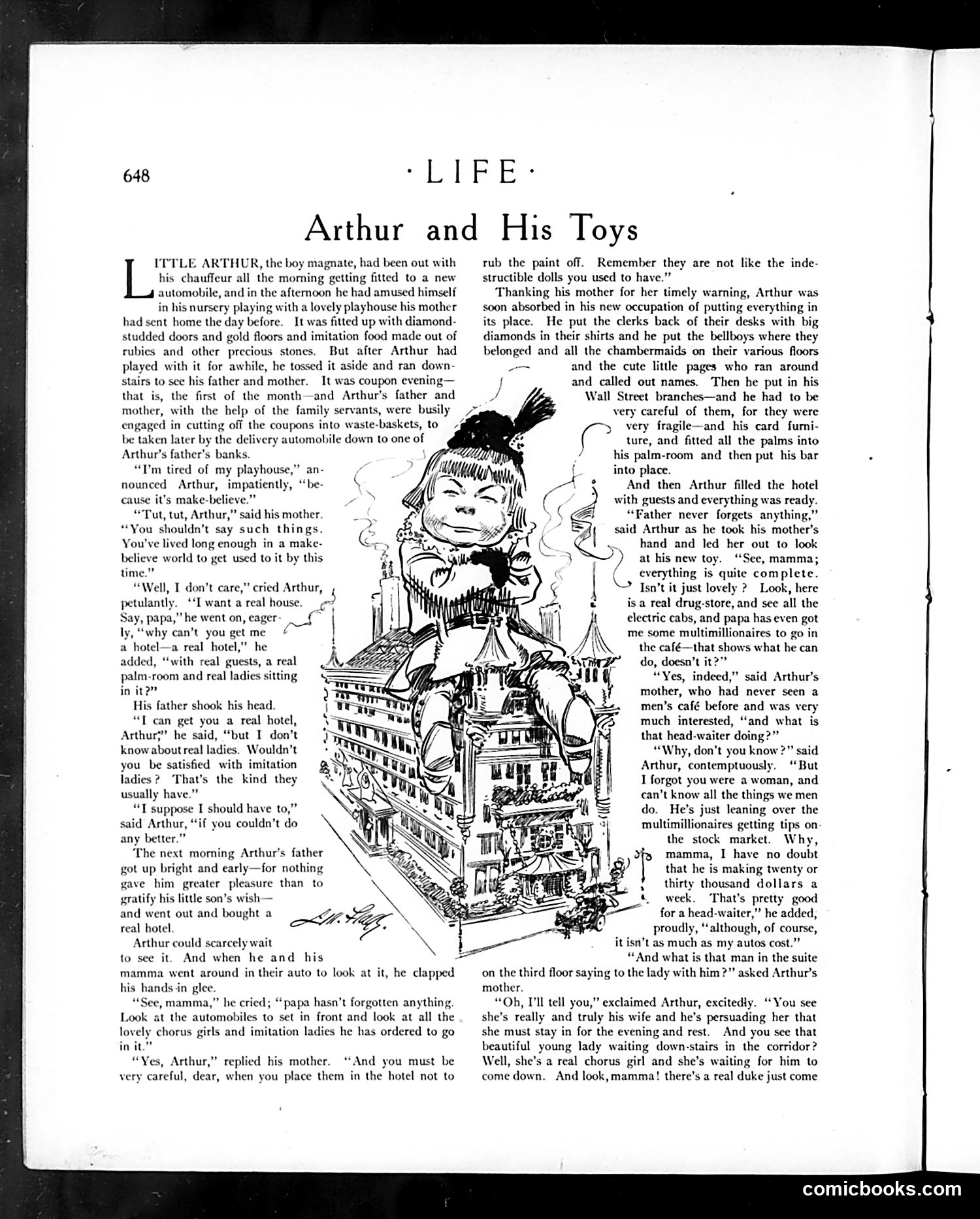
This is a short story illustration, not political satire. The narrative follows Little Arthur, a wealthy boy whose father is a financier, as he plays with an elaborate toy hotel. The story satirizes the excesses of the Gilded Age wealthy through Arthur's innocent perspective. The central illustration shows a massive dollhouse-hotel with fine details—automobiles, elegant guests, a café, and multimillionaires. The satire targets the era's conspicuous consumption: Arthur recreates the adult world of high finance and luxury hotels in miniature, reflecting how the wealthy displayed their status through extravagant possessions and establishments. The dialogue mocks society's priorities—his father's concern about "ladies" and "imitation" in hotel operations, and Arthur's matter-of-fact pursuit of profit and status symbols, all suggesting that such values were ingrained even in children of the rich.
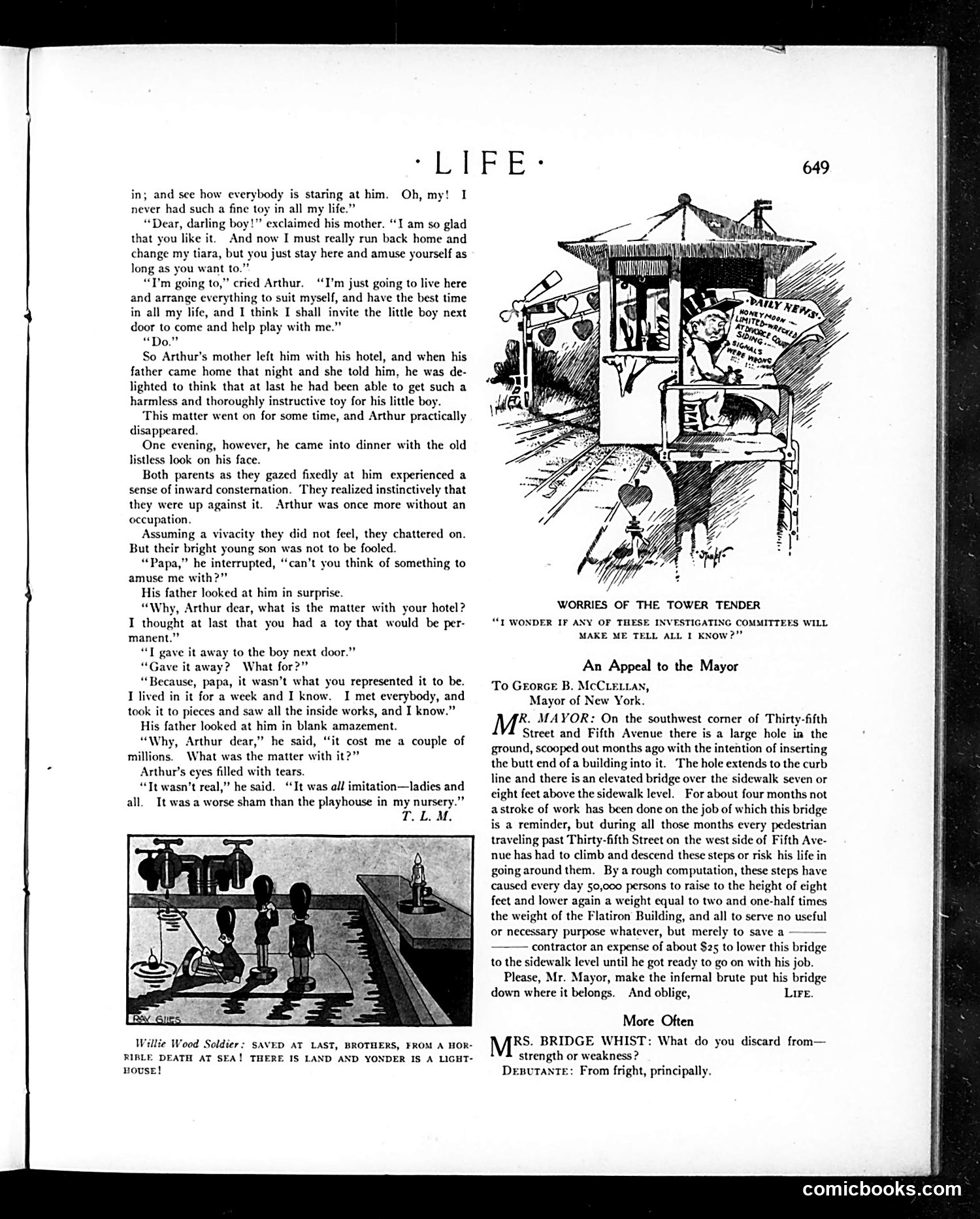
This page contains a humorous domestic narrative about a boy's toy hotel and two cartoons with accompanying jokes. **Main cartoon ("Worries of the Tower Tender"):** Shows a tower operator worried about investigating committees discovering his negligence. This appears to reference contemporary concerns about industrial safety oversight and regulatory accountability. **"An Appeal to the Mayor":** A letter to NYC Mayor George B. McClellan complaining about a dangerous construction bridge at 35th Street and Fifth Avenue that has caused daily foot traffic disruptions for months. The writer urges the mayor to force the contractor to lower the bridge to sidewalk level. **"More Often" dialogue:** A brief joke about what people discard—apparently playing on weakness versus strength. The page reflects Progressive Era concerns about urban infrastructure, worker safety, and municipal governance.
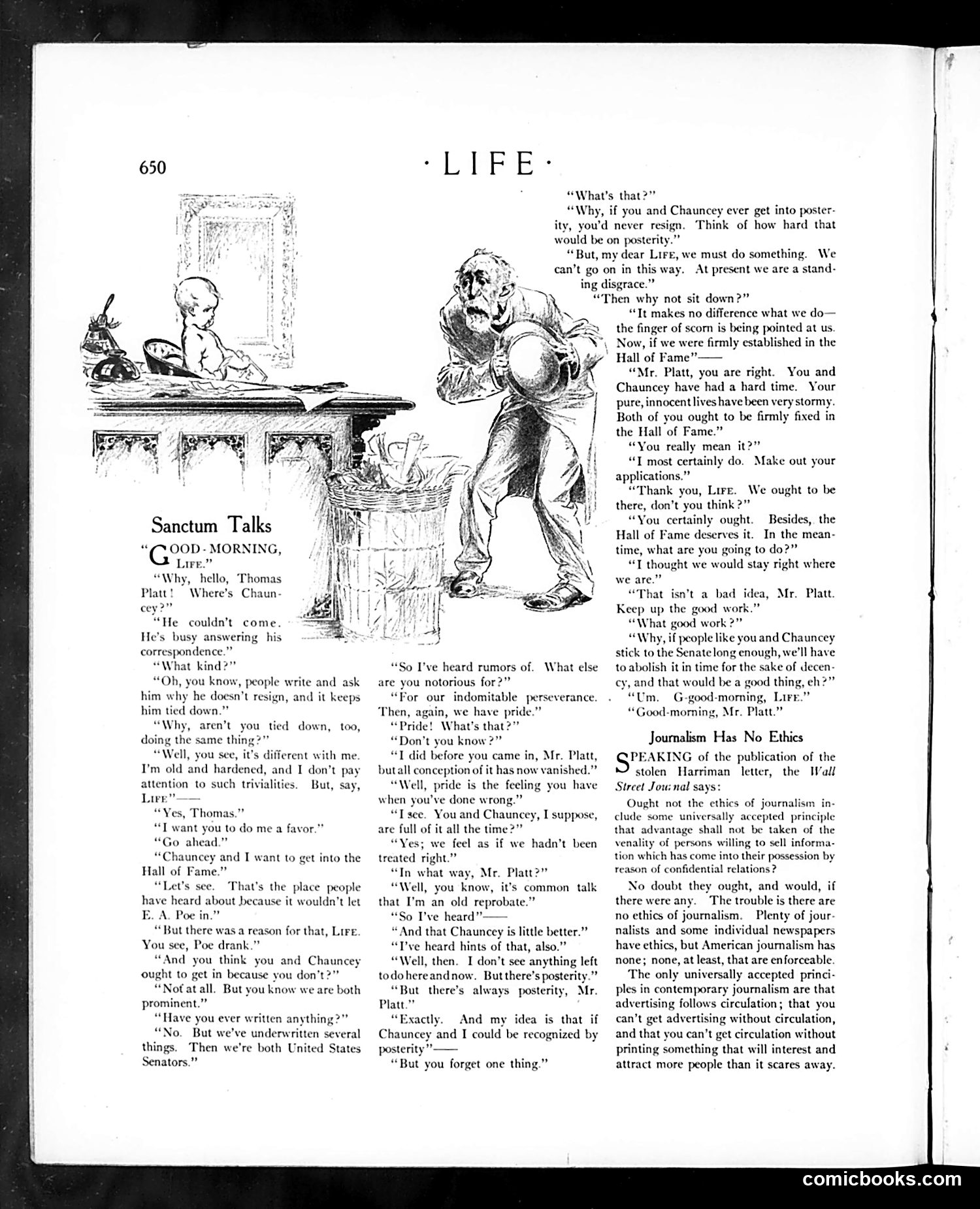
This cartoon depicts a conversation between "Life" (personified as a distinguished gentleman) and Thomas Platt, a political figure seeking entry to the "Hall of Fame." The satire targets Platt's political ambitions and reputation. Platt argues he and Chauncey (likely referring to Chauncey Depew, a contemporary politician) deserve Hall of Fame recognition despite their "stormy" records. Life responds skeptically, suggesting their primary qualification is "posterity"—implying they lack genuine accomplishment. The cartoon mocks political self-promotion and the questionable ethics of how public figures craft their legacies. The accompanying article "Journalism Has No Ethics" reinforces this critique, discussing how newspapers publish information based on circulation appeal rather than principled journalism.
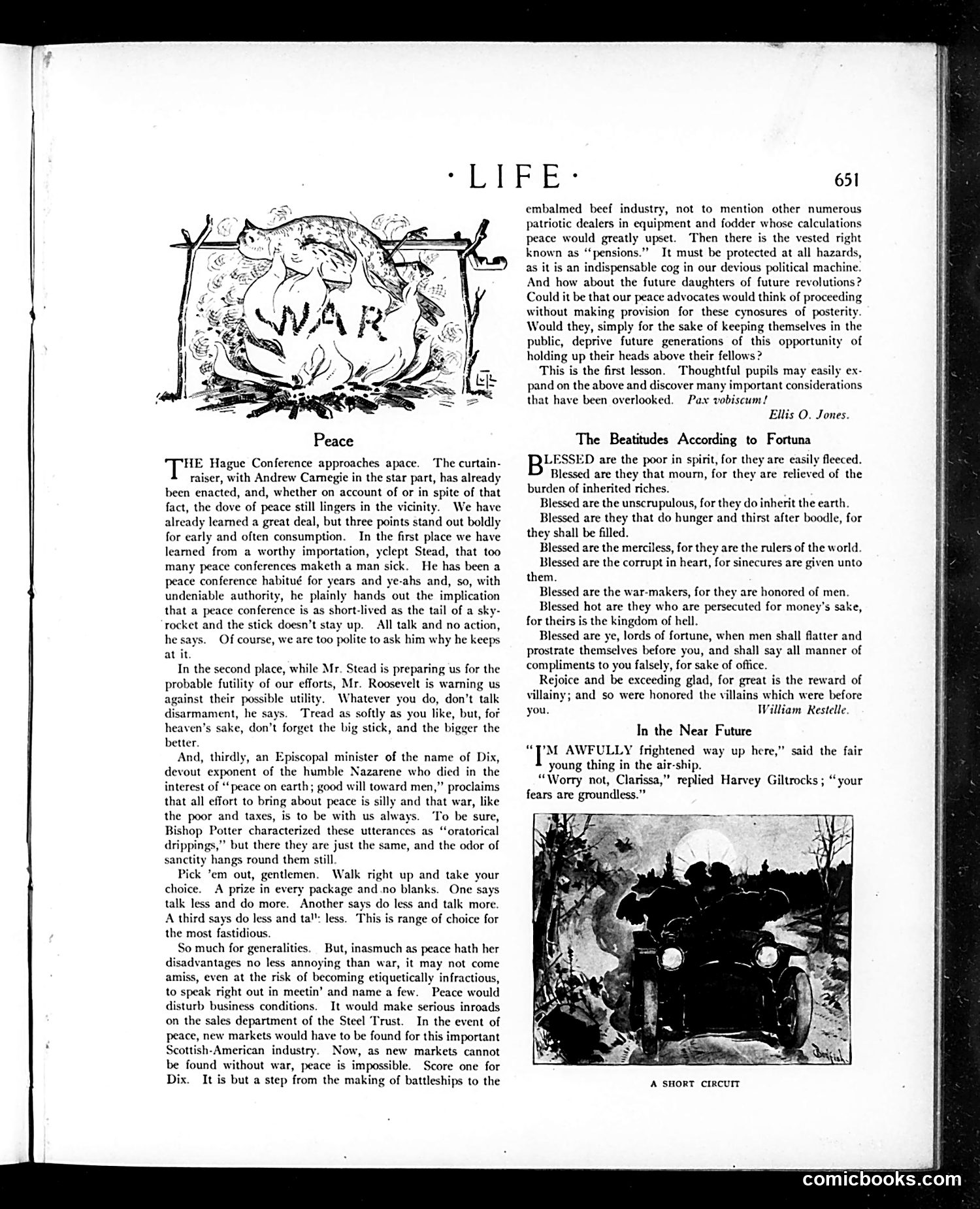
The main cartoon depicts a large cabbage or vegetable labeled "WAR" with decorative vine borders. This is political satire about peace negotiations—specifically referencing the approaching Hague Conference with Andrew Carnegie involved. The accompanying text satirizes those advocating for peace, suggesting their efforts are futile. The author (Ellis O. Jones) mocks the notion that peace conferences accomplish anything meaningful, arguing that economic interests—particularly in the steel and munitions industries—make genuine peace impossible. The cartoon's vegetable imagery likely represents how peace rhetoric is hollow or insubstantial compared to the "real" economic machinery of war. The satire suggests peace advocates are naive about the business interests profiting from conflict.
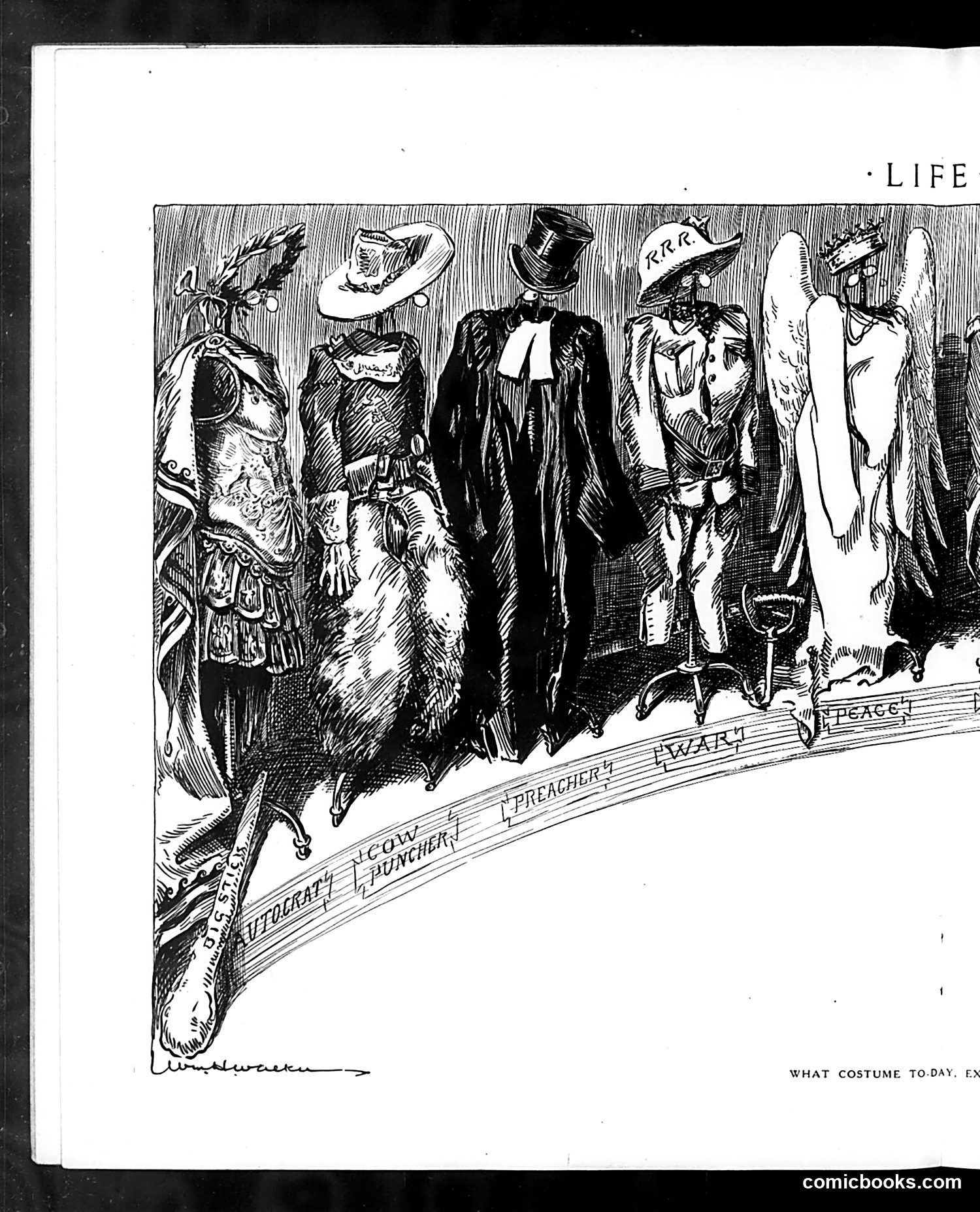
This Life magazine cartoon satirizes American social institutions through caricature. Five figures parade along a banner reading "AUTOCRACY, BUREAUCRACY, PUNCHINELLO, PREACHER, WAR, PEACE"—suggesting these represent different social forces or character types. The figures wear exaggerated costumes: military regalia, formal dress, angelic wings, and other theatrical garb. The artwork style and banner suggest this is mocking how these institutions or archetypes present themselves to the public—essentially asking "what costume will [each] wear today?" The satire appears to critique hypocrisy, suggesting that institutions like government, religion, and military present false or theatrical facades rather than genuine substance. The Punchinello reference (a stock character of deception) reinforces this theme of performative pretense.
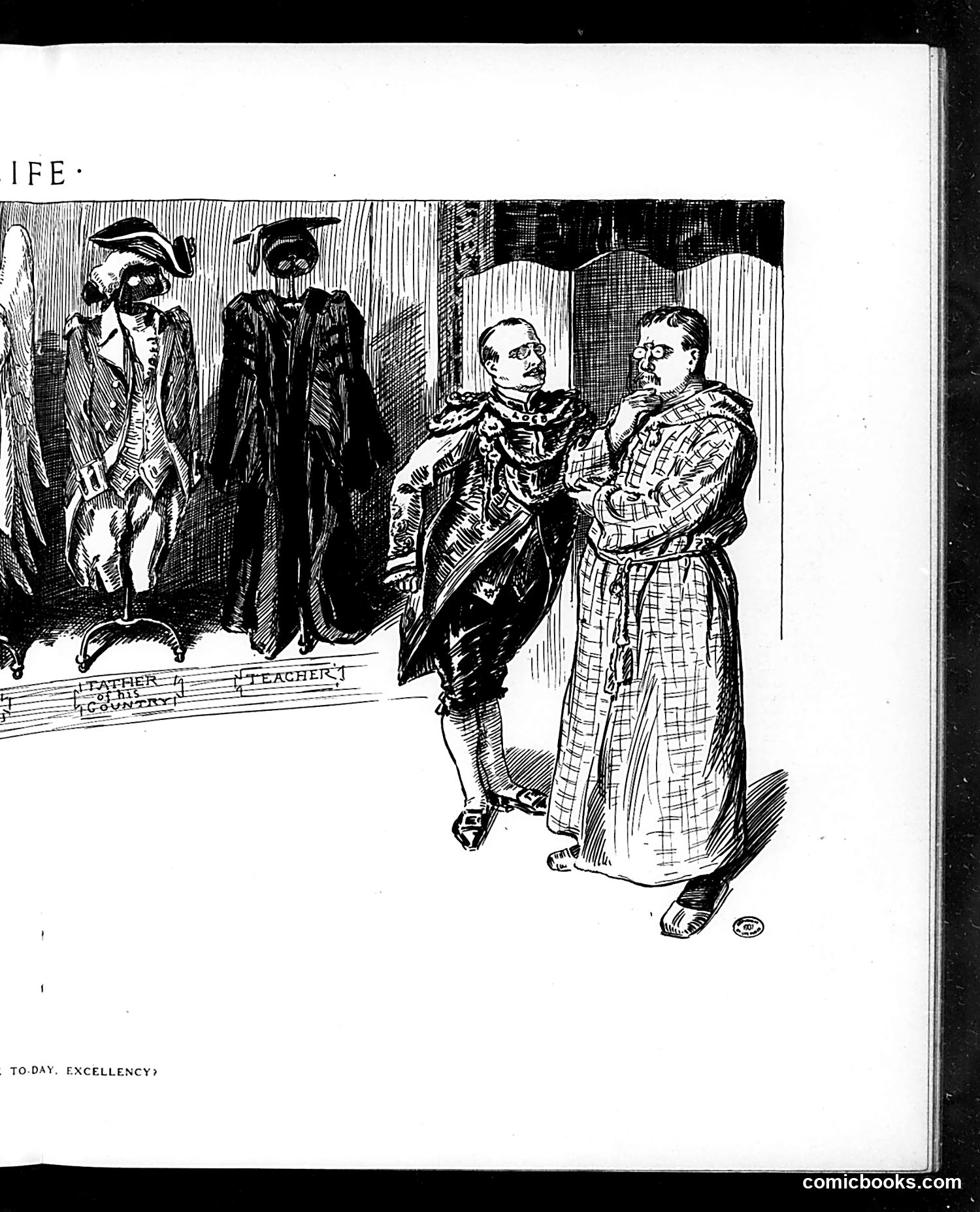
This Life magazine cartoon satirizes military authority versus civilian leadership. Two figures in military dress (one appears to be a high-ranking officer with decorations) are being confronted by a civilian in a robe. The caption reads "RATHER A TEACHER! A COUNTRY!" suggesting tension between military rule and civilian educational/democratic governance. The two shadowy figures in the background labeled "TEACHER" and what appears to be a reference to "COUNTRY" reinforce this theme. The cartoon critiques military overreach or militarism, advocating instead for civilian control and educational values to guide the nation. The exaggerated caricature style typical of early-20th-century Life magazine emphasizes the conflict between these competing power structures.
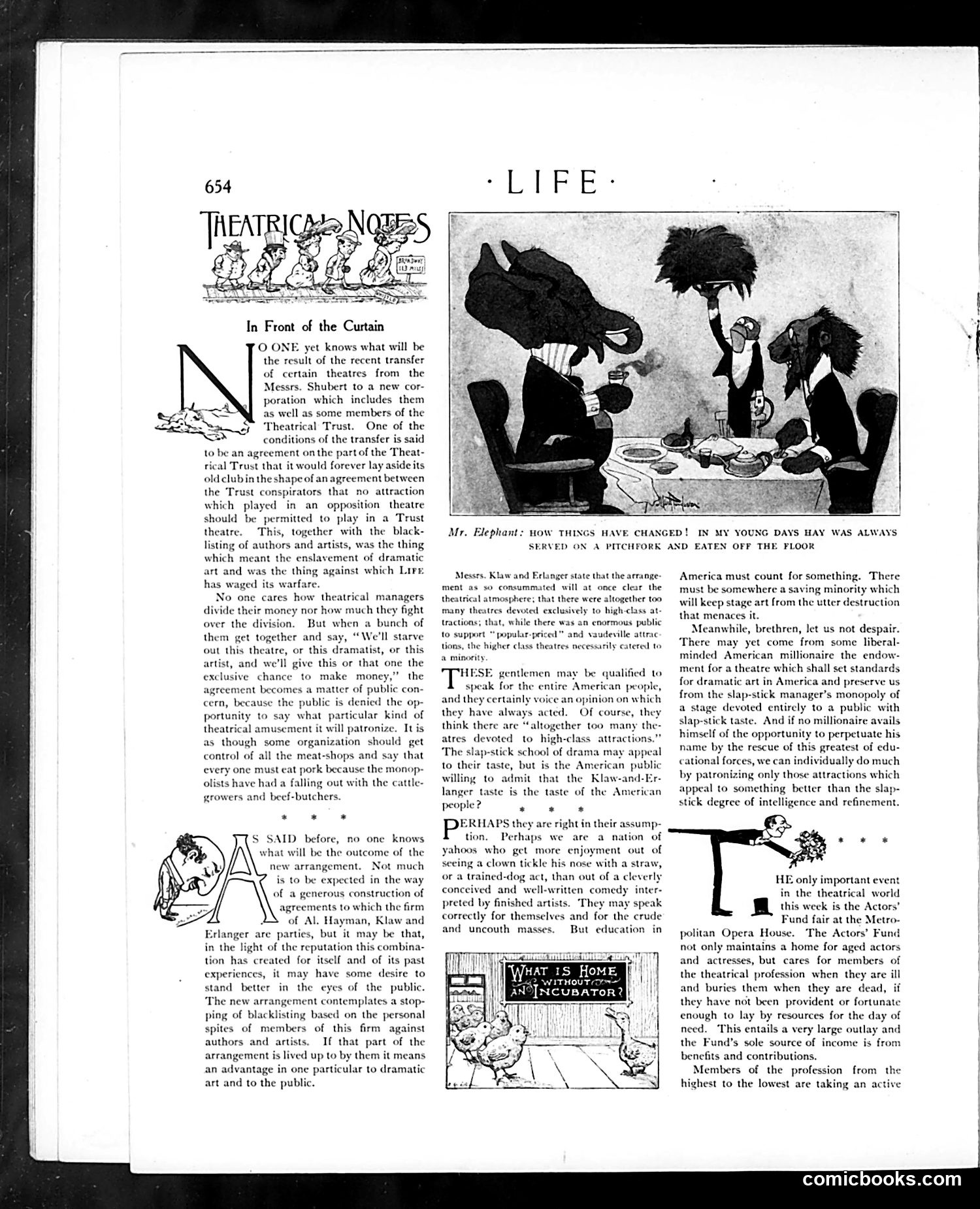
This page satirizes the Theatrical Trust's monopolistic control of American theatre. The main text criticizes a recent business arrangement involving theatrical impresarios **Klaw and Erlanger** (mentioned by name), who consolidated control over multiple theatres under a new corporation. The **cartoon at top** depicts an elephant (symbolizing the Trust's power) trampling theatrical productions, illustrating how the monopoly destroys competition and artistic freedom. **The satire's target**: Life argues the Trust used blacklisting agreements to eliminate competing theatres and punish independent dramatists and artists—comparable to a meat monopoly forcing consumers to eat only pork. **The core complaint**: Klaw and Erlanger allegedly believe American audiences prefer cheap vaudeville and slapstick over serious drama, so they deliberately eliminated "high-class" theatres. Life sarcastically questions whether the public actually shares this "crude" taste, arguing educated Americans deserve better theatrical options. The piece defends artistic merit against commercial monopoly control of entertainment.
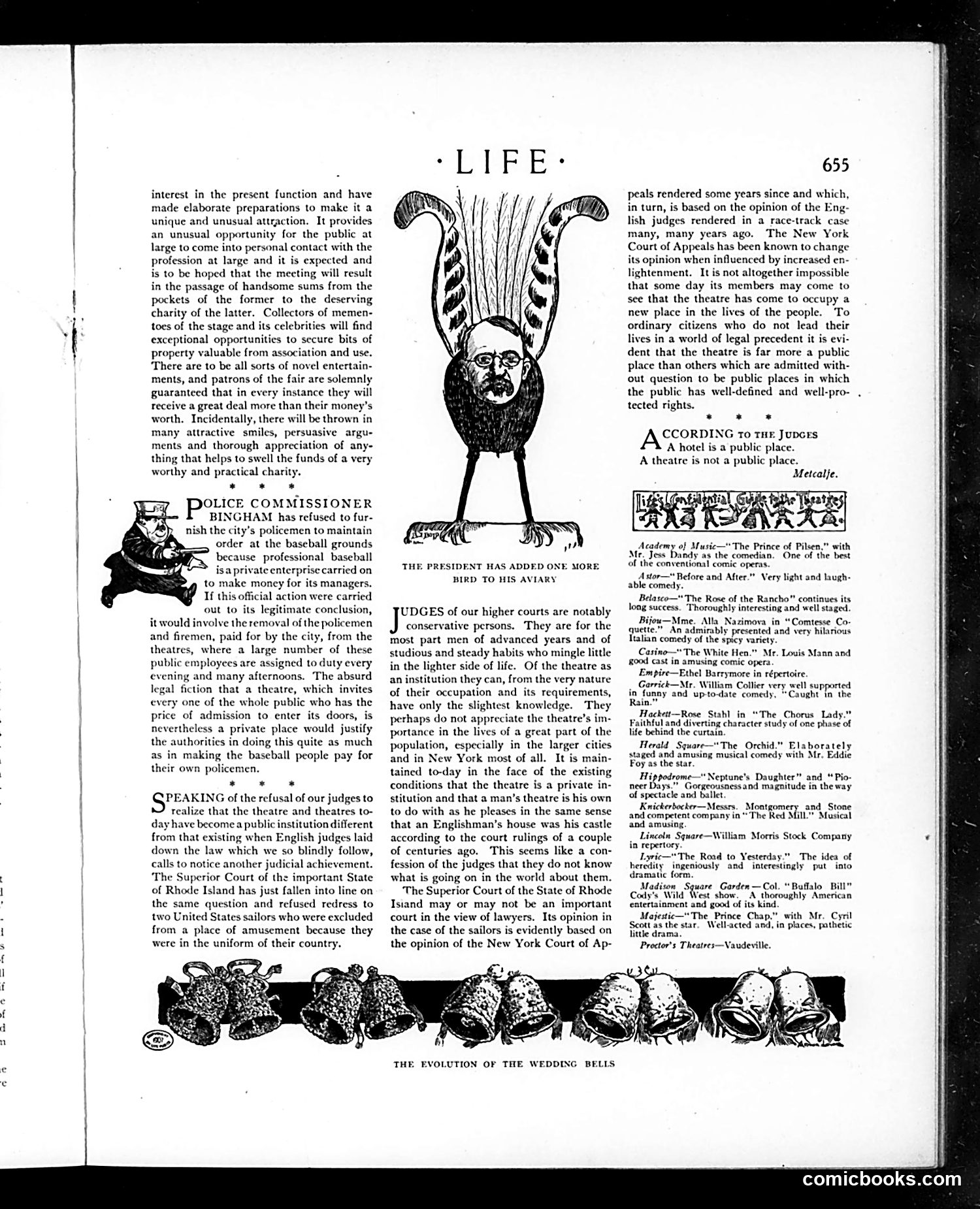
This page satirizes judicial ignorance about modern society, particularly judges' refusal to treat theaters as public institutions deserving police protection. **Main cartoon**: A grotesque figure with horns emerging from a man's head, captioned "THE PRESIDENT HAS ADDED ONE MORE BIRD TO HIS AVIARY." This appears to mock President Bingham's addition to his collection—likely satirizing his stubbornness or foolishness regarding theater policy. **The argument**: Life criticizes courts (especially Rhode Island's Superior Court and New York's appellate courts) for treating theaters as private enterprises rather than public spaces. The magazine argues this legal fiction is outdated—judges apply centuries-old English precedent treating theaters like private castles, ignoring that modern theaters are actually public institutions serving masses of citizens. **The specific complaint**: Police Commissioner Bingham refused to provide officers at baseball games because it's a private enterprise. Life argues this logic absurdly extends to theaters, where authorities *do* provide police despite the same "private" classification—exposing the inconsistent and archaic thinking of conservative judges.
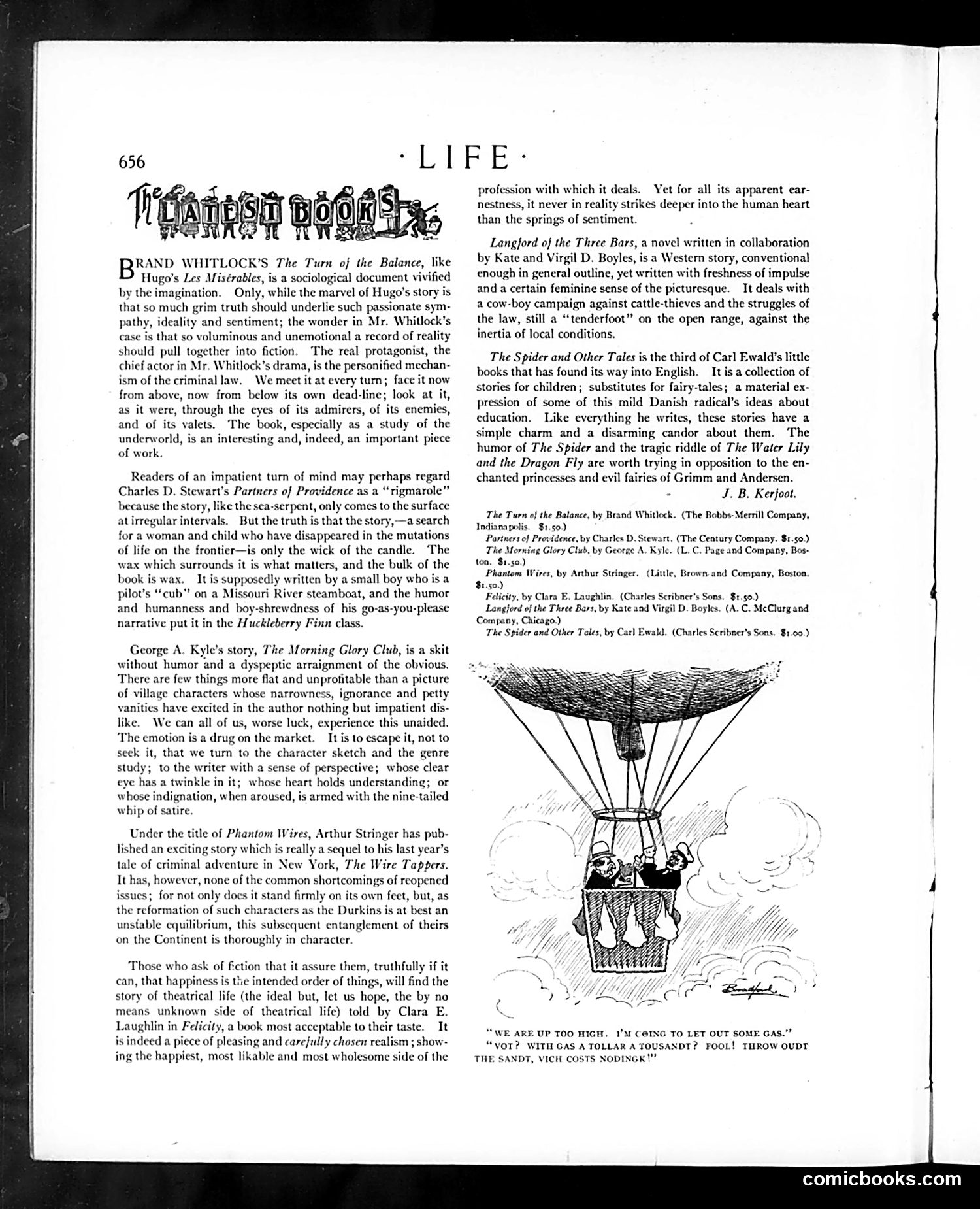
This page from *Life* magazine (page 656) contains literary reviews rather than political cartoons. The text discusses several novels, including Brand Whitlock's *The Turn of the Balance* (compared to Hugo's *Les Misérables*), Charles Stewart's *Partners of Providence*, and works by George Kyle and Arthur Stringer. The single illustration depicts a hot air balloon with two occupants in the basket, arguing about money. The caption reads: "We are up too high. I'm going to let out some gas." "Vot? Vith gas a tollar a thousand? Fool! throw oudt the sand, vich costs nodings!" This cartoon satirizes immigrant frugality during an era of high fuel costs—the character's deliberately exaggerated dialect and absurd prioritization of expensive gas over ballast exemplifies period stereotypes about penny-pinching foreigners. The joke relies on contemporary awareness of wartime or post-war inflation.
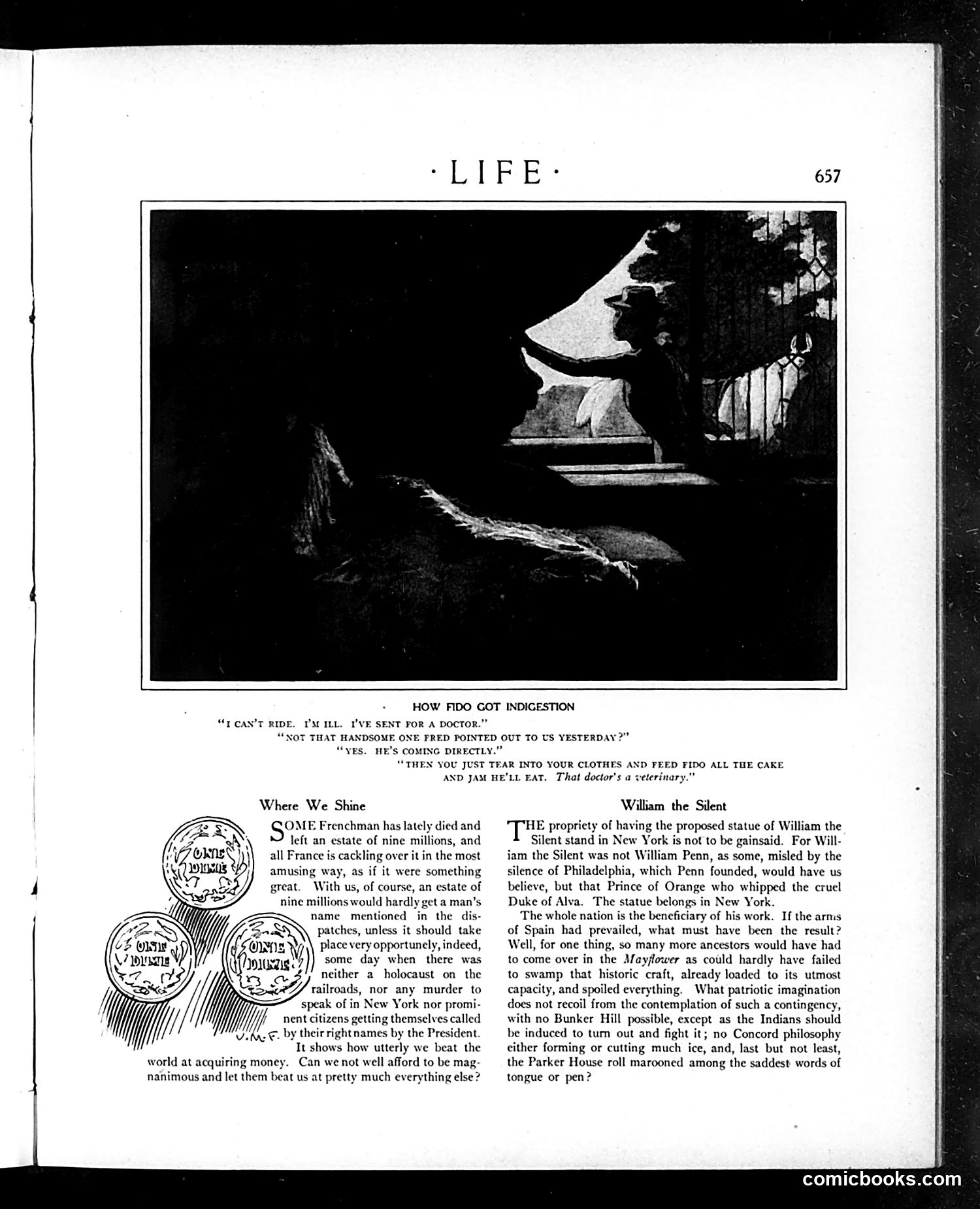
This page contains two humorous pieces from *Life*, the American satirical magazine. **"How Fido Got Indigestion"** (top): A visual gag about a woman feigning illness to avoid horseback riding, instructing her servant to feed her dog cake and jam—then revealing the "doctor" summoned is actually a veterinarian, making the servant's actions a cruel prank on the animal. **"Where We Shine"** (left column): Mocks American materialism by contrasting European and American attitudes toward wealth. A Frenchman's nine-million-franc estate causes national celebration in France, whereas America treats such sums as trivial—suggesting Americans' obsessive money-acquisition makes them culturally inferior despite financial superiority. **"William the Silent"** (right column): Defends placing a statue of William of Orange (Dutch Prince who opposed Spanish rule) in New York, arguing it benefited America by preventing Spanish conquest that would have overcrowded colonial ships and eliminated American independence. The satire humorously traces American identity back to this historical figure.
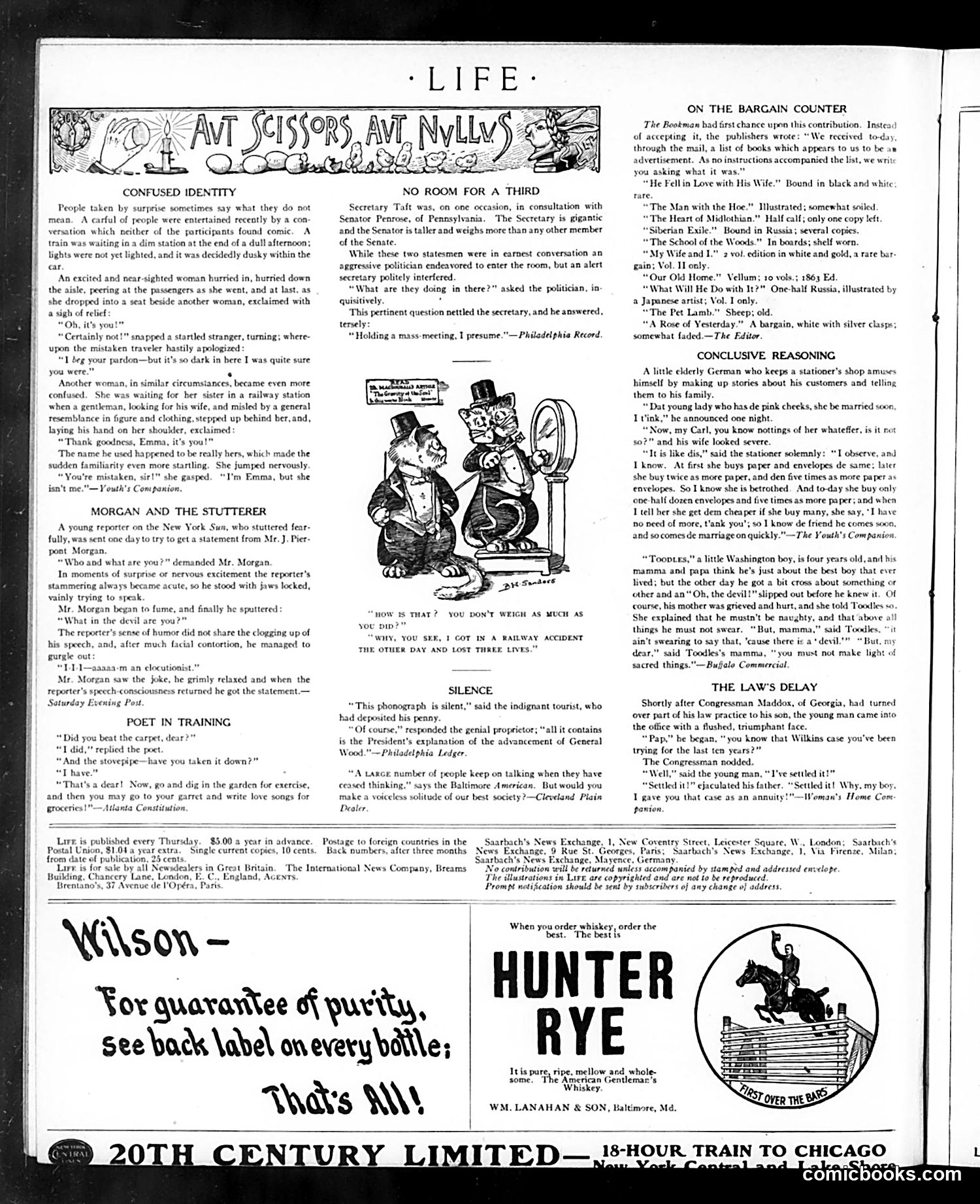
This is a humor page from Life magazine featuring several short comic anecdotes and jokes typical of early 20th-century American satire. **Key content:** The "Morgan and the Stutterer" anecdote mocks J.P. Morgan, the prominent banker, by depicting him as humorless and imperious until a stammering reporter's accidental quip breaks his stern demeanor. The "No Room for a Third" cartoon jokes about Secretary of War William Howard Taft and Senator Penrose—both notably large men—by implying their combined bulk fills a room entirely. Other brief pieces mock poets, confused train passengers, and include political jabs (one references President Theodore Roosevelt's "advancement of General Wood"). **Context for modern readers:** These jokes rely on recognition of famous public figures and play on physical characteristics, stuttering, and class anxiety about mistaken identity—humor styles that were acceptable then but would be considered insensitive today. The satire targets prominent politicians and wealthy industrialists.
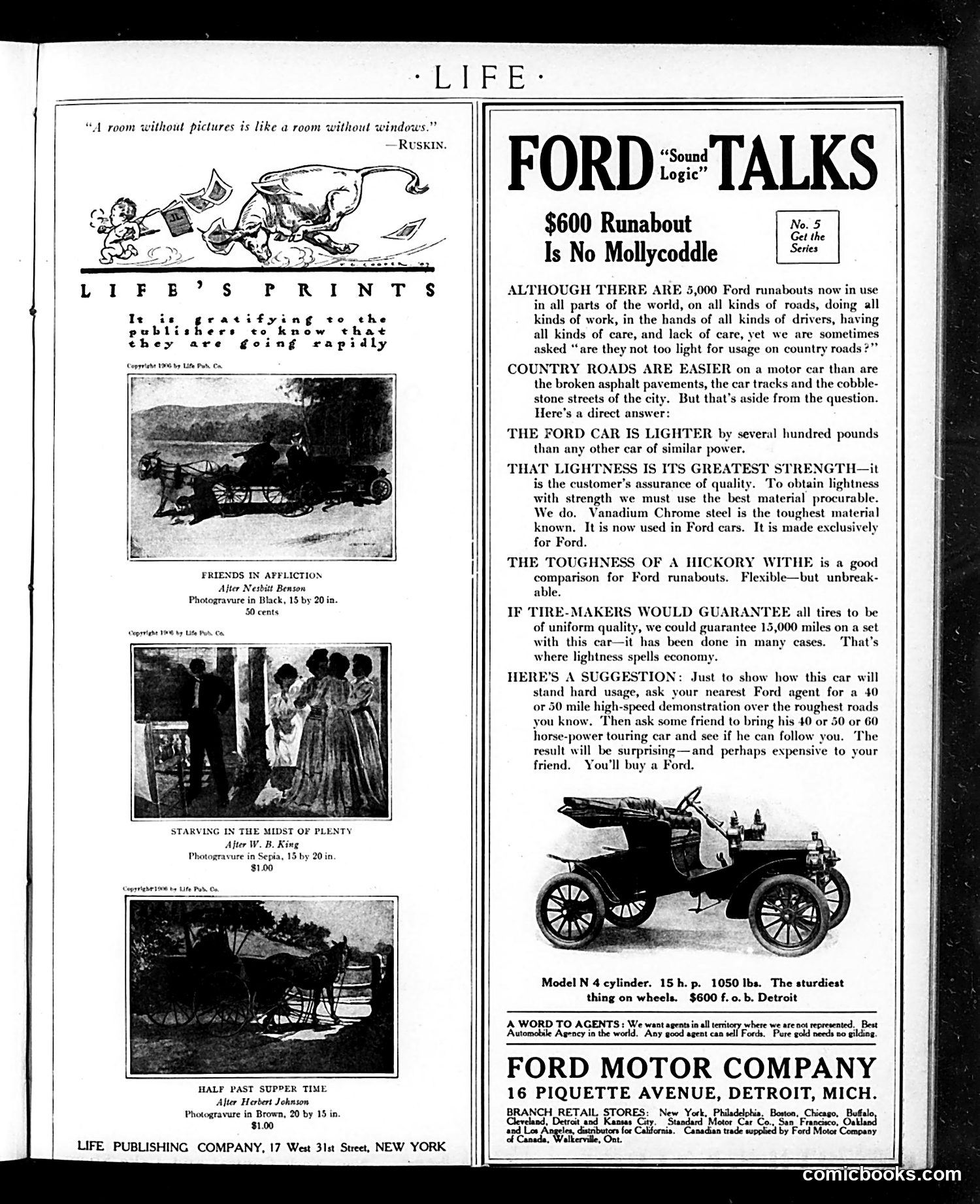
This page contains two distinct elements: satirical artwork on the left and a Ford advertising feature on the right. **Left side ("Life's Prints"):** Three photogravure artworks by named photographers depicting social hardship—"Friends in Affliction," "Starving in the Midst of Plenty," and "Half Past Supper Time." These appear to document poverty and hunger, likely reflecting early 20th-century concern with urban social conditions. The framing as "prints" suggests Life magazine's role documenting American social issues. **Right side ("Ford Sound Logic Talks"):** This is essentially an advertorial defending the $600 Ford Model N runabout against criticism that its lightweight construction made it unsuitable for rough roads. Ford argues lightness equals strength through superior materials (vanadium chrome steel), comparing durability to hickory wood. The piece challenges readers to test-drive the car against heavier competitors. The juxtaposition is striking: images of deprivation facing an optimistic pitch for an affordable automobile—reflecting the early automotive era's promise of mass mobility alongside persistent economic inequality.
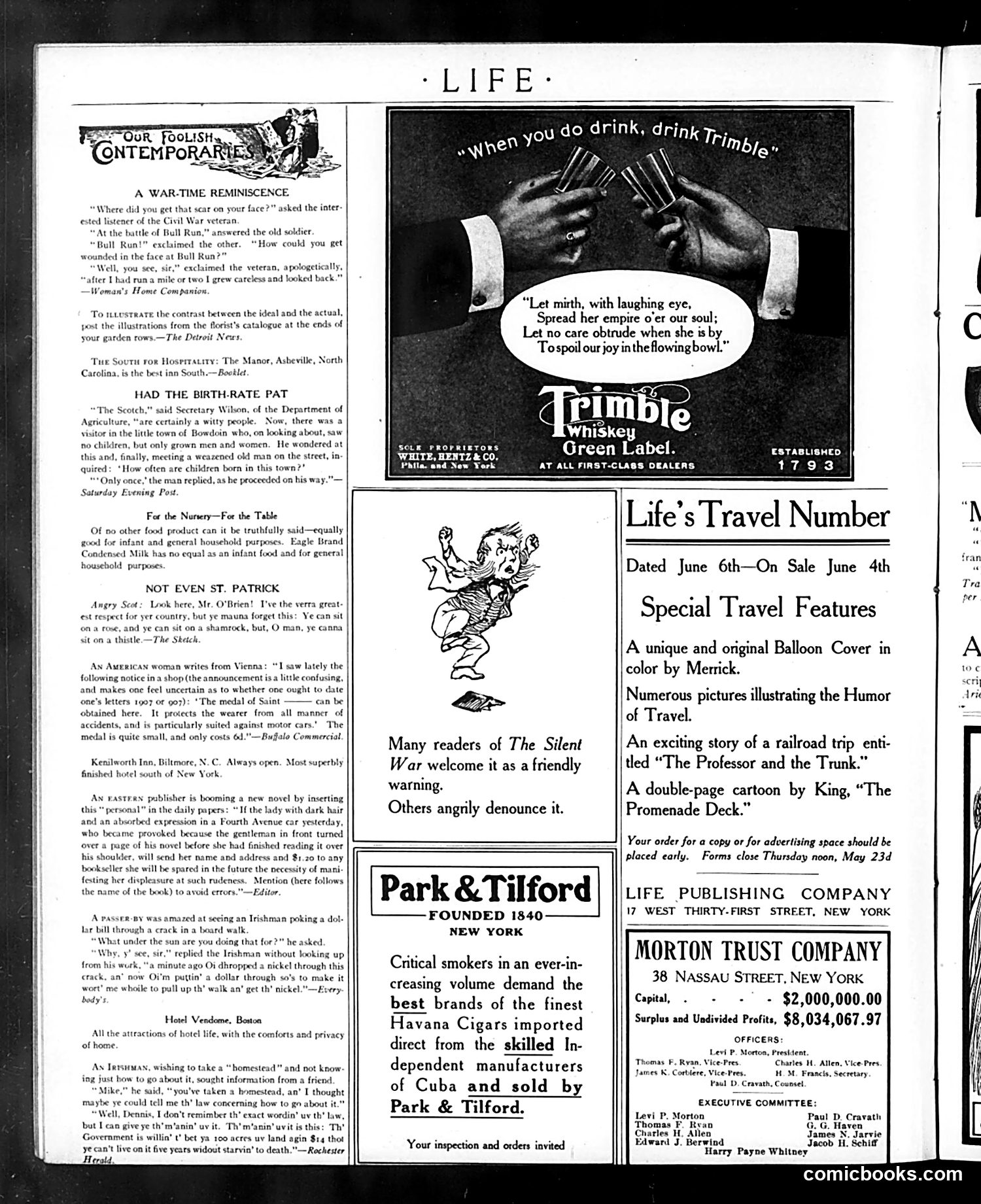
This page from Life magazine (dated June 6, based on the "Life's Travel Number" announcement) contains several short satirical anecdotes and advertisements typical of early 20th-century American humor. **Main Content:** The page features brief humorous pieces mocking various groups: a Civil War veteran at Bull Run who admits to cowardice by looking back while fleeing; Scottish people for their low birth rate; an Irishman's illogical attempt to retrieve a dropped nickel by inserting a dollar bill through a sidewalk crack; and an Irishman confused about homestead laws. **The Satire:** The humor relies on ethnic and national stereotypes—depicting Irish immigrants as foolish and Scots as calculating but childless. The war anecdote mocks military incompetence and fear. **Advertisements:** The page includes ads for Trimble Whiskey, Park & Tilford cigars, and the Morton Trust Company, reflecting Life's commercial partnerships. This represents typical turn-of-the-century American magazine humor, combining light social commentary with ethnic caricature that would be considered offensive today.
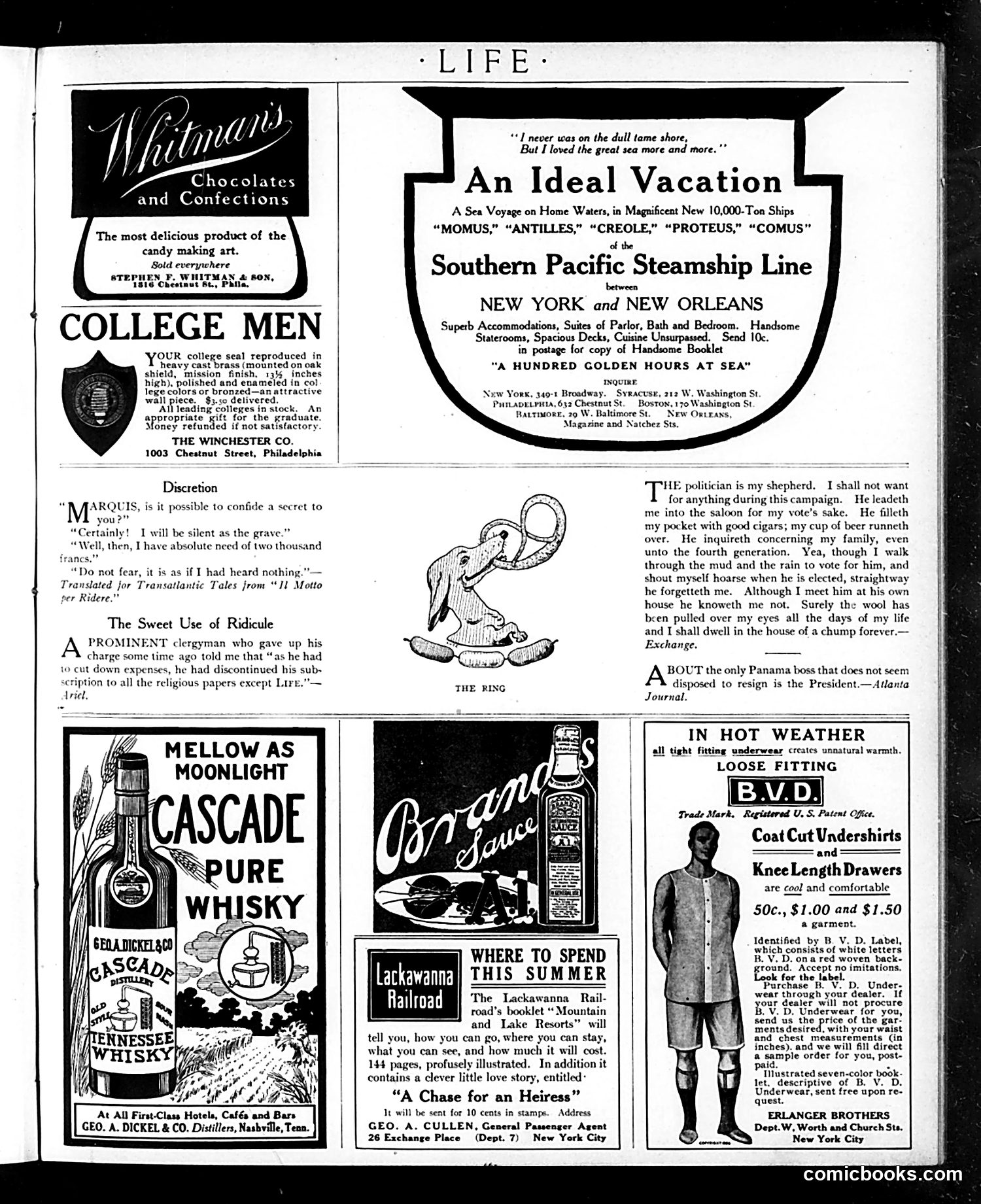
This is primarily an **advertising page** with some satirical editorial content. The key notable element is "**The Politician Is My Shepherd**" — a parody of Psalm 23 that critiques political corruption during election season (likely early 20th century). The satire mocks how politicians: - Bribe voters with saloon treats and cigars - Manipulate working families across generations - Demand votes regardless of voters' circumstances - Abandon constituents immediately after election The verse suggests voters are naive "chumps" exploited by politicians who exploit their poverty and desperation for votes. The remainder of the page is standard period advertisements: Whitman's chocolates, college seals, steamship vacations (Southern Pacific Line), Cascade whiskey, B.V.D. underwear, and railroad tourism booklets. These ads reflect upper-middle-class aspirations of the era.
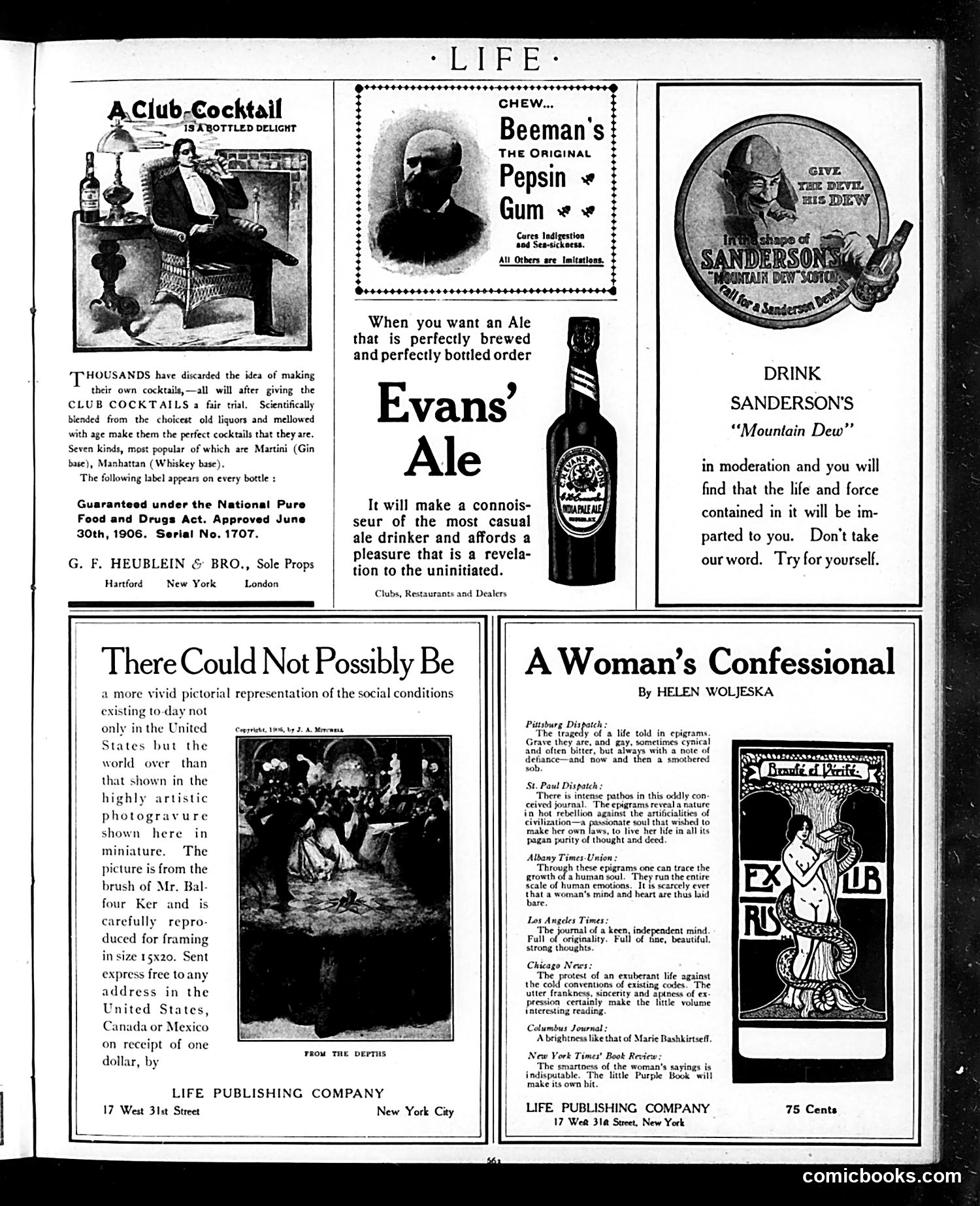
This page is primarily **advertising and book promotion**, not political satire. It contains: **Advertisements** for period products: Club Cocktails (home cocktail kits), Beeman's Pepsin Gum (marketed for digestion), Evans' Ale, and Sanderson's "Mountain Dew" (a mountain-themed beverage, not modern context). These ads reflect early 1900s consumer culture and patent medicine era claims. **Book promotion** dominates the lower half. "A Woman's Confessional" by Helen Woljeska is advertised as a collection of epigrams—brief, witty observations. The promotional quotes from newspapers praise its frank, independent voice and "rebellion against the artificialities of civilization." This appears aimed at educated, progressive readers interested in women's literary expression. **The photogravure** titled "There Could Not Possibly Be" depicts social conditions; the text suggests it shows poverty or hardship, available as framed art for one dollar—making fine art accessible to working-class readers. The page reflects Life's dual role: entertaining affluent readers with consumer goods while also promoting serious literary and artistic content.
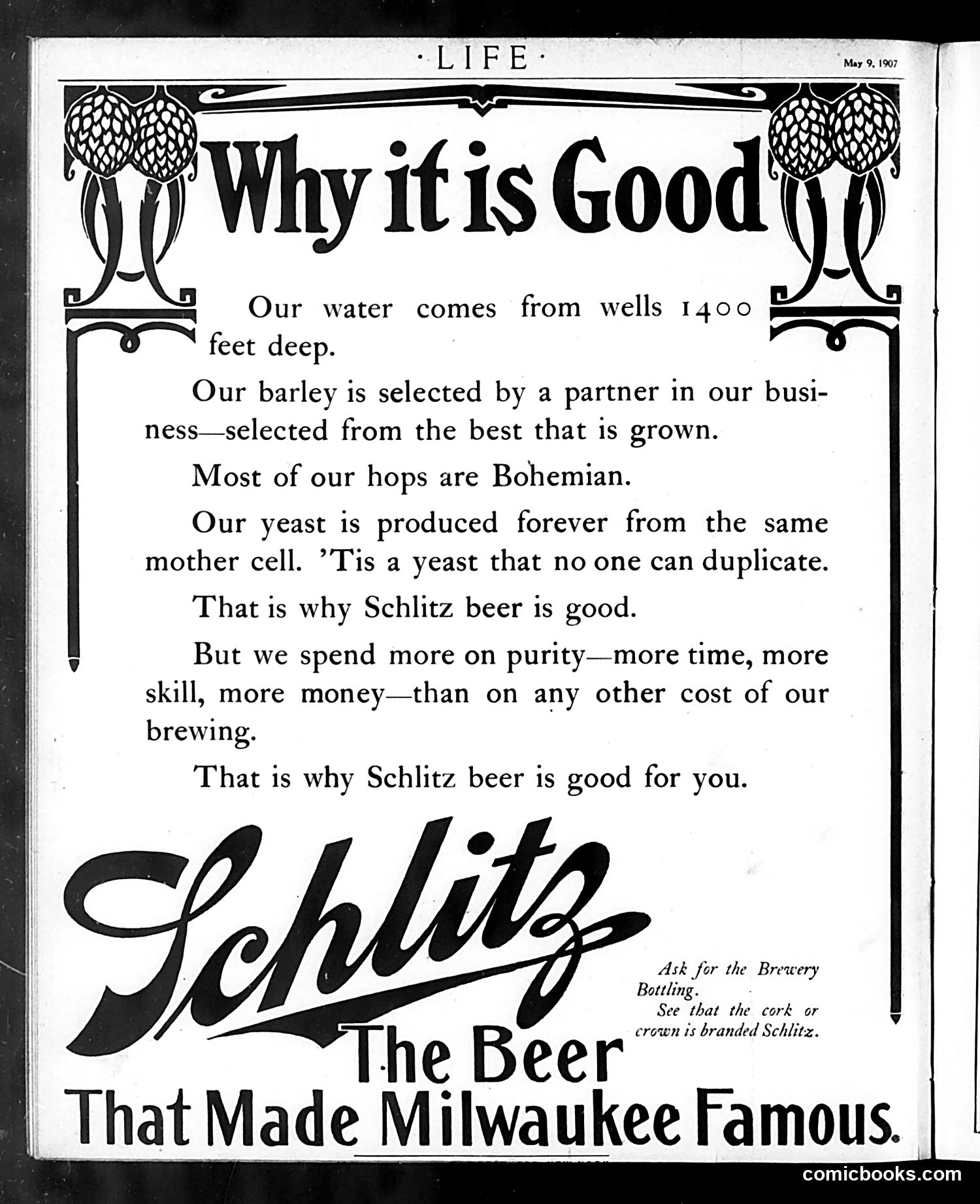
This is a **full-page advertisement**, not satire or cartoon commentary. It promotes Schlitz beer by emphasizing quality control and ingredient sourcing—standard advertising appeals for the era. The ad highlights competitive advantages: deep-well water, carefully selected barley, Bohemian hops, and most importantly, a proprietary yeast strain "no one can duplicate." The emphasis on purity reflects early-20th-century concerns about food and beverage safety, when contamination and adulteration were genuine public health issues. The tagline "The Beer That Made Milwaukee Famous" positions Schlitz as the city's signature product. The instruction to verify the cork or crown branding addresses consumer concerns about counterfeiting or inferior imitations—a real commercial problem of the period. This represents pre-Prohibition marketing targeting middle-class consumers who valued quality assurance.