
Life, 1907-05-09 · page 16 of 24
Life — May 9, 1907 — page 16: what you’re looking at
What you’re looking at
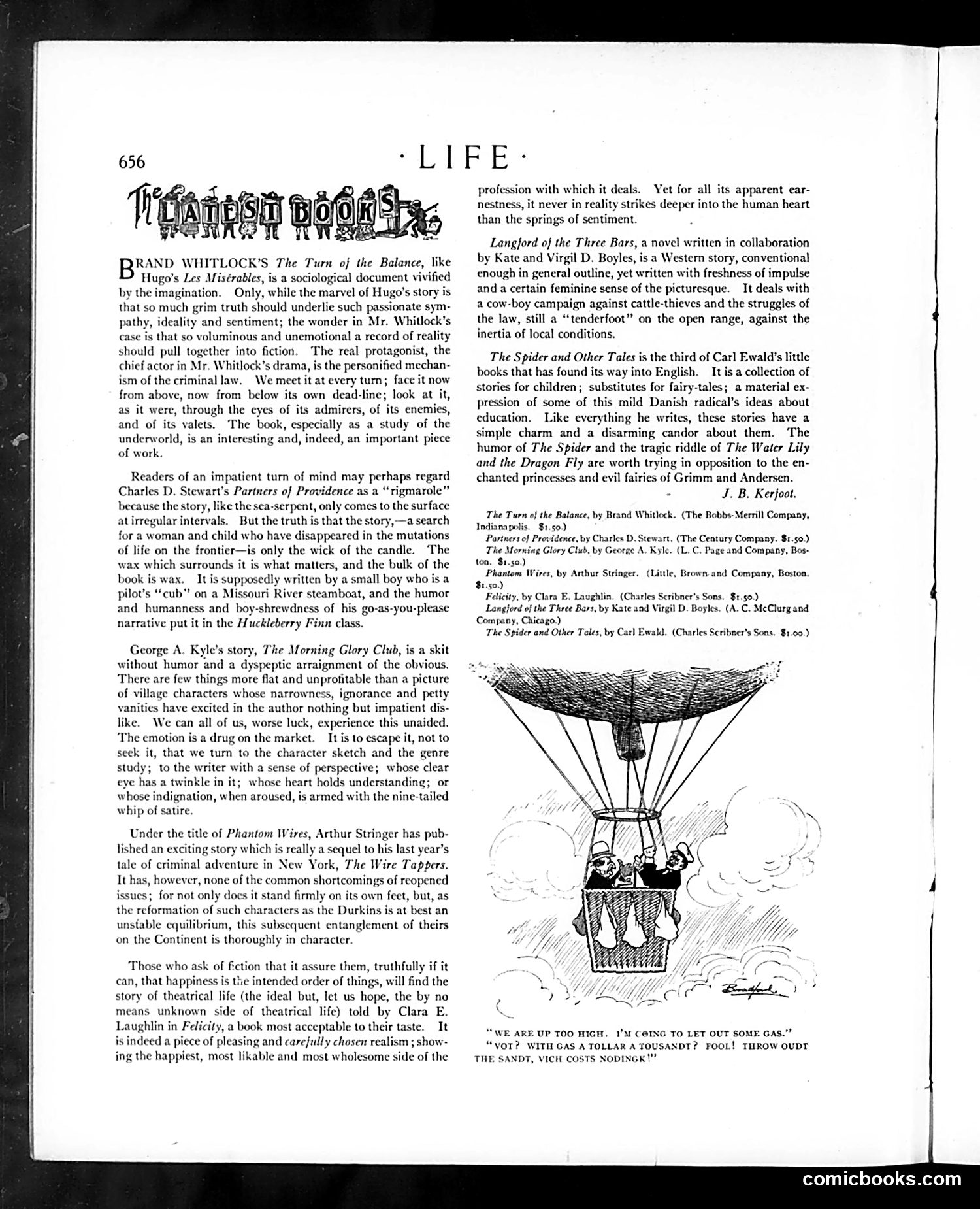
This page from *Life* magazine (page 656) contains literary reviews rather than political cartoons. The text discusses several novels, including Brand Whitlock's *The Turn of the Balance* (compared to Hugo's *Les Misérables*), Charles Stewart's *Partners of Providence*, and works by George Kyle and Arthur Stringer. The single illustration depicts a hot air balloon with two occupants in the basket, arguing about money. The caption reads: "We are up too high. I'm going to let out some gas." "Vot? Vith gas a tollar a thousand? Fool! throw oudt the sand, vich costs nodings!" This cartoon satirizes immigrant frugality during an era of high fuel costs—the character's deliberately exaggerated dialect and absurd prioritization of expensive gas over ballast exemplifies period stereotypes about penny-pinching foreigners. The joke relies on contemporary awareness of wartime or post-war inflation.
📄 Transcribed text from this page (OCR, searchable)
Machine-transcribed from the original scan — historical spelling and the odd misread are preserved.
“LIFE RAND WHITLOCK’S The Turn of the Balance, like Hugo's Les Misérables, is a sociological document vivified by the imagination. Only, while the marvel of Hugo's story is that so much grim truth should underlie such passionate sym- pathy, ideality and sentiment; the wonder in Mr. Whitlock’s case is that so voluminous and unemotional a record of reality should pull together into fiction. The real protagonist, the chief actor in Mr. Whitlock’s drama, is the personified mechan- ism of the criminal law. We meet it at every turn; face it now from above, now from below its own dead-line; look at it, as it were, through the eyes of its admirers, of its enemies, and of its valets. The book, especially as a study of the underworld, is an interesting and, indeed, an important piece of work. Readers of an impatient turn of mind may perhaps regard Charles D. Stewart's Partners of Providence as a ‘‘rigmarole” because the story, like the sea-serpent, only comes to the surface atirregular intervals. But the truth is that the story,—a search for a woman and child who have disappeared in the mutations of life on the frontier only the wick of the candle. The wax which surrounds it is what matters, and the bulk of the book It is supposedly written by a small boy who is a pilot’s “cub” on a Missouri River steamboat, and the humor and humanness and boy-shrewdness of his go-as-you-please narrative put it in the Huckleberry Finn class. George A. Kyle’s story, The Morning Glory Club, is a skit without humor and a dyspeptic arraignment of the obvious. There are few things more flat and unprofitable than a picture of village characters whose narrowness, ignorance and petty vanities have excited in the author nothing but impatient dis- like. We can all of us, worse luck, experience this unaided. ‘The emotion is a drug on the market. It is to escape it, not to seek it, that we turn to the character sketch and the genre study; to the writer with a sense of perspective; whose clear has a twinkle in it; whose heart holds understanding; or whose indignation, when aroused, is armed with the nine-tailed whip of satire, Under the title of Phantom Wires, Arthur Stringer has pub- lished an exciting story which is really a sequel to his last year’s tale of criminal adventure in New York, The Wire Tappers. , however, none of the common shortcomings of reopened 's; for not only does it stand firmly on its own feet, but, as the reformation of such characters as the Durkins is at best an unstable equilibrium, this subsequent entanglement of theirs on the Continent is thoroughly in character. Those who ask of fiction that it assure them, truthfully if it can, that happiness is the intended order of things, will find the story of theatrical life (the ideal but, let us hope, the by no means unknown side of theatrical life) told by Clara E. Laughlin in Felicity, a book most acceptable to their taste. It is indeed a piece of pleasing and carejully chosen realism ; show- ing the happiest, most likable and most wholesome side of the profession with which it deals. Yet for all its apparent ear- nestness, it never in reality strikes deeper into the human heart than the springs of sentiment. Langford oj the Three Bars, a novel written in collaboration by Kate and Virgil D. Boyles, is a Western story, conventional enough in general outline, yet written with freshness of impulse and a certain feminine sense of the picturesque. It deals with a cow-boy campaign against cattle-thieves and the struggles of the law, still a ‘tenderfoot” on the open range, against the inertia of local conditions. The Spider and Other Tales is the third of Carl Ewald’s little books that has found its way into English. It is a collection of stories for children; substitutes for fairy-tales; a material ex- pression of some of this mild Danish radical’s ideas about education. Like everything he writes, these stories have a simple charm and a disarming candor about them. The humor of The Spider and the tragic riddle of The Water Lily and the Dragon Fly are worth trying in opposition to the en- chanted princesses and evil fairies of Grimm and Andersen. - J.B. Kerjoot. The Turn of the Balance, by Brand Whitlock. (The Bobbs-Merrill Company, Indianapolis. $1.50.) Partners of Providence, by Charles D. Stewart. (The Century Company. $1.50.) The Morning Glory Club, by George A. Kyle. (L. C. Page and Company, Bos- ton. $1.50.) Phantom Wires, by Arthur Stringer. (Little, Brown and Company, Boston. $1.50.) Felicity, by Clara E. Laughlin. (Charles Scribner's Sons. $1.50.) Langjord of the Three Bars, by Kate and Virgil D. Boyles. (A. C. McClurg and Company, Chicago.) The Spider and Other Tales, by Carl Ewald. (Charles Scribner's Sons. $1.00.) “WE ARE UP TOO HIGH. 1'M C@ING TO LET OUT SOME GAS.’ “VOT? WITH GAS A TOLLAR A TOUSANDT? FOOL! THROW OUDT THE SANDT, VICH COSTS NODINGK!"” comicbooks.com