
Life, 1907-05-09 · page 15 of 24
Life — May 9, 1907 — page 15: what you’re looking at
What you’re looking at
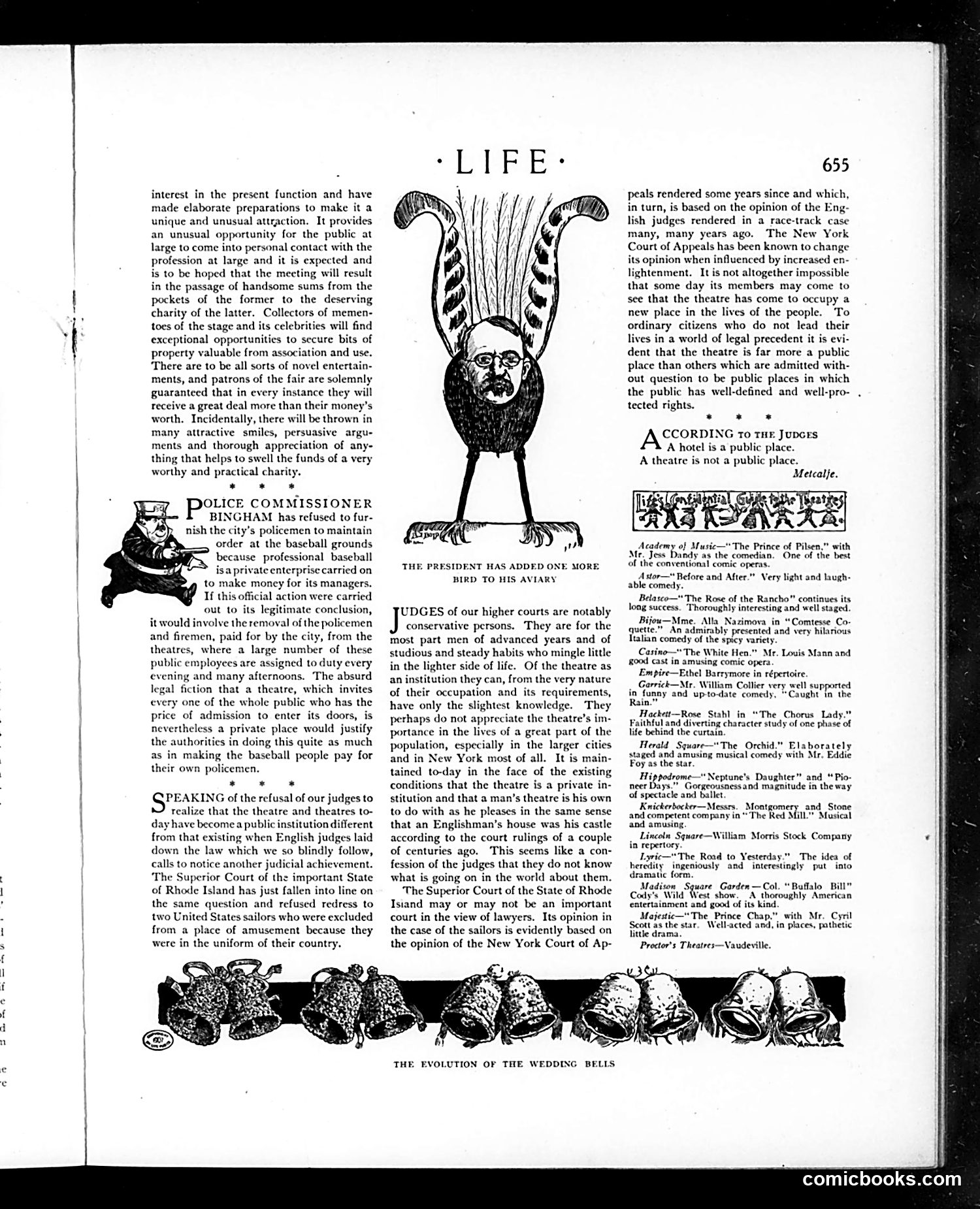
This page satirizes judicial ignorance about modern society, particularly judges' refusal to treat theaters as public institutions deserving police protection. **Main cartoon**: A grotesque figure with horns emerging from a man's head, captioned "THE PRESIDENT HAS ADDED ONE MORE BIRD TO HIS AVIARY." This appears to mock President Bingham's addition to his collection—likely satirizing his stubbornness or foolishness regarding theater policy. **The argument**: Life criticizes courts (especially Rhode Island's Superior Court and New York's appellate courts) for treating theaters as private enterprises rather than public spaces. The magazine argues this legal fiction is outdated—judges apply centuries-old English precedent treating theaters like private castles, ignoring that modern theaters are actually public institutions serving masses of citizens. **The specific complaint**: Police Commissioner Bingham refused to provide officers at baseball games because it's a private enterprise. Life argues this logic absurdly extends to theaters, where authorities *do* provide police despite the same "private" classification—exposing the inconsistent and archaic thinking of conservative judges.
📄 Transcribed text from this page (OCR, searchable)
Machine-transcribed from the original scan — historical spelling and the odd misread are preserved.
eens interest in the present function and have made elaborate preparations to make it a unique and unusual attraction. It provides an unusual opportunity for the public at large to come into personal contact with the profession at large and it is expected and is to be hoped that the mecting will result in the passage of handsome sums from the pockets of the former to the deserving charity of the latter. Collectors of memen- toes of the stage and its celebrities will find exceptional opportunities to secure bits of property valuable from association and use. ‘There are to be all sorts of novel entertain- ments, and patrons of the fair are solemnly guaranteed that in every instance they will receive a great deal more than their money’s worth. Incidentally, there will be thrown in many attractive smiles, persuasive argu- ments and thorough appreciation of any- thing that helps to swell the funds of a very worthy and practical charity. “ * «@ OLICE COMMISSIONER BINGHAM has refused to fur- nish the city’s policemen to maintain order at the baseball grounds because professional baseball isa privateenterprise carried on to make moncy for its managers. Tf this official action were carried out to its legitimate conclusion, it would involve the removal of the policemen and firemen, paid for by the city, from the theatres, where a large number of these public employees are assigned to duty every evening and many afternoons. The absurd legal fiction that a theatre, which invites every one of the whole public who has the price of admission to enter its doors, is nevertheless a private place would justify the authorities in doing this quite as much as in making the baseball people pay for their own policemen. * * * PEAKING of the refusal of our judges to realize that the theatre and theatres to- day have become a public institution different from that existing when English judges laid down the law which we so blindly follow, calls to notice another judicial achievement. ‘The Superior Court of the important State of Rhode Island has just fallen into line on the same question and refused redress to two United States sailors who were excluded from a place of amusement because they were in the uniform of their country. THE PR} ONE MORE BIRD TO HIS AVIARY conservative persons. They are for the most part men of advanced years and of studious and steady habits who mingle little in the lighter side of life. Of the theatre as an institution they can, from the very nature of their occupation and its requirements, have only the slightest knowledge. They perhaps do not appreciate the theatre’s im- portance in the lives of a great part of the population, especially in the larger cities and in New York most of all. It is main- tained to-day in the face of the existing conditions that the theatre is a private in- stitution and that a man’s theatre is his own to do with as he pleases in the same sense that an Englishman’s house was his castle according to the court rulings of a couple of centuries ago. This seems like a con- fession of the judges that they do not know what is going on in the world about them. ‘The Superior Court of the State of Rhode Istand may or may not be an important court in the view of lawyers. Its opinion in the case of the sailors is evidently based on the opinion of the New York Court of Ap- Jie of our higher courts are notably THE EVOLUTION OF THE WEDDING BELIS peals rendered some years since and whi in turn, is based on the opinion of the lish judges rendered in a race-track cas many, many years ago. The New York Court of Appeals has been known to change its opinion when influenced by increased en- lightenment. It is not altogether impossible that some day its members may come to see that the theatre has come to occupy a new place in the lives of the people. To ordinary citizens who do not lead their lives ina world of legal precedent it is evi- dent that the theatre is far more a public place than others which are admitted with- out question to be public places in which the public has well-defined and well-pro- tected rights. s 8 CCORDING 10 tHe Jupces A hotel is a public place. A theatre is not a public place. Metcalfe. Academy of Music—* The Prince of Pilsen,” with Mr. Jess Dandy as the comedian. One of the best of the conventional comic operas. A stor—" Before and After.” Very light and laugh- able comedy. Belasco—" The Rone of the Rancho" continues its long success. ‘Thoroughly interesting and well staged. Bijou— Alla Nazimova in “Comtesse Co- guette.” An admirably presented and very hilarious Italian comedy of the spicy variety. Casino—* The White Hen.” Mr. Louis Mann and good cast in amusing comic opera. Empire—Ethel Barrymore in répertoire. _ Garrick—Mr. William Collier very well supported in funny and up-to-date comedy, “Caught in the Rain.” Hockett—Rose Stahl in “The Chorus Lady.” thful and diverting character study of one phase of life behind the curtain. Herald Square—"The Orchid.” Elaborately staged and amusing musical comedy with Mr. Eddie Foy as the star Hippodrome" Neptune's Daughter” and * Pio neer Days.” Gorgeousnessand magnitude in the way of spectacle and ballet Knickerbocker—Messrs. Montgomery and Stone and competent company in * The Red Mill."" Musical and amusing. Lincoln Square—William Morris Stock Company in repertory. Lyric—"The Road to Yesterday.” The idea of heredity ingeniously and interestingly put into dramatic form. Maditon Square Garden —Col. “Buffalo Bill” Cody's Wild West show. thoroughly American entertainment and good of its kind. Majestic—" The Prince Chap.” with Mr. Cyril Scott as the star. Well-acted and, in places, pathetic little drama. Proctor’s Theatres—Vaudeville.