
Life, 1907-05-09 · page 11 of 24
Life — May 9, 1907 — page 11: what you’re looking at
What you’re looking at
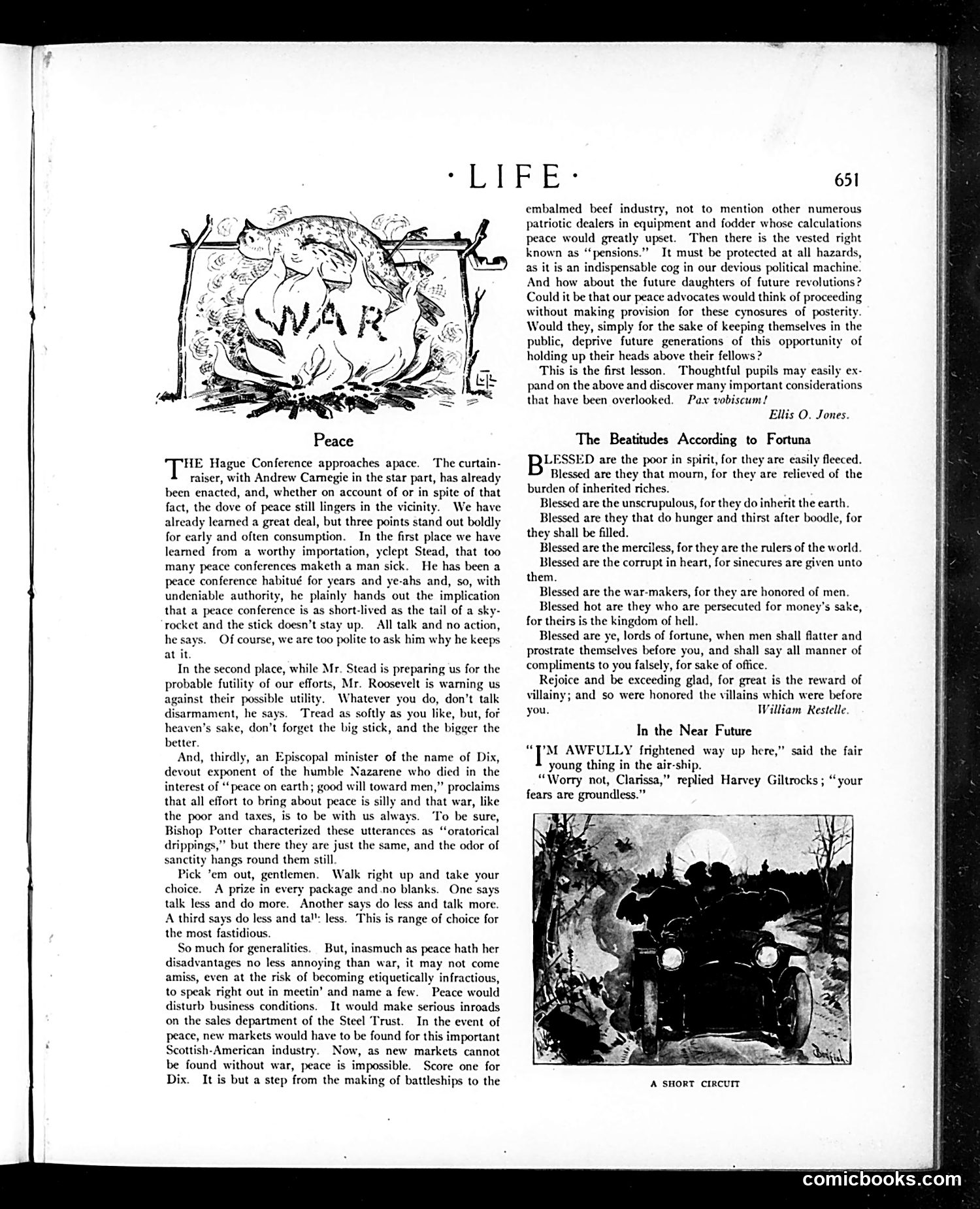
The main cartoon depicts a large cabbage or vegetable labeled "WAR" with decorative vine borders. This is political satire about peace negotiations—specifically referencing the approaching Hague Conference with Andrew Carnegie involved. The accompanying text satirizes those advocating for peace, suggesting their efforts are futile. The author (Ellis O. Jones) mocks the notion that peace conferences accomplish anything meaningful, arguing that economic interests—particularly in the steel and munitions industries—make genuine peace impossible. The cartoon's vegetable imagery likely represents how peace rhetoric is hollow or insubstantial compared to the "real" economic machinery of war. The satire suggests peace advocates are naive about the business interests profiting from conflict.
📄 Transcribed text from this page (OCR, searchable)
Machine-transcribed from the original scan — historical spelling and the odd misread are preserved.
-LIFE-: 651 Peace HE Hague Conference approaches apace. The curtain- raiser, with Andrew Camegie in the star part, has already been enacted, and, whether on account of or in spite of that fact, the dove of peace still lingers in the vicinity. We have already learned a great deal, but three points stand out boldly for early and often consumption. In the first place we have learned from a worthy importation, yclept Stead, that too many peace conferences maketh a man sick. He has been a peace conference habitué for years and ye-ahs and, so, with undeniable authority, he plainly hands out the implication that a peace conference is as short-lived as the tail of a sky- rocket and the stick doesn’t stay up. All talk and no action, he says. Of course, we are too polite to ask him why he keeps at it. In the second place, while Mr. Stead is preparing us for the probable futility of our efforts, Mr. Roosevelt is warning us against their possible utility. Whatever you do, don’t talk disarmament, he says. Tread as softly as you like, but, for heaven’s sake, don’t forget the big stick, and the bigger the better. And, thirdly, an Episcopal minister of the name of Dix, devout exponent of the humble Nazarene who died in the interest of “‘peace on earth; good will toward men,” proclaims that all effort to bring about peace is silly and that war, like the poor and taxes, is to be with us alw ‘To be sure, Bishop Potter characterized these utterances as ‘“oratorical drippings,” but there they are just the same, and the odor of sanctity hangs round them still Pick ’em out, gentlemen. Walk right up and take your choice. A prize in every package and.no blanks. One says talk less and do more. Another says do less and talk more. A third says do less and ta": less. This is range of choice for the most fastidious. So much for generalities. But, inasmuch as peace hath her disadvantages no less annoying than war, it may not come amiss, even at the risk of becoming ctiquetically infractious, to speak right out in meetin’ and name a few. Peace would disturb business conditions. It would make serious inroads on the sales department of the Steel Trust. In the event of peace, new markets would have to be found for this important Scottish-American industry. Now, as new markets cannot be found without war, peace is impossible. Score one for Dix. It is but a step from the making of battleships to the embalmed beef industry, not to mention other numerous patriotic dealers in equipment and fodder whose calculations peace would greatly upset. Then there is the vested right known as “pensions.” It must be protected at all hazards, as it is an indispensable cog in our devious political machine. And how about the future daughters of future revolutions? Could it be that our peace advocates would think of proceeding without making provision for these cynosures of posterity Would they, simply for the sake of keeping themselves in the public, deprive future generations of this opportunity of holding up their heads above their fellows? This is the first lesson. ‘Thoughtful pupils may easily ex- pand on the above and discover many important considerations that have been overlooked. Pax vobiscum! Ellis O. Jones. The Beatitudes According to Fortuna LESSED are the poor in spirit, for they are easily fleeced. Blessed are they that mourn, for they are relieved of the burden of inherited riches. Blessed are the unscrupulous, for they do inherit the earth. Blessed are they that do hunger and thirst after boodle, for they shall be filled. Blessed are the merciless, for they are the rulers of the world. Blessed are the corrupt in heart, for sinecures are given unto them. Blessed are the war-makers, for they are honored of men. Blessed hot are they who are persecuted for money's sake, for theirs is the kingdom of hell. Blessed are ye, lords of fortune, when men shall flatter and prostrate themselves before you, and shall say all manner of compliments to you falsely, for sake of office. Rejoice and be exceeding glad, for great is the reward of villainy; and so were honored the villains which were before you. William Restelle. In the Near Future i es AWFULLY frightened way up here,” said the fair young thing in the air-shi “Worry not, Clarissa,” replied Harvey Giltrocks; “your fears are groundless.” A SHORT CIRCUIT comicbooks.com