
Life, 1907-05-09 · page 14 of 24
Life — May 9, 1907 — page 14: what you’re looking at
What you’re looking at
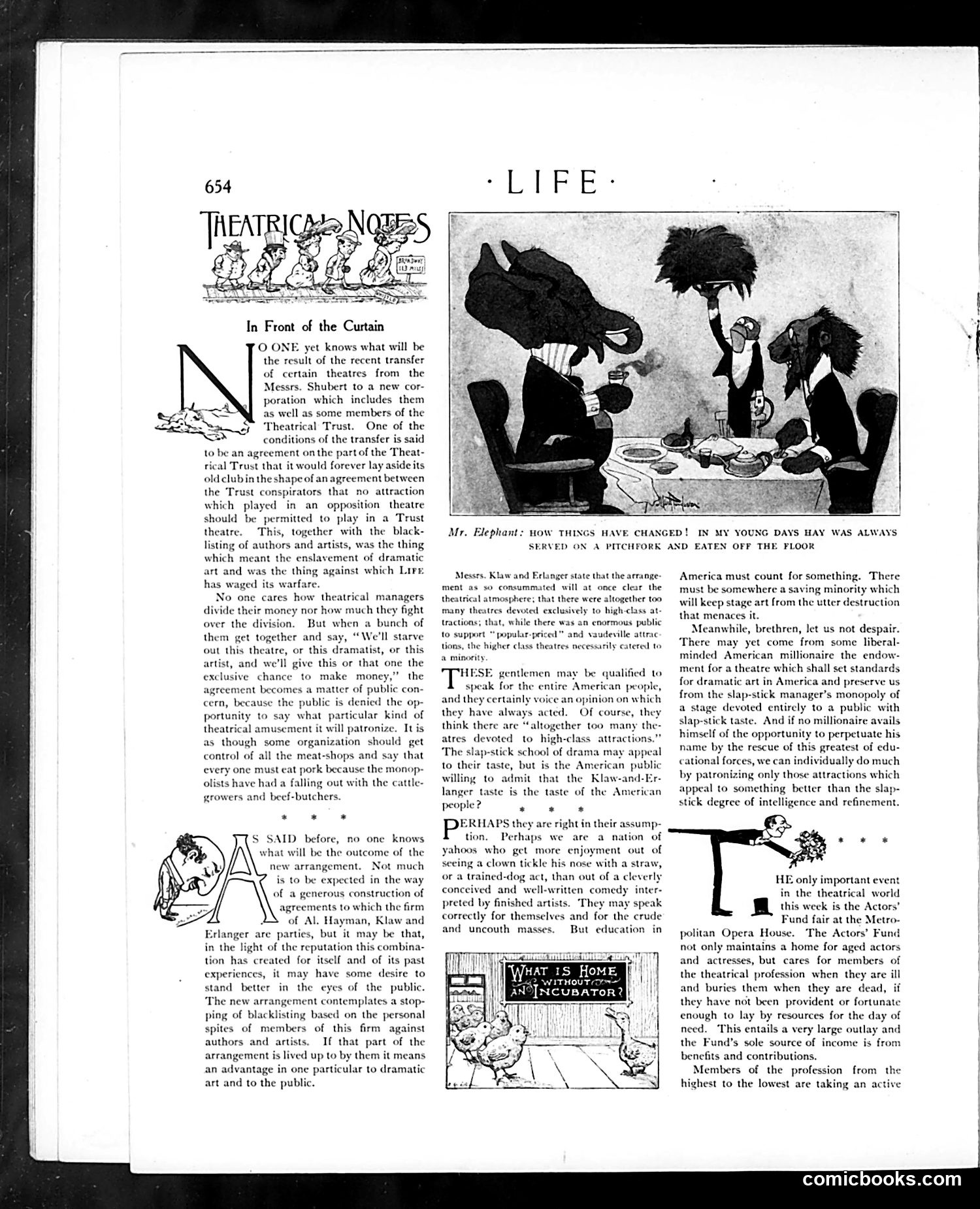
This page satirizes the Theatrical Trust's monopolistic control of American theatre. The main text criticizes a recent business arrangement involving theatrical impresarios **Klaw and Erlanger** (mentioned by name), who consolidated control over multiple theatres under a new corporation. The **cartoon at top** depicts an elephant (symbolizing the Trust's power) trampling theatrical productions, illustrating how the monopoly destroys competition and artistic freedom. **The satire's target**: Life argues the Trust used blacklisting agreements to eliminate competing theatres and punish independent dramatists and artists—comparable to a meat monopoly forcing consumers to eat only pork. **The core complaint**: Klaw and Erlanger allegedly believe American audiences prefer cheap vaudeville and slapstick over serious drama, so they deliberately eliminated "high-class" theatres. Life sarcastically questions whether the public actually shares this "crude" taste, arguing educated Americans deserve better theatrical options. The piece defends artistic merit against commercial monopoly control of entertainment.
📄 Transcribed text from this page (OCR, searchable)
Machine-transcribed from the original scan — historical spelling and the odd misread are preserved.
In Front of the Curtain yet knows what will be the result of the recent transfer of certain theatres from the Messrs. Shubert to a new cor- poration which includes them as well as some members of the Theatrical Trust. One of the conditions of the transfer is said to be an agreement on the part of the Theat- rical Trust that it would forever lay aside its old club in the shape of an agreement between the Trust conspirators that no attraction which played in an opposition theatre should be permitted to play in a Trust theatre. This, together with the black- listing of authors and artists, was the thing which meant the enslavement of dramatic art and was the thing against which Lire has waged its warfare. No one cares how theatrical managers divide their money nor how much they fight over the division. But when a bunch of them get together and say, “We'll starve out this theatre, or this dramatist, or this artist, and we'll give this or that one the exclusive chance to make money,” the agreement becomes a matter of public con- cern, because the public is denied the op- portunity to say what particular kind of theatrical amusement it will patronize. It is as though some organization should get control of all the meat-shops and say that every one must eat pork because the monop- olists have had a falling out with the cattle- growers and beef-butchers. + * * S SAID before, no one knows what will be the outcome of the y arrangement. Not much is to be expected in the way of a generous construction of agreements to which the firm JN of Al. Hayman, Klaw and rare parties, but it may be that, ht of the reputation this combina- tion has created for itself and of its past experiences, itm stand better in the eyes of the public. ‘The new arrangement contemplates a stop ping of blacklisting based on the personal spites of members of this firm against authors and artists. If that part of the arrangement is lived up to by them it means an advantage in one particular to dramatic art and to the publi y have some desire to Mr. Elephant: wow THINGS HAVE CHAN SERVED ON A PITCHFORK Messrs. Klaw and Erlanger state that the arrange: ment as so consummated will at once clear the theatrical atmosphere; that there were altogether too many theatres devoted exclusively to high-class at: tractions; that, while there was an enormous public popular-priced” and vaudeville attrac tions, the higher class theatres necessirily catered to to support a minor HES! = gentlemen may be qualified to for the entire American people, and they certainly voice an opinion on which they have always acted. Of course, they think there are “altogether too many the- atres devoted to high-class attractions.” ‘The slap-stick school of drama may appeal to their taste, but is the American public willing to admit that the Klaw-and-Er- langer taste is the taste of the American people? Se é * RHAPS they are right in their assump- tion. Perhaps we are a nation of yahoos who get more enjoyment out of seeing a clown tickle his nose with a straw, or a trained-dog act, than out of a cleverly conceived and well-written comedy inter preted by finished artists. They may speak correctly for themselves and for the crude and uncouth masses. But education in yy ena Toners TETAS Fe | if ! IN MY yor G DAYS HAY WAS ALWAYS AND EATEN OFF THE FLOOR America must count for something. There must be somewhere a saving minority which will keep stage art from the utter destruction that menaces it. Meanwhile, brethren, let us not desp: There may yet come from some liberal- minded American millionaire the endow- ment for a theatre which shall set standards for dramatic art in America and preserve us from the slap-stick manager's monopoly of a stage devoted entirely to a public with slap-stick taste, And if no millionaire avails himself of the opportunity to perpetuate his name by the rescue of this greatest of edu- cational forces, we can individually do much by patronizing only those attractions which appeal to something better than the slap- stick degree of intelligence and refinement. r. HE only important event in the theatrical world this week is the Actors’ Fund fair at the Metro- politan Opera House. The Actors’ Fund not only maintains a home for aged actors and actresses, but cares for members of the theatrical profession when they are ill and buries them when they are dead, if they have not been provident or fortunate enough to lay by resources for the day of need. ‘This entails a very large outlay and the Fund’s sole source of income is from benefits and contributions. Members of the profession from th highest to the lowest are taking an active comicbooks.com