
Life, 1907-05-09 · page 10 of 24
Life — May 9, 1907 — page 10: what you’re looking at
What you’re looking at
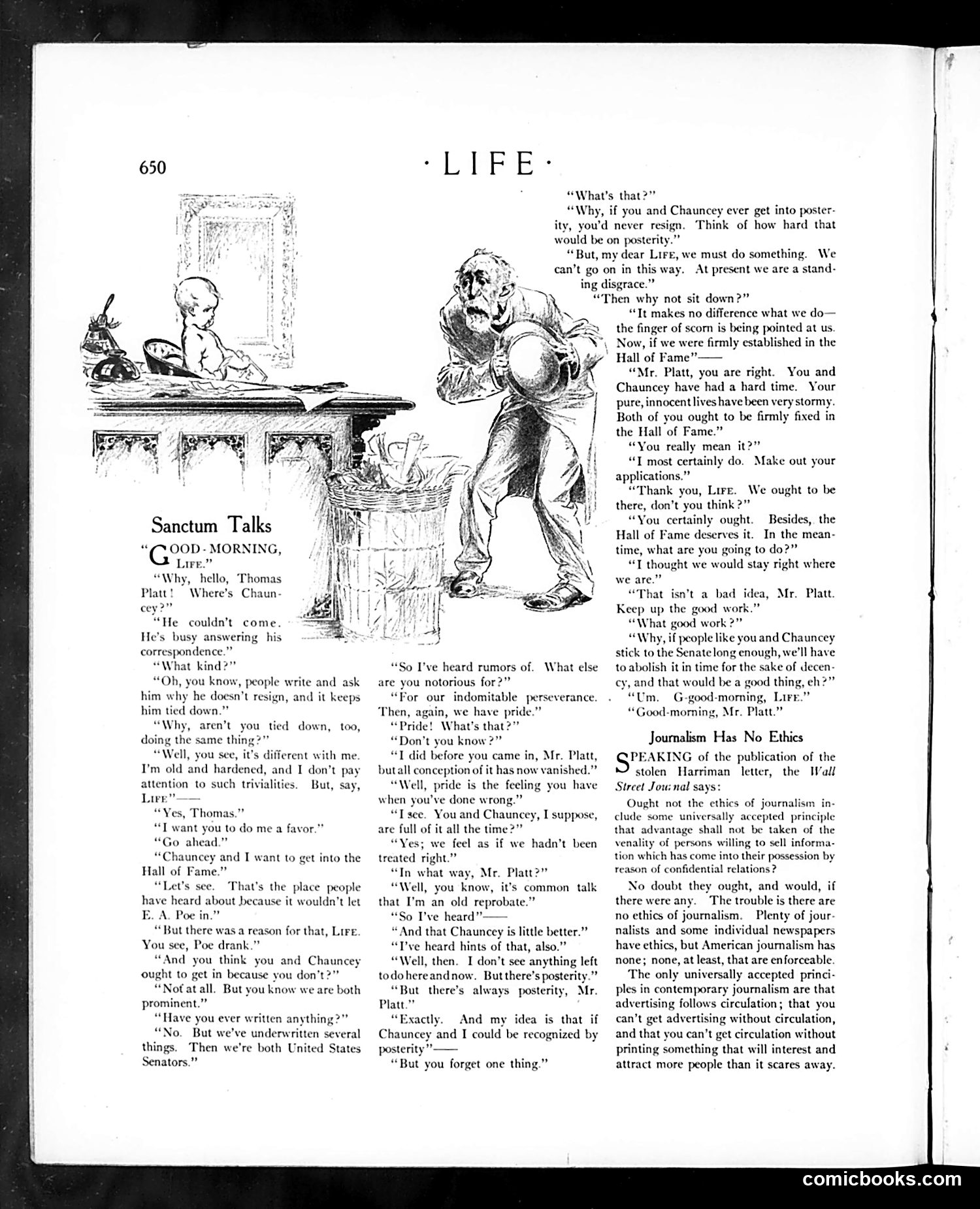
This cartoon depicts a conversation between "Life" (personified as a distinguished gentleman) and Thomas Platt, a political figure seeking entry to the "Hall of Fame." The satire targets Platt's political ambitions and reputation. Platt argues he and Chauncey (likely referring to Chauncey Depew, a contemporary politician) deserve Hall of Fame recognition despite their "stormy" records. Life responds skeptically, suggesting their primary qualification is "posterity"—implying they lack genuine accomplishment. The cartoon mocks political self-promotion and the questionable ethics of how public figures craft their legacies. The accompanying article "Journalism Has No Ethics" reinforces this critique, discussing how newspapers publish information based on circulation appeal rather than principled journalism.
📄 Transcribed text from this page (OCR, searchable)
Machine-transcribed from the original scan — historical spelling and the odd misread are preserved.
Sanctum Talks “(> OOD- MORNING, Lire.” “Why, hello, Thomas Platt! Where’s Chaun- cey?” “He couldn't come. He’s busy answering his correspondence.” “What kind?” “Oh, you know, people write and ask him why he doesn’t resign, and it keeps him tied down.” “Why, aren’t you tied down, too, doing the same thing?” “Well, you see, it’s different with me. I'm old and hardened, and I don’t pay attention to such trivialities. But, say, Thomas.” nt you to do me a favor.” “Go ahead.” “Chauncey and TI want to get into the Hall of Fame.” “Let’s see. That's the place people have heard about because it wouldn’t let A. Poe in.” Sut there was a reason for that, LIFE: You see, Poe drank.” “And you think you and Chauncey ought to get in because you don’t?” “Nof at all. But you know we are both prominent.” “Have you ever written anything?” “No. But we've underwritten several things. Then we're both United Senators.” “What's that?” “Why, if you and Chauncey ever get into poster- ity, you'd never resign. Think of how hard that would be on posterity.” “But, my dear Lire, we must do something. We can’t go on in this way. At present we are a stand- ing disgrace.” “Then why not sit down?” “So I’ve heard rumors of. What else are you notorious for?” “For our indomitable perseverance Then, again, we have pride.” “Pride! What's that?”” “Don’t you know? “1 did before you came in, Mr. Platt, butall conception of it has now vanished.” “Well, pride is the feeling you have when you've done wrong.” “Tsee. You and Chauncey, I suppose, are full of it all the time?” “Yes; we feel as if we hadn’t been treated right.” “In what way, Mr. Platt?” “Well, you know, it’s common talk that I’m an old reprobate.” “So I’ve heard”— And that Chauncey is little better.” I've heard hints of that, also.” “Well, then. I don’t see anything left todohereandnow. Butthere’s posterity.” “But there’s always posterity, Mr. Platt.” “Exactly. And my idea is that if Chauncey and I could be recognized by posterity ”’—— “But you forget one thing. “Tt makes no difference what we do— the finger of scorn is being pointed at us. Now, if we were firmly established in the Hall of Fame”—— “Mr. Platt, you are right. You and Chauncey have had a hard time. Your pure, innocent lives have been very stormy. Both of you ought to be firmly fixed in the Hall of Fame.” “You really mean it?” “T most certainly do. Make out your applications.” “Thank you, Lire. We ought to be there, don’t you think ?”” “You certainly ought. Besides, the Hall of Fame deserves it. In the mean- time, what are you going to do?” “T thought we would stay right where we are.” “That isn’t a bad idea, Mr. Platt. Keep up the good work.” “What good work ?”” “Why, if people like you and Chauncey stick to the Senatelong enough, we'll have to abolish it in time for the sake of decen- cy, and that would be a good thing, eh?” “Um, G-good-morning, Lire.” “Good-moming, Mr. Platt.’” Journalism Has No Ethics GPEARING of the publication of the stolen Harriman letter, the Wall Street Jou:nal says: Ought not the ethics of journalism in- clude some universally accepted principle that advantage shall not be taken of the venality of persons willing to sell informa- tion which has come into their possession by reason of confidential relations ? No doubt they ought, and would, if there were any. The trouble is there are Plenty of jour s and some individual newspapers have ethics, but American journalism has none; none, at least, that are enforceable. The only universally accepted princi- ples in contemporary journalism are that advertising follows circulation; that you can’t get advertising without circulation, and that you can’t get circulation without printing something that will interest and attract more people than it scares away. comicbooks.com