
A complete issue · 24 pages · 1907
Life — April 25, 1907
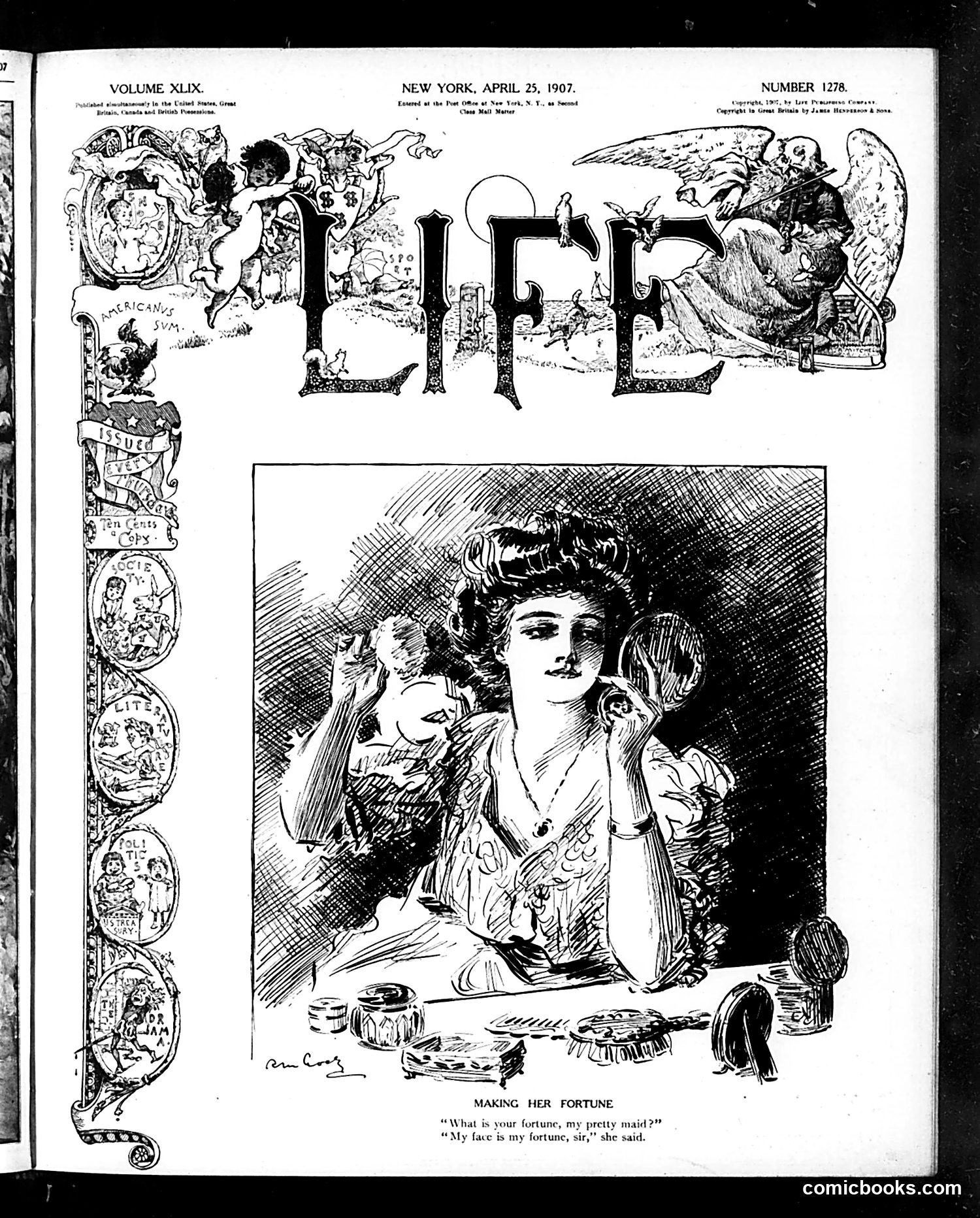
This page features a satirical illustration titled "Making Her Fortune" showing a woman with a child, surrounded by fortune-telling implements (cards, cups). The caption reads: "What is your fortune, my pretty maid?" / "My face is my fortune, sir," she said. This is a visual pun on the old nursery rhyme. The cartoon satirizes the common notion that a young woman's primary "fortune" or value lies in her physical appearance and marriageability rather than her intellect or skills. The fortune-telling setup suggests her only real asset being "read" or evaluated is her beauty. This reflects early 20th-century social commentary on women's limited economic opportunities and society's reduction of female worth to appearance and potential as a wife.
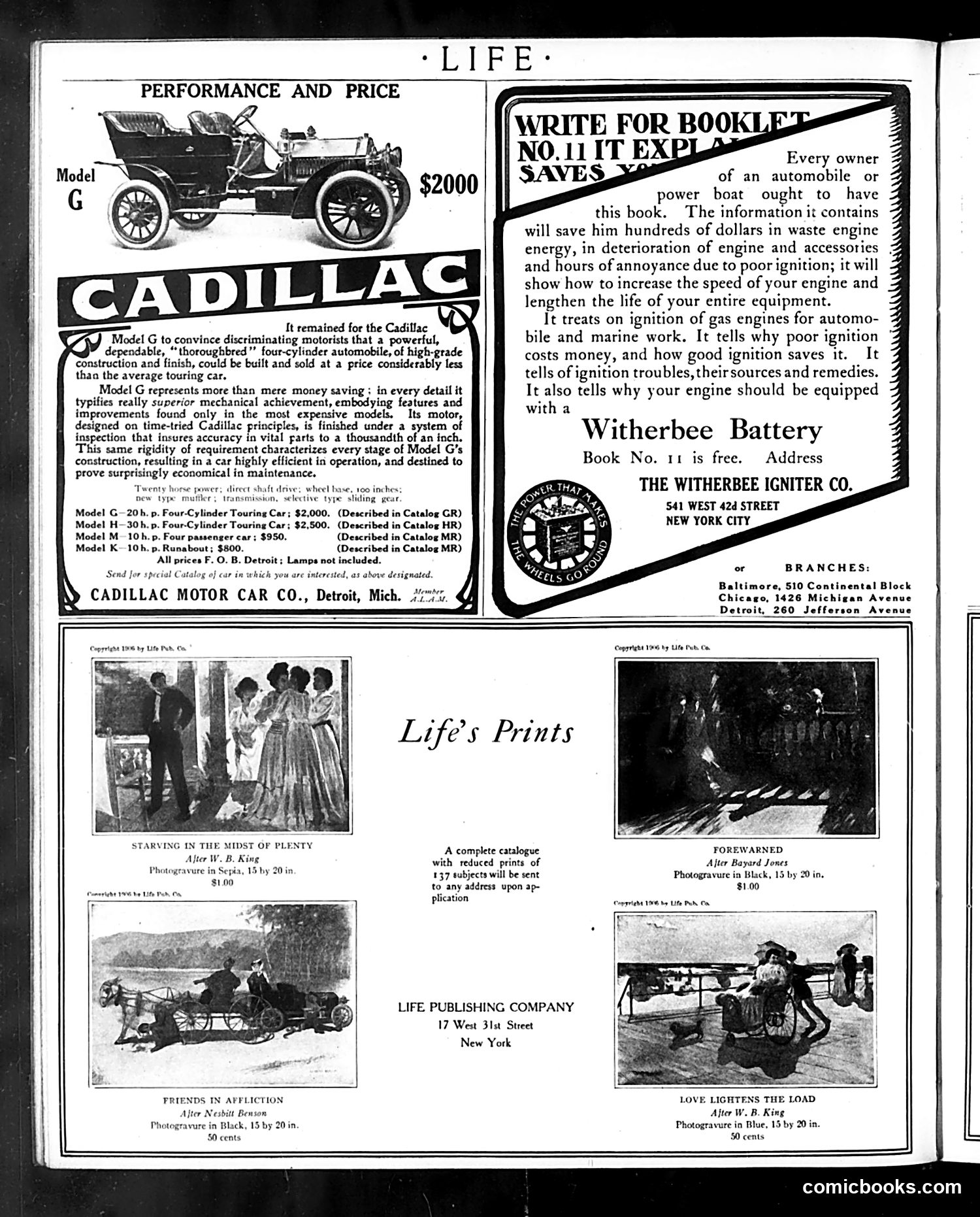
This page is primarily **advertising**, not satire or editorial content. The left side features a **Cadillac Model G advertisement** (priced at $2,000), emphasizing its powerful engine and quality construction. The ad targets "discriminating motorists" who want performance at lower cost than competing luxury cars. The right side advertises the **Witherbee Battery** and offers a free instructional booklet (No. 11) about engine ignition systems for automobiles and boats. The Witherbee Igniter Company lists branches in multiple cities. The bottom section, titled "Life's Prints," advertises photogravure prints available from Life Publishing Company, featuring scenes from films like "Starving in the Midst of Plenty" and "Forewarned" (all priced 50 cents to $1.00). This is a typical early-20th-century magazine page mixing automotive and consumer product advertisements with entertainment offerings.
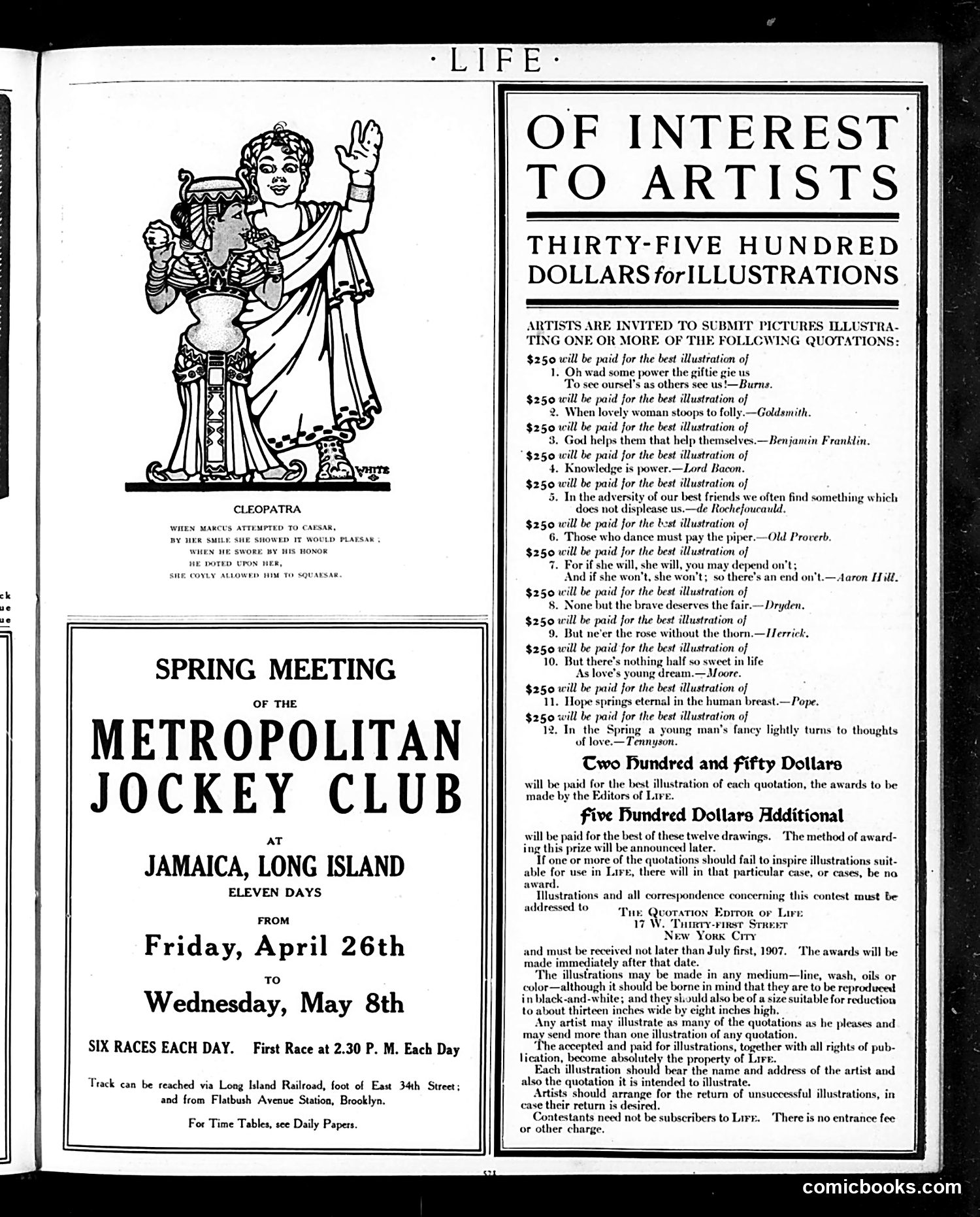
The left page features an illustration labeled "CLEOPATRA" with a classical figure in Egyptian dress. The accompanying caption references Shakespeare's *Antony and Cleopatra*, quoting: "When Marc's attempted to Caesar, by her smile she showed it would please her. When she invited upon him, she lovely allowed him to squander." This appears to be a classical artistic reference rather than political satire—illustrating a famous historical/literary figure. The image showcases decorative, historically-inspired artwork typical of early 20th-century magazine illustration. The right page advertises a contest for artists, offering substantial prizes ($3,500 total) for illustrations of literary quotations. This represents Life magazine's engagement with the visual arts community.
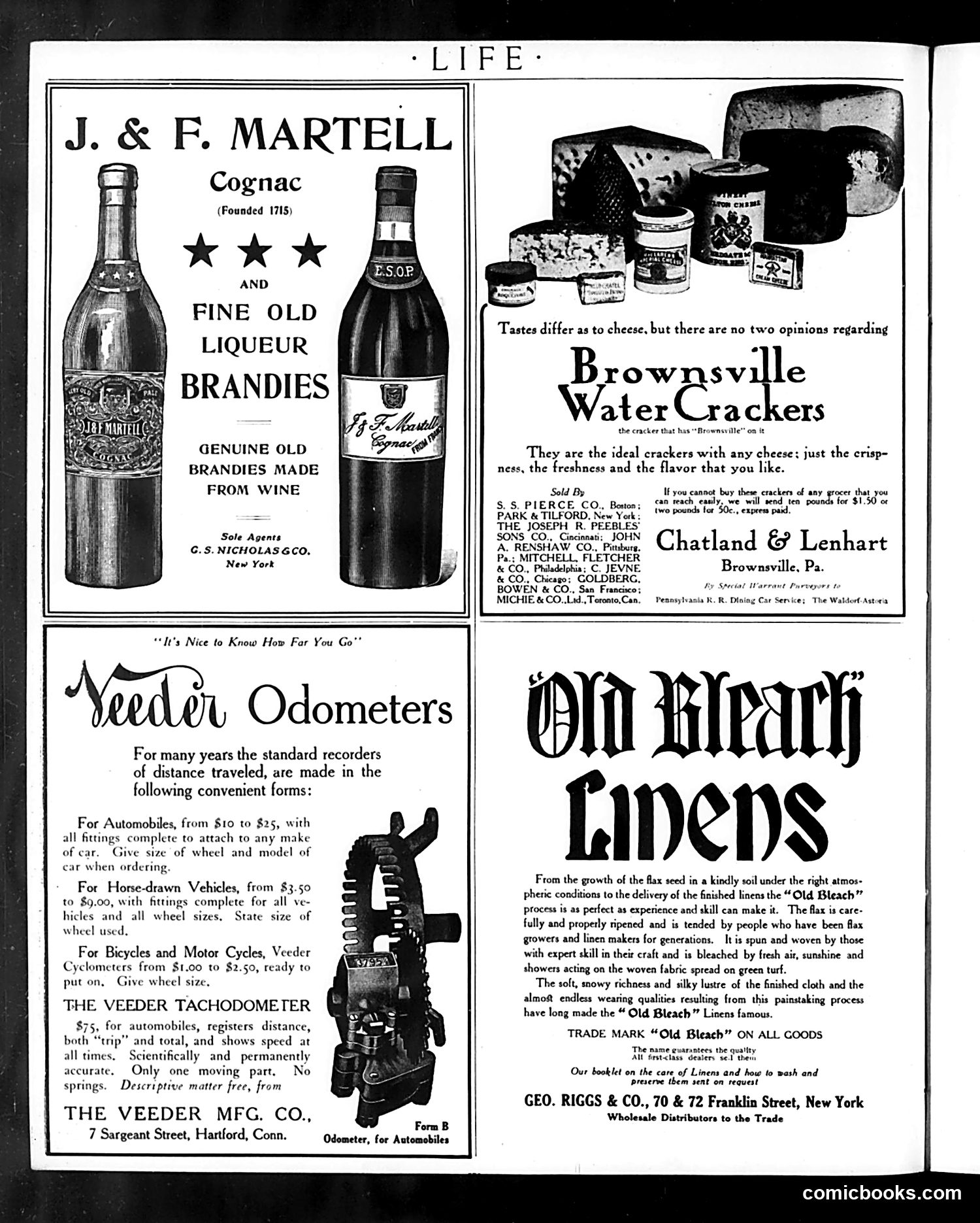
This page contains **advertisements, not political cartoons or satirical content**. The four ads showcase early 20th-century consumer products: 1. **J. & F. Martell Cognac** - French brandy marketed as "genuine old brandies made from wine" 2. **Brownsville Water Crackers** - Packaged crackers advertised as ideal cheese accompaniments 3. **Veeder Odometers** - Distance-measuring devices for automobiles, horse-drawn vehicles, bicycles, and motorcycles, priced $10-$25 4. **Old Bleach Linens** - High-quality linens from New York distributor Geo. Riggs & Co., emphasizing traditional bleaching methods The page reflects consumer culture of the era, featuring luxury imports, emerging automotive technology, and established textile goods. No political satire is present.
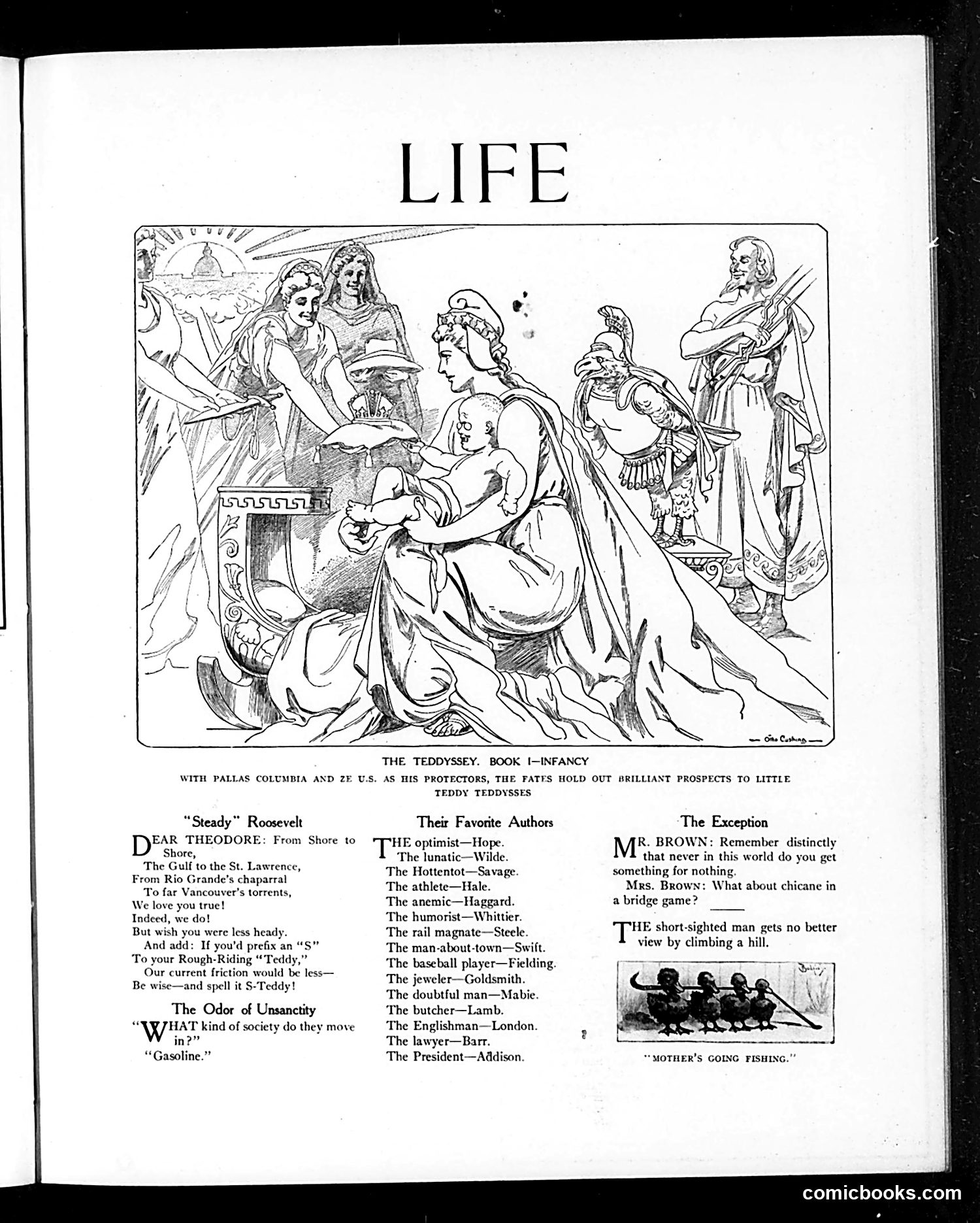
This page satirizes President Theodore Roosevelt ("Teddy") and his children, framing them as classical Greek/Roman figures embarking on an epic journey. The main illustration shows women and children in classical dress, referencing Homer's *Odyssey*. The left column mocks Roosevelt with a poem addressing him as "DEAR THEODORE," criticizing his rough persona ("Rough Riding 'Teddy'") while praising his children. "The Odor of Unsancity" jokes about Roosevelt's social position. The center column lists literary character archetypes matched with authors, appearing to mock contemporary writers' pretensions. "The Exception" section, with its photograph and caption "Mother's Going Fishing," satirizes social class and gender expectations—suggesting ironic commentary on aristocratic behavior versus ordinary life.
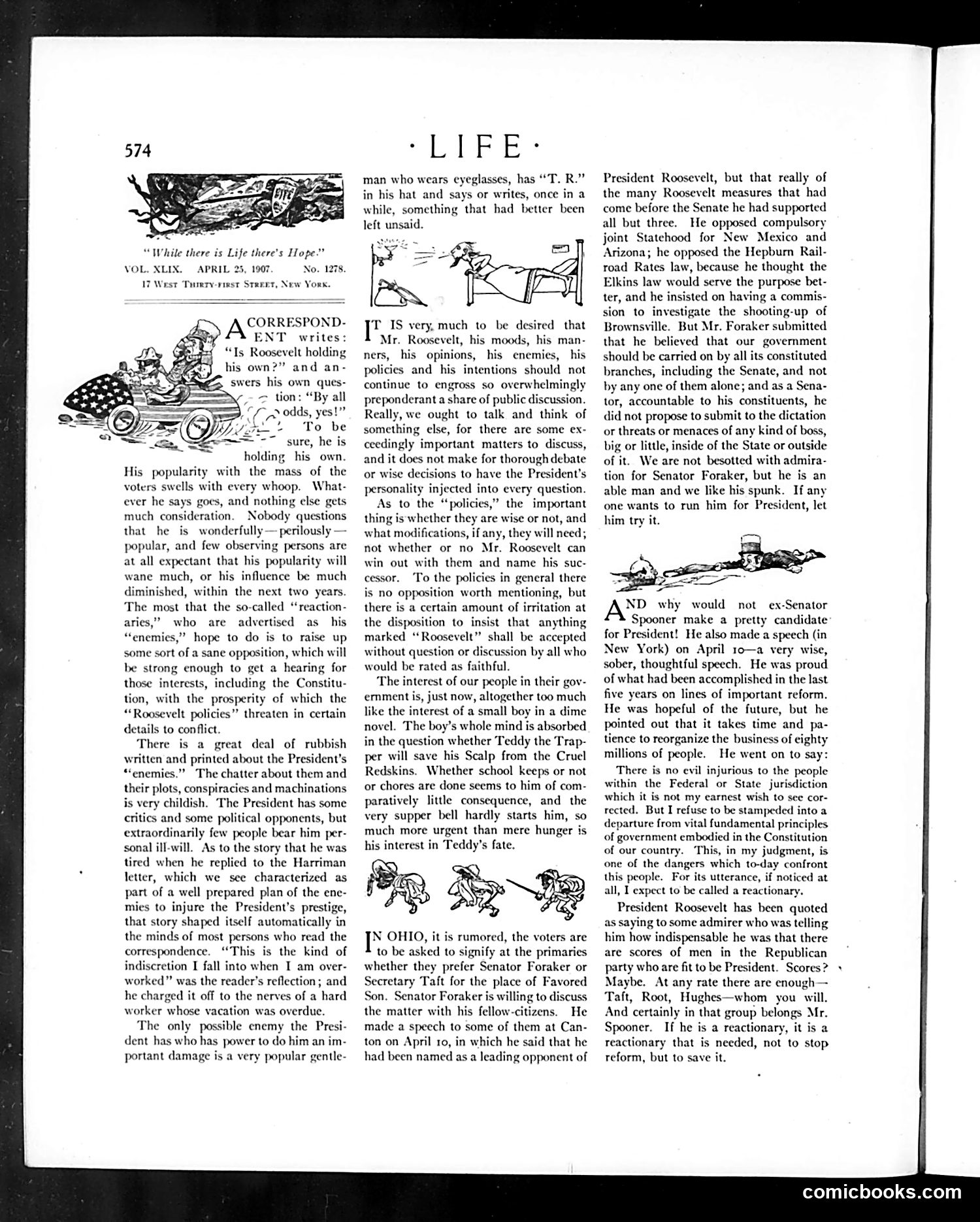
This page discusses President Theodore Roosevelt's overwhelming popularity and public influence. The text critiques how Roosevelt's personality dominates political discourse, arguing citizens should separately evaluate his "policies" from his personal popularity. A correspondent writes defending Roosevelt against critics who want him to stop influencing politics. The article suggests his popularity is so strong that opposition is nearly futile—comparing citizens' absorption with Roosevelt to a boy obsessed with saving his toy from "Teddy the Trapper." The page also discusses ex-Senator Spooner as a potential presidential candidate, suggesting he represents the Republican establishment seeking to continue or "save" reform efforts rather than reverse them. The illustrations (appearing to show cartoon figures) visually reinforce these political themes, though specific details are difficult to discern clearly in this reproduction.
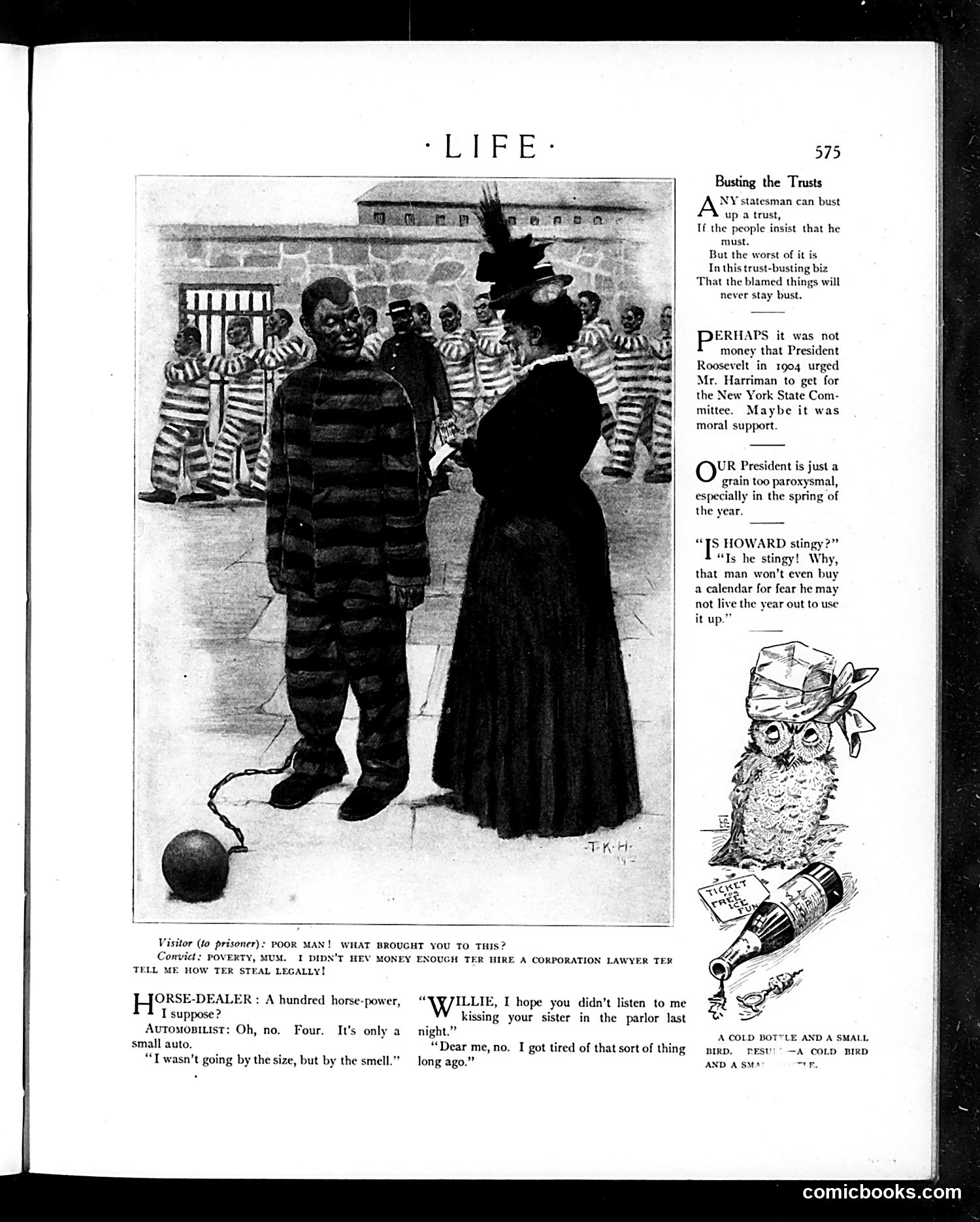
This page satirizes President Roosevelt's anti-trust efforts. The main cartoon depicts a prisoner in striped clothing (representing a "trust" or large corporation) confronted by a woman visitor in prison. The caption reveals the visitor is a poor man who couldn't afford a corporation lawyer—suggesting he's been imprisoned for poverty while wealthy trusts escape consequences. The accompanying text mocks Roosevelt as ineffectual at actually breaking up monopolies, despite his reputation as a "trust-buster." It suggests his efforts are performative: the imprisoned figure represents small-time offenders, not the powerful corporate interests the policy supposedly targets. The bottom vignettes contain unrelated satirical jokes about horse-dealers and romance.
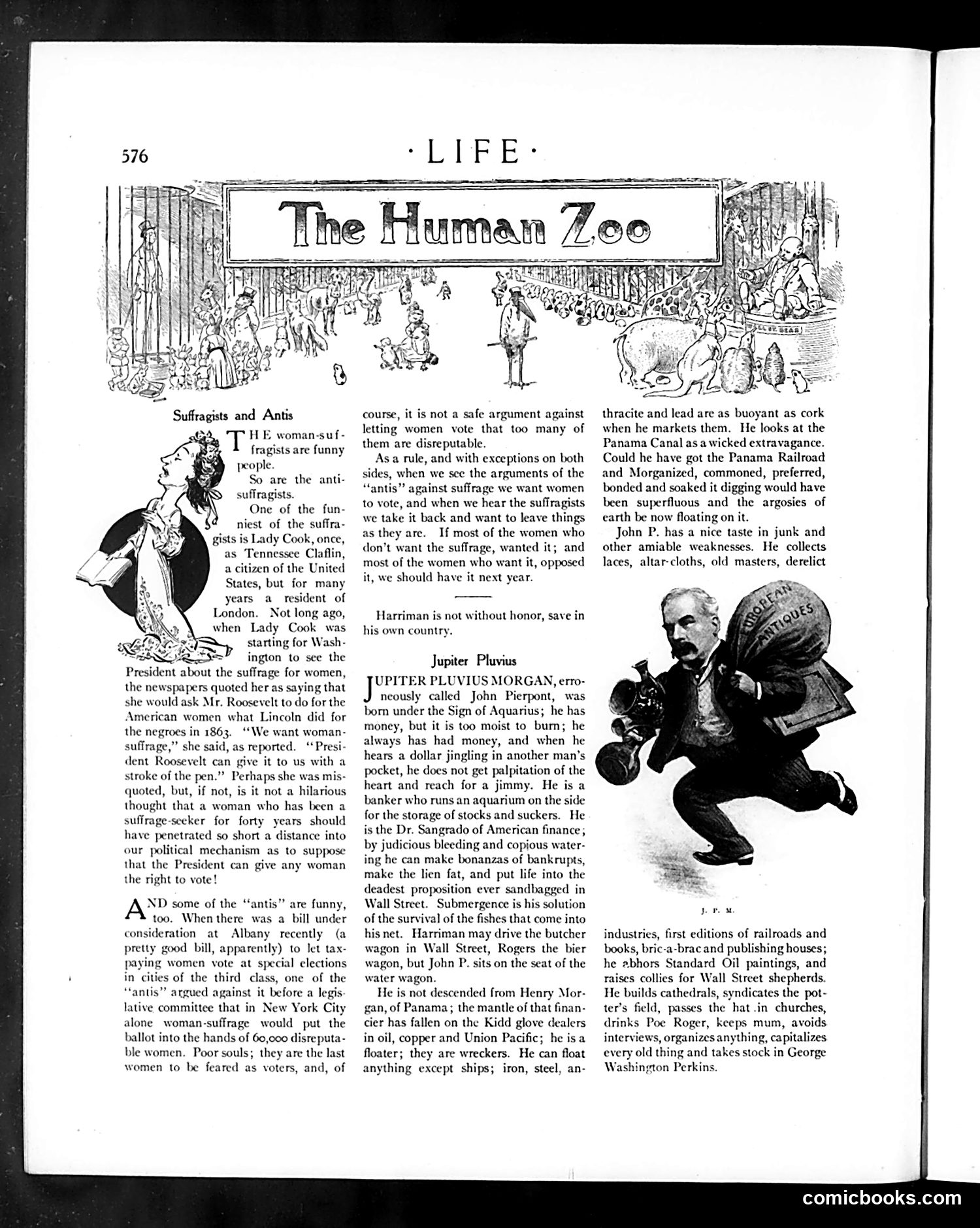
This page satirizes American political and social figures of the era through caricature. The main section "Suffragists and Antis" discusses women's voting rights, featuring a caricatured woman (labeled as Lady Cook, a British resident) representing suffragists. The text mocks both suffrage advocates and their opponents. The right side includes a caricature of "Jupiter Pluvius Morgan," appearing to reference a wealthy financier (likely J.P. Morgan), depicted as a corpulent man controlling vast economic interests. The satire critiques his influence over banks, railroads, and Wall Street while suggesting he manipulates everything from publishing to churches. The overall theme mocks American social hierarchies and power structures through grotesque character exaggeration.
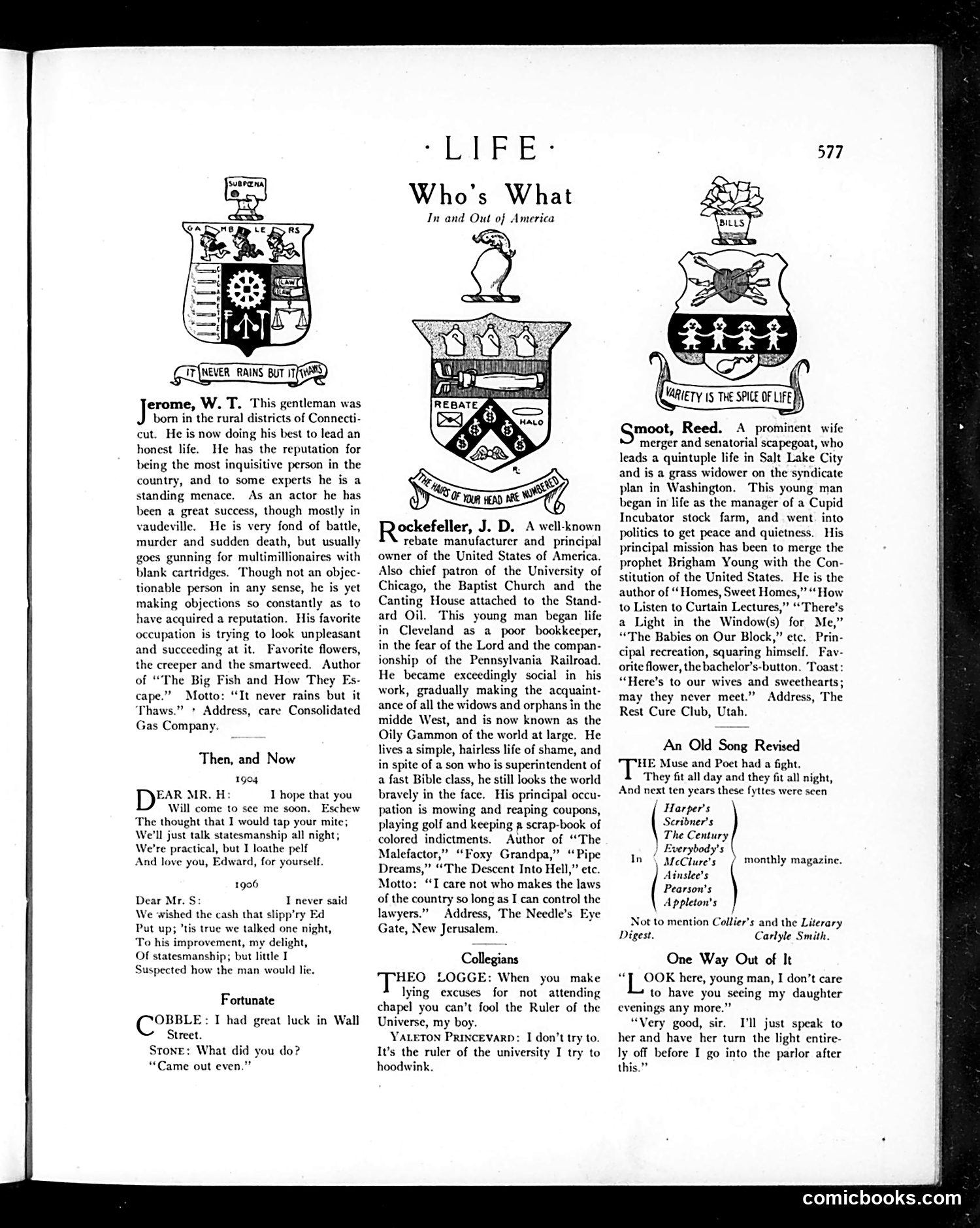
This page contains biographical sketches of prominent Americans, each with a heraldic coat-of-arms illustration. The entries profile Jerome W.T. (a Connecticut businessman), J.D. Rockefeller (the famous oil magnate and philanthropist), and Reed Smoot (a Utah businessman and polygamist). The heraldic shields use visual satire: Rockefeller's includes a gear (industry), while Smoot's shows multiple figures (referencing his polygamous lifestyle). The page also includes humorous dialogue sections like "Then, and Now" and "Colleagues," featuring witty exchanges. One sketch mocks excuses for missing chapel at university. The overall satirical intent appears to be lampooning American wealth, business practices, and moral hypocrisy among the elite—standard *Life* magazine social commentary of the era.
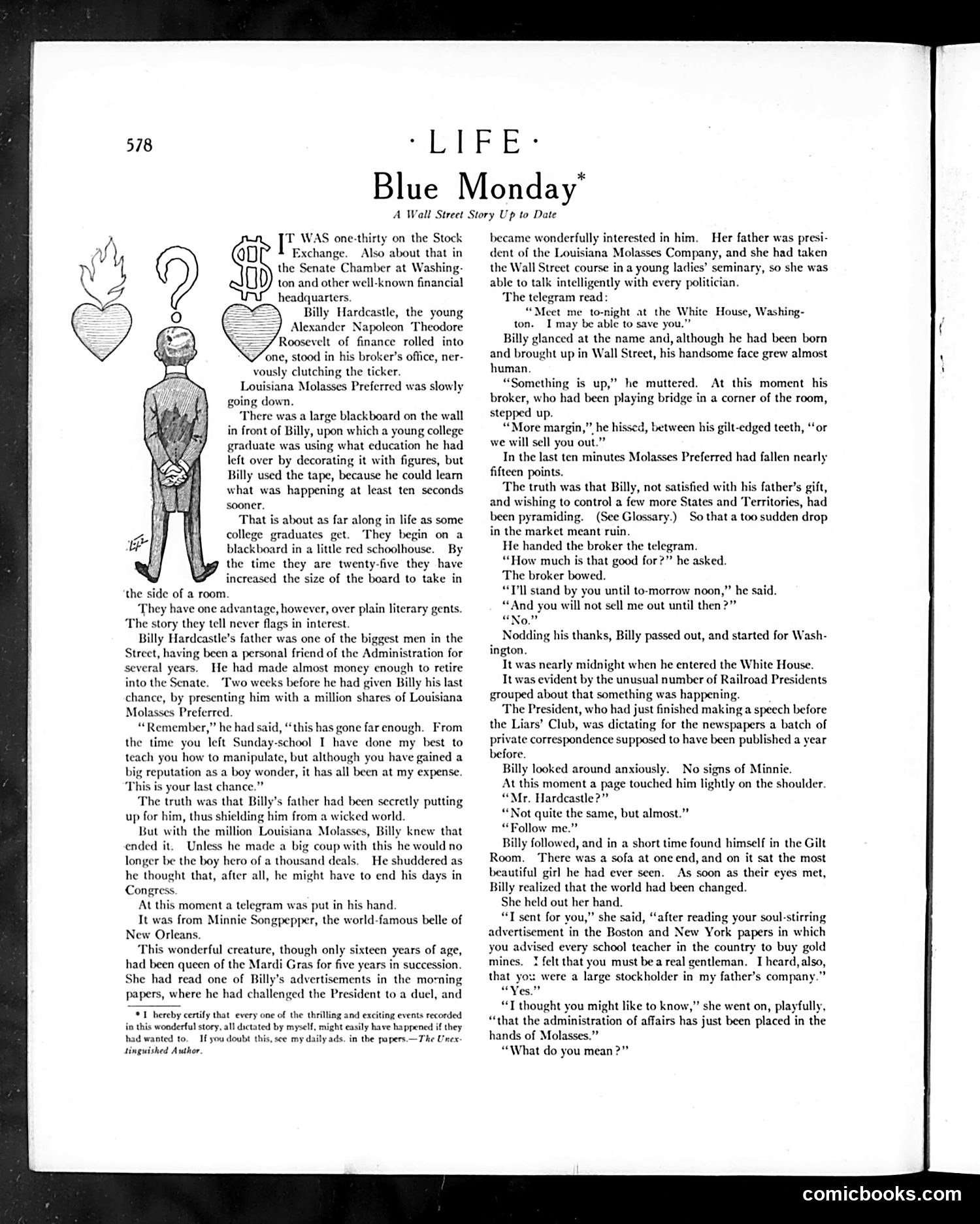
This Life magazine story satirizes young financier Billy Hardcastle, son of a prominent Wall Street broker. The narrative mocks Billy's inexperience and recklessness in stock trading—he's attempting to manipulate Louisiana Molasses Preferred stock despite lacking competence, nearly causing a market crash. The cartoon illustrates Billy as an overgrown child: small-headed, suited figure surrounded by financial symbols (dollar sign, question mark, ticker tape). This visual metaphor emphasizes how privileged but incompetent young men dominated finance through family connections rather than skill. The story criticizes nepotism and financial manipulation during what appears to be the prosperous 1920s, when such risky speculation by inexperienced heirs threatened market stability and ordinary investors.
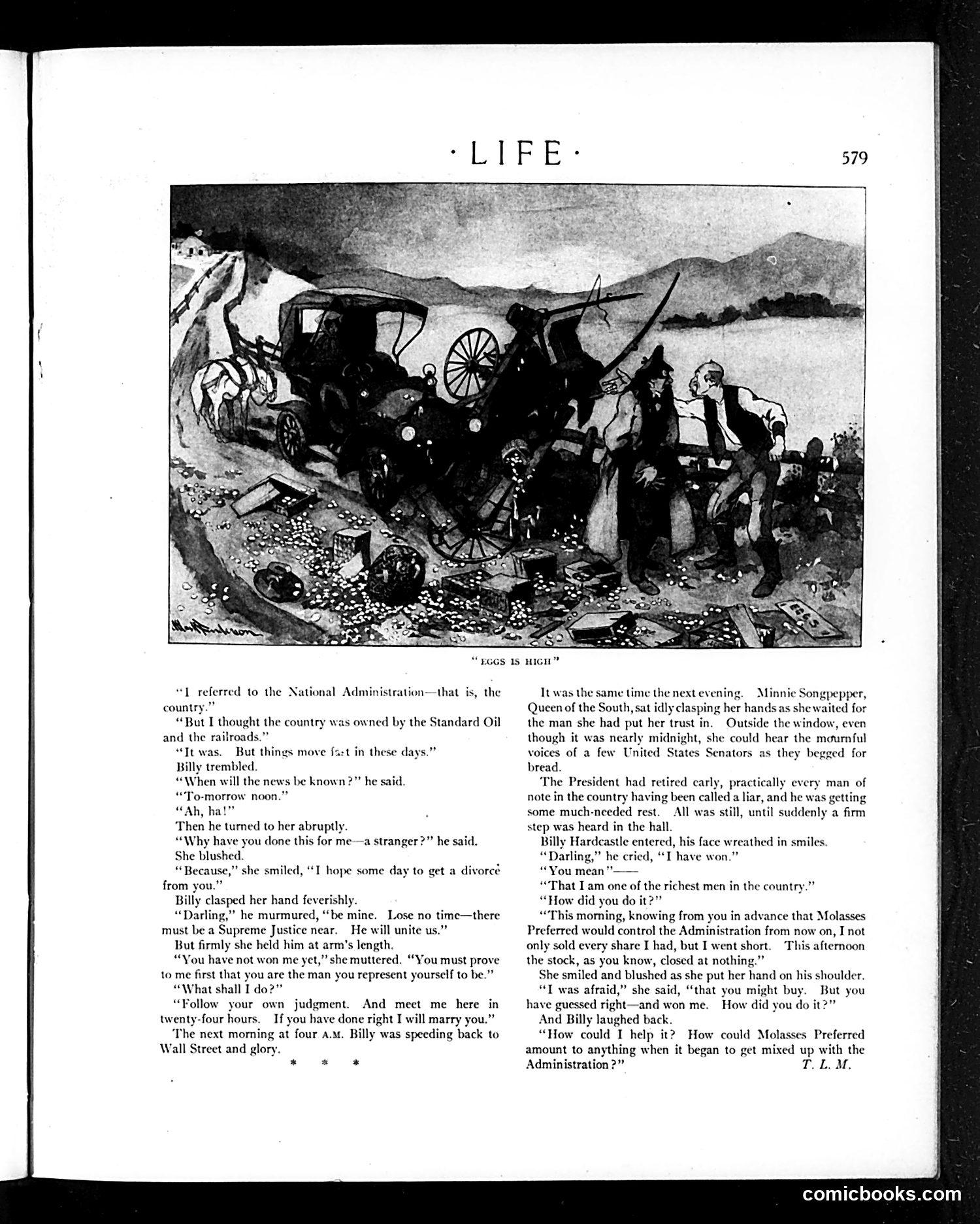
The illustration titled "Hogs Is High" depicts a satirical scene at what appears to be a riverside encampment. The cartoon illustrates a narrative about financial speculation and political corruption involving Standard Oil, railroads, and the National Administration—likely referencing early 20th-century trust concerns. The story dialogue reveals a scheme where Billy, apparently a businessman, has positioned himself to profit from political connections. References to "Molasses Preferred" controlling the Administration suggest satirizing how corporate interests manipulate government policy. The "Supreme Justice" mentioned implies judicial involvement in these arrangements. The satire targets the cozy relationship between big business monopolies and government officials, a common Progressive Era critique of how wealthy industrialists wielded political power through corruption and insider dealing.
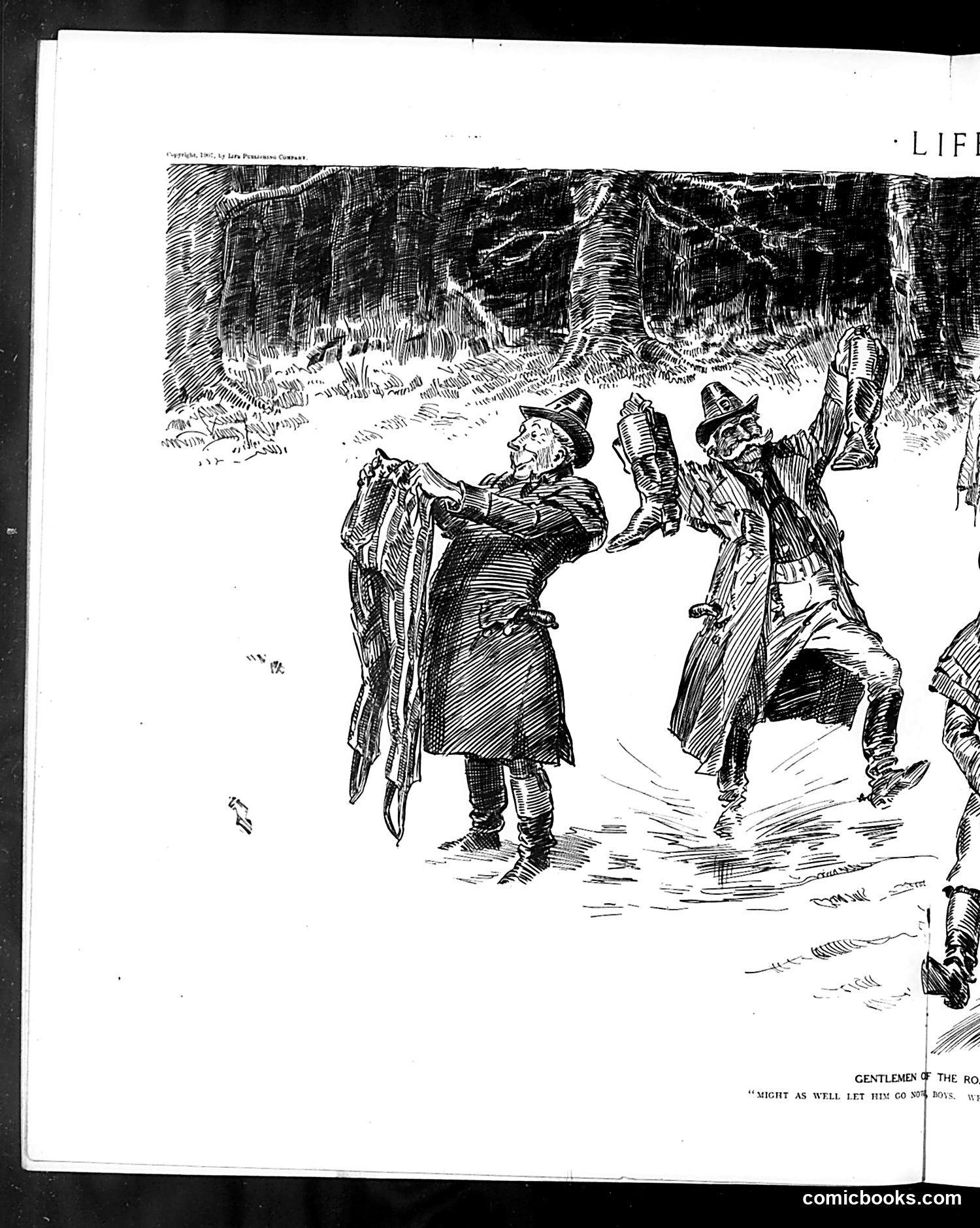
This is a political cartoon from *Life* magazine titled "Gentlemen of the Road," with the caption "Might as well let him go 50% box." The illustration depicts what appears to be highway robbers or bandits in a forest setting, dressed in period clothing with hats, confronting travelers. The cartoon likely satirizes corrupt officials or politicians who exploit the public through taxation or fees—referring to them as "gentlemen of the road" (a euphemism for highwaymen). The "50% box" caption suggests they're debating how much to steal from victims, implying that corrupt authorities are essentially no better than literal robbers, just more organized and sanctioned. Without the full publication date visible, the specific historical context remains unclear, but the satire targets institutional corruption.
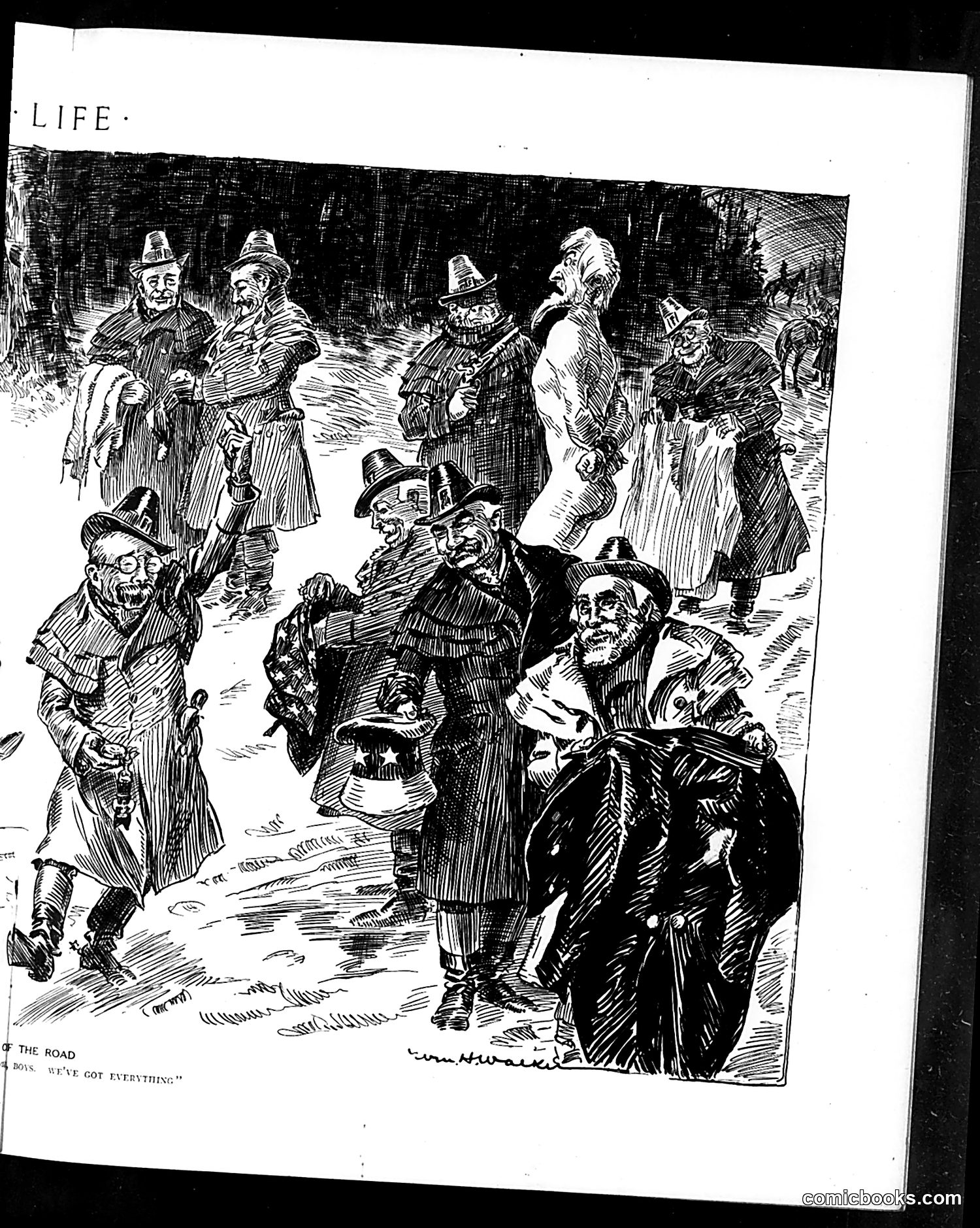
This satirical cartoon depicts a group of men in winter clothing gathered on a snowy road. The caption reads "Boys, we've got everything," suggesting irony—these figures appear to be homeless or destitute vagrants, contradicting the stated claim of having "everything." The artwork uses exaggerated caricature typical of early Life magazine satire, with heavily lined faces suggesting poverty and hardship. The scene likely comments on economic conditions, possibly referencing the Great Depression or similar period of widespread unemployment and homelessness in America. The satire works through contradiction: men with clearly nothing claiming to possess everything, critiquing either their delusion, society's indifference to their plight, or both. The specific historical context and intended target remain unclear without additional publication date information.
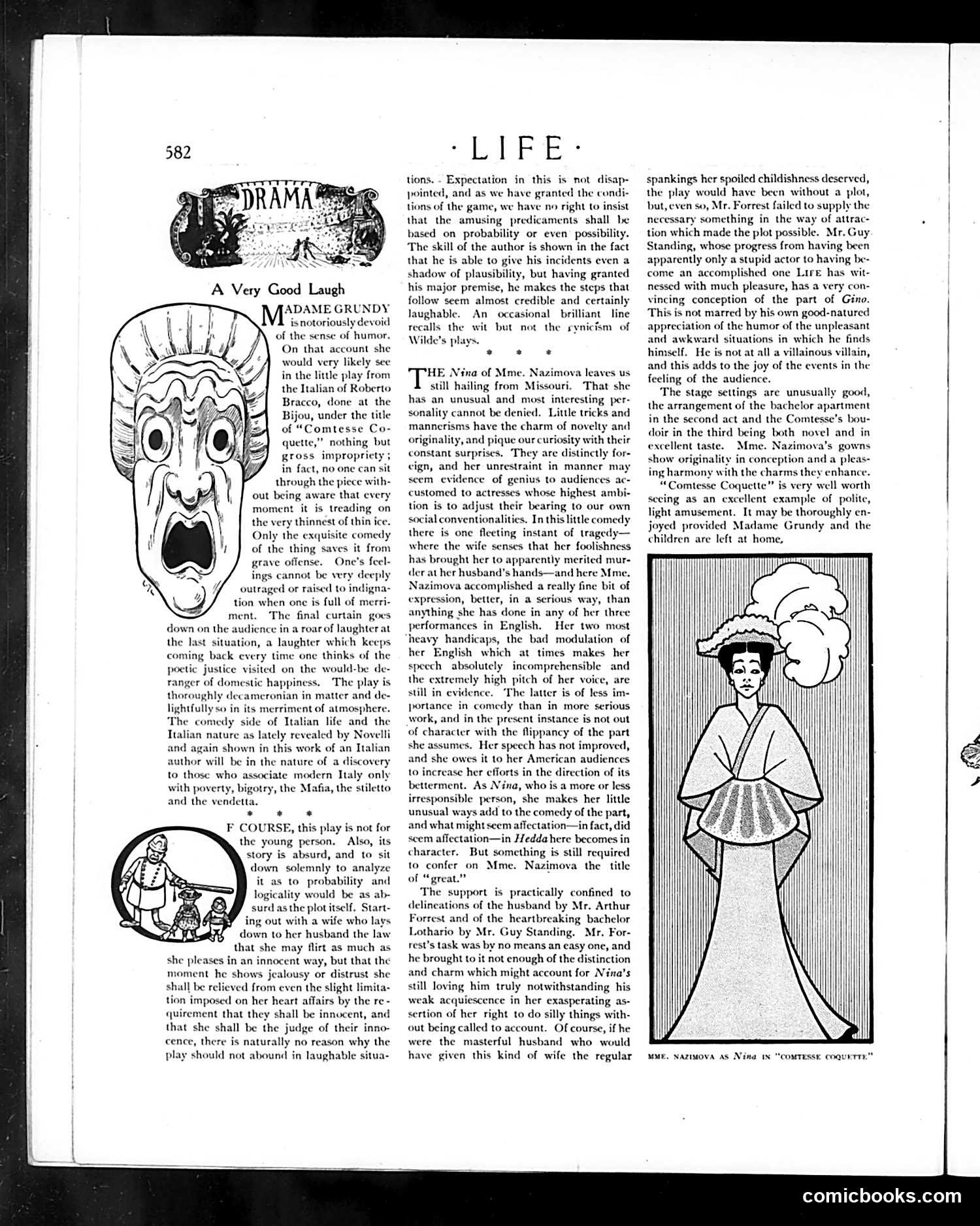
This page reviews a stage production of "Comtesse Coquette," an Italian play by Roberto Bracco at the Bijou theater. **The Cartoons**: The illustrated faces appear to mock "Madame Grundy"—a stock character representing rigid moral prudishness and disapproval of anything improper. The exaggerated expressions mock her hypothetical shock at the play's risqué content about marital infidelity. **The Point**: The critic argues the play succeeds because its *comedy* prevents moral offense—audiences are too busy laughing to feel outraged. The reviewer defends the absurd plot (a wife permits "innocent" flirtation while jealousy revokes restrictions) as legitimate theatrical fun. **Social Context**: "Madame Grundy" represents Victorian-era moral gatekeepers who would condemn such material. The review playfully mocks such censoriousness while defending sophisticated comedy. The critique of actress Nazimova's accent and high voice reveals period performance standards.
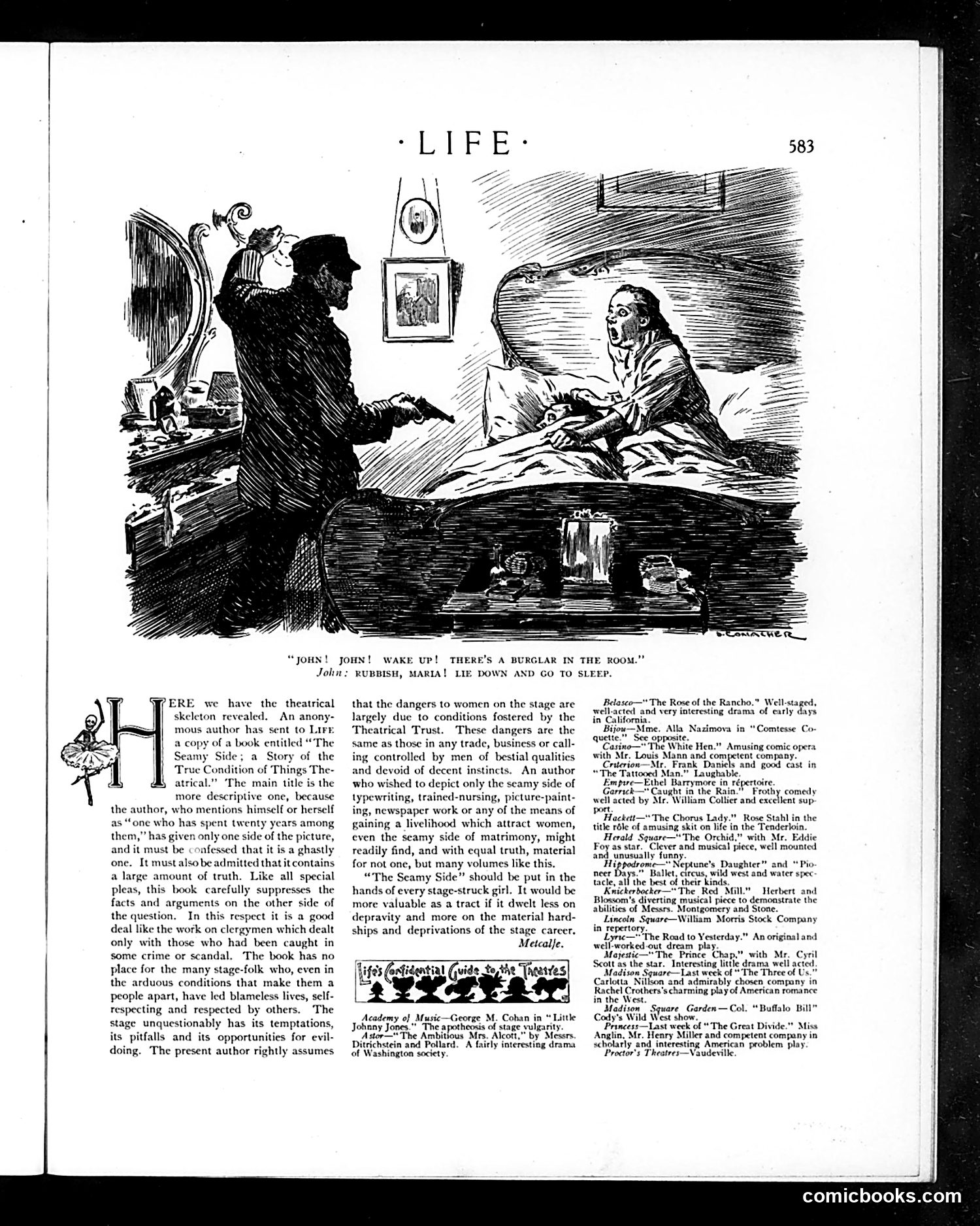
This page contains a satirical cartoon and theatrical review. The cartoon depicts a domestic scene where a wife repeatedly tries to wake her sleeping husband with increasingly alarming claims—first about a burglar, then other disturbances—but he dismissively tells her to "lie down and go to sleep." The joke satirizes male indifference and dismissiveness toward women's concerns, playing on the common trope of husbands ignoring their wives' warnings or complaints. The cartoon uses escalating urgency (the burglar claim) to mock his stubborn refusal to take her seriously. The accompanying text reviews a book titled "The Seamy Side" about theatrical working conditions. The critic acknowledges the book's truths about stage dangers while criticizing its one-sided presentation—arguing similar depravities exist in other professions. The page also lists current Broadway theater productions and performances, typical of Life's entertainment coverage during this period.
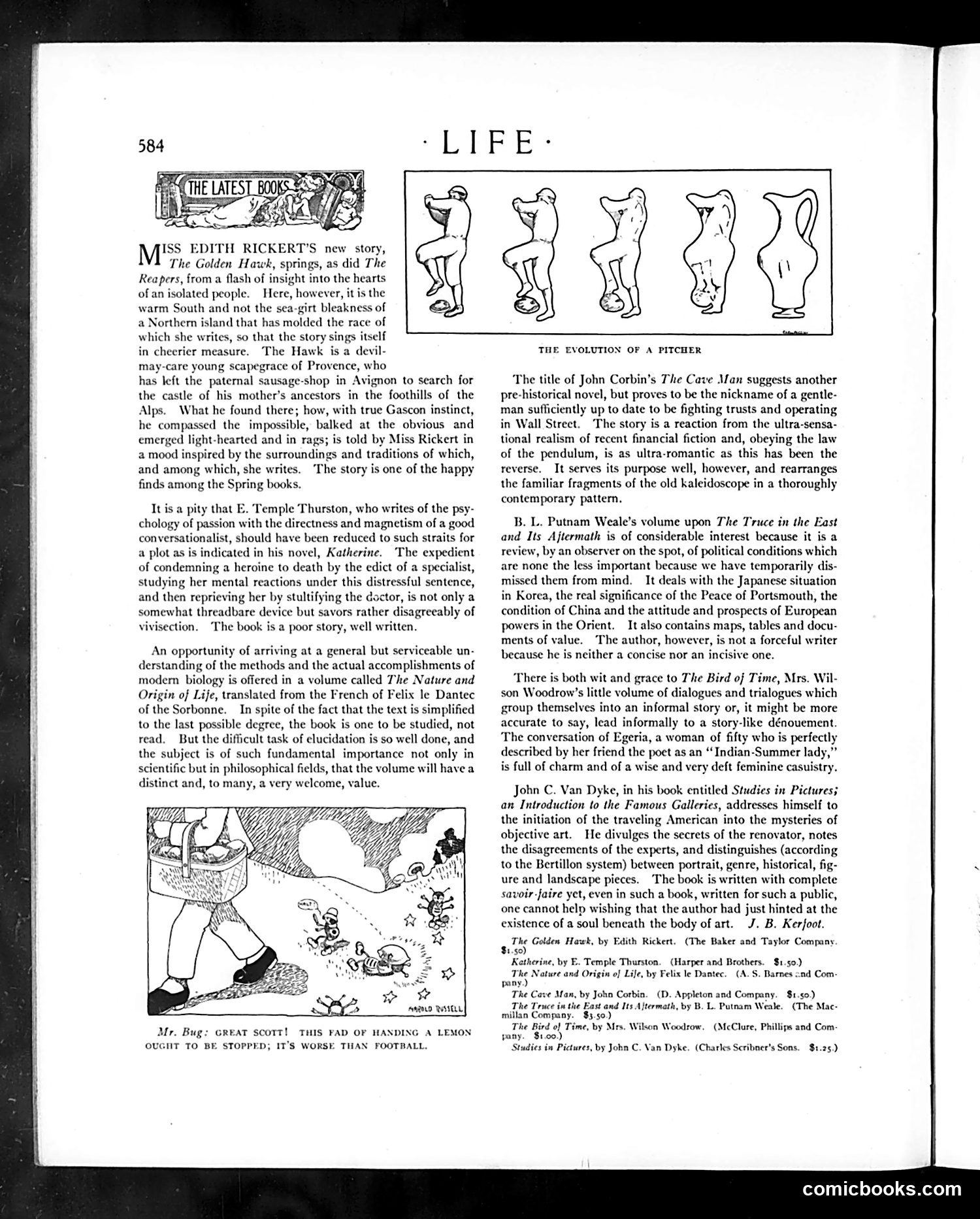
The top cartoon shows five sequential drawings of a baseball pitcher's body positions, labeled "The Evolution of a Pitcher"—a humorous visual pun playing on Darwin's evolutionary theory, which was still controversial and much-discussed in early 20th-century America. The bottom cartoon depicts an insect addressing another bug about "handing a lemon" being worse than football. "Lemon" was period slang for a defective product or disappointing thing. The joke appears to mock some contemporary fad (unclear which specific trend) by suggesting even insects recognize it's problematic—exaggerating its absurdity through the insects' perspective. Both cartoons use visual wit typical of *Life* magazine's satirical style, combining contemporary concerns (evolution, consumerism, sports culture) with clever visual metaphors for comedic effect.
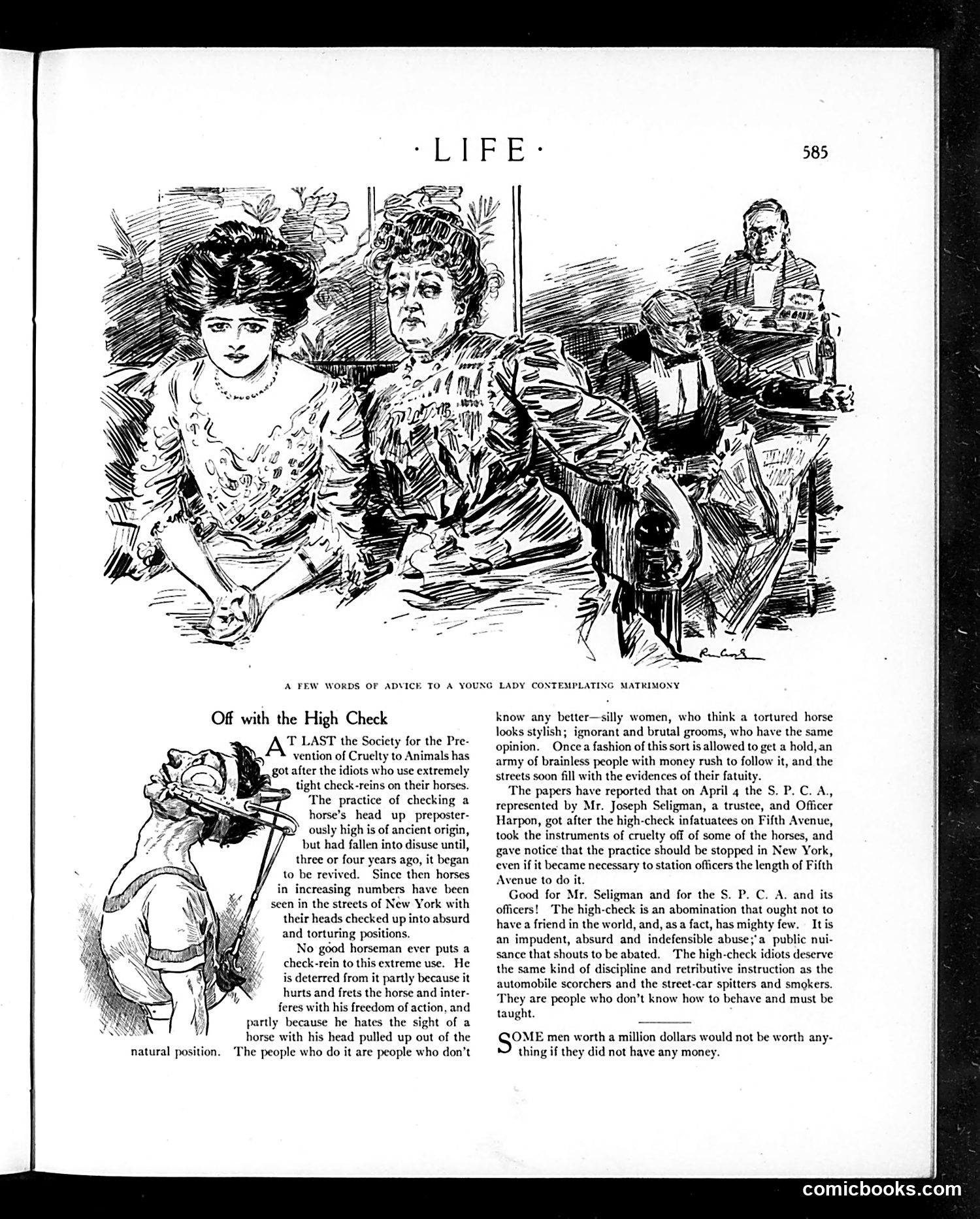
This *Life* magazine page satirizes the cruel fashion of artificially restraining horses' heads in exaggerated, upright positions on New York streets. The top illustration shows a young woman receiving matrimonial advice, while the main article "Off with the High Check" criticizes this animal abuse practice. The satire targets "silly women" and "ignorant grooms" who adopted this trend thinking tortured horses looked stylish. The author praises the Society for the Prevention of Cruelty to Animals (S.P.C.A.) and trustee Joseph Seligman for confronting Fifth Avenue offenders and removing the cruel check-reins. The piece compares these abusers to other public nuisances—reckless drivers and train smokers—arguing all deserve disciplinary instruction. The final aphorism mocks wealthy people with no character, suggesting mere money cannot create genuine worth. The satire uses class criticism and moral outrage to champion animal welfare reform.
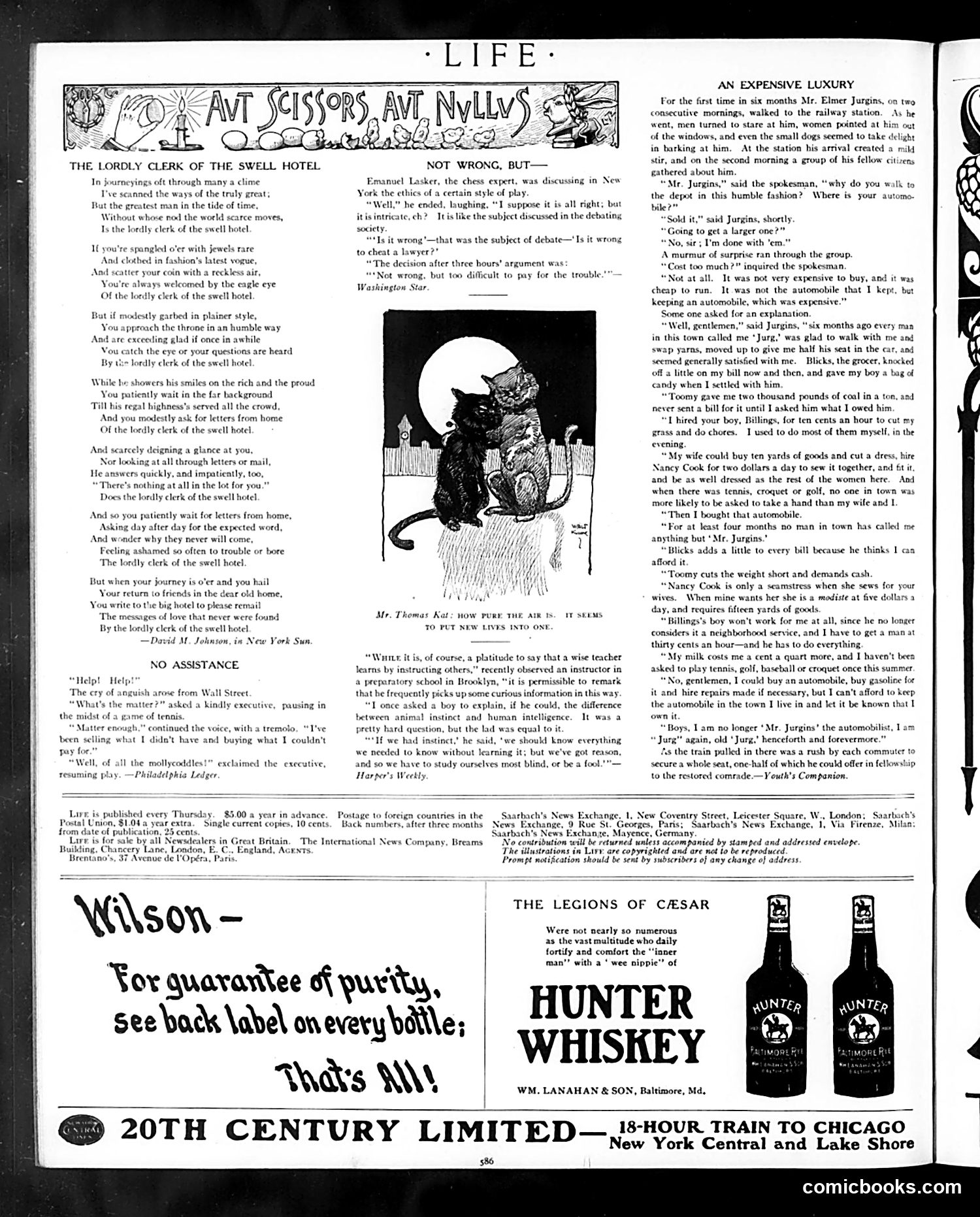
This page contains several satirical pieces about class and social hierarchy in early 20th-century America. **"The Lordly Clerk of the Swell Hotel"** mocks the arbitrary power of hotel desk clerks. The satire shows how they fawn over wealthy, flashy guests while ignoring or dismissing modest, plainly-dressed visitors—despite both being paying customers. The poem criticizes this class-based service discrimination, where a clerk's "regal" demeanor depends entirely on a guest's apparent wealth and style. The joke exposes the absurdity of giving such minor functionaries godlike authority. **"No Assistance"** is a brief quip about Wall Street speculation during what appears to be a financial crisis—a man admits to "selling what I didn't have and buying what I couldn't pay for," essentially confessing to fraud or reckless speculation. **"Not Wrong, But—"** presents a debate about whether cheating lawyers is "wrong," concluding it's not wrong but "too difficult"—a joke about lawyers' reputation for complexity and moral flexibility. The pieces collectively satirize social pretension, financial chicanery, and institutional indifference to ordinary people.
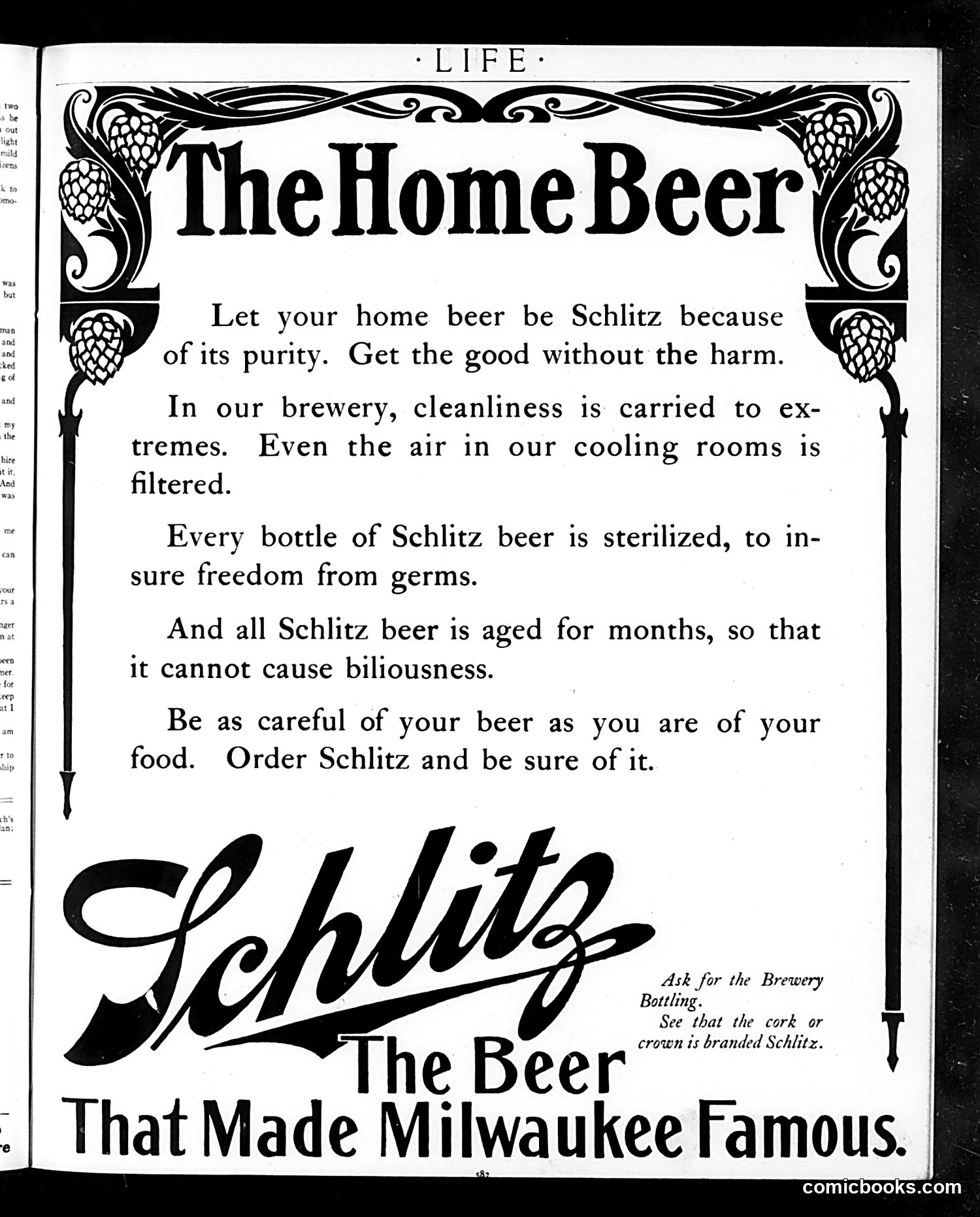
This is a **straight advertisement**, not satire or political content. Schlitz brewery marketed their beer by emphasizing health and safety—concerns paramount in early 20th-century America when food/beverage contamination was genuinely dangerous. The ad's appeals reflect period anxieties: sterilization, filtered air, aging to prevent illness ("biliousness"), and cleanliness as selling points. The phrase "Get the good without the harm" suggests beer's nutritional value while addressing concerns about adulteration or spoilage. "The Beer That Made Milwaukee Famous" was Schlitz's actual slogan, positioning Milwaukee as America's brewing capital. The decorative hops border and tagline about verifying authentic bottles (cork/crown branding) underscore authenticity—important when counterfeit products were common. This represents how manufacturers used emerging scientific language (sterilization, filtration) to build consumer trust in a pre-FDA regulatory era.
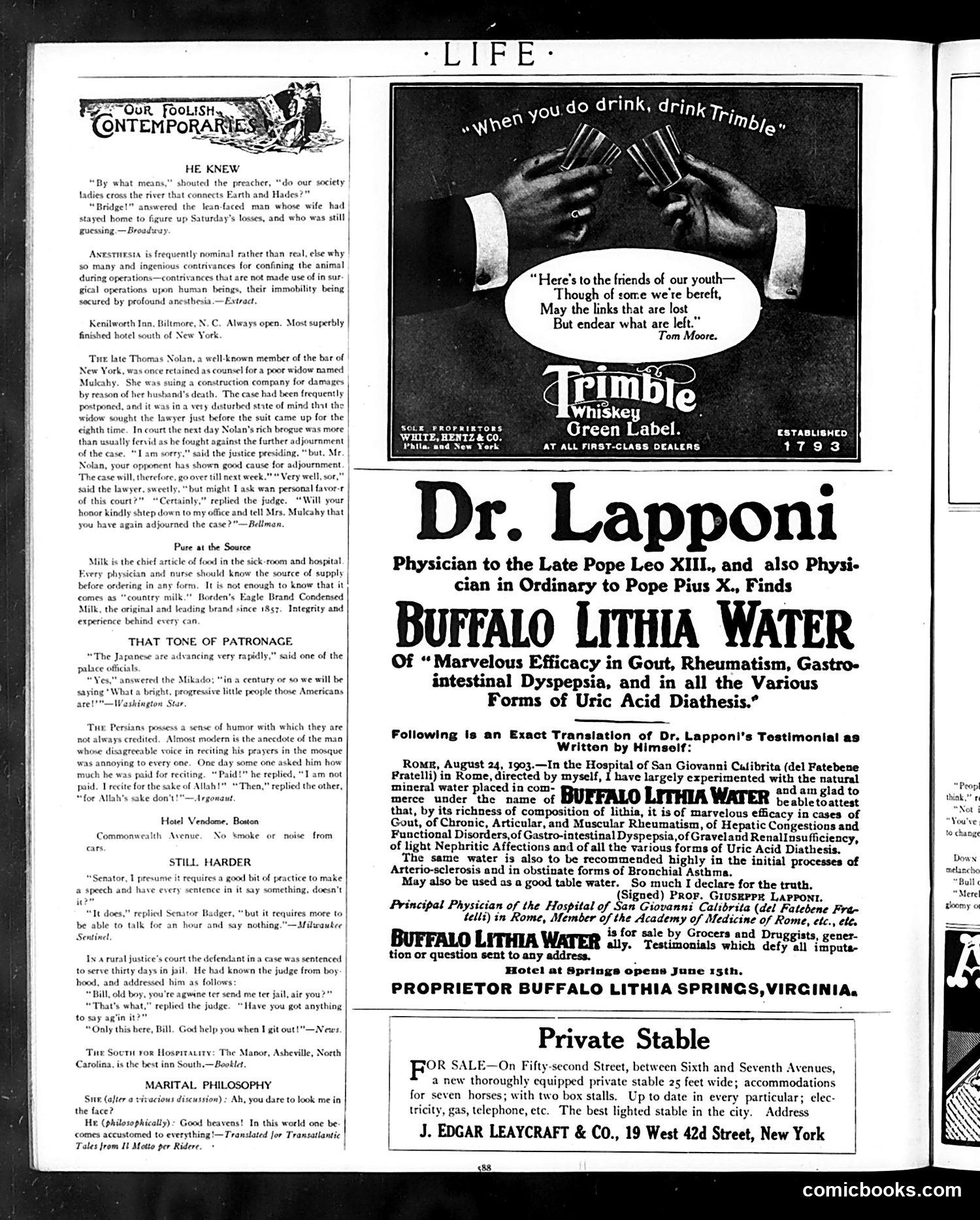
This page from the early 1900s LIFE contains a cartoon column titled "Our Foolish Contemporaries" plus period advertisements and humorous anecdotes. ## The Cartoon The visible cartoon mocks a bridge reference made by someone whose wife lost money gambling. When asked how people "cross the river" from society to Hades (Hell), the unshaven man answers "Bridge!"—the joke being his wife's financial losses have him joking darkly about damnation while she gambles away at home. ## The Content The remaining text consists of brief social satires and one-liners poking fun at: - Lawyers delaying cases - Political/national attitudes (the Mikado/Japan joke about American perceptions) - Senator effectiveness - Rural justice quirks This reflects LIFE's 1800s-early 1900s formula: satirical humor targeting contemporary manners, politicians, and social types through short, pithy jokes rather than sustained narrative satire. The advertisements (whiskey, water springs, hotels, stables) are period standard.
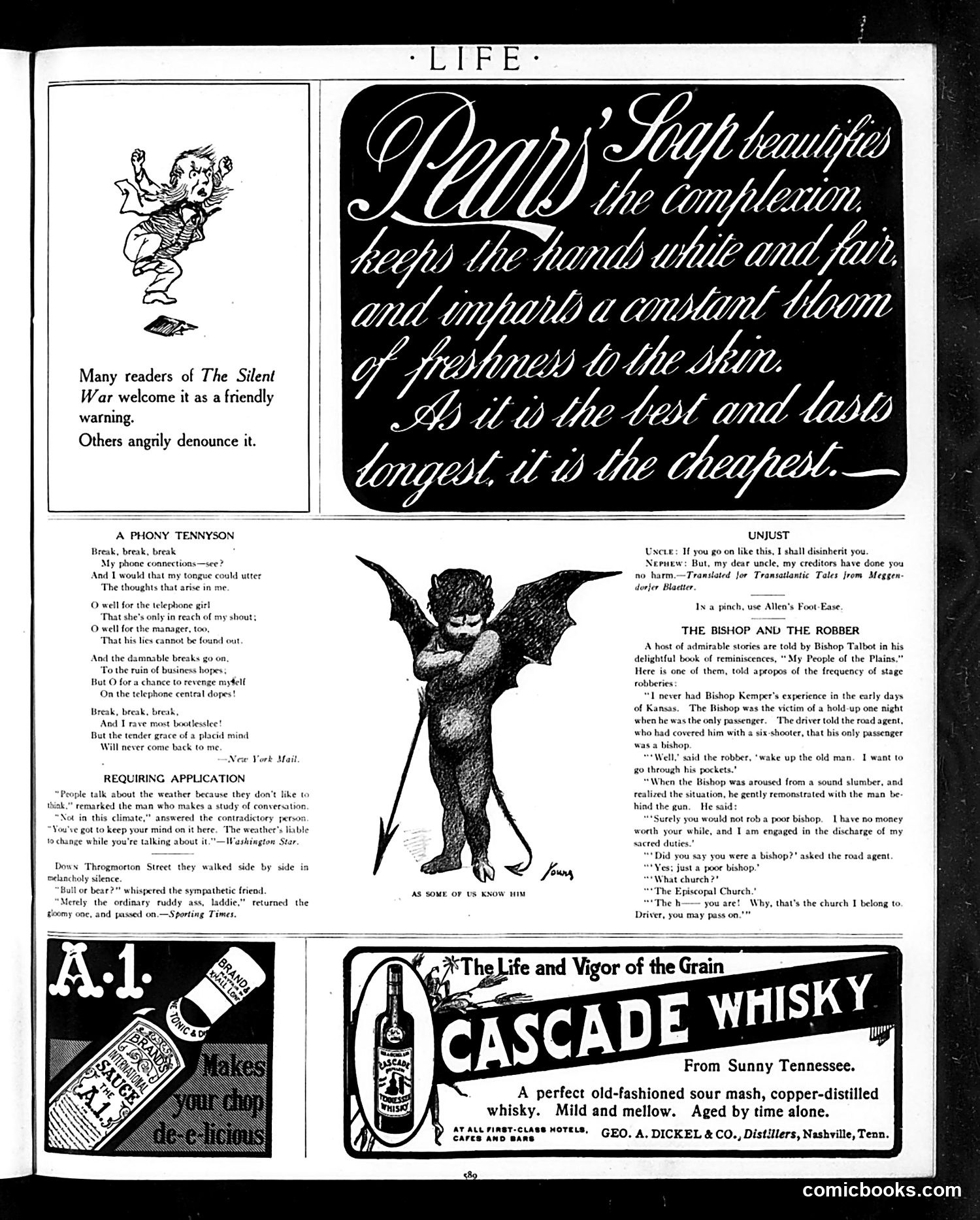
This page contains humorous short pieces typical of early 20th-century satirical magazines: **"A Phony Tennyson"** parodies Tennyson's famous poem "Break, Break, Break" to mock chronic telephone service failures—a modern frustration of the era. The speaker rages at dropped calls and incompetent operators instead of romantic loss. **"Requiring Application"** offers brief comedic anecdotes about conversation and social awkwardness, including jokes about weather talk and financial anxiety ("bull or bear"—stock market terminology). **"Unjust"** presents a short comic scenario where a nephew points out his creditors have wronged his uncle, so disinheriting him seems unfair. **"The Bishop and the Robber"** tells an anecdotal story (attributed to Bishop Talbot) about a stagecoach robbery where the robber, learning his victim is an Episcopal clergyman, lets him pass—implying either shared faith or mockery of the church's reputation. The remaining content consists of advertisements for A.1. sauce and Cascade Whisky. The page reflects early 1900s concerns: telecommunications reliability, market speculation, and social propriety.
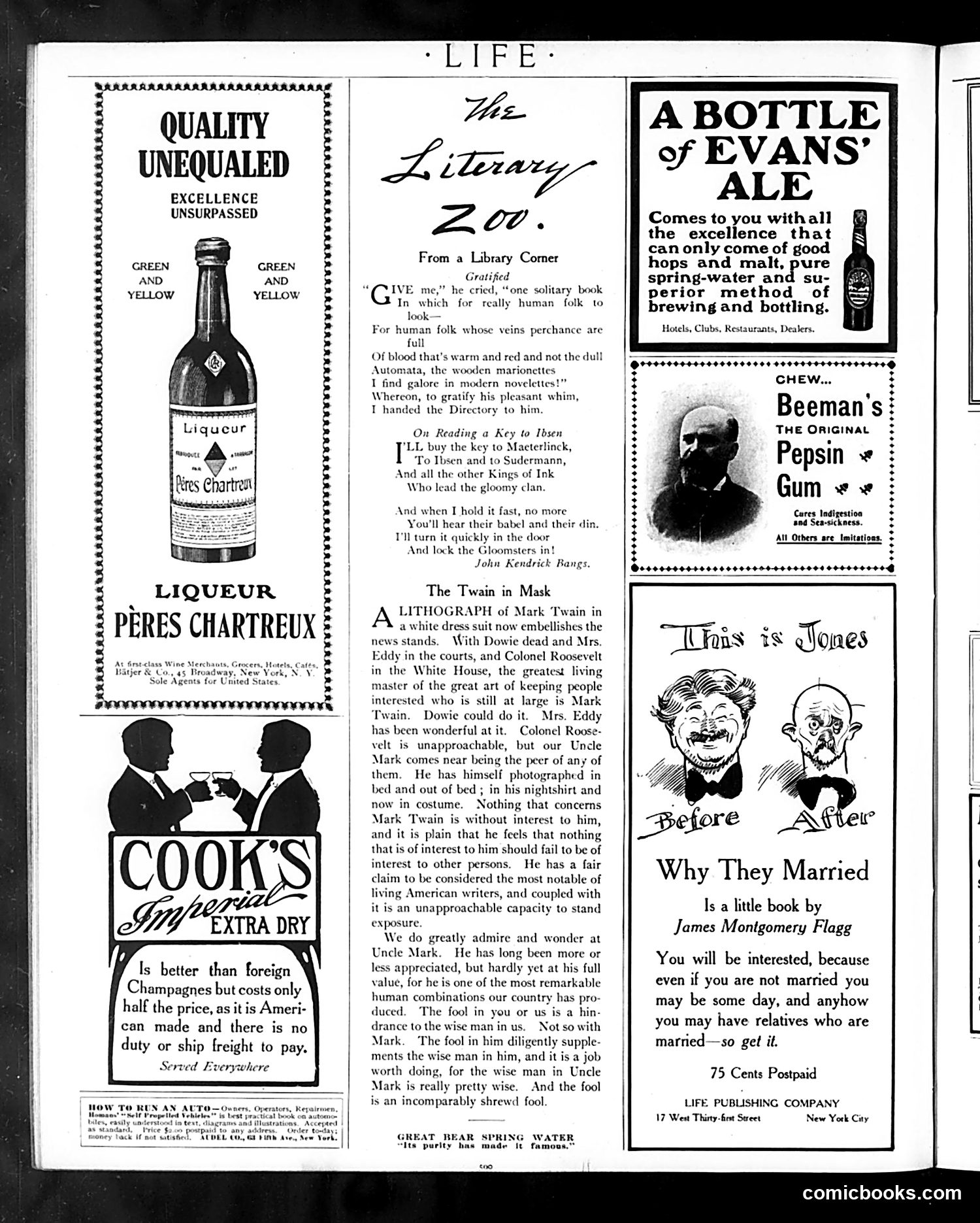
This page is primarily **advertising** interspersed with light literary content. The main satirical element appears in "The Twain in Mask," which discusses **Mark Twain's celebrity and self-promotion**. The text playfully critiques how Twain photographs himself in various states (in bed, in costume, in nightshirts) and orchestrates his public image, suggesting his capacity for self-exposure rivals that of religious figures like Dowie and Eddy or political figures like Theodore Roosevelt. The joke is that Twain's "fool" side cleverly complements his wise side—he's a shrewd self-promoter masquerading as guileless. The lithograph reference indicates Twain's image was being mass-marketed on newsstands. The page otherwise contains period advertisements (liqueurs, champagne, chewing gum, ale) and James Montgomery Flagg's comic book promotion "Why They Married," typical of early 20th-century *Life* magazine's mixed editorial-commercial format.
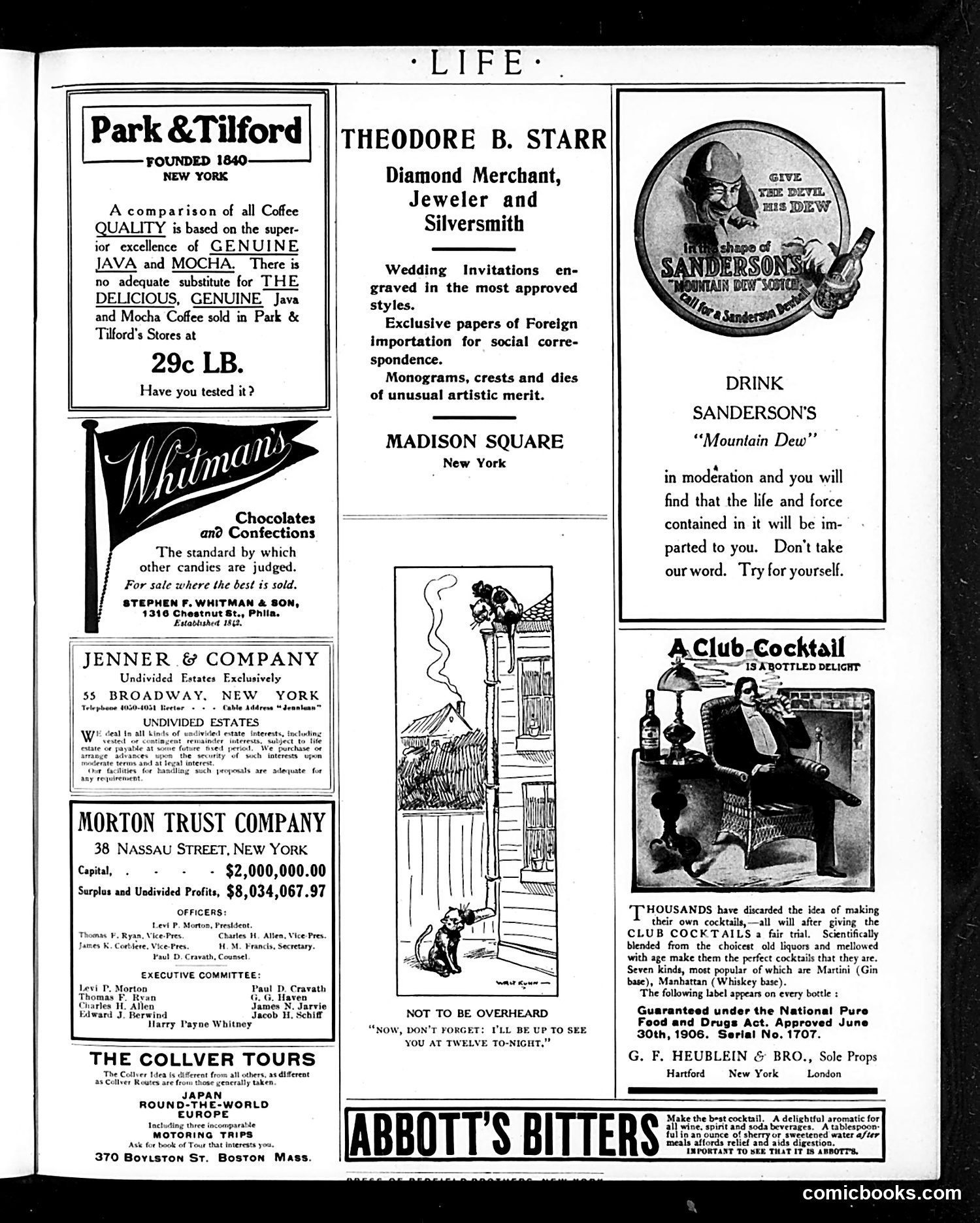
This page is primarily **advertising**, not satire or political commentary. It contains various commercial advertisements typical of early 1900s Life magazine. The one illustration—a small cartoon labeled "NOT TO BE OVERHEARD"—depicts a humorous domestic scene: a man telling a woman he'll visit her at midnight, presumably clandestinely. The caption warns readers not to overhear such arrangements, making a light joke about infidelity or secret romantic meetings. This reflects early-20th-century magazine humor about marital indiscretion, presented as genteel comedy rather than scandal. The advertisements themselves (Park & Tilford coffee, Whitman's chocolates, Theodore B. Starr jewelry, and notably Sanderson's "Mountain Dew" whiskey and Club Cocktails) represent luxury consumer goods marketed to wealthy readers. The inclusion of alcohol advertisements was legal and common before Prohibition (1920-1933). No political figures or satire are present on this page.
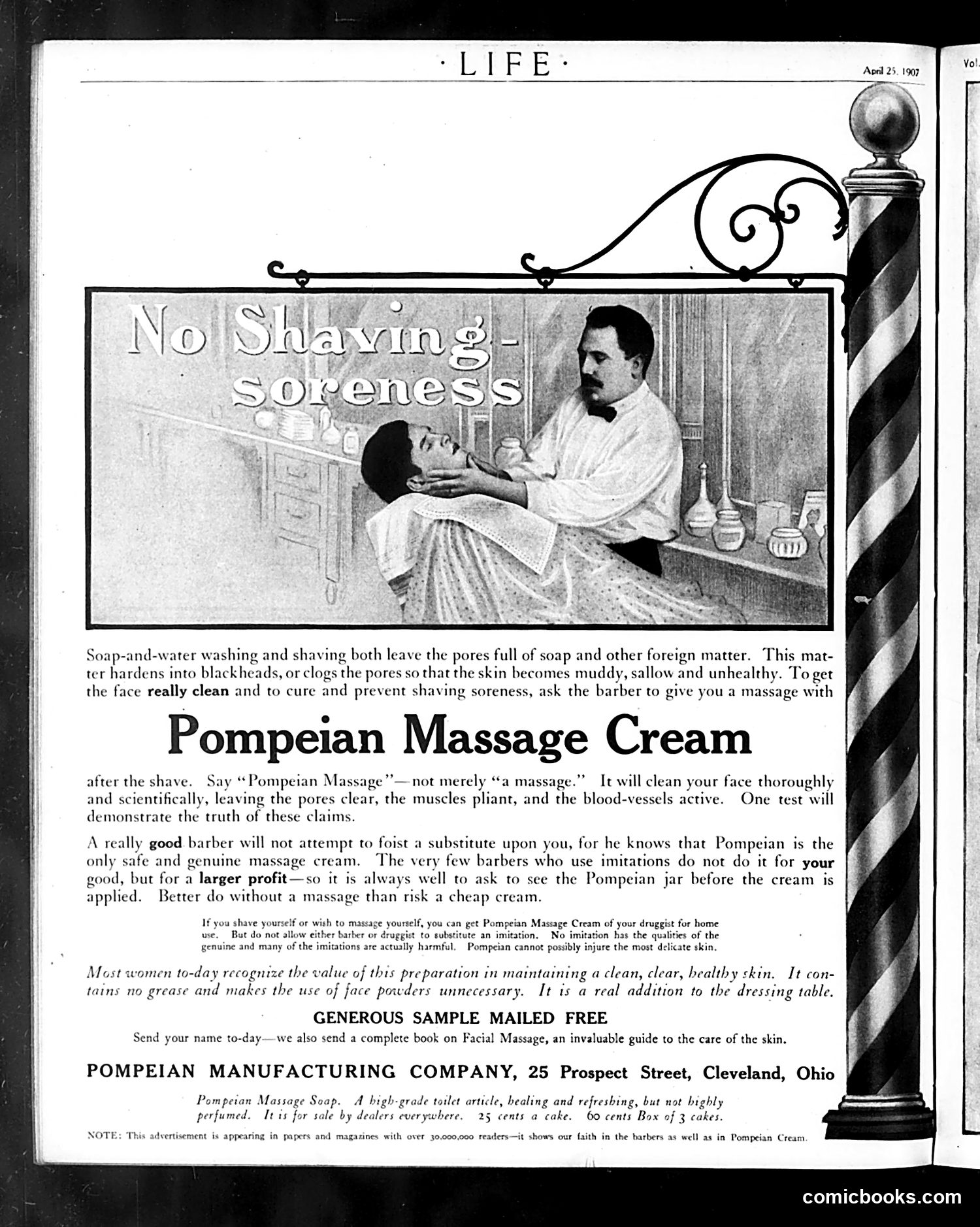
This is primarily a **product advertisement**, not political satire. It promotes Pompeian Massage Cream to male barber customers. The image shows a barber applying cream to a client's face after shaving, illustrating the advertised benefit: the cream allegedly cleanses pores clogged by soap residue, preventing blackheads and skin irritation. The ad's persuasive angle targets barbers directly, emphasizing that "a really good barber" will use only genuine Pompeian—not cheap imitations—because he "knows" it's the best product. This appeals to professional pride while warning against substitutes that harm skin. The text also notes that "most women" value the product for maintaining clear skin, broadening its market appeal beyond men's grooming. By 1907 standards, this represents typical early 20th-century advertising that combines pseudo-scientific claims about skin health with social status messaging—presenting the product as a mark of quality and respectability.