
Life, 1907-04-25 · page 15 of 24
Life — April 25, 1907 — page 15: what you’re looking at
What you’re looking at
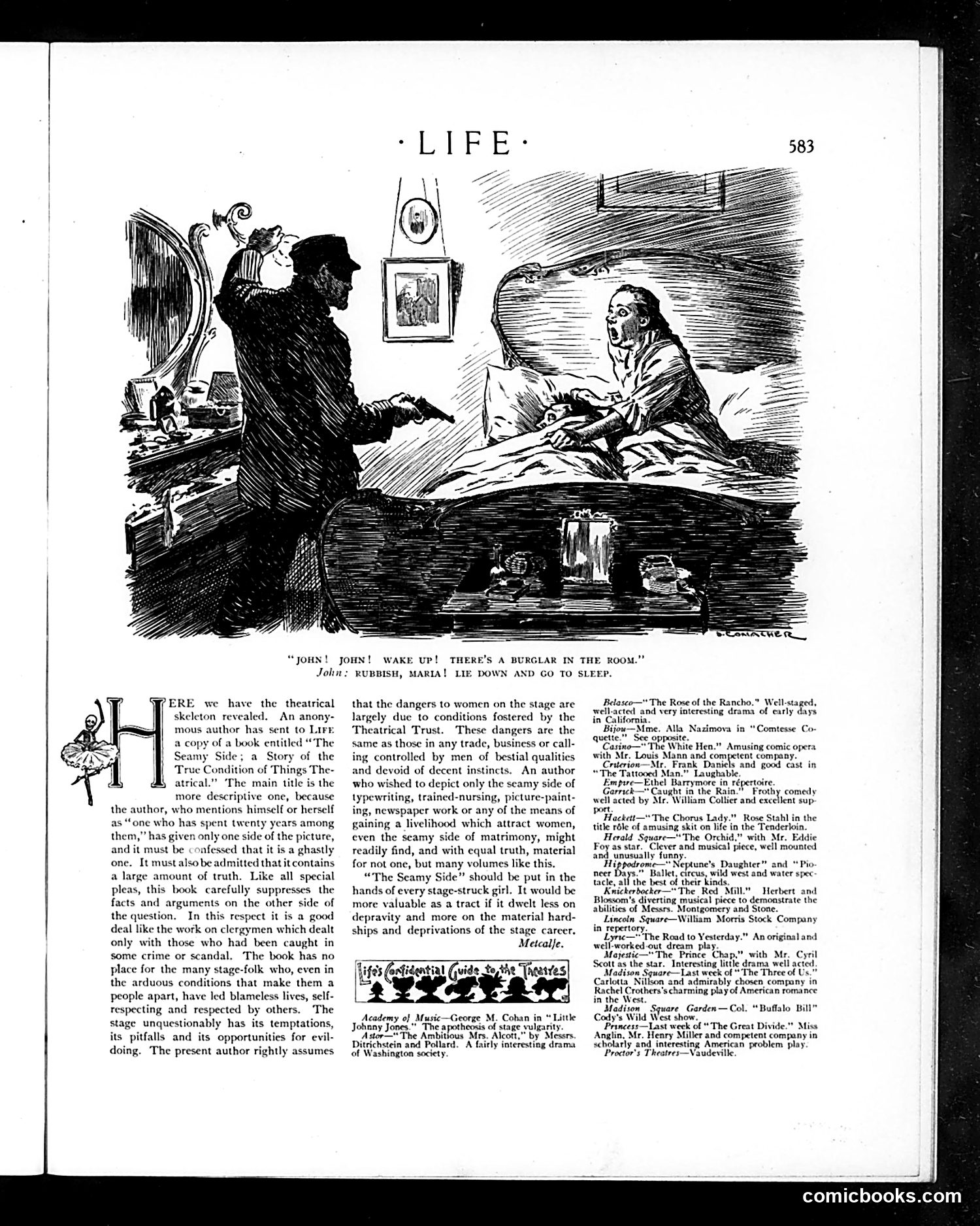
This page contains a satirical cartoon and theatrical review. The cartoon depicts a domestic scene where a wife repeatedly tries to wake her sleeping husband with increasingly alarming claims—first about a burglar, then other disturbances—but he dismissively tells her to "lie down and go to sleep." The joke satirizes male indifference and dismissiveness toward women's concerns, playing on the common trope of husbands ignoring their wives' warnings or complaints. The cartoon uses escalating urgency (the burglar claim) to mock his stubborn refusal to take her seriously. The accompanying text reviews a book titled "The Seamy Side" about theatrical working conditions. The critic acknowledges the book's truths about stage dangers while criticizing its one-sided presentation—arguing similar depravities exist in other professions. The page also lists current Broadway theater productions and performances, typical of Life's entertainment coverage during this period.
📄 Transcribed text from this page (OCR, searchable)
Machine-transcribed from the original scan — historical spelling and the odd misread are preserved.
“Joun! John: RUBBISH, MARIA! LIE DOWN AND GO TO SLEEP. ERE we have the theatrical skeleton revealed. An anony- mous author has sent to Lire a copy of a book entitled “The a Story of the Condition of Things The- atrical.”” ‘The main title is the more descriptive one, because the author, who mentions himself or herself as “one who has spent twenty years among them,” has given only one side of the picture, and it must be confessed that it is a ghastly one. It must also be admitted that it contains a large amount of truth. Like all special pleas, this book carefully suppresses the facts and arguments on the other side of the question. In this respect it is a good deal like the work on clergymen which dealt only with those who had been caught in some crime or scandal. The book has no place for the many stage-folk who, even in the arduous conditions that make them a people apart, have led blameless lives, self- respecting and respected by others. The stage unquestionably has its temptations, its pitfalls and its opportunities for evil- doing. The present author rightly assumes JOHN! WAKE UP! THERE’S A BURGLAR IN THE ROOM.”” that the dangers to women on the stage are largely due to conditions fostered by the Theatrical Trust. These dangers are the same as those in any trade, business or call- ing controlled by men of bestial qualities and devoid of decent instincts. An author who wished to depict only the seamy side of typewriting, trained-nursing, picture-paint- ing, newspaper work or any of the means of gaining a livelihood which attract women, even the seamy side of matrimony, might readily find, and with equal truth, material for not one, but many volumes like this. “The Scamy Side” should be put in the hands of every stage-struck girl. It would be more valuable as a tract if it dwelt less on depravity and more on the material hard- ships and deprivations of the stage career. Metcalfe. Academy of Music—George M. Coban in “ Little Johany Jones.” The apotheosis of stage vulgarity. Astor—"The Ambitious Mrs. Alcott,” by Messrs. Ditrichstein and Pollard. A fairly interesting drama of Washington society. Belasco—" The Rose of the Rancho.” Well-staged, well-acted_ and very interesting drama of early days in California. Bijou—Mme. Alla Nazimova in “Comtesse Co- quette.” See opposite. Casino—" The White Hen." Amusing comic opera with Mr. Louis Mann and competent company. Criterion Mr. Frank Daniels and good cast in “The Tattooed Man.” Laughable. Empire—Ethel Barrymore in repertoire. Garrick—" Caught in the Rain.” Frothy comedy well acted by Mr. William Collier and excellent sup- port Hackett—* The Chorus Lad: Rose Stahl in the title role of amusing skit on life in the Tenderloin. Herald Square—*The Orchid,” with Mr. Eddie Foy as star. Clever and musical piece, well mounted and unusually funny. a frome—* Neptune's Daughter” and “ Pio- neer Days.” Ballet, circus, wild west and water spec ticle, all the best of their kind Knickerbocker—* The Red Mill Herbert and Blossom's diverting musical piece to demonstrate the abilities of Messrs. Montgomery and Stone. Lincoln Square—William Morris Stock Company in repertory. Lyrie—"'The Road to Yesterday.” An original and well-worked-out dream play Mayestic—"The Prince Chap.” with Mr. Cyril Scott as the star. Interesting little drama well acted, Madison Square—Last week of "The Three of Us.” Carlotta Nillson and admirably chosen company in Rachel Crothers's charming play of American romance in the West. Madison Square Garden—Col. “Buffalo Bill” Cody's Wild West show. Princess—Last week of “The Great Divide.” Miss Anglin, Mr. Henry Miller and competent company in scholarly and interesting American problem play Proctor’s Theatres—Vaudeville. comicbooks.com