
Life, 1907-04-25 · page 14 of 24
Life — April 25, 1907 — page 14: what you’re looking at
What you’re looking at
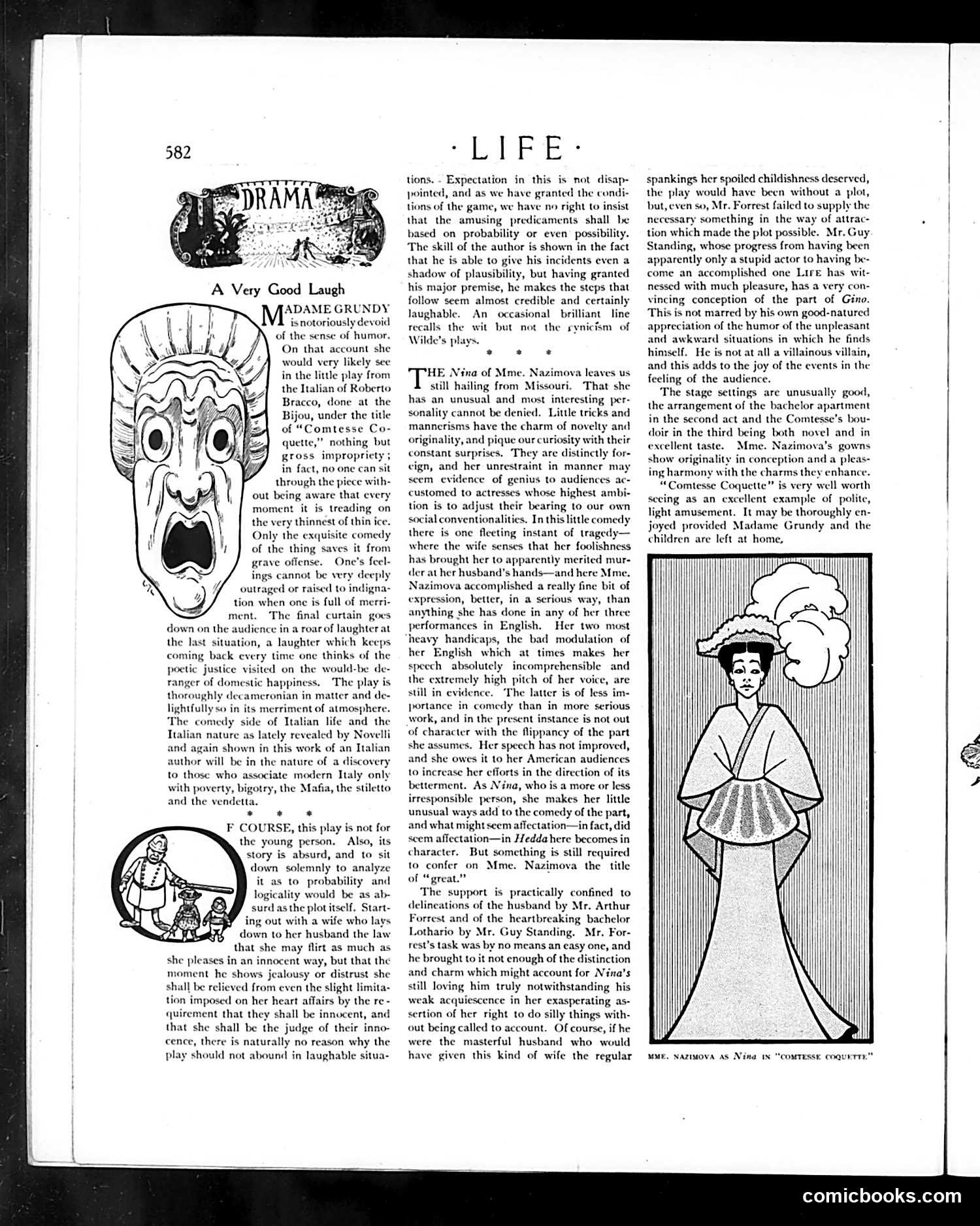
This page reviews a stage production of "Comtesse Coquette," an Italian play by Roberto Bracco at the Bijou theater. **The Cartoons**: The illustrated faces appear to mock "Madame Grundy"—a stock character representing rigid moral prudishness and disapproval of anything improper. The exaggerated expressions mock her hypothetical shock at the play's risqué content about marital infidelity. **The Point**: The critic argues the play succeeds because its *comedy* prevents moral offense—audiences are too busy laughing to feel outraged. The reviewer defends the absurd plot (a wife permits "innocent" flirtation while jealousy revokes restrictions) as legitimate theatrical fun. **Social Context**: "Madame Grundy" represents Victorian-era moral gatekeepers who would condemn such material. The review playfully mocks such censoriousness while defending sophisticated comedy. The critique of actress Nazimova's accent and high voice reveals period performance standards.
📄 Transcribed text from this page (OCR, searchable)
Machine-transcribed from the original scan — historical spelling and the odd misread are preserved.
A Very Good Laugh ADAME GRUNDY isnotoriously devoid of the sense of humor, On that account she would very likely see in the little play from the Italian of Roberto Bracco, done at the Bijou, under the title of “Comtesse Co- quette,” nothing but gross impropriety ; in fact, no one can sit through the piece with- out being aware that every moment it is treading on the very thinnest of thin ice. Only the exquisite comedy of the thing saves it from grave offense. One's feel- ings cannot be very deeply outraged of raised to indigna- tion when one is full of merri ment. ‘The final curtain. goc down on the audience in a roar of laughter at the last situation, a laughter which keeps. coming back every time one thinks of the poctic justice visited on the would-be de- ranger of domestic happiness. The play is thoroughly decameronian in matter and de- lightfully so in its merriment of atmosphere. The comedy side of Italian life and the Italian nature as lately revealed by Novelli and again shown in this work of an Italian uthor will be in the nature of a discovery to those who associate modern Italy only with poverty, bigotry, the Mafia, the stiletto and the vendetta. * 6 «@ F COURSE, this play is not for the young person. Also, its story is absurd, and to sit down solemnly to analyze it to probability and logicality would be as ab- surd asthe plot itself. Start- ing out with a wife who lays down to her husband the law that she may flirt as much she pleases in an innocent way, but that the moment he shows jealousy or distrust she shall be relieved from even the slight limita- tion imposed on her heart affairs by the re- quirement that they shall be innocent, and that she shall be the judge of their inno- cence, there is naturally no reason why the play should not abound in laughable situa- “LIFE? tions. - Expectation in this is not disap- pointed, and as we have granted the condi- tions of the game, we have no right to insist that the amusing predicaments shall be based on probability or even possibility. The skill of the author is shown in the fact that he is able to give his incidents even a shadow of plausibility, but having granted his major premise, he makes the steps that follow seem almost credible and certainly laughable. An occasional brilliant line recalls the wit but not the cynicism of Wilde’s plays. * 8 @ HE Nina of Mme. Nazimova leaves us still hailing from Missouri. That she has an unusual and most interesting per- sonality cannot be denied. Little tricks and mannerisms have the charm of novelty and originality, and pique our curiosity with their constant surprises. ‘They are distinctly for- m, and her unrestraint in manner may seem evidence of genius to audiences ac- customed to actresses whose highest ambi- tion is to adjust their bearing to our own social conventionalities. In this little comedy there is one fleeting instant of tragedy— where the wife senses that her foolishness has brought her to apparently merited mur- der at her husband's hands—and here Mme. N shed a really fine bit of expression, better, in a serious way, than nything she has done in any of her three performances in English. Her two most heavy handicaps, the bad modulation of her English which at times makes her speech absolutely incomprehensible and the extremely high pitch of her voice, are still in evidence. ‘The latter is of less im- portance in comedy than in more serious work, and in the present instance is not out of character with the flippancy of the part she assumes. Her speech has not improved, and she owes it to her American audiences to increase her efforts in the direction of its betterment. As Nina, who is a more or less irresponsible person, she makes her little unusual ways add to the comedy of the part, and what might seem affectation—in fact, did seem affectation—in Hedda here becomes in character. But something is still required to confer on Mme. Nazimova the title of “great.” The support is practically confined to delincations of the husband by Mr. Arthur Forrest and of the heartbreaking bachelor Lothario by Mr. Guy Standing. Mr. For- rest’s task was by no means an easy one, and he brought to it not enough of the distinction and charm which might account for Nina’s still loving him truly notwithstanding his weak acquiescence in her exasperating as- sertion of her right to do silly things with- out being called to account. Of course, if he were the masterful husband who would have given this kind of wife the regular zimova accomy spankings her spoiled childishness deserved, the play would have been without a plot, but, even so, Mr. Forrest failed to supply the necessary something in the way of attrac- tion which made the plot possible. Mr. Guy Standing, whose progress from having been apparently only a stupid actor to having be- come an accomplished one Lire has wit- nessed with much pleasure, has a very con- vincing conception of the part of Gino. This is not marred by his own good-natured appreciation of the humor of the unpleasant and awkward situations in which he finds himself. He is not at all a villainous villain, and this adds to the joy of the events in the feeling of the audience. The stage settings are unusually good, the arrangement of the bachelor apartment in the second act and the Comtesse’s bou- doir in the third being both novel and in excellent taste. Mme. Nazimova’s gowns show originality in conception and a plea ing harmony with the charms they enhance. “Comtesse Coquette” is very well worth sccing as an excellent example of polite, light amusement. It may be thoroughly en- joyed provided Madame Grundy and the children are left at home, aie. NAzIMOVA AS Nina IN “CcosTEsse coquertE.” comicbooks.com