
Life, 1907-04-25 · page 6 of 24
Life — April 25, 1907 — page 6: what you’re looking at
What you’re looking at
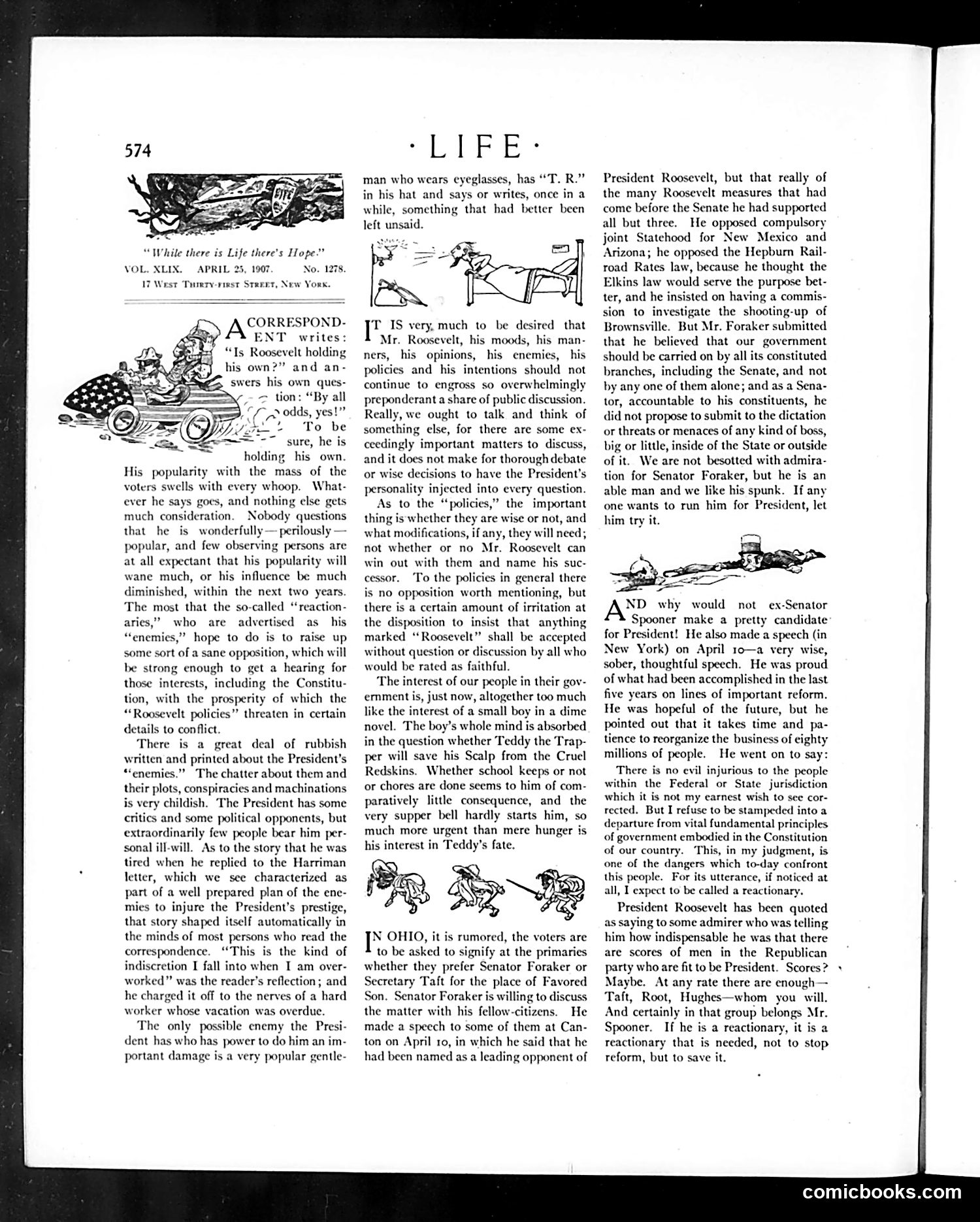
This page discusses President Theodore Roosevelt's overwhelming popularity and public influence. The text critiques how Roosevelt's personality dominates political discourse, arguing citizens should separately evaluate his "policies" from his personal popularity. A correspondent writes defending Roosevelt against critics who want him to stop influencing politics. The article suggests his popularity is so strong that opposition is nearly futile—comparing citizens' absorption with Roosevelt to a boy obsessed with saving his toy from "Teddy the Trapper." The page also discusses ex-Senator Spooner as a potential presidential candidate, suggesting he represents the Republican establishment seeking to continue or "save" reform efforts rather than reverse them. The illustrations (appearing to show cartoon figures) visually reinforce these political themes, though specific details are difficult to discern clearly in this reproduction.
📄 Transcribed text from this page (OCR, searchable)
Machine-transcribed from the original scan — historical spelling and the odd misread are preserved.
“While there is Life there's Hope.” VOL. XLIX. APRIL 25, 1907 No. 1278. wmRTY-riRsT Staret, New York. POND- writes: “Ts Roosevelt holding his own?” and an- swers his own ques- ~ tion: “By all > odds, yes!” r+ To be as sure, he is holding his own. His popularity with the mass of the . with every whoop. What- ever he says goes, and nothing else gets much consideration. Nobody questions that he is wonderfully — perilously popular, and few observing persons are at all expectant that his popularity will wane much, or his influence be much diminished, within the next two years. The most that the so-called “reaction- aries,” who are advertised as_ his “enemies,” hope to do is to raise up some sort of a sane opposition, which will be strong enough to get a hearing for those interests, including the Constitu- tion, with the prosperity of which the “Roosevelt policies” threaten in certain details to conflict. There is a great deal of rubbish written and printed about the President’s “enemies.” The chatter about them and their plots, conspiracies and machinations is very childish. The President has some critics and some political opponents, but extraordinarily few people bear him per- sonal ill-will. As to the story that he was tired when he replied to the Harriman letter, which we see characterized as part of a well prepared plan of the ene- mies to injure the President’s prestige, that story shaped itself automatically in the minds of most persons who read the correspondence. “This is the kind of indiscretion I fall into when I am over- worked” was the reader's reflection; and he charged it off to the nerves of a hard worker whose vacation was overdue. The only possible enemy the Pr dent has who has power to do him an im- portant damage is a very popular gentle- "LIFE: man who wears eyeglasses, has “T. R.”” in his hat and says or writes, once in a while, something that had better been left unsaid. I". IS very, much to be desired that Mr. Roosevelt, his moods, his man- ners, his opinions, his enemies, his policies and his intentions should not continue to engross so overwhelmingly preponderant a share of public discussion. Really, we ought to talk and think of something else, for there are some e: ceedingly important matters to discuss, and it does not make for thorough debate or wise decisions to have the President's personality injected into every question. As to the “policies,” the important thing is whether they are wise or not, and what modifications, if any, they will need; not whether or no Mr. Roosevelt can win out with them and name his suc- cessor. To the policies in general there is no opposition worth mentioning, but there is a certain amount of irritation at the disposition to insist that anything marked ‘‘Roosevelt” shall be accepted without question or discussion by all who would be rated as faithful. The interest of our people in their gov- ernment is, just now, altogether too much like the interest of a small boy in a dime novel. The boy’s whole mind is absorbed in the question whether Teddy the Trap- per will save his Scalp from the Cruel Redskins. Whether school keeps or not or chores are done seems to him of com- paratively little consequence, and the very supper bell hardly starts him, so much more urgent than mere hunger is his interest in Teddy’s fate. a Sy OHIO, it is rumored, the voters are to be asked to signify at the primaries whether they prefer Senator Foraker or Secretary Taft for the place of Favored Son. Senator Foraker is willing to discuss the matter with his fellow-citizens. He made a speech to some of them at Can- ton on April ro, in which he said that he had been named as a leading opponent of President Roosevelt, but that really of the many Roosevelt measures that had come before the Senate he had supported all but three. He opposed compulsory joint Statehood for New Mexico and Arizona; he opposed the Hepburn Rail- road Rates law, because he thought the Elkins law would serve the purpose bet- ter, and he insisted on having a commis- sion to investigate the shooting-up of Brownsville. But Mr. Foraker submitted that he believed that our government should be carried on by all its constituted branches, including the Senate, and not by any one of them alone; and as a Sena- tor, accountable to his constituents, he did not propose to submit to the dictation or threats or menaces of any kind of boss, big or little, inside of the State or outside of it. We are not besotted with admira- tion for Senator Foraker, but he is an able man and we like his spunk. If any one wants to run him for President, let him try it. oN ND why would not ex-Senator Spooner make a pretty candidate for President! He also made a speech (in New York) on April ro—a very wise, sober, thoughtful speech. He was proud of what had been accomplished in the last five years on lines of important reform, He was hopeful of the future, but he pointed out that it takes time and pa- tience to reorganize the business of eighty millions of people. He went on to say: There is no evil injurious to the people within the Federal or State jurisdiction which it is not my earnest wish to see cor- rected. But I refuse to be stampeded into a departure from vital fundamental principles of government embodied in the Constitution of our country. ‘This, in my judgment, is one of the dangers which to-day confront this people. For its utterance, if noticed at all, I expect to be called a reactionary. President Roosevelt has been quoted as saying to some admirer who was telling him how indispensable he was that there are scores of men in the Republican party who are fit to be President. Scores? Maybe. At any rate there are enough— Taft, Root, Hughes—whom you will. And certainly in that group belongs Mr. Spooner. If he is a reactionary, it is a reactionary that is needed, not to stop reform, but to save it. comicbooks.com