
Life, 1907-04-25 · page 16 of 24
Life — April 25, 1907 — page 16: what you’re looking at
What you’re looking at
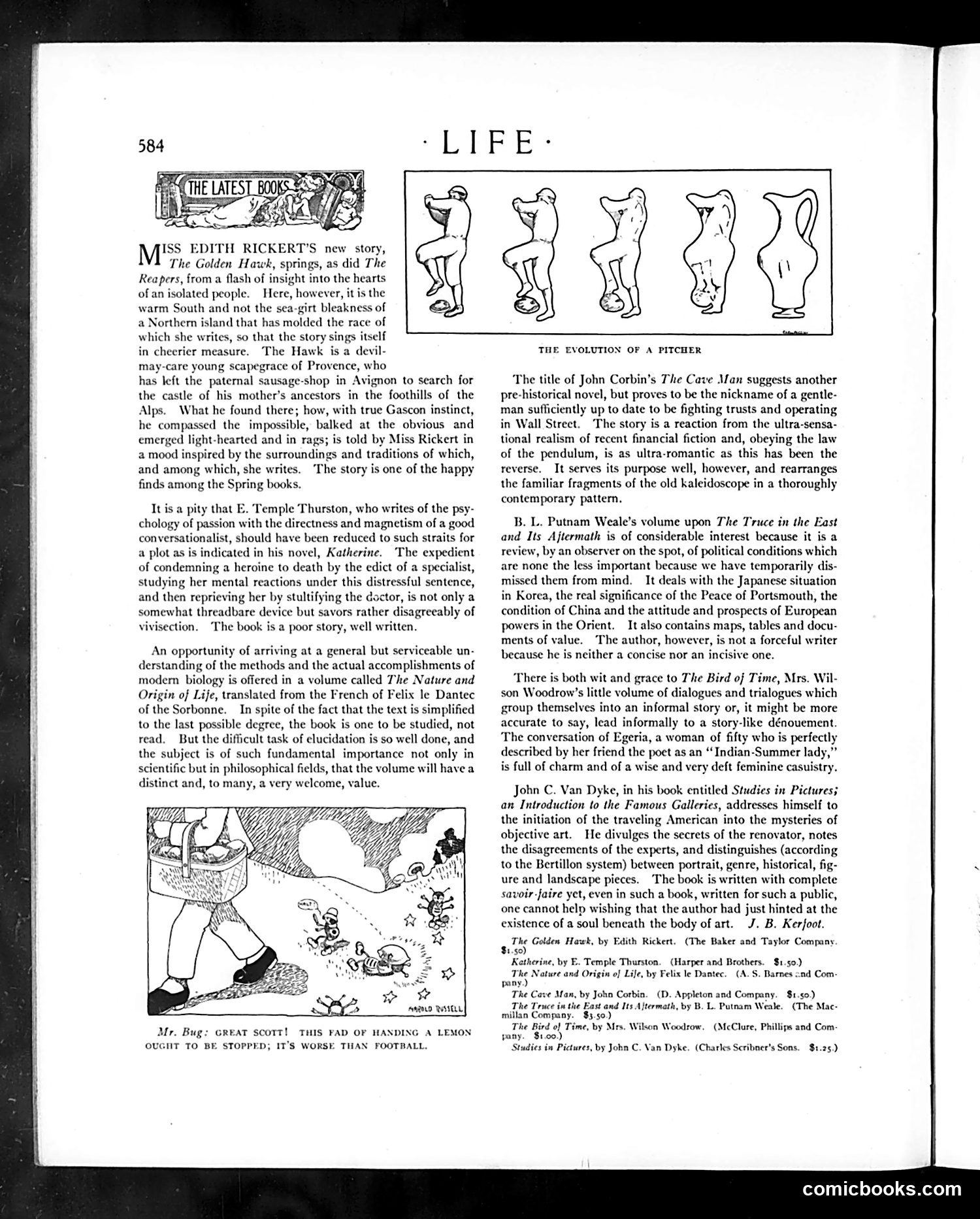
The top cartoon shows five sequential drawings of a baseball pitcher's body positions, labeled "The Evolution of a Pitcher"—a humorous visual pun playing on Darwin's evolutionary theory, which was still controversial and much-discussed in early 20th-century America. The bottom cartoon depicts an insect addressing another bug about "handing a lemon" being worse than football. "Lemon" was period slang for a defective product or disappointing thing. The joke appears to mock some contemporary fad (unclear which specific trend) by suggesting even insects recognize it's problematic—exaggerating its absurdity through the insects' perspective. Both cartoons use visual wit typical of *Life* magazine's satirical style, combining contemporary concerns (evolution, consumerism, sports culture) with clever visual metaphors for comedic effect.
📄 Transcribed text from this page (OCR, searchable)
Machine-transcribed from the original scan — historical spelling and the odd misread are preserved.
ISS EDITH RICKERT’S new story, The Golden Hawk, springs, as did The Rea pers, from a flash of insight into the hearts ofan isolated people. Here, however, it is the warm South and not the sea-girt bleakness of a Northern island that has molded the race of which she writes, so that the story sings itself in cheerier measure. The Hawk is a devil- may-care young scapegrace of Provence, who has left the pate sausage-shop in Avignon to search for the castle of his mother’s ancestors in the foothills of the Alps. What he found there; how, with true Gascon instinct, he compassed the impossible, balked at the obvious and emerged light-hearted and in rags; is told by Miss Rickert in a mood inspired by the surroundings and traditions of which, and among which, she writes. ‘The story is one of the happy finds among the Spring books. pity that E. Temple Thurston, who writes of the psy- chology of passion with the directness and magnetism of a good ‘sationalist, should have been reduced to such straits for a plot as is indicated in his novel, Katherine. The expedient of condemning a heroine to death by the edict of a specialist, studying her mental reactions under this distressful sentence, and then reprieving her by stultifying the doctor, is not only a ewhat threadbare device but savors rather disagreeably of ction. The book is a poor story, well written. An opportunity of arriving at a general but serviceable un- derstanding of the methods and the actual accomplishments of erm biology is offered in a volume called The Nature and igin of Lije, translated from the French of Felix le Dantec of the Sorbonne. In spite of the fact that the text is simplified to the last possible degree, the book is one to be studied, not read. But the difficult task of elucidation is so well done, and the subject is of such fundamental importance not only in scientific but in philosophical fields, that the volume will have a distinct and, to many, a very welcome, value. yyy Ya LET), Wi ee “Gy Ly E Ly, LA fe Ae OL Mr. Bug: Great scort! ovcnt To THIS FAD OF HANDING A LEMON STOPPED; IT’S WORSE THAN FOOTBALL. THE EVOLUTION OF A PITCHER The title of John Corbin’s The Cave Man suggests another pre-historical novel, but proves to be the nickname of a gentle- man sufficiently up to date to be fighting trusts and operating in Wall Street. The story is a reaction from the ultra-sensa- tional realism of recent financial fiction and, obeying the law of the pendulum, is as ultra-romantic as this has been the reverse. It serves its purpose well, however, and rearranges the familiar fragments of the old kaleidoscope in a thoroughly contemporary pattern, B. L. Putnam Weale’s volume upon The Truce in the East and Its Ajtermath is of considerable interest because it is a review, by an observer on the spot, of political conditions which are none the less important because we have temporarily dis- missed them from mind. It deals with the Japanese situation in Korea, the real significance of the Peace of Portsmouth, the condition of China and the attitude and prospects of European powers in the Orient. It also contains maps, tables and docu- ments of value. The author, however, is not a forceful writer because he is neither a concise nor an incisive one. There is both wit and grace to The Bird of Time, Mrs. Wil- son Woodrow’s little volume of dialogues and trialogues which group themselves into an informal story or, it might be more accurate to say, lead informally to a story-like dénouement. The conversation of Egeria, a woman of fifty who is perfectly described by her friend the poet as an “Indian-Summer lady,” is full of charm and of a wise and very deft feminine casuistry. John C. Van Dyke, in his book entitled Studies in Pictures; an Introduction to the Famous Galleries, addresses himself to the initiation of the traveling American into the mysteries of objective art. He divulges the secrets of the renovator, notes the disagreements of the experts, and distinguishes (according to the Bertillon system) between portrait, genre, historical, fig- ure and landscape pieces. ‘The book is written with complete savoir-faire yet, even in such a book, written for such a public, one cannot help wishing that the author had just hinted at the existence of a soul beneath the body of art. J. B. Kerjoot. gi 7h Golden Hawk, by Ealth Rickert. (The Baker and Taylor Commas 1-50) Katherine, by E. Temple Thurston. (Harper and Brothers. $1.50.) The Nature and Origin of LiJe, by Felix le Dantec. (A. S. Barnes 2nd Com: pany.) The Cave Man, by John Corbin. (D. Appleton and Company. $1.50) The Truce in te East and Its Ajtermath, by B. L. Putnam Weale. (The Mac millan Company. $3.50.) The Bird o} Time, by Mrs. Wilson Woodrow. pany. $1.00.) Studies in Pictures, by John C. Van Dyke. (Charles Scribner's Sons. $1.25.) (McClure, Phillips and Com- comicbooks.com