
A complete issue · 24 pages · 1907
Life — March 28, 1907
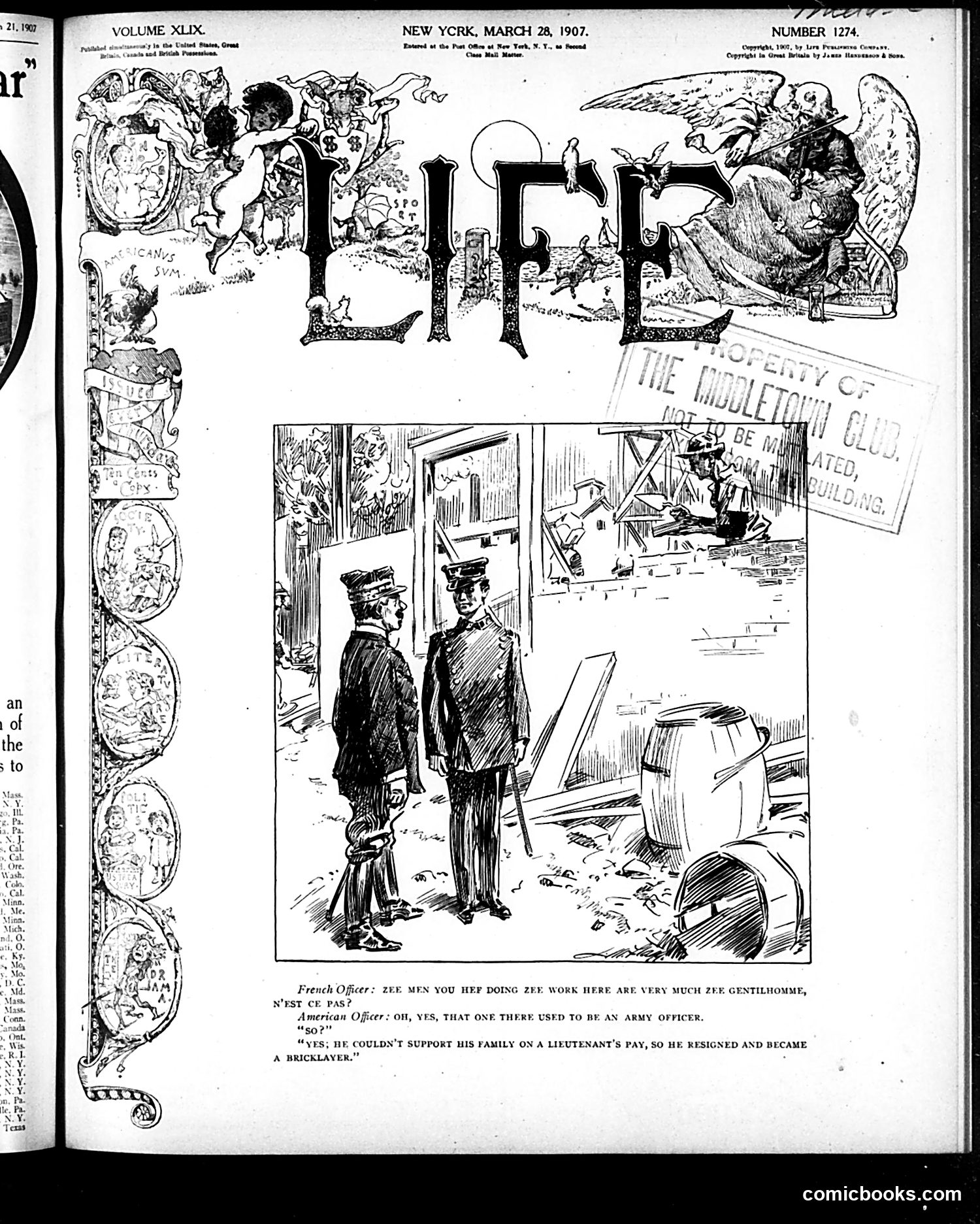
This page satirizes Franco-American military relations, likely during the period of cordial diplomatic relations between France and the United States (the "Entente Cordiale" era). The main cartoon depicts two French officers inspecting construction work, commenting approvingly on the laborers' "gentlemanly" demeanor. An American officer responds that one worker was formerly an army officer who resigned because he couldn't support his family on a lieutenant's pay, so "he resigned and became a bricklayer." The satire targets the contrast between military rank/prestige and economic hardship—American military officers earned so little that some had to abandon their commissions for manual labor. The joke mocks both the financial inadequacy of American military compensation and the absurdity of an educated officer forced into bricklaying work.
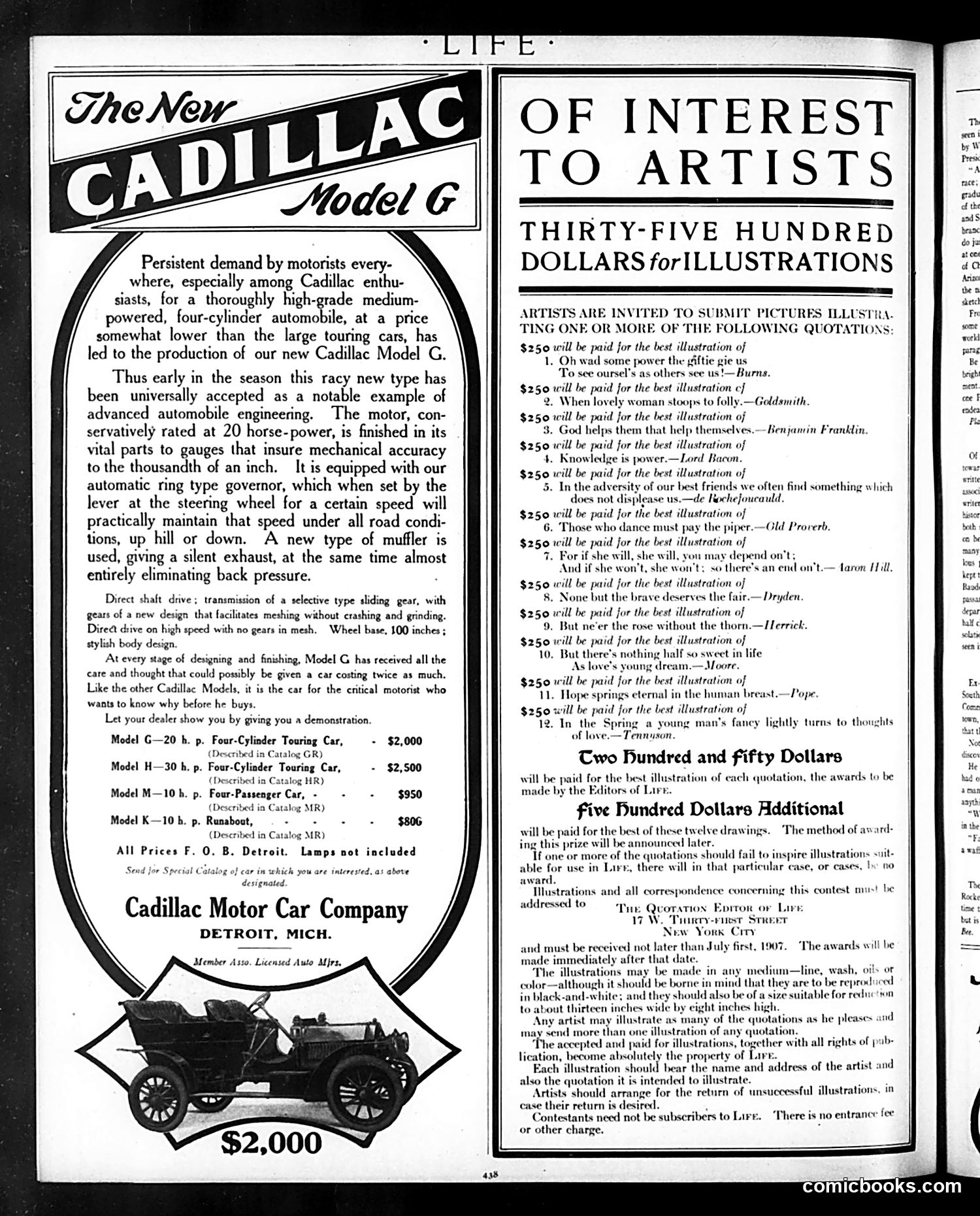
This page contains **no political cartoons or satirical content**—it's primarily advertising and a contest announcement. The **left side** advertises the new Cadillac Model G automobile, emphasizing its engineering features (ring-type governor, direct drive, selective sliding gear) and competitive pricing ($950–$2,500 depending on model). The **right side** announces a contest by *Life* magazine offering **$3,550 in total prizes** for illustrations of literary quotations. Artists could submit pictures for various famous quotes (from Burns, Goldsmith, Franklin, etc.), with individual prizes ranging from $250–$500. This represents typical early-20th-century magazine content: luxury advertising alongside contests designed to attract artists and boost readership engagement.
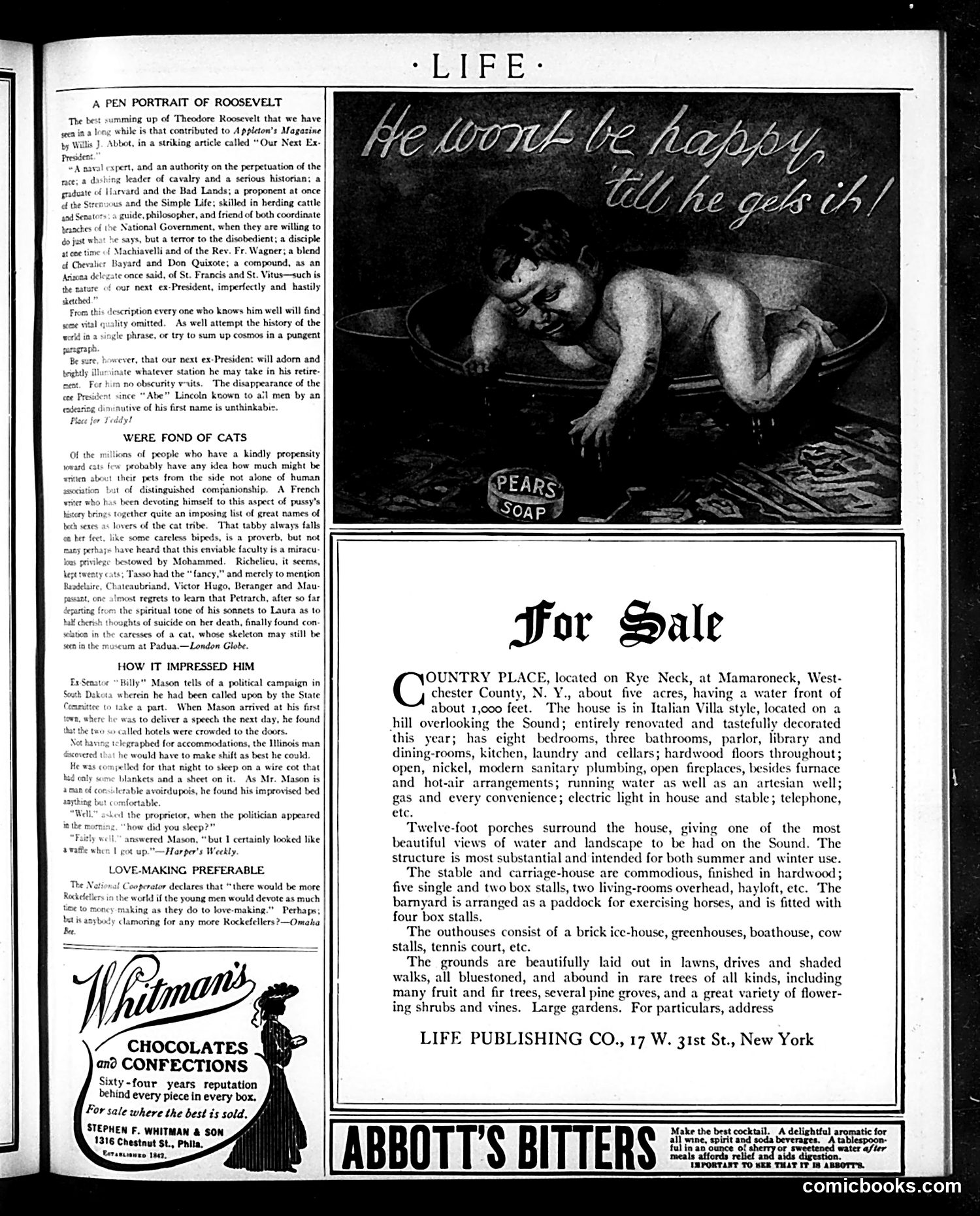
This page is primarily **advertising and non-political content**. The main elements are: 1. **"A Pen Portrait of Roosevelt"** (left column) — a favorable literary sketch praising Theodore Roosevelt's character and accomplishments, describing him as having qualities of a cavalry leader, historian, and guide-philosopher. 2. **"Were Fond of Cats"** — a lighthearted piece about cat appreciation among notable historical figures (Mohammed, Richelieu, Tasso, Petrarch). 3. **"How It Impressed Him"** — a brief anecdote about politician "Billy" Mason's political campaign experience. 4. **Large real-estate advertisement** for a country property in Westchester County, New York. 5. **Product advertisements** for Pears Soap, Whitman's Chocolates, and Abbott's Bitters. The page contains **no satirical cartoons** — it's primarily editorial content and advertising from what appears to be an early 20th-century issue.
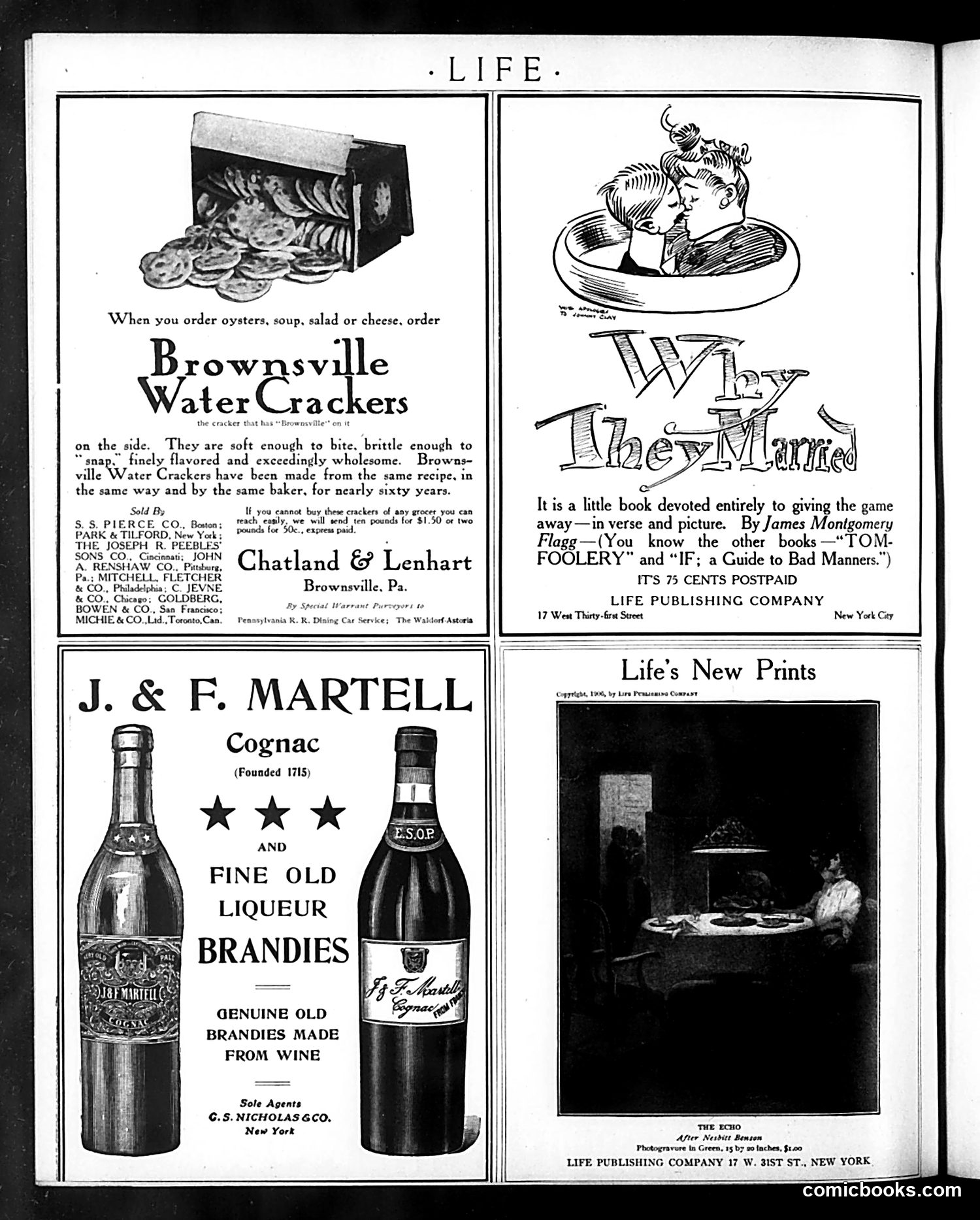
This page consists primarily of **advertisements** rather than political cartoons or satire. The upper left advertises **Brownsville Water Crackers**, emphasizing their quality and versatility as accompaniments to oysters and cheese. The upper right promotes a small book titled **"Why They Married"** by James Montgomery Flagg, described as giving "the game away" through witty pictures about marriage—a humorous self-help or entertainment book. The lower half features a **J. & F. Martell Cognac advertisement**, highlighting their three-star and VSOP brandies "founded 1715," marketed as genuine old brandies made from wine. The bottom right shows **Life's New Prints** photography section featuring "The Echo" by Nesbitt Benson. There is **no political satire or social commentary** on this particular page—it is a standard commercial advertising layout typical of early-to-mid 20th century magazines.
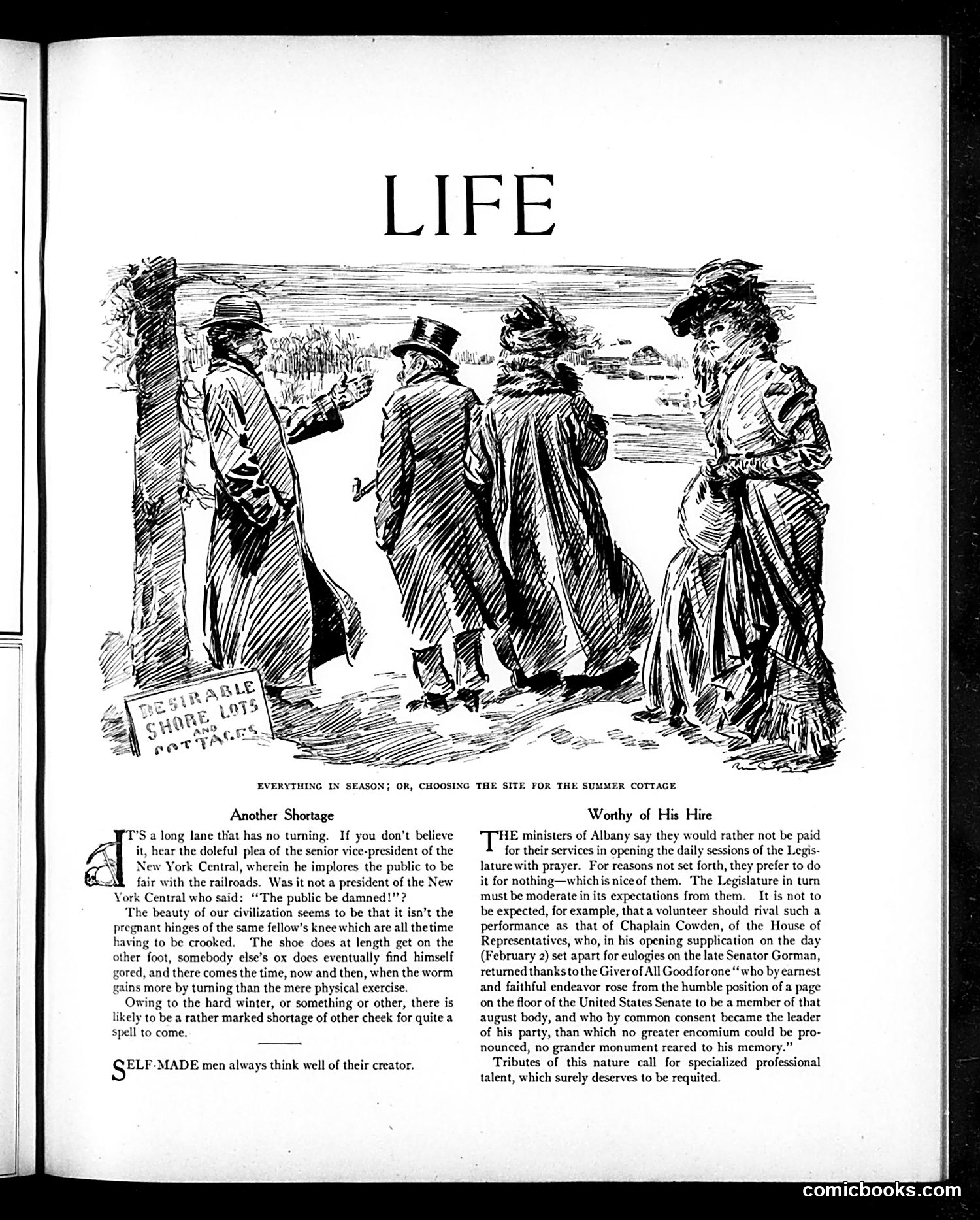
The main cartoon illustrates "Everything in Season; or, Choosing the Site for the Summer Cottage"—depicting well-dressed figures discussing real estate by a waterfront. This satirizes wealthy Americans' seasonal migration patterns and the competitive real estate market for summer homes, a common leisure pursuit among the affluent. The text columns address unrelated topics: "Another Shortage" discusses New York Central railroad labor issues, while "Worthy of His Hire" debates whether legislators should be paid for opening daily prayer sessions in the state legislature. The cartoon's humor targets upper-class pretension and materialism around vacation property—a recognizable concern for Life's educated readership. The specific legislative debate appears to reflect early 20th-century American church-state tensions.
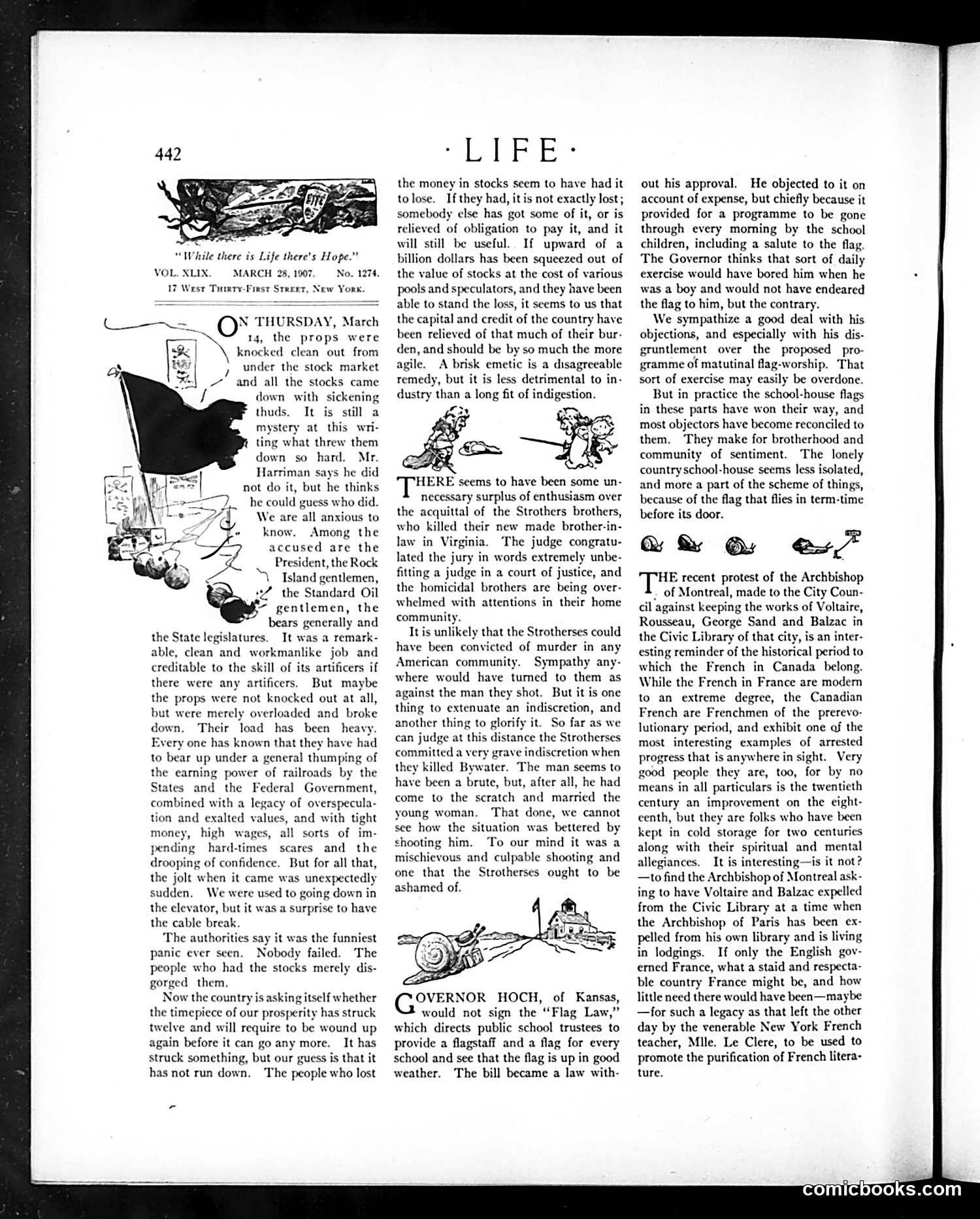
This page contains primarily text commentary rather than political cartoons. The main content discusses the 1914 stock market crash ("props were knocked out"), comparing it to previous financial panics. The author notes the public remained calm during the crisis. The text also covers Governor Hoch of Kansas's objection to a proposed "Flag Law" requiring public schools to display flags daily—he deemed it an unnecessary expense and a program better suited to homes than schools. Finally, there's discussion of the Archbishop of Montreal's protest against keeping French authors (Voltaire, Rousseau, Sand, Balzac) in the city's civic library, framed as preserving French literary heritage. The small decorative illustrations are generic vignettes rather than specific political caricatures.
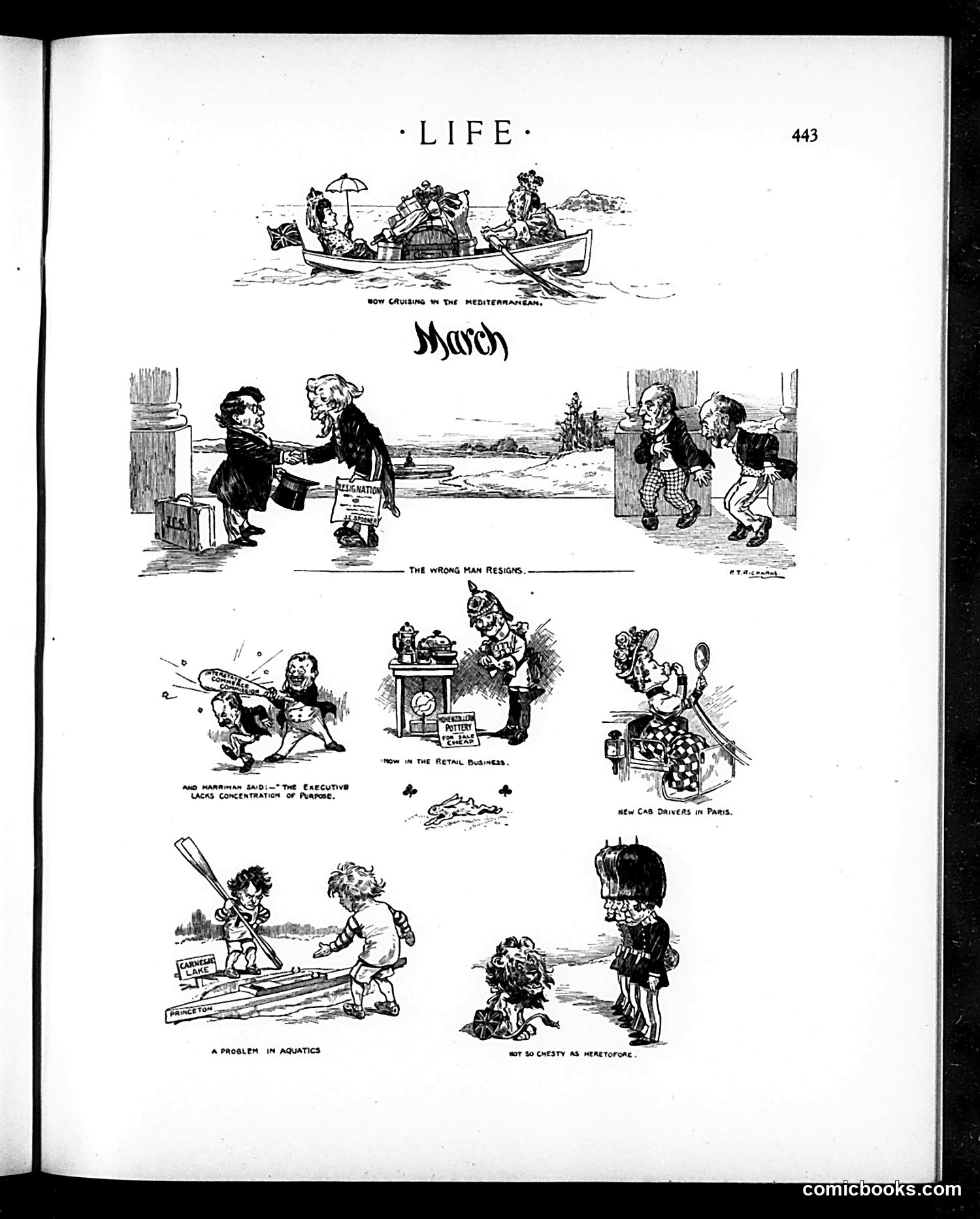
This page contains six satirical cartoons commenting on early 20th-century political and social issues: 1. **"Row Cruising in the Mediterranean"** - depicts figures in boats, likely referencing diplomatic or military activities. 2. **"The Wrong Man Resigns"** - shows a resignation or political upheaval scenario. 3. **"Frog in the Retail Business"** and **"And Harrison Said"** - appear to mock business practices or executive decisions. 4. **"New Cab Drivers in Paris"** - satirizes Parisian transportation workers. 5. **"A Problem in Aquatics"** - depicts a conflict over water/swimming access, possibly commenting on class divisions. 6. **"Not So Chesty as Heretofore"** - unclear without additional context, but appears to mock someone's reduced confidence or status. The cartoons use exaggerated caricatures typical of early 20th-century satirical journalism.
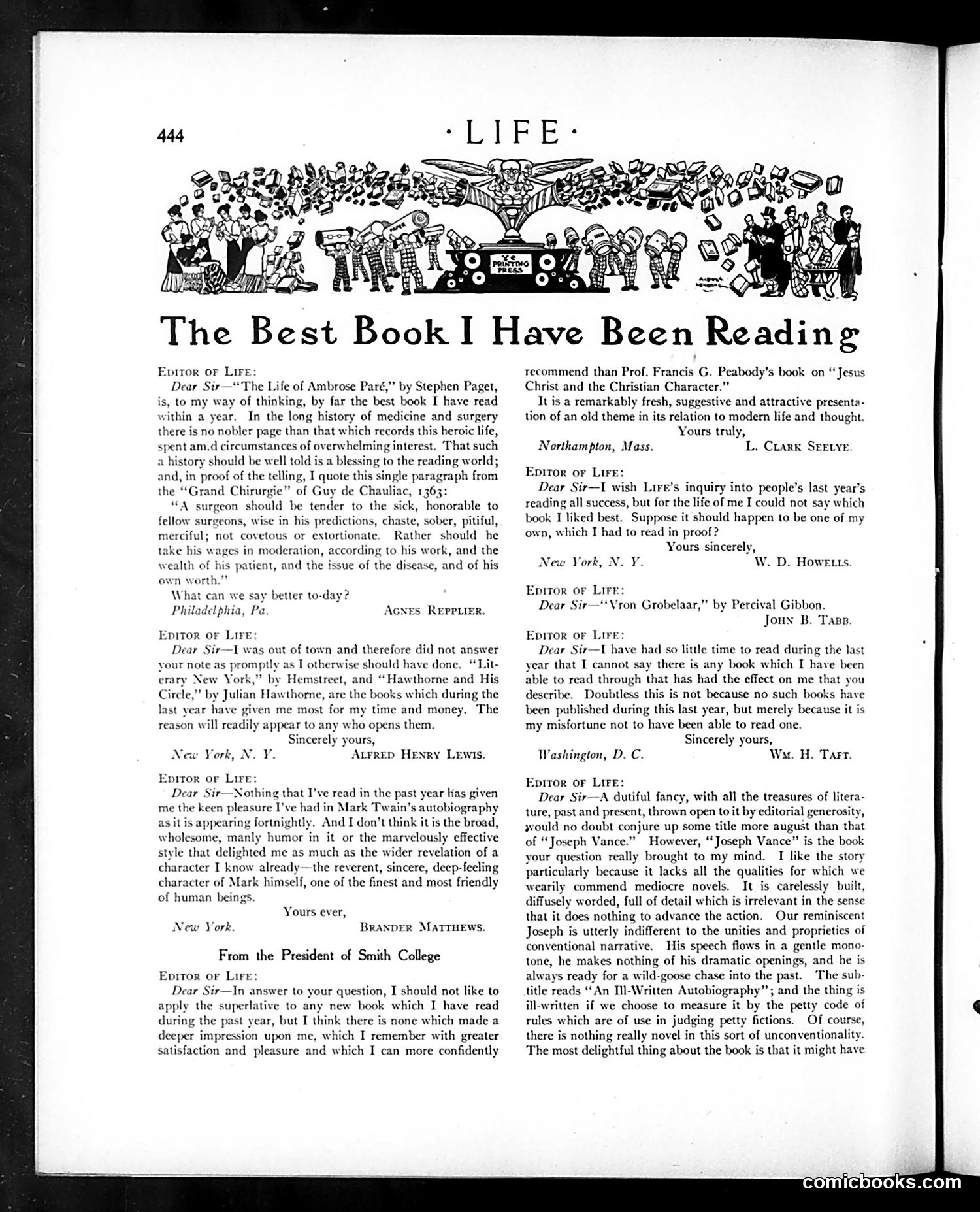
This page is not a political cartoon but rather a **letters-to-the-editor section** titled "The Best Book I Have Been Reading." It contains reader responses to *Life* magazine's inquiry about notable books. The decorative header features an illustrated crowd of diverse figures under a winged eagle emblem—a common *Life* magazine masthead element symbolizing American culture and readership. The letters discuss books like "The Life of Ambrose Paré" (medical history), "Von Grobelaar" by Percival Gibbon, and Hawthorne's works. One correspondent critiques "Joseph Vance" as poorly written despite its subject matter. There is **no satire or political commentary**—this is straightforward reader engagement content reflecting early-20th-century literary tastes among educated Americans.
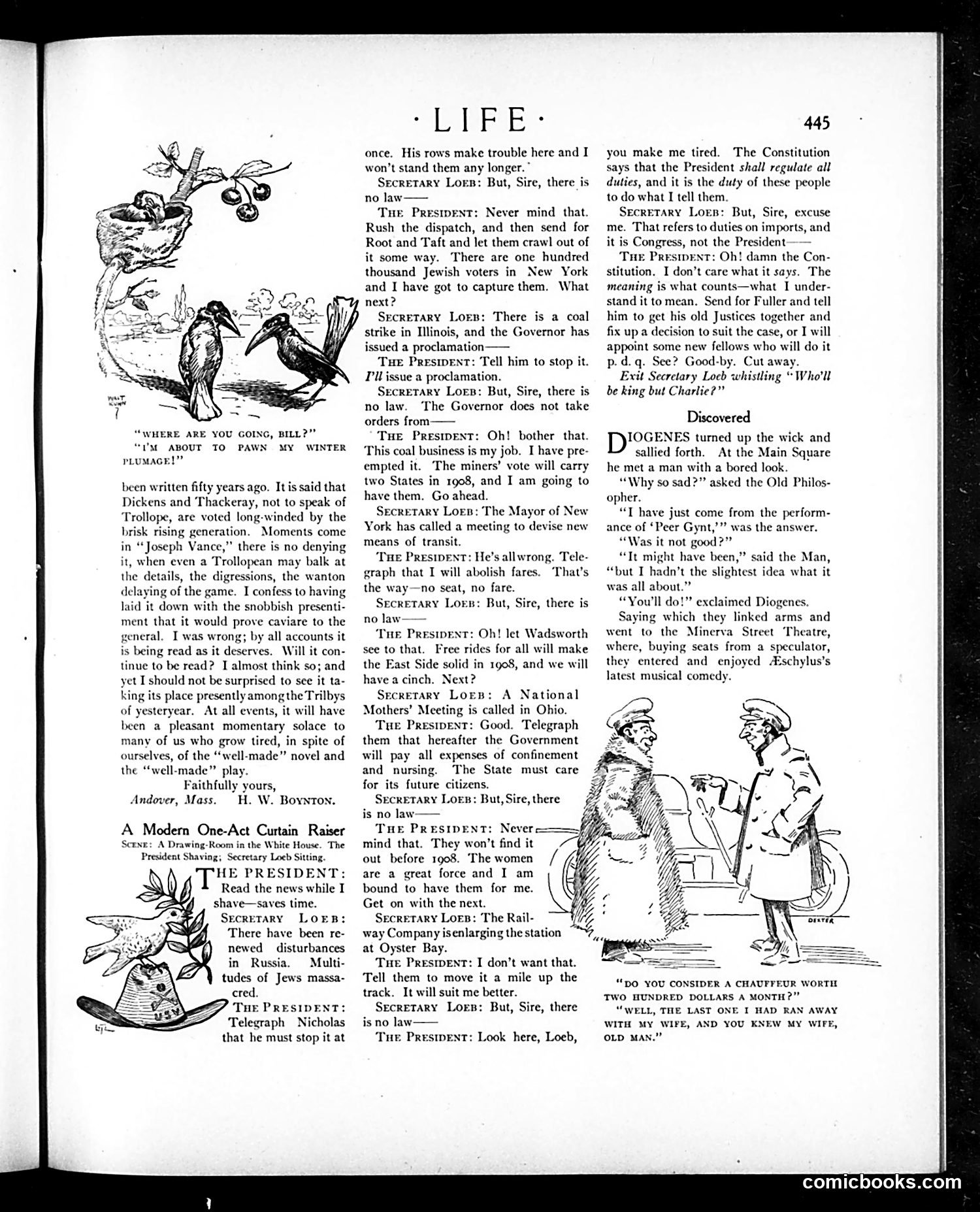
This page contains a satirical one-act play titled "A Modern One-Act Curtain Raiser," set in the White House drawing room. The dialogue depicts the President and Secretary Lord debating various policy issues—Jewish voters in New York, coal strikes in Illinois, railroad expansion, and government expenses. The satire mocks presidential decision-making as reactive and chaotic, with the Secretary constantly objecting "But, Sire, there is no law" to each proposal, while the President dismissively overrides concerns. The cartoons illustrate the tension between executive overreach and legal constraints. The accompanying illustrations show political figures in period dress, likely representing early 20th-century government officials, emphasizing the absurdity of attempting to solve complex policy problems through presidential decree alone. The humor targets both executive overconfidence and bureaucratic obstruction.
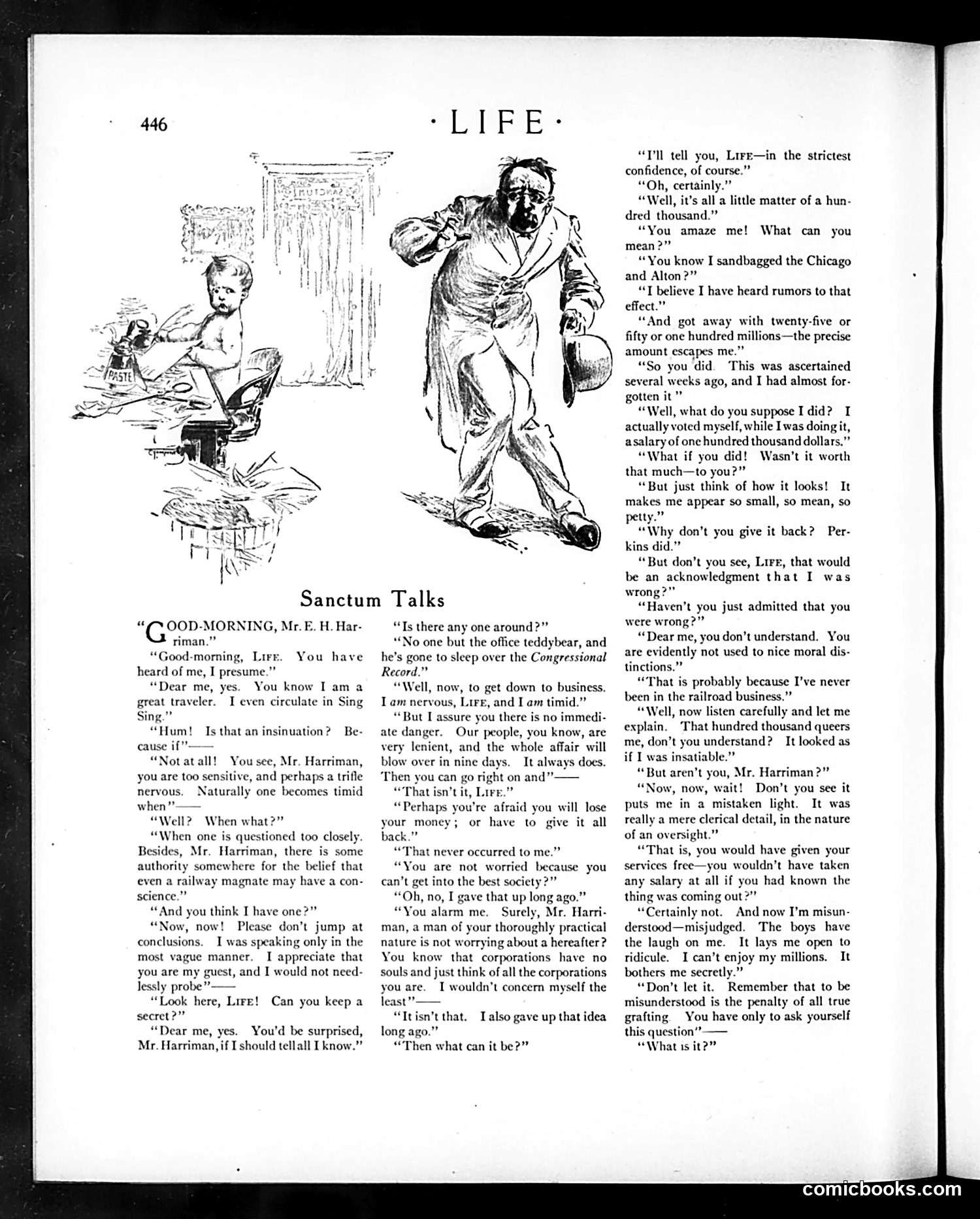
This page features a dialogue between "Life" (the magazine's personified voice) and Mr. E.H. Harriman, a prominent railroad magnate. The cartoon depicts Harriman as a disheveled, anxious figure—visual satire of his nervous disposition. The conversation satirizes Harriman's involvement in a financial scandal involving the Chicago and Alton Railway, where he allegedly misappropriated millions of dollars. Life mocks Harriman's attempts to minimize the scandal as merely a "clerical detail" and an "oversight," while questioning how he could claim such large sums "escaped" him. The satire exposes corporate malfeasance and the wealthy elite's casual dismissal of financial impropriety as minor bookkeeping errors.
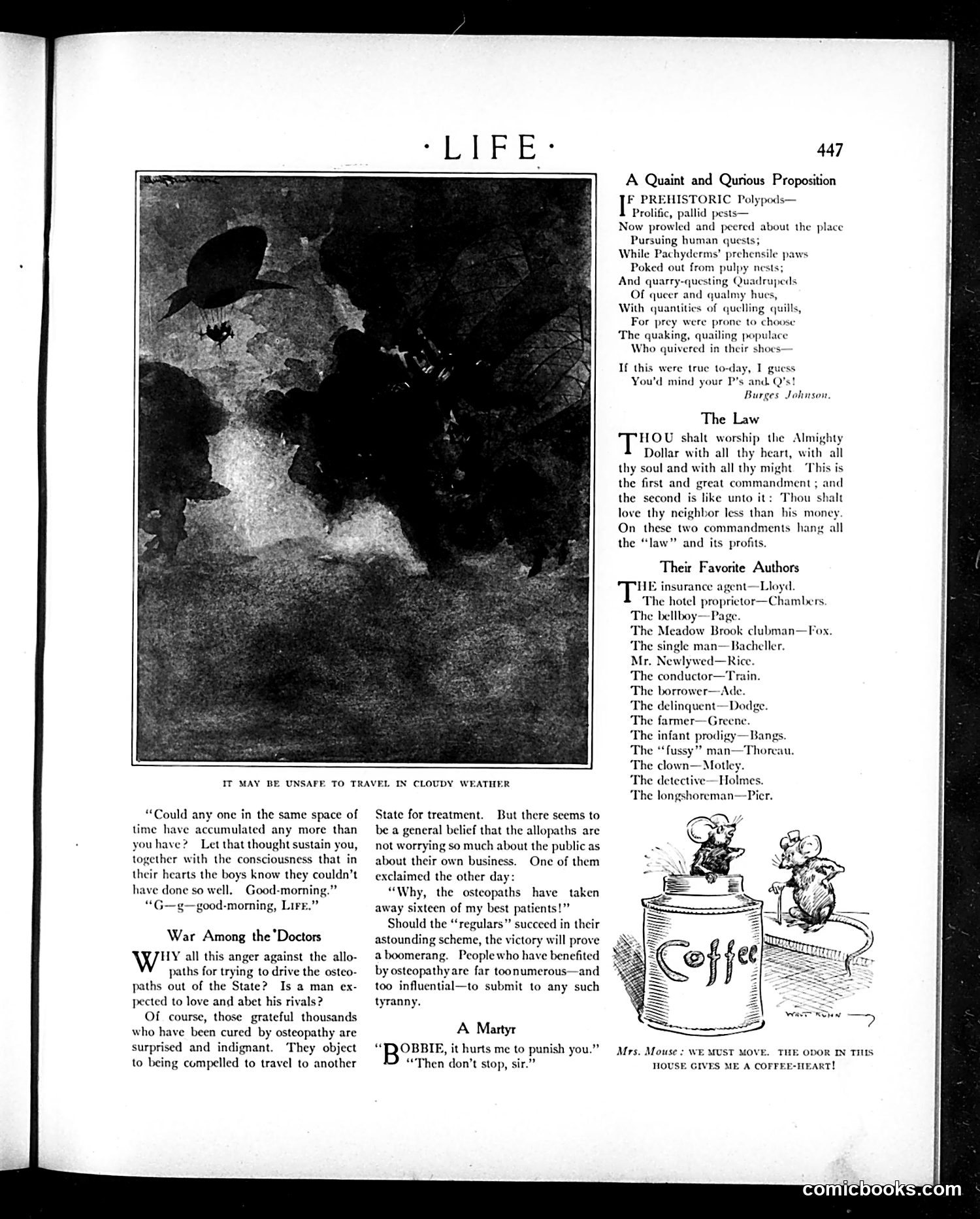
This page satirizes early 20th-century medical disputes. The main article "War Among the Doctors" criticizes osteopaths attempting to establish themselves as legitimate medical practitioners in competition with traditional doctors. The text expresses indignation that patients cured by osteopathy are being pressured to travel elsewhere for treatment—apparently a regulatory effort by established physicians to drive osteopaths out of states. The cartoon at bottom shows a mouse being punished for drinking from a coffee pot, with caption "MRS. MOUSE: WE MUST MOVE. THE ODOR IN THIS HOUSE GIVES ME A COFFEE-HEART!" This appears unrelated satirical humor about domestic life rather than medical commentary. The page demonstrates Life magazine's role exposing professional turf wars and medical establishment gatekeeping.
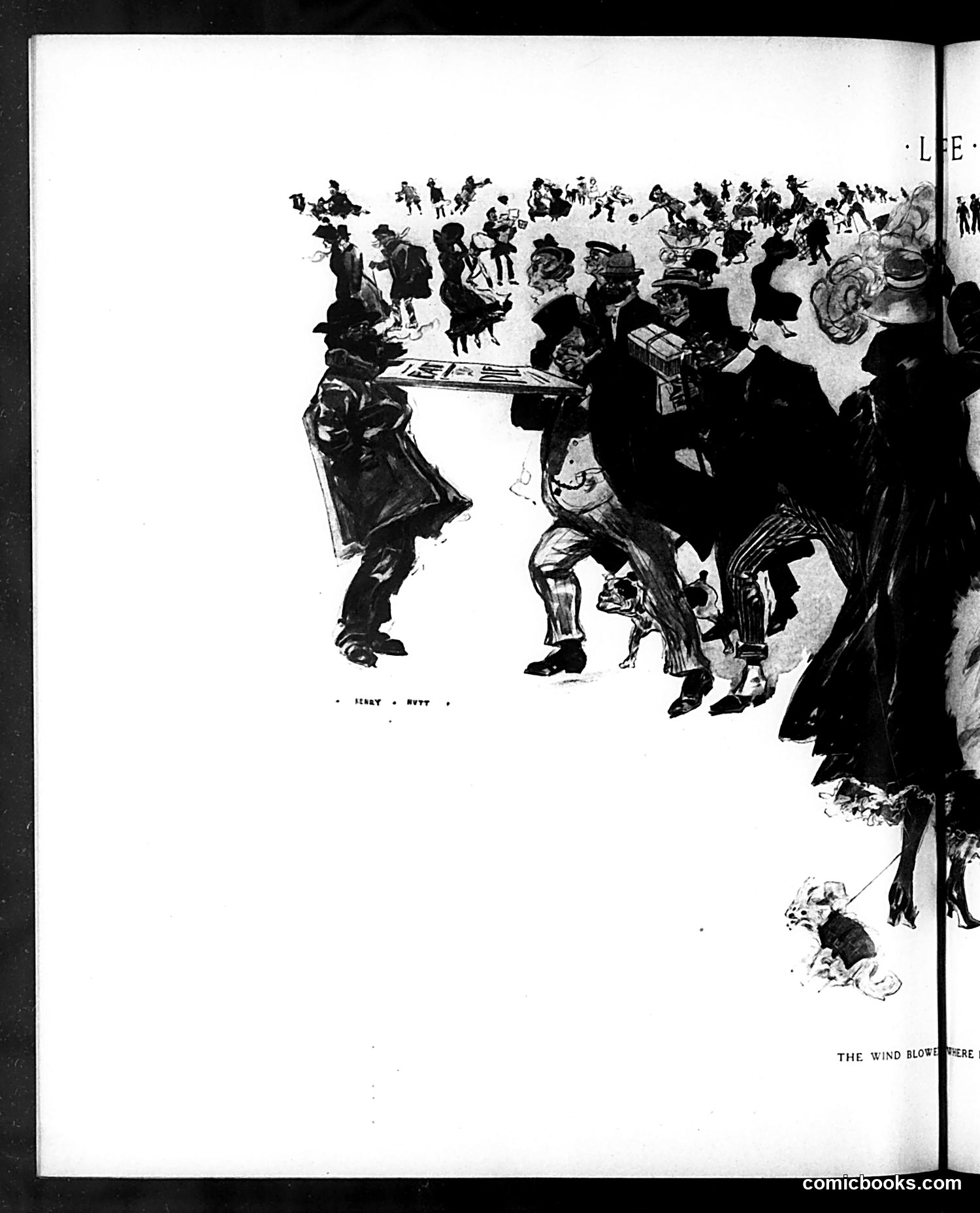
This page contains satirical illustrations depicting a social scene with exaggerated characters in period dress (appears to be early 20th century). The caption "HEAVY + DUTY" and "THE WIND BLEW HERE" suggest commentary on fashion or social pretension. The foreground shows caricatured figures with pronounced features—likely satirizing wealthy or fashionable society types. The crowd in the background represents observers or the general public witnessing this spectacle. Without clearer text identifying specific individuals or events, the exact political reference remains unclear. However, the style suggests *Life* magazine's typical approach: mocking upper-class vanity, fashion excess, or social climbing through exaggerated physical comedy and crowd dynamics. The "wind" reference may joke about fragility or absurdity of these social presentations.
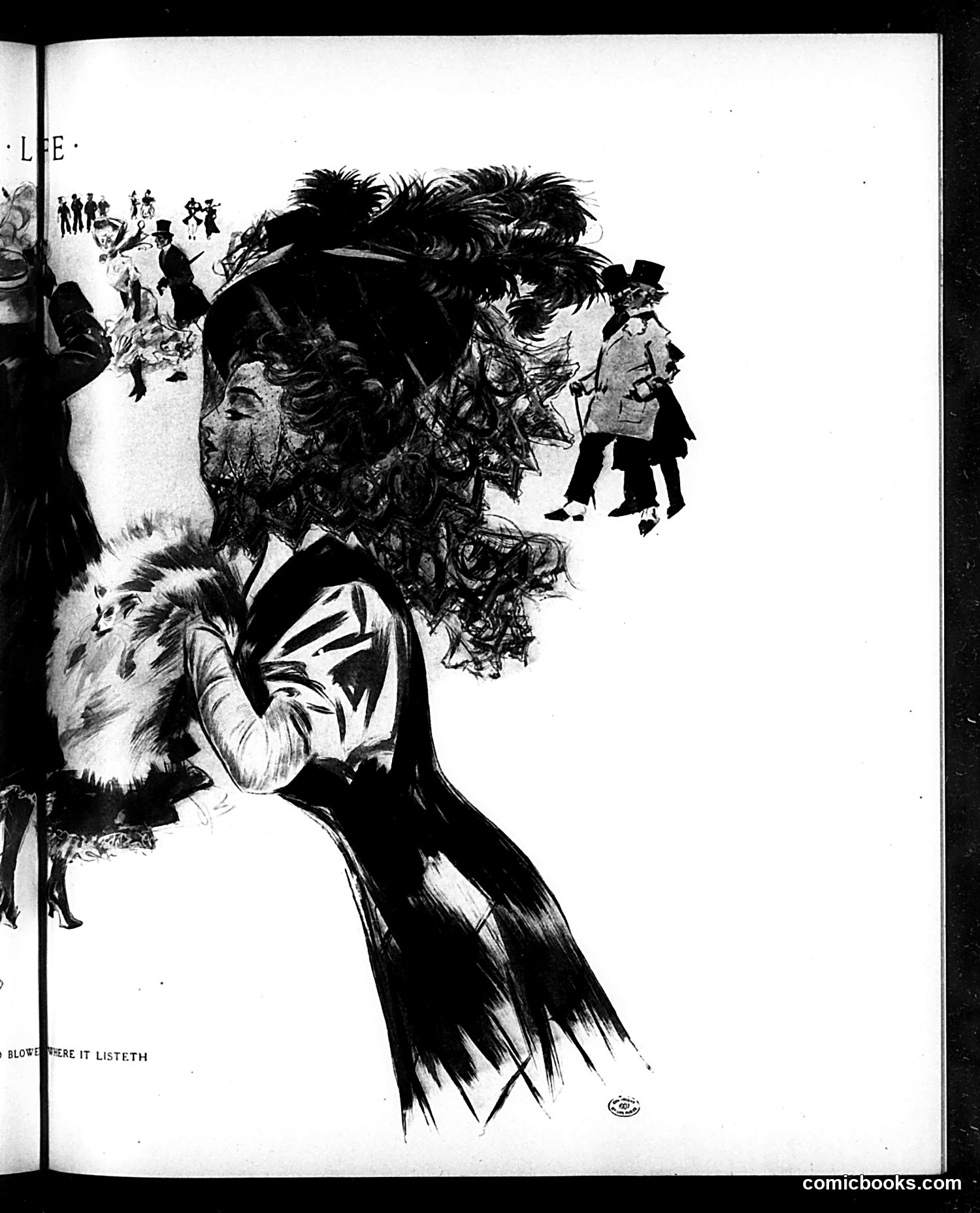
This appears to be a page from *Life* magazine featuring a satirical illustration. The main image shows an exaggerated male figure in profile (lower left) with elaborate facial hair, observing a chaotic scene of elegantly-dressed socialites and figures in the background (upper right). The style suggests early 20th-century social satire. The partial text "BLOWS THERE IT LISTETH" and the word "LIFE" at top indicate this is commentary on contemporary society. However, without complete caption text or a visible date, I cannot definitively identify the specific figures being caricatured or the precise social/political event being satirized. The drawing style and clothing suggest commentary on high society or elite circles of that era, but the exact targets remain unclear from the visible portion.
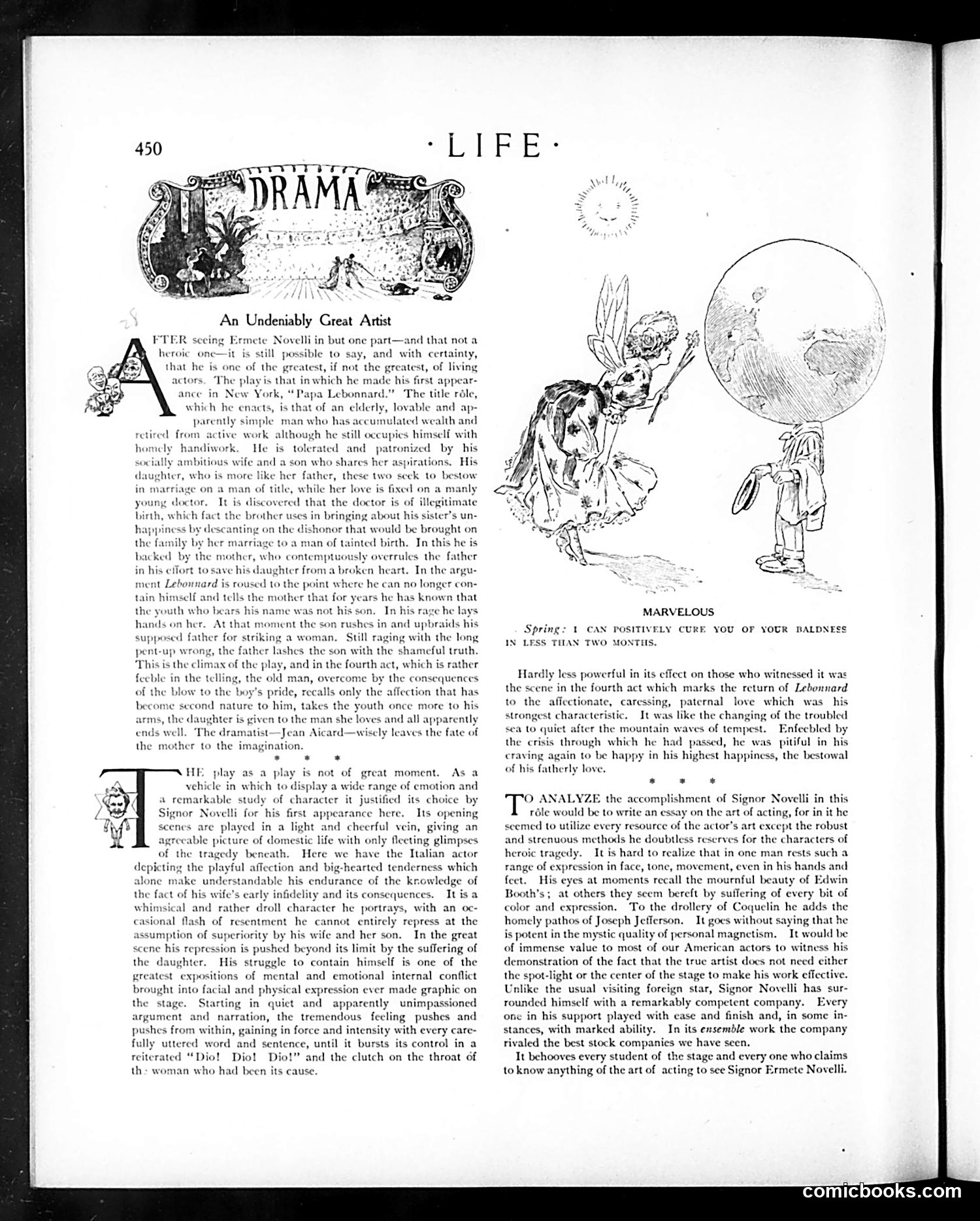
This is a theater review praising Italian actor Ermete Novelli's performance in the play *Papa Lebonnard*. The illustration shows a domestic scene from the production. The review discusses Novelli's portrayal of an elderly, wealthy, retired man whose working-class values clash with his socially ambitious wife and son. The drama hinges on a revelation: the man discovers his son is illegitimate (born of tainted birth), leading to a climactic confrontation where suppressed emotion erupts into rage—depicted through physical violence and repeated cries of "Dio! Dio! Dio!" The critic argues that despite the play's modest literary merit, Novelli's acting is extraordinary, particularly in the famous scene where internal emotional conflict visibly builds before exploding. This was likely a renowned moment in theatrical performance of the era, showcasing the actor's technical mastery of emotional expression.
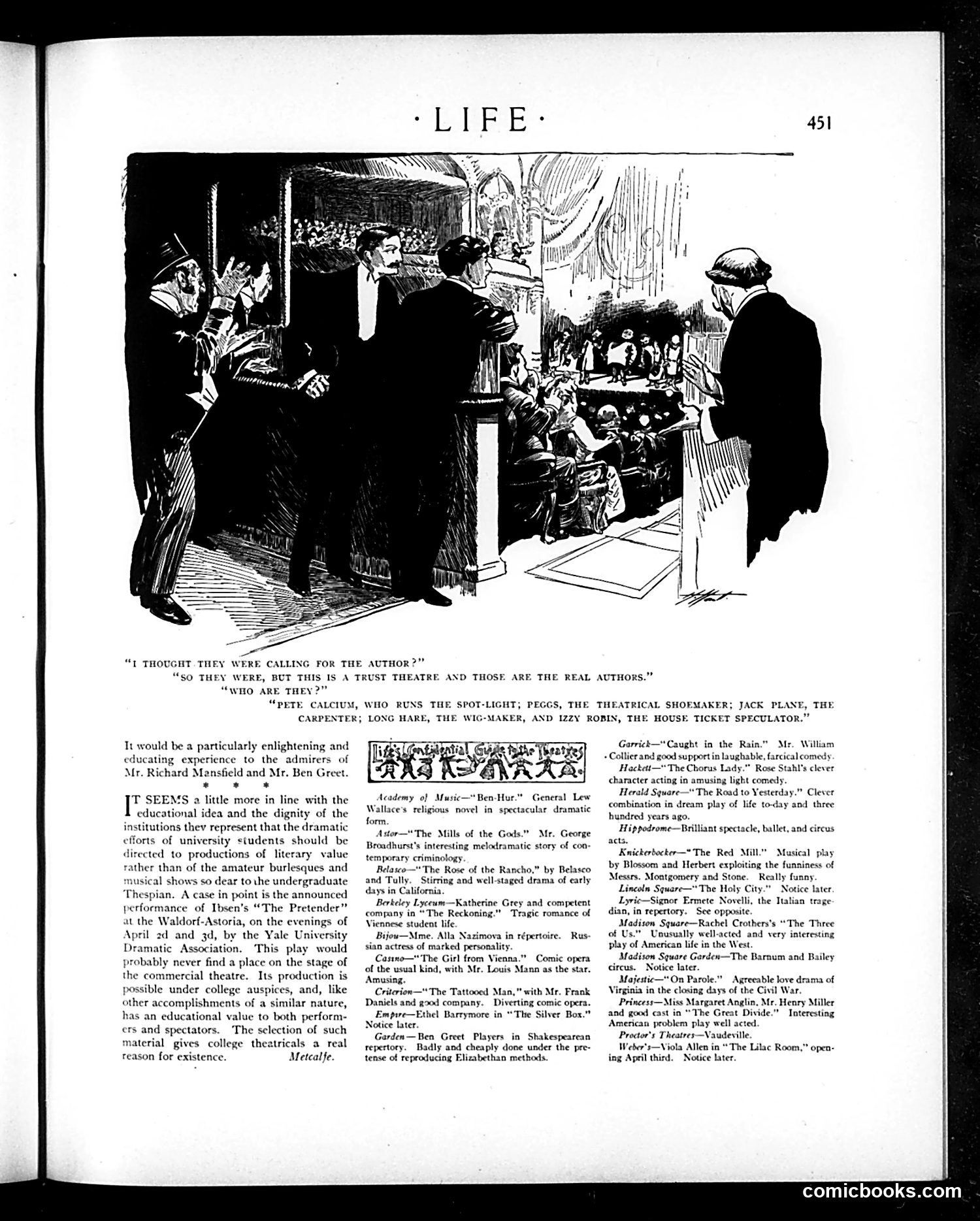
This cartoon satirizes the commercialization of theater through a "trust" monopoly system. When audience members call for the author to take a bow, they're told those weren't the real "authors"—instead, the true authors are the behind-the-scenes operators: Pete Calcium (spotlight operator), Peggs (theatrical shoemaker), Jack Plane (carpenter), Long Hare (wig-maker), and Izzy Robin (ticket speculator). The joke targets how theatrical "trusts" (monopolistic business consortiums controlling theater production and distribution) had reduced plays to mere commercial products. The actual creative and literary merit became secondary to the machinery that manufactured and profited from entertainment. The names appear to be comedic pseudonyms representing these various commercial interests rather than real individuals. The accompanying text celebrates Yale University's production of Ibsen's "The Pretender" as a refreshing alternative to commercial theater's profit-driven approach.
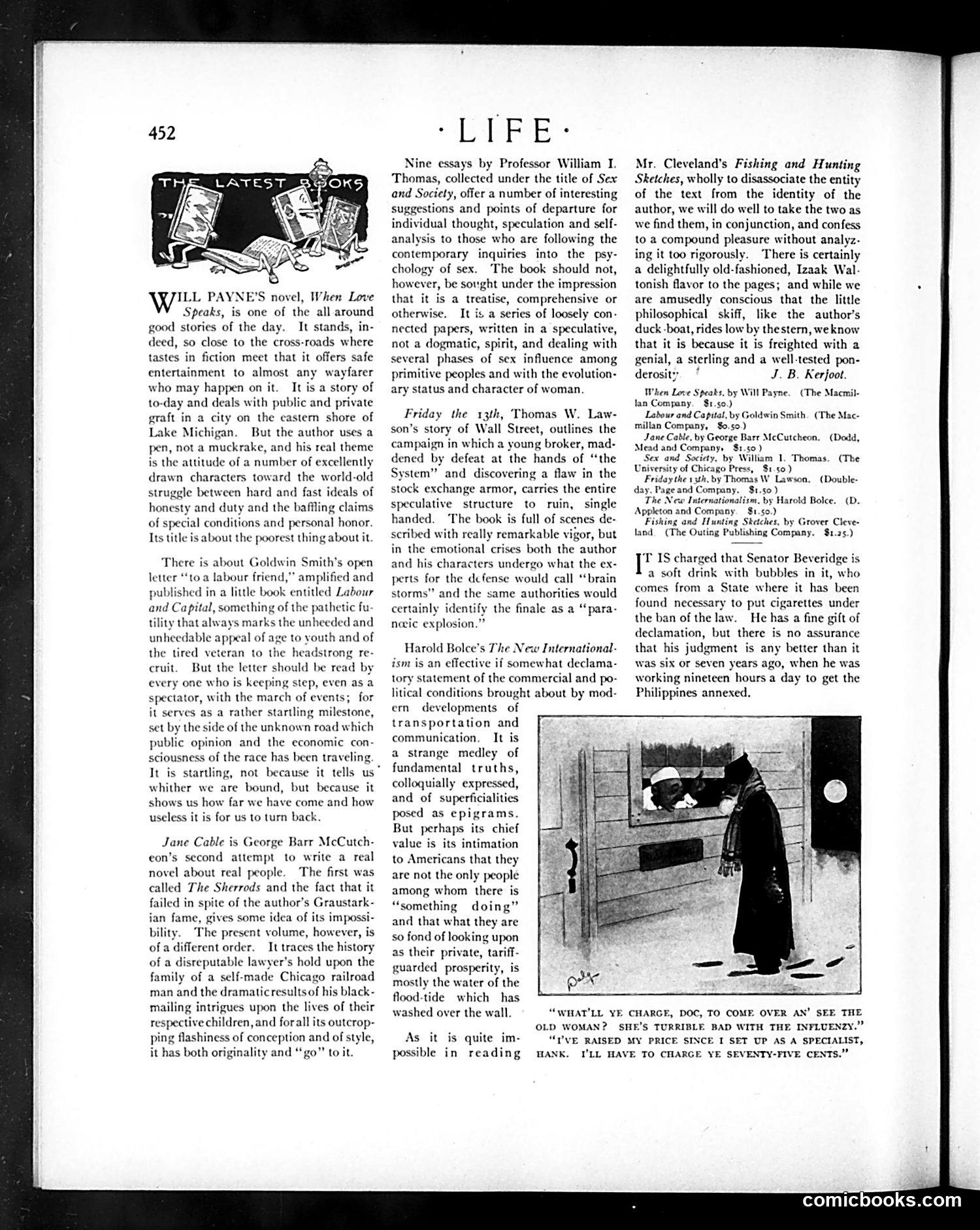
This page reviews nine recent books, primarily literary fiction and social commentary. The cartoon illustrates a scene from one book, showing a man in a coat and hat confronting an elderly woman at a doorway. The caption reads: "WHAT'LL YE CHARGE, DOC, TO COME OVER AN' SEE THE OLD WOMAN? SHE'S TERRIBLE BAD WITH THE INFLUENZA. I'VE RAISED MY PRICE SINCE I SET UP AS A SPECIALIST, HANK. I'LL HAVE TO CHARGE YE SEVENTY-FIVE CENTS." The joke satirizes medical profiteering: a self-proclaimed doctor has inflated his fees by claiming "specialist" status. The scene appears drawn from one of the reviewed novels dealing with contemporary urban life and character. The reviews discuss books addressing timely concerns—labor relations, Wall Street speculation, and sex psychology—reflecting early 20th-century intellectual debates. The overall tone suggests Life magazine positioned itself as a literary arbiter for educated readers interested in serious fiction alongside satire.
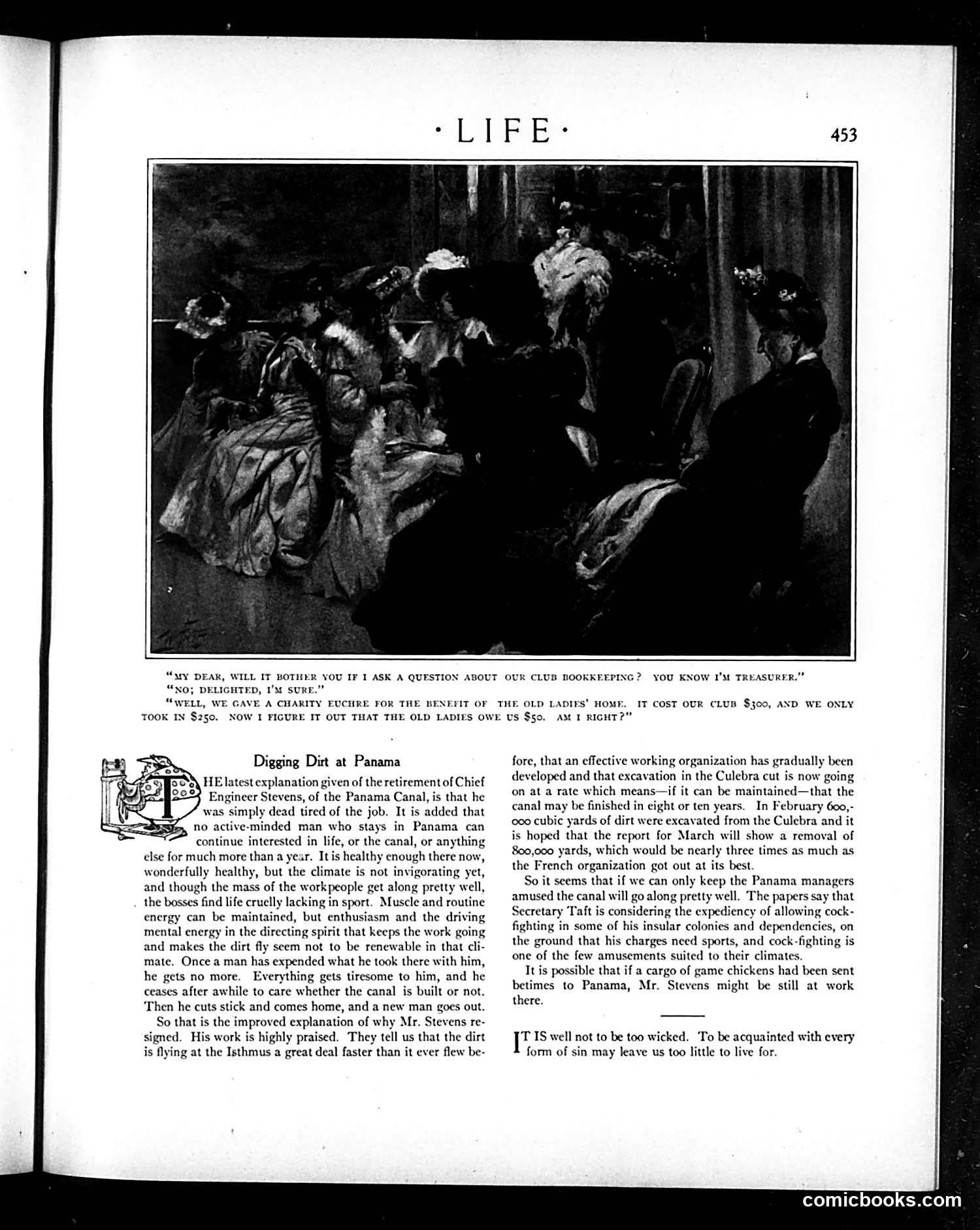
## The Top Cartoon This satirical sketch mocks women's club fundraising practices. A treasurer is confronted about questionable bookkeeping: the club raised money for charity through a euchre (card game) tournament, collecting $250 in donations but spending $300 on the event itself—leaving the "old ladies' home" actually *owing* $50 rather than benefiting from it. The joke exposes the gap between charitable intentions and actual financial outcomes, suggesting incompetence or self-serving expense management in women's social organizations. ## "Digging Dirt at Panama" The article discusses Chief Engineer John F. Stevens' resignation from the Panama Canal project. The satirical premise: Stevens quit not due to engineering challenges but because Panama's tropical climate saps mental vigor and lacks entertainment for management. The piece mocks this explanation while noting actual progress (600,000+ cubic yards excavated monthly). It mockingly suggests Secretary Taft might retain workers by permitting cockfighting—implying that bored American engineers need vice and sport to stay motivated, a critique of both colonial management and American moral standards.
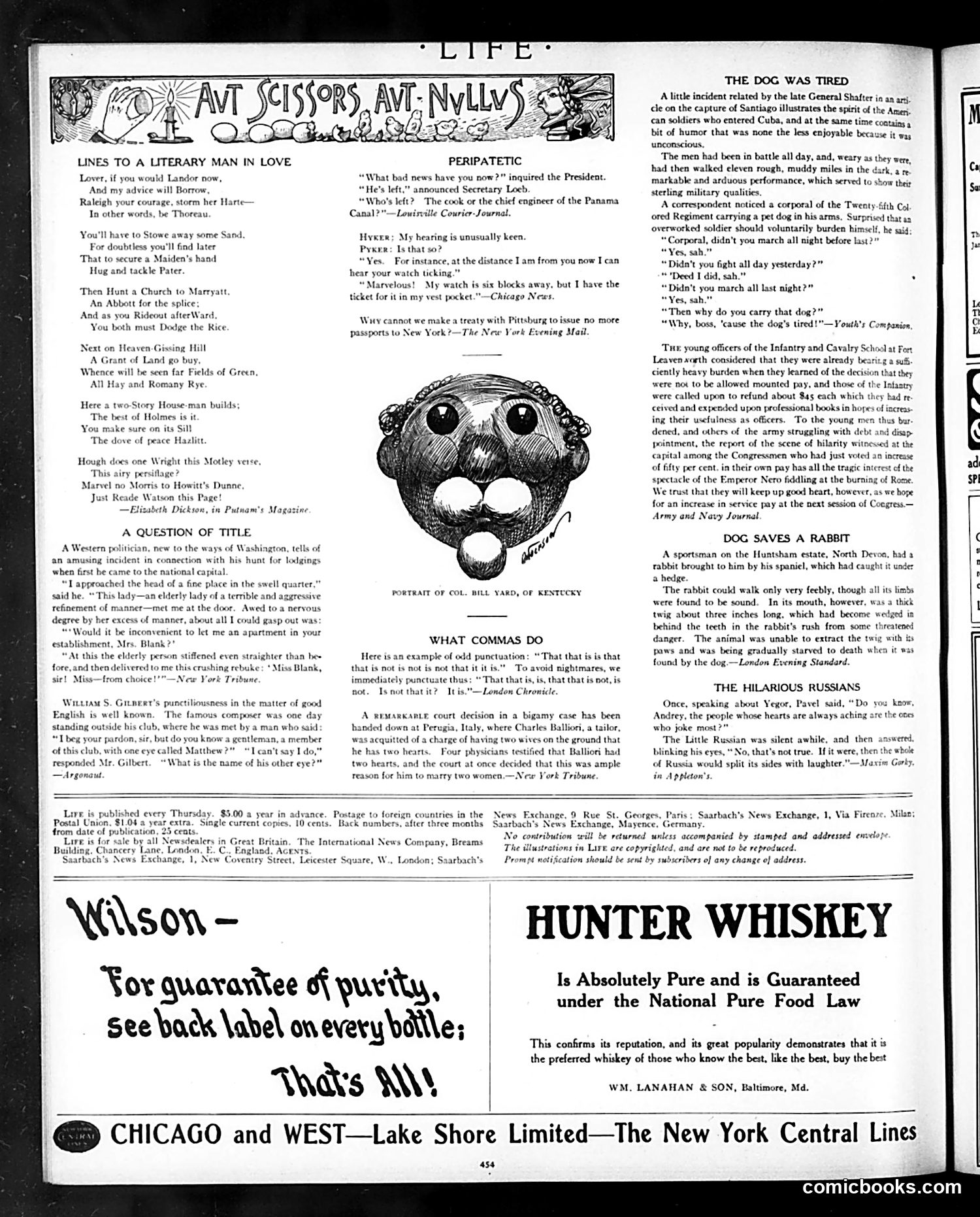
This page contains three distinct humorous pieces: **"Lines to a Literary Man in Love"** is a clever wordplay poem where the author embeds famous literary figures' names (Landor, Borrow, Thoreau, Stowe, Pater, Hunt, etc.) into romantic advice. The joke relies on readers recognizing these 19th-century writers' surnames and appreciating how they're punned into the narrative about courting. **"A Question of Title"** mocks social pretension: a newly-arrived Western politician attempts to rent a room from an elderly landlady, using awkward formal language. She corrects him sharply—it's "Miss Blank," not "Mrs."—asserting her unmarried status and proper standing. The satire targets both the politician's unrefined manners and the landlady's rigid class consciousness. **Other brief anecdotes** joke about a man's exceptional hearing (which turns out to be false), punctuation absurdities, and an Italian court acquitting a bigamist because he allegedly had two hearts. The page is primarily satirical humor aimed at educated readers familiar with literary figures and social etiquette conventions of the era.
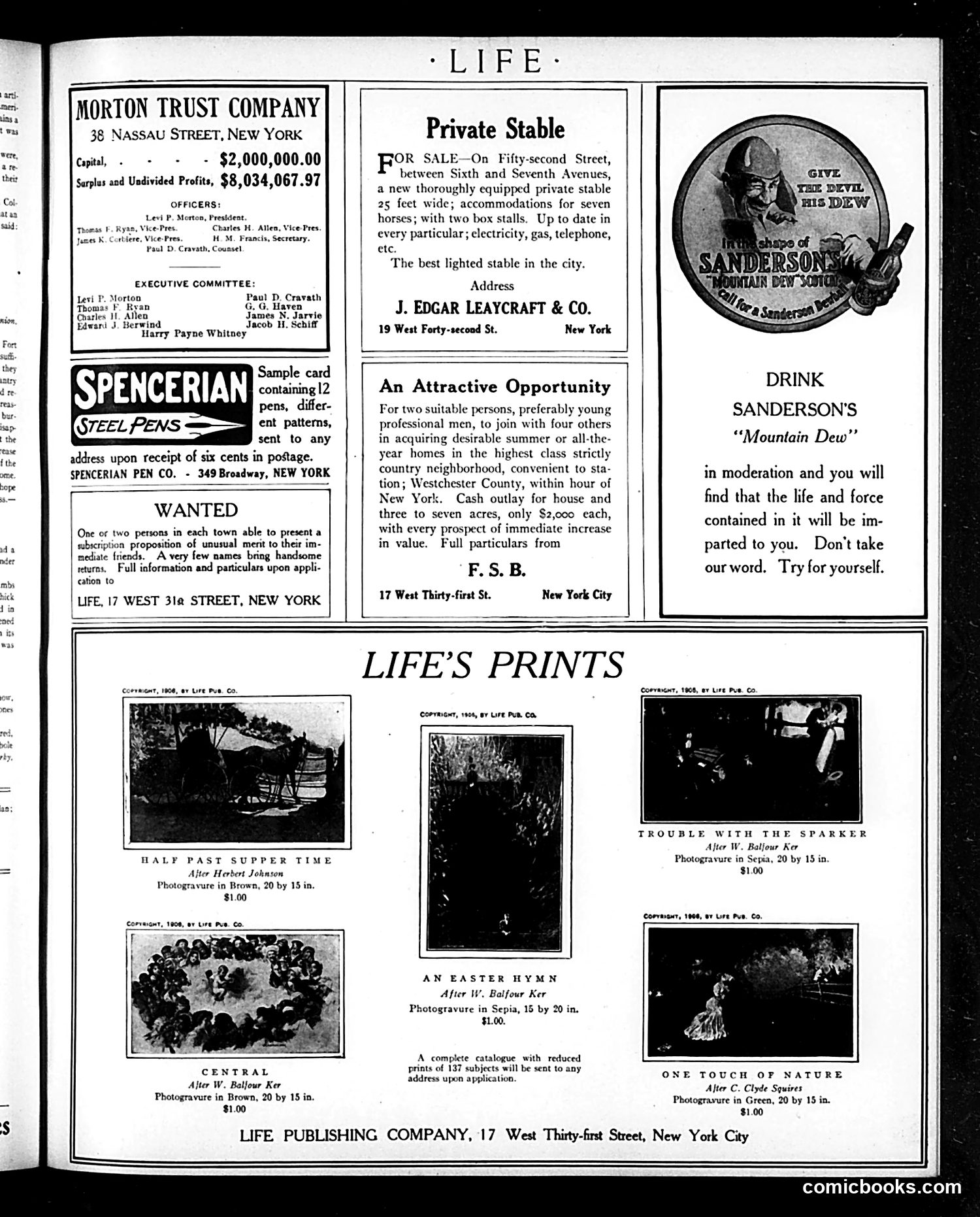
This page is primarily **advertising and business listings** from an early 1900s issue of Life magazine, with minimal satirical content. The main advertisements include: - **Morton Trust Company** (financial services) - **Private Stable** for sale on Fifty-second Street - **Spencerian Steel Pens** (writing instruments) - **Sanderson's Mountain Dew** beverage (promoting moderation) - Real estate opportunity in Westchester County - Employment solicitation for Life magazine subscriptions The bottom section features **"Life's Prints"**—reproductions of illustrations by artists like Herbert Johnson and W. Balfour Ker, available for purchase ($1.00 each). Titles include "Half Past Supper Time," "Central," "An Easter Hymn," "Trouble with the Sparker," and "One Touch of Nature." Rather than political satire, this page reflects the magazine's business operations: selling financial services, consumer goods, real estate, and artwork to its readership. The content is typical early-20th-century commercial publishing.
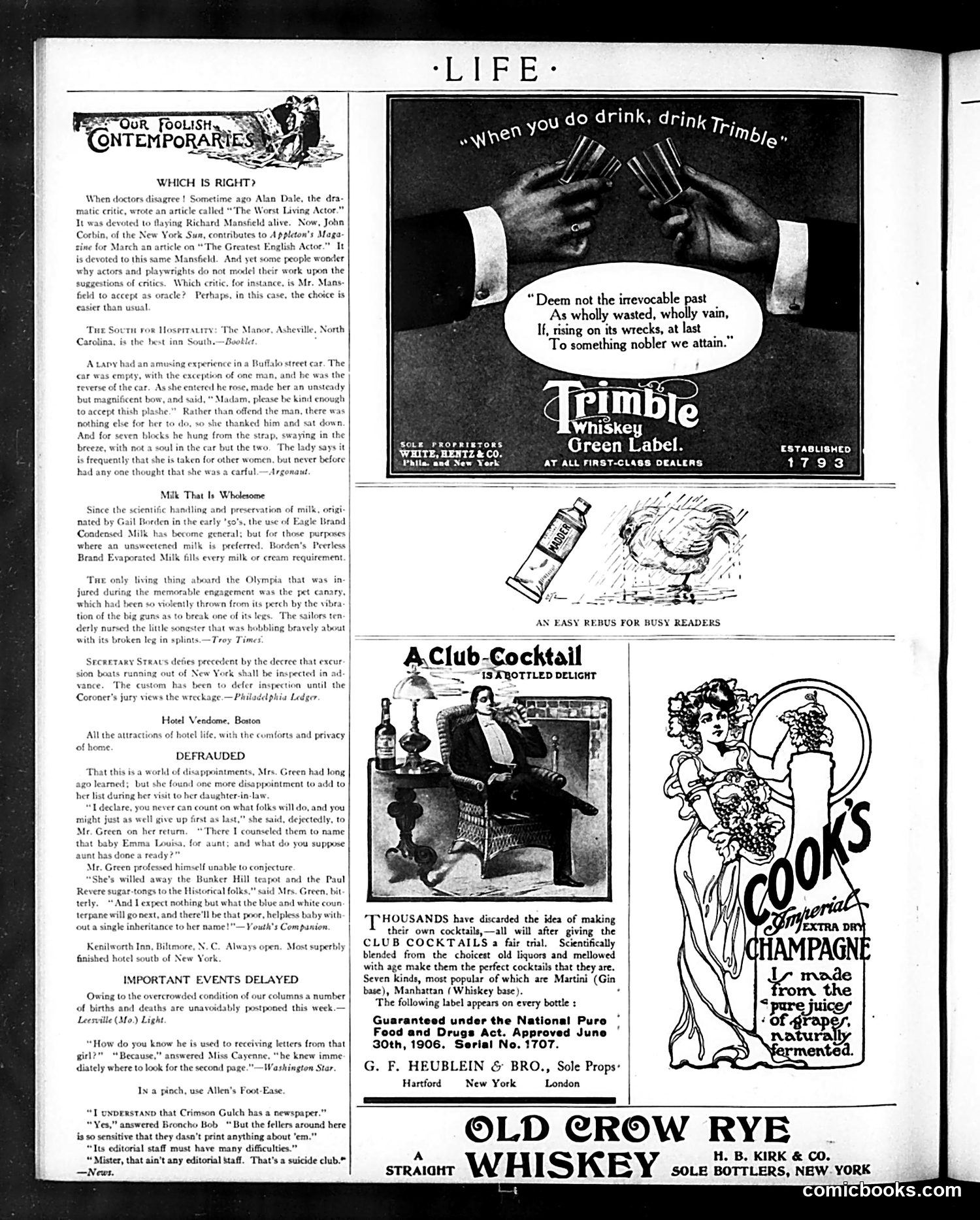
This page from *Life* magazine is primarily **advertising** with some satirical short pieces. The main content includes: **"Which Is Right?" column:** A brief satire about critical disagreement. When doctors recently debated whether actor Richard Mansfield was "the worst living actor," the piece humorously questions which critic to trust—suggesting the choice between bad opinions is easier than usual. **Advertisements dominate the page:** Multiple liquor ads (Trimble Whiskey, Cook's Champagne, Old Crow Rye, Club Cocktails) capitalize on the Prohibition-era fascination with drinking culture, presenting cocktails as sophisticated pleasures. **Small humor pieces** scattered throughout mock contemporary life: a woman disappointed her daughter won't inherit money (babies need inheritances), a frontier newspaper editor whose readers are too sensitive for honest reporting. The satire is gentle and social rather than political—targeting human folly, pretension, and the absurdities of modern life. The heavy advertising reflects *Life's* business model while the drinking ads suggest pre-Prohibition American attitudes toward alcohol as respectable commerce.
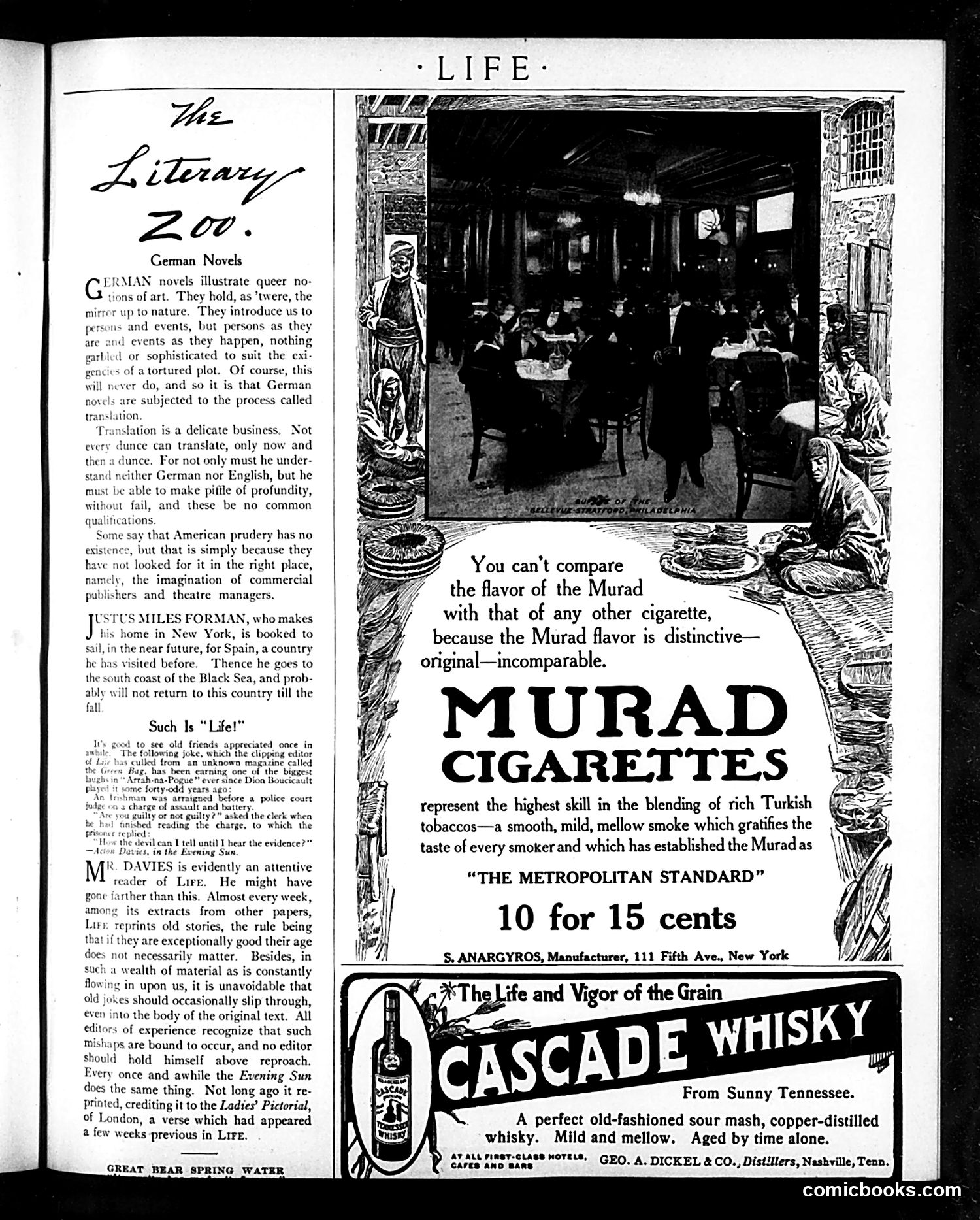
This page is primarily **advertising** with a brief editorial commentary about German literature and translation. The main content discusses how German novels represent life authentically without artificial plot devices, unlike American publications constrained by commercial and theatrical prudery. The text notes that translation is difficult—translators must understand both languages while maintaining profundity. A small anecdote appears about a courtroom joke circulating from an obscure magazine, highlighting how Life's editors occasionally reprint stories without full attribution. The page features **two product advertisements**: Murad Cigarettes (marketed as "the metropolitan standard" for superior Turkish tobacco blending) and Cascade Whisky from Tennessee. There is **no political cartoon** on this page—it's primarily editorial discussion alongside commercial advertisements typical of early 20th-century American magazines.
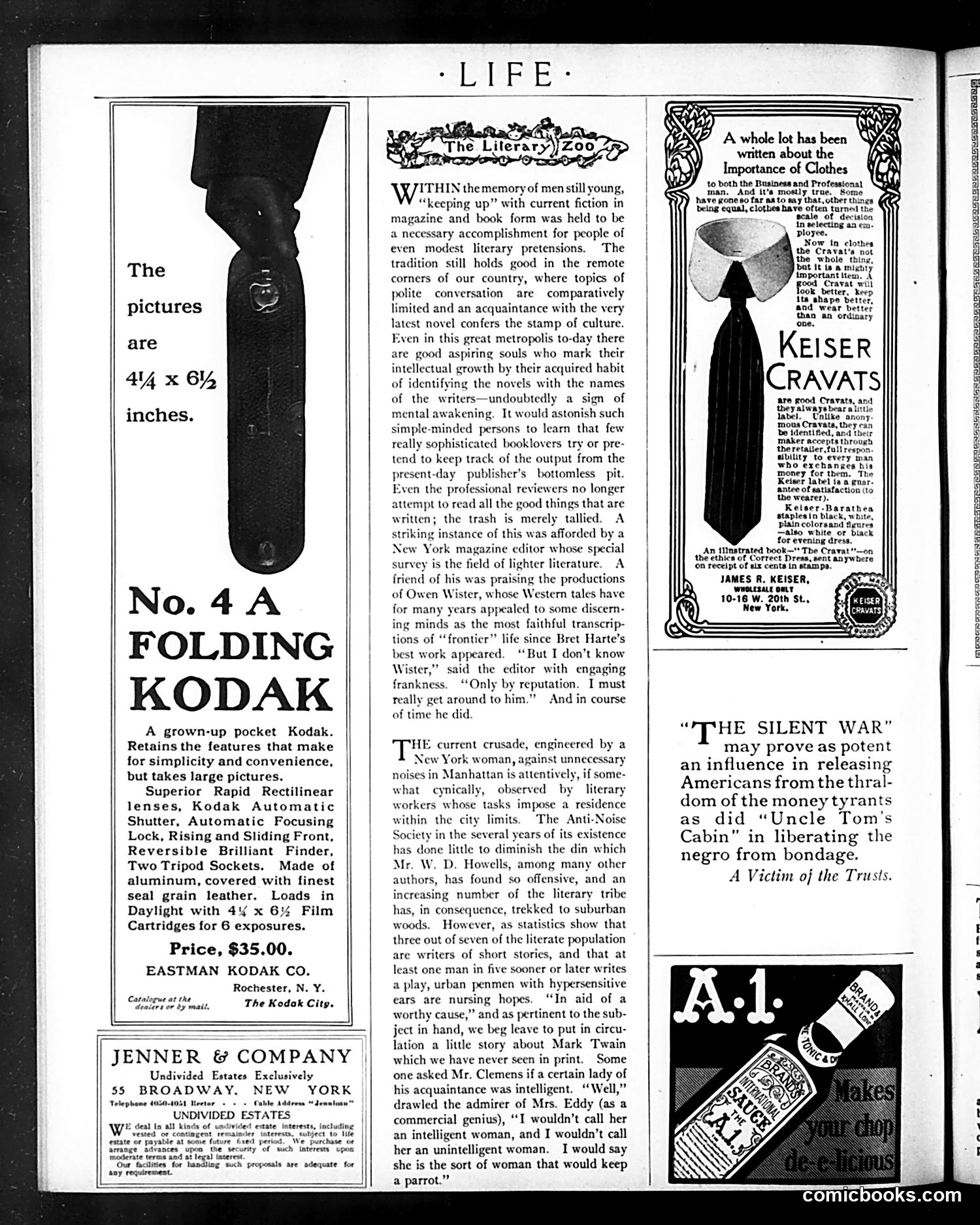
This page satirizes the literary pretensions and hypocrisy of early 20th-century American culture. "The Literary Zoo" attacks three targets: **1. Fake cultured readers:** The essay mocks people who claim intellectual sophistication by memorizing authors' names without actually reading their work—a sign of shallow social climbing rather than genuine literacy. **2. Publishing excess:** The piece critiques publishers flooding the market with mediocre work faster than readers (even professional critics) can keep up, making "keeping current" with literature impossible and somewhat ridiculous. **3. Literary snobbery:** A New York magazine editor admits he doesn't know Owen Wister's acclaimed Western fiction—only knows him "by reputation"—exemplifying how pretentious figures fake cultural knowledge. The closing anecdote attributes a Mark Twain quip dismissing a woman as neither intelligent nor unintelligent, but rather "the sort of woman that would keep a parrot"—implying she's decorative but vacuous. The satire suggests that both shallow readers and dismissive critics inhabit the same ridiculous literary culture.
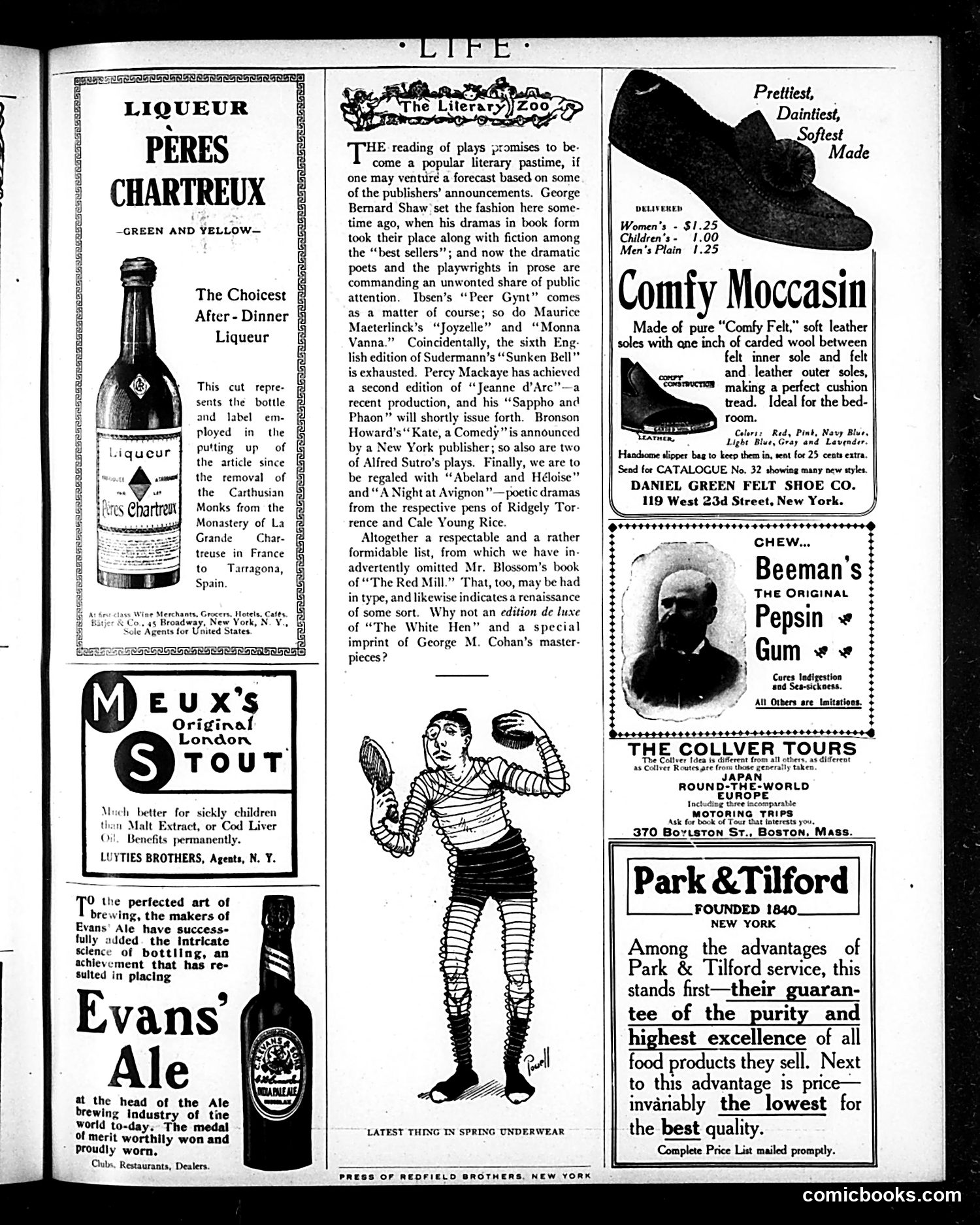
This page is primarily **advertising**, not political satire. The central cartoon depicts a man in full-body wrappings (like a mummy) labeled "Latest Thing in Spring Underwear"—apparently mocking the era's elaborate, restrictive undergarment fashions for men. The joke is visual: men's spring underwear of this period involved so much binding and layering that the wearer resembles an Egyptian mummy. It's satirizing the absurd restrictiveness and complexity of contemporary male fashion, suggesting that men are as thoroughly wrapped and constrained as ancient preserved corpses. The surrounding content—ads for liqueurs, ale, felt shoes, and chewing gum—indicates this is from an early 1900s *Life* magazine issue functioning primarily as an advertising vehicle, with the cartoon providing mild social commentary on fashion excess rather than serious political satire.
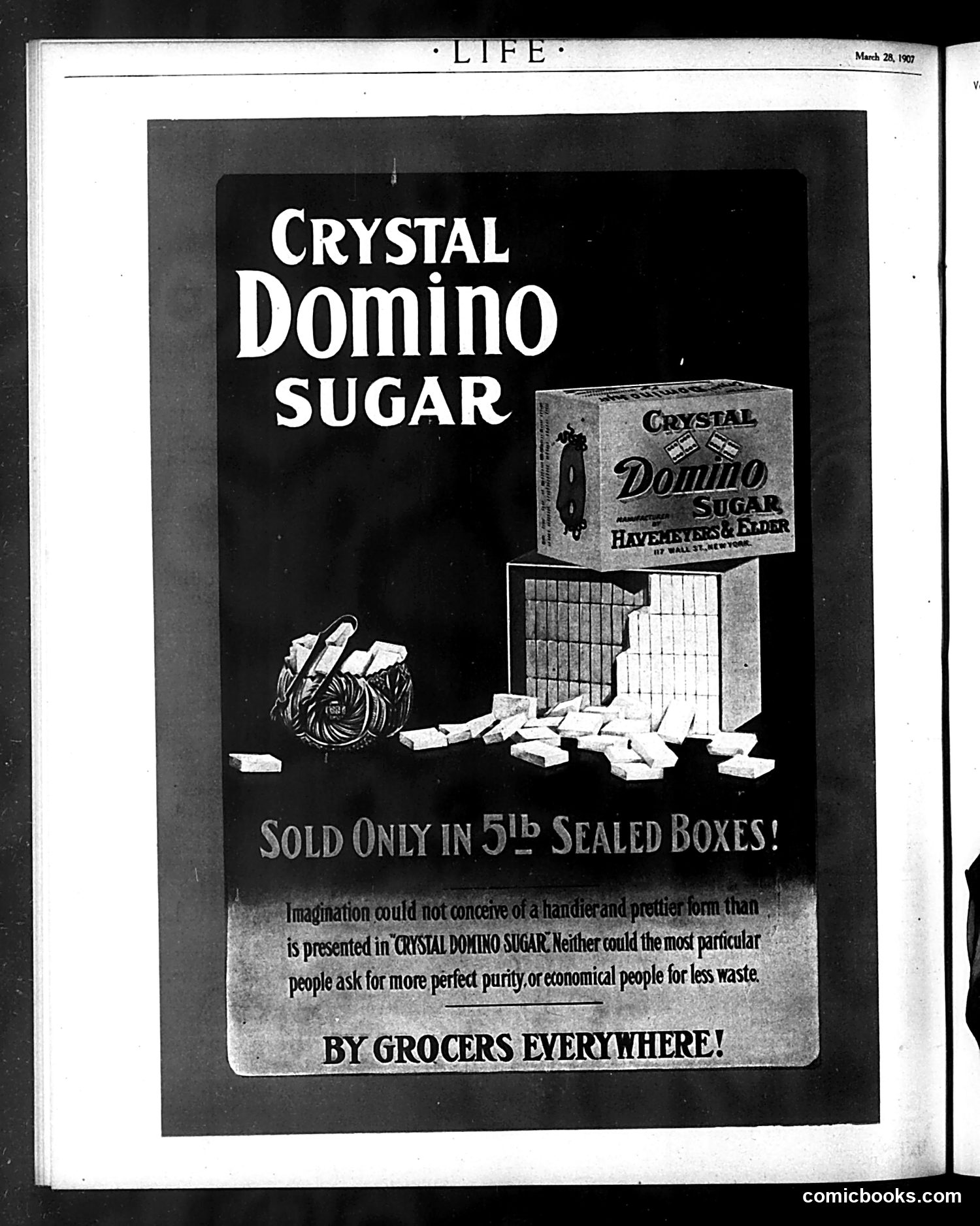
This is a straightforward **advertisement, not satire or political commentary**. It appears in *Life* magazine from March 28, 1907, promoting Crystal Domino Sugar. The ad emphasizes the product's purity and convenient packaging—sold exclusively in sealed 5-pound boxes to prevent contamination and waste. The visual shows sugar cubes spilling from an open box, alongside a sugar loaf (the traditional form), highlighting the modernized, hygienic presentation. The copy appeals to both "particular people" concerned with purity and "economical people" worried about waste—positioning sealed boxes as the superior, contemporary choice. The tagline "By Grocers Everywhere!" indicates widespread availability. This reflects early 20th-century marketing focused on cleanliness, efficiency, and modern convenience as selling points.