
Life, 1907-03-28 · page 8 of 24
Life — March 28, 1907 — page 8: what you’re looking at
What you’re looking at
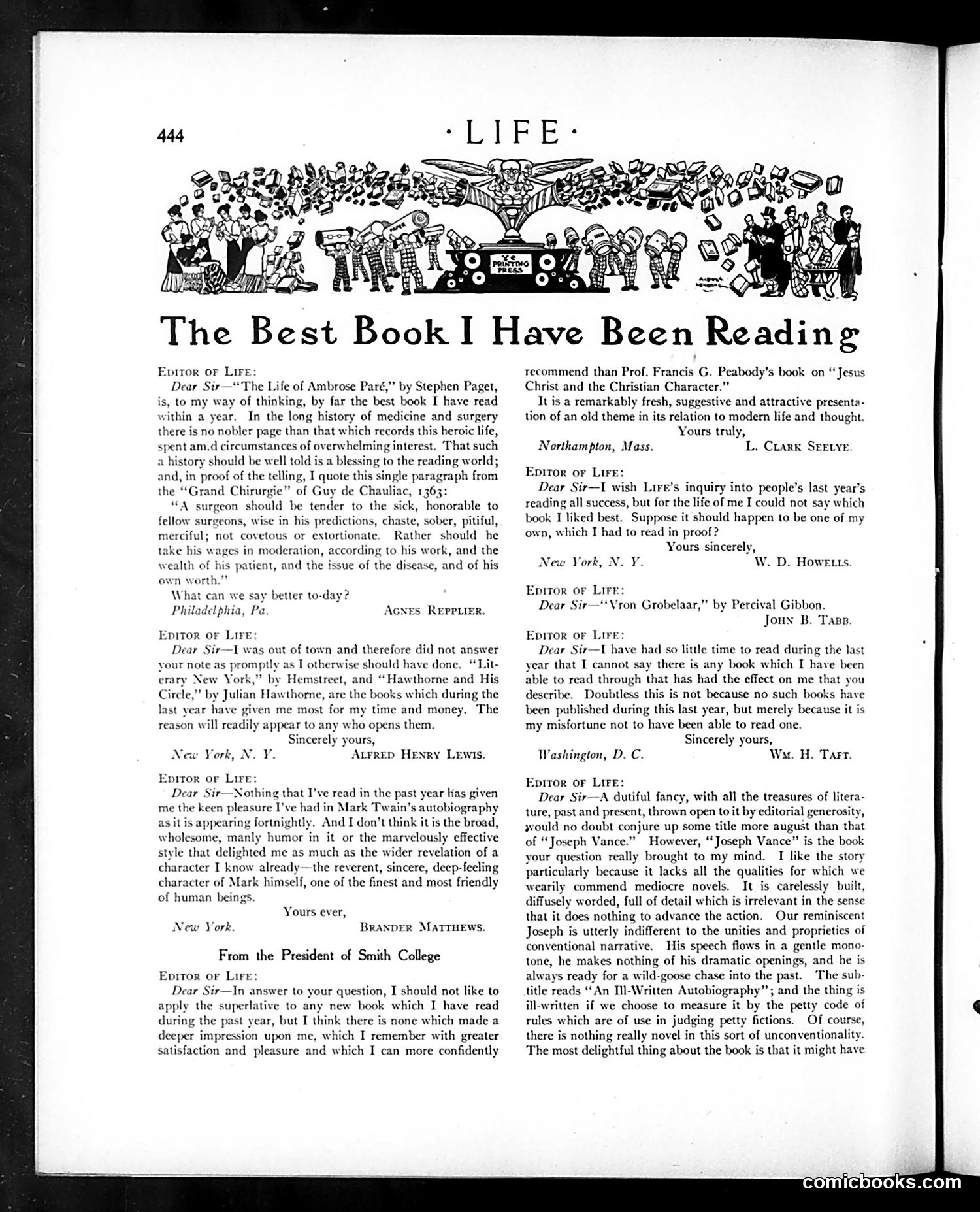
This page is not a political cartoon but rather a **letters-to-the-editor section** titled "The Best Book I Have Been Reading." It contains reader responses to *Life* magazine's inquiry about notable books. The decorative header features an illustrated crowd of diverse figures under a winged eagle emblem—a common *Life* magazine masthead element symbolizing American culture and readership. The letters discuss books like "The Life of Ambrose Paré" (medical history), "Von Grobelaar" by Percival Gibbon, and Hawthorne's works. One correspondent critiques "Joseph Vance" as poorly written despite its subject matter. There is **no satire or political commentary**—this is straightforward reader engagement content reflecting early-20th-century literary tastes among educated Americans.
📄 Transcribed text from this page (OCR, searchable)
Machine-transcribed from the original scan — historical spelling and the odd misread are preserved.
d Seta) eoS. INE: The Best Book I Have Been Reading Epitor or Lire: Dear Sir—‘The Life of Ambrose Paré,” by Stephen Paget, is, to my way of thinking, by far the best book I have read within a year. In the long history of medicine and surgery there is no nobler page than that which records this heroic life, spent am.d circumstances of overwhelming interest. That such a history should be well told is a blessing to the reading world; and, in proof of the telling, I quote this single paragraph from the “Grand Chirurgie” of Guy de Chauliac, 1363: ““\ surgeon should be tender to the sick, honorable to fellow surgeons, wise in his predictions, chaste, sober, pitiful, merciful; not covetous or extortionate. Rather should he take his wages in moderation, according to his work, and the wealth of his patient, and the issue of the disease, and of his own worth.” What can we say better to-day? Philadelphia, Pa. Acnes REppPLierR. Epitor oF Lire: Dear Sir—I was out of town and therefore did not answer your note as promptly as T otherwise should have done. “Lit- erary New York,” by Hemstreet, and “Hawthorne and His Circle,” by Julian Hawthorme, are the books which during the last year have given me most for my time and money, The reason will readily appear to any who opens them. New York, N.Y. ALFRED Henry Lewis. Eprror or Lire: Dear Sir—Nothing that I’ve read in the past year Kas given me the keen pleasure I've had in Mark Twain's autobiography as it is appearing fortnight! nd I don’t think it is the broad, wholesome, manly humor in it or the marvelously effective style that delighted me as much as the wider revelation of a character I know already—the reverent, sincere, deep-feeling character of Mark himself, one of the finest and most friendly of human beings. Yours ever, New York. BRANDER MATTHEWS. From the President of Smith College Eprtor or Lire: Dear Sir—In answer to your question, I should not like to apply the superlative to any new book which I have read during the past year, but I think there is none which made a deeper impression upon me, which I remember with greater satisfaction and pleasure and which I can more confidently recommend than Prof. Francis G. Peabody’s book on “Jesus Christ and the Christian Character.” It is a remarkably fresh, suggestive and attractive presenta- tion of an old theme in its relation to modern life and thought. Yours truly, L. Crark SEELYE. Northampton, Mass. Eprror oF Li Dear Sir—I wish 1 inquiry into people’s last reading all success, but for the life of me I could not say book I liked best. Suppose it should happen to be one of my own, which I had to read in proof? Yours sincerely, New York, N.Y. W. D. Howe ts. Eprtor oF Lire: Dear Sir—‘*Vron Grobelaar,” by Percival Gibbon. Joux B. Tass. Eprtor or Lire: Dear Sir—I have had so little time to read during the last year that I cannot say there is any book which I have been able to read through that has had the effect on me that you describe. Doubtless this is not because no such books have been published during this last year, but merely because it is my misfortune not to have been able to read one. Sincerely yours, Washington, D. C. Wa. H. Tarr. Eprtor oF Lire: Dear Sir—A dutiful fancy, with all the treasures of litera- ture, past and present, thrown open to it by editorial generosity, would no doubt conjure up some title more august than that of “Joseph Vance.” However, “Joseph Vance” is the book your question really brought to my mind. I like the story particularly because it lacks all the quali for which we wearily commend mediocre novels. It is carelessly built, diffusely worded, full of detail which is irrelevant in the sense that it does nothing to advance the action. Our remi ent Joseph is utterly indifferent to the unities and proprietics of conventional narrative. His speech flows in a gentle mono- tone, he makes nothing of his dramatic openings, and he is always ready for a wild-goose chase into the past. The sub- title reads “An Ill-Written Autobiography”; and the thing is ill-written if we choose to measure it by the petty code of rules which are of use in judging petty fictions. Of course, there is nothing really novel in this sort of unconventionality. ‘The most delightful thing about the book is that it might have micbooks.com