
Life, 1907-03-28 · page 22 of 24
Life — March 28, 1907 — page 22: what you’re looking at
What you’re looking at
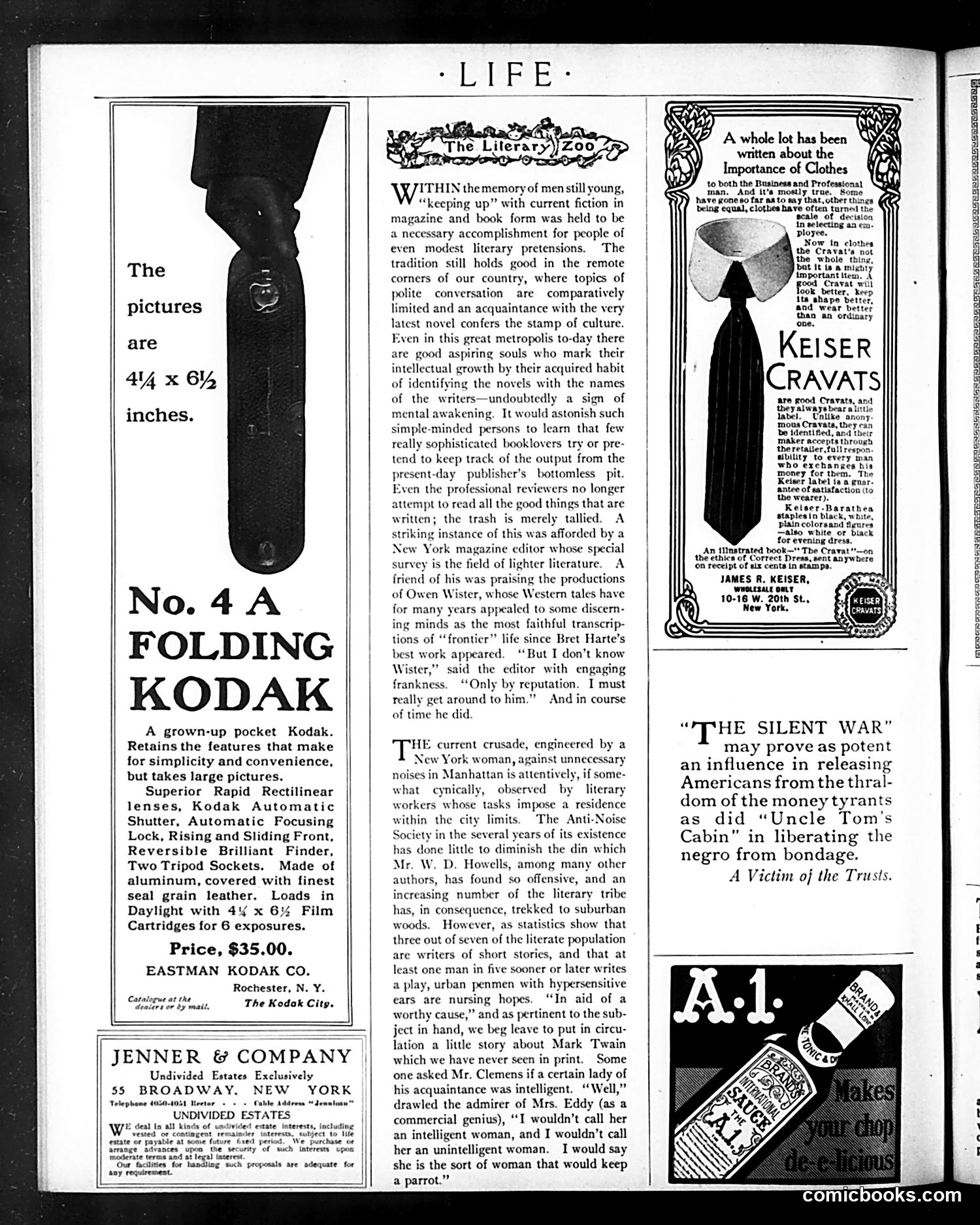
This page satirizes the literary pretensions and hypocrisy of early 20th-century American culture. "The Literary Zoo" attacks three targets: **1. Fake cultured readers:** The essay mocks people who claim intellectual sophistication by memorizing authors' names without actually reading their work—a sign of shallow social climbing rather than genuine literacy. **2. Publishing excess:** The piece critiques publishers flooding the market with mediocre work faster than readers (even professional critics) can keep up, making "keeping current" with literature impossible and somewhat ridiculous. **3. Literary snobbery:** A New York magazine editor admits he doesn't know Owen Wister's acclaimed Western fiction—only knows him "by reputation"—exemplifying how pretentious figures fake cultural knowledge. The closing anecdote attributes a Mark Twain quip dismissing a woman as neither intelligent nor unintelligent, but rather "the sort of woman that would keep a parrot"—implying she's decorative but vacuous. The satire suggests that both shallow readers and dismissive critics inhabit the same ridiculous literary culture.
📄 Transcribed text from this page (OCR, searchable)
Machine-transcribed from the original scan — historical spelling and the odd misread are preserved.
The pictures are 44x64 inches. No. 4A FOLDING KODAK A grown-up pocket Kodak. Retains the features that make for simplicity and convenience, but takes large pictures. Superior Rapid Rectilinear lenses, Kodak Automatic Shutter, Automatic Focusing Lock, Rising and Sliding Front, Reversible Brilliant Finder, Two Tripod Sockets. Made of aluminum, covered with finest seal grain leather. Loads in Daylight with 44 x 6% Film Cartridges for 6 exposures. Price, $35.00. EASTMAN KODAK CO. Rochester, N. Y. The Kodak City. Catalogue at the dealers or by mail, JENNER & COMPAN Undivided Estates Exclusively 55 BROADWAY, NEW YORK + Cable Address “Jewmtone™ - sub We purchase or ‘of such interests upon moderate terms and at legal interest ‘Our facilities for handling such proposals are adequate for | any requirement. WITHIN thememoryof men still young, “keeping up” with current fiction in magazine and book form was held to be a necessary accomplishment for people of even modest literary pretensions. The tradition still holds good in the remote corners of our country, where topics of polite conversation are comparatively limited and an acquaintance with the very latest novel confers the stamp of culture. Even in this great metropolis to-day there are good aspiring souls who mark their intellectual growth by their acquired habit of identifying the novels with the names of the writers—undoubtedly a sign of mental awakening. It would astonish such simple-minded persons to learn that few really sophisticated booklovers try or pre- tend to keep track of the output from the present-day publisher’s bottomless _ pit. Even the professional reviewers no longer attempt to read all the good things that are written; the trash is merely tallied. A striking instance of this was afforded by a New York magazine editor whose special survey is the field of lighter literature. A friend of his was praising the productions of Owen Wister, whose Western tales have for many years appealed to some discern- ing minds as the most faithful transcrip- tions of ‘‘fronticr” life since Bret Harte’s best work appeared. “But I don’t know Wister,” said the editor with engaging frankness. ‘Only by reputation. I must really get around to him.” And in course of time he did 5 current crusade, engineered by a ew York woman, against unnecessary f some- what cynical literary workers whose ta s residence within the city limits. The Anti-Noise Society in the several years of its existence has done little to diminish the din which Mr. W. D. Howells, among many other authors, has found so offen: increasing number of the literary tribe has, in consequence, trekked to suburban woods. However, as statistics show that three out of seven of the literate population are writers of short stories, and that at least one man in five sooner or later writes a play, urban penmen with hypersensitive ears are nursing hopes. “In aid of a worthy cause,” and as pertinent to the sub- ject in hand, we beg leave to put in circu- lation a little story about Mark Twain which we have never seen in print. Some one asked Mr. Clemens if a certain lady of his acquaintance was intelligent. “Well,” drawled the admirer of Mrs. Eddy (as a commercial genius), “I wouldn’t call her an intelligent woman, and I wouldn’t call her an unintelligent woman. I would say she is the sort of woman that would keep a parrot.”” Importance of Clothes Baainess and Professional CK man. And it’s mostly true. Somo have gone so far as to say that, other things belng equal, clothes have often turned the A Now tn clothes the Cravat its ehape better, and wear better than an ordinary ‘one, uy ability to'every man who exchanges bis money for t Keiser latel 1 Kelser-Barathea staples in black, white, plain colorsand figures also white or black for evening dress. An {Iinstrated book—"* The Cravat""—on the ethics of Correct Dress, sent anywhere (on receipt of six cents in stampa. y 0-16 W. 20th St., New York. “THE SILENT WAR” may prove as potent an influence in releasing Americans from the thral- dom of the money tyrants as did “Uncle Tom's Cabin” in liberating the negro from bondage. A Victim of the Trusts. | | exeemenconcerecro Canora Urn ETRETIRETETINGTTIO GIN nn cnn one cna OnmorE com cnn EER ore gon oom OrNser comicbooks.com