
Life, 1907-03-28 · page 15 of 24
Life — March 28, 1907 — page 15: what you’re looking at
What you’re looking at
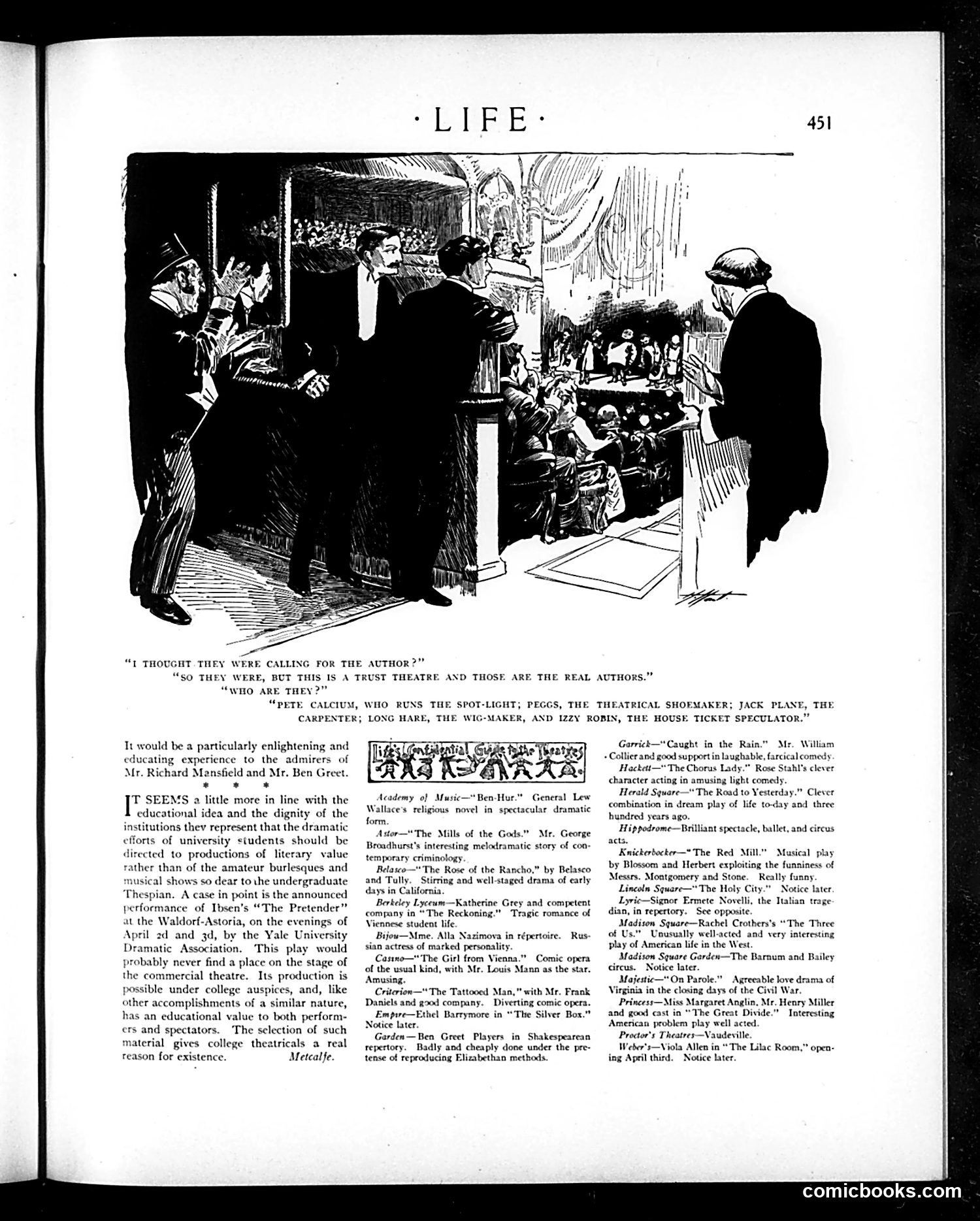
This cartoon satirizes the commercialization of theater through a "trust" monopoly system. When audience members call for the author to take a bow, they're told those weren't the real "authors"—instead, the true authors are the behind-the-scenes operators: Pete Calcium (spotlight operator), Peggs (theatrical shoemaker), Jack Plane (carpenter), Long Hare (wig-maker), and Izzy Robin (ticket speculator). The joke targets how theatrical "trusts" (monopolistic business consortiums controlling theater production and distribution) had reduced plays to mere commercial products. The actual creative and literary merit became secondary to the machinery that manufactured and profited from entertainment. The names appear to be comedic pseudonyms representing these various commercial interests rather than real individuals. The accompanying text celebrates Yale University's production of Ibsen's "The Pretender" as a refreshing alternative to commercial theater's profit-driven approach.
📄 Transcribed text from this page (OCR, searchable)
Machine-transcribed from the original scan — historical spelling and the odd misread are preserved.
“1 THOUGHT THEY WERE CALLING FOR THE AUTHOR?” “So THEY WERE, BUT THIS IS A TRUST THEATRE AND THOSE ARE THE REAL AUTHORS.” “WHO ARE THEY? “PETE CALCIUM, WHO RUNS THE SPOT-LIGHT; PEGGS, THE THEATRICAL SHOEMAKER; JACK PLANE, THE CARPENTER; LONG HARE, THE WIG-MAKER, AND IZZY ROBIN, THE HOUSE TICKET SPECULATOR.” It would be a particularly enlightening and educating experience to the admirers of Mr. Richard Mansfield and Mr. Ben Greet. * 8 * T SEEMS a little more in line with the educational idea and the dignity of the institutions thev represent that the dramatic efforts of university students should be directed to productions of literary value than of the amateur burlesques and 1 shows so dear to che undergraduate ase in point is the announced performance of Ibsen’s “The Pretender” at the Waldorf-Astoria, on the evenings of April 2d and 3d, by the Yale University matic iati This pl would. probably never find a place on the stage of the commercial theatre. Its production is possible under college auspices, and, like other accomplishments of a similar nature, has an educational value to both perform- ers and spectators. The selection of such terial gives college theatricals a real reason for existence. Metcalfe. teademy of Music—" Ben-Hur.” General Lew Wallace's religious novel in spectacular dramatic form. Astor—“The Mills of the Gods.” Mr. George Broadhurst's interesting melodramatic story of con- temporary criminology Belasco—" The Rose of the Rancho,” by Belasco and Tully. Stirring and well-staged drama of early days in California. Berkeley Lyceum—Katherine Grey and competent company in “The Reckoning.” Tragic romance of Viennese student life Bijow—Mme. Alla Nazimova in répertoire. Rus: sian actress of marked personality Casino—""The Girl from Vienna.” Comic opera of the usual kind, with Mr. Louis Mann as the star. Amusing. Criterion—" The Tattooed Man," with Mr, Frank Daniels and good company. Diverting comic opera. ‘mpire—Ethel Barrymore in “The Silver Box.” Notice later Garden—Ben Greet Players in Shakespearean repertory. Badly and cheaply done under the pre- tense of reproducing Elizabethan methods. + Collier and good Garrick—" Caught in the Rain.” Mz. William support in laughable, farcical comedy Hackett—" The Chorus Lady.” Rose Stahl's clever character acting in amusing light comedy Herald Square—" The Road to Yesterday.” Clever combination in dream play of life to-day and three hundred years ago. Hippodrome—Brilliant spectacle, ballet, and circus acts. Knickerbocker—*The Red Mill.” Musical play by Blossom and Herbert exploiting the funniness of Messrs. Montgomery and Stone. Really funny Lincoln Square—"The Holy City.” Notice later Lyric—Signor Ermete Novelli, the Italian trage dian, in repertory. Sce opposite. Madison Square—Rachel Crothers’s “The Three of Us." Unusually well-acted and very interesting play of American life in the West Madison Square Gerden—The Barnum and Bailey circus. Notice later. Majestic—"On Parole.” Agrecable love drama of Virginia in the closing days of the Civil War. Princess—Miss Margaret Anglin, Mr. Henry Miller and good cast in “The Great Divide.” Interesting American problem play well acted. Proctor’s Theatres—Vaudeville. Weber's—Viola Allen in “The Lilac Room,” open- ing April third. Notice later. comicbooks.com