
Life, 1907-03-28 · page 6 of 24
Life — March 28, 1907 — page 6: what you’re looking at
What you’re looking at
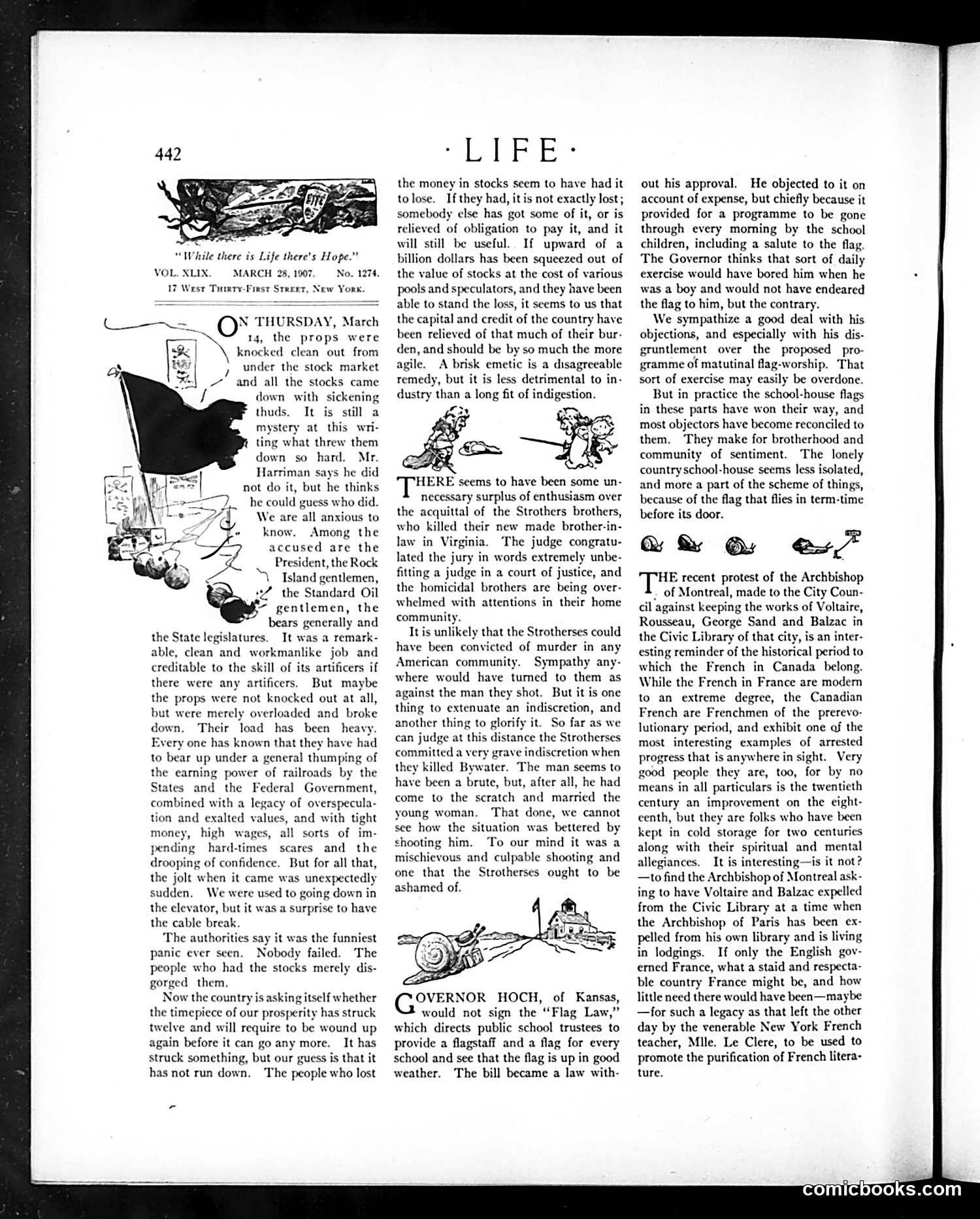
This page contains primarily text commentary rather than political cartoons. The main content discusses the 1914 stock market crash ("props were knocked out"), comparing it to previous financial panics. The author notes the public remained calm during the crisis. The text also covers Governor Hoch of Kansas's objection to a proposed "Flag Law" requiring public schools to display flags daily—he deemed it an unnecessary expense and a program better suited to homes than schools. Finally, there's discussion of the Archbishop of Montreal's protest against keeping French authors (Voltaire, Rousseau, Sand, Balzac) in the city's civic library, framed as preserving French literary heritage. The small decorative illustrations are generic vignettes rather than specific political caricatures.
📄 Transcribed text from this page (OCR, searchable)
Machine-transcribed from the original scan — historical spelling and the odd misread are preserved.
Ge “While there is Life there’s Hope.” VOL. XLIX. — MARCH 28,1907. No. 1274. 17 West Tinty-Fiest Street, New York. O* THURSDAY, March 14, the props were | knocked clean out from under the stock market and all the stocks came down with sickening thuds. It is still a mystery at this wri- ting what threw them down so hard. Mr. Harriman says he did not do it, but he thinks he could guess who did. We are all anxious to know. Among the accused are the President, the Rock “\ Island gentlemen, +7 the Standard Oil ~ gentlemen, the bears generally and the State legislatures. It was a remark- able, clean and workmanlike job and creditable to the skill of its artificers if there were any artificers. But maybe the props were not knocked out at all, but were merely overloaded and broke down. Their load has been heavy. Every one has known that they have had to bear up under a general thumping of the earning power of railroads by the States and the Federal Government, combined with a legacy of overspecula- tion and exalted values, and with tight money, high wages, all sorts of im- pending hard-times scares and the drooping of confidence. But for all that, the jolt when it came was unexpectedly sudden. We were used to going down in the elevator, but it was a surprise to have the cable break. The authorities say it was the funniest panic ever seen. Nobody failed. The people who had the stocks merely dis- gorged them, Now the country is asking itself whether the timepiece of our prosperity has struck twelve and will require to be wound up again before it can go any more. It has struck something, but our guess is that it has not run down. The people who lost a sD i ae the money in stocks seem to have had it tolose. If they had, it is not exactly lost; somebody else has got some of it, or is relieved of obligation to pay it, and it will still be useful. If upward of a billion dollars has been squeezed out of the value of stocks at the cost of various pools and speculators, and they have been able to stand the los seems to us that the capital and credit of the country have been relieved of that much of their bur- den, and should be by so much the more agile. A brisk emetic is a disagreeable remedy, but it is less detrimental to in- dustry than a long fit of indigestion. HERE seems to have been some un- necessary surplus of enthusiasm over the acquittal of the Strothers brothers, who killed their new made brother-in- law in Virginia. The judge congratu- lated the jury in words extremely unbe- fitting a judge in a court of justice, and the homicidal brothers are being over- whelmed with attentions in their home community. It is unlikely that the Strotherses could have been convicted of murder in any American community. Sympathy any- where would have tumed to them as against the man they shot. But it is one thing to extenuate an indiscretion, and another thing to glorify it. So far as we can judge at this distance the Strotherses committed a very grave indiscretion when they killed Bywater. The man scems to have been a brute, but, after all, he had come to the scratch and married the young woman. That done, we cannot see how the situation was bettered by shooting him. To our mind it was a mischievous and culpable shooting and one that the Strotherses ought to be ashamed of. OVERNOR HOCH, of Kansas, would not sign the “Flag Law,” which directs public school trustees to provide a flagstaff and a flag for every school and see that the flag is up in good weather. The bill became a law with- out his approval. He objected to it on account of expense, but chiefly because it provided for a programme to be gone through every morning by the school children, including a salute to the flag. The Governor thinks that sort of daily exercise would have bored him when he was a boy and would not have endeared the flag to him, but the contrary. We sympathize a good deal with his objections, and especially with his dis- gruntlement over the proposed pro- gramme of matutinal flag-worship. That sort of exercise may easily be overdone. But in practice the school-house flags in these parts have won their way, and most objectors have become reconciled to them. They make for brotherhood and community of sentiment. The lonely country school-house seems less isolated, and more a part of the scheme of things, because of the flag that flies in term-time before its door. THe recent protest of the Archbishop , of Montreal, made to the City Coun- cil against keeping the works of Voltaire, Rousseau, George Sand and Balzac in the Civic Library of that city, is an inter- esting reminder of the historical period to which the French in Canada belong. While the French in France are modem to an extreme degree, the Canadian French are Frenchmen of the prerevo- lutionary period, and exhibit one of the most interesting examples of arrested progress that is anywhere in sight. Very good people they are, too, for by no means in all particulars is the twentieth century an improvement on the eight- eenth, but they are folks who have been kept in cold storage for two centuries along with their spiritual and mental allegiances. It is interesting—is it not? —to find the Archbishop of Montreal ask- ing to have Voltaire and Balzac expelled from the Civic Library at a time when the Archbishop of Paris has been ex- pelled from his own library and is living in lodgings. If only the English gov- erned France, what a staid and respecta- ble country France might be, and how little need there would have been—maybe —for such a legacy as that left the other day by the venerable New York French teacher, Mile. Le Clere, to be used to promote the purification of French litera- ture. Tomicbooks.com