
Life, 1907-03-28 · page 16 of 24
Life — March 28, 1907 — page 16: what you’re looking at
What you’re looking at
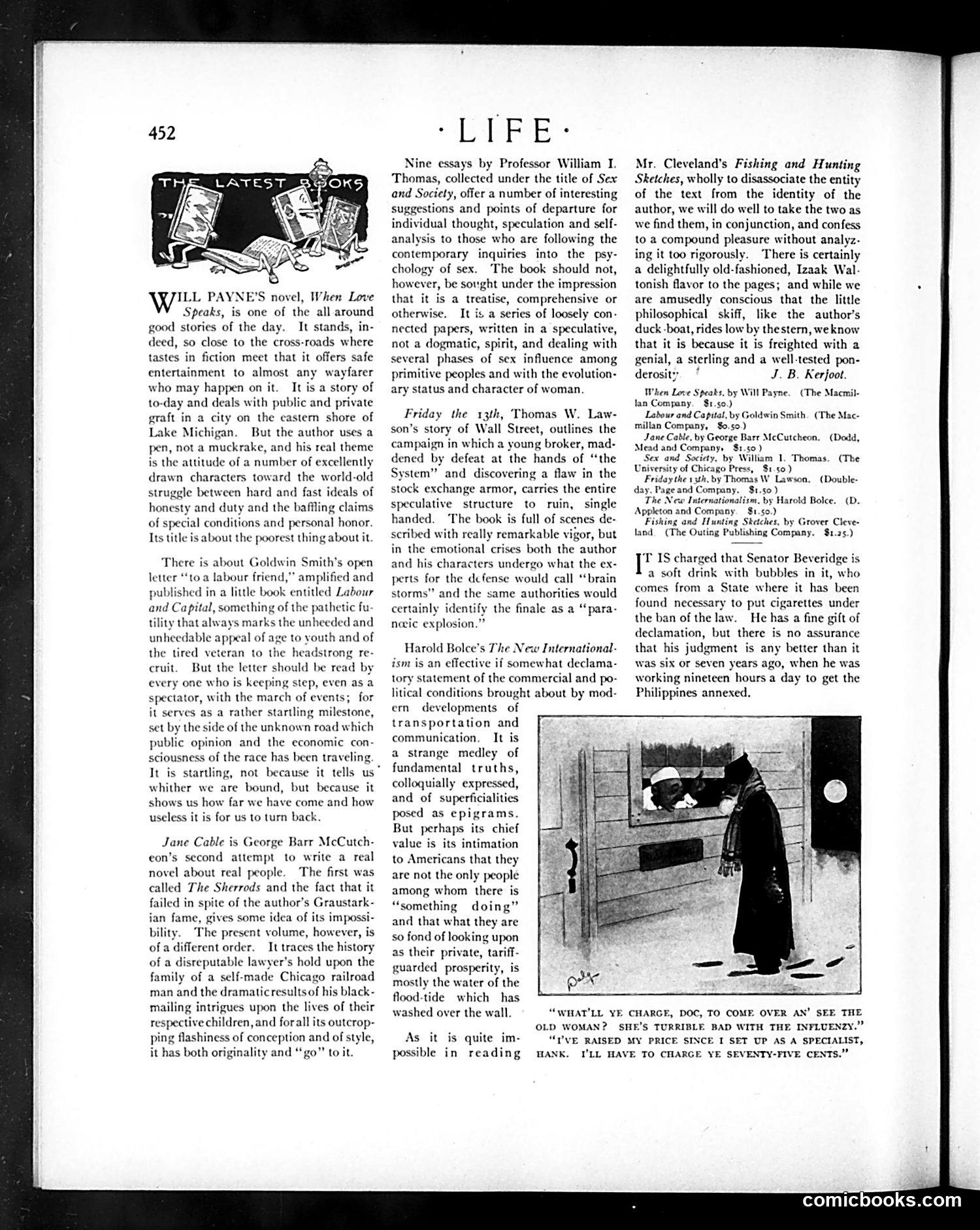
This page reviews nine recent books, primarily literary fiction and social commentary. The cartoon illustrates a scene from one book, showing a man in a coat and hat confronting an elderly woman at a doorway. The caption reads: "WHAT'LL YE CHARGE, DOC, TO COME OVER AN' SEE THE OLD WOMAN? SHE'S TERRIBLE BAD WITH THE INFLUENZA. I'VE RAISED MY PRICE SINCE I SET UP AS A SPECIALIST, HANK. I'LL HAVE TO CHARGE YE SEVENTY-FIVE CENTS." The joke satirizes medical profiteering: a self-proclaimed doctor has inflated his fees by claiming "specialist" status. The scene appears drawn from one of the reviewed novels dealing with contemporary urban life and character. The reviews discuss books addressing timely concerns—labor relations, Wall Street speculation, and sex psychology—reflecting early 20th-century intellectual debates. The overall tone suggests Life magazine positioned itself as a literary arbiter for educated readers interested in serious fiction alongside satire.
📄 Transcribed text from this page (OCR, searchable)
Machine-transcribed from the original scan — historical spelling and the odd misread are preserved.
ILL PAYNE'S novel, When Love ‘peaks, is one of the all around good stories of the day. It stands, in- deed, so close to the cross-roads where tastes in fiction meet that it offers safe entertainment to almost any wayfarer who may happen on it. It is a story of to-day and deals with public and private graft in a city on the eastern shore of Lake Michigan, But the author uses a pen, not a muckrake, and his real theme is the attitude of a number of excellently drawn characters toward the world-old struggle between hard and fast ideals of honesty and duty and the baffling claims of special conditions and personal honor Its title is about the poorest thing about it. There is about Goldwin Smith’s open letter ‘to a labour friend,” amplified and published in a little book entitled Labour and Capital, something of the pathetic fu tility that always marks the unheeded and unheedable appeal of age to youth and of the tired veteran to the headstror cruit. But the letter should be read by one who is keeping step, even as a tator, with the march of events; for it serves as a rather startling milestone, set by the side of the unknown road which public opinion and the economic con- sciousness of the race has been traveling. It is startling, not because whither we are bound, but because it shows us how far we have come and how useless it is for us to turn back. Jane Cable is George Barr McCutch- eon’s second attempt to write ar novel about real people. The first was called The Sherrods and the fact that it failed in spite of the author’s Graustark ian fame, gives some idea of its impo: bility. The present volume, however, is ofa different order. It traces the history of a disreputable lawyer’s hold upon the family of a self-made Chicago railroad man and the dramatic results of his black- mailing intrigues upon the lives of their respective children, and forall its outcrop- ping flashiness of conception and of style, it has both originality and “go” to it. it tells us’ Nine essays by Professor William I Thomas, collected under the title of Sex and Society, offer a number of interesting suggestions and points of departure for individual thought, speculation and self- analysis to those who are following the contemporary inquiries into the psy- chology of sex. The book should not, however, be sought under the impression that it is a treatise, comprehensive or otherwise. It is a series of loosely con- nected papers, written in a speculati not a dogmatic, spirit, and dealing with several phases of sex influence among primitive peoples and with the evolution- ary status and character of woman. iday the 13th, Thomas W. Law- son’s story of Wall Street, outlines the campaign in which a young broker, mad- dened by defeat at the hands of “the System” and discovering a flaw in the stock exchange armor, carries the entire speculative structure to ruin, single handed. ‘The book is full of scenes de- scribed with really remarkable vigor, but in the emotional crises both the author and his characters undergo what the ex- perts for the defense would call “brain storms” and the same authorities would certainly identify the finale as a “‘para- nevic explosion.” Harold Bol The New International- ism is an effective if somewhat declama- tory statement of the commercial and po- litical conditions brought about by mod- em developments of transportation and communication. It is a strange medley of fundamental truths, colloquially expressed, and of superficialities posed as epigrams. But perhaps its chief value is its intimation to Americans that they are not the only people among whom there is “something doing” and that what they are so fond of looking upon as their private, tariff- guarded prosperity, is mostly the water of the flood-tide which has washed over the wall. “WHAT'LL ¥ OLD WOMAN? SH “VE RAISED MY PRICE SID As it is quite im- possible in reading mas V'LL HAVE TO CHARGE YE Mr. Cleveland's Fishing and Hunting Sketches, wholly to disassociate the entity of the text from the identity of the author, we will do well to take the two as we find them, in conjunction, and confess toa compound pleasure without analyz- ing it too rigorous There is certainly a delightfully old-fashioned, Izaak Wal- tonish flavor to the pages; and while we are amusedly conscious that the little philosophical skiff, like the author's duck -boat, rides low by thestern, we know that it is because it is freighted with a genial, a sterling and a well-tested pon- derosity J. B. Kerjoot. When Love Speaks, by Will Payne. (The Macmil- fan Company. $1.50.) Labour and Capital, by Goldwin Smith millan Company, $0.50.) Jane Cable, by George Bare McCutcheon Mead and Companys $1.50) Sex and Society, by William 1 University of Chicago Press, $1.50) Friday the 13th. by Thomas W Lawson, day, Page and Company. $1.0) The New Internationatism. by Harold Bole. (D. Appleton and Company. $1.50.) Fishing and Hunting Sketches, by Grover Cleve- land. (The Outing Publishing Company. $1.25.) (The Mac- (Dodd, Thomas. (The (Double- I ’ IS charged that Senator Beveridge is a soft drink with bubbles in it, who comes from a State where it has been found necessary to put cigarettes under the ban of the law. He has a fine gift of declamation, but there is no assurance that his judgment is any better than it was six or seven years ago, when he was working nineteen hours a day to get the Philippines annexed. CHARGE, DOC, TO COME. OVER AN’ SEE THE 'S TURRIBLE BAD WITH THE INFLUENZY.” ‘E I SET UP AS A SPECIALIST, SEVENTY-FIVE CENTS.” comicbooks.com