
A complete issue · 28 pages · 1906
Life — December 13, 1906
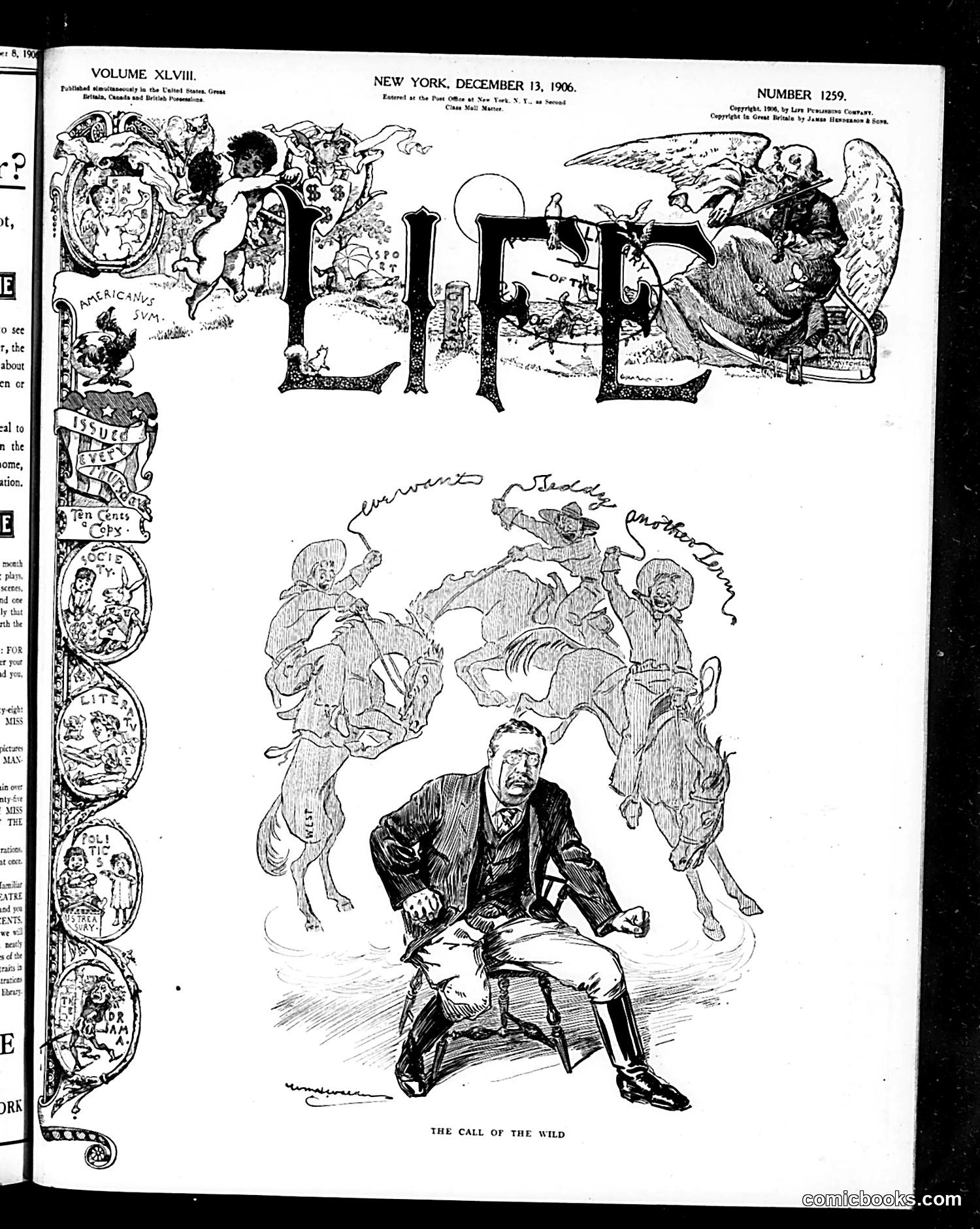
The bottom cartoon depicts a distressed man seated alone, surrounded by aggressive animal figures looming above him. The title "The Call of the Wild" references Jack London's popular 1906 novel of the same name, which tells of a domesticated dog thrust into Yukon wilderness. This appears to be satirical commentary on the novel's themes—perhaps mocking either the book's popularity, the romanticization of primitive nature, or contemporary anxieties about "civilization versus savagery." The man's troubled expression suggests he's overwhelmed or threatened by these wild forces. The ornate decorative borders and additional satirical imagery at page top are typical of Life's design aesthetic. Without additional context, the specific political or social target remains unclear.
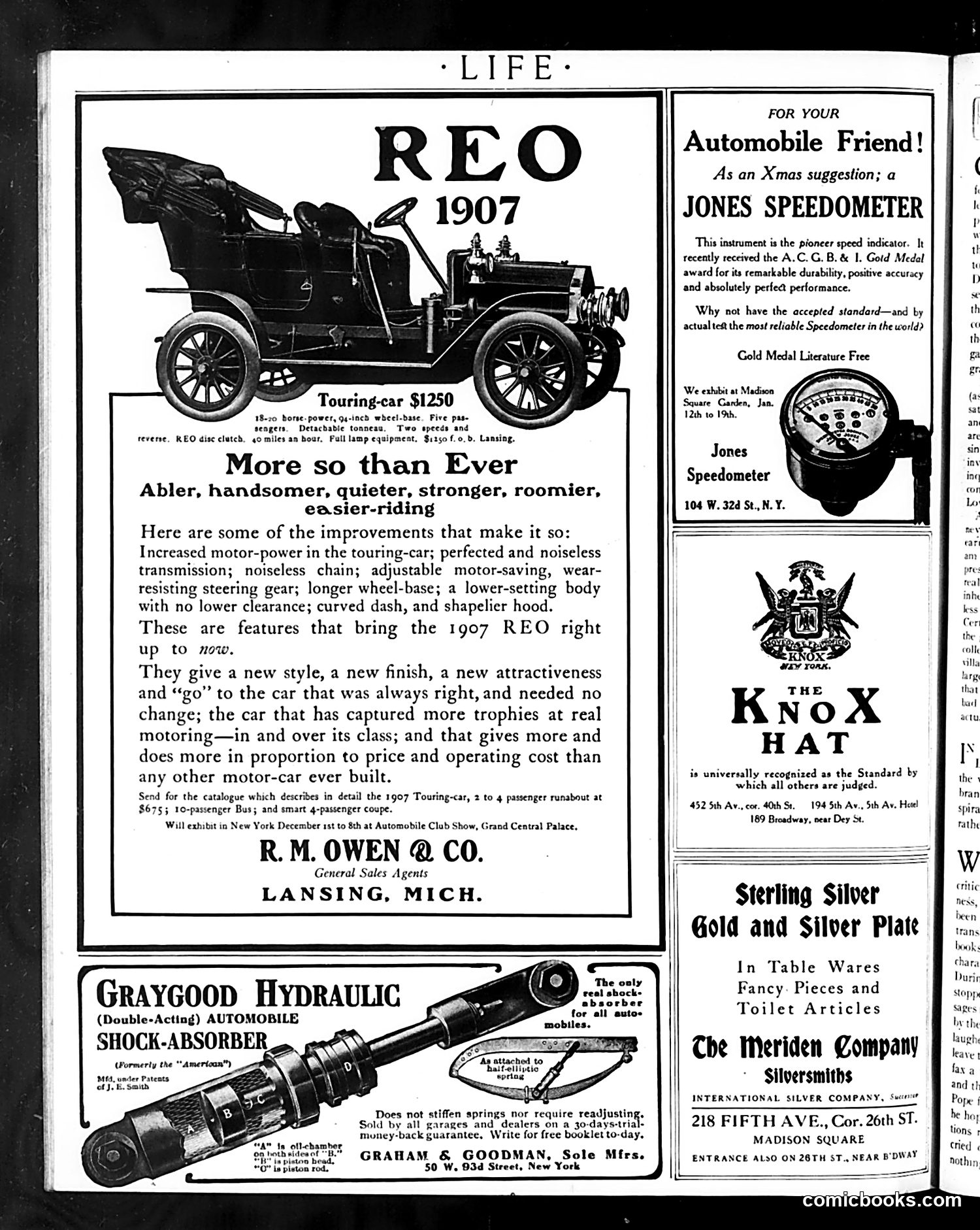
This page is **primarily advertising**, not satire or political commentary. The main content is a straightforward advertisement for the REO 1907 touring car, manufactured by R.M. Owen & Co. in Lansing, Michigan. The ad emphasizes mechanical improvements like "noiseless transmission" and "noiseless chain" to appeal to buyers seeking reliability and comfort. The surrounding advertisements for the Jones Speedometer, Knox Hat, and Sterling Silver goods are typical period product placements—not satirical content. **No political cartoon or satire is present.** This represents early 20th-century automotive marketing emphasizing technological advancement and quality craftsmanship as selling points to affluent consumers.
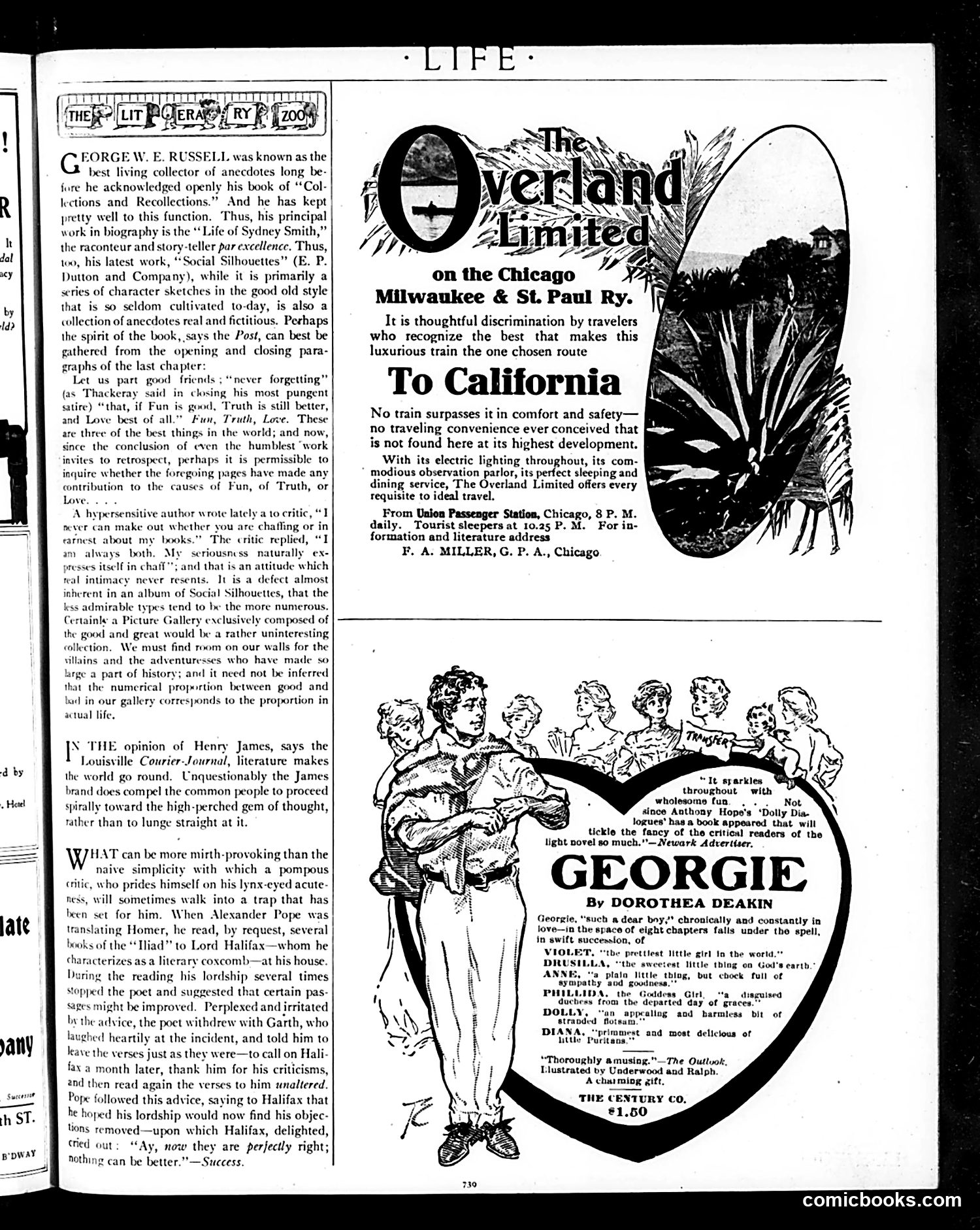
This page contains **primarily advertisements and literary commentary**, not political satire. The main content discusses **George W.E. Russell's writing style**—praising his biographical work and character sketches. The text debates literature's role: one critic argues books should entertain rather than instruct; Henry James's opinion on literature is cited approvingly. **The advertisements** include: - "The Overland Limited" train to California (emphasizing comfort and safety) - "Georgie" by Dorothea Deakin—a children's book described as a "dear, brave" character study The page reflects **early 20th-century literary and consumer culture**, with no apparent political commentary or caricature. The focus is on promoting both serious literature and commercial products to educated middle-class readers.
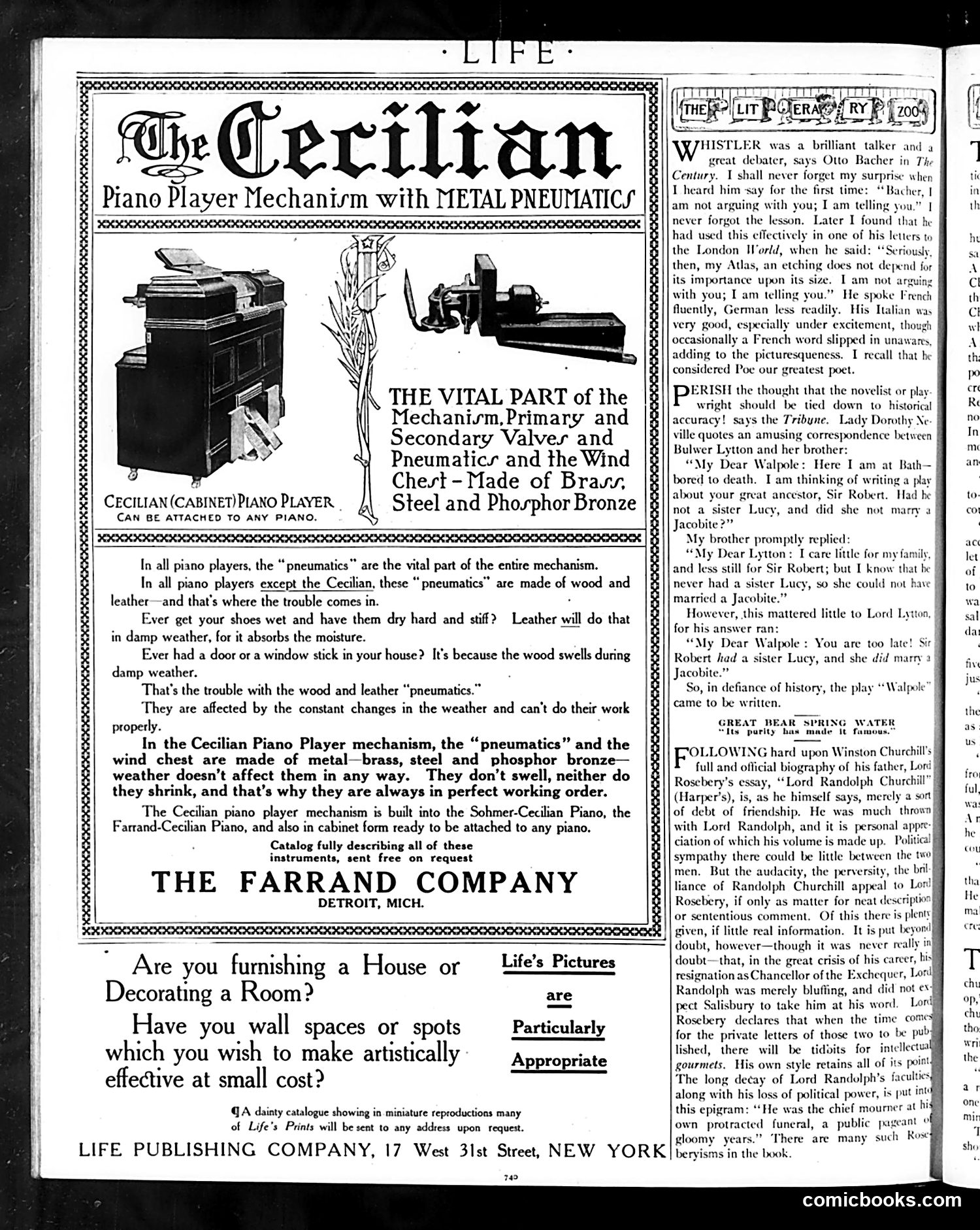
This page is primarily **advertising and editorial content** rather than political satire. The left side features a full advertisement for **The Cecilian Piano Player Mechanism** by the Farrand Company (Detroit), emphasizing its metal pneumatics that resist weather damage better than wood-and-leather alternatives. The right side contains two distinct items: 1. **"The Literary Zoo"** — a brief satirical piece mocking novelist **Whistler** and debater **Otto Bismarck** for their argumentative tendencies, with anecdotes about their rhetorical styles. 2. **"Great Head Spring Water"** — editorial text beginning a biographical essay on **Lord Randolph Churchill**, discussing his political career and personal correspondence. The page represents typical *Life* magazine content: commercial advertisements interspersed with light humor and literary commentary, rather than focused political cartooning.
This page is primarily **advertising**, not political satire. The left column contains excerpts from a speech against religion by Bernani Shaw, but the bulk of the page features four commercial advertisements: 1. **Franco-American Soups** - promoting French-prepared soups sold in America 2. **Meux's Original London Stout** - a beer advertisement 3. **Spencerian Steel Pens** - promoting writing instruments 4. **Great Western Extra Dry Champagne** - wine advertisement emphasizing that U.S. tariffs inflate the price of imported champagne The only potentially satirical element is the champagne ad's complaint about customs duties raising costs—a mild critique of trade policy. Otherwise, this represents typical early 20th-century *Life* magazine content: mixing intellectual commentary with period advertising.
This page is primarily **advertising**, not satirical content. It contains four advertisements: 1. **Williams' Shaving Stick** - claims to be "the only kind that won't smart or dry on the face," marketed by The J.B. Williams Company (Glastonbury, Connecticut). 2. **Andrew Usher & Co. Scotch Whiskies** - promotes "Exceptional Special Reserve O.V.G." and "Old Vatted Glenlivet," sold by G.S. Nicholas & Co. in New York. 3. **Henry Hutt Calendar (1907)** - a decorative calendar featuring an illustration of a woman, priced at $5.00, published by Life Publishing Company. 4. **"A Woman's Confessional" by Helen Woljeska** - a serialized article about a woman's diary, with critical reviews from various newspapers quoted. The page represents typical early 20th-century magazine advertising and serialized content.
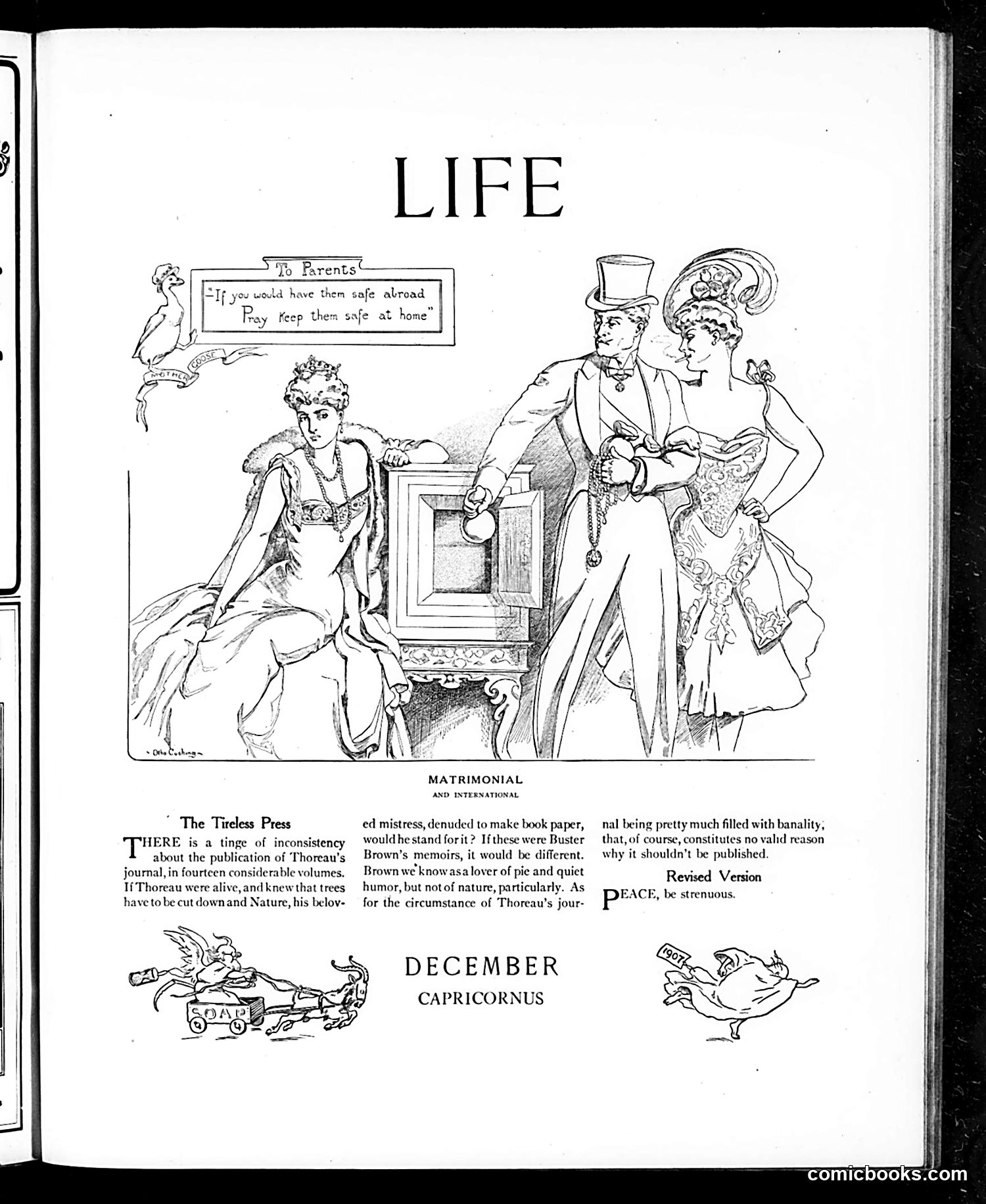
This page contains satirical commentary on publishing and marriage customs. The main cartoon titled "To Parents" features a stork delivering a baby, with the caption advising parents to keep children safe at home rather than abroad—likely satirizing wealthy families sending children overseas. Below, "The Tireless Press" section critiques inconsistency in publishing Thoreau's journal, suggesting editors cut content to fit their preferences. The text implies such editorial manipulation constitutes invalid publication. The "Matrimonial and International" section appears to reference marriage customs, with three elegantly dressed figures in the illustration, though the specific social commentary isn't entirely clear from the visible text. The December/Capricornus section includes decorative illustrations of cherubs or putti, typical of the magazine's lighter seasonal content.
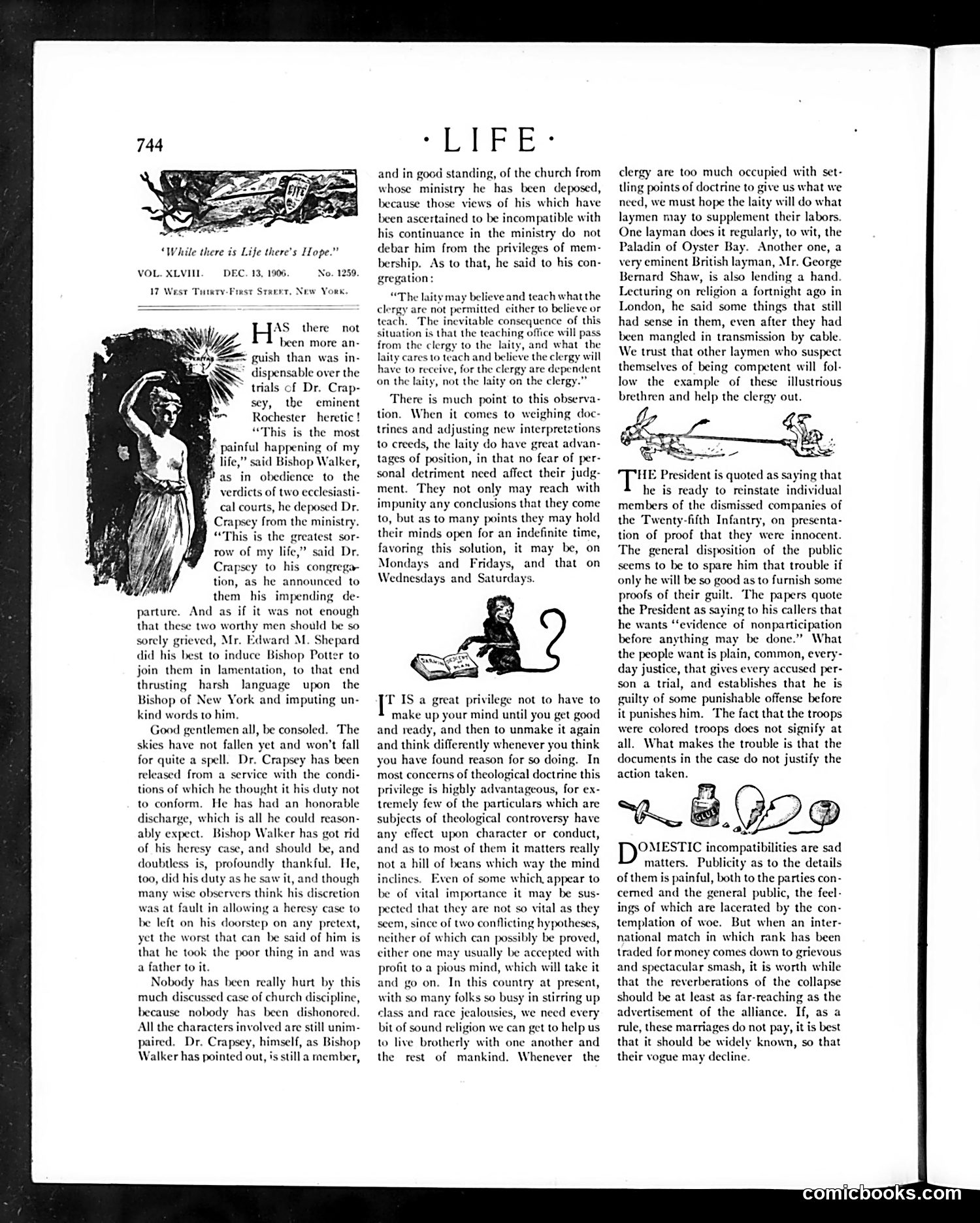
This page contains editorial commentary rather than political cartoons. The illustrations are decorative vignettes—a classical female figure and small sketches of cherubs or children—not satirical caricatures. The text discusses ecclesiastical controversy, specifically defending Dr. Crapsey, a Rochester clergyman dismissed from ministry over doctrinal disagreements. The article argues that laypeople should help support dismissed clergy and that theological disputes shouldn't affect a minister's character or conduct. A secondary editorial addresses domestic incompatibilities and marriage dissolution, advocating for discrete handling of such private matters rather than public scandal. The page reflects Progressive Era debates about religious authority, clerical discipline, and social propriety—but contains no identifiable political figures or satirical caricatures requiring historical context.
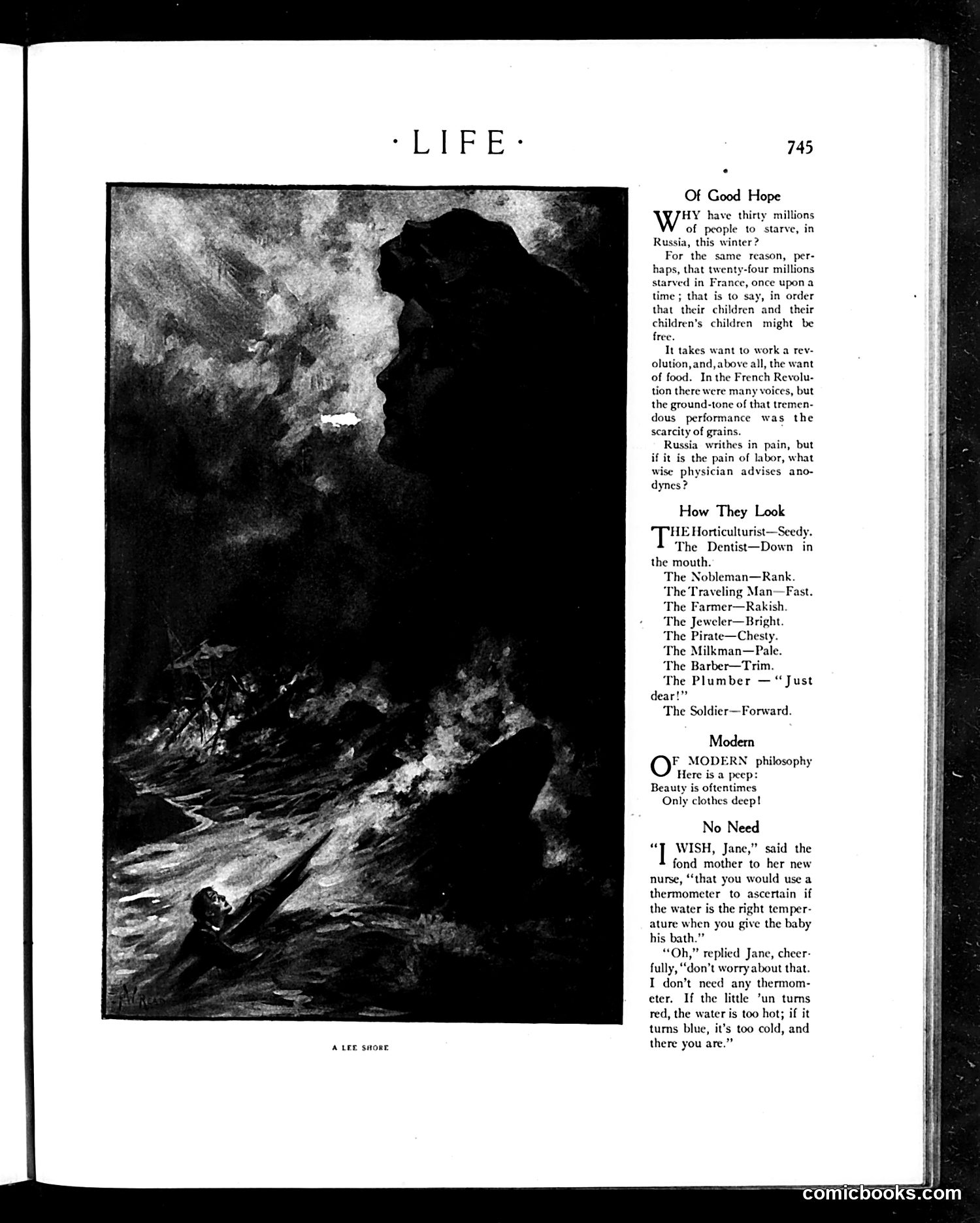
This dramatic illustration by a credited artist depicts a shipwreck or maritime disaster, showing figures struggling in turbulent waters near rocky cliffs. The accompanying text discusses starvation and revolution, specifically referencing thirty million starving people in Russia and twenty-four million in France. The "Lee Shore" (a dangerous coastline) appears to be a metaphor for political and social upheaval following World War I and the Russian Revolution. The drowning figures likely represent populations caught in famine and revolutionary turmoil. The various character descriptions ("The Horticulturist," "The Soldier," etc.) suggest ordinary people of different social classes all facing the same catastrophic circumstances. The piece critiques the human cost of post-war chaos and revolutionary violence.
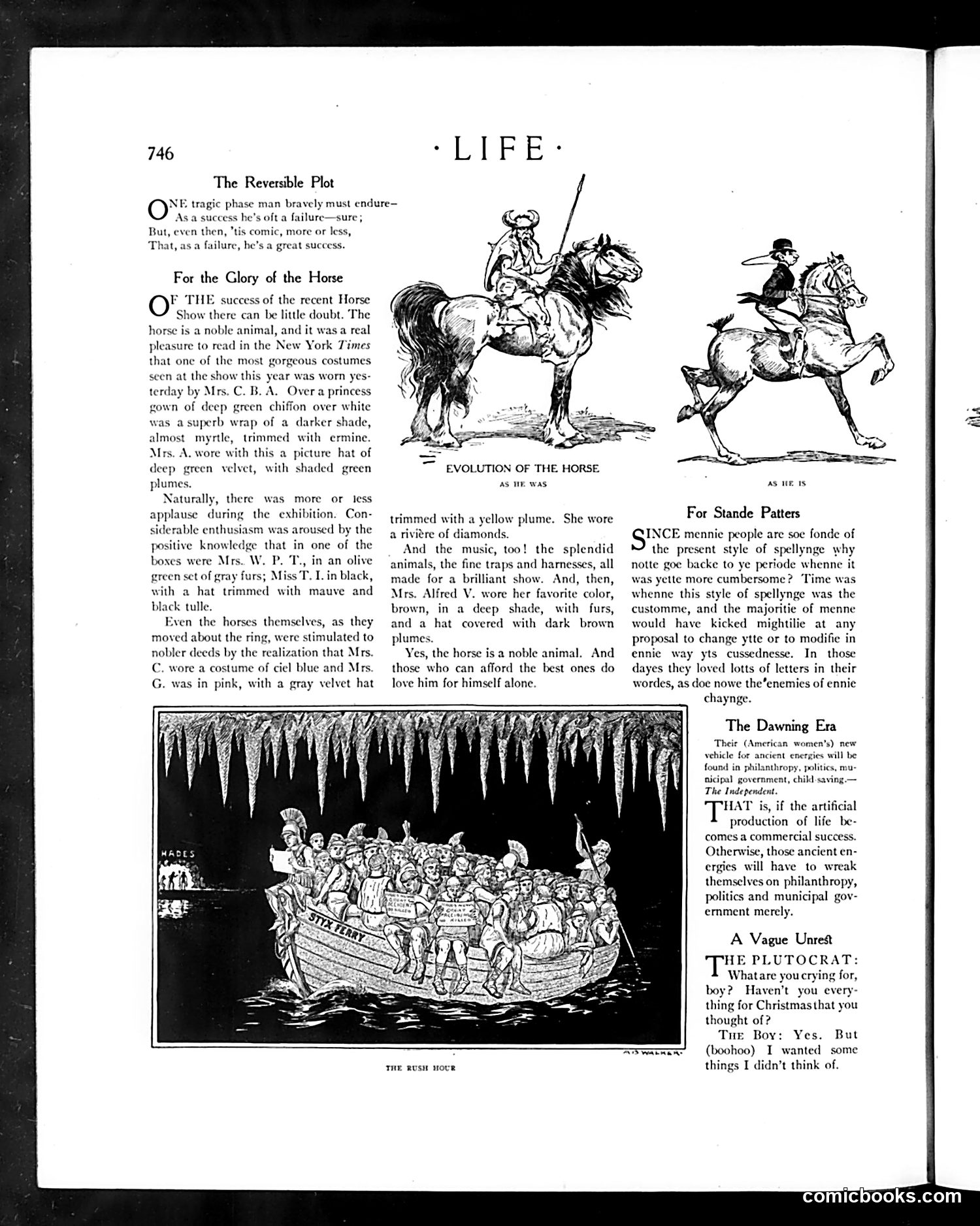
This page contains satirical commentary on high society and fashion, illustrated with two cartoons. **"The Reversible Plot"** mocks wealthy women's obsession with horses and elaborate costumes at shows. The text describes absurdly expensive outfits (green velvet, diamonds, plumes, furs) worn to display horses—yet the "noble animal" deserves appreciation for itself alone. The accompanying "Evolution of the Horse" drawings humorously contrast an idealized show horse with an awkward, poorly-ridden one. **"The Rush Hour"** depicts a crowded boat, appearing to satirize overcrowding or chaotic Christmas shopping/holiday travel among the masses. The pieces suggest Life magazine's critique of upper-class vanity and conspicuous consumption, while treating common people's experiences with comic exaggeration.
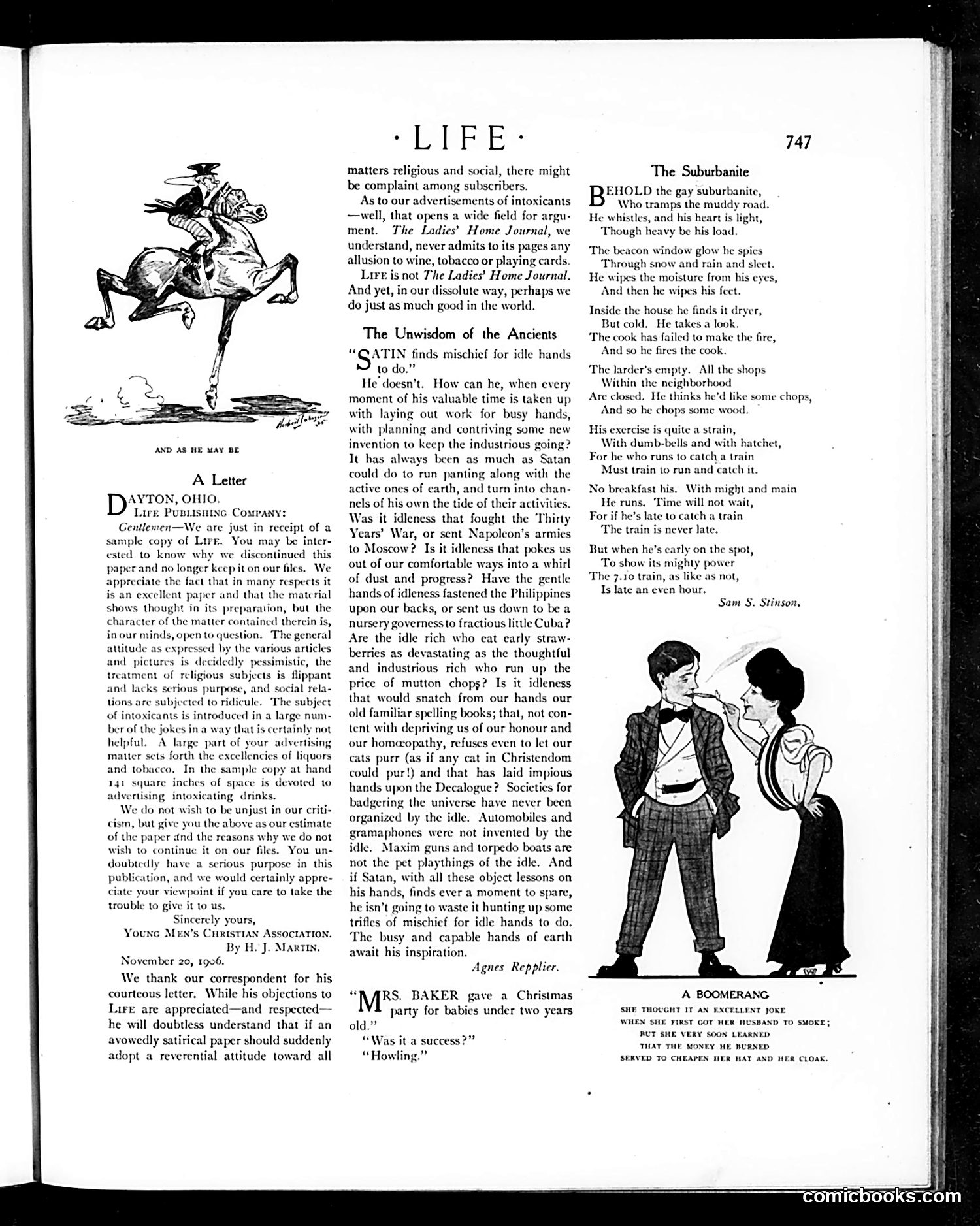
This page contains two main sections: **"A Letter"** from the Young Men's Christian Association responding to criticism about Life's satirical content regarding religion and social issues. The YMCA defends Life's right to satirize while noting Life respects religious subjects. **The cartoons** illustrate articles about idleness and domestic life: 1. **Top illustration**: A figure on horseback labeled "AND AS HE MAY BE" - appears to comment on frivolous behavior. 2. **"A Boomerang"**: Shows a couple where the woman jokes about her husband burning money for heat. The caption suggests her joke backfired when he actually did so, returning the "boomerang" to her. The page satirizes both idle leisure pursuits and marital dynamics of the era.
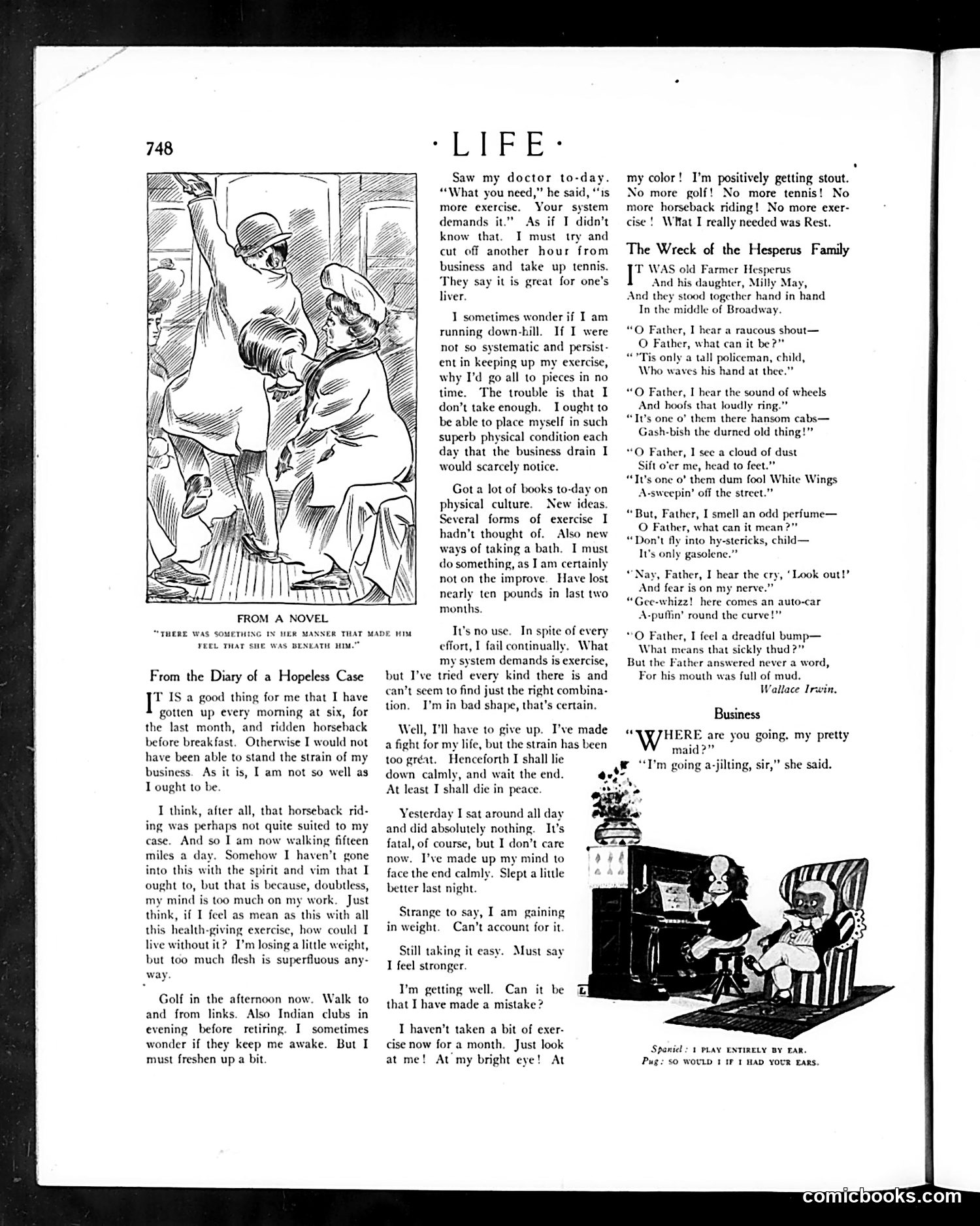
This page contains two distinct pieces of satirical commentary on American life: **"From the Diary of a Hopeless Case"** (left): A first-person account mocking the obsession with physical fitness and exercise culture. The narrator, despite doctor's orders and various fitness regimens (tennis, horseback riding, golf, Indian clubs), remains consistently out of shape and unhealthy. The satire targets both the era's health-conscious fads and the narrator's inability to maintain discipline—a common anxiety about modern life's conflicting demands between work and wellness. **"The Wreck of the Hesperus Family"** (right): A poem satirizing urban family life and traffic dangers in the modern city, featuring a father and daughter navigating Broadway amid automobiles and pollution. It parodies Longfellow's famous shipwreck poem, treating contemporary urban hazards as equivalent to maritime disaster. Both pieces mock early 20th-century anxieties about modernity's pressures.
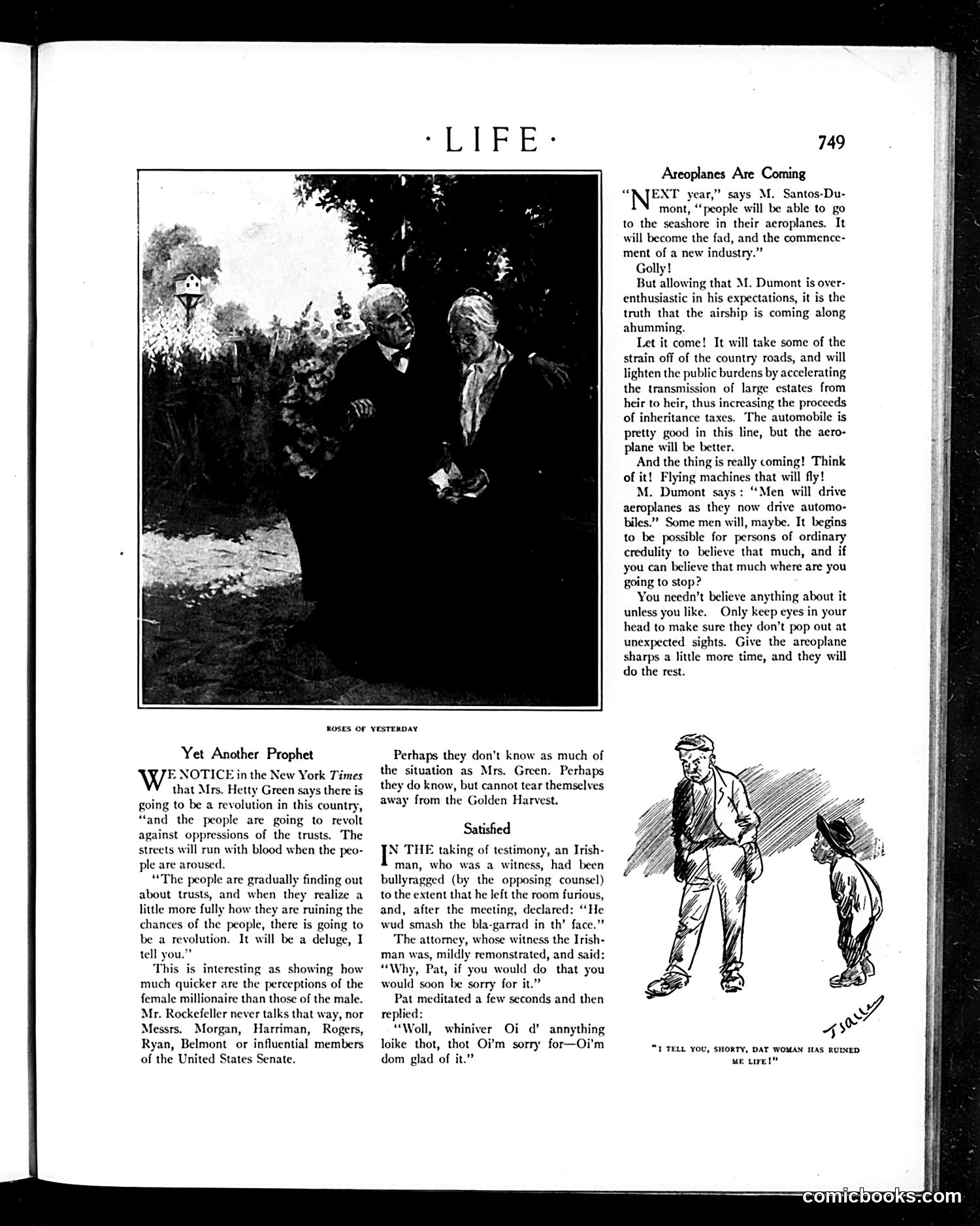
**Top Section - "Aeroplanes Are Coming":** This satirical piece mocks M. Santos-Dumont's optimistic predictions about commercial aviation becoming accessible to ordinary people. The author ("Golly!") is skeptical, arguing that while airships may eventually come, people should focus on more pressing issues like taxing large estates and improving roads. The joke is that aviation skepticism was common—the piece sarcastically suggests people should "give the aeroplane a little more time" before expecting miracles, implying its practical viability remained doubtful. **Bottom Section - "Yet Another Prophet":** This mocks female millionaire Hetty Green's alleged predictions of violent revolution and trust-busting upheaval. The text suggests her revolutionary rhetoric is exaggerated. The accompanying cartoon shows a man and woman in conversation, illustrating the "Satisfied" anecdote about an Irishman's humorous deflation of heated political accusations—a mild joke about people's tendency to overstate grievances.
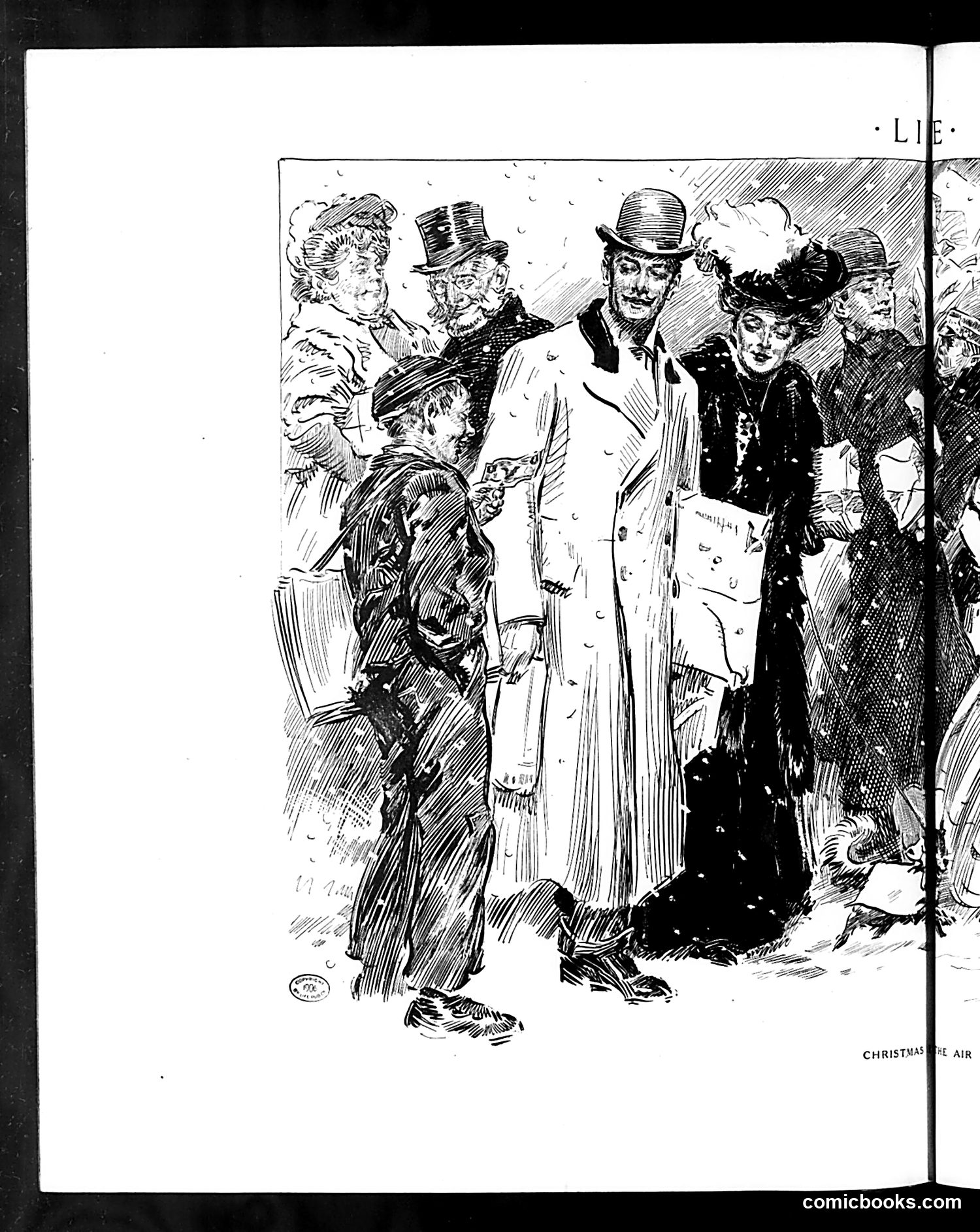
This appears to be a satirical Christmas illustration from *Life* magazine, though the OCR text is incomplete ("CHRISTMAS BEE air"). The sketch depicts a group of well-dressed figures in winter clothing gathered together outdoors in snowy conditions. The art style—with exaggerated facial features and expressive line work—is typical of early 20th-century satirical illustration. Without the complete caption or fuller context, I cannot definitively identify the specific figures or political references intended. The title fragment "CHRISTMAS BEE" might suggest commentary on holiday charity, social gatherings, or contemporary public figures, but I cannot assert the specific satire's point without clearer text or additional context about the publication date. The drawing's technique and composition suggest social or political commentary characteristic of *Life's* editorial content.
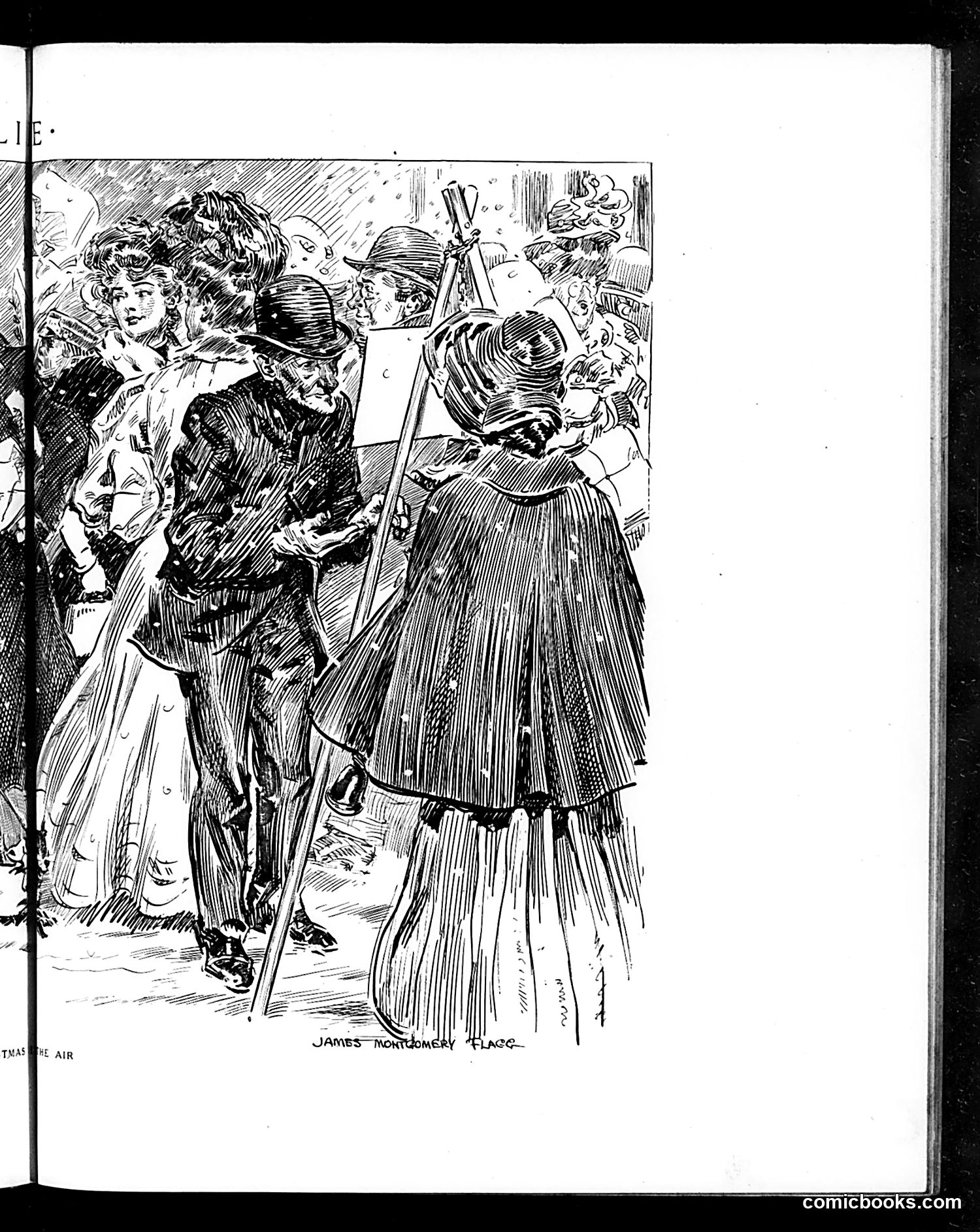
This appears to be an illustration by **James Montgomery Flagg**, a prominent American cartoonist and illustrator of the early 20th century (signature visible at bottom). The sketch depicts a **crowded social scene**, likely at a fashionable venue or gathering. Multiple figures in period dress (early 1900s) are shown interacting—women in elaborate hats and clothing, men in suits and bowler hats. The style and composition suggest this is **satirizing high society or upper-class social conventions** of the era. Without additional context from the magazine's text or surrounding content, the specific political or social critique isn't entirely clear from the image alone. However, Flagg typically lampooned pretension, fashion excess, and social hierarchies of his time. The partial text "TMAS BE AIR" at bottom-left is OCR error and doesn't clarify the cartoon's subject.
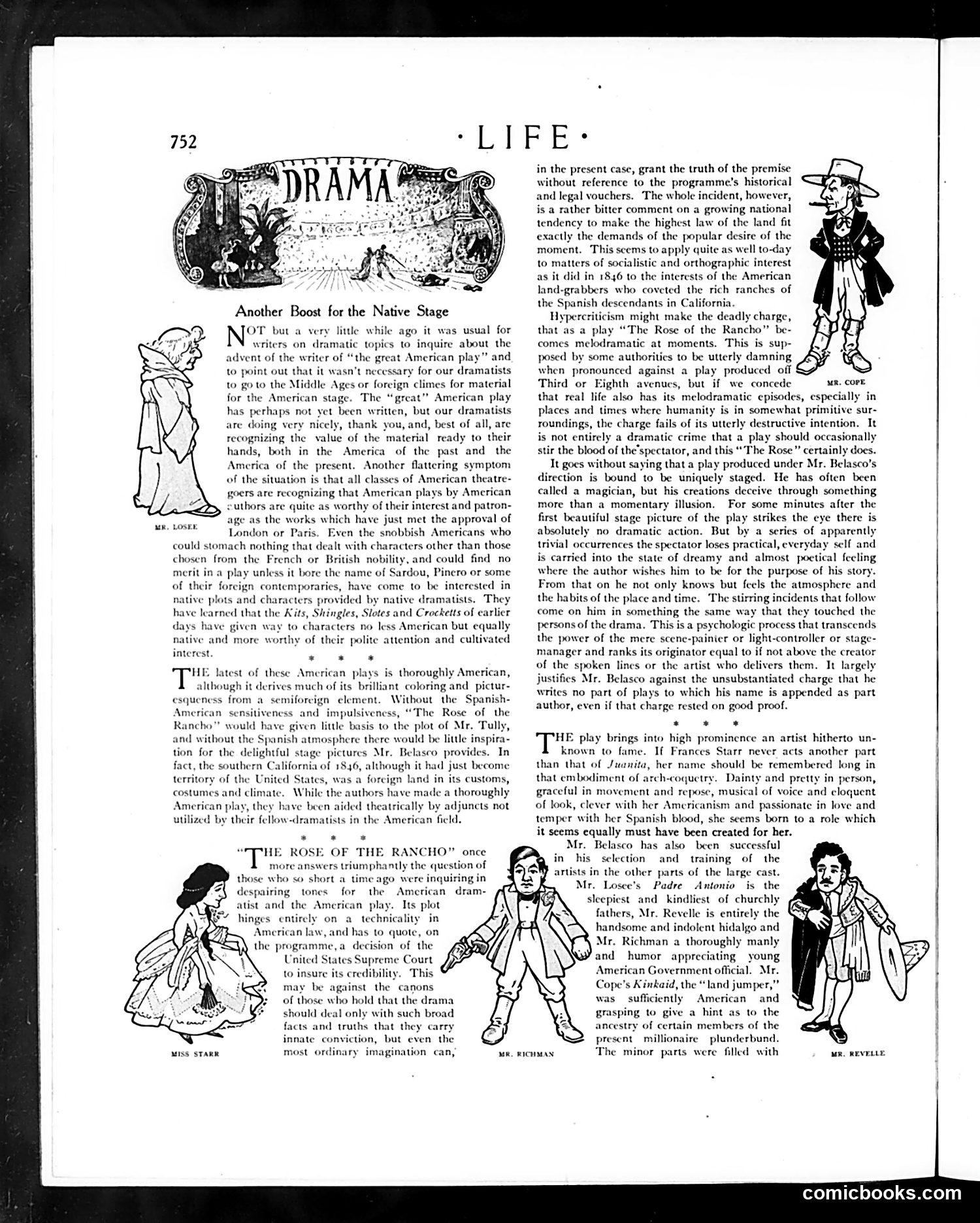
This page reviews "The Rose of the Rancho," a contemporary American play, celebrating the emergence of native American drama. The article argues that American audiences and writers no longer need to slavishly imitate European (French, British) theatrical works. The cartoon illustrations show cast members (Miss Starr, Mr. Richman, Mr. Revelle, and Mr. Cope) in period Spanish-Californian costume, reflecting the play's 1846 Southern California setting—just after American territorial acquisition. The satire targets earlier American cultural snobbery: wealthy Americans who dismissed native plays unless they featured European nobility or were written by foreign dramatists like Sardou or Pinero. The review argues this prejudice has finally yielded to appreciation for authentically American stories and characters. A secondary critique notes the play's plot hinges on a U.S. Supreme Court decision, mocking how American law gets manipulated to serve popular demands—a jab at contemporary land-grabbing interests in the Southwest.
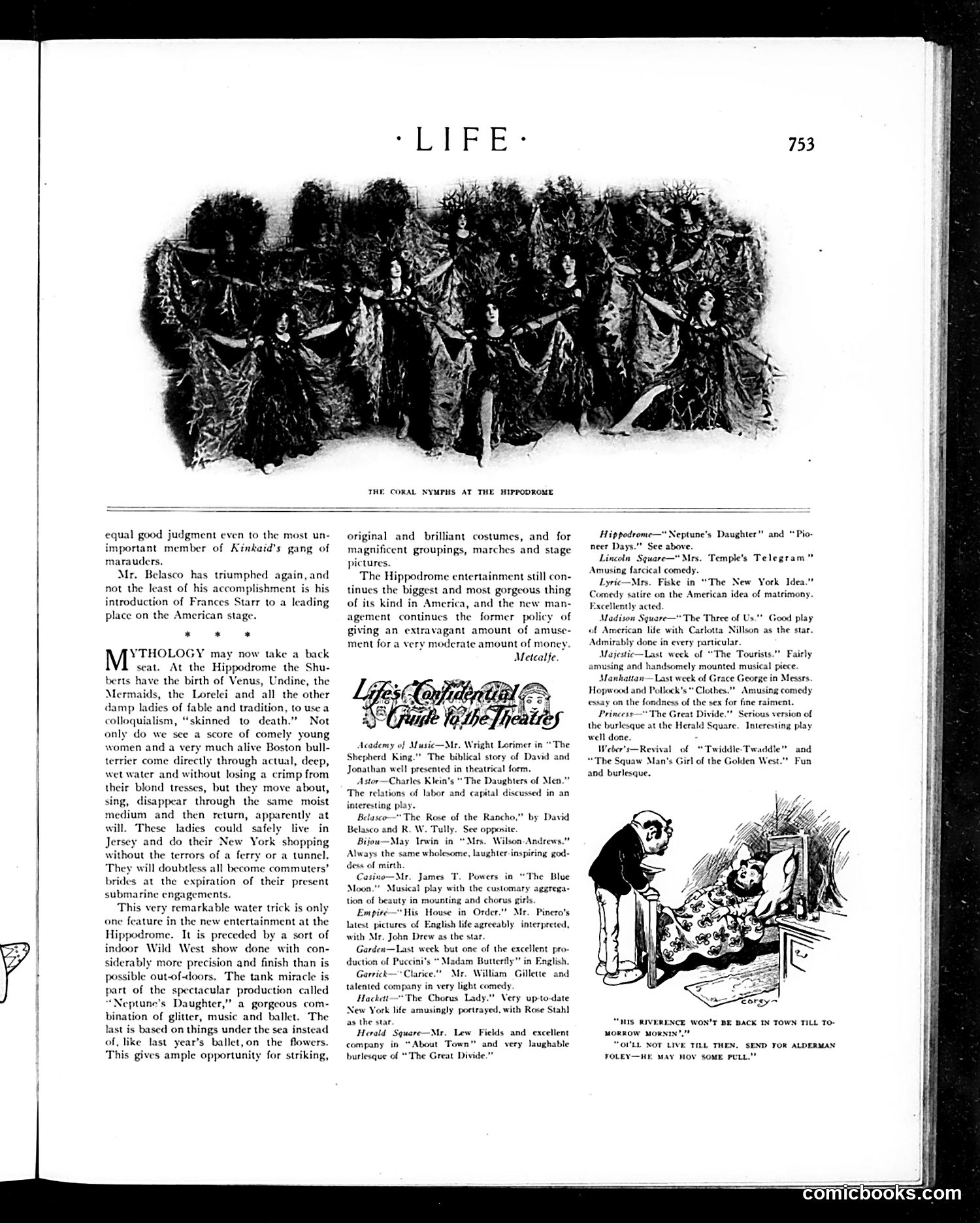
This page from *Life* magazine consists primarily of theatrical reviews and a small cartoon illustration. The main content discusses the Hippodrome's new production "Neptune's Daughter," praising its spectacular underwater effects featuring women performers and a Boston bull terrier moving through actual water without damaging their hair—presented as a marvel of stagecraft. The accompanying cartoon (bottom right) depicts two figures in what appears to be a domestic scene, with a caption about someone's "reverence won't be back in town till tomorrow morning" and a humorous reference to Alderman Foley obtaining "some pull." The satire targets the pretensions of theatrical spectacle over substance, mocking how audiences were amazed by technical tricks (the water effects) while theater continued serving as escapist entertainment. The page reflects early 1900s entertainment culture where elaborate production values and novelty effects drove patronage.
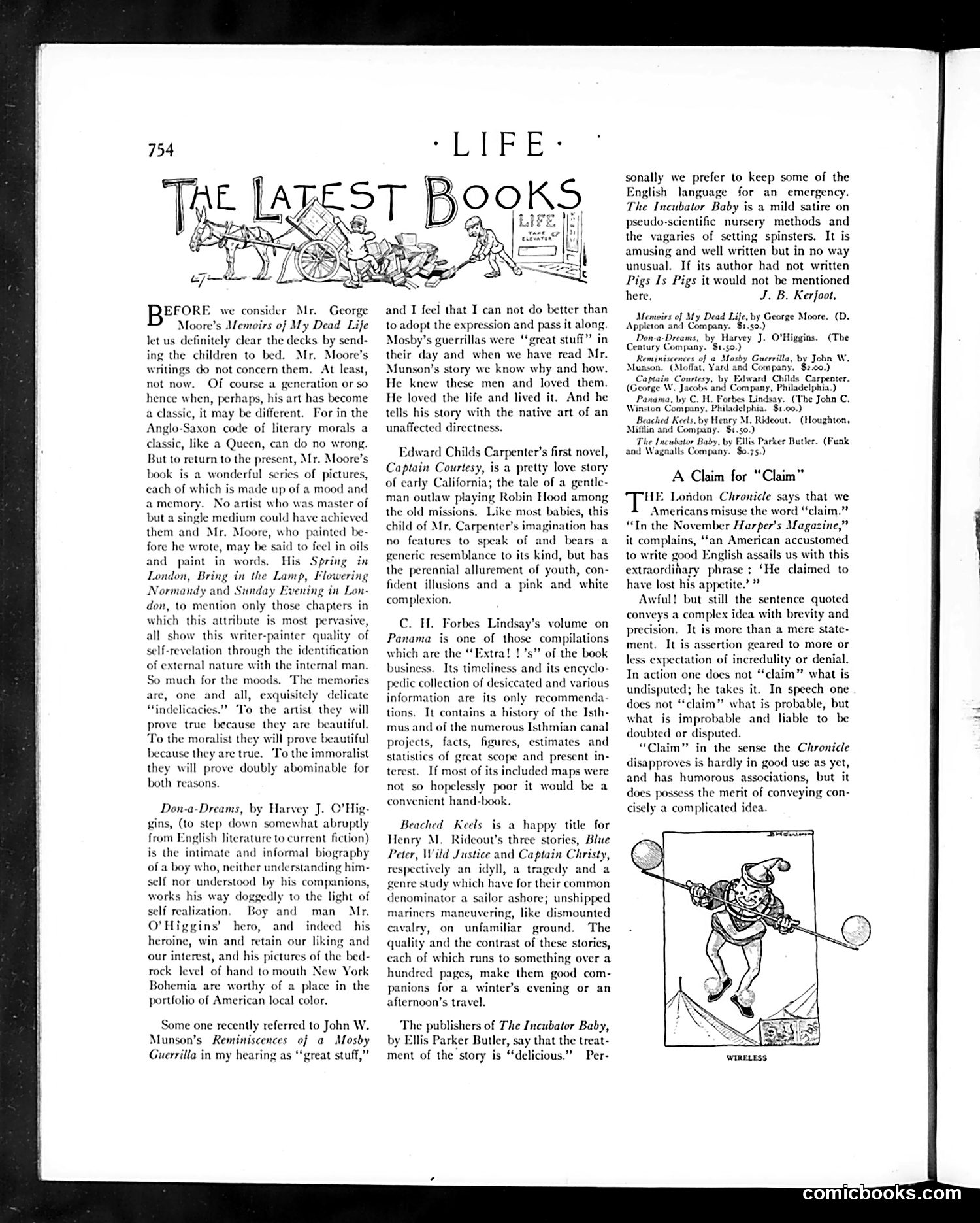
This page reviews recent books, primarily novels. The main cartoon (bottom right, labeled "Wireless") depicts a figure juggling or playing with spheres, likely satirizing the contemporary fascination with wireless technology or modern inventions. The text focuses on literary criticism of works by George Moore, Harvey J. O'Higgins, John W. Munson, and others. The reviewer employs Victorian-era literary sensibilities, notably warning that Moore's *Memoirs of My Dead Life* contains material unsuitable for children—reflecting early 20th-century prudishness about candid autobiographical writing. The page demonstrates Life magazine's role as a cultural arbiter, blending high-minded literary discussion with light satire. The reviewer uses sophisticated, sometimes arch language ("doubly abominable") typical of the era's book criticism. References to Mosby's guerrillas and early California reflect contemporary American historical interests.
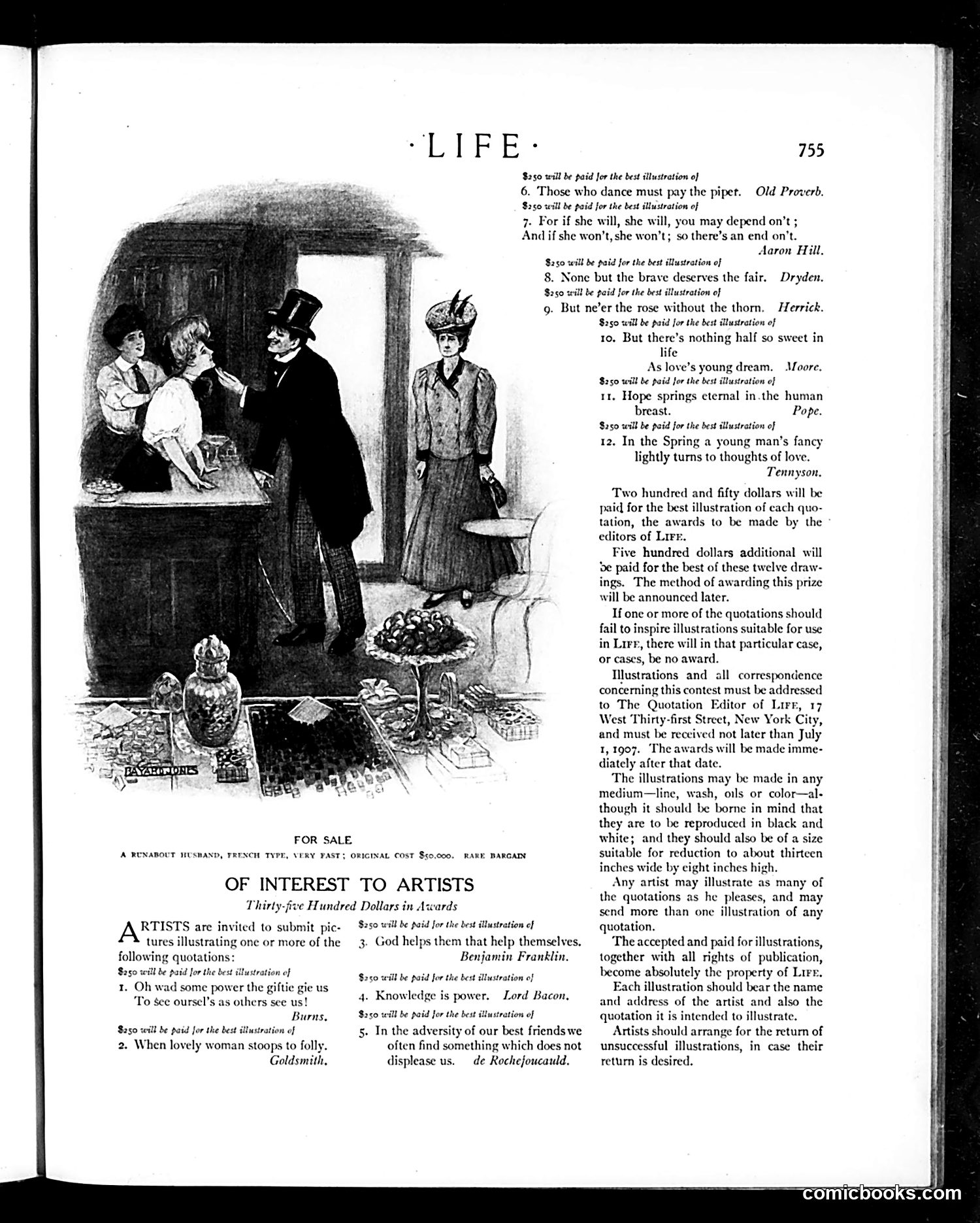
This page contains a satirical cartoon captioned "For Sale: A Runabout Husband, French Type, Very Fast; Original Cost $50,000. Rare Bargain." The cartoon depicts a well-dressed man in a top hat being presented to a woman by what appears to be a salesman or broker, while another elegantly-dressed woman stands observing. The joke satirizes the commodification of marriage and male infidelity during the early 1900s. The "French type" reference likely alludes to stereotypes about French men and romantic/sexual escapades. The absurdly high original price humorously suggests the husband's diminished value—he's now being sold off cheaply, presumably due to his unfaithfulness or unsuitability. The cartoon mocks both the commercialization of marriage and the disposable nature of husbands in wealthy society. This reflects Progressive Era anxieties about marriage, gender relations, and the treatment of women as economic transactions.
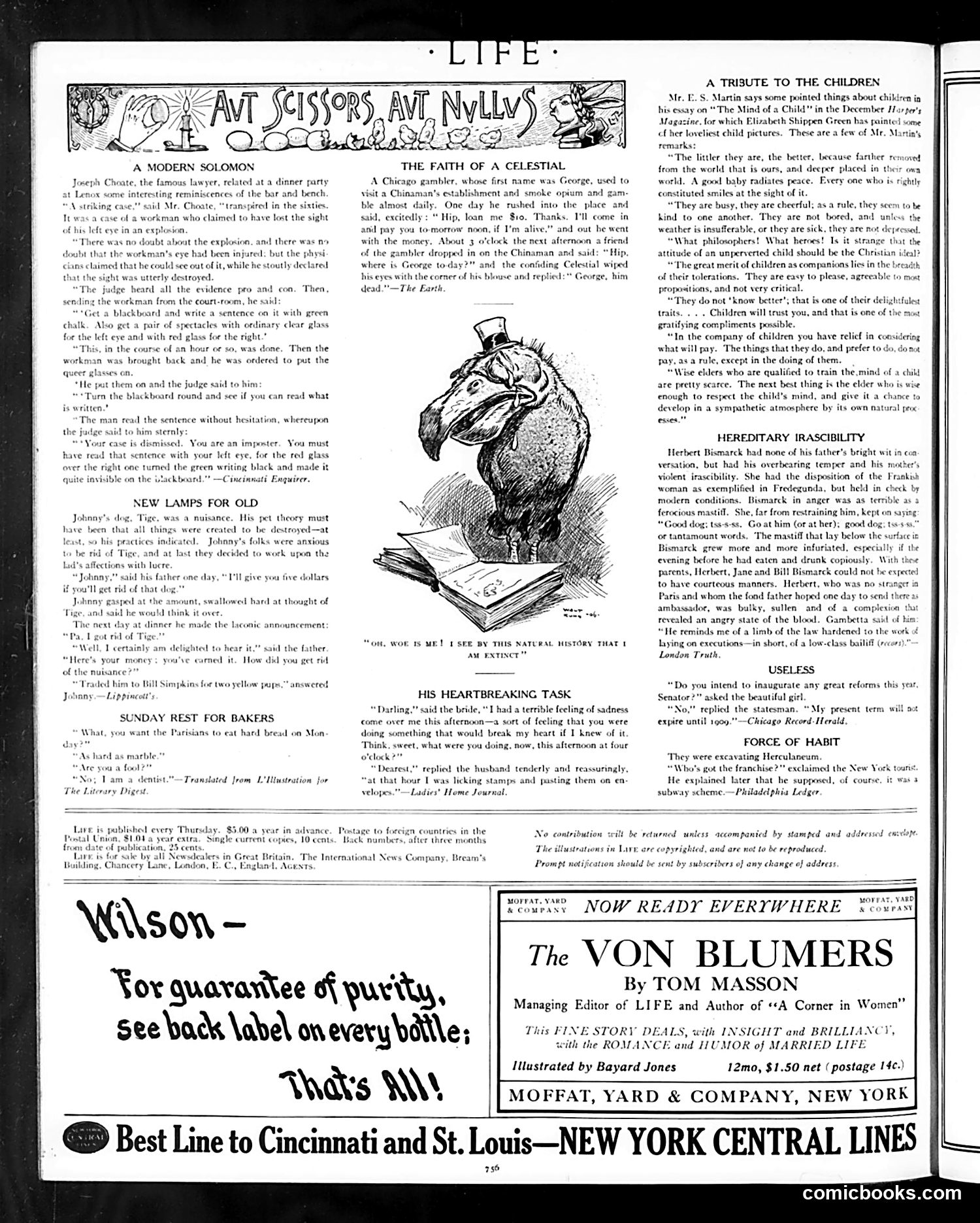
This page contains several humorous anecdotes rather than political cartoons. The main pieces are: **"A Modern Solomon"**: A lawyer (Joseph Choate) recounts a court case where a judge cleverly determines a workman's honesty by having him read sentences through different colored spectacles. The workman can read with one eye but not the other, proving he's faking his injury claim. **"New Lamps for Old"**: A boy trades away his annoying dog "Tige" to a neighbor for two yellow puppies—essentially making the family's problem someone else's. **"The Faith of a Celestial"**: A Chinese immigrant's deadpan response to learning his gambling-addicted friend "George" has died—he simply observes that according to natural history, he himself must now be extinct, since George was his only source of loans. These are lighthearted satirical pieces poking fun at human nature, legal absurdities, and cross-cultural misunderstandings. The page also includes advertisements and a book promotion for *The Von Blumers* by Tom Masson.
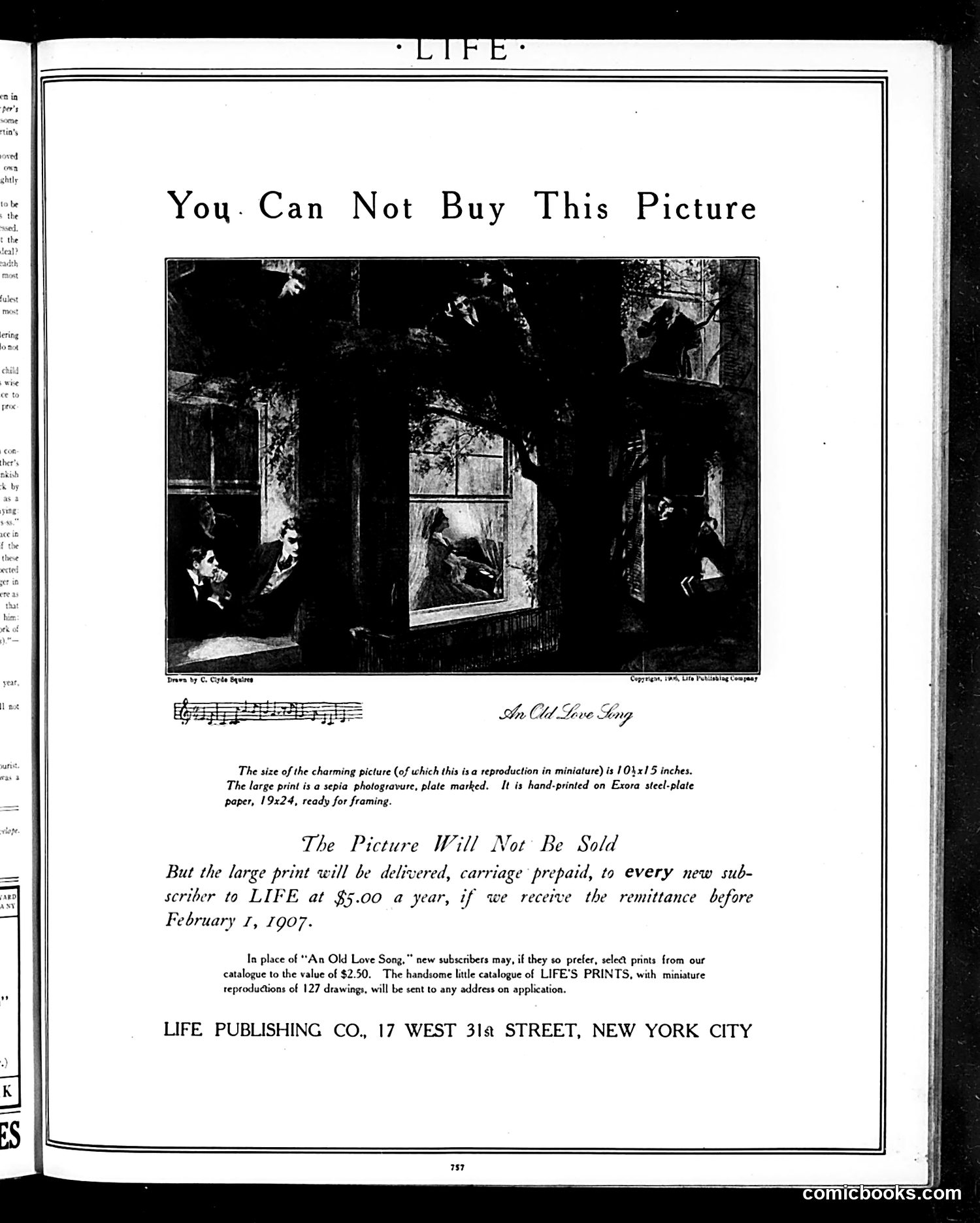
This is primarily a **subscription promotion**, not political satire. The page advertises Life magazine's 1907 subscription offer. The artwork depicts a romantic scene: figures in period dress outside a lit window at night, titled "An Old Love Song." The image itself appears to be sentimental Victorian-era genre art rather than satirical commentary. The advertisement's hook is unusual—**the picture cannot be purchased separately**, but Life promises to deliver a large hand-printed version (19×24 inches) free to new annual subscribers ($5.00) if they pay before February 1, 1907. This was a common marketing tactic: using desirable artwork as an incentive for subscriptions. The text notes subscribers could alternatively select different prints from Life's catalog of 127 drawings, suggesting the magazine regularly commissioned or collected artwork for promotional purposes.
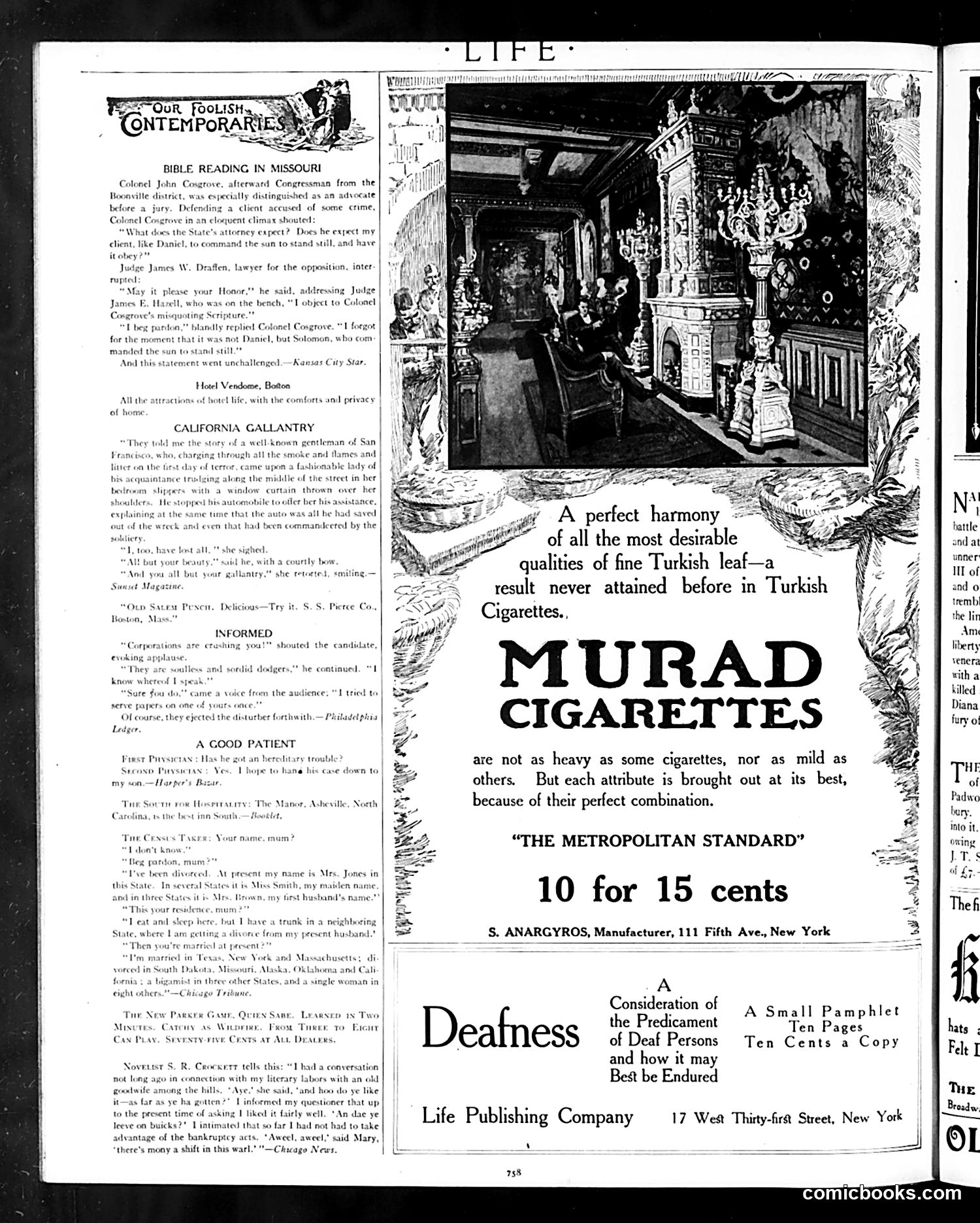
This page is primarily **advertising and miscellaneous content** rather than satirical cartoons. The dominant feature is a large **Murad Cigarettes advertisement** showcasing a luxurious interior scene, claiming the product achieves "perfect harmony" of Turkish tobacco qualities at "10 for 15 cents." The left column contains brief humor pieces under "Our Foolish Contemporaries"—snippets mocking various people's statements or situations, including a Biblical reading dispute in Missouri and a hospital patient exchange. These are light, topical jokes rather than sustained satire. Below the cigarette ad are notices for other products: a pamphlet on deafness from Life Publishing Company and references to hotel amenities and food products. The page reflects early 20th-century magazine advertising conventions, mixing entertainment with commercial content. The satire is minimal and local rather than addressing major political events—typical of Life's format as a general-interest satirical weekly.
This page is primarily **advertisements and humorous anecdotal pieces**, not political cartoons. The layout alternates between ads (Seaboard Air Line Railway, Garrick Club Whiskey, Coca-Cola, Old Crow Rye) and brief satirical stories. The humor pieces include: - **"Some Cat Superstitions"**: Historical anecdotes about famous figures (Napoleon, Henry III) fearing cats—light cultural commentary playing on superstition. - **"A Matter of Climate"**: A joke about Persian vs. English honesty, where a Persian character claims climate determines truthfulness. This reflects period attitudes about cultural/racial differences—stereotyping Persians as naturally dishonest. - **"A Cautious Doctor"**: A brief joke about a doctor demanding payment in advance from an absent-minded patient. - **"O'Hare's Status"**: An "Irish bull" (a traditional joke form)—wordplay about someone who "would be one week dead" if he'd lived another day. These are mild, genteel humor pieces typical of *Life* magazine's satirical approach, relying on cultural stereotypes and linguistic jokes rather than sharp political critique.
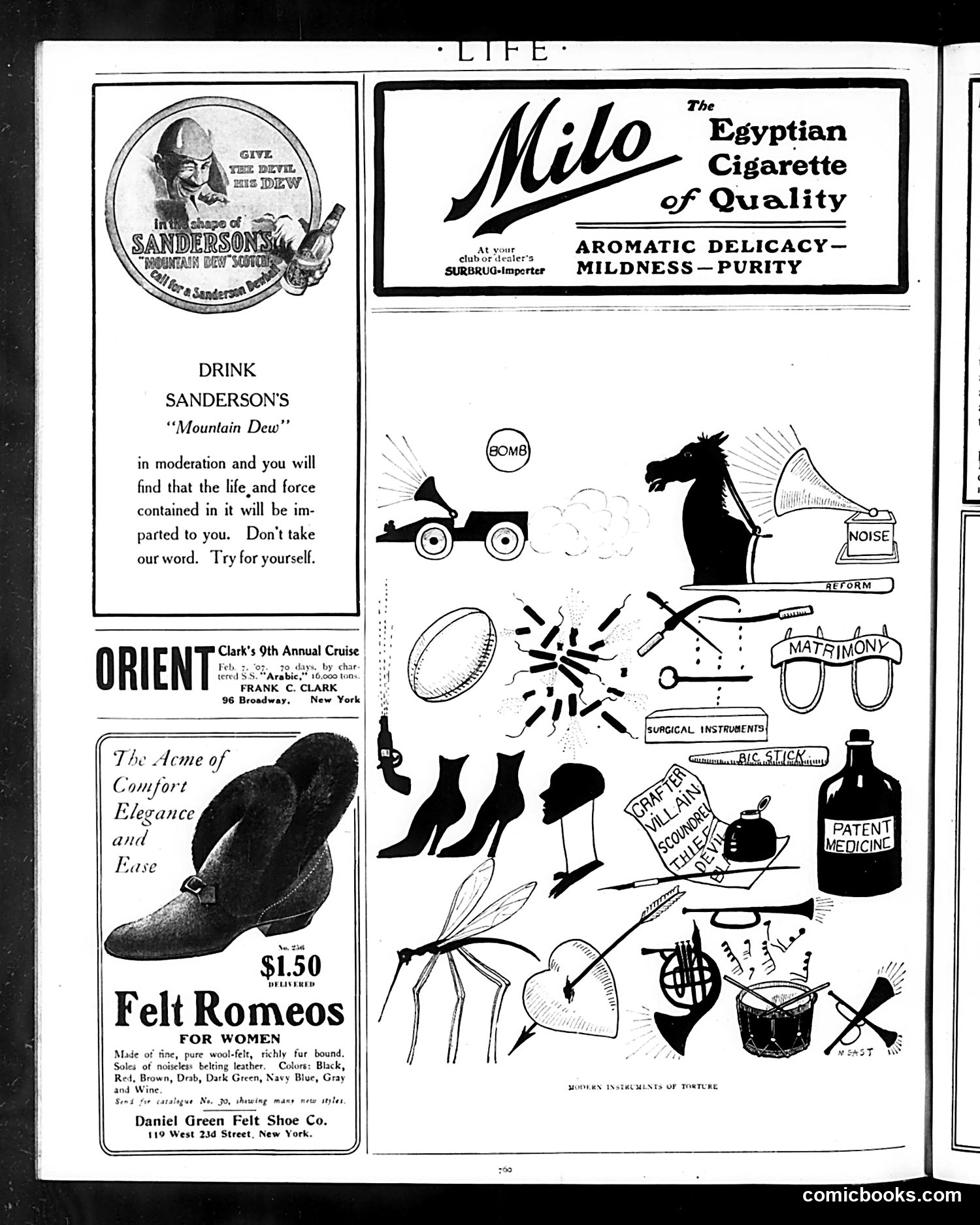
This page is primarily **advertising**, but the right side features a satirical cartoon titled "Modern Instruments of Torture" that critiques contemporary life's annoyances and hazards. The cartoon assembles images of everyday objects presented as instruments of torture: a bomb, a horse labeled "NOISE," surgical instruments, women's high heels, a patent medicine bottle, a mosquito, a dollar sign, and a drum. The satire suggests that modern conveniences and social fixtures—from fashion (heels) to commerce (patent medicines) to warfare (bombs)—are torments inflicted on the public. This reflects early 20th-century anxieties about industrialization, commercialism, and urban life's pace. The inclusion of patent medicine satirizes dubious health products prevalent in the era. The overall message: progress and modern society inflict their own forms of suffering. The surrounding ads for whiskey, cigarettes, and shoes ironically exemplify the very consumer culture being mocked.
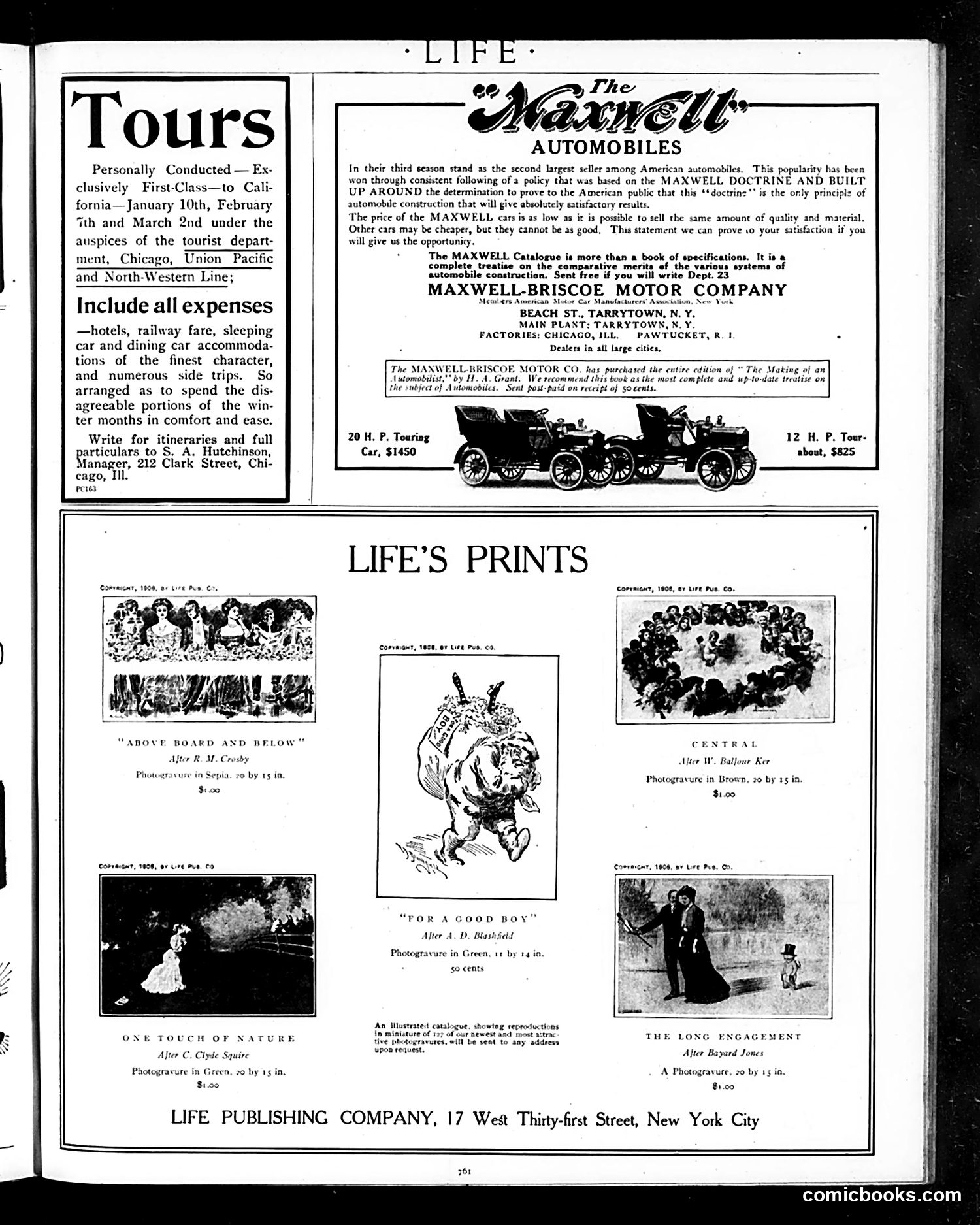
This page is primarily **advertising and product promotion**, not satire or political commentary. The dominant content advertises **Maxwell-Briscoe automobiles**, positioning them as the second-largest American car seller based on their "Maxwell Doctrine"—a manufacturing philosophy emphasizing quality at low cost. Two touring models are displayed with prices ($1,450 and $825). The left column advertises **Chicago & North Western Railway tours** to California for winter travel, emphasizing luxury accommodations and comfort. Below are **Life Publishing Company's art prints for sale**—photogravures by named artists (Crosby, Squire, Ker, Blashfield, Jones) depicting genteel domestic and romantic scenes typical of the era. These were decorative prints consumers could purchase. **Context for modern readers**: This represents early-1900s magazine revenue models, mixing editorial content with lucrative advertising. The aspirational messaging—affordable luxury travel, quality automobiles, fine art for home display—targeted the rising middle class.
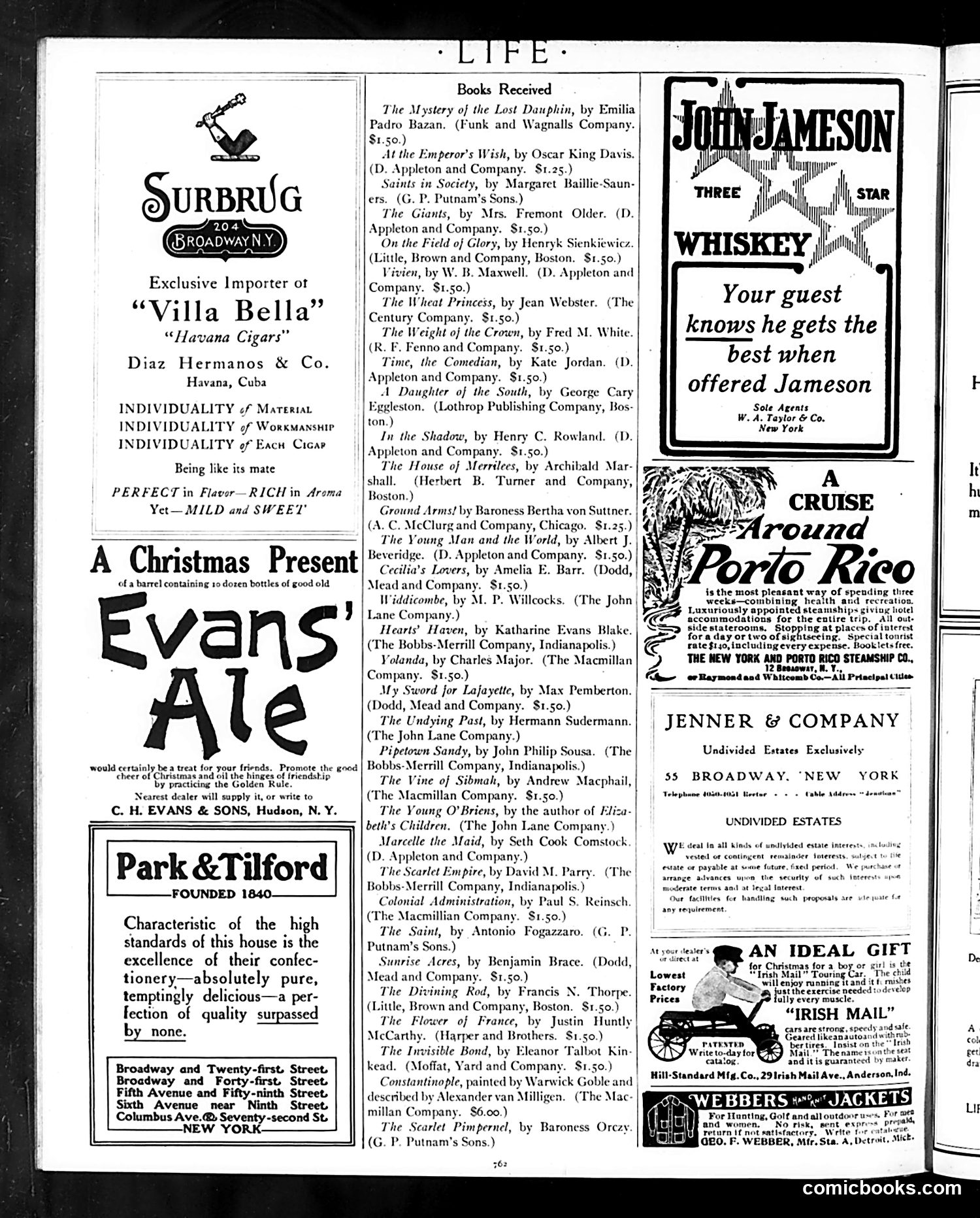
This page is primarily **advertising and book listings**, not satirical content. It contains: **Books Received section**: A list of newly published novels from circa early 1900s, including titles by popular authors of the era like Jean Webster and John Philip Sousa. **Advertisements**: - Surbrug cigars (imported from Havana) - Evans Ale (positioned as a Christmas gift) - Park & Tilford confectionery (emphasizing purity and quality) - John Jameson whiskey - Porto Rico cruises - Real estate and other services **No political cartoons or satire appear on this page.** The only visual elements are commercial logos and decorative illustrations accompanying advertisements. This is a typical interior page from *Life* magazine showing how the publication funded itself through paid advertising while also reviewing contemporary literature. There is nothing requiring historical context to understand—it's straightforward early-20th-century commercial content.
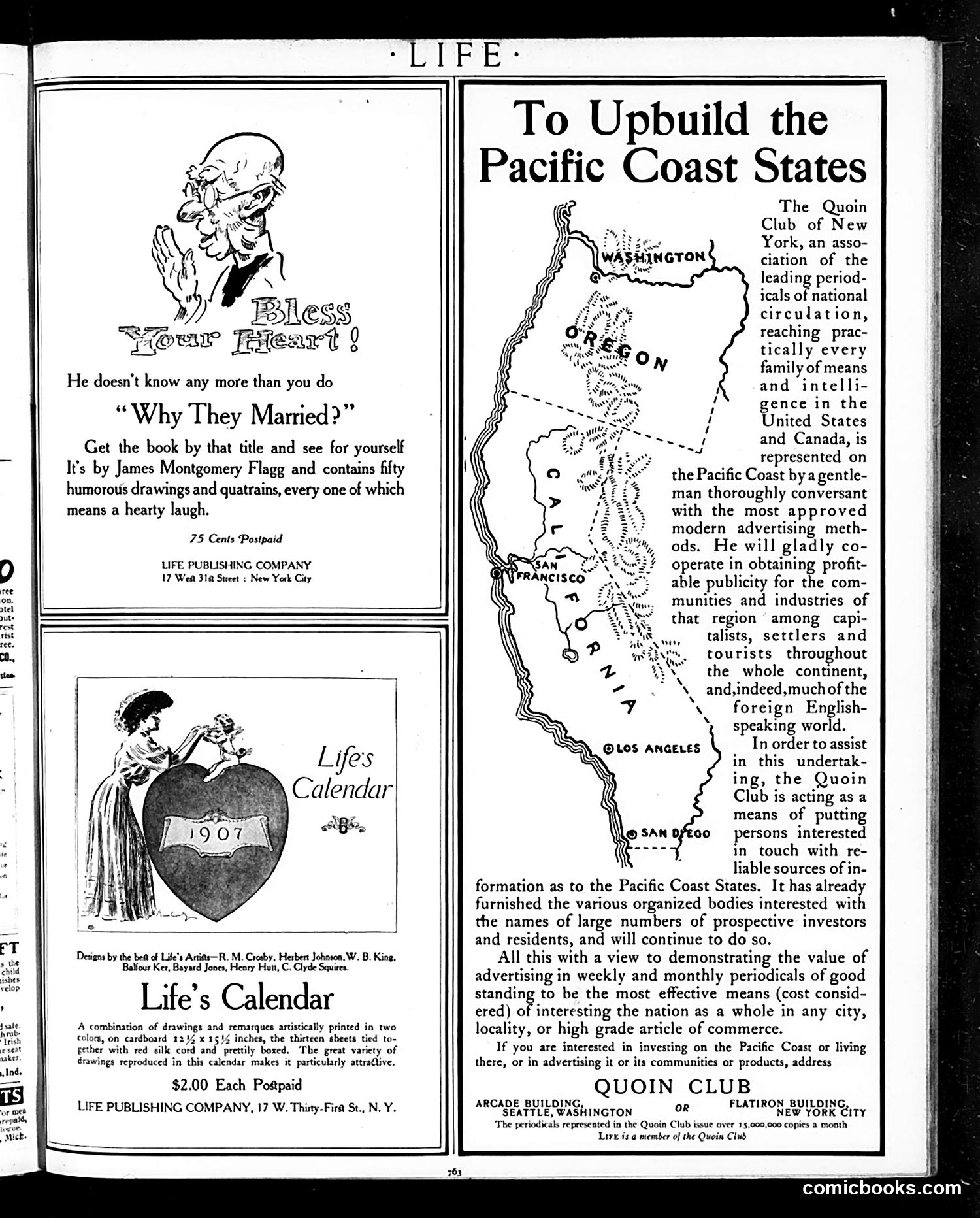
This page contains mostly **advertising** rather than satirical content. The left side promotes two products from Life Publishing Company: a humorous book "Why They Married?" by James Montgomery Flagg (featuring a cartoon of a befuddled man) and a 1907 calendar with drawings by prominent Life artists. The right side is a substantial **promotional advertisement** for the Quoin Club, a trade association of major periodicals. The Club advertises its service connecting Pacific Coast businesses and communities with potential investors, settlers, and tourists through coordinated advertising in their member publications. A map shows Washington, Oregon, and California. The pitch emphasizes that strategic advertising in quality periodicals reaches affluent, educated audiences nationwide and internationally—essentially a sales pitch from the magazine industry to demonstrate advertising's value. This reflects early-1900s boosterism promoting Western expansion and investment. The content is commercial rather than satirical.
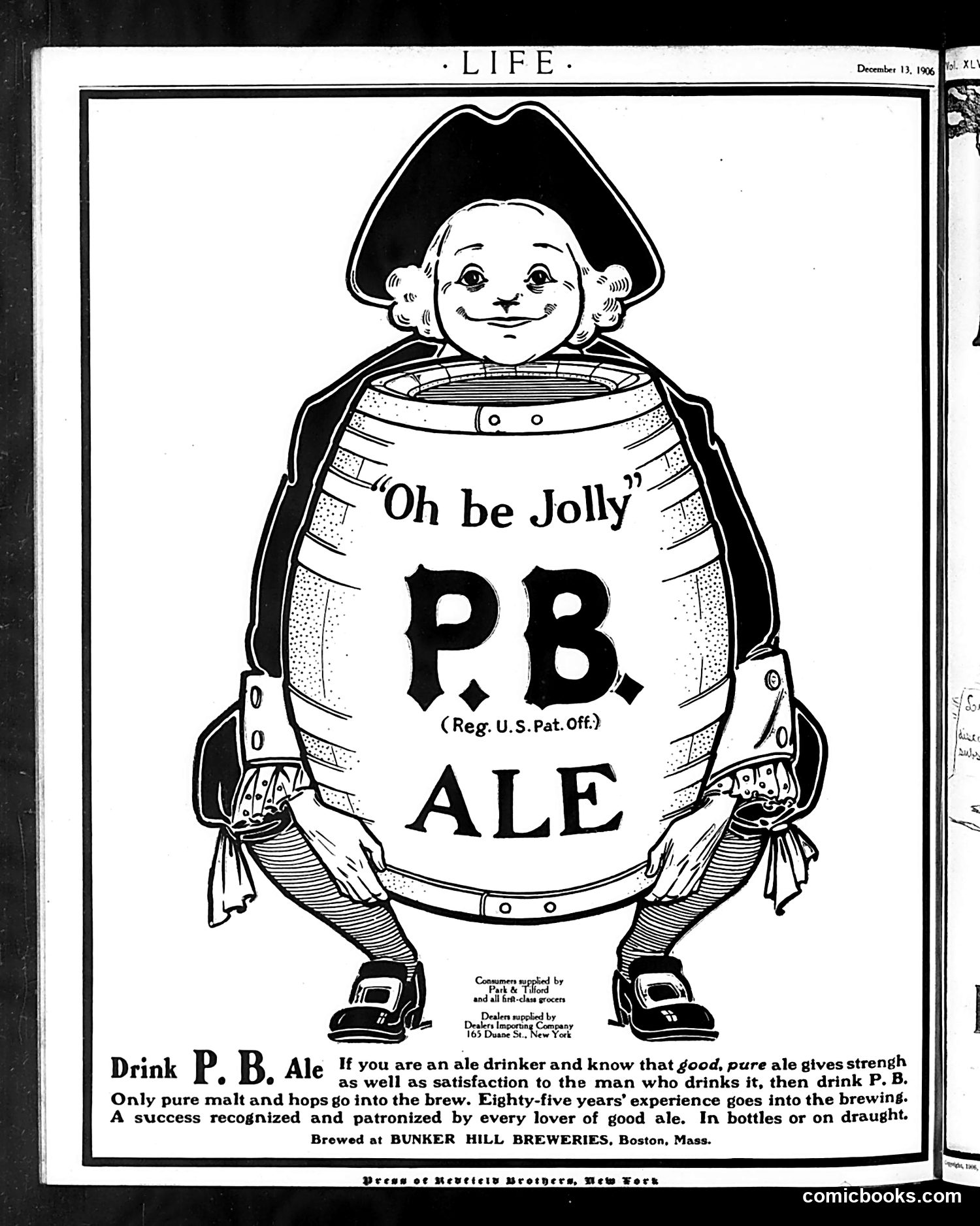
This is a full-page advertisement for P.B. Ale, brewed by Bunker Hill Breweries in Boston. The ad features a cheerful, rotund character dressed in colonial/18th-century clothing (tricorn hat, breeches), designed to evoke American Revolutionary heritage and suggest tradition and quality. The copywriting emphasizes that the ale contains "only pure malt and hops" and boasts "eighty-five years' experience" in brewing—appeals to purity and longevity common in early 20th-century product marketing. The phrase "Oh be Jolly" combines patriotic Americana imagery with the promise of good cheer. There is no political satire here. This appears from *Life* magazine's advertising section (note the printer's mark at bottom), reflecting pre-Prohibition beer marketing when ale was marketed as wholesome and strength-giving rather than frivolous.