
Life, 1906-12-13 · page 18 of 28
Life — December 13, 1906 — page 18: what you’re looking at
What you’re looking at
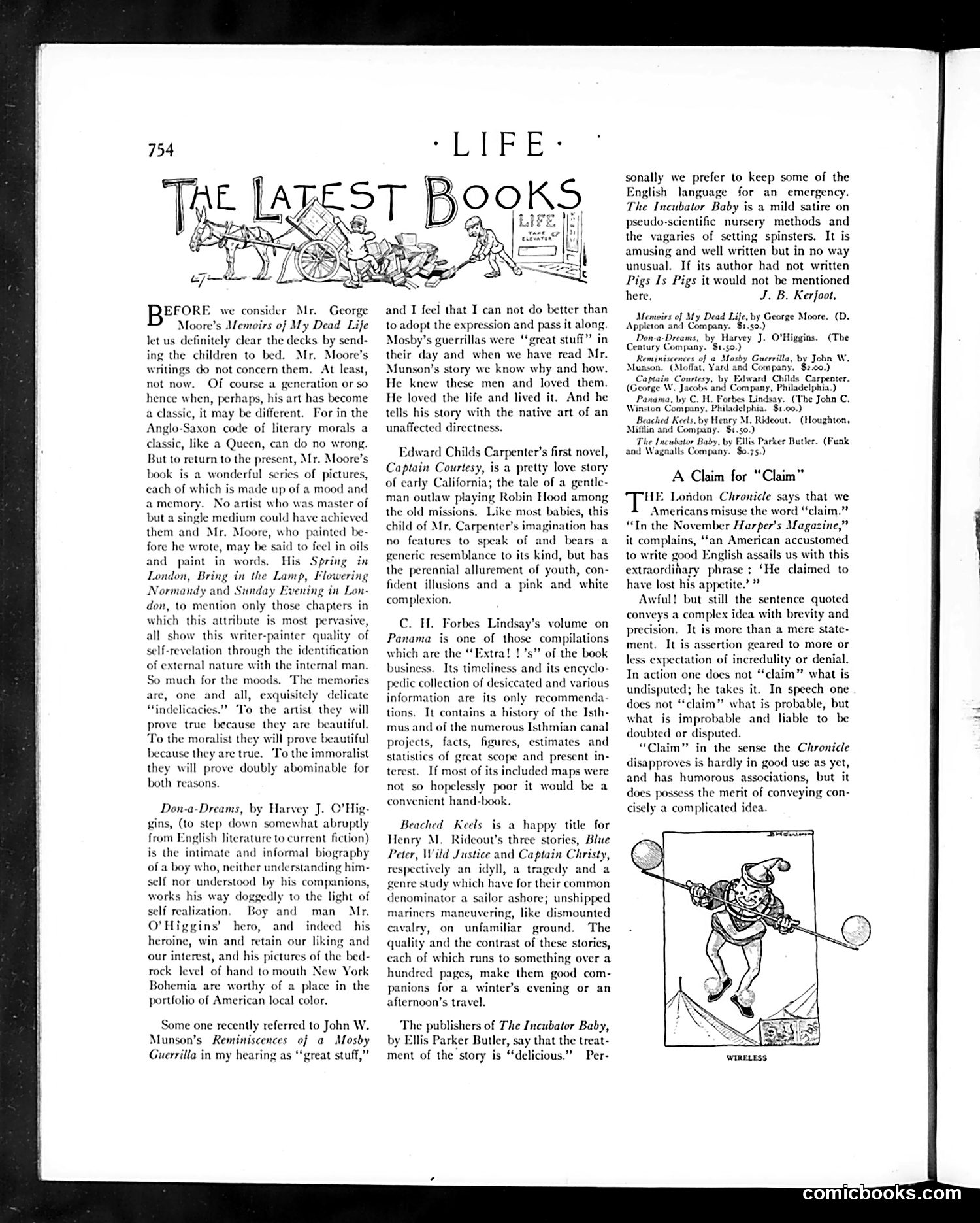
This page reviews recent books, primarily novels. The main cartoon (bottom right, labeled "Wireless") depicts a figure juggling or playing with spheres, likely satirizing the contemporary fascination with wireless technology or modern inventions. The text focuses on literary criticism of works by George Moore, Harvey J. O'Higgins, John W. Munson, and others. The reviewer employs Victorian-era literary sensibilities, notably warning that Moore's *Memoirs of My Dead Life* contains material unsuitable for children—reflecting early 20th-century prudishness about candid autobiographical writing. The page demonstrates Life magazine's role as a cultural arbiter, blending high-minded literary discussion with light satire. The reviewer uses sophisticated, sometimes arch language ("doubly abominable") typical of the era's book criticism. References to Mosby's guerrillas and early California reflect contemporary American historical interests.
📄 Transcribed text from this page (OCR, searchable)
Machine-transcribed from the original scan — historical spelling and the odd misread are preserved.
EFORE we consider Mr. George Moore’s Memoirs oj My Dead Lije let us definitely clear the decks by send- ing the children to bed. Mr. Moore's writings do not concern them. At least, not now. Of course a generation or so hence when, perhaps, his art has become a classic, it may be different. For in the Anglo-Saxon code of literary morals a classic, like a Queen, can do no wrong. But to return to the present, Mr. Moore’s book is a wonderful series of pictures, cach of which is made up of a mood and a memory. No artist who was master of le medium could have achieved them and Mr. Moore, who painted be- fore he wrote, may be said to feel in oils and paint in words, His Spring in London, Bring in the Lamp, Flowering Normandy and Sunday Evening in Lon- don, to mention only those chapters in which this attribute is most pervasive, all show this writer-painter quality of self-revelation through the identification of external nature with the internal man. So much for the moods. The memories are, one and all, exquisitely delicate “indelicacies.” To the artist they will prove true because they are beautiful. To the moralist they will prove beautiful because they are true. To the immoralist they will prove doubly abominable for both reasons. Don-a-Dreams, by Harvey J. O'Hig- gins, (to step down somewhat abruptly from English literature to current fiction) is the intimate and informal biography ofa boy who, neither understanding him- self nor understood by his companions, works his way doggedly to the light of self realization. Boy and man Mr. O'Higgins’ hero, and indeed his heroine, win and retain our liking and our interest, and his pictures of the bed- rock level of hand to mouth New York Bohemia are worthy of a place in the portfolio of American local color. Some one recently referred to John W. Munson’s Reminiscences of a Mosby Guerrilla in my hearing as “great stuff,” Lite, and I feel that I can not do better than to adopt the expression and pass it along. Mosby’s guerrillas were ‘great stuff” in their day and when we have read Mr. Munson’s story we know why and how. He knew these men and loved them. He loved the life and lived it, And he tells his story with the native art of an unaffected directness. Edward Childs Carpenter's first novel, Captain Courtesy, is a pretty love story of carly California; the tale of a gentle- man outlaw playing Robin Hood among the old missions. Like most babies, this. child of Mr. Carpenter’s imagination has no features to speak of and bears a generic resemblance to its kind, but has the perennial allurement of youth, con- fident illusions and a pink and white complexion. C. H. Forbes Lindsay’s volume on Panama is one of those compilations which are the “Extra! !’s” of the book business. Its timeliness and its encyclo- pedic collection of desiccated and various information are its only recommenda- tions. It contains a history of the Isth- mus and of the numerous Isthmian canal projects, facts, figures, estimates and statistics of great scope and present in- terest. If most of its included maps were not so hopelessly poor it would be a convenient hand-book. Beached Keels is a happy title for Henry M. Ridcout’s three stories, Blue Peter, Wild Justice and Captain Christy, respectively an idyll, a tragedy and a genre study which have for their common. denominator a sailor ashore; unshipped mariners mancuvcring, like dismounted cavalry, on unfamiliar ground. The quality and the contrast of these stories, each of which runs to something over a hundred pages, them good com- panions for a winter’s evening or an afternoon's travel. The publishers of The Incubator Baby, by Ellis Parker Butler, say that the treat- ment of the story is “delicious.” Per- sonally we prefer to keep some of the English language for an emergency. The Incubator Baby is a mild satire on pseudo-scientific nursery methods and the vagaries of setting spinsters. It is amusing and well written but in no way unusual. If its author had not written Pigs Is Pigs it would not be mentioned here, J. B. Kerjoot, Memoirs of My Dead Life, by George Moore. (D. Appleton and Compaay. $1150.) Don-a-Dreams, by Harvey J. O'Higgins. Century Company. $1.50.) Reminiscences of @ Mosby Guerrilla, by John W. Munson. (Moffat, Yard and Company, $2/00.) Captain Courtesy, by Edward Childs Carpenter. (George W. Jacobs and Company, Philadelphia.) Panama. by C. H. Forbes Lindsay. (The John C. Winston Company, Philadelphia. $1.00.) Beached Keets, by Henry M. Rideout. (Houghton, Mifilin and Company. $1.50.) The Incubator Baby. by Ellis Parker Butler. (Funk and Wagnalls Company. $0.75.) A Claim for “Claim” (The T" London Chronicle says that we Americans misuse the word “claim.” “In the November Harper’s Magazine,” it complains, “an American accustomed to write good English assails us with this extraordihary phrase : ‘He claimed to have lost his appetite? ” Awful! but still the sentence quoted conveys a complex idea with brevity and precision. It is more than a mere state- ment. It is assertion geared to more or less expectation of incredulity or denial. In action one does not “claim” what is undisputed; he takes it. In speech one does not “claim” what is probable, but what is improbable and liable to be doubted or disputed. “Claim” in the sense the Chronicle disapproves is hardly in good use as yet, and humorous associations, but it does possess the merit of conveying con- cisely a complicated idea. comicbooks.com