
Life, 1906-12-13 · page 16 of 28
Life — December 13, 1906 — page 16: what you’re looking at
What you’re looking at
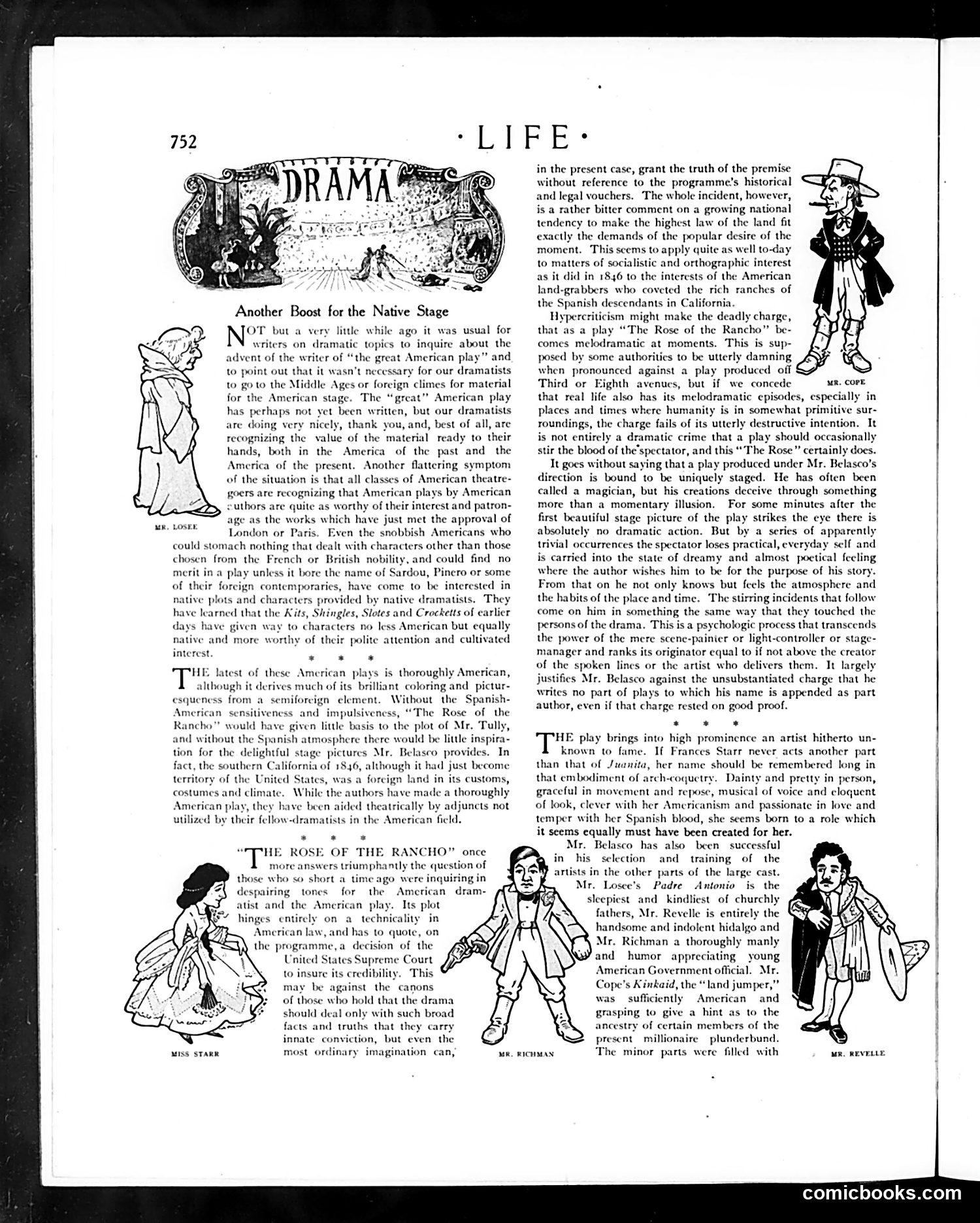
This page reviews "The Rose of the Rancho," a contemporary American play, celebrating the emergence of native American drama. The article argues that American audiences and writers no longer need to slavishly imitate European (French, British) theatrical works. The cartoon illustrations show cast members (Miss Starr, Mr. Richman, Mr. Revelle, and Mr. Cope) in period Spanish-Californian costume, reflecting the play's 1846 Southern California setting—just after American territorial acquisition. The satire targets earlier American cultural snobbery: wealthy Americans who dismissed native plays unless they featured European nobility or were written by foreign dramatists like Sardou or Pinero. The review argues this prejudice has finally yielded to appreciation for authentically American stories and characters. A secondary critique notes the play's plot hinges on a U.S. Supreme Court decision, mocking how American law gets manipulated to serve popular demands—a jab at contemporary land-grabbing interests in the Southwest.
📄 Transcribed text from this page (OCR, searchable)
Machine-transcribed from the original scan — historical spelling and the odd misread are preserved.
Another Boost for the Native Stage OT but a very little while ago it was usual for writers on dramatic topics to inquire about the us advent of the writer of “the great American play” and to point out that it wasn’t necessary for our dramatists to goto the Middle Ages or foreign climes for material for the American stage. The “great” American play has perhaps not yet been written, but our dramatists are doing very nicely, thank you, and, best of all, are recognizing the value of the material ready to their hands, both in the America of the past and the America of the present. Another flattering symptom of the situation is that all classes of American theatre- goers are recognizing that American plays by American Suthors are quite as worthy of their interest and patron- age as the works which have just met the approval of London or Paris. Even the snobbish Americans who could stomach nothing that dealt with characters other than those chosen from the French or British nobility, and could find no merit in a play unless it bore the name of Sardou, Pinero or some of their foreign contemporaries, have come to be interested in native plots and characters provided by native dramatists. They have learned that the Kits, Shingles, Slotes and Crocketts of earlier days have given way to characters no less American but equally native and more worthy of their polite attention and cultivated interest * + * HE latest of these American plays is thoroughly American, although it derives much of its brilliant coloring and_pictur- esqueness from a semiforeign clement. Without the Spanish- American sensitiveness and impulsiveness, “The Rose of the Rancho” would have given little basis to the plot of Mr. Tully, and without the Spanish atmosphere there would be little inspira- tion for the delightful stage pictures Mr. Belasco provides. In fact, the southern California of 1846, although it had just become territory of the United States, was a foreign land in its customs, costumes and climate. While the authors have made a thoroughly American play, they have been aided theatrically by adjuncts not utilized by their fellow-dramatists in the American field. s 8 8 HE ROSE OF THE RANCHO” once more answers triumphantly the question of those who so short a time ago were inquiring in despairing tones for the American dram- atist and the American play. Its plot *% hinges entirely on a technicality in American law, and has to quote, on the programme,a decision of the United States Supreme Court to insure its credibility. This may be against the canons of those who hold that the drama should deal only with such broad facts and truths that they carry innate conviction, but even the most ordi miss STARR ury imagination can, ‘LIFE * Mam. RICHMAN, in the present case, grant the truth of the premise without reference to the programme’s historical and legal vouchers. The whole incident, however, is a rather bitter comment on a growing national tendency to make the highest law of the land fit exactly the demands of the popular desire of the moment. This scems to apply quite as well to-day to matters of socialistic and orthographic interest as it did in 1846 to the interests of the American land-grabbers who coveted the rich ranches of the Spanish descendants in California. Hypercriticism might make the deadly charge, that as a play “The Rose of the Rancho” be- comes melodramatic at moments. This is sup- posed by some authorities to be utterly damning when pronounced against a play produced off Third or Eighth avenues, but if we concede ‘MR. COPE that real life also has its melodramatic episodes, especially in places and times where humanity is in somewhat primitive sur- roundings, the charge fails of its utterly destructive intention. It is not entirely a dramatic crime that a play should occasionally stir the blood of the’spectator, and this “The Rose” certainly does. It gocs without saying that a play produced under Mr. Belasco’s direction is bound to be uniquely staged. He has often been called a magician, but his creations deceive through something more than a momentary illusion. For some minutes after the first beautiful stage picture of the play strikes the eye there is lutely no dramatic action. But by a series of apparently trivial occurrences the spectator loses practical, everyday self and is carried into the state of dreamy and almost. poetical feeling ¢ the author wishes him to be for the purpose of his story. om that on he not only knows but feels the atmosphere and the habits of the place and time. The stirring incidents that follow come on him in something the same way that they touched the persons of the drama. Th chologic process that transcends. the power of the mere scene-painier or light-controller or stage- manager and ranks its originator equal to if not above the creator of the spoken lines or the artist who delivers them. It largely justifies Mr. Belasco against the unsubstantiated charge that he writes no part of plays to which his name is appended as part author, even if that charge rested on good proof. * 8 6 HE play brings into high prominence an artist hitherto un- known to fame. If Frances Starr never acts another part than that of Juanita, her name should be remembered long in that embodiment of arch-coquetry. Dainty and pretty in person, graceful in movement and repose, musical of voice and eloquent of look, clever with her Americanism and passionate in love and temper with her Spanish blood, she seems born to a role which it seems equally must have been created for her. Mr. Belasco has also been successful in his selection and training of the artists in the other parts of the large cast. Mr. Losee’s Padre Antonio is the sleepiest and kindliest of churchly fathers, Mr. Revelle is entirely the handsome and indolent hidalgo and Mr. Richman a thoroughly manly and humor appreciating young American Government official. Mr. Cope’s Kinkaid, the “land jumper,” was sufficiently American and grasping to give a hint as to the ancestry of certain members of the present millionaire plunderbund. The minor parts were filled with MR, REVELLE comicbooks.com