
Life, 1906-12-13 · page 8 of 28
Life — December 13, 1906 — page 8: what you’re looking at
What you’re looking at
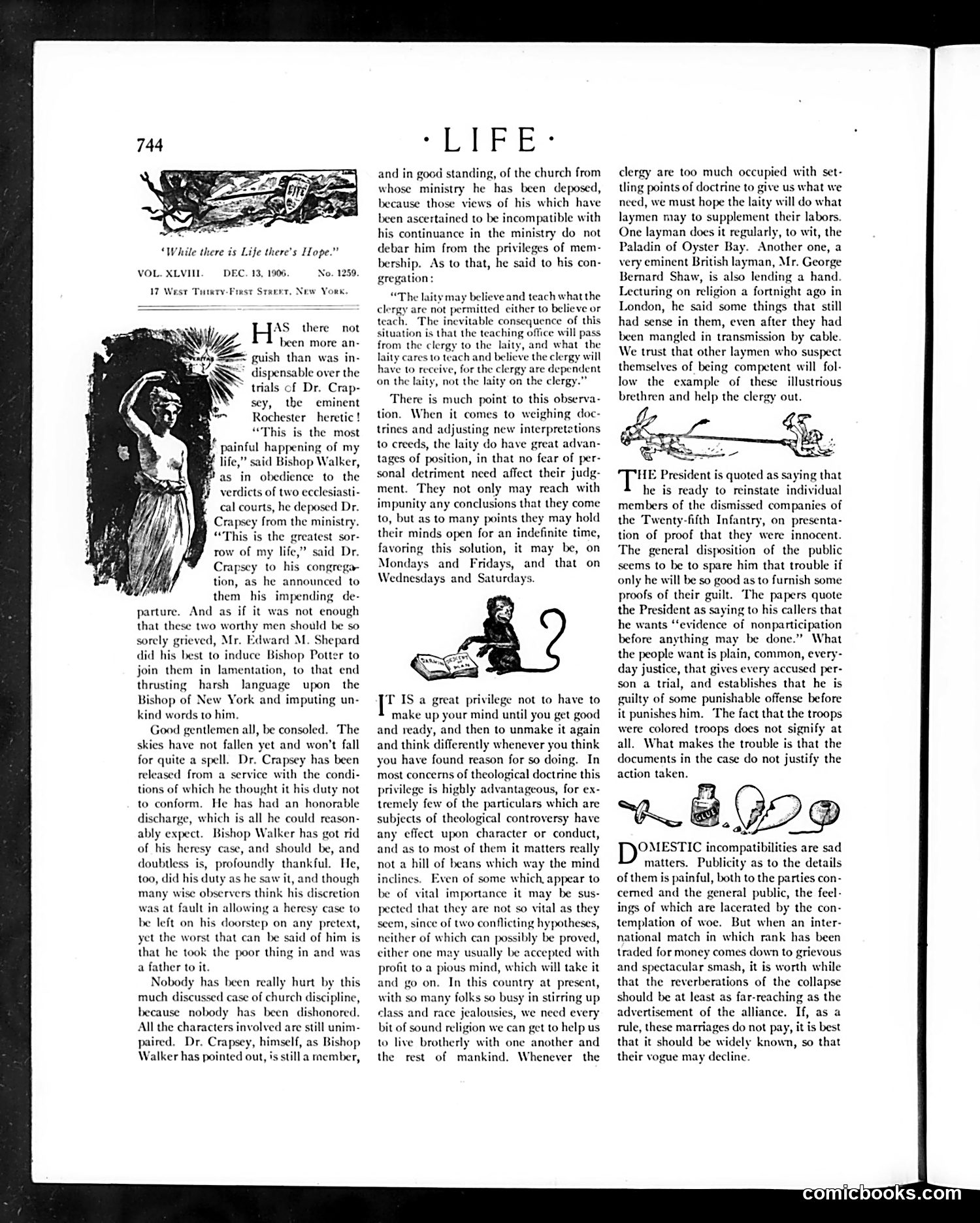
This page contains editorial commentary rather than political cartoons. The illustrations are decorative vignettes—a classical female figure and small sketches of cherubs or children—not satirical caricatures. The text discusses ecclesiastical controversy, specifically defending Dr. Crapsey, a Rochester clergyman dismissed from ministry over doctrinal disagreements. The article argues that laypeople should help support dismissed clergy and that theological disputes shouldn't affect a minister's character or conduct. A secondary editorial addresses domestic incompatibilities and marriage dissolution, advocating for discrete handling of such private matters rather than public scandal. The page reflects Progressive Era debates about religious authority, clerical discipline, and social propriety—but contains no identifiable political figures or satirical caricatures requiring historical context.
📄 Transcribed text from this page (OCR, searchable)
Machine-transcribed from the original scan — historical spelling and the odd misread are preserved.
‘While there is Life there's Hope.” VOL. XLVIII 17 West Tutery. DEC. 13, 1906. No. 1259. t Starker, New Yous. S there not been more an- guish than was in- = dispensable over the trials of Dr. Crap- sey, the eminent Rochester heretic! “This is the most ie *, . painful happening of my life,” said Bishop Walker, s in obedience to the verdicts of two ecclesiasti- , he deposed Dr. Crapsey from the ministry. “This is the greatest sor- row of my life,” said Dr. Crapsey to his congrega- tion, as he announced to them his impending de- And as if it was not enough se two worthy men should be so sorely grieved, Mr. Edward M. Shepard did his best to induce Bishop Potter to join them in lamentation, to that end thrusting harsh language upon the Bishop of New York and imputing un- kind words to him. Good gentlemen all, be consoled. The skies have not fallen yet and won't fall for quite a spell. Dr. Crapsey has been released from a service with the condi- tions of which he thought it his duty not to conform. He has had an honorable discharge, which is all he could reason- ably expect. Bishop Walker has got rid of his heresy case, and should be, and doubtless is, profoundly thankful. He, too, did his duty as he saw it, and though many wise observers think his discretion was at fault in allowing a heresy case to be left on his doorstep on any pretext, yet the worst that can be said of him is that he took the poor thing in and was a father to it. Nobody has been really hurt by this much discussed case of church discipline, because nobody has been dishonored. All the characters involved are still unim- paired. Dr. Crapsey, himself, as Bishop Walker has pointed out, is still a member, LIFE and in good standing, of the church from whose ministry he has been deposed, because those views of his which have been ascertained to be incompatible with his continuance in the ministry do not debar him from the privileges of mem- bership. As to that, he said to his con- gregation: “The laity may believe and teach what the clergy are not permitted either to believe or teach. The inevitable consequence of this situation is that the teaching office will pass from the clergy to the laity, and what the laity cares to teach and belicve the clergy will have to receive, for the clergy are dependent on the laity, not the laity on the clergy.” There is much point to this observa- tion. When it comes to weighing doc- trines and adjusting new interpretetions to creeds, the laity do have great advan- tages of position, in that no fear of per- sonal detriment need affect their judg- ment. They not only may reach with impunity any conclusions that they come to, but as to many points they may hold their minds open for an indefinite time, favoring this solution, it may be, on and Mondays and Fridays, that on Wednesdays and Saturd: Y IS a great privilege not to have to up your mind until you get good and ready, and then to unmake it again and think differently whenever you think you have found reason for so doing. In st concerns of theological doctrine this ivilege is highly advantageous, for ex- tremely few of the particulars which are subjects of theological controversy have any effect upon character or conduct, and as to most of them it matters really not a hill of beans which way the mind inclines. en of some which, appear to be of vital importance it may be sus- pected that they are not so vital as they seem, since of two conflicting hypoth neither of which can possibly be proved, either one may usually be accepted with profit toa pious mind, which will take it and yo on. In this country at present, with so many folks so busy in stirring up class and race jealousies, we need every bit of sound religion we can get to help us to live brotherly with one another and the rest of mankind. Whenever the clergy are too much occupied with tling points of doctrine to give us what we need, we must hope the laity will do what laymen may to supplement their labors. One layman does it regularly, to wit, the Paladin of Oyster Bay. Another one, a very eminent British layman, Mr. George Bernard Shaw, is also lending a hand. Lecturing on religion a fortnight ago in London, he said some things that still had sense in them, even after they had been mangled in transmission by cable. We trust that other laymen who suspect themselves of being competent will fol- low the example of these illustrious brethren and help the clergy out. HE President is quoted as saying that he is ready to reinstate individual members of the dismissed companies of the Twenty-fifth Infantry, on presenta- tion of proof that they were innocent. The gencral disposition of the public seems to be to spare him that trouble if only he will be so good as to furnish some proofs of their guilt. The papers quote the President as saying to his call he wants “evidence of nonparti before anything may be done.” What the people want is plain, common, every- day justice, that gives every accused per- son a trial, and establishes that he is guilty of some punishable offense before it punishes him. The fact that the troops were colored troops does not signify at all. What makes the trouble is that the documents in the case do not justify the action taken. WA .G9@ Domestic incompatibilities are sad Dares. Publicity as to the details of them is painful, both to the parties con- cerned and the general public, the feel- ings of which are lacerated by the con- templation of woe. But when an inter- national match in which rank has been traded for money comes down to grievous and spectacular smash, it is worth while that the reverberations of the collapse should be at least as far-reaching as the advertisement of the alliance. If, as a tule, these marriages do not pay, it is best that it should be widely known, so that their vogue may decline Comicbooks.com