
A complete issue · 30 pages · 1906
Life — November 8, 1906
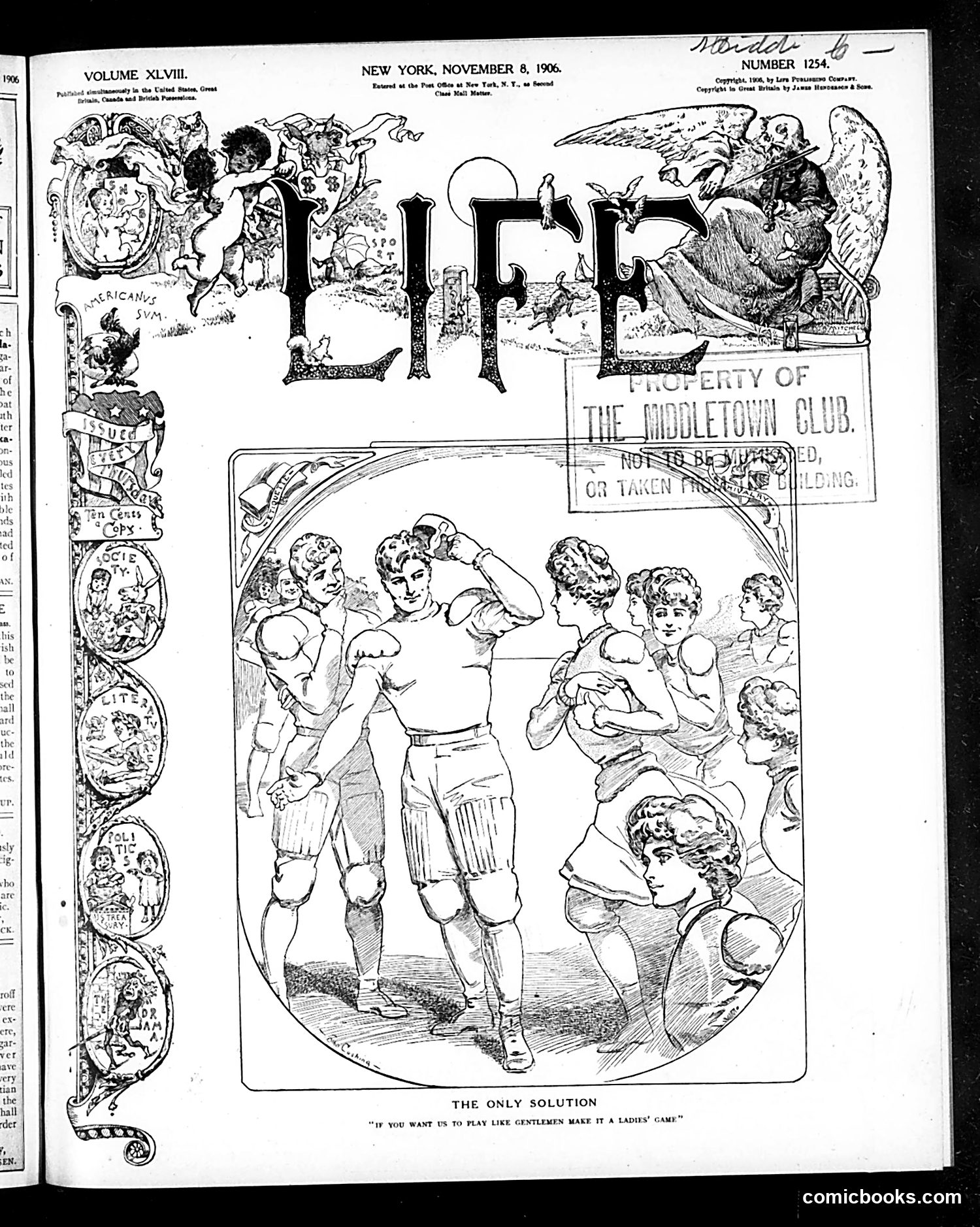
This page from the satirical magazine *Life* features a cartoon titled "The Only Solution" with the subtitle "If you want us to play like gentlemen make it a ladies' game." The main illustration depicts women in athletic attire (boxing gloves and shorts) engaged in boxing, surrounding male boxers. The satire appears to mock contemporary debates about gender and athletics. By suggesting women take up boxing "like gentlemen," the cartoonist ironically critiques both the rough masculinity of boxing and contemporary anxieties about women entering traditionally male athletic spaces. The ornate left border with classical medallions and the elaborate header decorations are typical of *Life*'s decorative style. The humor relies on the absurdist inversion of gender norms—presenting women boxers as a "solution" to gentlemanly sporting conduct.
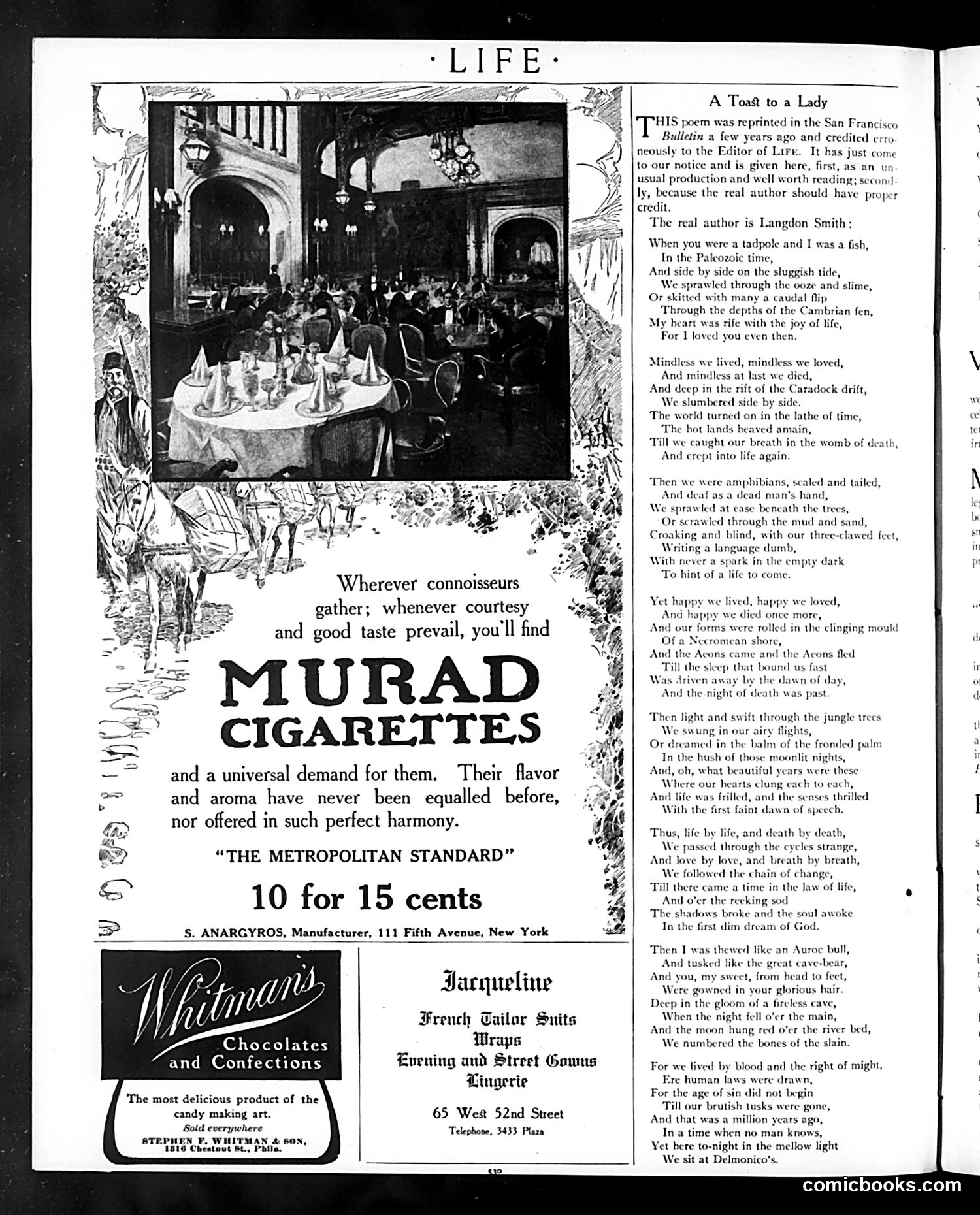
This page is primarily **advertising and poetry**, not political satire. The main content is a lengthy poem titled "A Toast to a Lady" by Langdon Smith, which traces human and evolutionary history from prehistoric times through modern day. The poem uses romantic, flowery language to address a woman, celebrating their relationship across these ages. The page includes three advertisements: **Murad Cigarettes** (10 for 15 cents), **Whitman's Chocolates and Confections**, and **Jacqueline French Tailor Suits**. The decorative border illustration shows a formal dinner scene with well-dressed diners in an elegant hall—a visual reinforcement of the sophisticated, refined audience these luxury products targeted in the early 20th century.
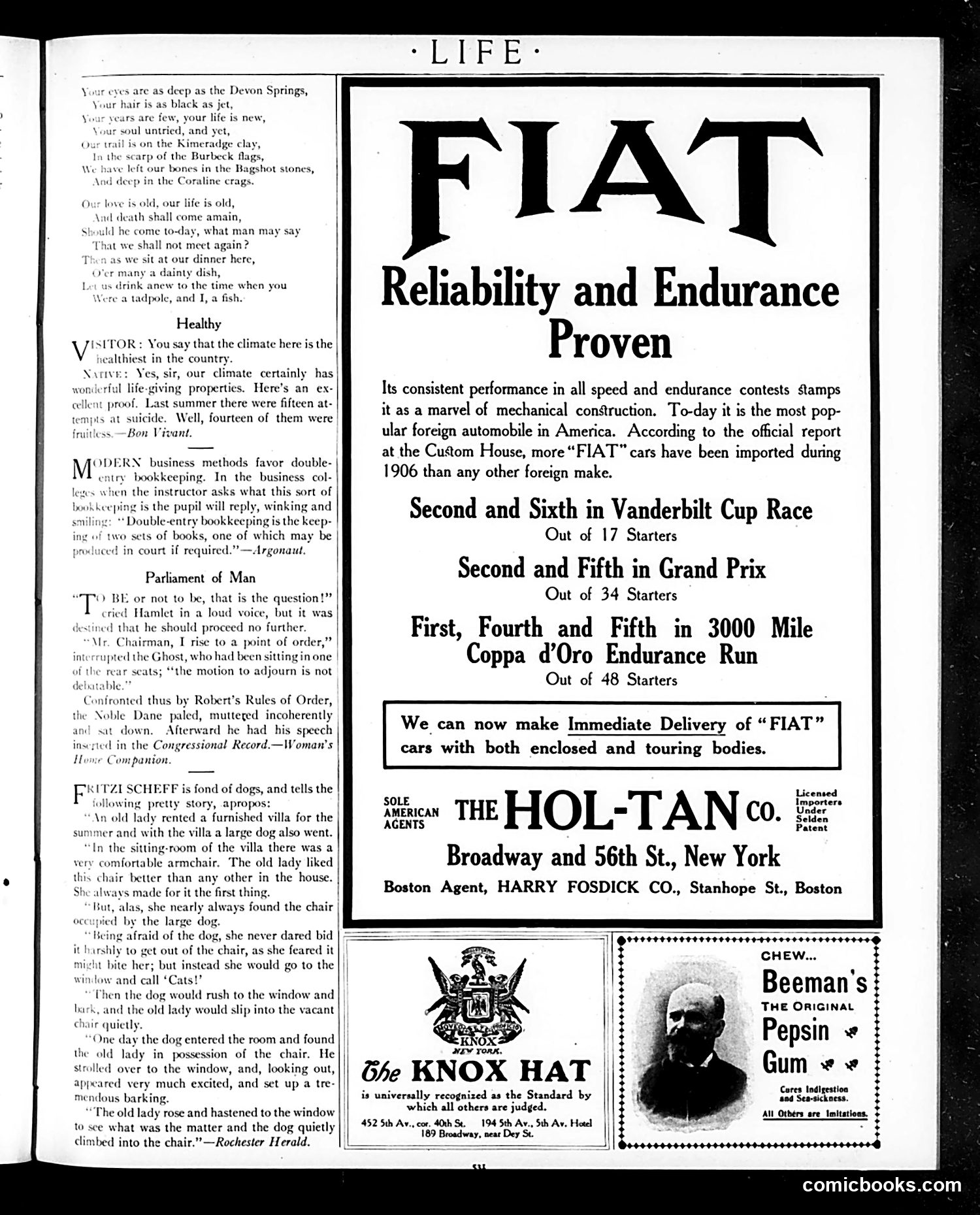
This page is **primarily advertising**, not political satire. The dominant content features a FIAT automobile advertisement highlighting the Italian car's racing achievements—second and sixth place finishes in various competitions, positioning it as the most popular foreign import in America as of 1906. The left column contains miscellaneous literary pieces and anecdotes ("Healthy," "Parliament of Man," "Fritzi Scheff"), unrelated to the advertisements. Additional ads promote the Knox Hat, Beeman's Pepsin Gum, and Harry Fosdick Co. as Boston FIAT agents. There is **no political cartoon** on this page. It represents Life magazine's mixed content model: satirical articles alongside commercial advertisements.
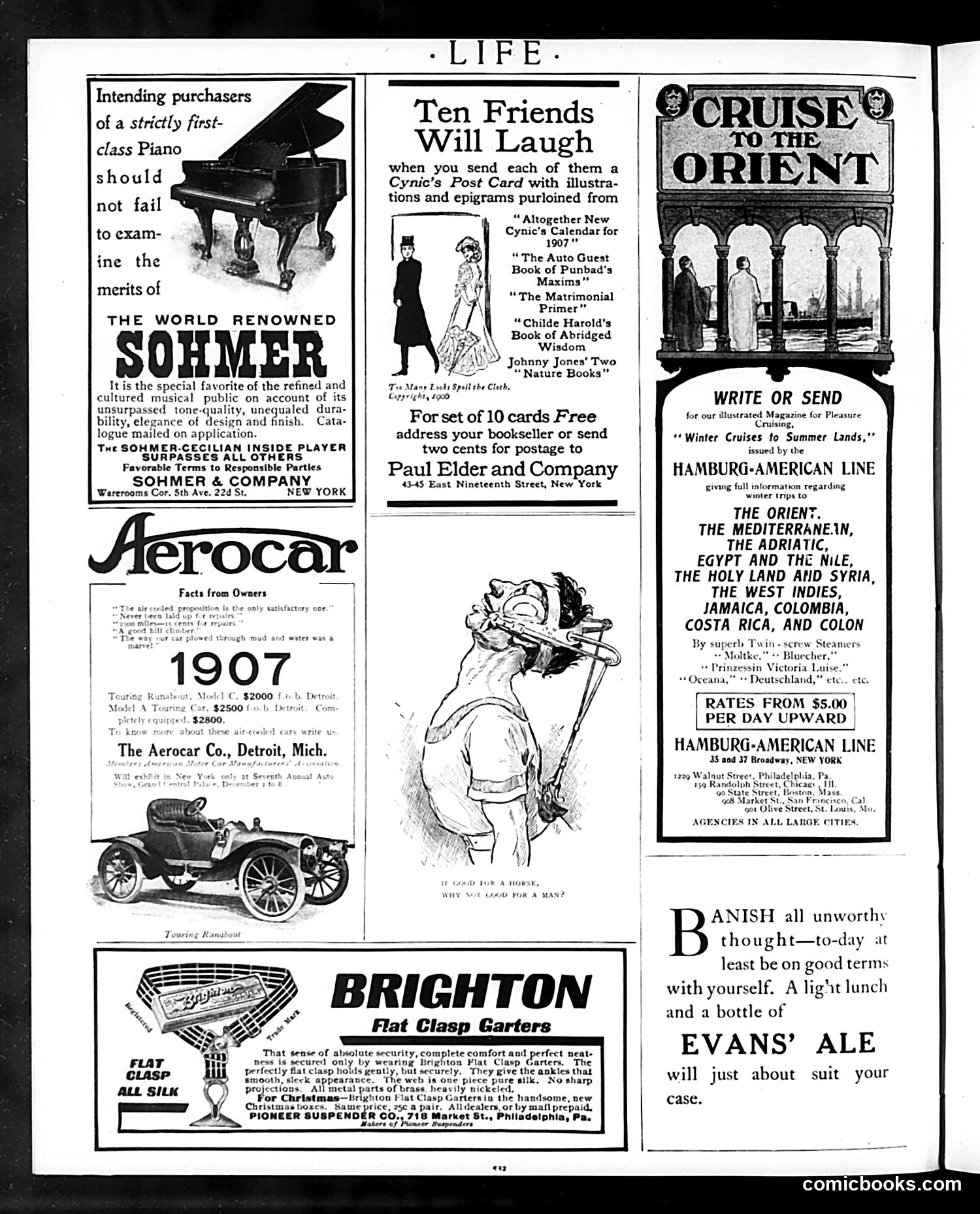
This page is primarily **advertising** from circa 1907, with one editorial cartoon. The central cartoon shows a rotund man smoking a pipe with the caption "IF GOOD FOR A HORSE, WHY NOT GOOD FOR A MAN?" This appears to be **satirizing patent medicine or dubious health products** — a common target of early 20th-century satire. The joke suggests someone is considering using an animal remedy on themselves, mocking the era's unregulated health claims and absurd marketing practices. The advertisements feature luxury goods (Sohmer pianos, Aerocar automobiles, Brighton garters) and travel (Hamburg-American Line cruises), reflecting early 1900s consumer culture aimed at affluent readers. The "Evans' Ale" ad at bottom right promotes alcohol as a digestive aid — typical of Prohibition-era marketing normalizing drinking for "health."
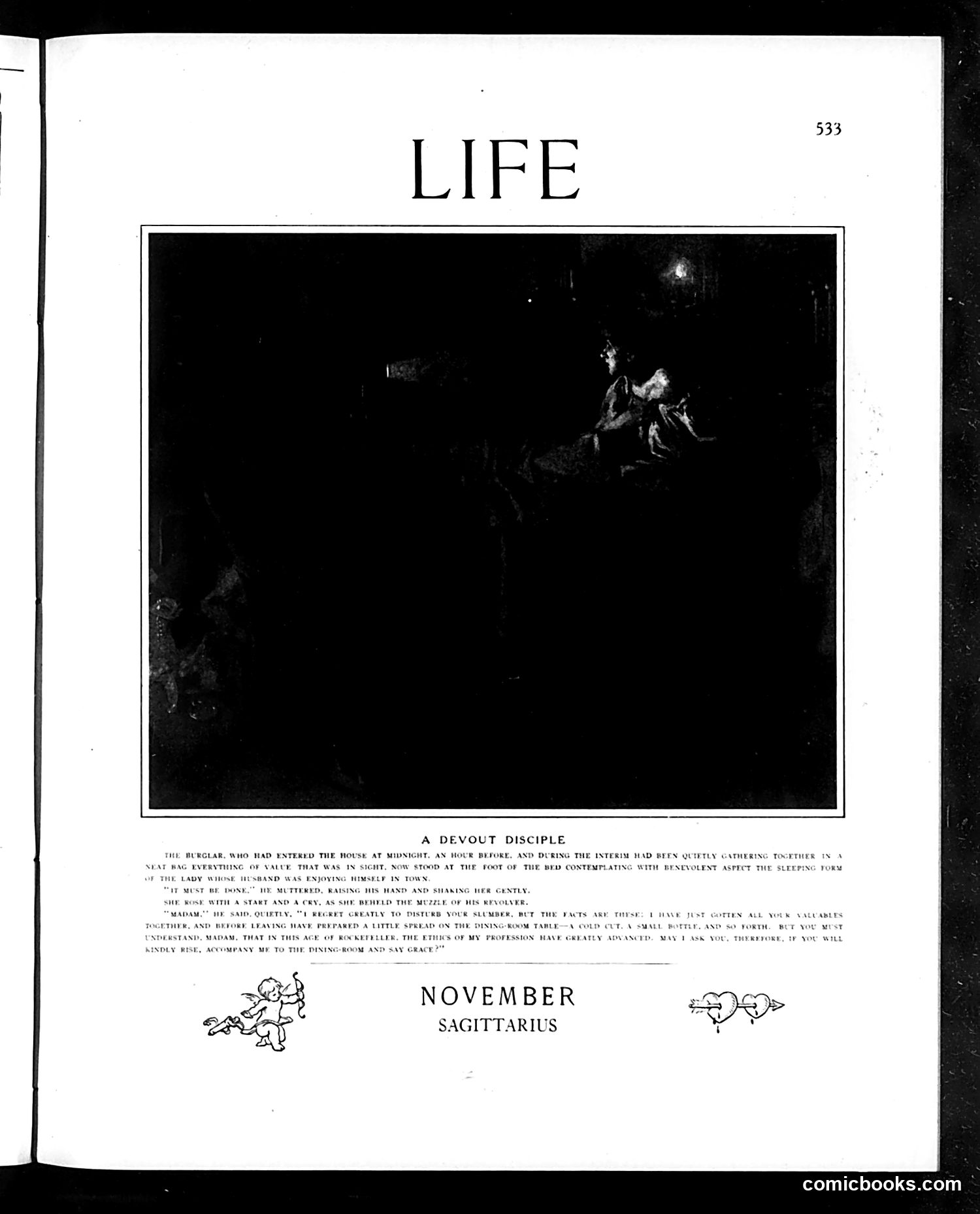
This Life magazine page presents a satirical illustrated story titled "A Devout Disciple." The narrative describes a burglar entering a house at midnight while the lady of the house is away. The text indicates the burglar displays unexpected gentleness—carefully maneuvering around the sleeping form of the lady's husband, then delicately placing items on the dining room table rather than simply stealing them. The satire appears to mock Victorian sentimentality or ironic moral codes: a criminal displays more consideration and restraint than society might expect, suggesting hypocrisy about what constitutes "civilized" behavior. The accompanying illustration is quite dark, making specific details difficult to discern. The cherub illustrations marking "November/Sagittarius" are decorative rather than narrative elements.
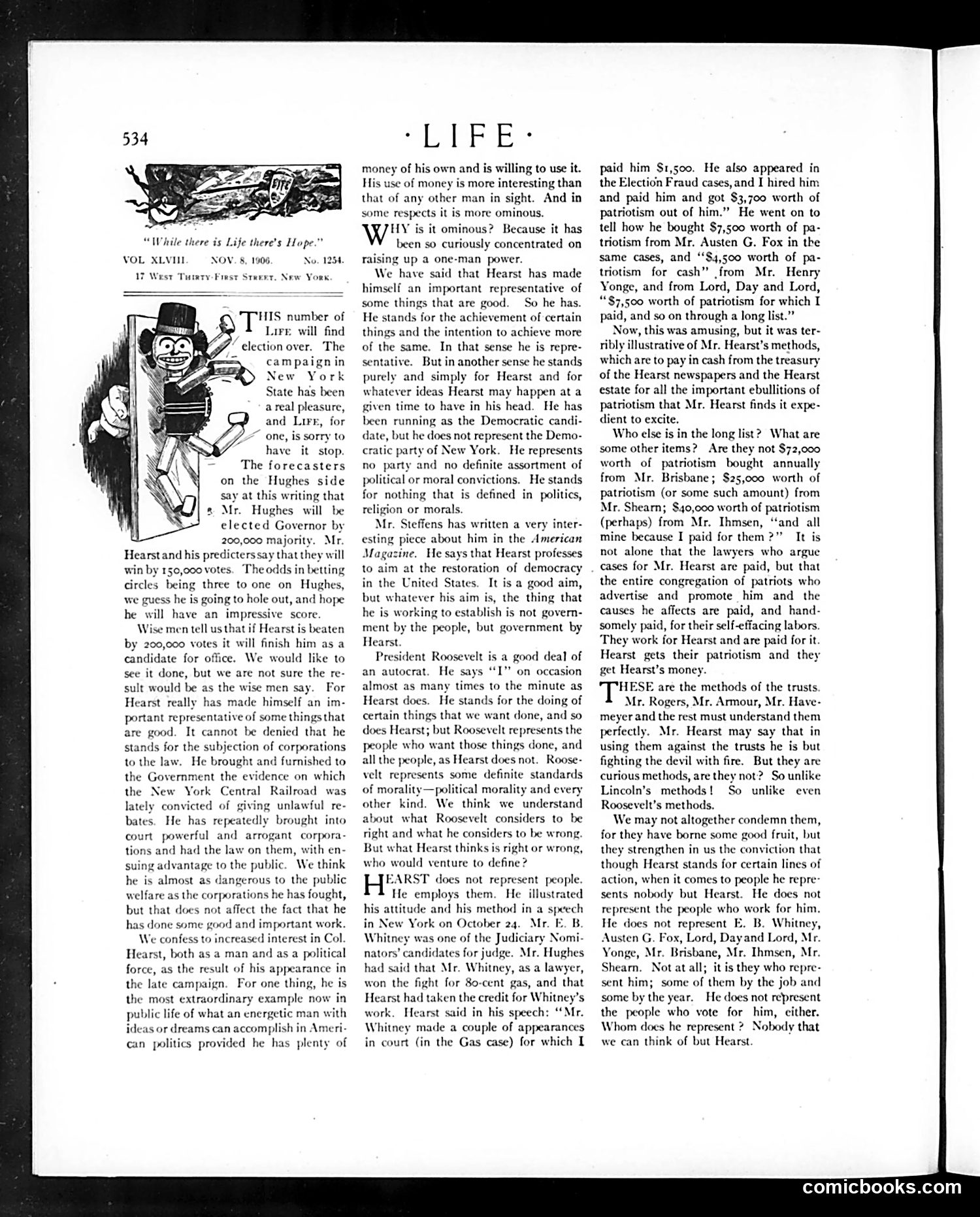
This page satirizes William Randolph Hearst's 1906 New York gubernatorial campaign. The cartoon depicts Hearst as a caricatured figure in formal dress, seemingly celebrating or proclaiming victory. The accompanying article critiques Hearst as a political force who "does not represent people" but rather "employs them." The text argues Hearst is primarily a self-interested businessman using politics for personal gain, having funded his campaign through newspapers and purchased patriotism from various politicians and causes. The satire's core point: Hearst represents wealth and ambition divorced from genuine democratic principles—he funds candidates and causes not from conviction but from calculated self-interest. The article contrasts this with President Roosevelt, whom the writer sees as representing defined moral standards, unlike Hearst's purely transactional approach to politics.
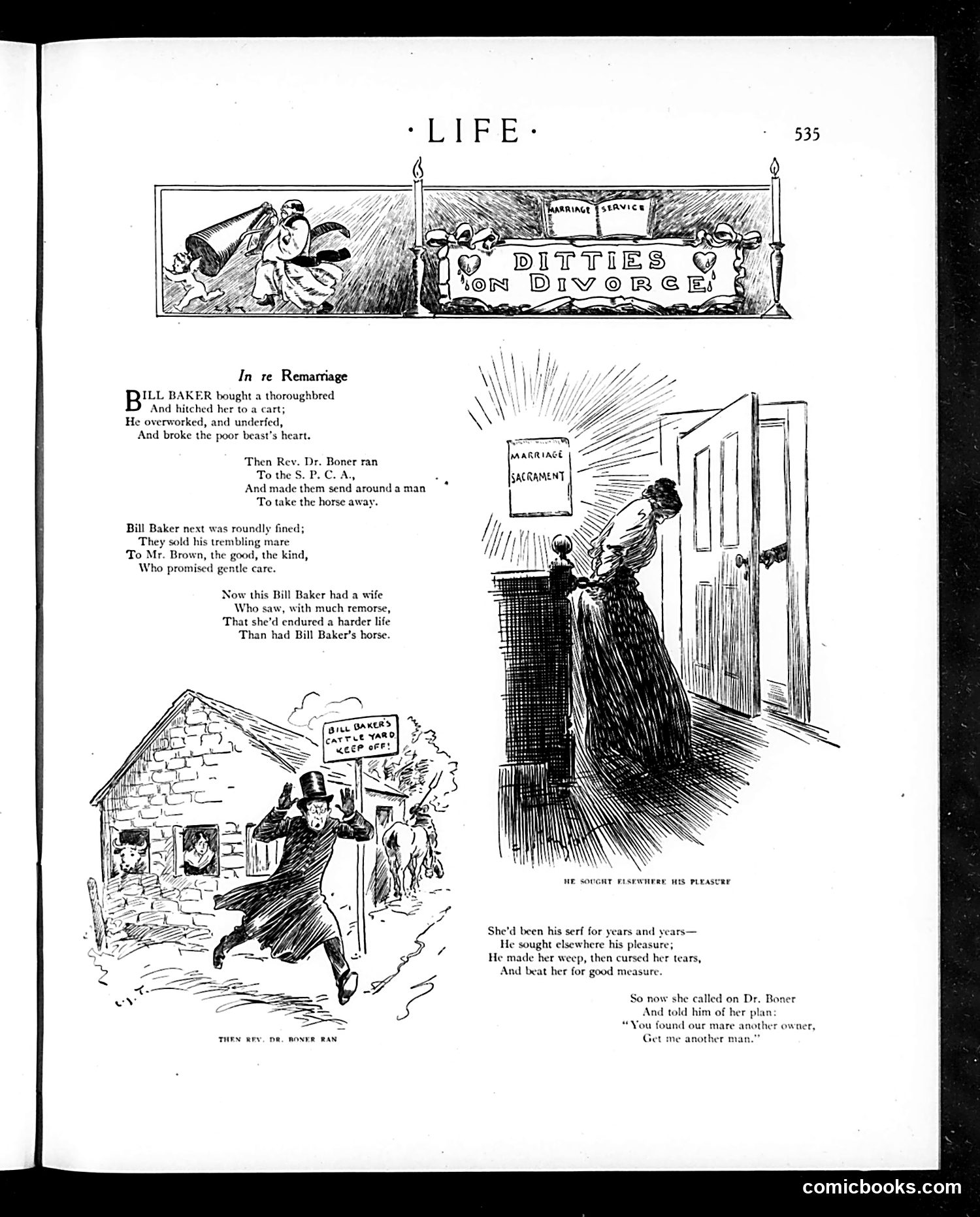
This satirical piece mocks the consequences of divorce through the cautionary tale of Bill Baker. The narrative traces Baker's downfall: he mistreats a horse, which gets seized by animal welfare authorities (the S.P.C.A.); he then marries a woman who endures similar harsh treatment; she eventually seeks divorce and remarriage to escape him. The cartoons illustrate this social commentary. One shows Rev. Dr. Boner (likely a generic clergyman figure) intervening in animal cruelty. Another depicts a woman at a marriage sacrament document, contemplating escape from an abusive spouse. The satire criticizes men who abuse dependents—whether animals or wives—suggesting divorce serves as necessary liberation from domestic tyranny. The piece reflects early 20th-century attitudes toward marriage, divorce, and animal welfare reform.
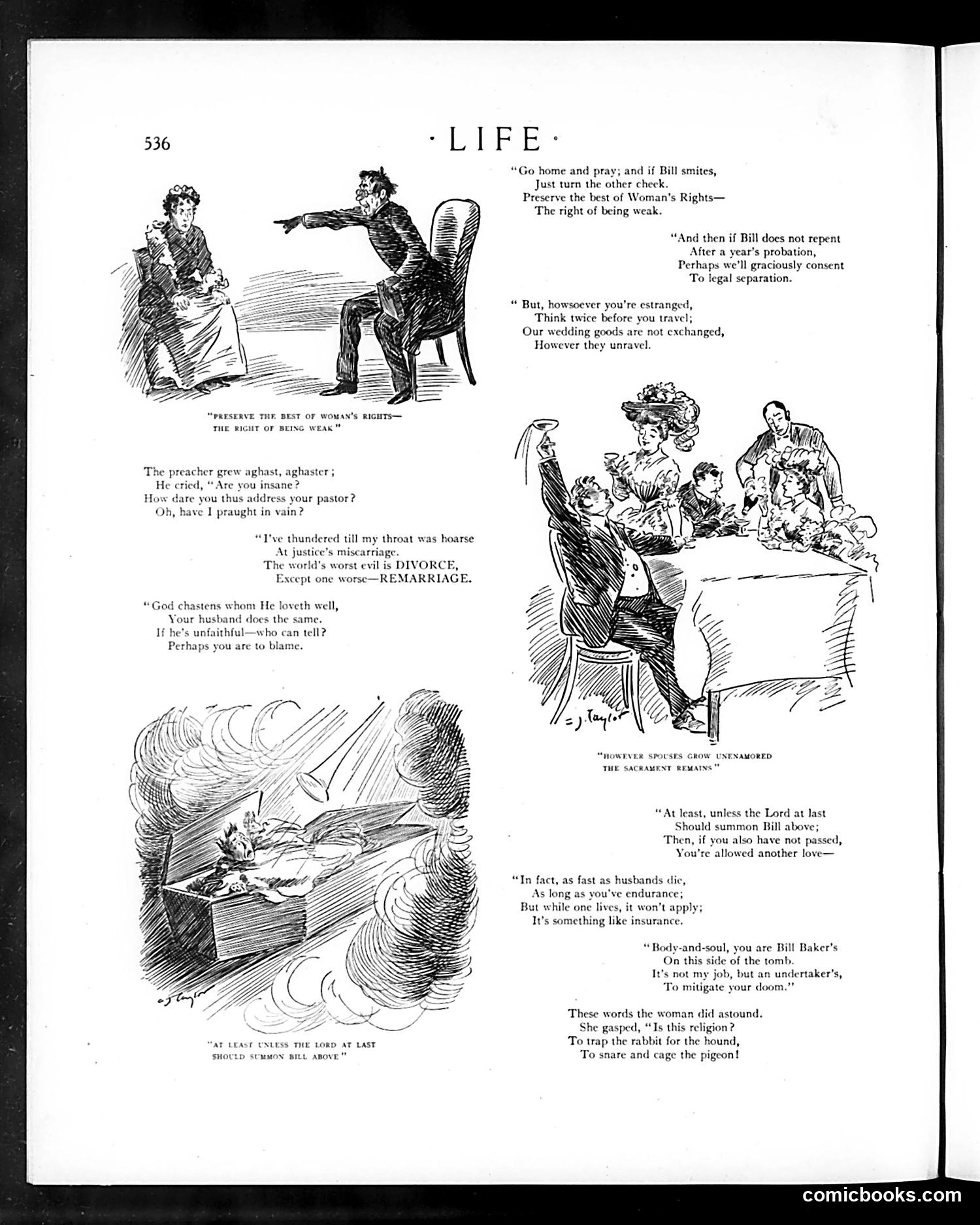
This page satirizes late 19th/early 20th-century attitudes toward marriage and divorce. The central narrative concerns "Bill," a man facing marital dissolution. A preacher condemns divorce as "the world's worst evil" (worse than remarriage), while ironically suggesting the woman bears blame for her husband's infidelity. The satirical point: the hypocrisy of religious and legal institutions that theoretically condemn divorce yet blame women for marital failure, denying them equal rights. The caption "Preserve the best of Woman's Rights—The right of being weak" drips with sarcasm, mocking how society infantilizes women while holding them responsible for men's behavior. The imagery of death and remarriage as "insurance" mocks the grim calculus women faced legally and socially when trapped in bad marriages.
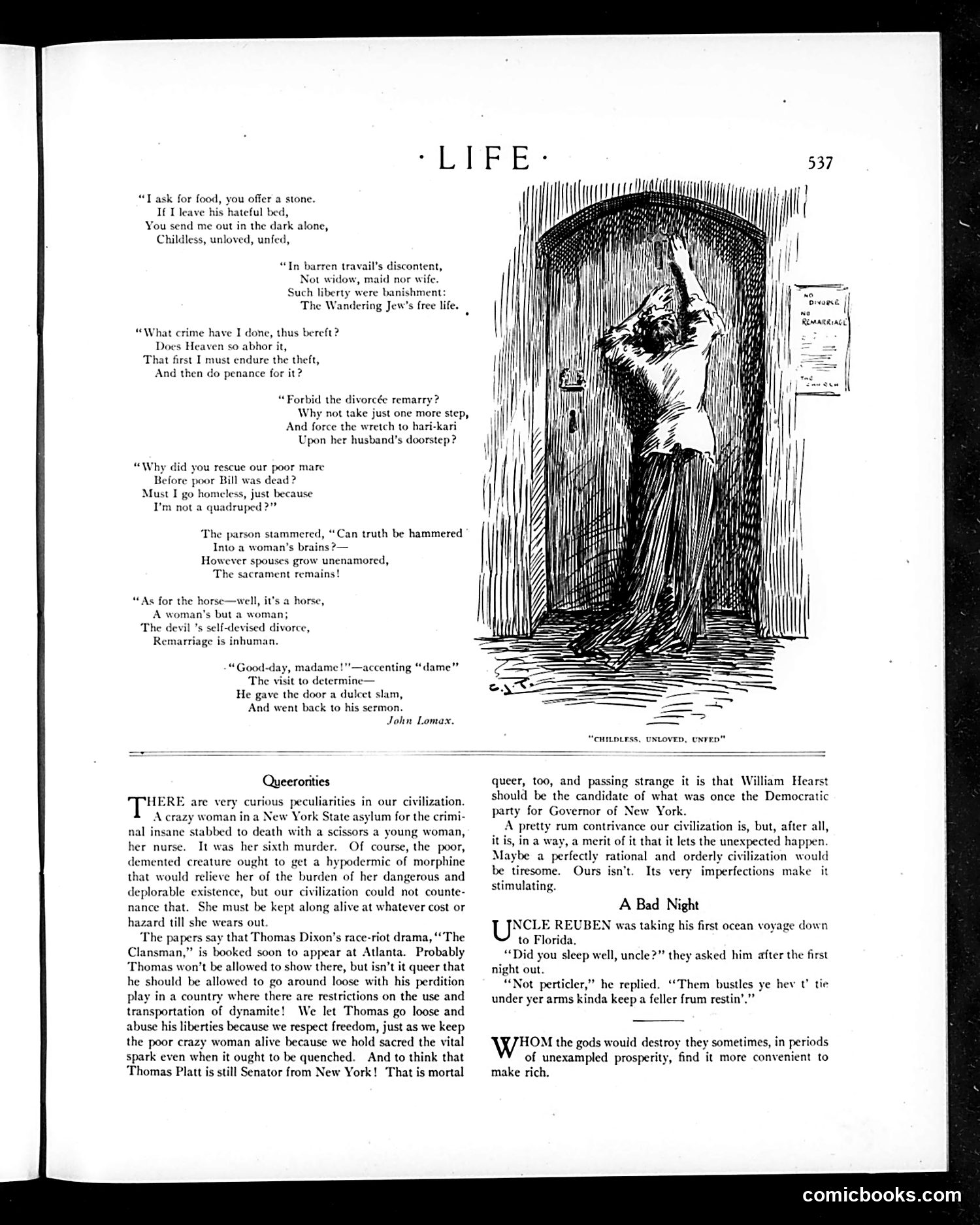
This page contains a John Lamax poem titled "Childless, Unloved, Unfed" (illustrated by a sketch of a distressed figure at a doorway) addressing social hypocrisy toward the poor and marginalized. The poem questions Christian morality—asking why society offers "stones" instead of food, forces the poor into darkness, and denies basic dignity to the destitute. Below, the "Queercities" section critiques a New York asylum case involving a woman institutionalized for allegedly murdering her nurse, and discusses Thomas Dixon's race-riot drama "The Clansman" (soon to premiere in Atlanta). The piece argues for respecting even those society deems "crazy" or dangerous, as we claim to value freedom. The satire targets moral inconsistency in American civilization.
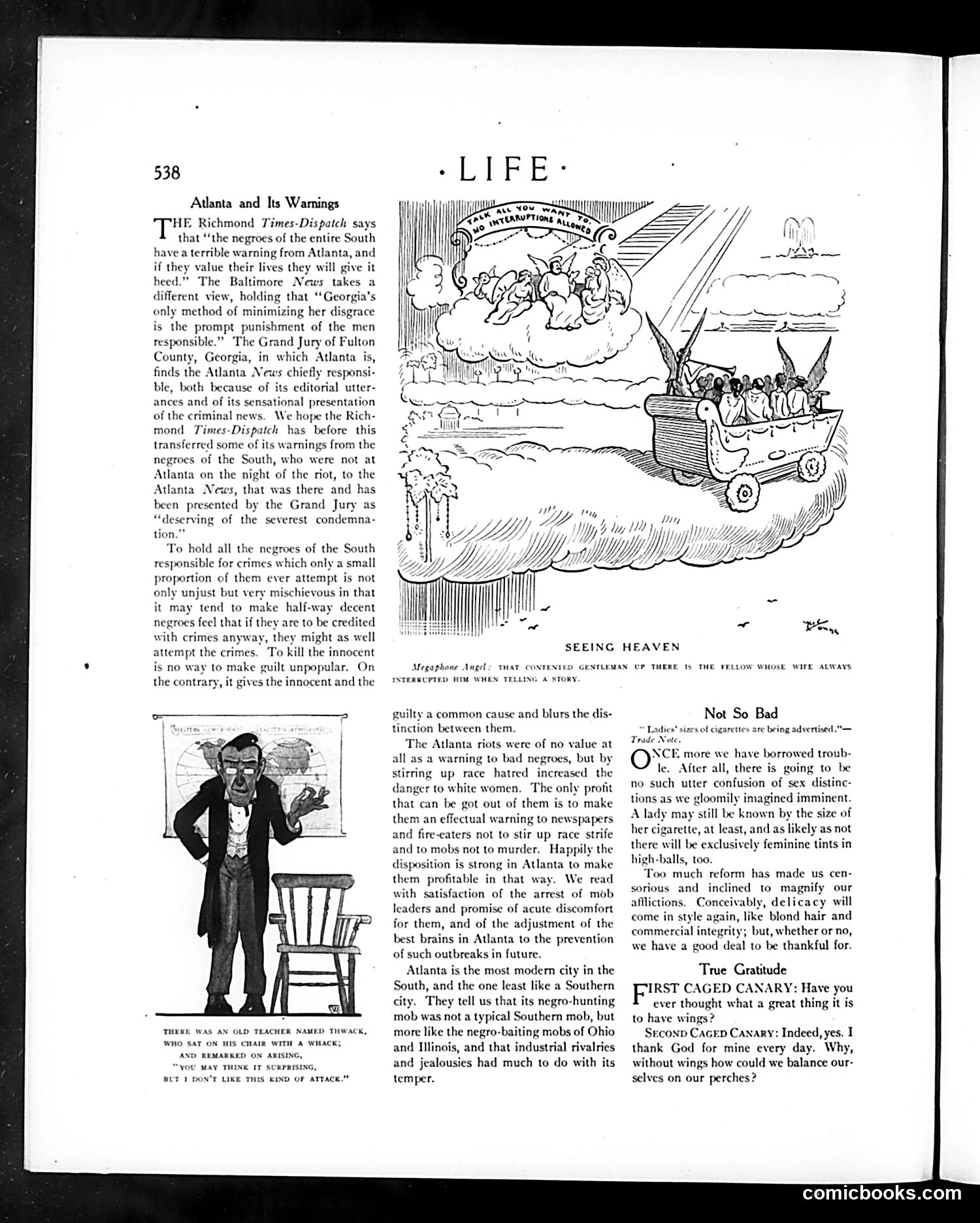
This page addresses the 1906 Atlanta Race Riot through satirical commentary. The main article "Atlanta and Its Warnings" critiques how various Southern newspapers blamed the violence on Black Atlantans rather than examining root causes. The illustration "Seeing Heaven" depicts a sarcastic scene of figures arriving at heaven in a vehicle, captioning that a man interrupts storytelling to tell tales—likely mocking how officials deflected blame. The lower cartoon features "an old teacher named Thwack" who strikes a student, with the caption questioning whether this violent punishment method should continue. This appears to be a metaphorical commentary on how Southern authority figures handle social problems through brutality rather than reform. The "Not So Bad" section sardonically dismisses concerns about racial violence while offering genteel observations about women's fashion.
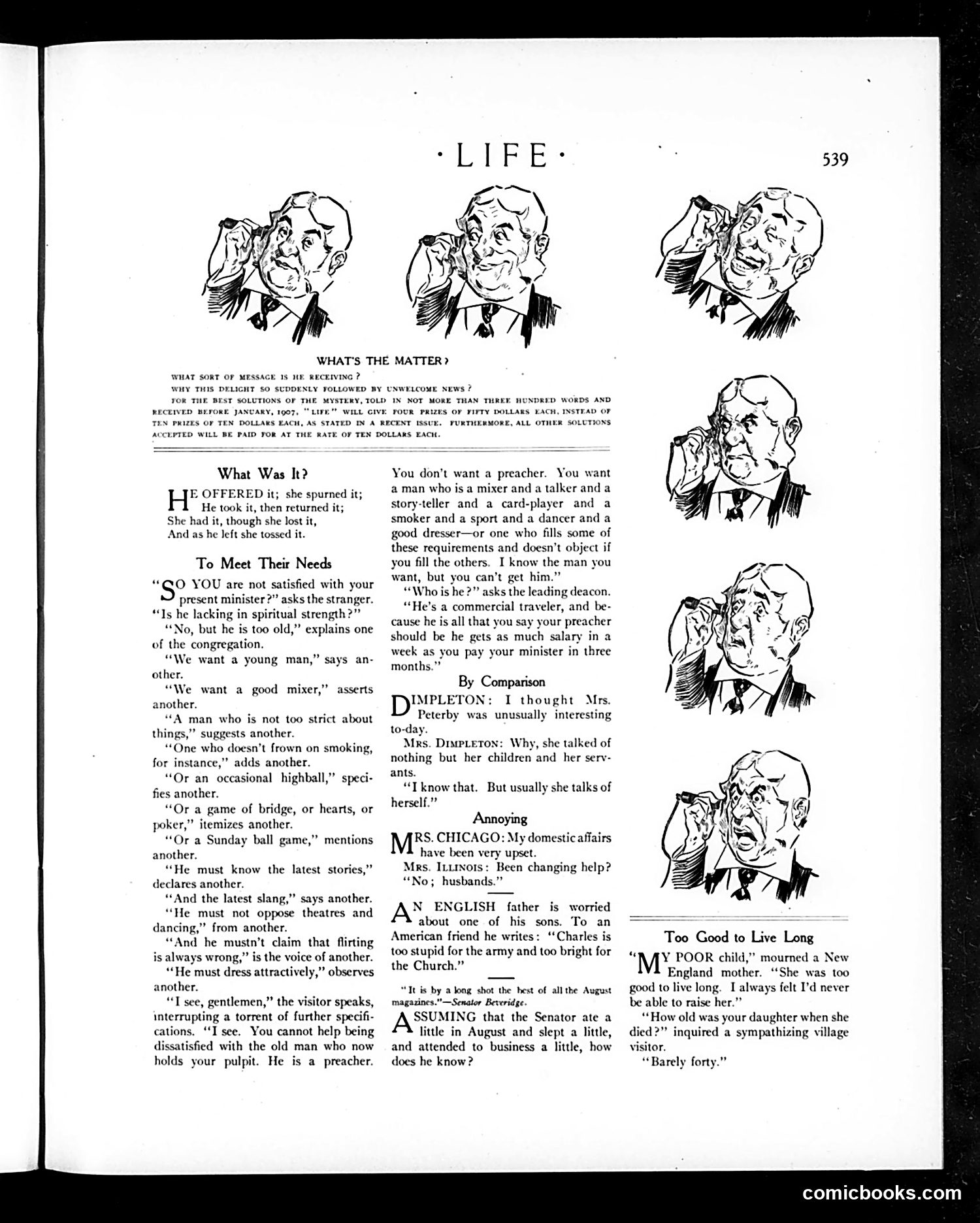
This page contains **humorous short anecdotes** rather than political cartoons. The accompanying **caricature sketches** (right side) show exaggerated facial expressions of a man in various states of distress or emotion—a visual complement to the jokes. The content satirizes **social expectations** around finding an ideal minister or companion. Multiple sections mock how people have contradictory demands: they want someone who is a "mixer," "talker," "card-player," and "dancer," yet also spiritually strong—an impossible combination. Other brief jokes address **domestic life frustrations**: wives who talk only about servants and children, changing household help, and a dark joke about a daughter dying young being a financial relief. The satire targets **middle-class pretensions and hypocrisy** about what people claim to want versus their actual shallow desires.
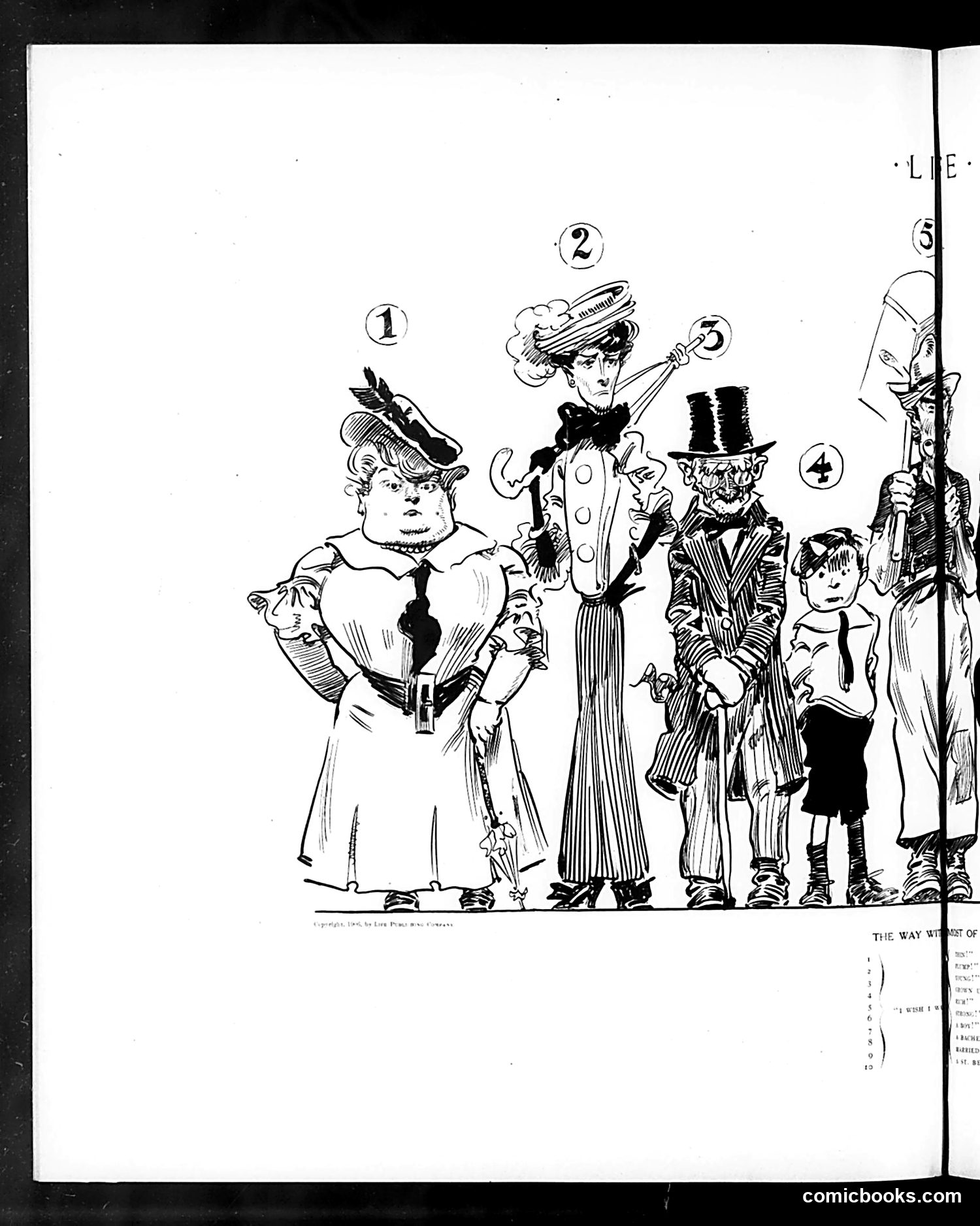
This appears to be a satirical illustration titled "The Way We Dress" showing five numbered figures in various fashionable outfits from what seems to be the early 20th century. The cartoon critiques contemporary fashion trends through exaggeration: 1. A heavyset woman in a simple dress 2. A tall woman with an elaborate, towering hat and feathered accessories 3. A woman in a long, narrow silhouette with a tiny waist 4. A gentleman in formal wear with a top hat 5. Partially visible figure on the right edge The satire appears to mock the impracticality and absurdity of fashionable dress of the era—particularly women's extreme hats and constrictive silhouettes. The numbered format suggests these represent different style trends being mocked for their excessiveness and ridiculousness.
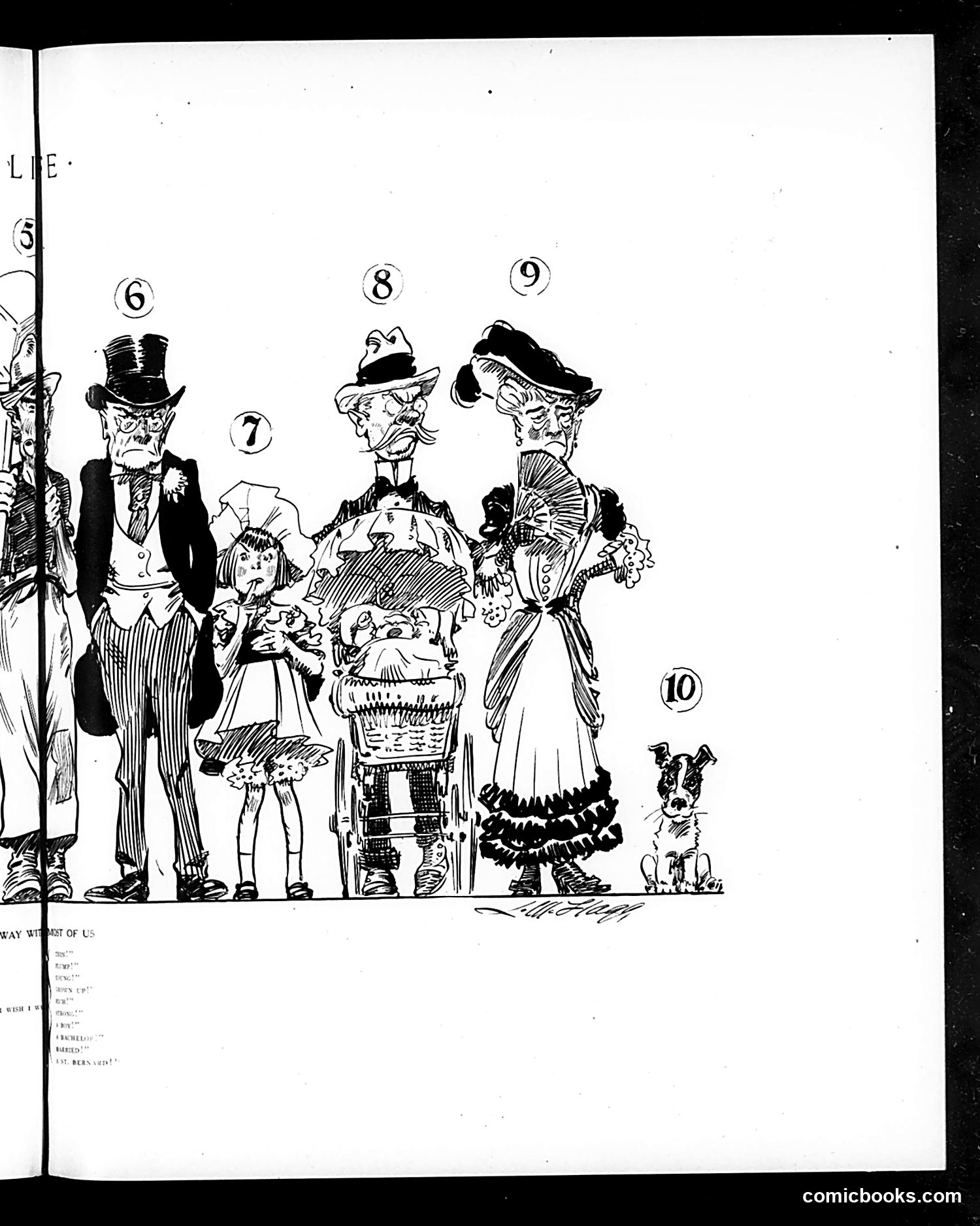
This appears to be a numbered illustration guide (figures 6-10) showing character types or caricatures in exaggerated style typical of early 20th-century satirical art. The drawing style and composition suggest it's demonstrating character archetypes or social types for comedic purposes. The figures display distinctly caricatured features - elongated faces, exaggerated expressions, and formal period clothing including top hats and elaborate dress. Figure 10 shows a small dog. Without visible text labels identifying specific individuals or a clear headline explaining the cartoon's satirical target, I cannot definitively state who these figures represent or what political/social commentary they're making. The page appears to be instructional or demonstrative in nature, but the specific meaning and contemporary references remain unclear from the image alone.
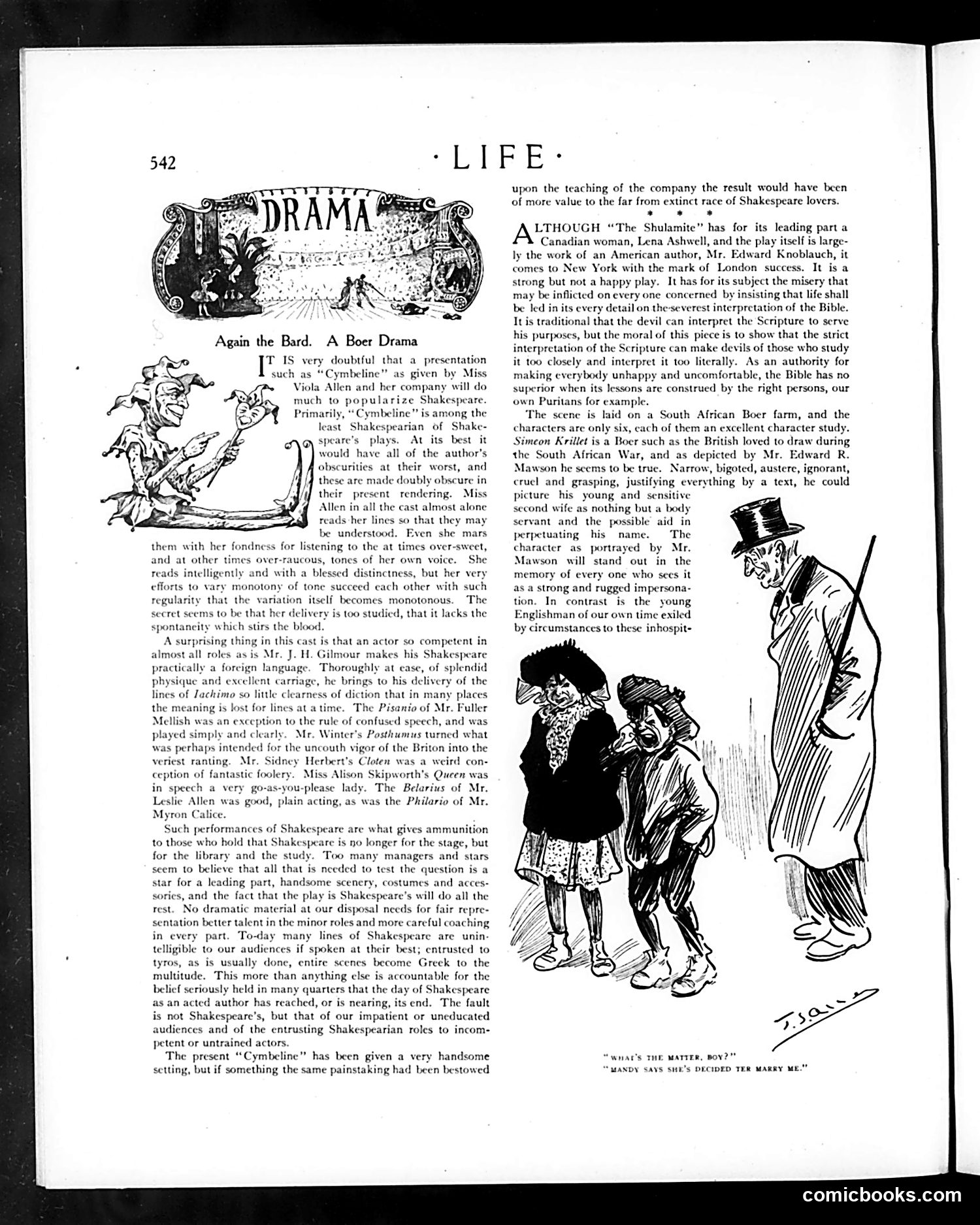
This page contains theater reviews, not political cartoons. The main illustration depicts a scene from "Again the Bard: A Boer Drama," likely showing characters from a South African-set play with six characters, per the text's description. The review critiques a production of Shakespeare's *Cymbeline* by Miss Willa Allen's company. The writer argues the performance demonstrates why some believe Shakespeare belongs only in libraries, not on stage. Key complaints: actors mumble their lines (particularly J.H. Gilmour as Jachimo), the direction is over-studied, and Shakespeare requires better casting and coaching than producers provide. The reviewer blames poor *acting* and *education*, not the playwright, for Shakespeare's perceived decline in theatrical relevance. The page's satire targets theatrical producers who assume a famous script plus handsome scenery equals success, neglecting the talent and training minor roles demand.
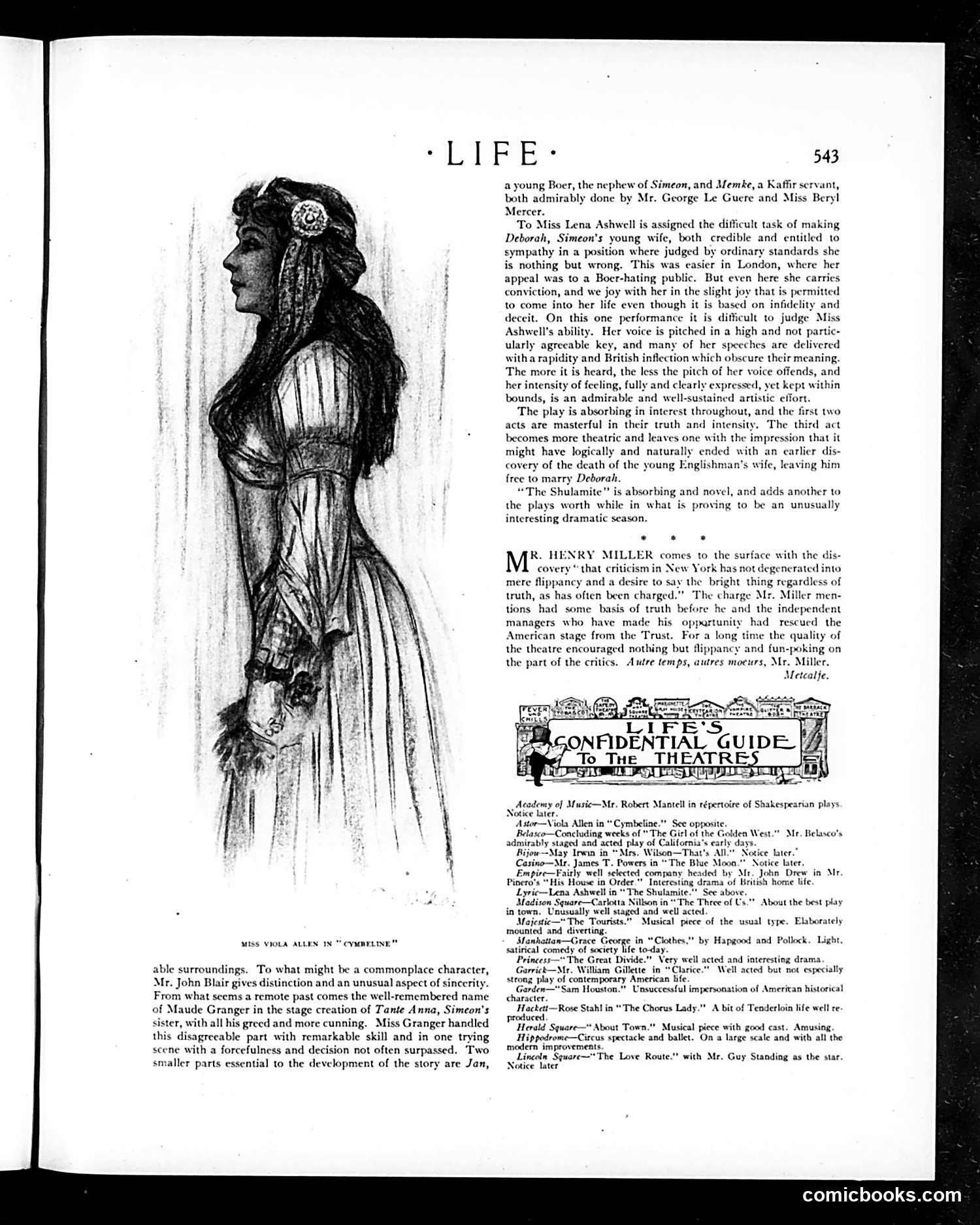
This page reviews current Broadway productions, with a sketch of actress **Viola Allen** in "Cymbeline" (Shakespeare's play). The main text praises Allen's performance as Deborah in "The Shulamite," noting her ability to make a morally questionable character sympathetic despite her "high and not particularly agreeable" voice. The page also includes commentary by critic **Henry Metcalfe** defending New York theater criticism against charges of mere "flippancy," arguing that independent theater managers have elevated standards beyond what the old theatrical Trust permitted. At bottom, "Life's Confidential Guide to the Theatres" lists current Broadway shows with brief notices—typical of the magazine's role as a cultural arbiter for educated readers interested in theater, music, and current events. This reflects Life's function as a sophisticated satirical weekly covering arts and society.
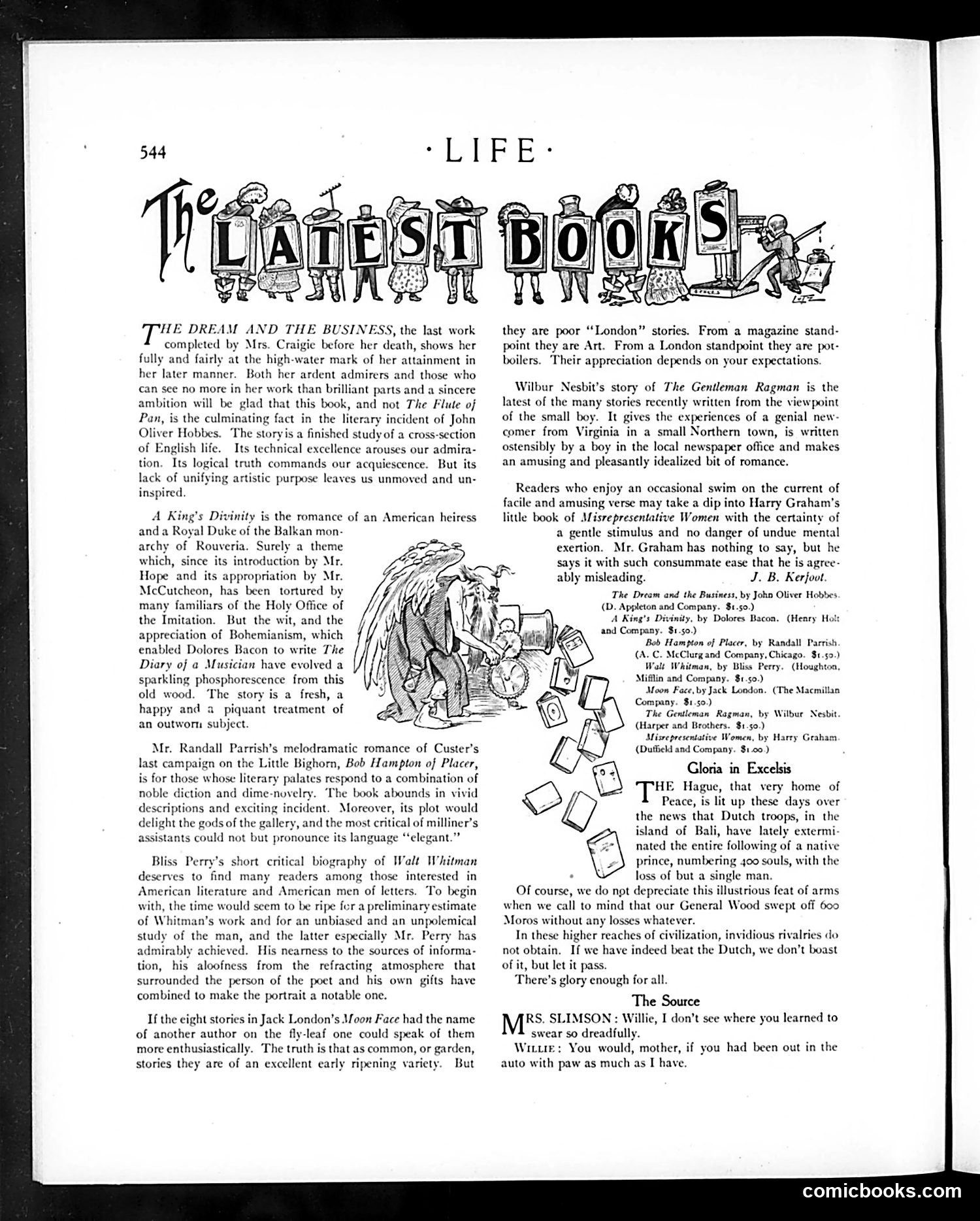
This is a **book review section** from Life magazine, not a political cartoon. The illustrated header features whimsical drawings of children and books, serving as decoration for literary criticism. The page reviews six contemporary novels, including works by John Oliver Hobbes, Dolores Bacon, and Jack London. The reviews are relatively brief critical assessments—some praise ("finished study," "sparkling phosphorescence"), others mild dismissal (London's stories are "pot-boilers" rather than genuine "London" stories). The only satirical content appears at the bottom in "The Source," a brief comedic dialogue between Mrs. Slimson and Willie about the boy swearing after encountering a muddy automobile. This represents Life's function as a **literary journal** alongside humor—reflecting early 20th-century magazine culture where book reviews served educated readers interested in contemporary American literature.
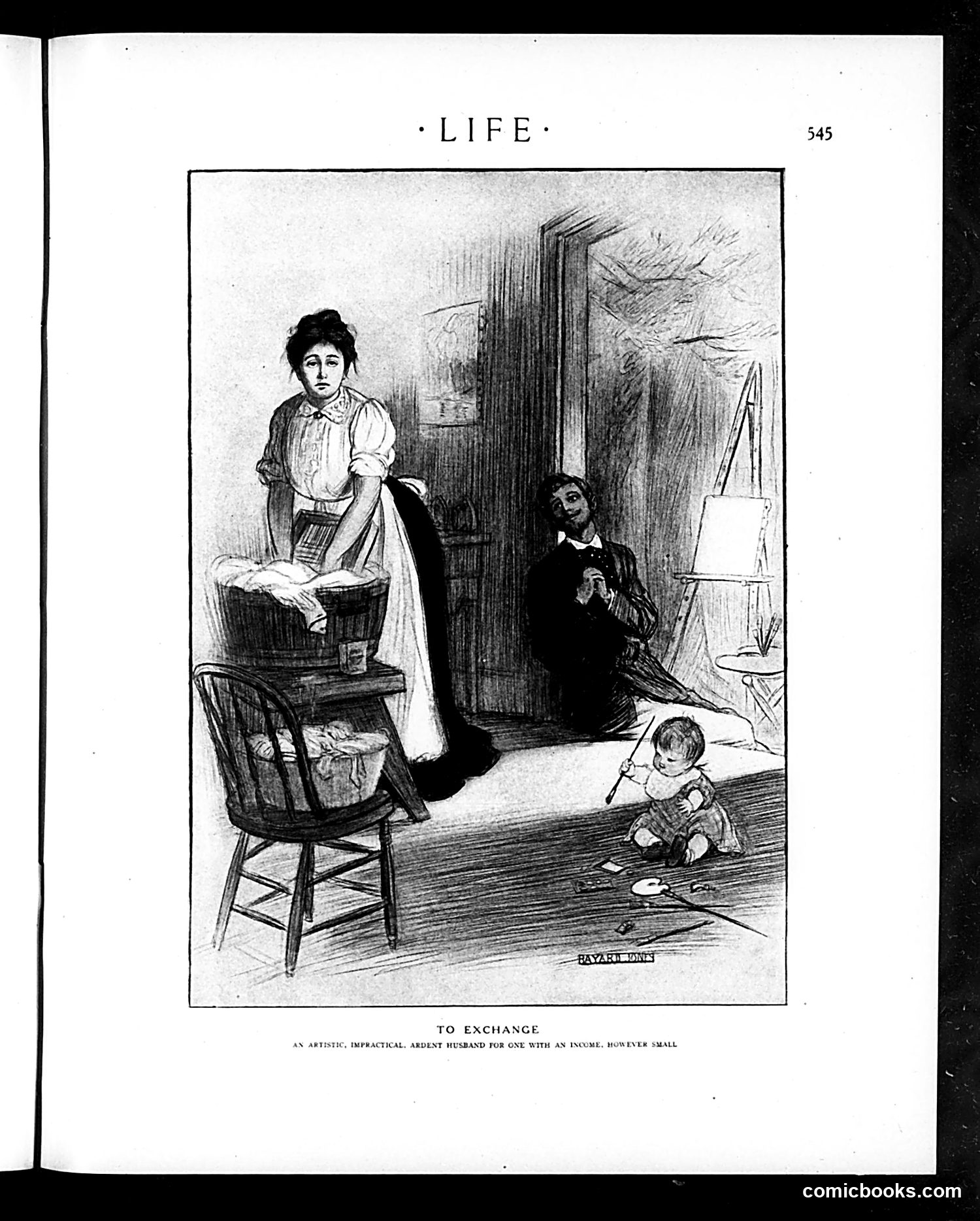
This satirical cartoon depicts a domestic scene critiquing marriage and economic realities. A woman stands at a washtub doing laundry while holding what appears to be a child's garment, suggesting poverty. A small child plays on the floor. Behind her, a man in dark clothing sits dejectedly—characterized as an "artistic, impractical, ardent husband" by the caption. The satire mocks the tension between romantic ideals and financial necessity in marriage. The woman's weary posture implies she would willingly trade her passionate but penniless artist husband for someone with steady income, "however small." The cartoon exposes the harsh reality that romantic love cannot sustain a household without money, particularly for women responsible for domestic labor and childcare. This reflects early-20th-century anxieties about class, marriage, and women's economic dependence.
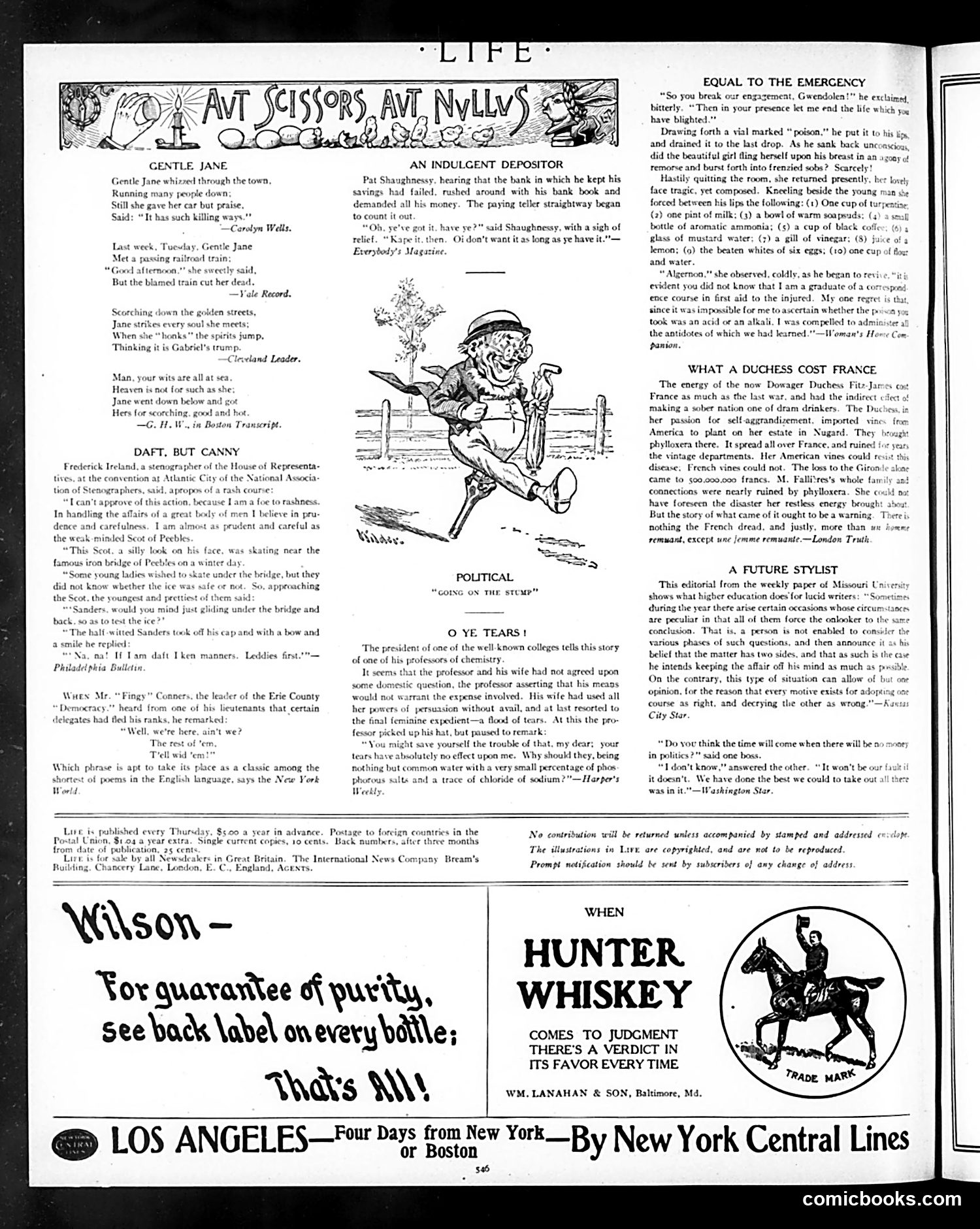
This page from *Life* magazine contains several satirical pieces mocking early 1900s society: **"Gentle Jane"** ridicules reckless automobile drivers—a new social menace. Jane speeds through town "killing" pedestrians, then is ironically "cut dead" by a train, suggesting cars and drivers were dangerous nuisances to established transportation. **"An Indulgent Depositor"** jokes about bank failures (common during this era), showing Irish immigrant Pat Shaughnessy rushing to withdraw savings, only to have the teller cheerfully continue serving him as if nothing's wrong—dark humor about financial instability. **"O Ye Tears!"** satirizes both academic pedantry and female emotional manipulation. A college professor dismisses his wife's tears by analyzing them chemically, undermining her emotional appeal through masculine rationality—contemporary satire of gender relations. **"Equal to the Emergency"** depicts a woman responding to a suicide attempt with practical first aid rather than romantic hysteria—mocking both melodramatic romance conventions and progressive "New Woman" attitudes. The page reflects early-century anxieties: automobile dangers, financial insecurity, and shifting gender roles.
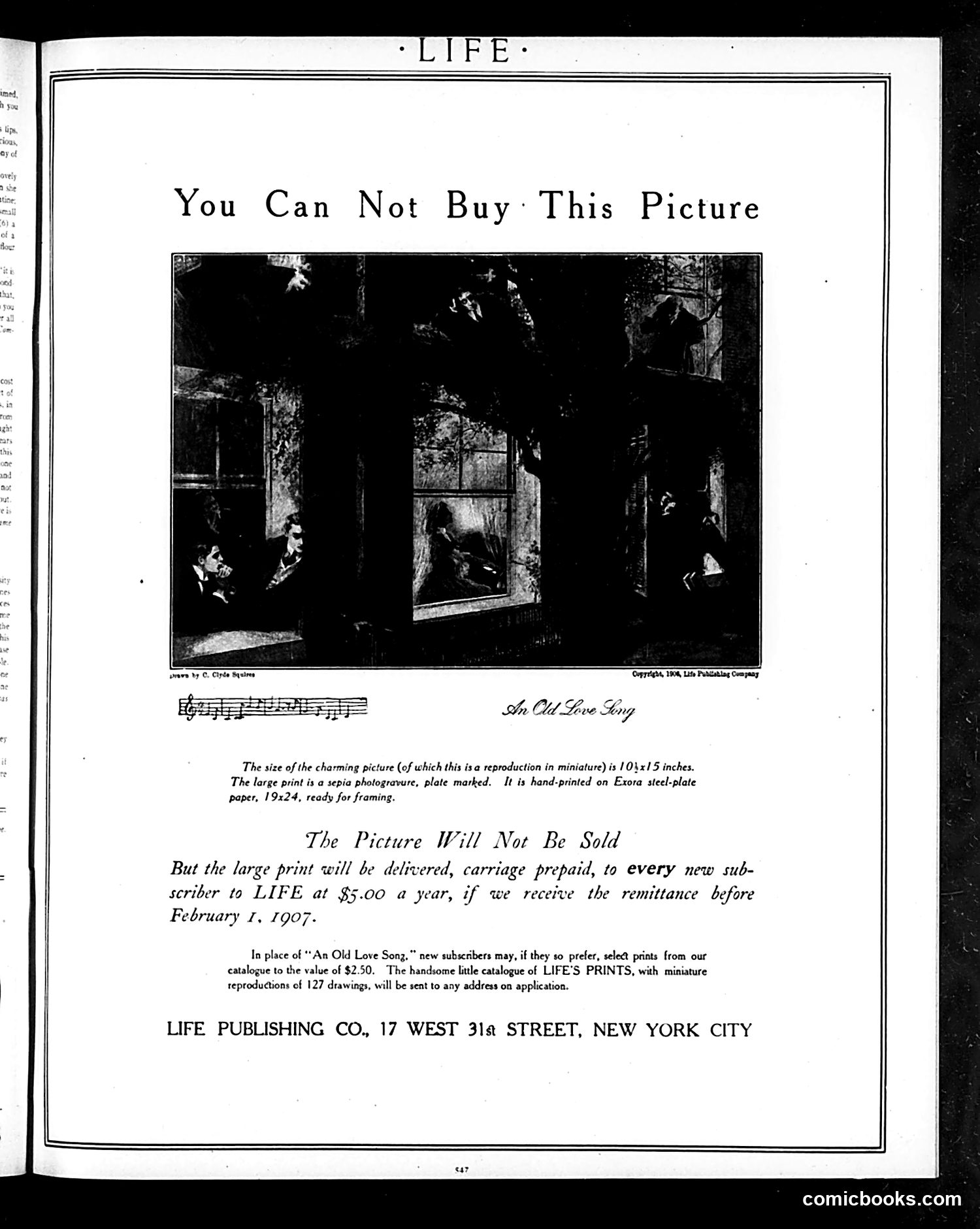
This is primarily a **subscription advertisement** rather than political satire. Life magazine is promoting a promotional offer for new subscribers. The page features a sepia photogravure titled "An Old Love Song"—a sentimental scene depicting figures in what appears to be a domestic or romantic setting viewed through a window, photographed by C. Cirde Syckes. **The Sales Pitch:** The "picture will not be sold" separately, but Life offers it as a **free premium** to new annual subscribers paying $5.00 before February 1, 1907. The large print (19x24 inches, hand-printed on steel-plate paper) is framed-ready. **Alternative offer:** New subscribers could instead select prints from Life's catalog (127 reproductions available) valued at $2.50. This reflects early-1900s magazine marketing strategies: offering high-quality art reproductions as subscription incentives to attract readers in a competitive publishing market. The dramatic headline "You Cannot Buy This Picture" is a marketing hook—creating exclusivity through subscription-only availability.
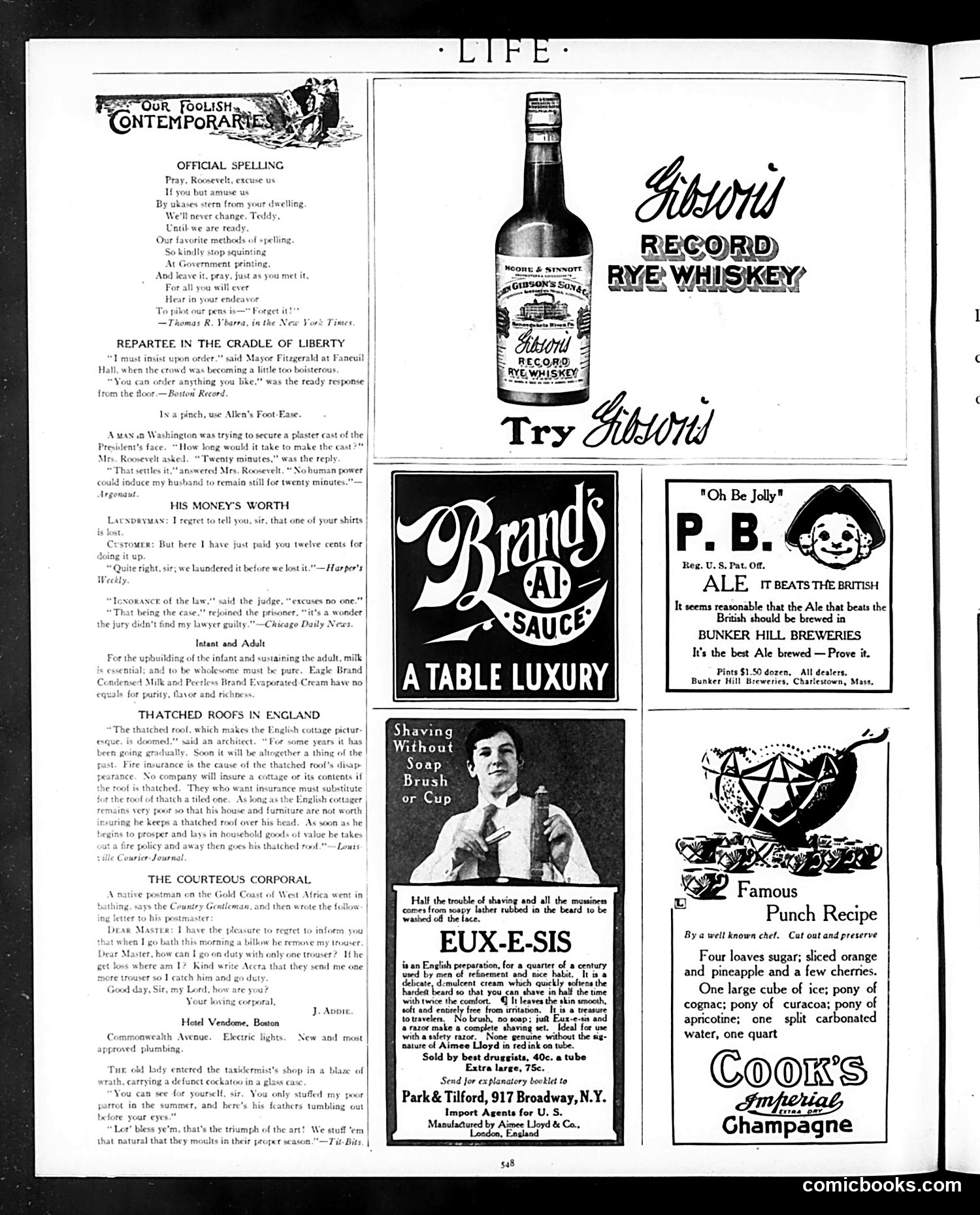
This page is primarily **advertisements interspersed with humorous anecdotes**, not political cartoons. The satirical content is mild and domestic. The text snippets mock **bureaucratic absurdity and everyday frustrations**: Roosevelt's "official spelling" reform (a real Progressive Era initiative), a laundry service that charges for cleaning a shirt that disintegrates, and insurance companies destroying England's picturesque thatched roofs through excessive regulation. "The Courteous Corporal" appears to mock **British military formality**—a soldier apologizes elaborately for minor infractions, contrasting rigid protocol with practical reality. The page is dominated by **product advertisements**: Gibson's whiskey, Brand's sauce, EUX-E-SIS shaving cream, P.B. Ale, and Cook's Champagne. These reflect early 20th-century consumer culture targeting middle and upper-class readers. The humor is genteel and conservative—poking fun at modernization, bureaucratic overreach, and pretension rather than advancing political critique.
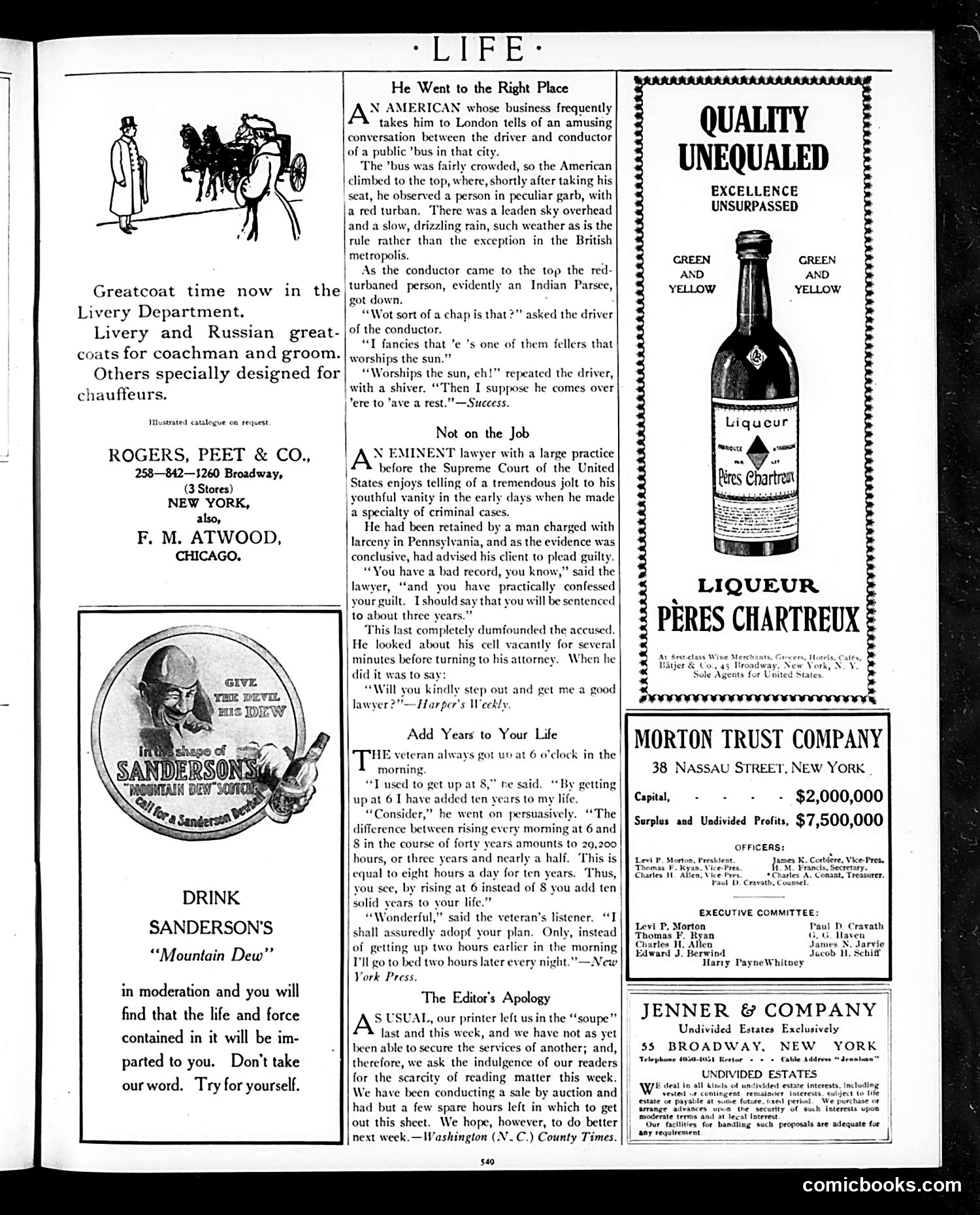
This page from *Life* magazine is primarily advertising with three humorous anecdotes interspersed. The main satire concerns British culture and attitudes: **"He Went to the Right Place"** mocks British weather and indifference. A London bus conductor and driver observe a Parsee (Indian Zoroastrian) in traditional red turban descending during drizzle. The driver's joke—that the sun-worshipper has come to London "to 'ave a rest"—satirizes Britain's notoriously gray, rainy climate as so relentlessly gloomy that even someone seeking sunshine would find London a respite. **"Not on the Job"** jokes about lawyer incompetence: a criminal defendant, after his own attorney advises guilty plea to larceny charges, fires him, asking for a better lawyer—suggesting the first attorney was negligent or unhelpful. **"Add Years to Your Life"** offers absurdist humor: a man's mathematical argument that rising at 6 instead of 8 *adds ten years* is undercut when his listener proposes simply going to bed two hours later instead—exposing the logical fallacy. The advertisements (greatcoats, liqueur, financial services) fill remaining space.
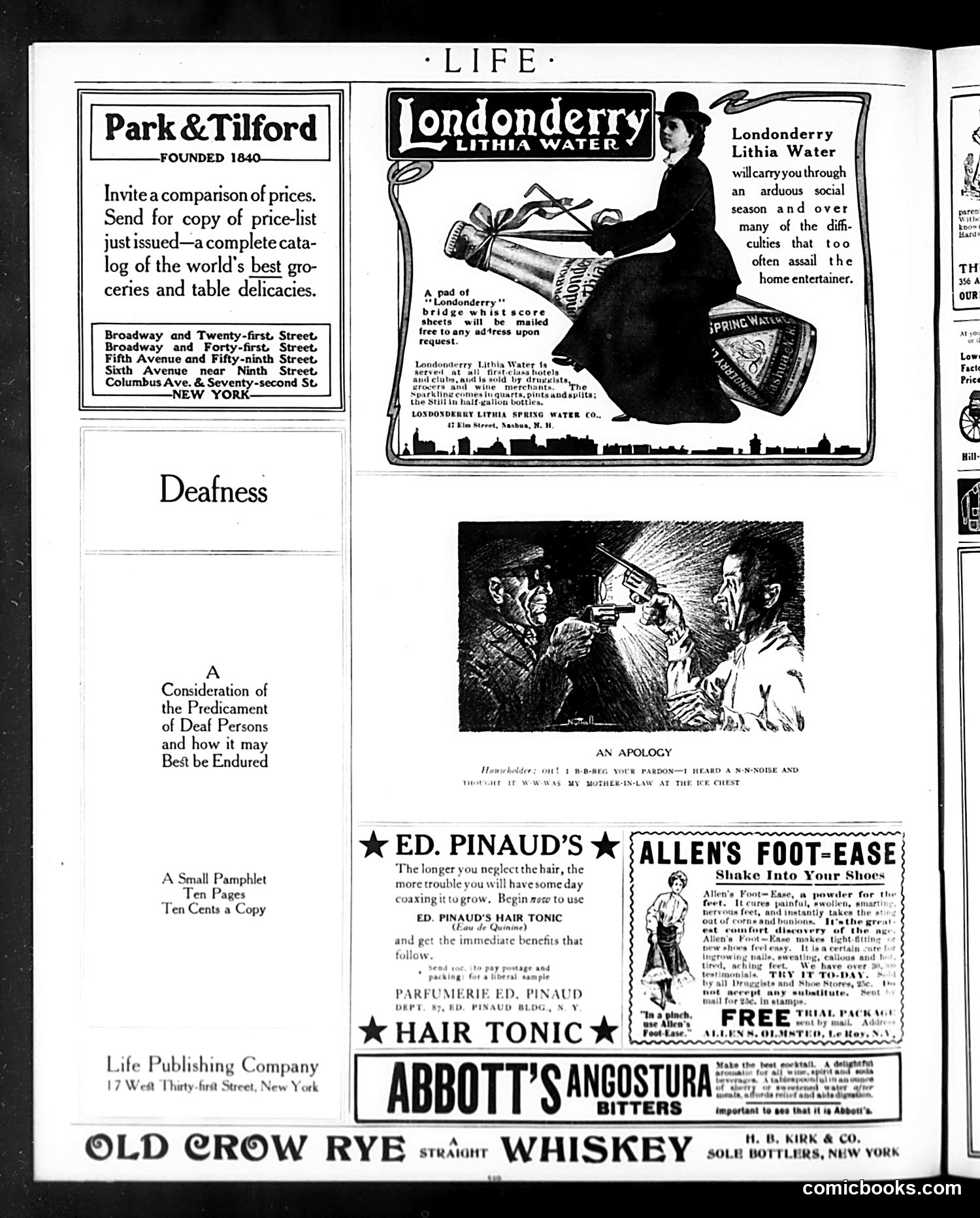
This single cartoon on the page depicts a deaf man apologizing to hearing people, apparently for not responding to a noise. The humor—which would register differently to modern readers—relies on the period's common stereotype of deaf people as objects of ridicule. The caption reads: "B-B-REG YOUR PARDON—I HEARD A N-N-NOISE AND THOUGHT IT WAS MY MOTHER-IN-LAW AT THE ICE CHEST." The stutter in his speech attempts comedic effect through mockery of his disability. The joke operates on multiple levels: the absurdity of a deaf person claiming to have "heard" a noise, combined with the era's standard mother-in-law ridicule humor. The page itself includes a serious article titled "Deafness: A Consideration of the Predicament of Deaf Persons and how it may Best be Endured," suggesting Life mixed earnest disability advocacy with cruel caricature—a stark contradiction reflecting early 20th-century attitudes toward disability and humor.
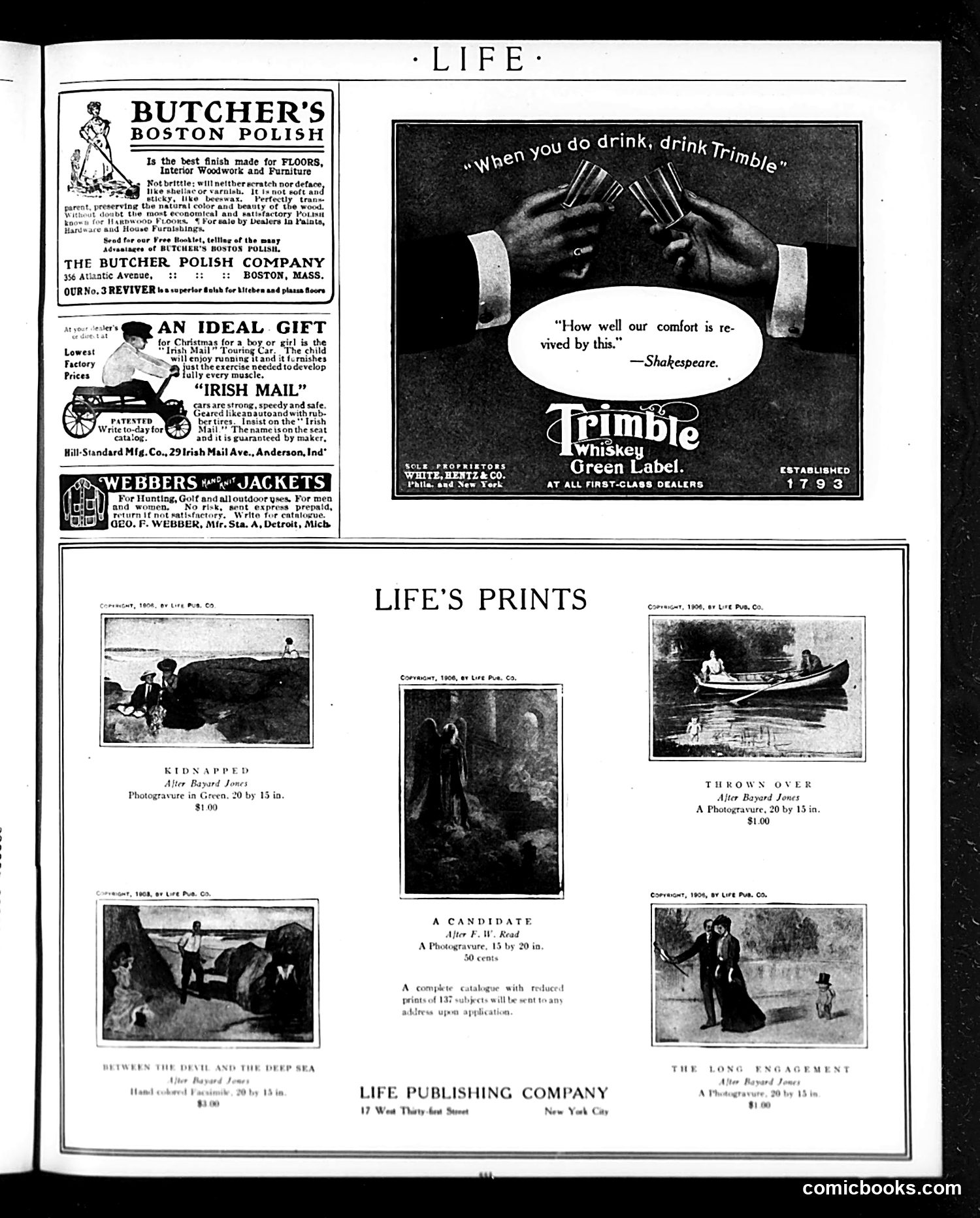
This page is primarily **advertising and product catalog**, not political satire. The top half contains commercial advertisements for floor polish, toy cars, jackets, and notably **Trimble Whiskey**, which uses a Shakespeare quote to promote drinking. The lower half shows **"Life's Prints"** — a catalog of photogravure artwork available for purchase from Life Publishing Company. These appear to be sentimental domestic scenes by artists like Bayard Jones and F.W. Read, with titles like "Kidnapped," "Thrown Over," "A Candidate," and "The Long Engagement" — suggesting romantic or melodramatic subject matter popular with early 20th-century buyers. The page reflects the magazine's dual business model: satirical editorial content supported by advertising revenue, plus merchandise sales to readers. There is no discernible political cartoon or satire present on this particular page.
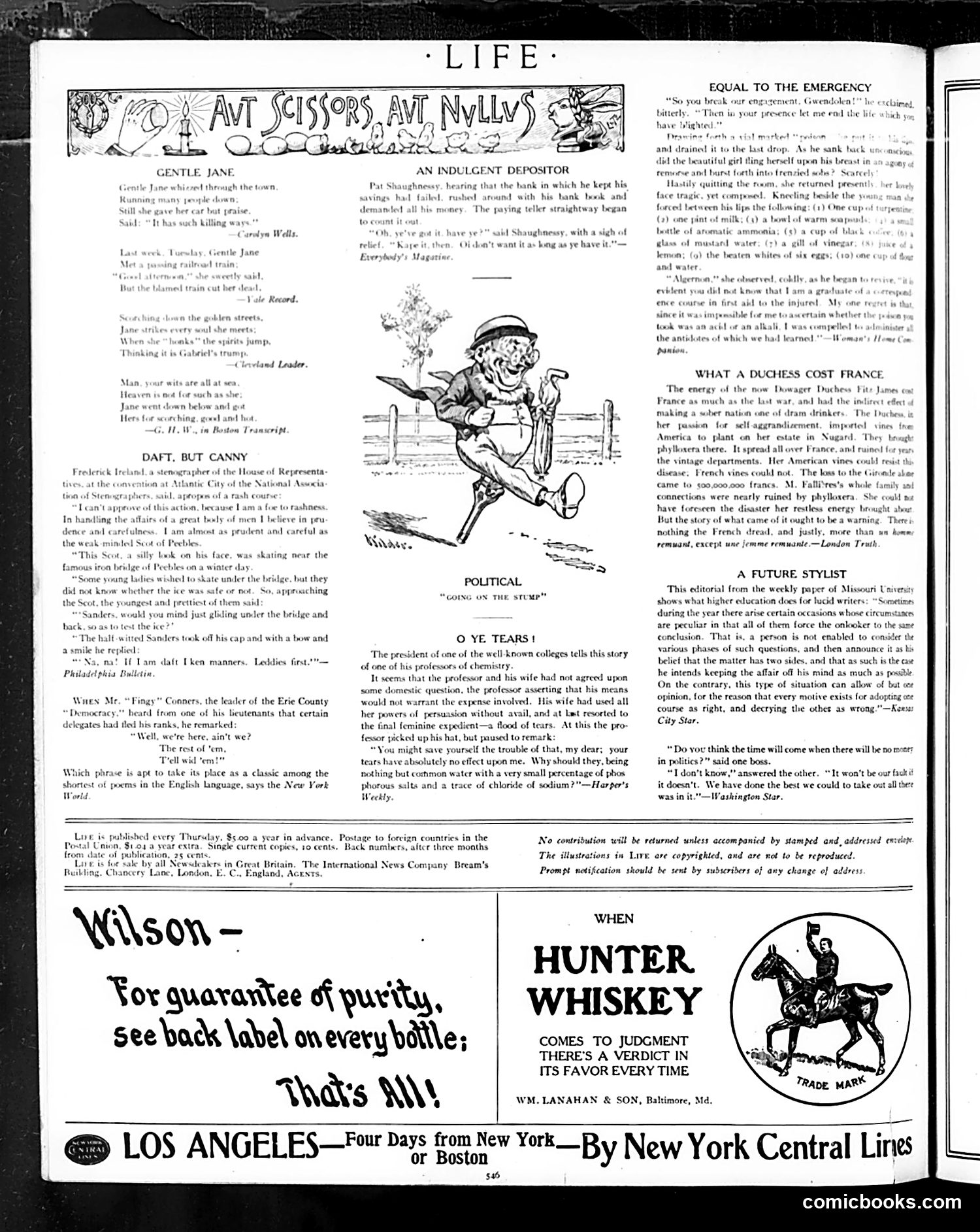
This page from *Life* magazine contains several short satirical pieces and jokes typical of early 20th-century American humor: **"Gentle Jane"** and **"Daft, But Canny"** are brief comic poems poking fun at character types—a naive young woman and a shrewd Scottish negotiator, respectively. **"An Indulgent Depositor"** depicts a bank customer (Shaughnessy) panicking during what appears to be a financial crisis, rushing to withdraw his savings. The humor lies in his emotional overreaction. **"O Ye Tears!"** satirizes a college professor who dismisses his wife's tears by analyzing them as "common water with phosphorous salts"—mocking both marital conflict and pedantic over-rationalization. **"Political"** section includes anecdotes about political figures like "Fingy" Conners, depicting politicians as cynical and dismissive. The remaining pieces—"Equal to the Emergency," "What a Duchess Cost France," and "A Future Stylist"—are brief humorous observations on melodrama, European excess, and educational pretension. The advertisements for Wilson whiskey and Los Angeles travel complete the page.
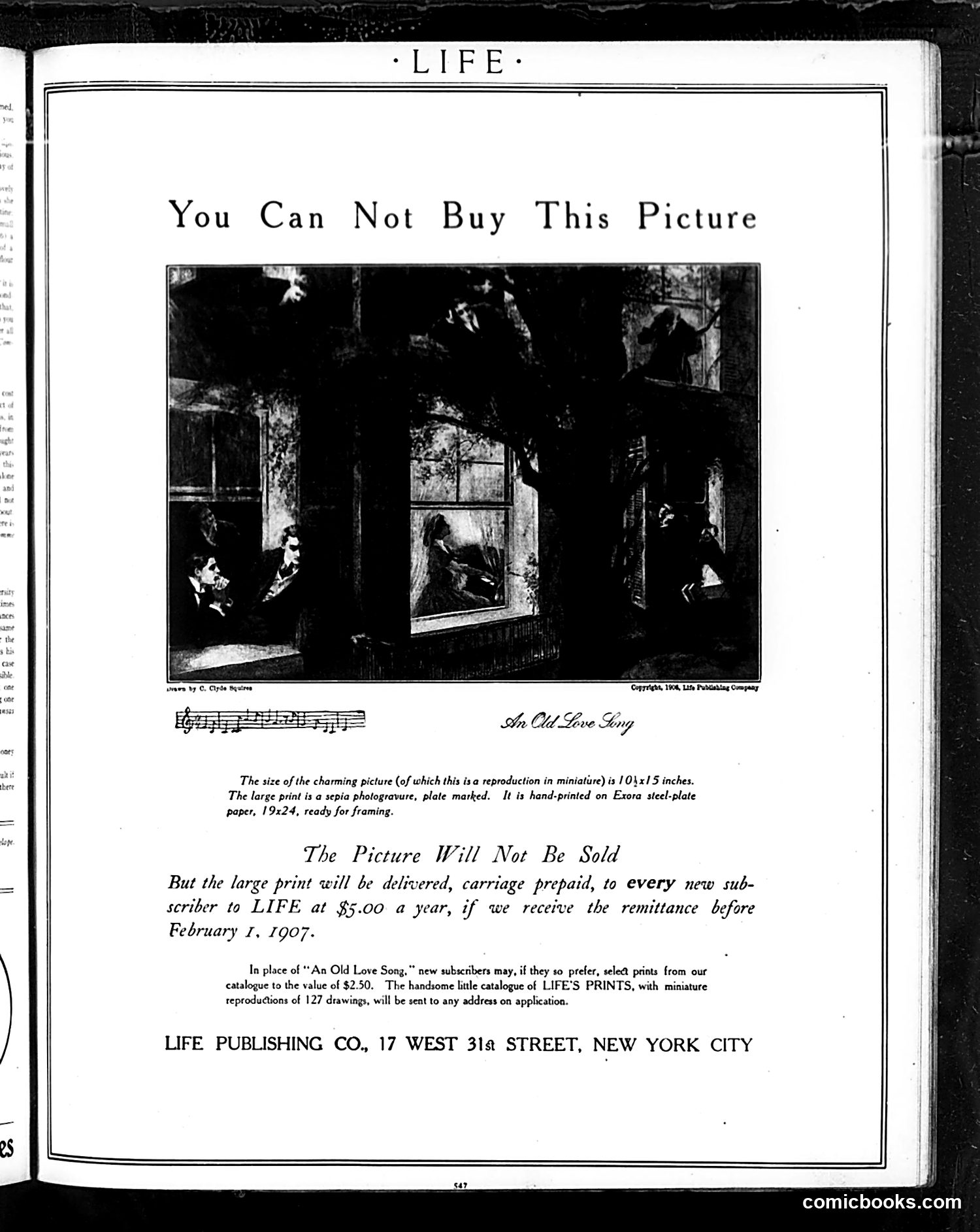
This is primarily an **advertisement** for Life magazine's subscription offer, not a political cartoon. The page promotes a promotional print titled "An Old Love Song"—a sepia photogravure depicting a romantic scene of figures by a window at night. The image itself appears to be sentimental rather than satirical. The advertisement's key offer: new subscribers paying $5.00 annually (with payment received by February 1, 1907) would receive a large hand-printed art print (19x24 inches) free, delivered with postage prepaid. Alternatively, subscribers could select other prints from Life's catalog worth $2.50. This reflects early-1900s magazine marketing strategy—using attractive art prints as subscription incentives. The phrase "You Cannot Buy This Picture" creates urgency by emphasizing the offer's exclusivity to new subscribers only.
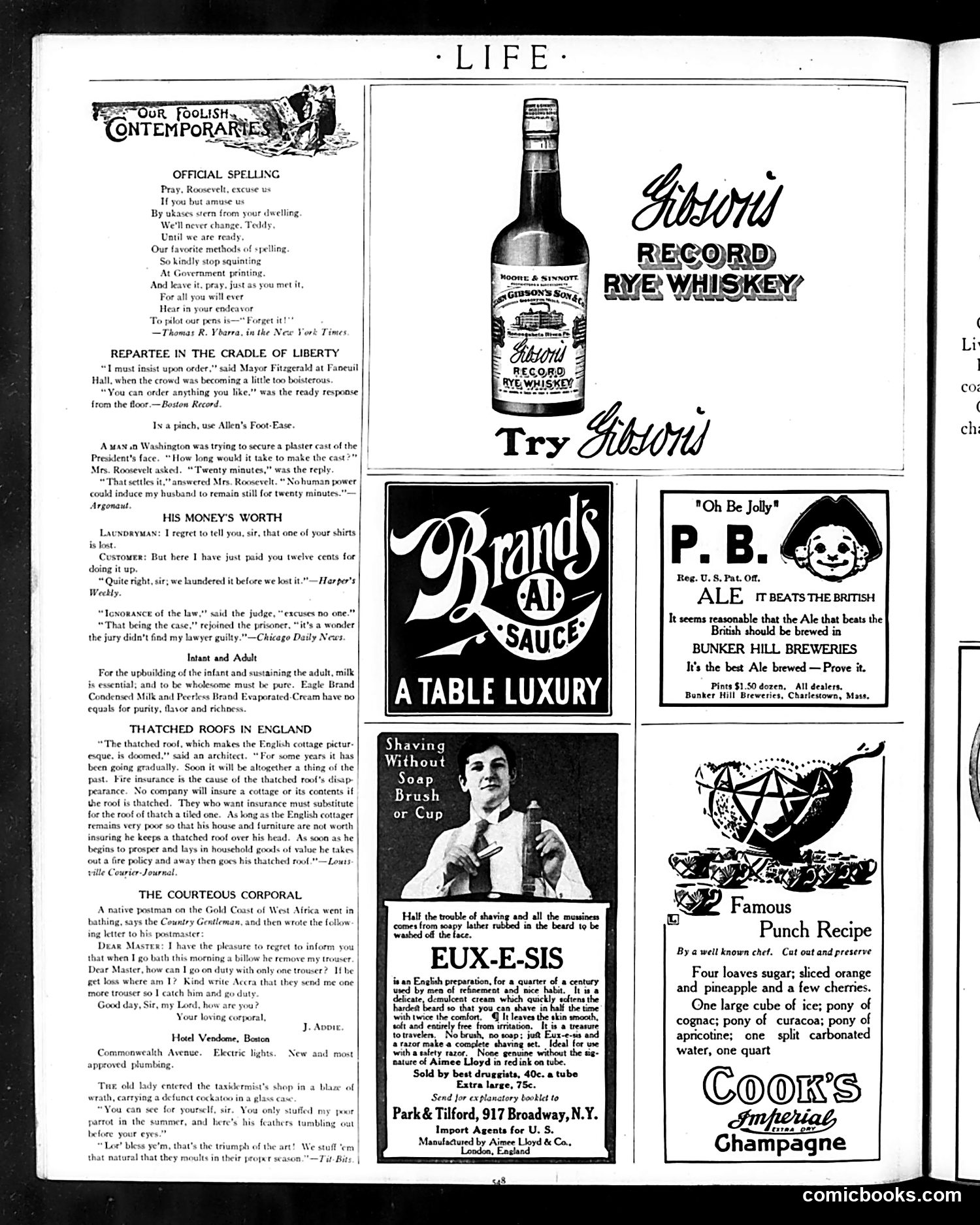
This page is primarily **satirical commentary on contemporary (early 1900s) American life and politics**, not political cartoons in the visual sense. The content mocks several targets: 1. **"Official Spelling"** — satire of President Theodore Roosevelt's efforts to reform American spelling conventions, a genuine but unpopular initiative that drew ridicule. 2. **Mayor Fitzgerald anecdote** — satirizes political theater and hecklers at public events in Boston. 3. **Multiple humorous vignettes** — joke about Mrs. Roosevelt's impatience with her husband; laundry mishaps; legal ignorance; a West African postman's polite complaint about lost trousers. 4. **"Thatched Roofs in England"** — social commentary on how insurance requirements modernize rural cottage architecture, forcing poor farmers to abandon tradition as they gain wealth. The page is mostly **humor writing** rather than visual satire—typical of *Life* magazine's format during this era. The jokes target bureaucratic foolishness, class pretension, and social absurdity. The surrounding advertisements (whiskey, ale, sauce) are period-appropriate commercial content.
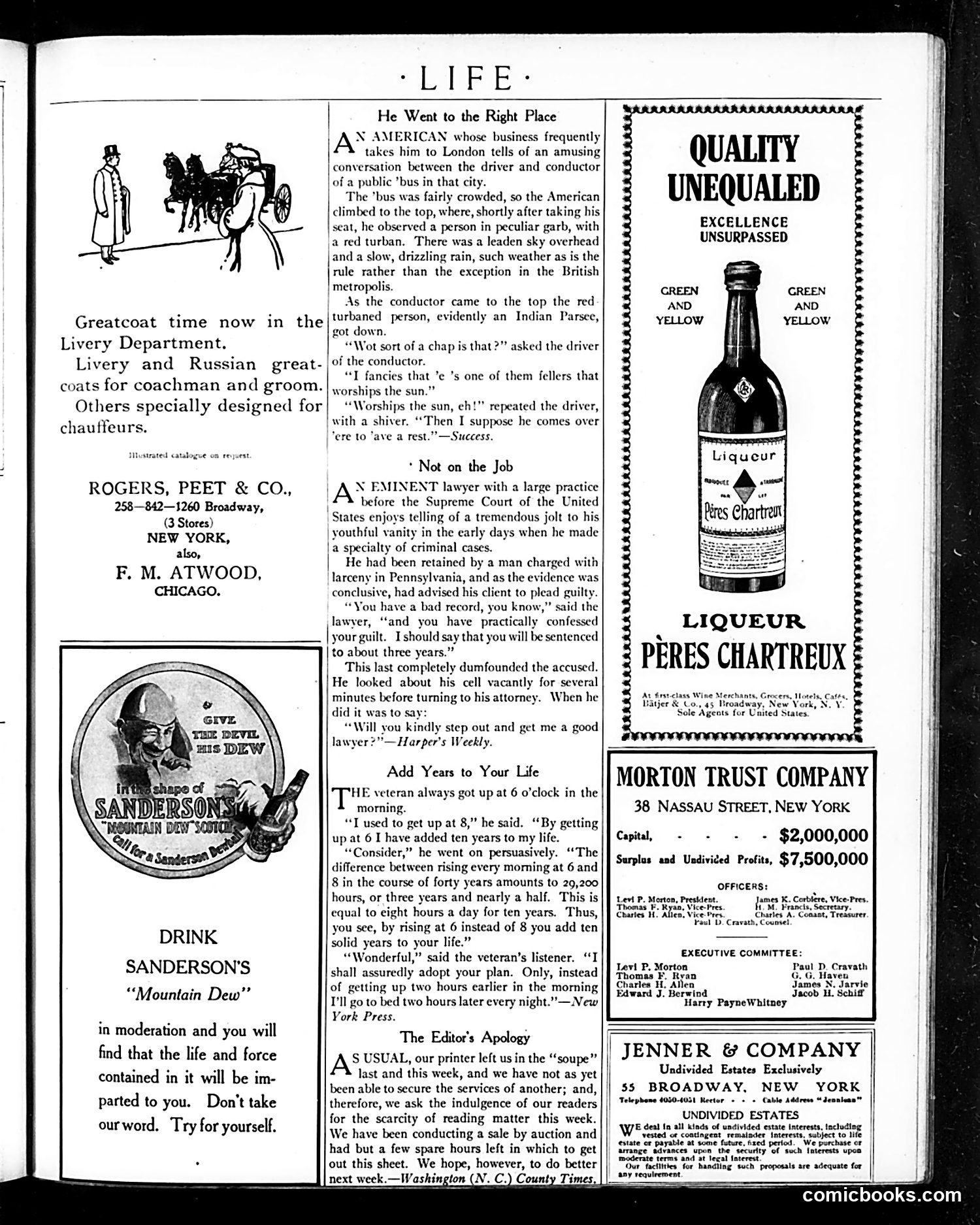
This page contains **three humorous anecdotes** aimed at educated readers: 1. **"He Went to the Right Place"**: An American visiting London observes an Indian Parsee (Zoroastrian, identifiable by red turban) on a crowded bus in dreary, rainy weather. The bus conductor jokes that since the man "worships the sun," he must have come to London to "have a rest"—satire of both the Parsee's religion and England's notoriously gloomy climate. 2. **"Not on the Job"**: A lawyer advises a guilty client to plead guilty, predicting three years imprisonment. The accused, shocked, asks for a *different* lawyer—humor about the client's poor judgment and legal representation quality. 3. **"Add Years to Your Life"**: A veteran claims rising at 6 a.m. instead of 8 a.m. adds ten years to life through mathematical calculation of hours. His listener agrees but proposes staying up two hours *later*—absurdist logic about sleep and longevity. The page also contains period advertisements for clothing, liqueur, and financial services.
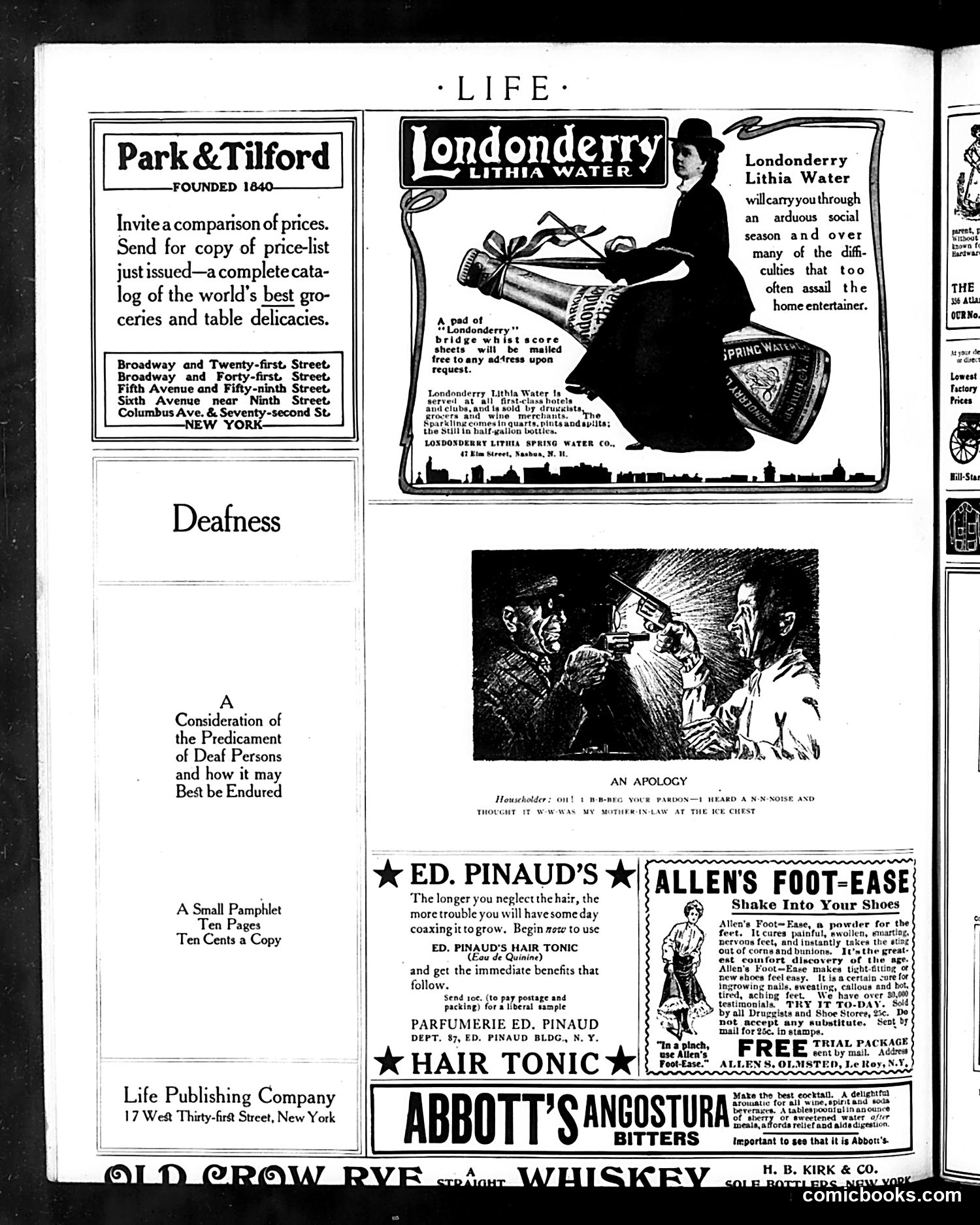
This page is primarily **advertising**, not editorial content or political satire. It showcases various commercial products targeting early 20th-century consumers. The only cartoon appears under "AN APOLOGY"—a domestic humor sketch showing a householder apologizing for mistaking a noise for his mother-in-law at the ice chest. This plays on the common sitcom trope of the bothersome mother-in-law as a family nuisance. The rest consists of ads for luxury goods (Park & Tilford groceries, Londonderry Lithia Water), health/beauty products (Ed. Pinaud hair tonic, Allen's Foot-Ease powder), and medicinal bitters. These ads reflect period anxieties about social respectability, health, and appearance. The "Deafness" pamphlet advertisement appears unrelated to the cartoons—likely a standalone offer from Life Publishing Company.
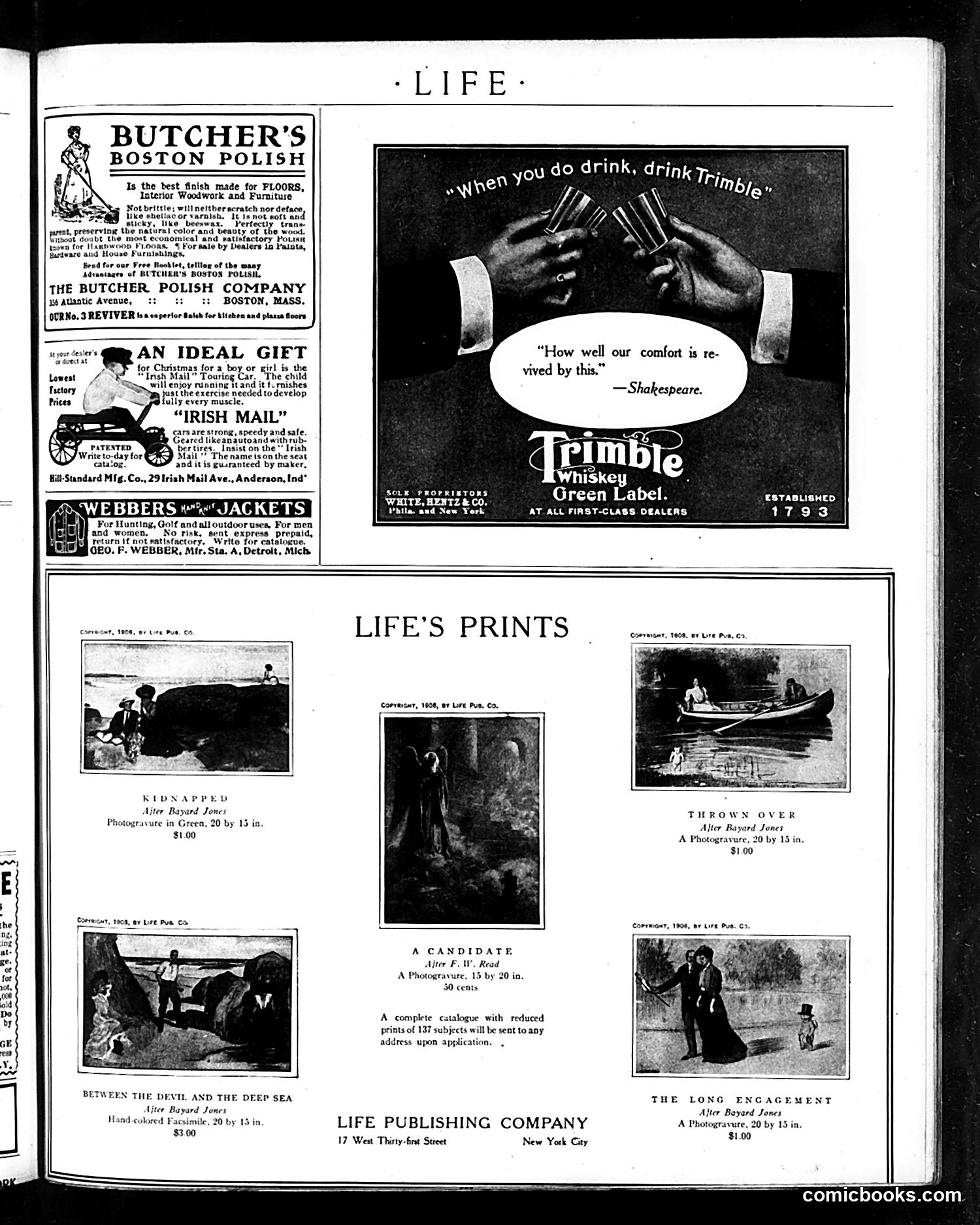
This page is primarily **advertising and product catalog**, not political satire. The top half contains ads for floor polish, a children's toy car, hunting jackets, and whiskey. The bottom half showcases "Life's Prints"—photogravure reproductions for sale by Life Publishing Company. The only potential satirical element is the **Trimble Whiskey ad** (center-right), which uses a Shakespeare quote ("How well our comfort is revived by this") to humorously associate alcohol with literary sophistication. The image shows two men clinking glasses—a common marketing tactic of the era suggesting that quality whiskey enhances social refinement and comfort. The "Life's Prints" section advertises framed photographs available for purchase, featuring titles like "Kidnapped," "Between the Devil and the Deep Sea," and "The Long Engagement"—likely sentimental or dramatic scenes appealing to middle-class home décor tastes of the early 1900s. This reflects Life magazine's dual function as both satirical publication and commercial venture.
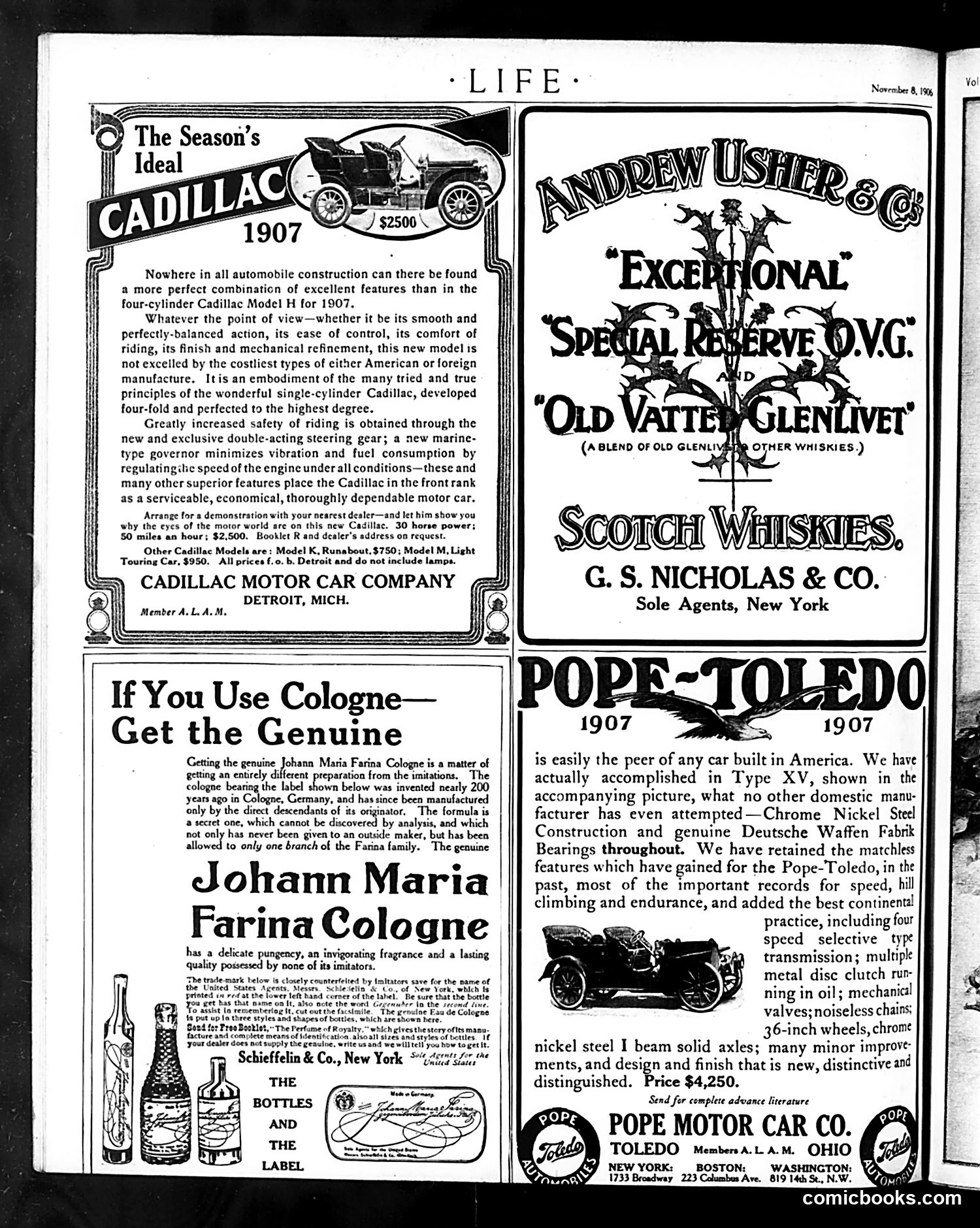
This page contains **no political cartoons or satire**—it is purely **advertising**. The page features four product advertisements typical of early 1900s luxury goods: 1. **Cadillac automobiles** (1907 Model H, $2,500)—emphasizing reliability and engineering superiority 2. **Andrew Usher Scotch Whisky**—marketed as a premium import 3. **Johann Maria Farina Cologne**—claiming authenticity and 200-year heritage, warning against counterfeits 4. **Pope-Toledo automobiles** (Type XV, $4,250)—competing with Cadillac by highlighting "Chrome Nickel Steel Construction" and advanced features These ads reflect the wealthy readership Life targeted, showcasing expensive imports and cutting-edge automobiles. The cologne ad's anti-counterfeiting language suggests brand imitation was already a commercial problem in this era. No satire or political commentary is present—this is a straightforward commercial page typical of early 20th-century magazines.