
Life, 1906-11-08 · page 6 of 30
Life — November 8, 1906 — page 6: what you’re looking at
What you’re looking at
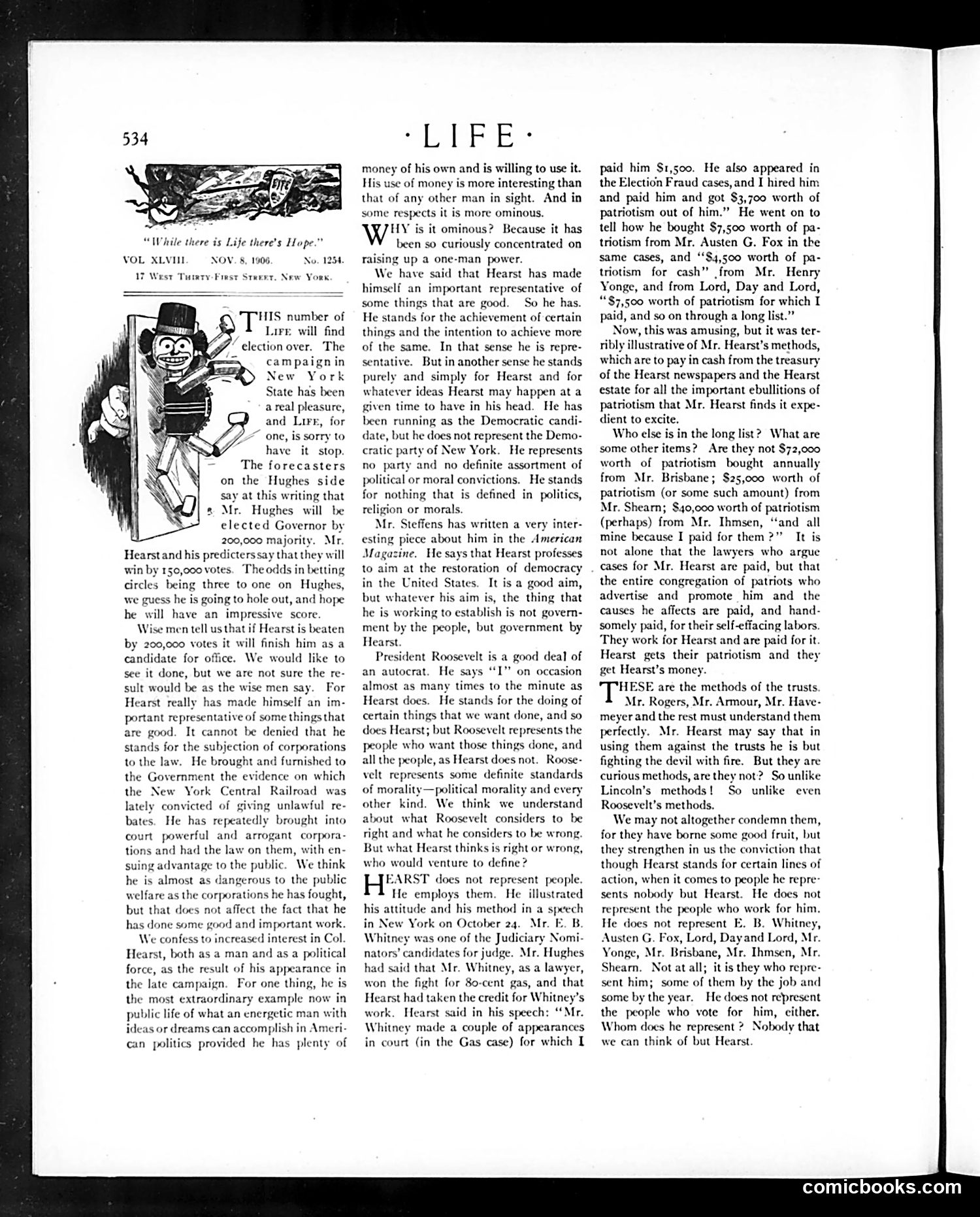
This page satirizes William Randolph Hearst's 1906 New York gubernatorial campaign. The cartoon depicts Hearst as a caricatured figure in formal dress, seemingly celebrating or proclaiming victory. The accompanying article critiques Hearst as a political force who "does not represent people" but rather "employs them." The text argues Hearst is primarily a self-interested businessman using politics for personal gain, having funded his campaign through newspapers and purchased patriotism from various politicians and causes. The satire's core point: Hearst represents wealth and ambition divorced from genuine democratic principles—he funds candidates and causes not from conviction but from calculated self-interest. The article contrasts this with President Roosevelt, whom the writer sees as representing defined moral standards, unlike Hearst's purely transactional approach to politics.
📄 Transcribed text from this page (OCR, searchable)
Machine-transcribed from the original scan — historical spelling and the odd misread are preserved.
“While there is Life there's Hope.” VOL XLVIII No. 1254. AZ West Turety-Fiest Steerer, New York, NOV. 8, 1906. HIS number of Lire will find 7. election over. The ; campaign in New York State has been areal pleasure, and Lire, for one, is sorry to have it stop. The forecasters on the Hughes side say at this writing that Mr. Hughes will be elected Governor by 200,000 majority. Mr. Hearst and his predicters say that they will win by 130,000 votes. The odds in betting circles being three to one on Hughes, we guess he is going to hole out, and hope he will have an impressive scor Wise men tell ust Hearst is beaten by 200,000 votes it will finish him as a candidate for office. We would like to see it done, but we are not sure the re- sult would be as the wise men say. For Hearst really has made himself an im- portant representative of some things that are good. It cannot be denied that he stands for the subjection of corporations to the law. He brought and furnished to the Government the evidence on which the New York ntral Railroad was lately convicted of giving unlawful re- bates. He has repeatedly brought into court powerful and arrogant. corpora- tions and had the law on them, with en- suing advantage to the public. We think he is almost as dangerous to the public welfare as the corporations he has fought, but that does not affect the fact that he has done some good and important work. We confess to increased interest in Col. Hearst, both as a man and as a political force, as the result of his appearance in the late campaign. For one thing, he is the most extraordinary example now in public life of what an energetic man with ideas or dreams can accomplish in Ameri- can politics provided he has plenty of LEP E of his own and is willing to use it. His use of money is more interesting than that of any other man in sight. And in some respects it is more ominous. HY is it ominous? Because it has been so curiously concentrated on raising up a one-man power. We have said that Hearst has made himself an important representative of some things that are good. So he has. He stands for the achievement of certain things and the intention to achieve more of the same. In that sense he is repre- sentative. But in another sense he stands purely and simply for Hearst and for whatever ideas Hearst may happen at a given time to have in his head. He has been running as the Democratic candi- date, but he does not represent the Demo- cratic party of New York. He represents no party and no definite assortment of political or moral convictions. He stands for nothing that is defined in politics, religion or morals Mr. Steffens has written a very inter- esting piece about him in the American Magazine. He says that Hearst professes to aim at the restoration of democracy in the United States. It is a good aim, but whatever his aim is, the thing that he is working to establish is not govern- ment by the people, but government by Hearst. President Roosevelt is a good deal of an autocrat. He says “I” on occasion almost as many times to the minute as Hearst does. He stands for the doing of certain things that we want done, and so does Hearst; but Roosevelt represents the people who want those things done, and all the people, as Hearst does not. Roose- velt represents some definite standards of morality—political morality and every other kind. We think we understand about what Roosevelt considers to be right and what he considers to be wrong. But what Hearst thinks is right or wrong, who would venture to define? ARST does not represent people. He employs them. He illustrated his attitude and his method in a speech had said that Mr. Whitney, as a lawyer, won the fight for 80-cent gas, and that Hearst had taken the credit for Whitney’s Hearst said in his speech: “Mr. Whitney made a couple of appearances in court (in the Gas case) for which I paid him $1,500. He also appeared in the Election Fraud cases, and I hired him and paid him and got $3,700 worth of patriotism out of him.” He went on to tell how he bought $7,500 worth of pa- triotism from Mr. Austen G. Fox in the same cases, and ‘$4,500 worth of pa- triotism for cash” from Mr. Henry Yonge, and from Lord, Day and Lord, “$7,500 worth of patriotism for which I paid, and so on through a long list.”” Now, this was amusing, but it was ter- ribly illustrative of Mr. Hearst’s methods, which are to pay in cash from the treasury of the Hearst newspapers and the Hearst estate for all the important ebullitions of patriotism that Mr. Hearst finds it expe- dient to excite. Who else is in the long list? What are some other items? Are they not $72,000 worth of patriotism bought annually from Mr. Brisbane; $25,000 worth of patriotism (or some such amount) from Mr. Shearn; $40,000 worth of patriotism (perhaps) from Mr. Thmsen, “and all mine because I paid for them?” It is not alone that the lawyers who argue cases for Mr. Hearst are paid, but that the entire congregation of patriots who advertise and promote him and the causes he affects are paid, and hand- somely paid, for their self-effacing labors. ‘They work for Hearst and are paid for it Hearst gets their patriotism and they get Hearst’s money. THESE are the methods of the trusts. Mr. Rogers, Mr. Armour, Mr. Have- meyer and the rest must understand them. perfectly. Mr. Hearst may say that in using them against the trusts he is but fighting the devil with fire. But they are curious methods, are they not? So unlike Lincoln’s methods! So unlike even Roosevelt’s methods. We may not altogether condemn them, for they have borne some good fruit, but they strengthen in us the conviction that though Hearst stands for certain lines of action, when it comes to people he repre- sents nobody but Hearst. He does not represent the people who work for him, He does not represent E. B. Whitney, Austen G. Fox, Lord, Dayand Lord, Mr. Yonge, Mr. Brisbane, Mr. Ihmsen, Mr. Shearn. Not atall; it is they who repre- sent him; some of them by the job and some by the year. He does not represent the people who vote for him, cither. Whom does he represent ? Nobody that we can think of but Hearst. comicbooks.com