
Life, 1906-11-08 · page 16 of 30
Life — November 8, 1906 — page 16: what you’re looking at
What you’re looking at
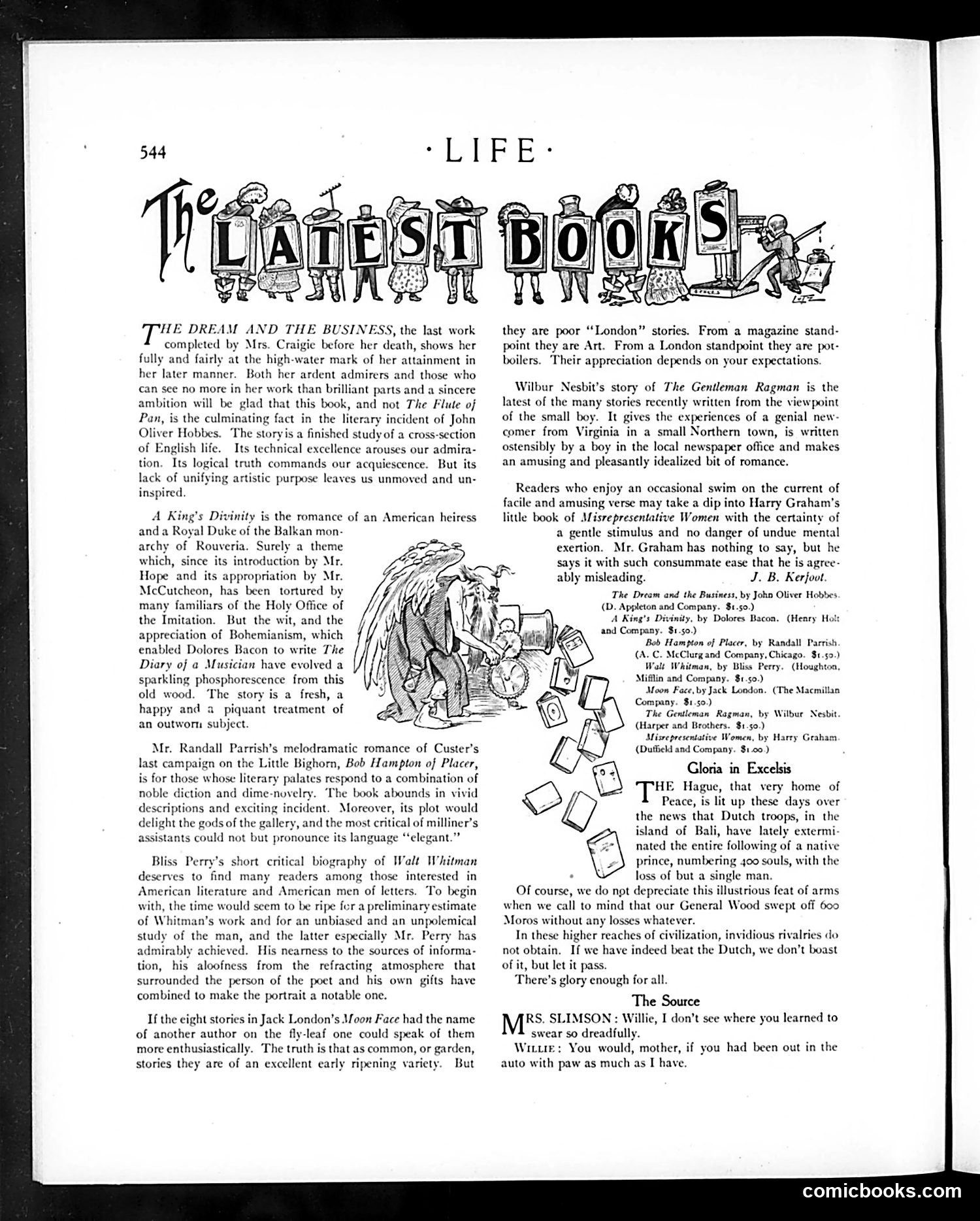
This is a **book review section** from Life magazine, not a political cartoon. The illustrated header features whimsical drawings of children and books, serving as decoration for literary criticism. The page reviews six contemporary novels, including works by John Oliver Hobbes, Dolores Bacon, and Jack London. The reviews are relatively brief critical assessments—some praise ("finished study," "sparkling phosphorescence"), others mild dismissal (London's stories are "pot-boilers" rather than genuine "London" stories). The only satirical content appears at the bottom in "The Source," a brief comedic dialogue between Mrs. Slimson and Willie about the boy swearing after encountering a muddy automobile. This represents Life's function as a **literary journal** alongside humor—reflecting early 20th-century magazine culture where book reviews served educated readers interested in contemporary American literature.
📄 Transcribed text from this page (OCR, searchable)
Machine-transcribed from the original scan — historical spelling and the odd misread are preserved.
‘HE DREAM AND THE BUSI S, the last work completed by Mrs. Craigie before her death, shows her fully and fairly at the high-water mark of her attainment in her later manner. Both her ardent admirers and those who can see no more in her work than brilliant parts and a sincere ambition will be glad that this book, and not The Flute of Pan, is the culminating fact in the literary incident of John Oliver Hobbes. The storyis a finished study of a cross-section of Eng! Its technical excellence arouses our admira- tion. Its logical truth commands our acquiescence. But its lack of unifying artistic purpose leaves us unmoved and un- inspired. A King’s Divinity is the romance of an American heiress Royal Duke of the Balkan mon- archy of Rouveria. Surely a theme which, since its introduction by Mr. Hope and its appropriation by Mr. McCutcheon, has been tortured by many familiars of the Holy Office of the Imitation. But the wit, and the appreciation of Bohemianism, which enabled Dolores Bacon to write The Diary of a Musician have evolved a sparkling phosphorescence from this old wood. The story is a fresh, a happy and a piquant treatment of an outworn subject. Mr. Randall Parrish’s melodramatic romance of Custer’s last campaign on the Little Bighorn, Bob Hampton of Placer, is for those whose literary palates respond to a combination of noble diction and dime-novelry. The book abounds in vivid descriptions and exciting incident. Moreover, its plot would delight the gods of the gallery, and the most crit of milliner’s assistants could not but pronounce its language “elegant.” Bliss Perry’s short critical biography of Walt Whitman deserves to find many readers among those interested in American literature and American men of letters. To begin with, the time would scem to be ripe fer a preliminary estimate of Whitman’s work and for an unbiased and an unpolemical study of the man, and the latter especially Mr. Perry has admirably achieved. His nearness to the sources of informa- tion, his aloofness from the refracting atmosphere that surrounded the person of the poet and his own gifts have combined to make the portrait a notable one. If the eight stories in Jack London’s Moon Face had the name of another author on the fly-leaf one could speak of them more enthusiastically. The truth is that as common, or garden, stories they are of an excellent early ripening variety. But they are poor “London” stories. From a magazine stand- point they are Art. From a London standpoint they are pot- boilers. Their appreciation depends on your expectations. Wilbur Nesbit’s story of The Gentleman Ragman is the latest of the many stories recently written from the viewpoint of the small boy. It gives the experiences of a genial new- comer from Virginia in a small Northern town, is written ostensibly by a boy in the local newspaper office and makes an amusing and pleasantly idealized bit of romance. Readers who enjoy an occasional swim on the current of facile and amusing verse may take a dip into Harry Graham's litle book of Misrepresentative Women with the certainty of a gentle stimulus and no danger of undue mental exertion. Mr. Graham has nothing to say, but he says it with such consummate ease that he is agree- ably misleading. J. B. Kerjoot. The Dream and the Business, by John Oliver Hobbes. (D. Appleton and Company. $1.50.) A King’s Divinity, by Dolores Bacon. (Henry Holt and Company. $1.50.) Bob Hampton of Placer, by Randall Parrish (A. C. McClurg and Company, Chicago. $1.59.) Walt Whitman, by Bliss Perry. (Houghton, Mifflin and Company. $1.50.) Moon Face,by Jack Loodon. (The Macmillan Company. 81.50.) The Gentleman Ragman, by Wilbur Nesbit (Harper and Brothers. $1.50.) Misrepresentative Women, by Harry Graham (Dutield and Company. $1.00.) Gloria in Excelsis HE Hague, that very home of Peace, is lit up these days over the news that Dutch troops, in the island of Bali, have lately extermi- nated the entire following of a native prince, numbering 400 souls, with the . loss of but a single man. Of course, we do npt depreciate this illustrious feat of arms when we call to mind that our General Wood swept off 600 Moros without any losses whatever. In these higher reaches of civilization, invidious rivalries do not obtain. If we have indeed beat the Dutch, we don’t boast of it, but let it pass. There's glory enough for all. The Source RS. SLIMSON : Willie, I don’t see where you learned to swear so dreadfully. Witte: You would, mother, if you had been out in the auto with paw as much as I have. comicbooks.com