
Life, 1906-11-08 · page 14 of 30
Life — November 8, 1906 — page 14: what you’re looking at
What you’re looking at
This page contains theater reviews, not political cartoons. The main illustration depicts a scene from "Again the Bard: A Boer Drama," likely showing characters from a South African-set play with six characters, per the text's description. The review critiques a production of Shakespeare's *Cymbeline* by Miss Willa Allen's company. The writer argues the performance demonstrates why some believe Shakespeare belongs only in libraries, not on stage. Key complaints: actors mumble their lines (particularly J.H. Gilmour as Jachimo), the direction is over-studied, and Shakespeare requires better casting and coaching than producers provide. The reviewer blames poor *acting* and *education*, not the playwright, for Shakespeare's perceived decline in theatrical relevance. The page's satire targets theatrical producers who assume a famous script plus handsome scenery equals success, neglecting the talent and training minor roles demand.
📄 Transcribed text from this page (OCR, searchable)
Machine-transcribed from the original scan — historical spelling and the odd misread are preserved.
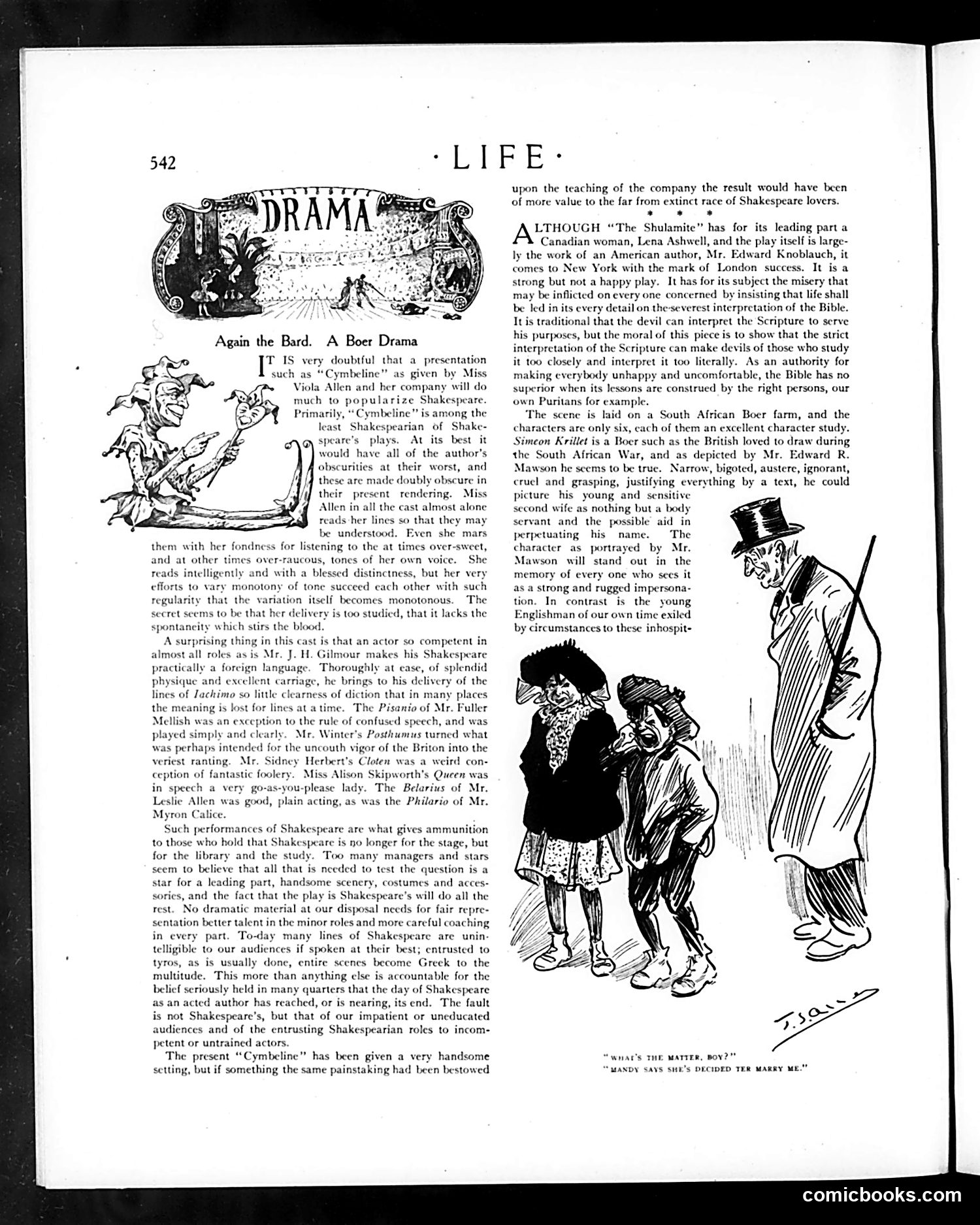
‘LLFE> Again the Bard. A Boer Drama c doubtful that a presentation s “Cymbeline” as given by Miss la Allen and her company will do much to popularize “ymbeline” is among the Shake- speare’s plays. At its best it would have all of the author's obscurities at their worst, and these are made doubly obscure in their present’ rendering. Miss Allen in all the cast almost alone reads her lines so that they may be understood. Even she mars them with her fondness for listening to the at times over-sweet, and at other times over-raucous, tones of her own voice. She reads intelligently and with a blessed distinctness, but her very efforts to vary monotony of tone succeed each other with such regularity that the variation itself becomes monotonous. The secret scems to be that her delivery is too studied, that it lacks the spontaneity which stirs the blood. A surprising thing in this cast is that tor so competent in almost all roles as is Mr. J. H. Gilmour makes his espeare practically a foreign language. Thoroughly at ease, of splendid physique and excellent carriage, he brings to his delivery of the lines of Jachimo so little clearness of diction that in many places the meaning is k lines at atime. The Pisanio of Mr. Fuller Mellish was an exception to the rule of confused speech, and was played simply and clearly. Mr. Winter's Posthumus turned what was perhaps intended for the uncouth vigor of the Briton into the veriest ranting. Mr. Sidney Herbert's Cloten was a weird con- ception of fantastic foolery. Miss Alison Skipworth’s Queen was in speech a very go-as-you-please lady. The Belarius of Mr. Leslie Allen was good, plain acting, as was the Philario of Mr. Myron Calice Such performances of Shakespeare are what gives ammunition to those who hold that Shakespeare is no longer for the stage, but for the library and the study. Too many managers and stars seem to believe that all that is needed to test the question is a star for a leading part, handsome scenery, costumes and acces- sories, and the fact that the play is Shakespeare's will do all the rest. No dramatic material at our disposal needs for fair repre- sentation better talent in the minor roles and more careful coaching in every part. To-day many lines of Shakespeare are unin. telligible to our audiences if spoken at their best; entrusted to tyros, as is usually done, entire scenes become Greek to the multitude. This more than anything else is accountable for the belief seriously held in many quarters that the day of Shakespeare in acted author has reached, or is nearing, its end. The fault is not Shakespeare's, but that of our impatient or uneducated audiences and of the entrusting Shakespearian roles to incom- petent or untrained actors. The present “Cymbeline” has been given a very handsome setting, but if something the same painstaking had been bestowed upon the teaching of the company the result would have been of more value to the far from extinct race of Shakespeare lovers. * + 8 LTHOUGH “The Shulamite” has for its leading part a Canadian woman, Lena Ashwell, and the play itself is large- ly the work of an American author, Mr. Edward Knoblauch, it comes to New York with the mark of London success. It is a strong but not a happy play. It has for its subject the misery that may be inflicted on every one concerned by insisting that life shall be led in its every detail on the-severest interpretation of the Bible Itis traditional that the devil can interpret the Scripture to serve his purposes, but the of this piece is to show that the strict interpretation of the Scripture can make devils of those who study it too closely and interpret it too literally. As an authority for making everybody unhappy and uncomfortable, the Bible has no superior when its lessons are construed by the right persons, our own Puritans for example. The scene is laid on a South African Boer farm, and the characters are only six, cach of them an excellent character study. Simeon Krillet is a Boer such as the British loved to draw during the South African War, and as depicted by Mr. ard R. Mawson he seems to be true. Narrow, bigoted, austere, ignorant, crucl and grasping, justifying everything by a text, he could picture his young and sensitive second wife as nothing but a body servant and the possible aid in perpetuating his nai The character as portrayed by Mr. Mawson will stand out in the memory of every one who secs it as a strong and rugged impersona- tion. In contrast is the young Englishman of our own time exiled by circumstances to these inhospit- “what's THE MATTER, Boy?” “WANDY SAYS Sit’S DECIDED TER MARRY ME." comicbooks.com