
Life, 1906-11-08 · page 15 of 30
Life — November 8, 1906 — page 15: what you’re looking at
What you’re looking at
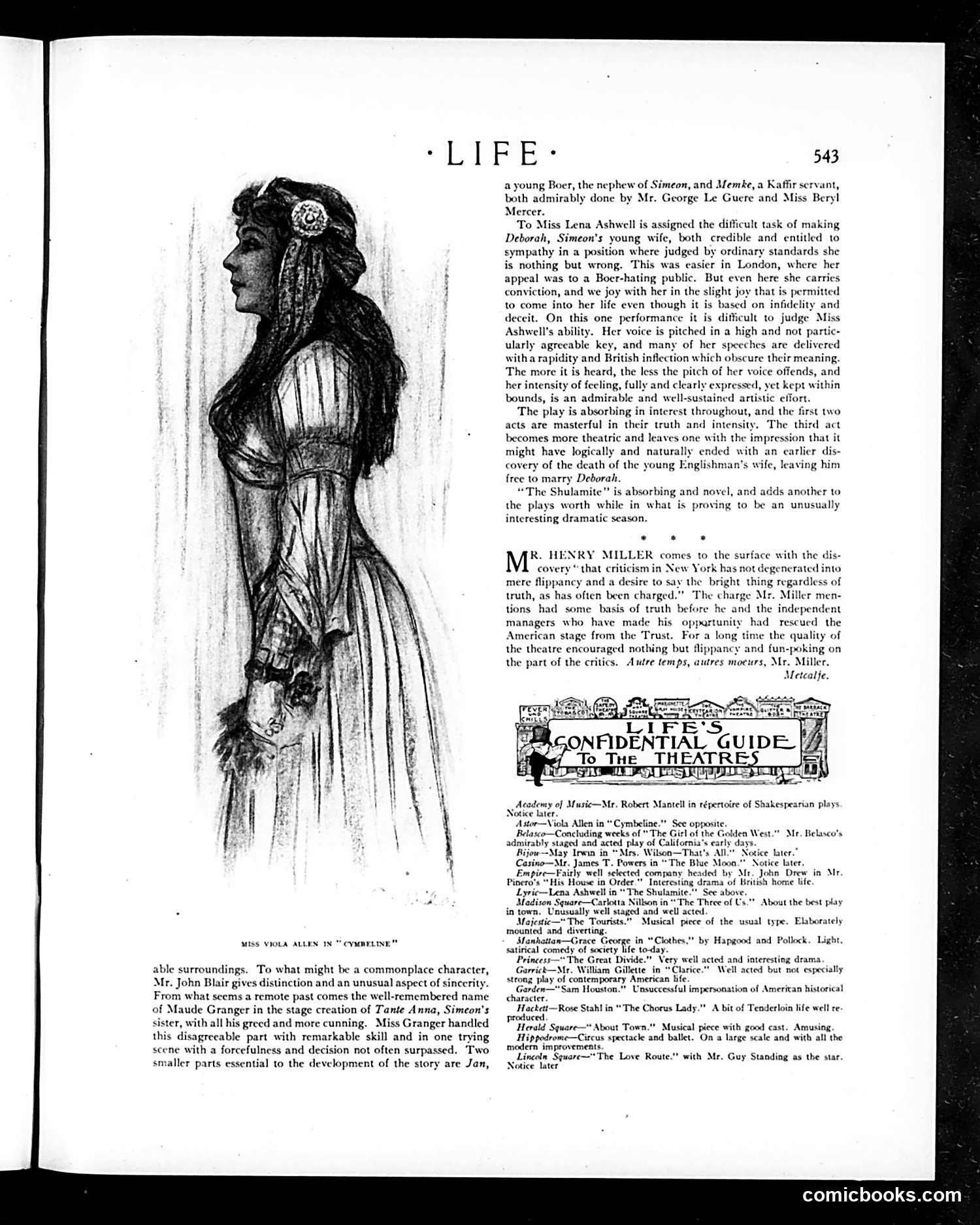
This page reviews current Broadway productions, with a sketch of actress **Viola Allen** in "Cymbeline" (Shakespeare's play). The main text praises Allen's performance as Deborah in "The Shulamite," noting her ability to make a morally questionable character sympathetic despite her "high and not particularly agreeable" voice. The page also includes commentary by critic **Henry Metcalfe** defending New York theater criticism against charges of mere "flippancy," arguing that independent theater managers have elevated standards beyond what the old theatrical Trust permitted. At bottom, "Life's Confidential Guide to the Theatres" lists current Broadway shows with brief notices—typical of the magazine's role as a cultural arbiter for educated readers interested in theater, music, and current events. This reflects Life's function as a sophisticated satirical weekly covering arts and society.
📄 Transcribed text from this page (OCR, searchable)
Machine-transcribed from the original scan — historical spelling and the odd misread are preserved.
LL FE MISS VIOLA ALLEN IN eysemrivE” able surroundings. To what might be a commonplace character, Mr. John Blair gives distinction and an unusual aspect of sincerity. From what scems a remote past comes the well-remembered name of Maude Granger in the stage creation of Tante Anna, Simeon's sister, with all his greed and more cunning. Miss Granger handled this disagreeable part with remarkable skill and in one trying scene with a forcefulness and decision not often surpassed. Two smaller parts essential to the development of the story are Jan, 543 a young Boer, the nephew of Simeon, and Memke, a Kaffir servant, both admirably done by Mr. George Le Guere and Miss Beryl Mercer. To Miss Lena Ashwell is assigned the difficult task of making Deborah, Simeon's young wife, both credible and entitled to sympathy in a position where judged by ordinary standards she is nothing but wrong. This was casier in London, where her appeal was to a Boer-hating public. But even here she carric conviction, and we joy with her in the slight joy that is permitted to come into her life even though it is based on infidelity and deceit. On this one performance it is difficult to judge Miss Ashwell’s ability. Her voice is pitched in a high and not partic- ularly agreeable key, and many of her speeches are delivered with a rapidity and British inflection which obscure their meaning. The more it is heard, the less the pitch of her voice offends, and her intensity of fecling, fully and clearly expressed, yet kept within bounds, is an admirable and well-sustained artistic effort. The play is absorbing in interest throughout, and the first two acts are masterful in their truth and intensity. The third act becomes more theatric and leaves one with the impression that it might have logically and naturally ended with an earlier dis- covery of the death of the young Englishman's wife, leaving him free to marry Deborah. “The Shulamite” is absorbing and novel, and adds another to the plays worth while in what is proving to be an unusually interesting dramatic season. :NRY MILLER comes to the surface with the dis- “that criticism in New York has not degenerated into mere flippancy and a desire to say the bright thing regardless of truth, as has often been charged.” The charge Mr. Miller men- tions had some basis of truth before he and the independent managers who have made his oppartunity had rescued the American stage from the Trust. For a long time the quality of the theatre encouraged nothing but flippancy and fun-poking on the part of the critics. Autre temps, autres moeurs, Mr. Miller. Metcalfe. = =a LIFE'S PSONFIDENTIAL GUIDE seedy of Musie—Mr. Robert Mantel! in répertoite of Shakespeatian plays Notice later. Astor—Viola Allen in“ Cymbeline.”” See opposite. Belasco—Concluding weeks of * The Girl of the Golden West." Mr. Belasco’s admirably staged and acted play of California's early days. Rijow—May Inwin in “Mrs, Wilson—That’s All."" Notice later.” Casino—Mr. James T. Powers in “The Blue Moon." Notice later. Empire—Faitly well selected company headed by Mr. John Drew in Mr Pinero's “His House in Order." Interesting yma of British home life. Lyric—Lena Ashwell in “The Shulamite.”” See above. Medison Square—Carlotia Nillson in “The Three of Us." usually well staged and well acted. Majestic—" The Tourists.” Musical piece of the usual type. Elaborately mounted and diverting. Manhatian—Grace George in “Clothes,” by Hapgood and Pollock satirical comedy of society life to-day. Princess y well acted and interesting drama Garrick—Mr. William Gillette in "Clarice." Well acted but not especially contemporary American life. am Houston.” Unsuccessful impersonation of Ameritan historical About the best play Light, character. Hacketi—Rose Stahl in "The Chorus Lady."" A bit of Tenderloin life well re: produced. Herald Square—" About Town." Musical piece with good cast. Amusing Hippodrome—Circus spectacle and ballet. On a large scale and with all the modern improvements. Lincoln Square~"The Love Route.” with Mr. Guy Standing as the star. Notice later comicbooks.com