
A complete issue · 28 pages · 1906
Life — July 19, 1906
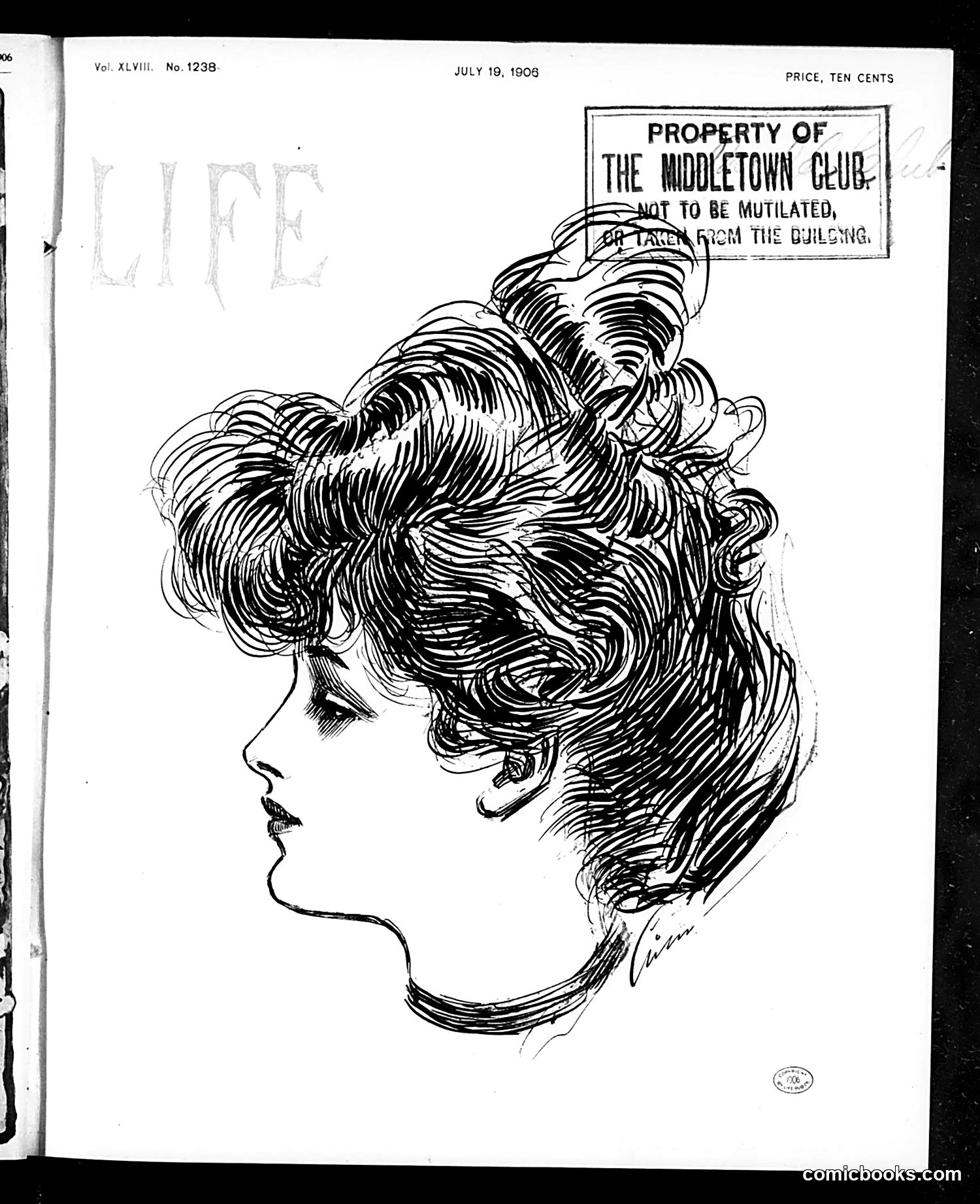
This cover features an elegant line-drawing portrait of a woman's head in profile, showcasing elaborate upswept hair styled in the fashionable Gibson Girl aesthetic popular during the early 1900s. The word "LIFE" appears on the left side. The library stamp "PROPERTY OF THE MIDDLETOWN CLUB" with a note "NOT TO BE MUTILATED, OR TAKEN FROM THE BUILDING" indicates this was institutional property. The cartoon itself appears to be primarily a fashion/style illustration rather than political satire—celebrating contemporary women's beauty standards and hairstyling rather than commenting on current events. The precise satirical intent, if any, remains unclear from the image alone.
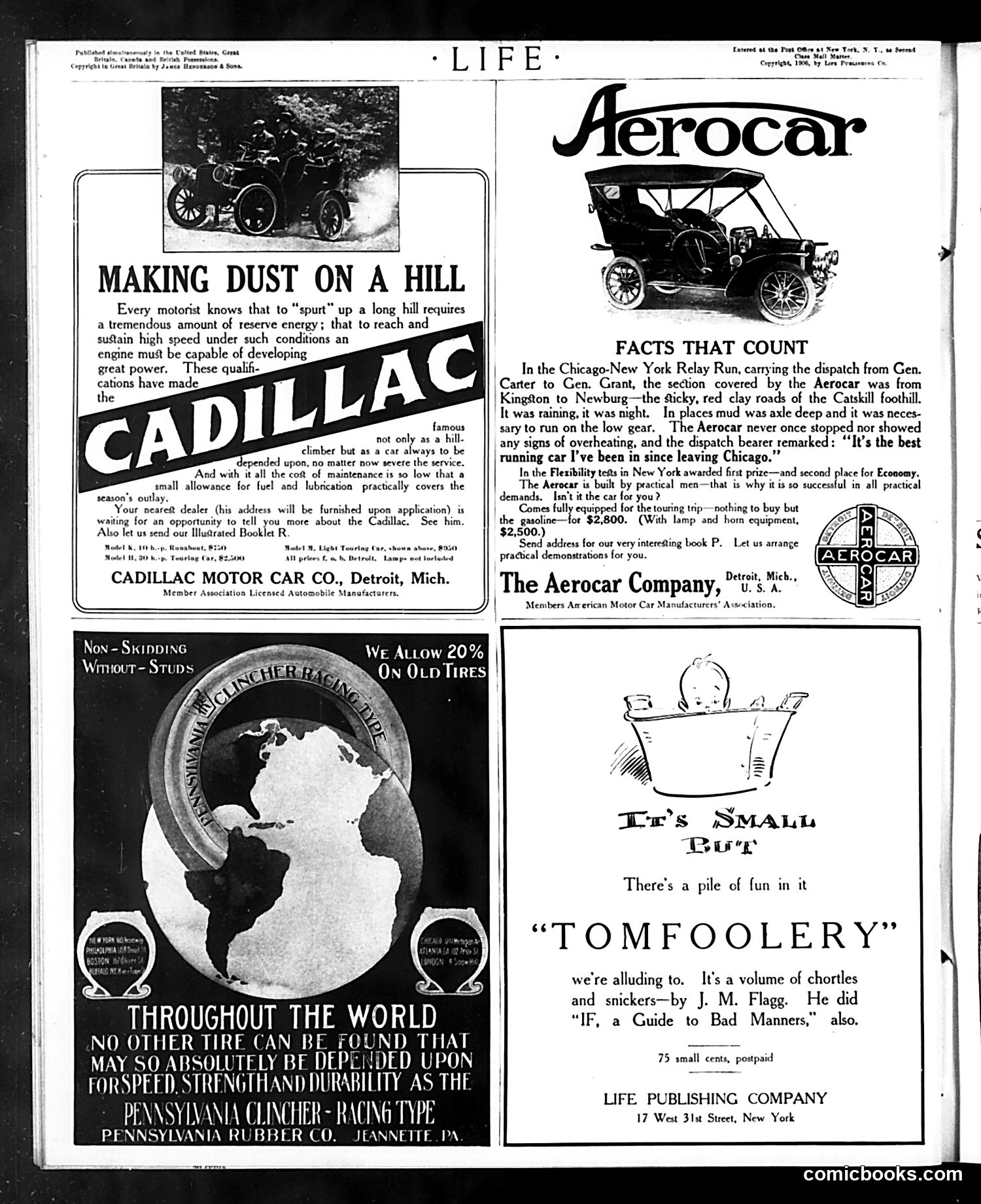
This page is **primarily advertising** from the early automobile era, with no political cartoons or satirical commentary. The ads feature: 1. **Cadillac** (top left): Emphasizes power for hill-climbing, appealing to motorists' desire for performance and reliability. 2. **Aerocar** (top right): Advertises a touring car, highlighting its success in a Chicago-New York relay race as proof of durability. 3. **Pennsylvania Clincher Racing Tire** (bottom left): Claims superiority for "speed and durability" compared to competitors worldwide. 4. **"Tomfoolery"** (bottom right): A humorous book advertisement offering "chorties and snickers"—a lighthearted parody guide to bad manners. The page reflects early 1900s consumer culture, emphasizing automotive performance and entertainment products.
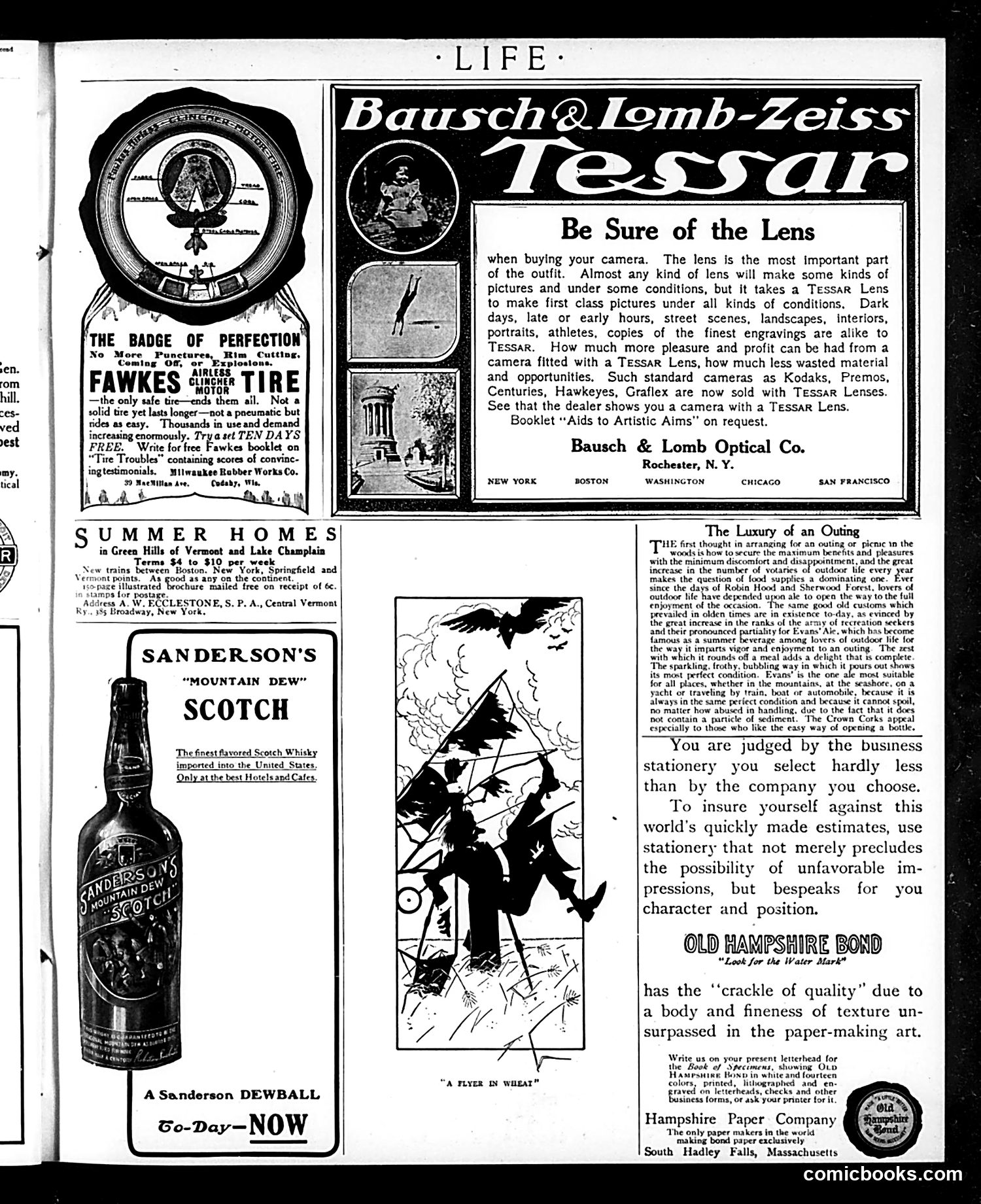
This page is primarily **advertising**, not political satire. The main content includes: 1. **Fawkes Airless Tire** ad (top left): Claims superiority over conventional tires with "Badge of Perfection" branding 2. **Bausch & Lomb Tessar Lens** (top right): Camera equipment advertisement emphasizing lens quality for professional photography 3. **Summer Homes** listing (middle left) 4. **Sanderson's "Mountain Dew" Scotch** (left): Whiskey advertisement 5. **Old Hampshire Bond** stationery (right): Business paper promotion emphasizing quality and professional image 6. **"A Flyer in Wheat"** illustration (center): A dramatic artistic sketch, likely editorial content rather than advertisement The page reflects early 20th-century consumer culture, targeting middle and upper-class readers through luxury goods and professional products. No clear political satire is evident.
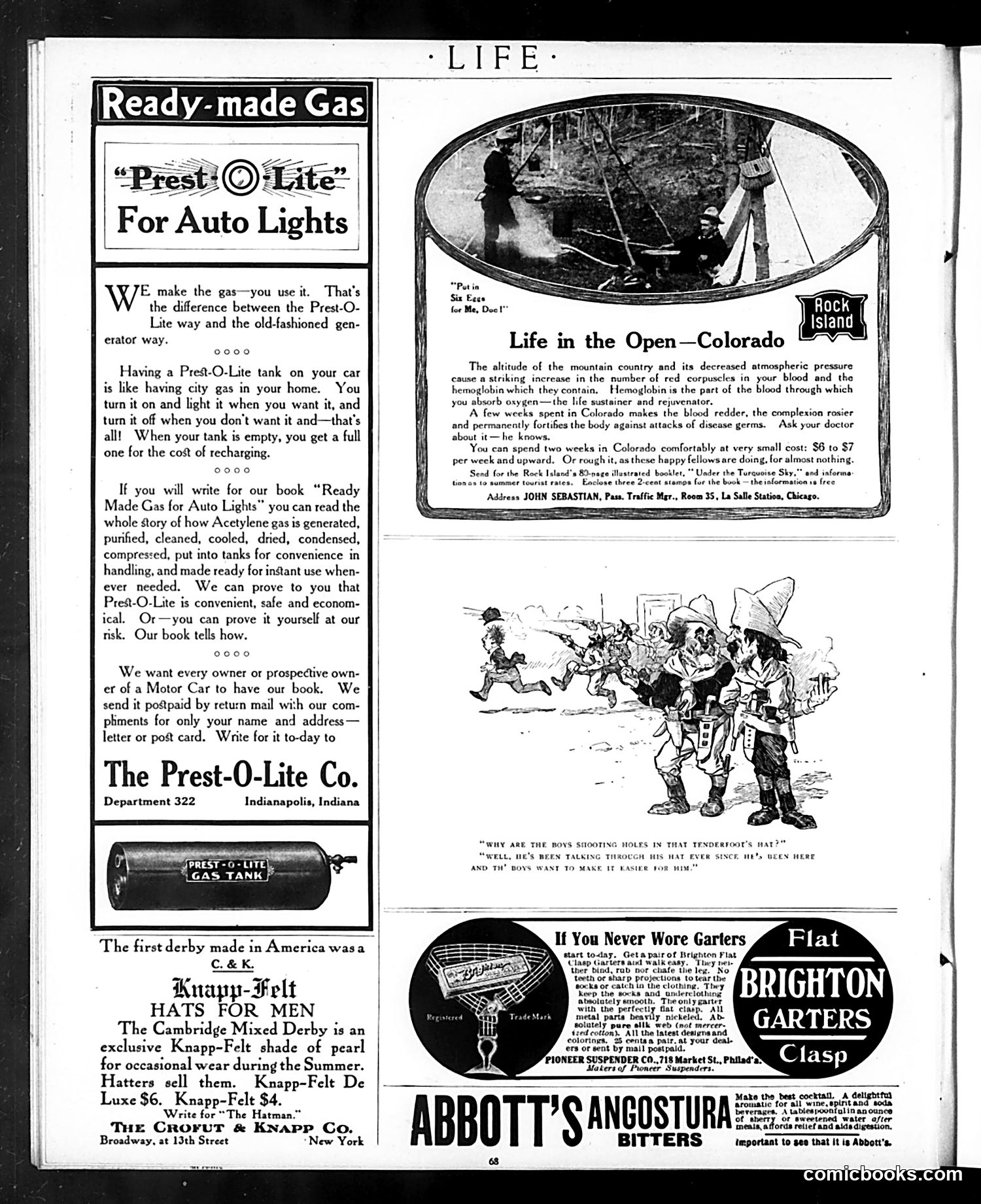
This page is primarily **advertising**, not political satire. It contains: 1. **Prest-O-Lite Co.** advertisement for ready-made gas for automobile lights—a commercial product pitch with a call-to-action postcard offer. 2. **"Life in the Open—Colorado"** travel promotion with a photo and text touting Colorado's health benefits, particularly its altitude and "oxygen-absorbing" properties as a cure for disease. 3. **A cartoon illustration** (lower right) showing what appears to be prospectors or miners with the caption about "shooting holes in that tenderfoor's hat"—a humorous Western scene depicting frontier figures. 4. Other ads for **Knapp-Felt hats**, **Brighton garters**, and **Abbott's Angostura bitters**. The page reflects early 20th-century American consumer culture and marketing rather than political commentary.
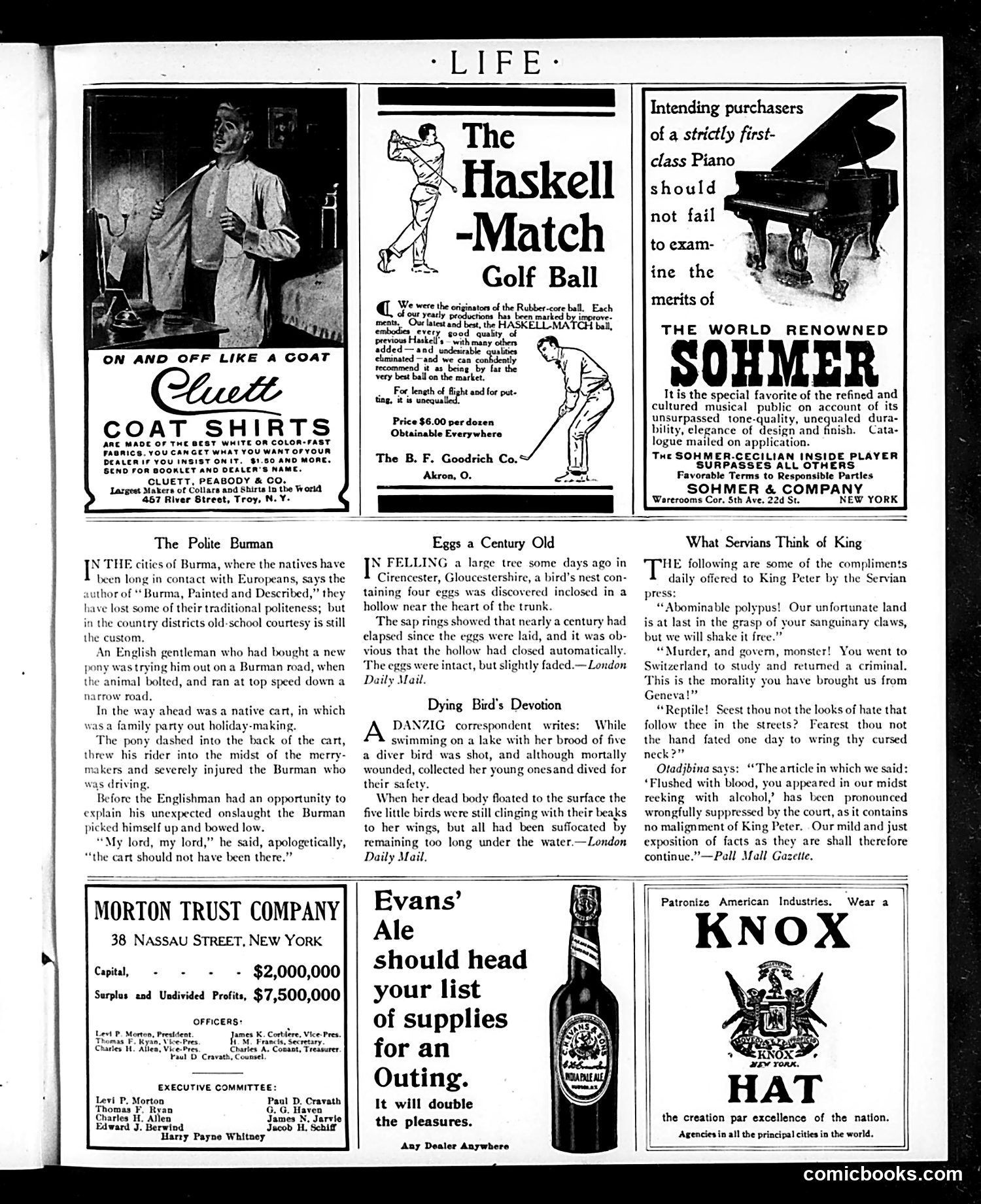
This appears to be primarily **advertising and human-interest stories** rather than political satire. The page contains: **Top advertisements:** Cluett coat shirts, Haskell-Match golf balls, and Sohmer pianos. **Three short articles:** - "The Polite Burman" describes British colonial encounters in Burma - "Eggs a Century Old" recounts finding preserved eggs in a tree - "What Servians Think of King" presents compliments to King Peter of Serbia from the Serbian press **Bottom advertisements:** Morton Trust Company, Evans' Ale, and Knox Hats. The content reflects early 20th-century Life magazine's mix of light humor, travel narratives, and product advertisements. The Serbia item suggests pre-WWI publication, but no specific date appears. The satirical element is minimal—primarily gentle, anecdotal storytelling rather than political commentary.
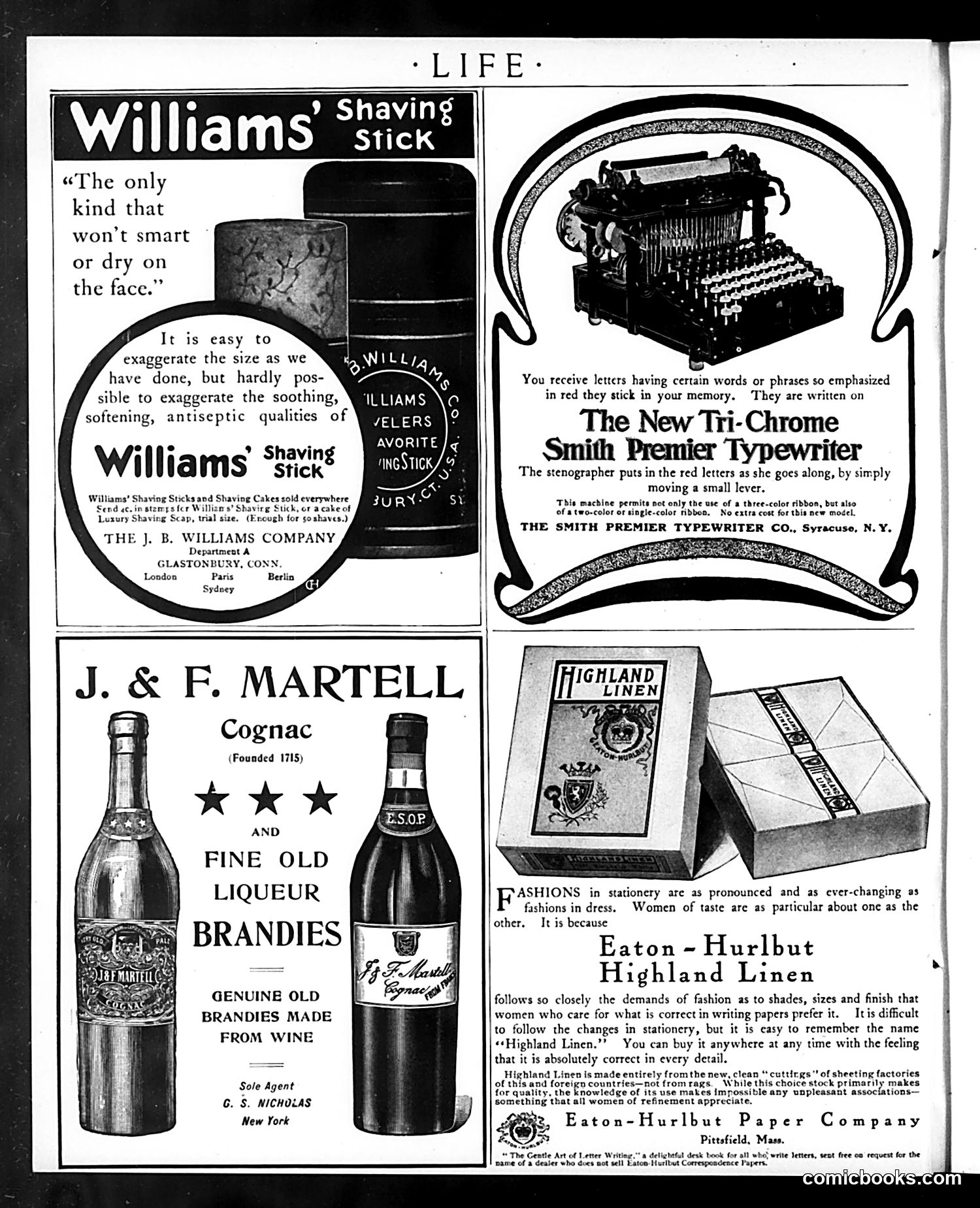
This page contains **four advertisements with no political cartoons or satire**. The ads promote: 1. **Williams' Shaving Stick** — emphasizing the product won't "smart or dry on the face" 2. **Smith Premier Tri-Chrome Typewriter** — highlighting a two-color ribbon feature that prints certain words in red for emphasis 3. **J. & F. Martell Cognac and Brandies** — featuring two bottle images, established 1715 4. **Eaton-Hurlbut Highland Linen stationery** — describing fashionable writing paper available "anywhere at any time" These are straightforward commercial advertisements typical of early-20th-century *Life* magazine. There is no political commentary, caricature, or satirical content on this particular page. The magazine's "Life" masthead appears at top, but this section consists entirely of product marketing.
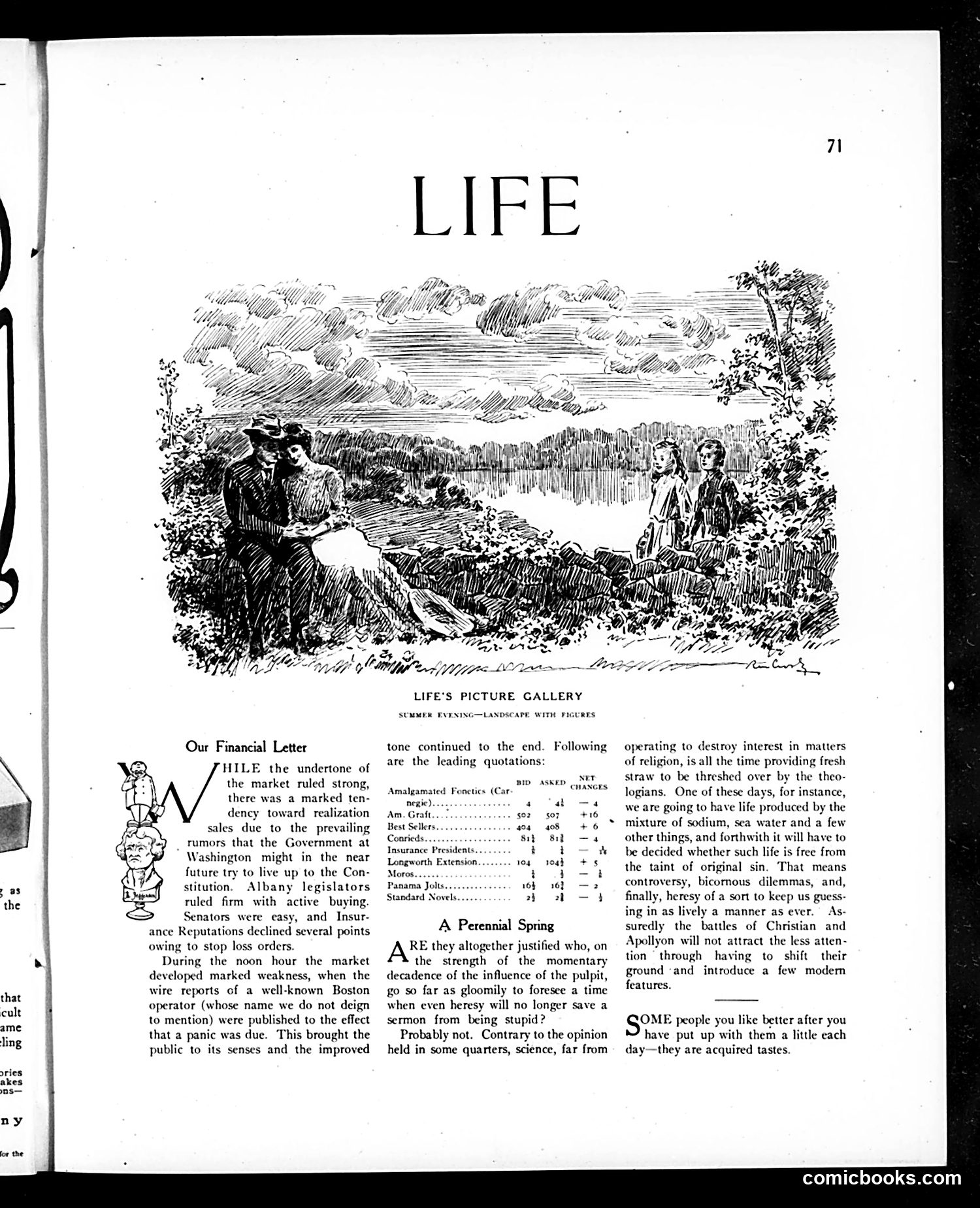
This page contains financial commentary and social satire rather than a political cartoon. **"Our Financial Letter"** discusses market volatility and stock prices during what appears to be an economic downturn. The accompanying illustration shows caricatured figures (likely representing financiers or speculators) amid market chaos—a common Life satirical device mocking Wall Street. **"A Perennial Spring"** section critiques religious hypocrisy, suggesting that some churches use "gloomily" forecasted sermons to keep congregants compliant and fearful. The satire targets institutions that allegedly exploit believers' anxieties. **"Life's Picture Gallery"** heading features a pastoral sketch showing leisure-class figures in an idealized landscape—contrasting with the financial and religious critiques above, possibly ironizing how the wealthy escape these concerns through rural retreat.
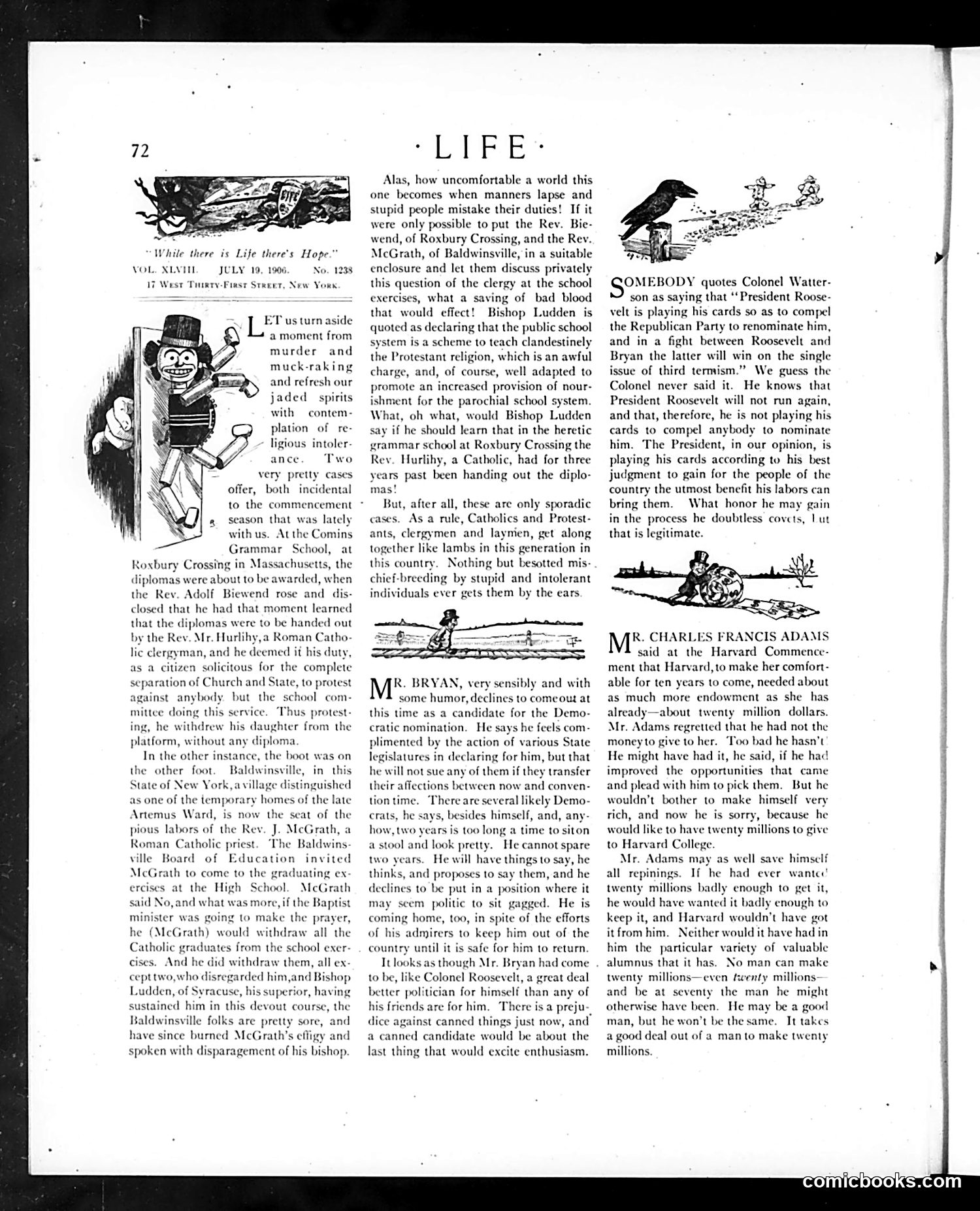
This page contains political commentary on early 20th-century American issues. The left column discusses the Roxbury Crossing affair in Massachusetts, where Catholic clergy allegedly withheld school diplomas to protest the public school system's alleged anti-Catholic bias. The text satirizes this as an overreach by religious institutions. The right column mocks Mr. Bryan (likely William Jennings Bryan, a Democratic presidential candidate) for his positions and political ambitions. It also critiques Charles Francis Adams' Harvard commencement speech about acquiring wealth. The cartoons (depicting a skull-faced figure and a drowning scene) appear to illustrate moral warnings about these social/political failures. The overall tone is satirical commentary on institutional overreach, political opportunism, and clerical influence in American civic life.
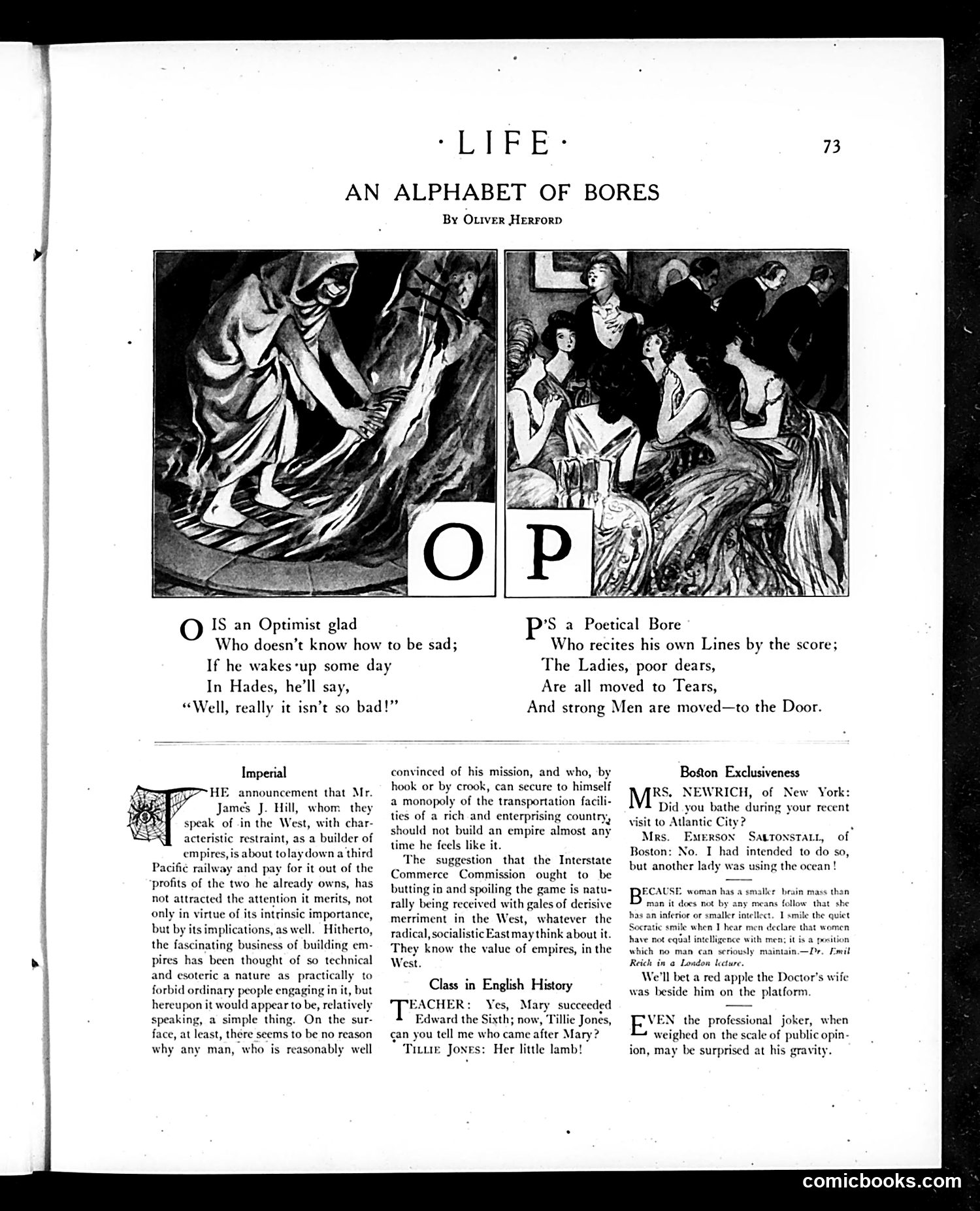
This page presents satirical character sketches from Oliver Herford defining social types considered tedious. **Letter O: "The Optimist"** - A cheerful person who denies life's difficulties, claiming that even Hades "isn't so bad." The satire targets excessive positivity as a form of willful ignorance. **Letter P: "The Poetical Bore"** - A person who recites their own poetry at length to unwilling audiences (ladies moved to tears, men fleeing). This mocks aspiring poets who inflict amateur verse on captive social audiences. The accompanying prose pieces below ridicule other social annoyances: James J. Hill's self-promoting railroad announcements, someone named Edward the Sixth, and professional jokers. The satire targets people whose behavior or conversation makes them insufferable company—universal social complaints.
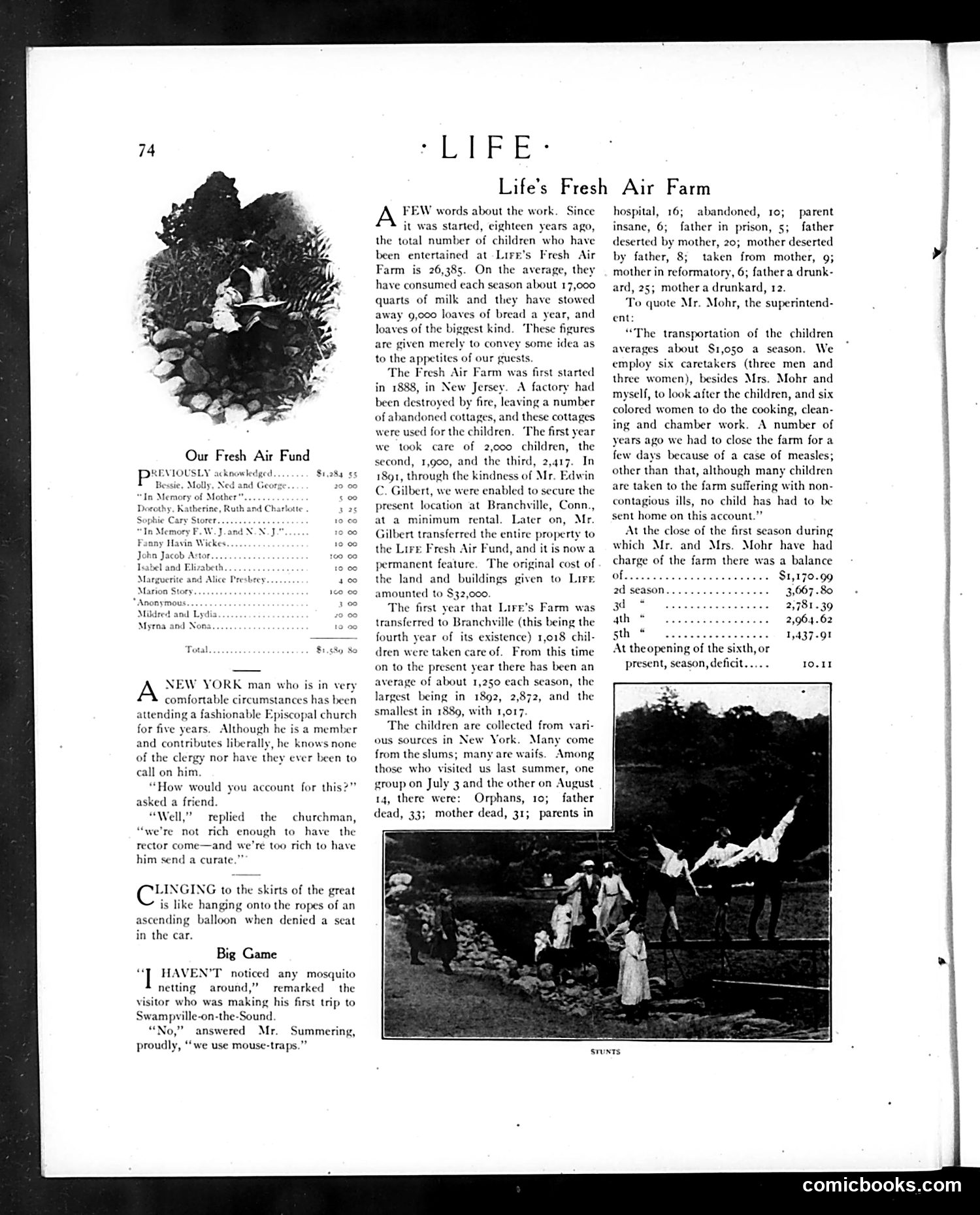
This page features an article about **Life's Fresh Air Farm**, a charitable institution serving underprivileged children in the New York area. The text describes operational details: the farm accommodates roughly 1,250 children seasonally, feeds them substantially (13,000 quarts of milk annually), and costs approximately $1,250 per season to operate. The accompanying photograph shows children at recreational play outdoors. The page includes a donation list ("Our Fresh Air Fund") acknowledging contributors, and several brief humorous anecdotes about rural/pastoral observations—including a joke about mosquito netting and another about mousetraps. The content reflects turn-of-the-century Progressive Era philanthropy, emphasizing fresh air and outdoor recreation as remedies for urban poverty and disease among children.
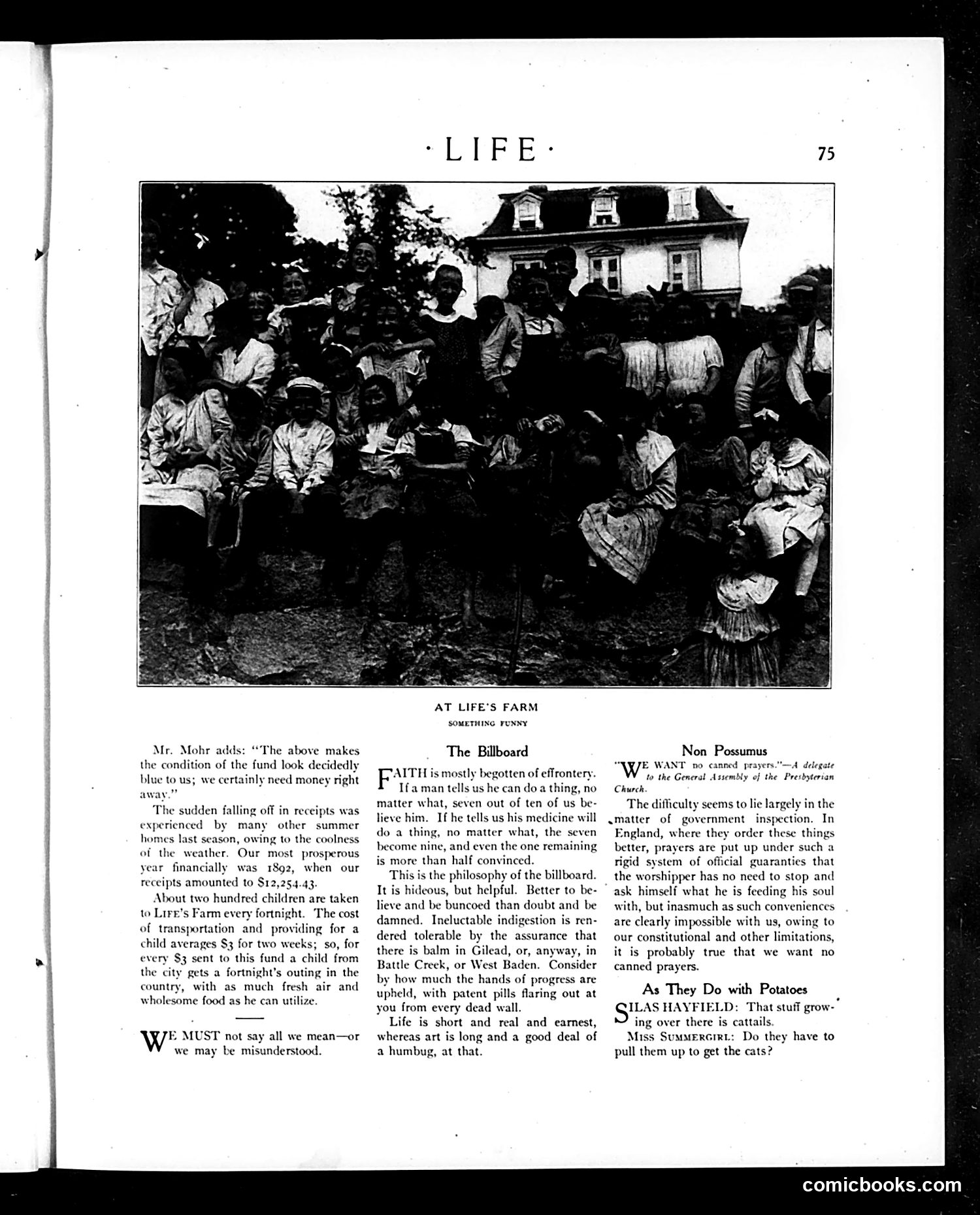
This page contains a photograph labeled "AT LIFE'S FARM—SOMETHING FUNNY" showing a large group gathering at what appears to be a charitable or social event, with a substantial house visible in the background. The accompanying text consists of three separate satirical columns: "The Billboard" (on faith and belief), "Non Possumus" (on prayer and government inspection in England), and "As They Do with Potatoes" (a brief humorous exchange between characters Silas Hayfield and Miss Summerley about growing vegetables). The page appears to mix photojournalism documenting Life magazine's own charitable farm activities with unrelated satirical commentary on contemporary social and religious topics. Without additional context, the specific political figures or events referenced remain unclear.
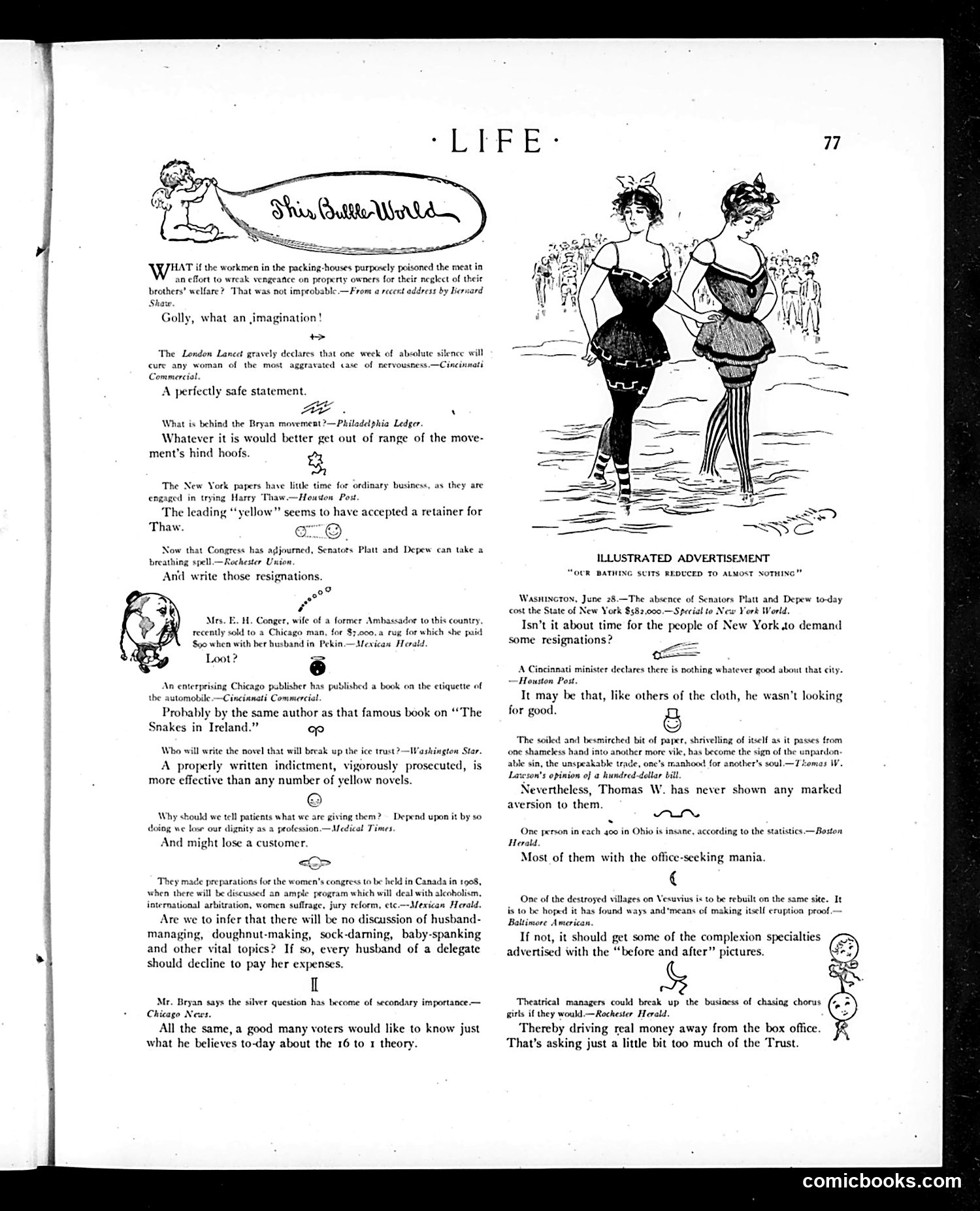
This page contains miscellaneous political and social satire typical of Life magazine's editorial style. The main illustration shows two women in bathing suits, captioned "Our Bathing Suits Reduced to Almost Nothing" — likely mocking either fashion trends or the minimal coverage of contemporary swimwear. The text snippets critique various contemporary figures and issues: Congress members Platt and Depew are referenced regarding resignations; there are jabs at newspaper coverage of Harry Thaw (a famous scandal case); and commentary on the Bryan political movement. References to women's suffrage, labor disputes, and urban corruption appear throughout. The overall tone is satirical commentary on 1900s American politics, high society, and public figures, using humor to critique incompetence and hypocrisy among the powerful.
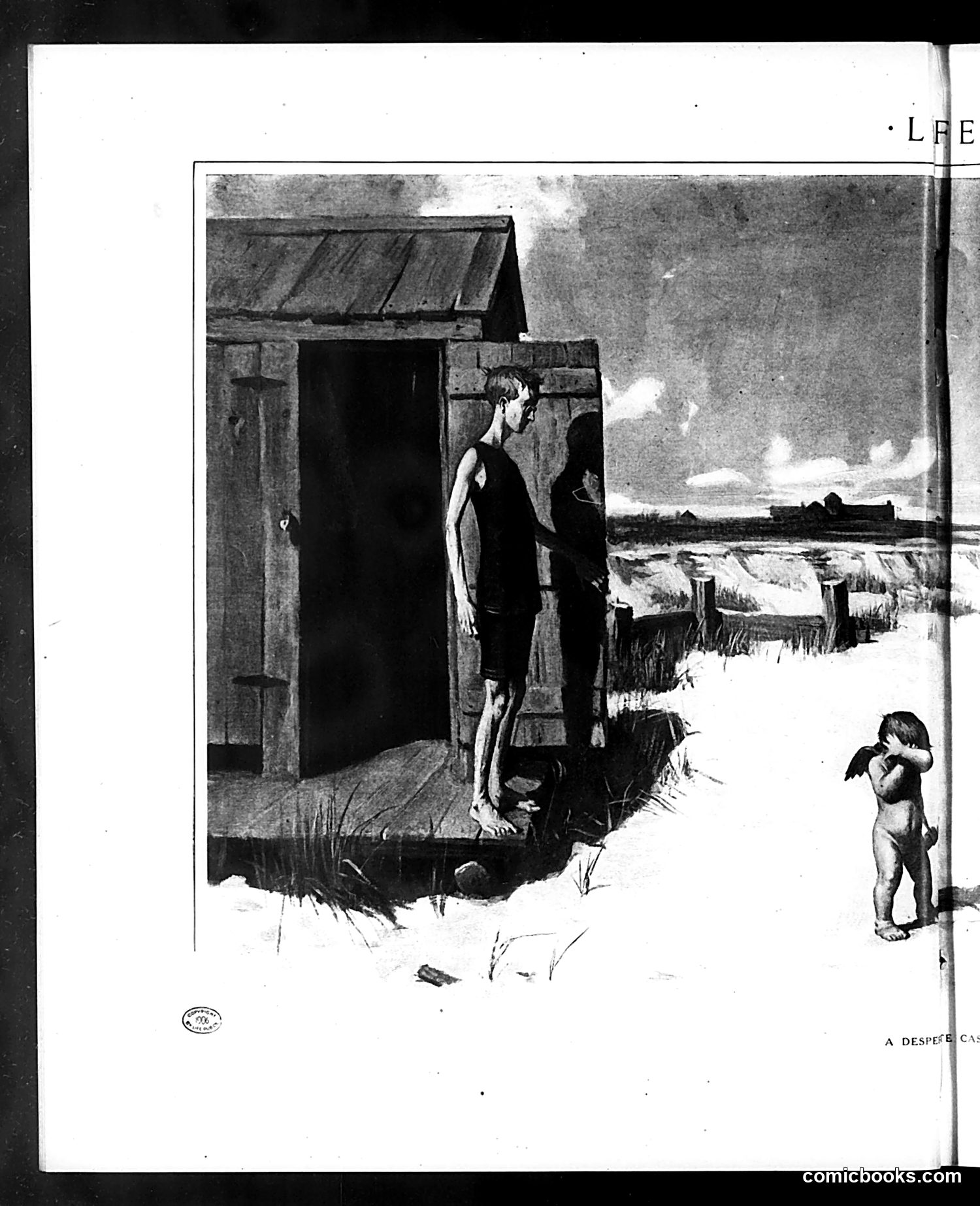
The OCR text appears to be corrupted and unreadable, providing no usable information. Based solely on the **image**, this appears to be a satirical illustration depicting a scene at a modest dwelling near marshland or wetlands. A thin, underdressed figure stands in or near a doorway, while a small child stands outside. The composition suggests social commentary about poverty or difficult living conditions. However, **without legible text, I cannot identify**: the specific figures depicted, any political figures being caricatured, the historical event or social issue being referenced, or the intended satirical message. The illustration's style suggests early-to-mid 20th century, but the meaning remains unclear without supporting text.
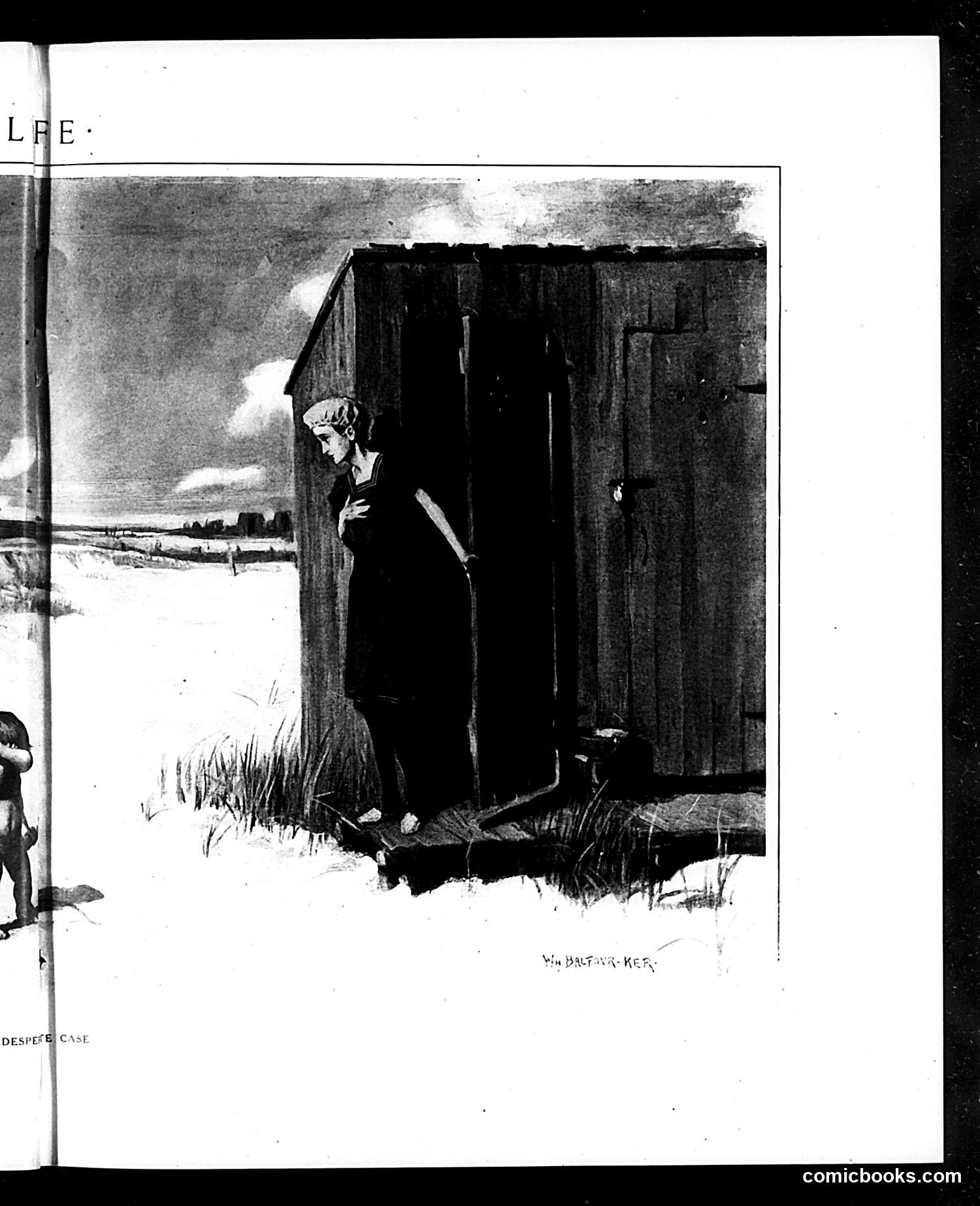
This is a satirical illustration from *Life* magazine showing a figure in dark clothing standing in the doorway of a ramshackle wooden structure, leaning on a cane or walking stick. The figure appears elderly or infirm. Beyond the structure stretches a snowy, desolate landscape with bare trees on the horizon. The OCR text is too corrupted to read clearly, making it difficult to identify the specific political or social reference. The artist's signature appears to read "Van Balt" or similar. Without legible text identifying the figure or context, I cannot definitively explain what this cartoon satirizes. It may reference poverty, hardship, exile, or abandonment—themes *Life* frequently addressed—but the specific target of satire remains unclear from the visible elements alone.
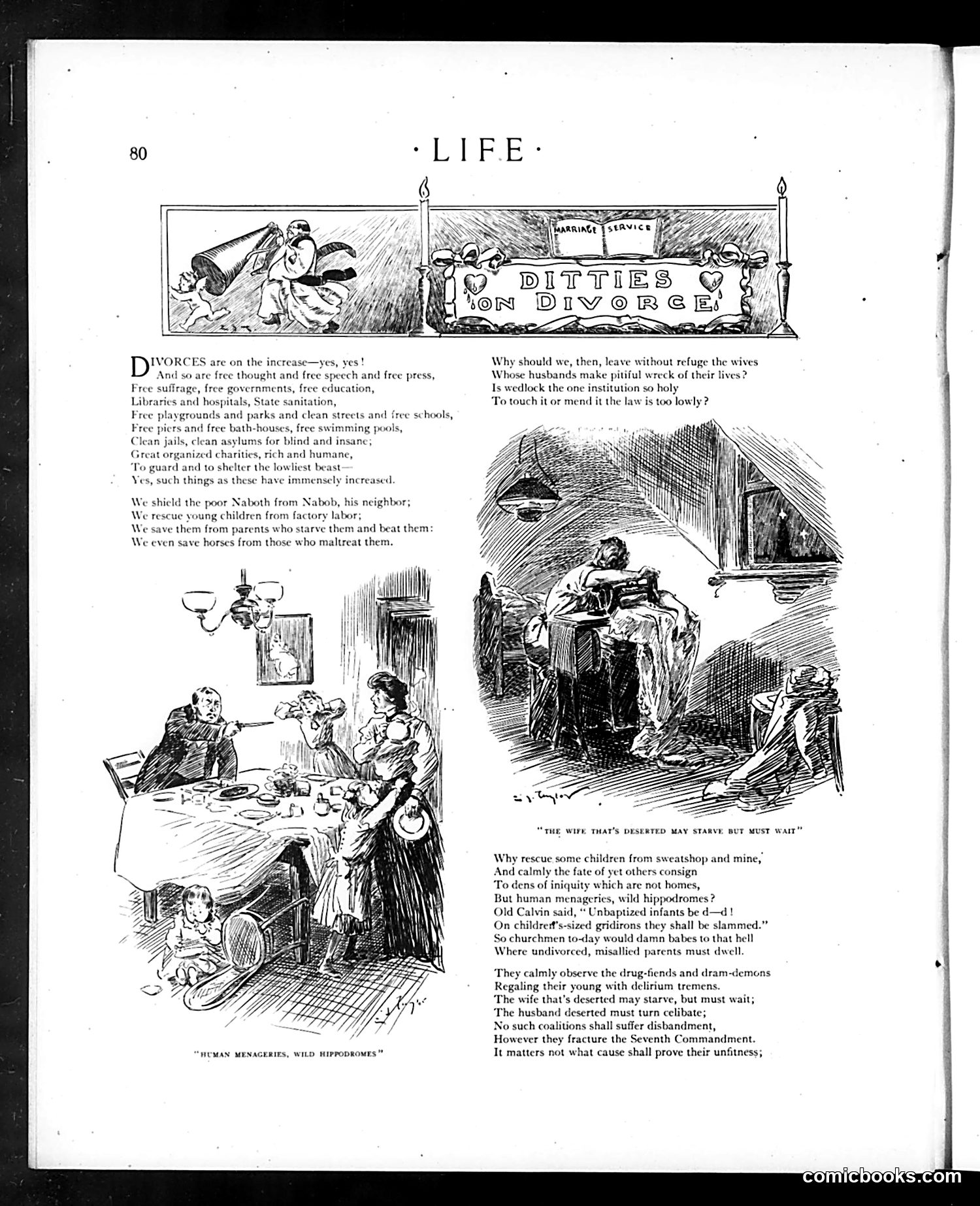
This page satirizes America's restrictive divorce laws through savage irony. The masthead "Ditties on Divorce" frames the critique. The argument: Progressive America has abolished child labor, freed slaves, established public institutions, and reformed countless abuses—yet refuses to allow divorce, even when marriages become destructive. The cartoons illustrate the hypocrisy: "Human Menageries, Wild Hippodromes" depicts squalid domestic misery; "The Wife That's Deserted May Starve But Must Wait" shows abandoned women in poverty. The text mocks religious doctrine (invoking Calvinist condemnation) and legal logic that prioritizes the sanctity of marriage over human welfare. The poet argues that if society rescues children from sweatshops and horses from abuse, why abandon spouses trapped in cruel or abandoned marriages? This appears to be early-20th-century advocacy for divorce reform, challenging laws that forced people—especially women—to remain legally bound to deserting or abusive partners.
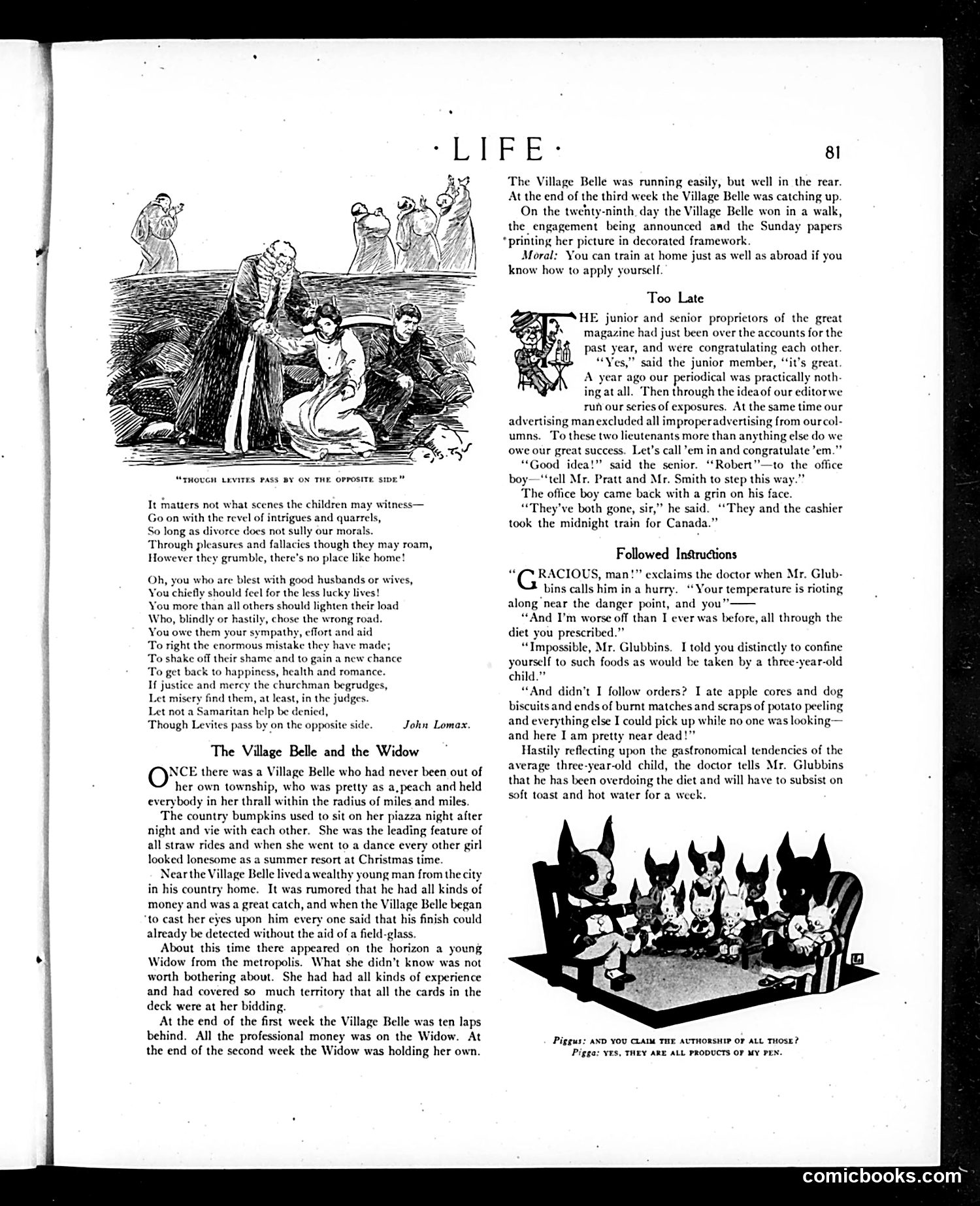
This page contains two distinct satirical pieces. The upper story mocks romantic competition: a pretty local girl ("Village Belle") nearly loses a wealthy city suitor to a cosmopolitan "Widow," but ultimately wins through natural advantage and home-field superiority. The moral—"you can train at home just as well as abroad"—sarcastically suggests provincial simplicity triumphs over urban sophistication. The "Too Late" piece satirizes magazine publishing ethics. Editors congratulate themselves for running exposés and refusing improper ads, crediting staff members "Mr. Pratt and Mr. Smith" with their success—only to discover both have absconded to Canada with the cashier. The joke: virtuous business practices are performative; the real operators flee with profits. Both stories mock hypocrisy and appearance versus reality in American society.
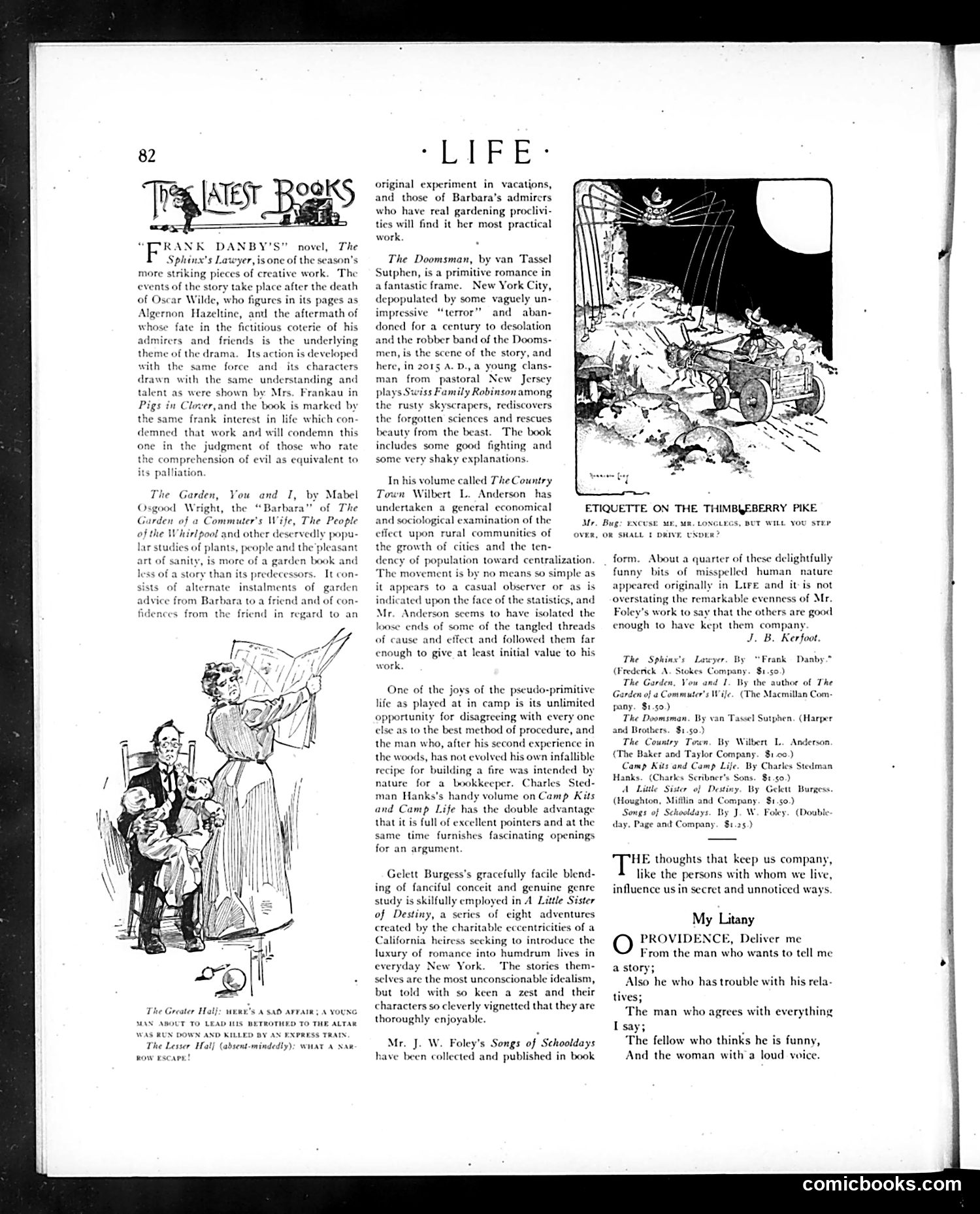
This page is primarily a **book review section**, not a political cartoon page. However, it contains one small cartoon captioned "The Greater Half" that uses dark humor about a contemporary social concern. The cartoon depicts a young man about to marry, who is struck and killed by an express train. His fiancée's response—calling it "a narrow row escape"—is absurdist comedy playing on the phrase "narrow escape." The joke relies on the tragic irony that she's relieved about a near-miss when he's actually dead. The cartoon likely satirizes **wealthy or distracted upper-class women** of the era, suggesting obliviousness or callousness. The reference to "the Greater Half" and "the Lesser Half" appears to comment on gender dynamics in marriage, with grim implications about women's priorities or awareness. The page's main content reviews contemporary novels by Frank Danby, Mabel Osgood Wright, and others—standard literary criticism for Life's educated readership.
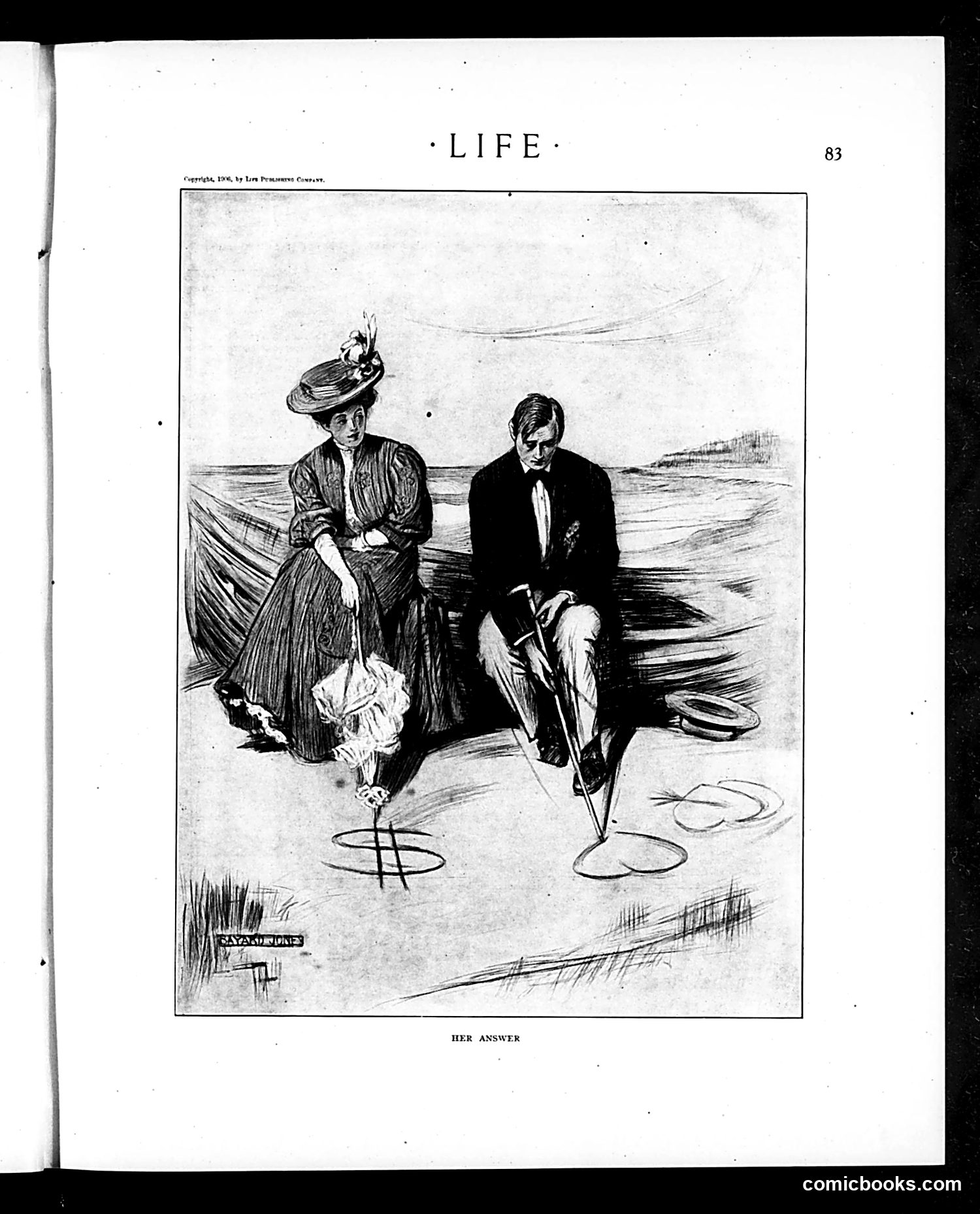
This single cartoon depicts a woman and man on a beach, each drawing circles in the sand with sticks. The title "Her Answer" suggests this is a response to a proposal or question. The visual joke appears to play on a common romantic scenario: the man has drawn a circle (likely representing a ring or proposal), and the woman has drawn her own circle in response—a clever, noncommittal "answer" that mirrors his gesture without accepting or rejecting it directly. The cartoon satirizes courtship dynamics and indecisiveness, using the beach-drawing setup as a visual metaphor for evasive or ambiguous romantic communication. The woman's mirroring action suggests she's deflecting rather than giving a clear yes or no.
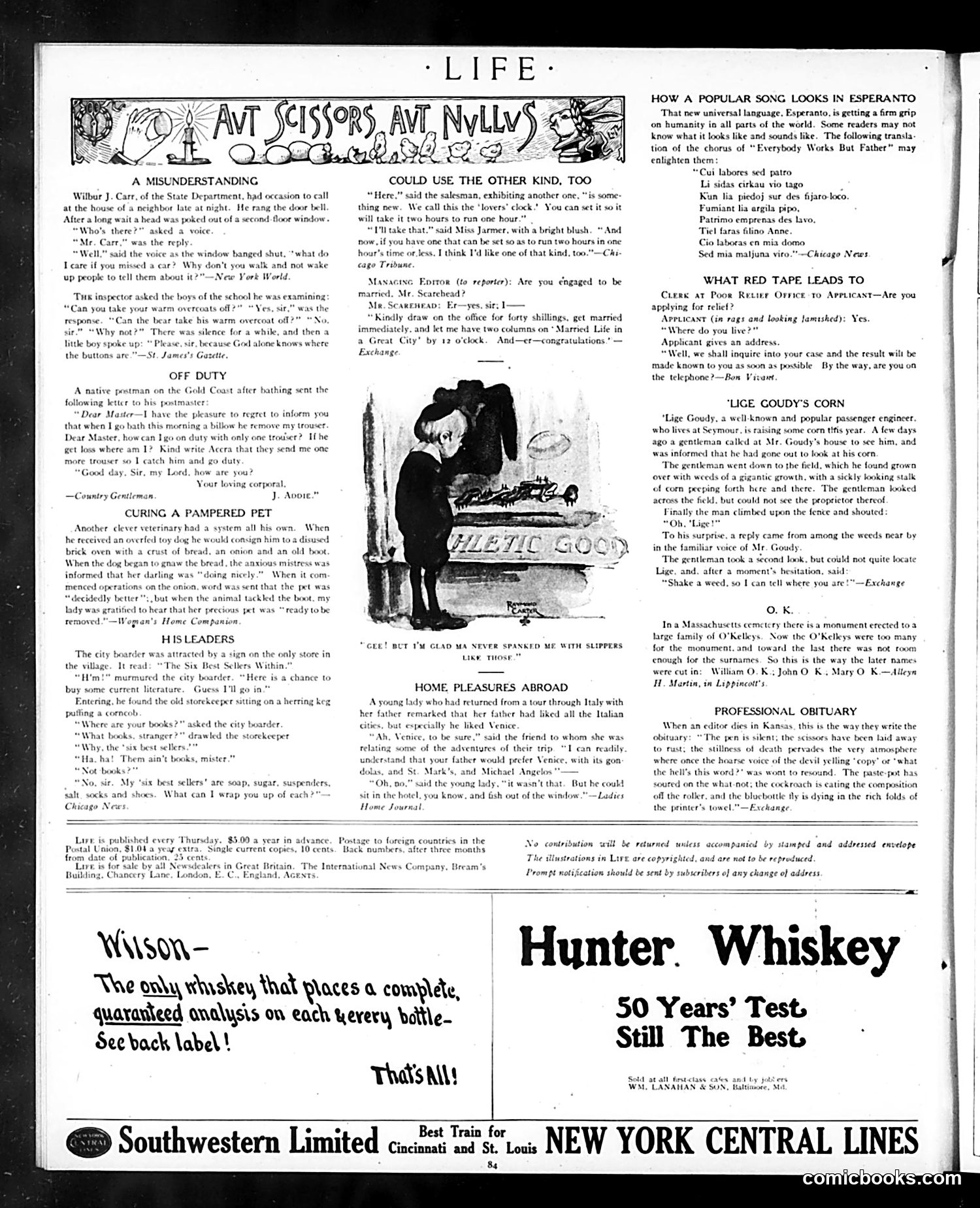
This page from *Life* magazine contains several short humorous anecdotes typical of the publication's satirical style: **"A Misunderstanding"** mocks bureaucratic officials through an anecdote about a State Department figure (Wilbur J. Carr) being mistaken for a burglar when visiting a neighbor at night—a joke about how even government officials appear suspicious in certain contexts. **"Off Duty"** and **"His Leaders"** are rural/colonial humor pieces contrasting urban sophistication with rural simplicity—a common *Life* theme. The Gold Coast postman's letter and the city boarder discovering a village store sells practical goods (soap, sugar) rather than books play on stereotypes about rural ignorance. **"Curing a Pampered Pet"** satirizes overly indulged urban pet owners through a veterinarian's practical (if harsh) methods. The remaining pieces joke about romance and travel in similarly light ways. **The advertisements** for Wilson whiskey, Hunter whiskey, and train services anchor the page in its era—Prohibition hadn't yet begun (this appears pre-1920). The overall tone is genteel, class-conscious humor aimed at educated, urban readers.
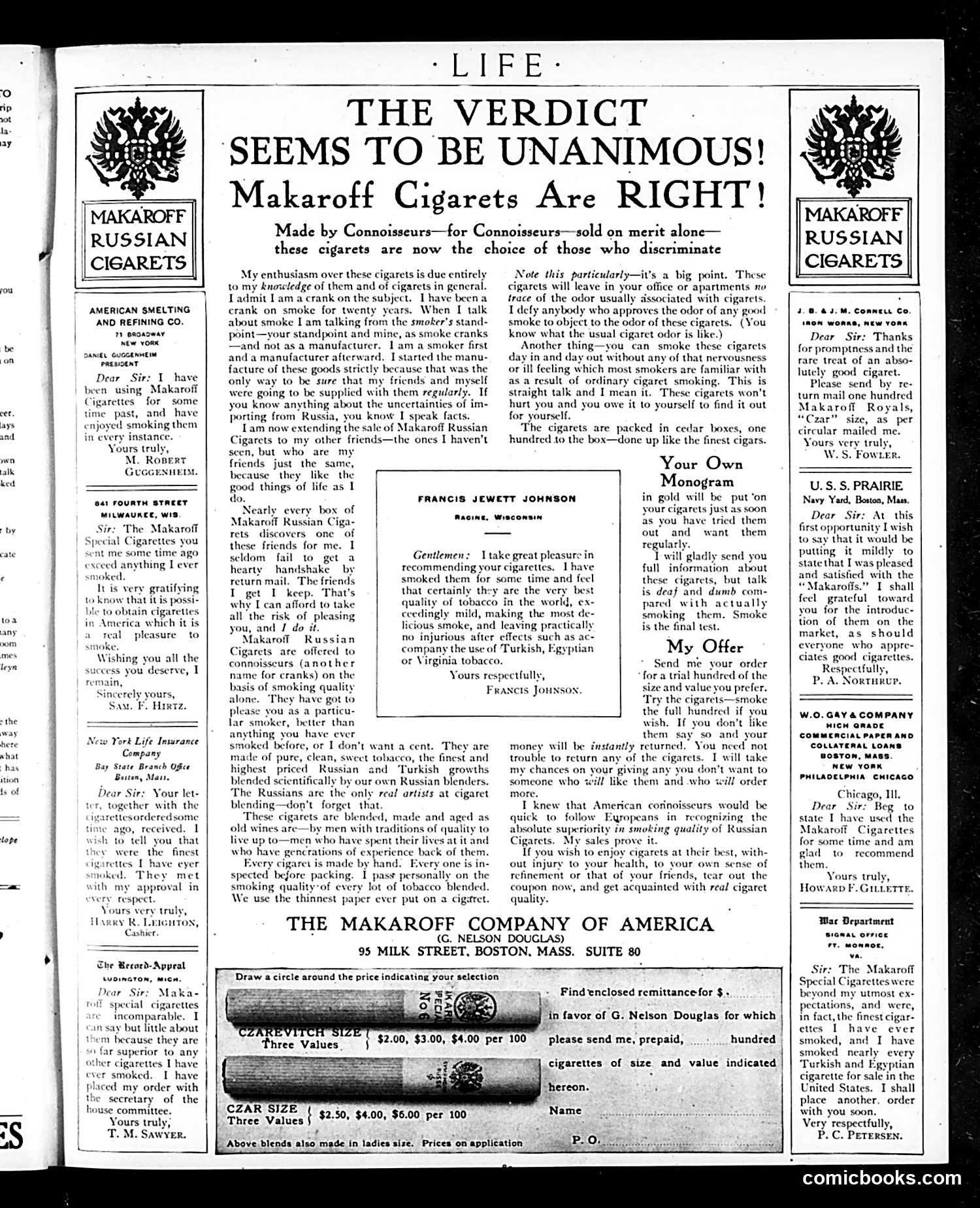
This page is primarily a **cigarette advertisement**, not political satire. It's a promotional piece for Makaroff Russian Cigarettes sold by G. Nelson Douglas in Boston. The layout mimics testimonial journalism—multiple letters from satisfied customers (businessmen, insurance executives, cashiers) praising the product's quality, lack of odor, and smooth smoking experience. The stated appeal is to "connoisseurs" who "discriminate" in taste. Francis Jewett Johnson, identified as from Racine, Wisconsin, provides an extended endorsement claiming these are superior to Turkish or Egyptian tobacco, leaving no offensive residue. The advertisement includes pricing ($2.00-$6.00 per 100 cigarettes) and an order form offering monogrammed packaging. **Context for modern readers**: Early 20th-century cigarette marketing often emphasized refinement and quality while celebrities/prominent figures provided endorsements—a practice later restricted as advertising ethics evolved. The emphasis on "no odor" suggests cigarettes were still somewhat controversial in office/social settings.
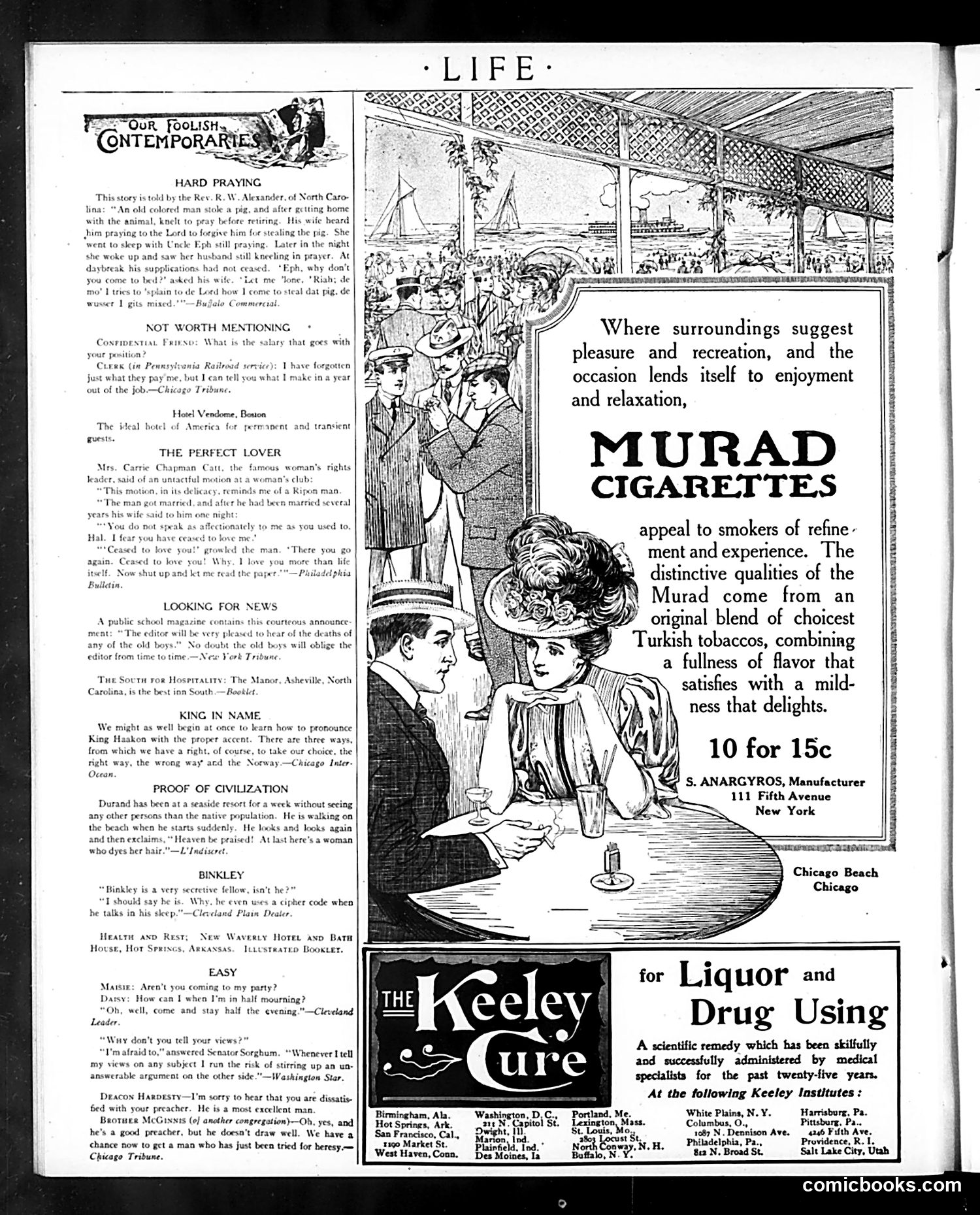
This page from *Life* magazine combines satirical short humor pieces with period advertisements. The main content consists of brief, unrelated anecdotes mocking everyday social situations: a woman's misguided prayer about a stolen pig, confusion over Norwegian pronunciation, a man underdressed at the beach, clerical salary disputes, and a preacher's poor drawing ability versus his heretical reputation. The satire targets minor social absurdities and hypocrisy rather than major political issues. The advertisements—for Murad cigarettes, the Keeley Institute (a real treatment facility for alcohol and drug addiction), and various hotels—reflect early 20th-century consumer culture. Notably, the Keeley ad promotes medical treatment for substance abuse as scientifically legitimate, representing contemporary attitudes toward addiction as a treatable medical condition rather than moral failing.
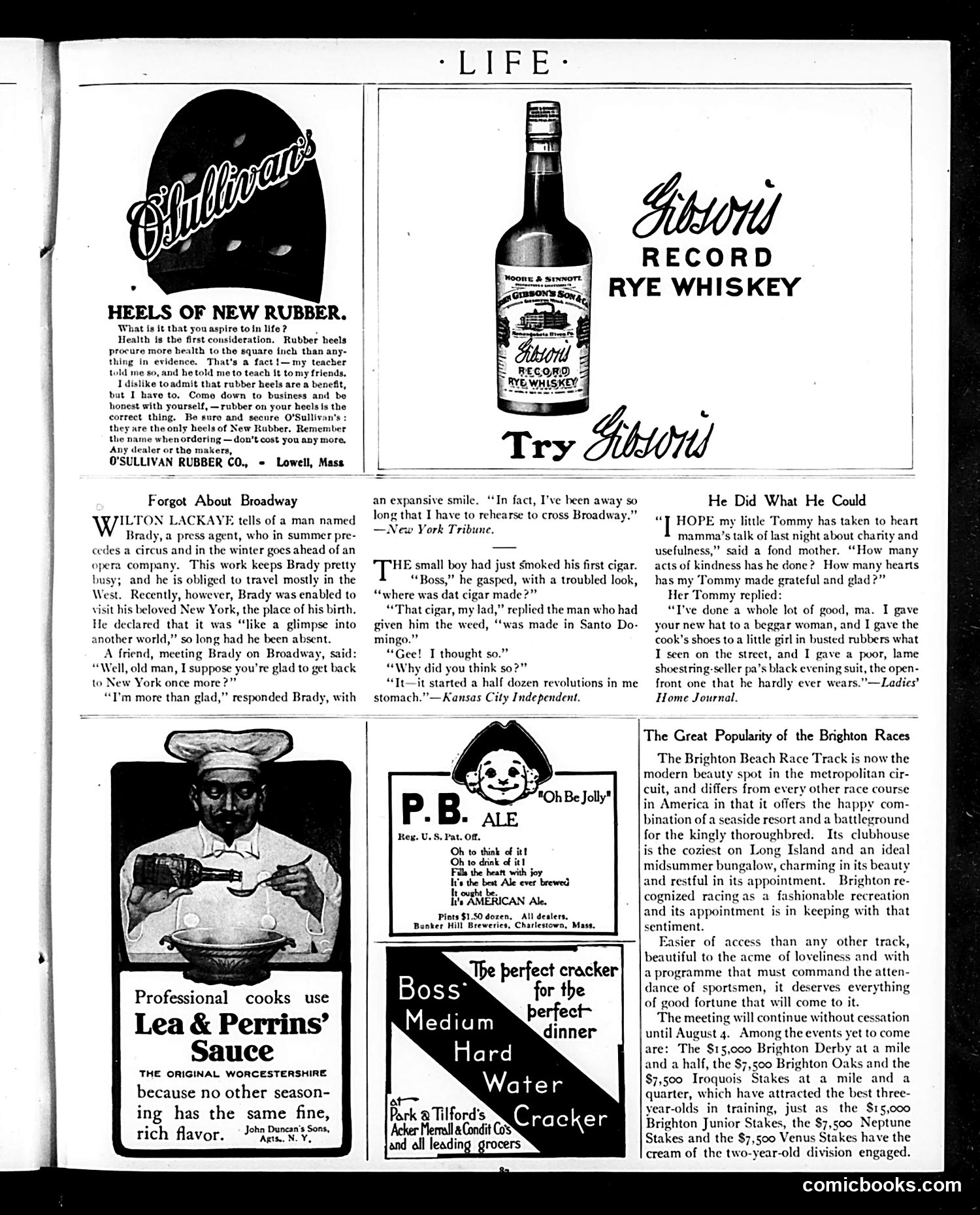
This page combines advertisements with humorous anecdotes typical of early 20th-century Life magazine's satirical format. **The Main Content:** The page features four brief comedic stories: 1. **"Forgot About Broadway"**: A press agent named Brady returns to New York after years away and jokes that he must "rehearse to cross Broadway"—suggesting the city has changed so dramatically he's forgotten how to navigate it. 2. **"He Did What He Could"**: A boy misinterprets his mother's charity lesson, donating her hat, the maid's shoes, and his father's evening suit to the poor—satirizing naive good intentions causing household chaos. 3. **"First Cigar"**: A boy smokes a cigar from Santo Domingo and claims it "started a half dozen revolutions in me stomach," playing on contemporary Latin American political instability. **The Advertisements** include product endorsements for rubber heels, Lea & Perrins sauce, ales, whiskey, and restaurant supplies—typical commercial content. The humor relies on wordplay, irony, and gentle social observation rather than political commentary.
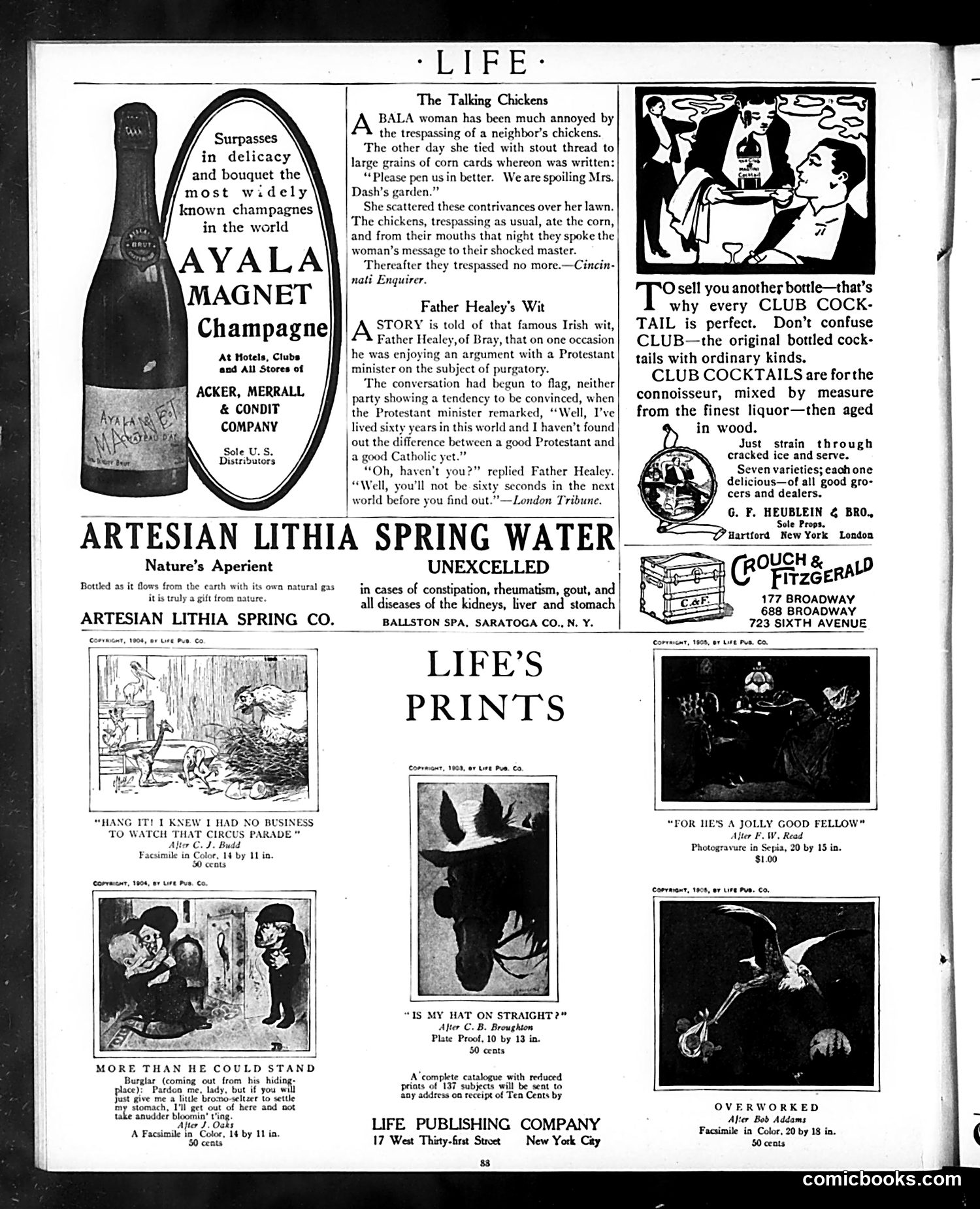
This page is primarily **advertisements and product promotions** interspersed with brief humorous anecdotes and print offerings. The "Talking Chickens" story is a mild rural joke: a woman annoyed by trespassing chickens ties corn-grain cards with a polite message to the feed, hoping the birds will deliver her complaint to their owner. The humor lies in the absurd premise that chickens could speak human messages. "Father Healey's Wit" recounts Irish clergy humor—a Catholic priest's retort to a Protestant minister about doctrinal differences, suggesting the answer will only become clear after death. The page primarily markets **Ayala Magnet Champagne**, **Artesian Lithia Spring Water** (claimed to treat gout and kidney ailments), **Club Cocktails**, and **Heublein liquors**. Below are offerings of **Life's Prints**—framed artwork and photogravures available for purchase, with titles like "Hang It! I Knew I Had No Business to Watch That Circus Parade" and "More Than He Could Stand." This represents early 1900s magazine publishing: editorial content serving as wrapper for lucrative alcohol and luxury goods advertising.
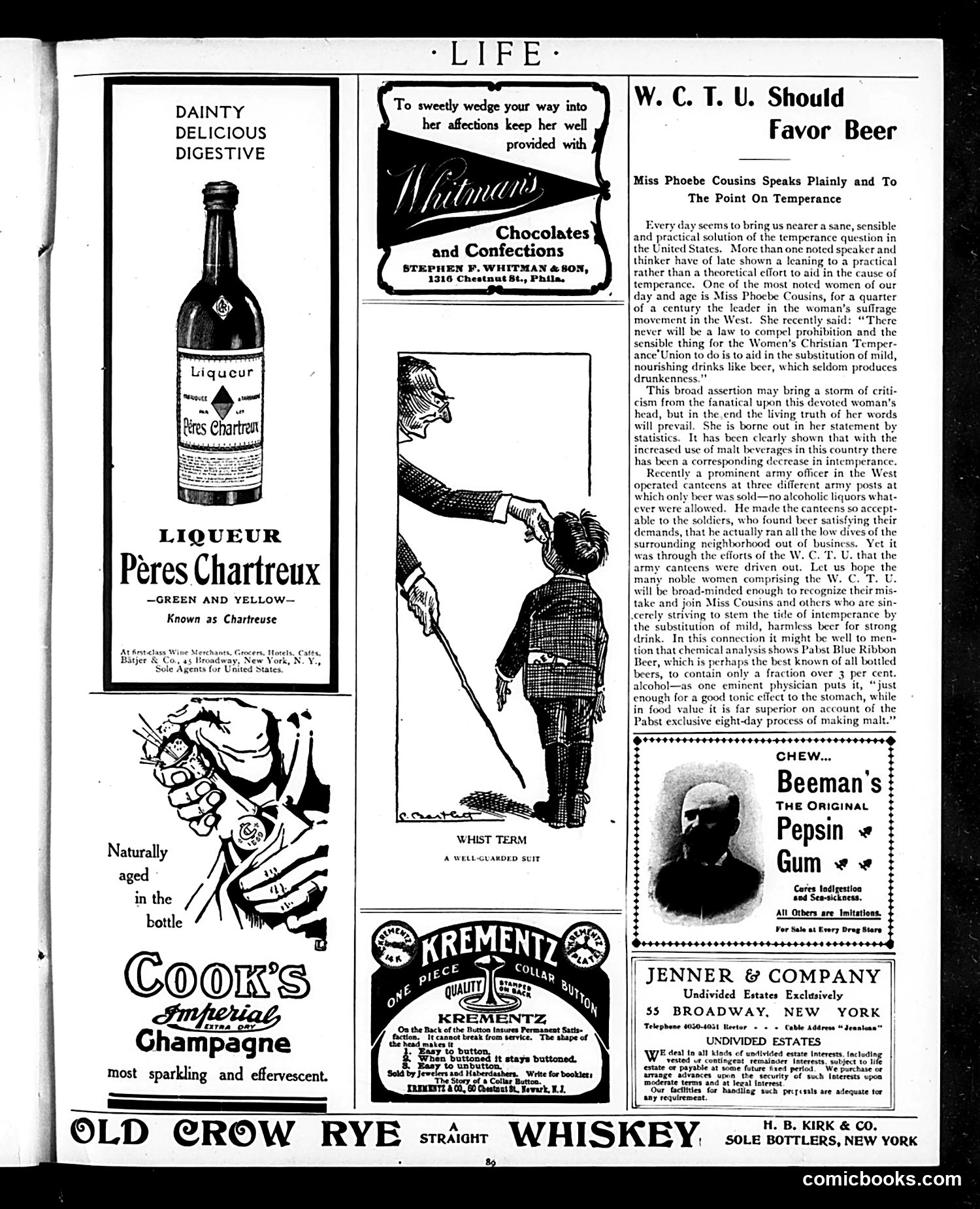
This page is primarily **advertisements** with one significant editorial piece. The main content is an article titled "W.C.T.U. Should Favor Beer," featuring Miss Phoebe Cousins, a prominent women's suffrage leader from the West. Cousins argues that the Women's Christian Temperance Union should support beer as a substitute for hard liquor rather than pursuing total prohibition. She cites statistics showing increased beer consumption correlates with decreased intemperance, and references an Army officer who successfully operated beer-only canteens that undersold local saloons. The article contends that beer's low alcohol content (citing Pabst Blue Ribbon at 3% ABV) and food value make it a practical harm-reduction approach. The piece represents an early 20th-century pragmatic temperance position—not opposing alcohol outright but promoting weaker beverages over spirits. This contrasts with prohibitionist ideology, which ultimately prevailed in American policy. The surrounding advertisements (Cook's Champagne, Old Crow Whiskey, liqueurs) create ironic juxtaposition with the temperance discussion.
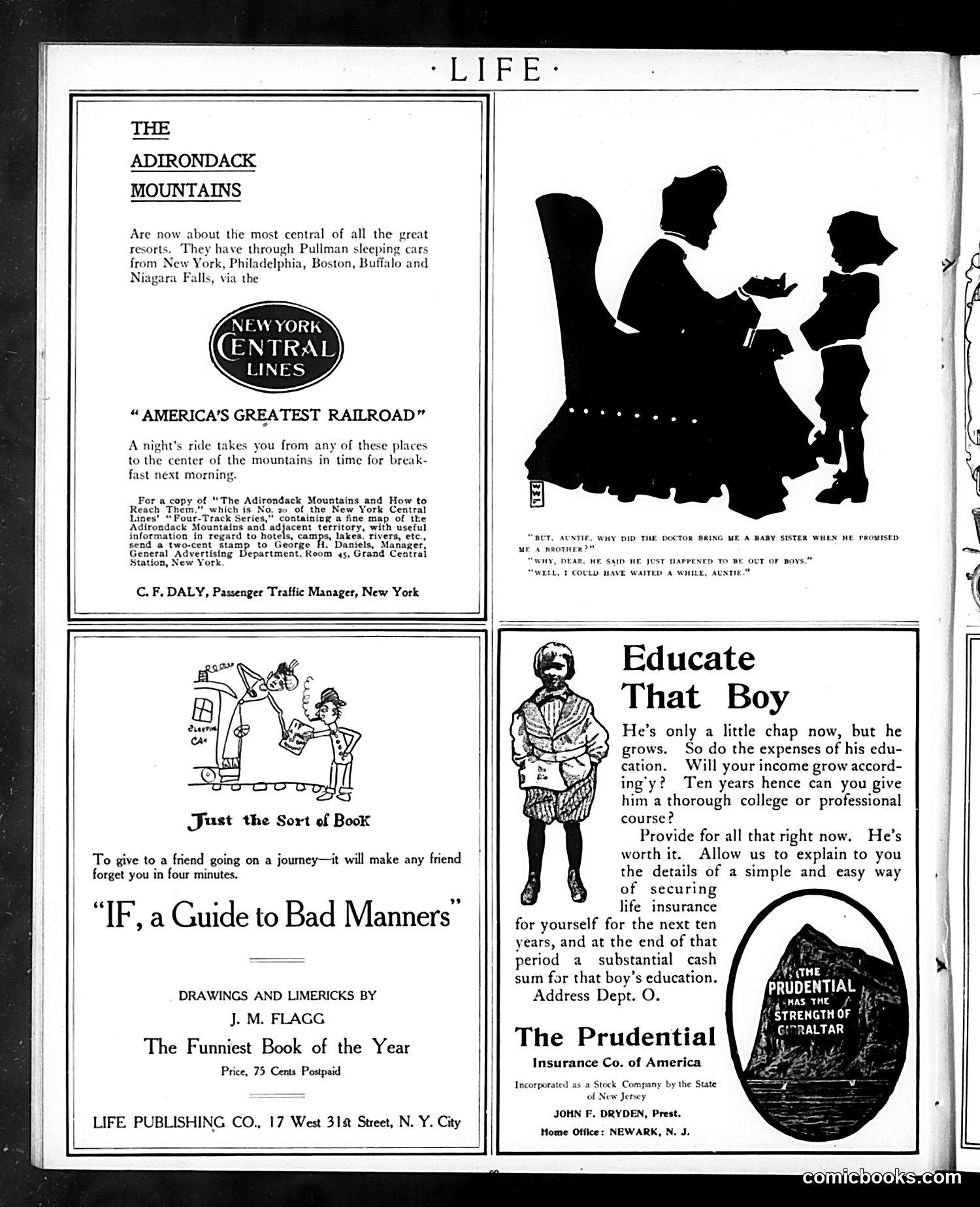
This page mixes advertisements with one cartoon joke. The main humor appears in the silhouette scene showing a child asking why the doctor brought a baby sister instead of a brother. The aunt's response—that the doctor was "out of boys"—is the joke: it suggests boys are so undesirable that they're in short supply, implying boys are troublesome or unwanted compared to girls. The page otherwise advertises three products: New York Central Railroad's Adirondack Mountain service, "IF, a Guide to Bad Manners" (a humor book with drawings by J.M. Flagg mocking etiquette), and Prudential Insurance's education savings plan for children. All content reflects early 20th-century concerns: leisure travel for the wealthy, satirical commentary on social manners and behavior, and financial planning for children's futures—typical Life magazine material aimed at middle-to-upper-class readers.
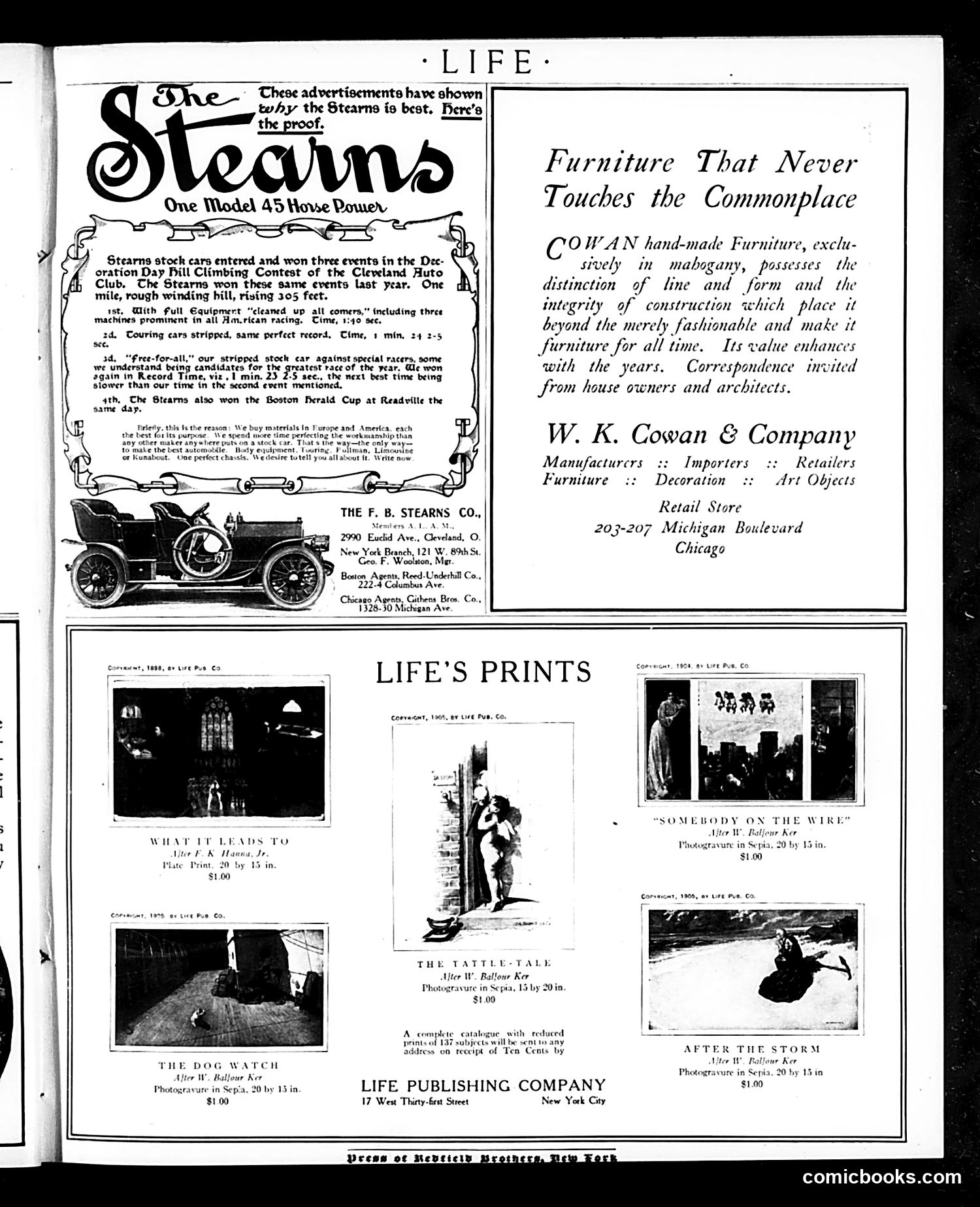
This is primarily an **advertising page** rather than editorial content. The page contains: 1. **Stearns Automobiles Advertisement** (top left): Promotes the F.B. Stearns Company's cars by highlighting racing victories at a Cleveland Auto Club hill-climbing contest. The ad emphasizes the car's superior performance and reliability through competitive proof. 2. **W.K. Cowan & Company Advertisement** (top right): Luxury furniture marketing emphasizing hand-crafted mahogany pieces that transcend fashion trends. The copy appeals to wealthy homeowners and architects seeking timeless, high-quality goods. 3. **Life's Prints Section** (bottom): Showcases four photographic prints available for purchase—"What It Leads To," "The Dog Watch," "The Tattle-Tale," and "Somebody on the Wire"—priced at $1.00 each, with publication details. The page reflects early 1900s advertising targeting affluent consumers through appeals to quality, exclusivity, and status. There is no political cartoon or satire present.
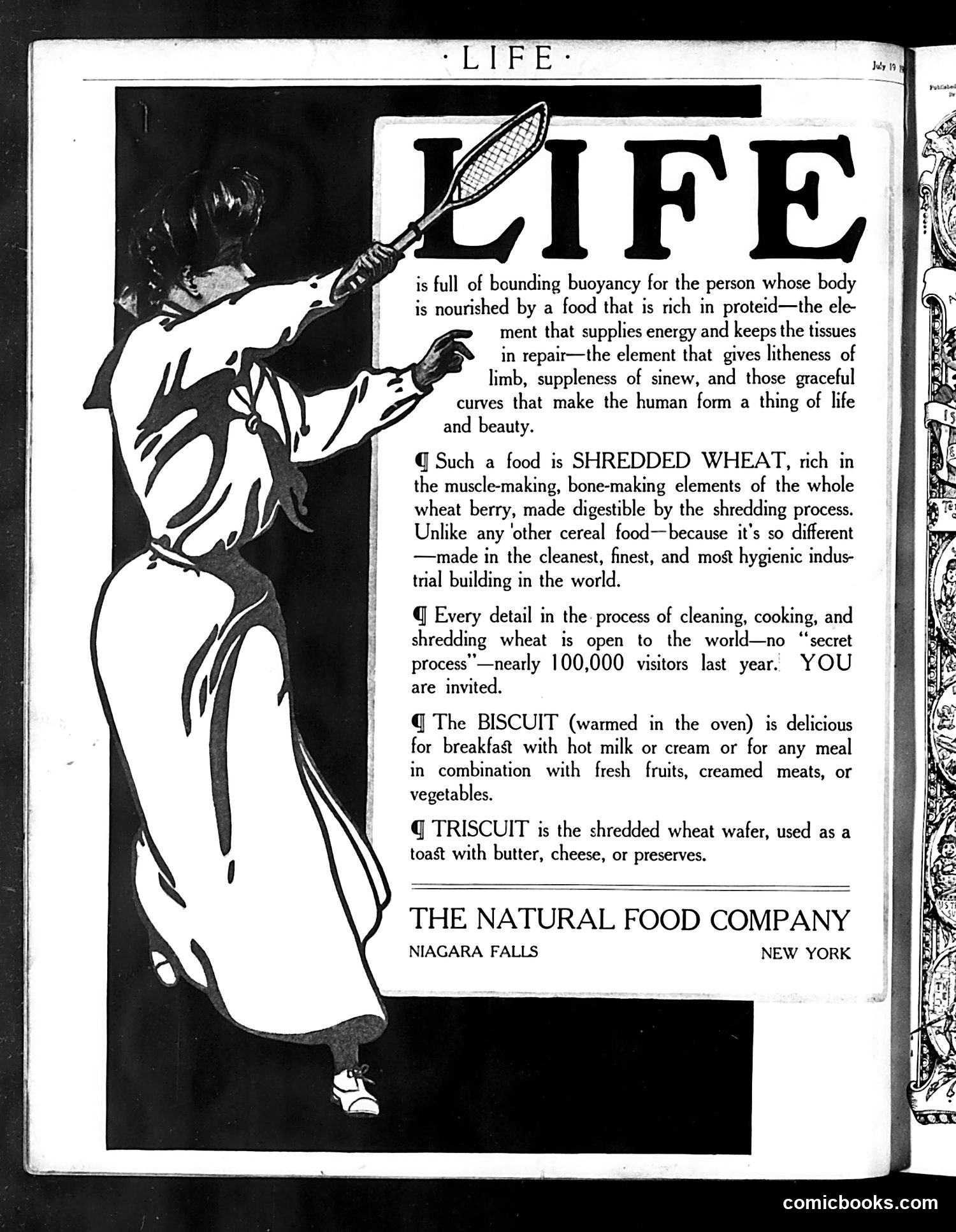
This is a **Shredded Wheat cereal advertisement**, not political satire. The illustration depicts a classical female figure (likely representing health, vitality, or ideal femininity) holding a wheat sheaf, embodying the product's promise of nutritional wellness. The ad's appeal centers on **early 20th-century health marketing**: emphasizing protein's role in building muscle, bone, and "graceful curves"—reflecting period ideals linking proper nutrition to physical beauty and vigor. The text stresses manufacturing transparency ("open to the world—no 'secret process'"), which was a selling point when food safety and industrial hygiene were public concerns. The company highlights its Niagara Falls location and claims 100,000 annual visitors, suggesting pride in visible, inspectable production. This reflects an era when consumers demanded proof of clean food manufacturing, particularly following food-safety scandals. The three products mentioned (Biscuit, Triscuit, loose cereal) show product diversification typical of competitive cereal markets in that period.