
Life, 1906-07-19 · page 18 of 28
Life — July 19, 1906 — page 18: what you’re looking at
What you’re looking at
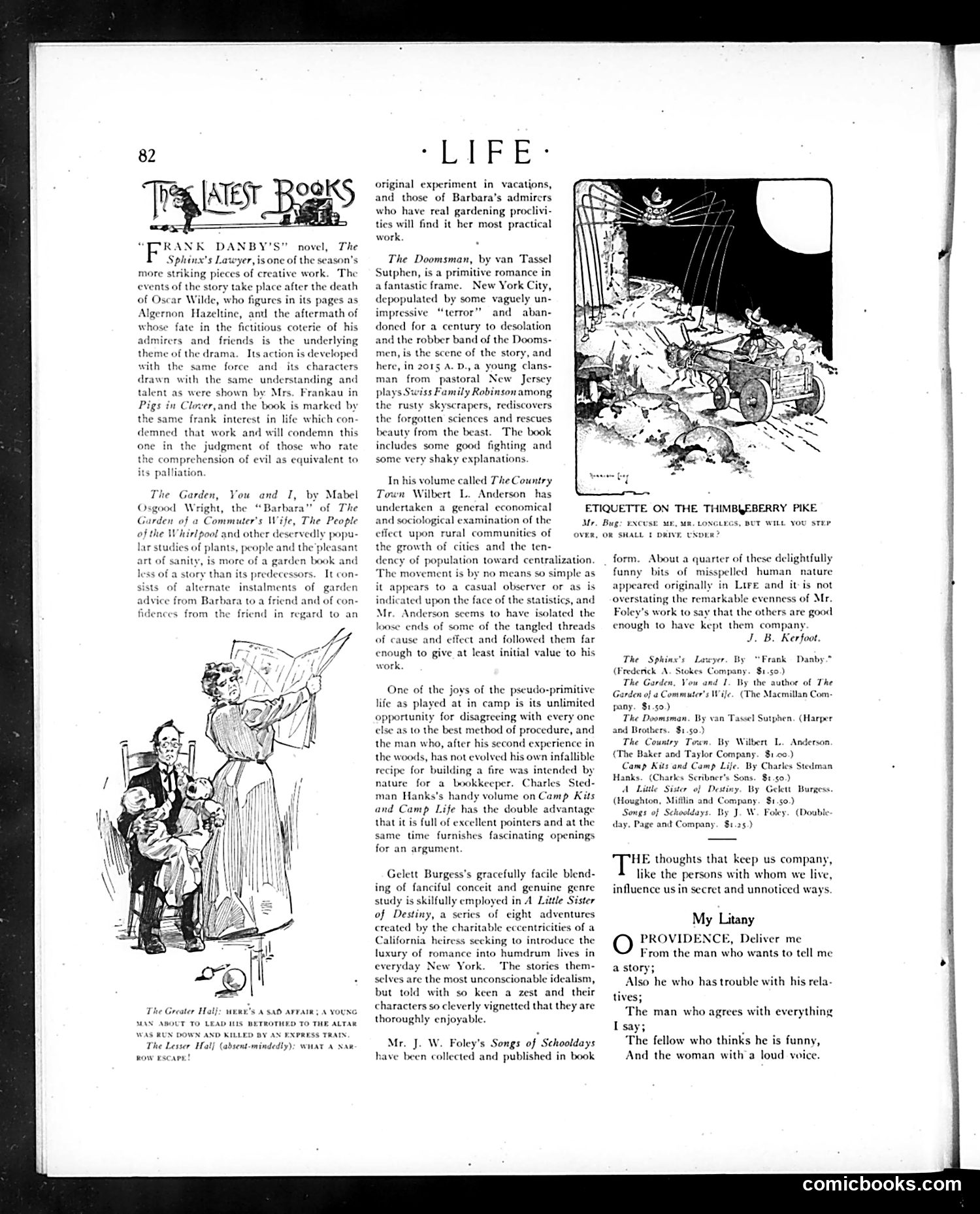
This page is primarily a **book review section**, not a political cartoon page. However, it contains one small cartoon captioned "The Greater Half" that uses dark humor about a contemporary social concern. The cartoon depicts a young man about to marry, who is struck and killed by an express train. His fiancée's response—calling it "a narrow row escape"—is absurdist comedy playing on the phrase "narrow escape." The joke relies on the tragic irony that she's relieved about a near-miss when he's actually dead. The cartoon likely satirizes **wealthy or distracted upper-class women** of the era, suggesting obliviousness or callousness. The reference to "the Greater Half" and "the Lesser Half" appears to comment on gender dynamics in marriage, with grim implications about women's priorities or awareness. The page's main content reviews contemporary novels by Frank Danby, Mabel Osgood Wright, and others—standard literary criticism for Life's educated readership.
📄 Transcribed text from this page (OCR, searchable)
Machine-transcribed from the original scan — historical spelling and the odd misread are preserved.
“DRANK DANBY’S” novel, The Sphinx's Lawyer, ison re striking pieces of creative work. The events of the story take place after the death of Oscar Wilde, who figures in its pages as Algernon Hazeltine, and the aftermath of whose ie of his irers and friends is the underlying ne of the drama. Its acti with the same force of the season's 1m fate in the fictitious cote nis developed nd its characters understanding and talent as were shown by Mrs. Frankau in Pigs in Clover,and the book is marked by the same frank interest in life which con- demned that work and will condemn this one in the judgment of those who rate comprehension of evil as equivalent to ts pal drawn with the sam ion. The Garden, You and I, by Mabel Osgood Wright, the “Barbara” of The Garden of a Commuters Wife, The People of the Whirlpool and other deservedly popu- lar studies of plants, people and the’pleasant garden book and essors, It con- art of san is more o} less of a story than its pred alternate instalments of garden Barbara to a fri e friend in regard to an sists ¢ advice fro: end and of con- fi The Greater Half: Wene's 4 SA AVTAIR; 4 YOUNG MAN ABOUT TO LEAD ILS BETROTHED TO THE ALTAR WAS RUN DOWN AND KILLED BY AN EXPRESS TRAIN The Lesser Half (absent-mindedly): WUat 4 Naw Row escape! ‘LIFE: original experiment in vacations, and those of Barbara’s admircrs who have real gardening proclivi- tics will find it her most. practical work. The Doomsman, by van Tassel Sutphen, is a primitive romance in a fantastic frame. New York City, depopulated by some vaguely un- impressive “terror” and aban- doned for a century to desolation and the robber band of the Dooms- men, is the scene of the story, and here, in 2015 A. D., a young clans man from pastoral New Jerse plays Swiss Family Robinson among the rusty skyscrapers, rediscovers the forgotten sciences and rescues beauty from the beast. The book includes some good fighting and some very shaky explanations In his volume called The Country Town Wilbert L. Anderson has undertaken a general economical and sociological examination of the Mr effect upon rural communities of over. the growth of cities and the ten- dency of population toward centralization. The movement is by no means so simple as it appears to a casual observer or as is indicated upon the face of the statistics, and Mr. Anderson scems to have isolated the loose ends of some of the tangled threads of cause and effect and followed them far cnough to give at Icast initial value to his One of the joys of the pscudo-primitive life as played at in camp is its unlimited ‘ y for disagreeing with © else as to the best method of procedure, and the man who, after hi the woods, has not evolved his own infallible recipe for building a fire was intended by pature for a bookkeeper. Charles Sted- man Hanks's handy volume on Camp Kits and Camp Life has the double advantage that it is full of excellent pointers and at the same time furnishes fascinating openings for an argument. one second experience in Gelett Burgess’s gracefully facile blend- ing of fanciful conceit and genuine genre study is skilfully employed in A Little Sister of Destiny, a series of eight adventures created by the charitable eccentricities of a California heiress secking to introduce the luxury of romance into humdrum lives in everyday New York. ‘The stories them- selves are the most unconscionable idealism, but told with so keen a zest and their characters so cleverly vignetted that they are thoroughly enjoyable. Mr. J. W. Foley’s Songs of Schooldays have been collected and published in book ETIQUETTE ON THE THIMBREBERRY PIKE Bug: eXCust ae, ste. LONGLEGS, BUT WILL You stEP OR SHALL £ DRIVE, UNDER? form. About a quarter of these delightfully funny bits of misspelled human nature ppeared originally in Lure and it is not tating the remarkable evenness of Mr. Foley’s work to say that the others a enough to have kept them company J. B. Kerfoot. ovel 1 good The Sphinx's Lawyer. By “Frank Danby (Frederick A. Stokes Company. $1.59.) The Garden, Vou and 1. Wy the author of The Garden of a Commuter’s Wife. (The Macmillan Com pany. $1.50.) The Doomsman. By van Tassel Sutphen. (Harper and Brothers. $1.50.) The Country Ton. By Wilbert L. A (The Baker and Taylor Company. $1.00.) Camp Kits and Camp Lije, By Charles Stedman Hanks. (Charles Scribner's Sons. $1.50.) A Little Sister 0] Destiny. By Gelett Burgess. (Houghton, Mifilin and Company. $1.50.) Songs of Schooldays. By J. W. Foley. (Double day, Page and Company. $t.25.) son THE thoughts that keep us compan ike the persons with whom we live, influence usin secret and unnoticed ways. My Litany EO PROVIDENCE, Deliver me From the man who wants to tell me a story; Also he who has trouble with his re tives; The man who agre I say; The fellow who thinks he is funny, And the woman with a loud voice. s with everything comicbooks.com