
A complete issue · 28 pages · 1906
Life — June 21, 1906
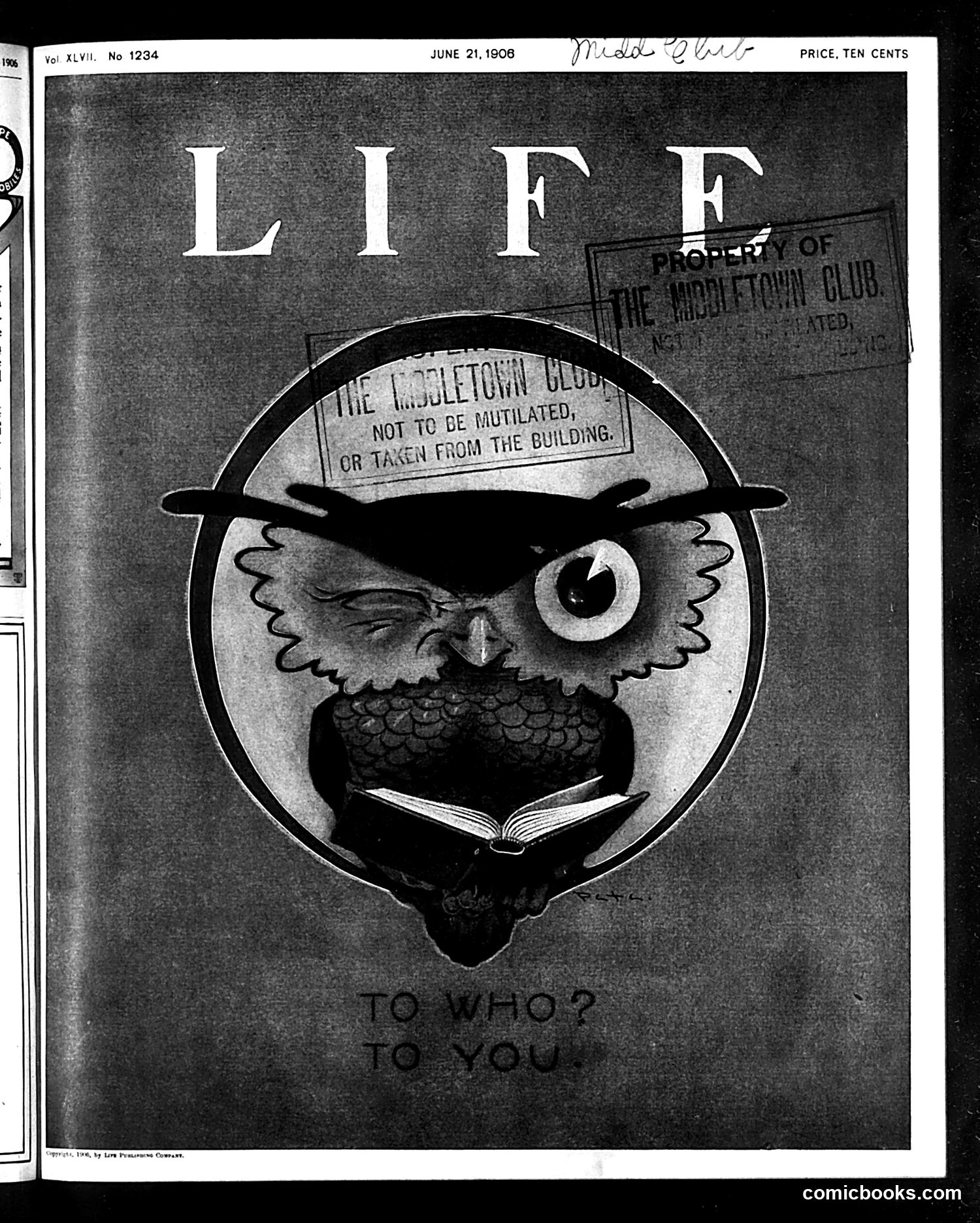
This is the *Life* magazine cover from June 21, 1908, featuring an owl reading a book as the central image. The owl's head contains a label reading "THE MIDDLETOWN CLUB / NOT TO BE MUTILATED / OR TAKEN FROM THE BUILDING," suggesting this is property of the Middletown Club library. The cover's caption reads "LIFE / TO WHO? / TO YOU?" The satire appears to target intellectual pretension or the gap between claimed learning and actual wisdom—represented by the earnest, scholarly owl with its book, yet wearing a comical expression. The "do not remove from building" label may mock institutional knowledge that cannot leave its confines, or critique the exclusivity of club membership and learning. The specific social commentary remains somewhat unclear without additional context about 1908 events.
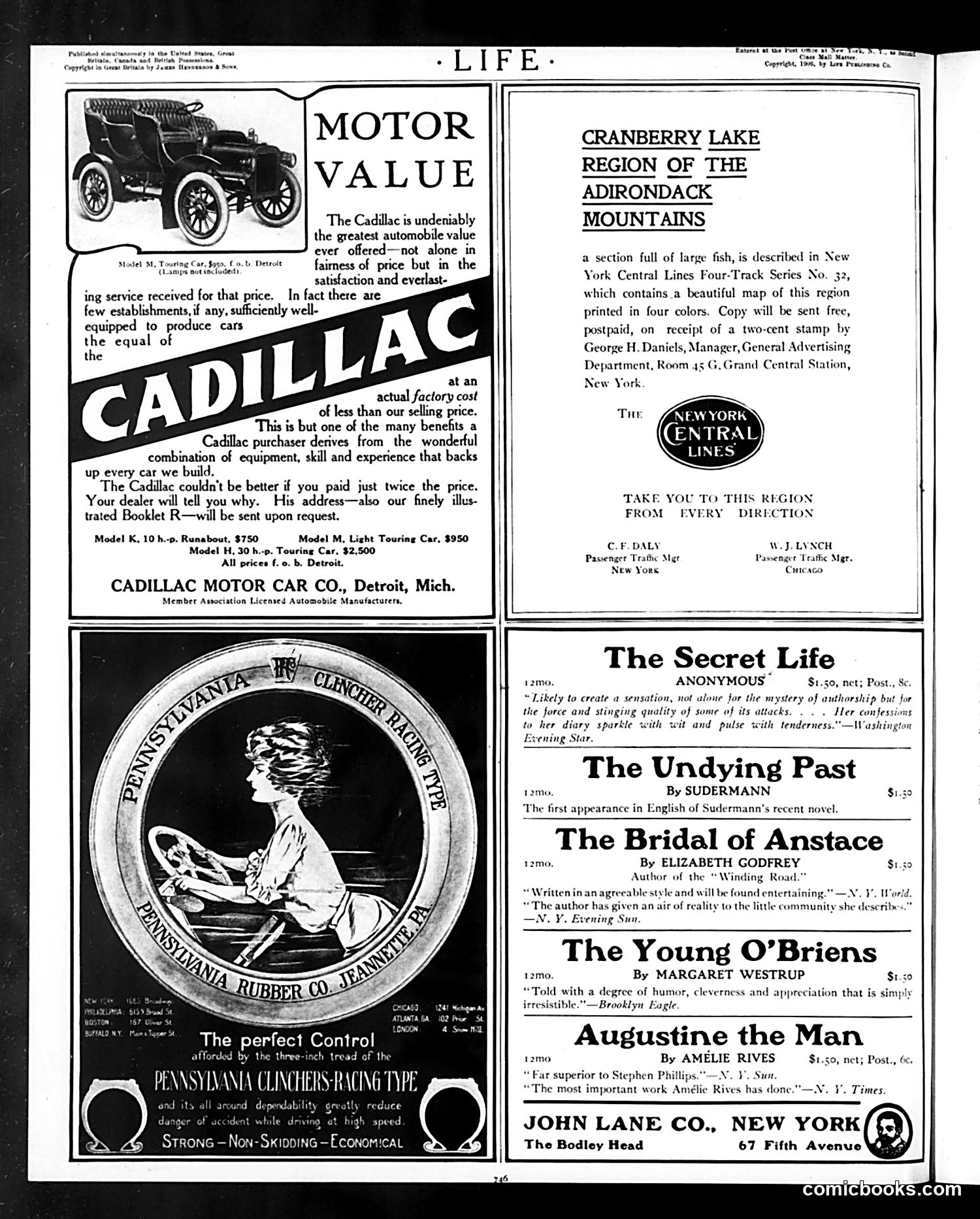
This page is **primarily advertising**, not satirical content. The top half features a Cadillac automobile advertisement emphasizing "Motor Value"—highlighting the car's quality and affordability at factory cost pricing. The bottom left shows a Pennsylvania Clincher Racing Tire advertisement with a circular logo depicting a woman driver, promoting tire reliability and safety at high speeds. The right side contains book advertisements from John Lane Co., listing five novels including "The Secret Life" by Anonymous and "The Bridal of Anstace" by Elizabeth Godfrey. There is no political satire or social commentary evident. This is a standard commercial magazine page from the early 20th century showcasing consumer goods and literature available for purchase.
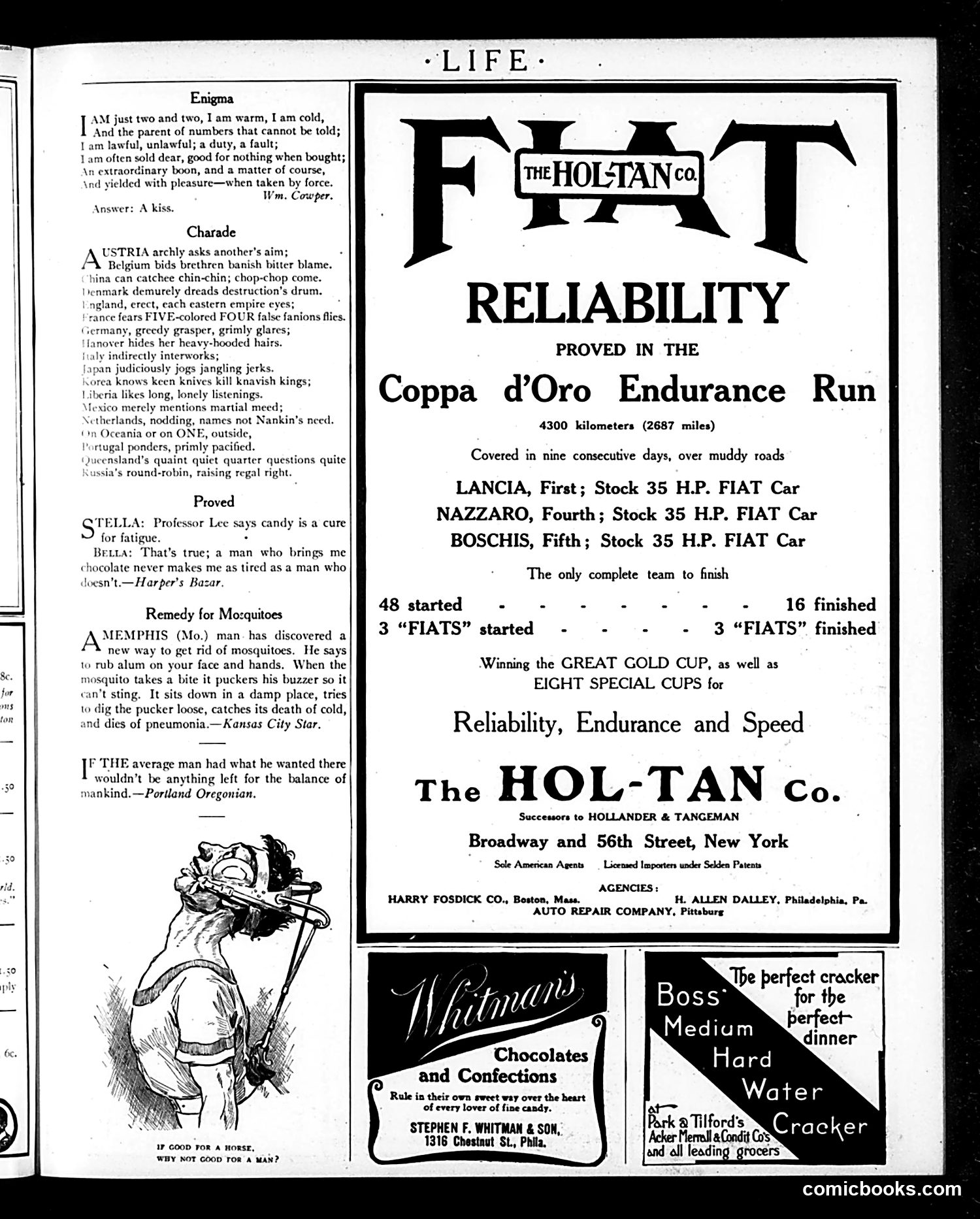
This page is primarily **advertising content** rather than political satire. The dominant feature is a large advertisement for The Holtan Co.'s FIAT automobiles, promoting their reliability based on winning the "Coppa d'Oro Endurance Run" (a 4,300-kilometer race completed in nine days). The left column contains light humor pieces—an "Enigma" riddle, a "Charade" wordplay, and a joke about mosquitoes—typical of Life's satirical filler content. A small cartoon depicts a figure with a wrench, accompanying a joke about balance in life. The page also advertises Whitman's Chocolates and Boss Hard Water Crackers. These ads reflect early 20th-century consumer culture and lifestyle marketing typical of Life magazine during this era.
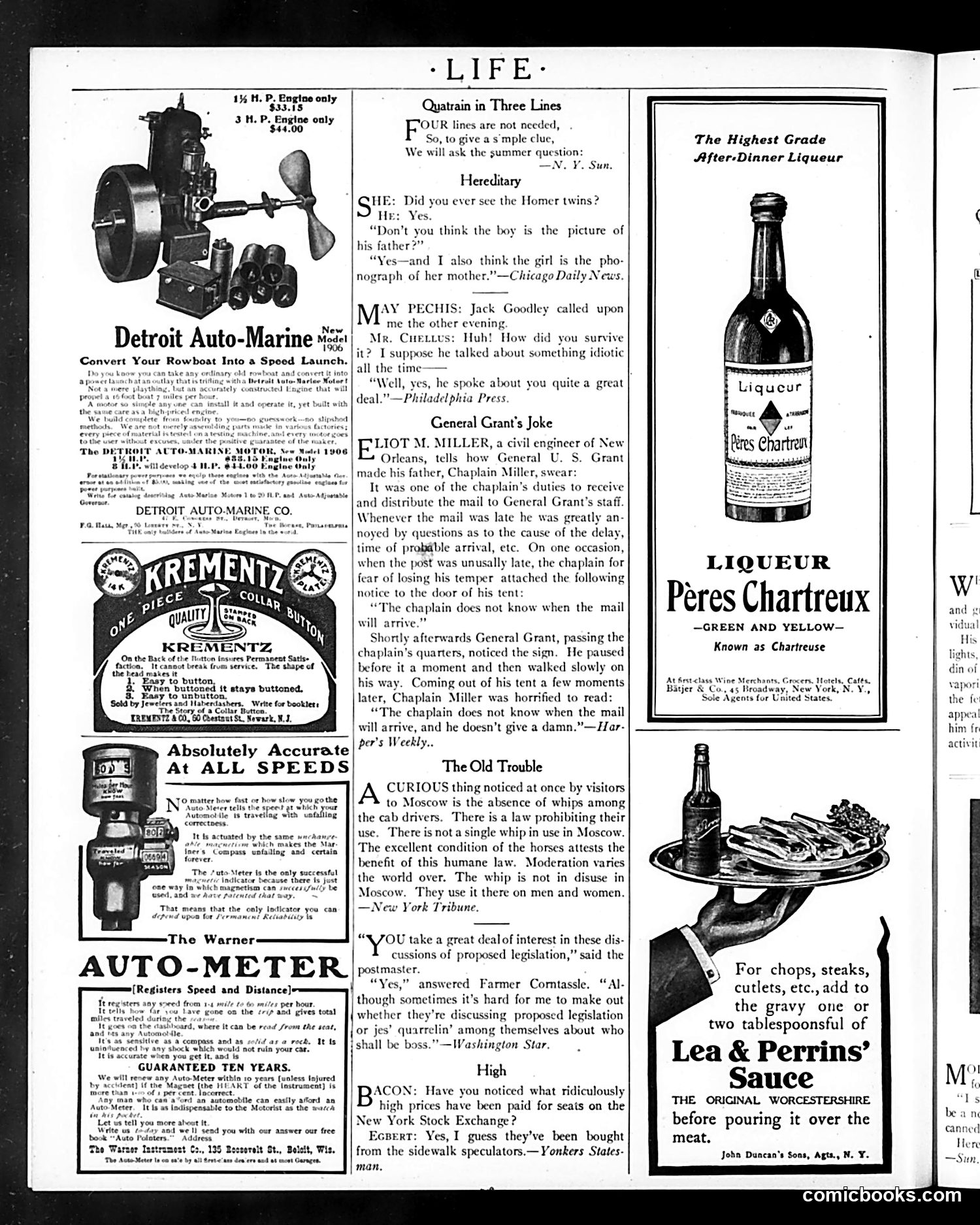
This page is primarily **advertising content**, not political cartoons. The main features are: 1. **Detroit Auto-Marine Motor** - promoting engines for boats and vehicles 2. **Krementz collar buttons** - a fashion accessory ad 3. **Warner Auto-Meter** - a speedometer device 4. **Peres Chartreux liqueur** and **Lea & Perrins Sauce** advertisements The middle section contains brief **humorous anecdotes** rather than satire: jokes about the Homer twins' resemblance to parents, a General Grant story about mail delivery, and observations about Moscow's prohibition on whips. These are light social humor pieces typical of Life magazine's entertainment content, not political commentary. The page reflects early 20th-century consumer culture and product-driven magazine publishing.
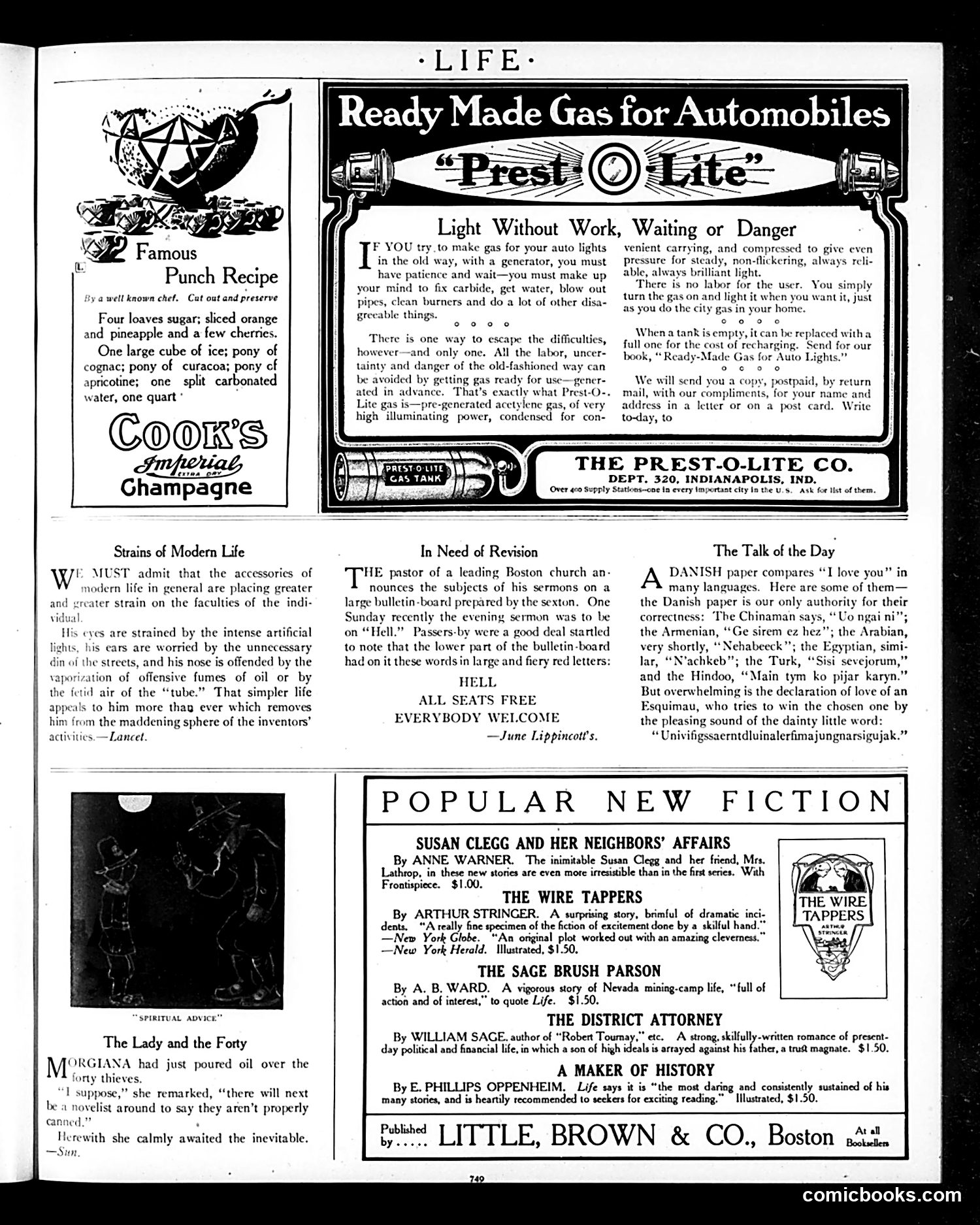
This page is **primarily advertising and editorial content**, not political cartoons. The main visual elements are: 1. **Advertisements** for "Prest-O-Lite" ready-made automobile gas and Cook's Imperial Champagne 2. A **recipe column** for "Famous Punch Recipe" 3. **Three opinion/humor pieces** titled "Strains of Modern Life," "In Need of Revision," and "The Talk of the Day"—brief satirical commentary on contemporary annoyances (artificial lights, church bulletins, and language translations) 4. An illustration titled **"Spiritual Advice"** accompanying a short story excerpt, "The Lady and the Forty" 5. **Book advertisements** from Little, Brown & Co. The page reflects early 20th-century Life magazine's mix of light satire, consumer advertising, and literary promotion rather than focused political cartooning.
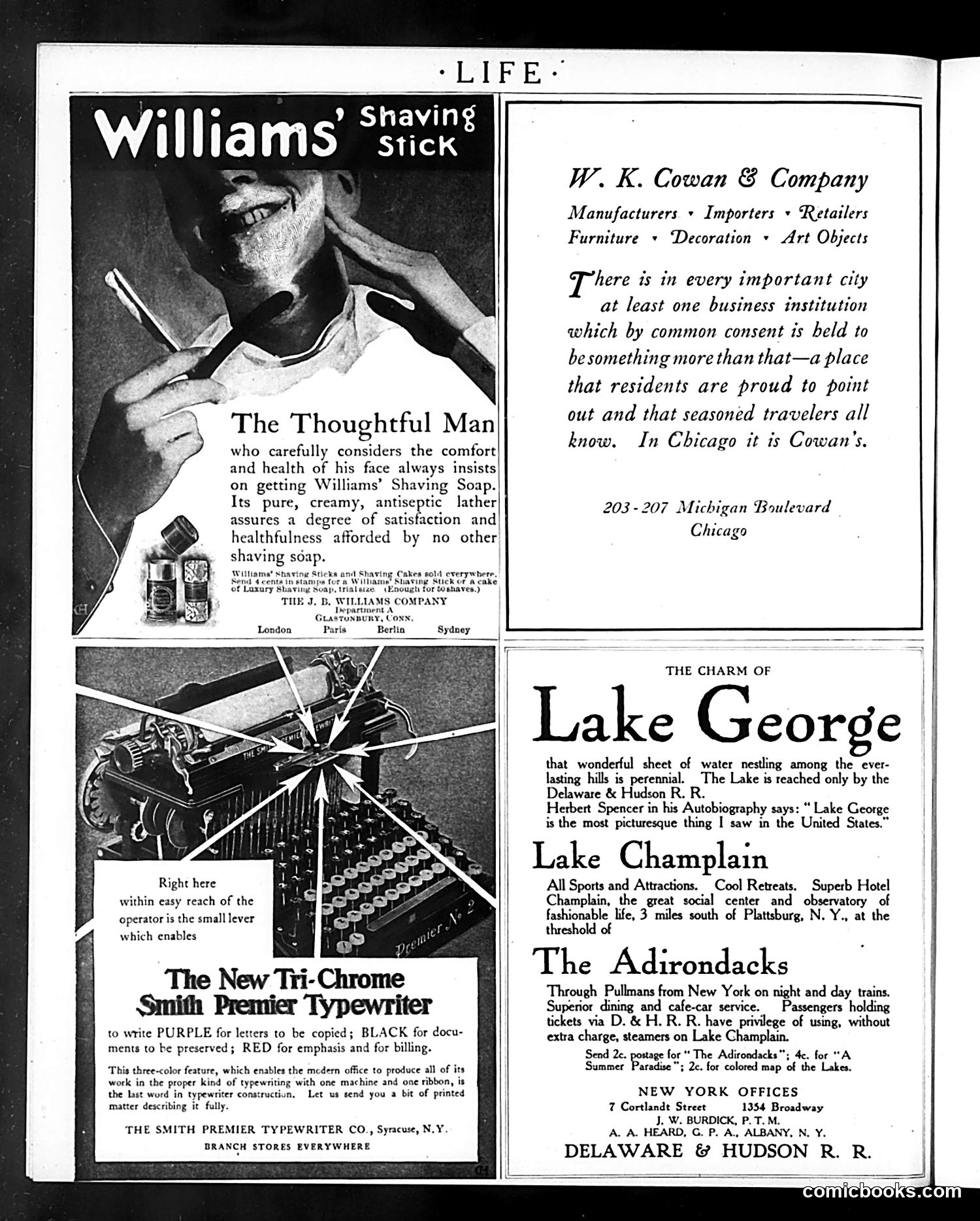
This page is **primarily advertising**, not satire or political commentary. It contains four ads: 1. **Williams' Shaving Stick**: Features a man shaving, marketing the product's antiseptic lather and health benefits. 2. **W. K. Cowan & Company**: A Chicago furniture and decorations business. 3. **Smith Premier Typewriter**: Promotes a new "Tri-Chrome" model allowing purple, black, and red typing—marketed as enabling modern office efficiency. 4. **Lake George/Lake Champlain/The Adirondacks**: Travel promotions for northeastern vacation destinations, with details on train service via the Delaware & Hudson Railroad. These are straightforward commercial advertisements typical of *Life* magazine's revenue model. No political cartoons or satirical content appears on this page.
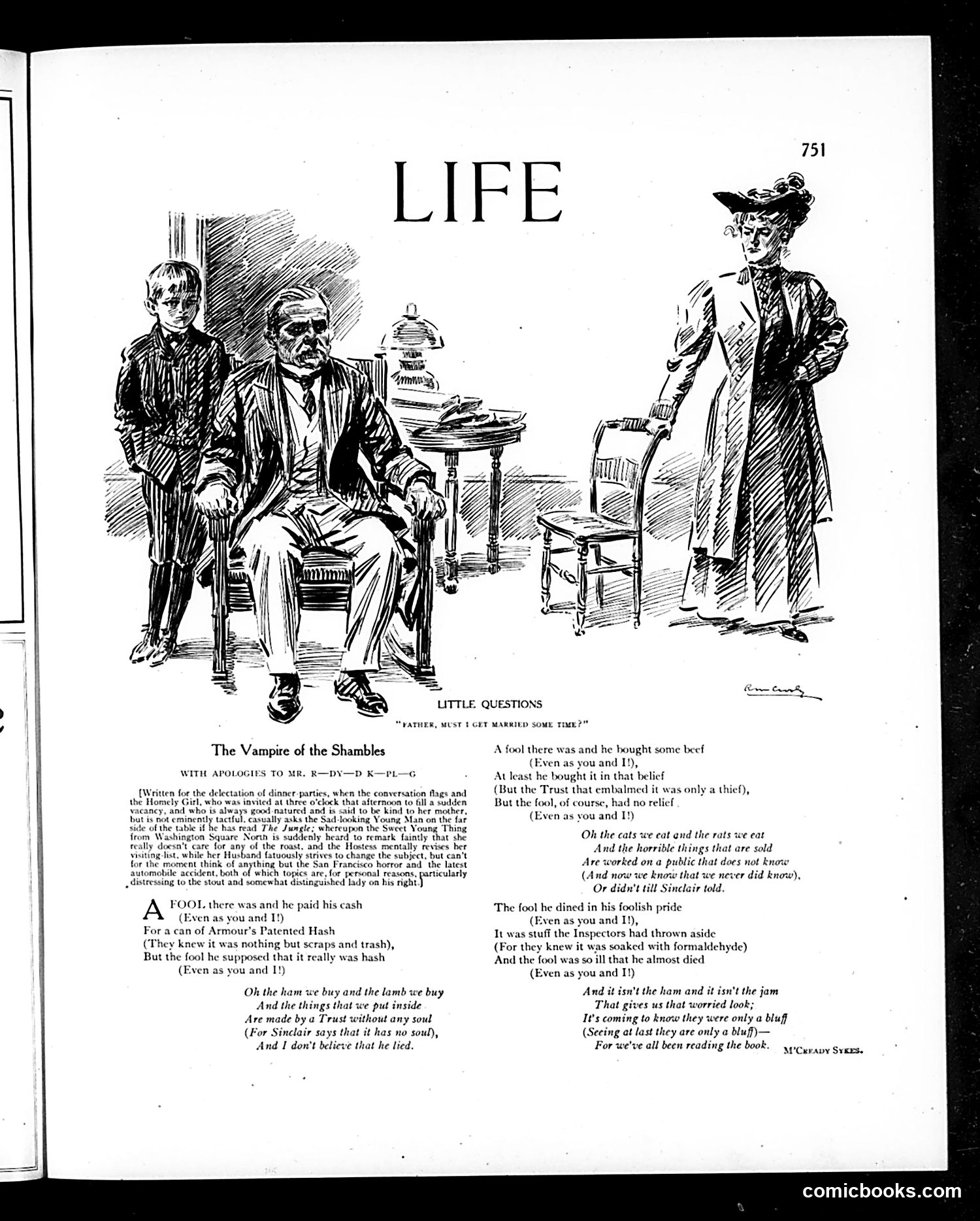
This satirical piece critiques food fraud and adulteration—common concerns in early 20th-century America. The sketch shows a well-dressed man and boy confronting a woman, with the title suggesting she's a dishonest butcher or food seller ("shambles" = butcher's market). The poem mocks a fool who bought allegedly "hash" that was actually discarded meat from food inspectors. The repeated refrain "(Even as you and I!)" suggests this deception was widespread and normalized. The satire targets both the dishonest merchant and consumer gullibility—the "fool" who believes false claims about food quality. The "vampire" metaphor indicates the seller profits by selling dangerous, worthless meat to unsuspecting customers. This reflects genuine Progressive Era anxieties about food safety before modern regulations.
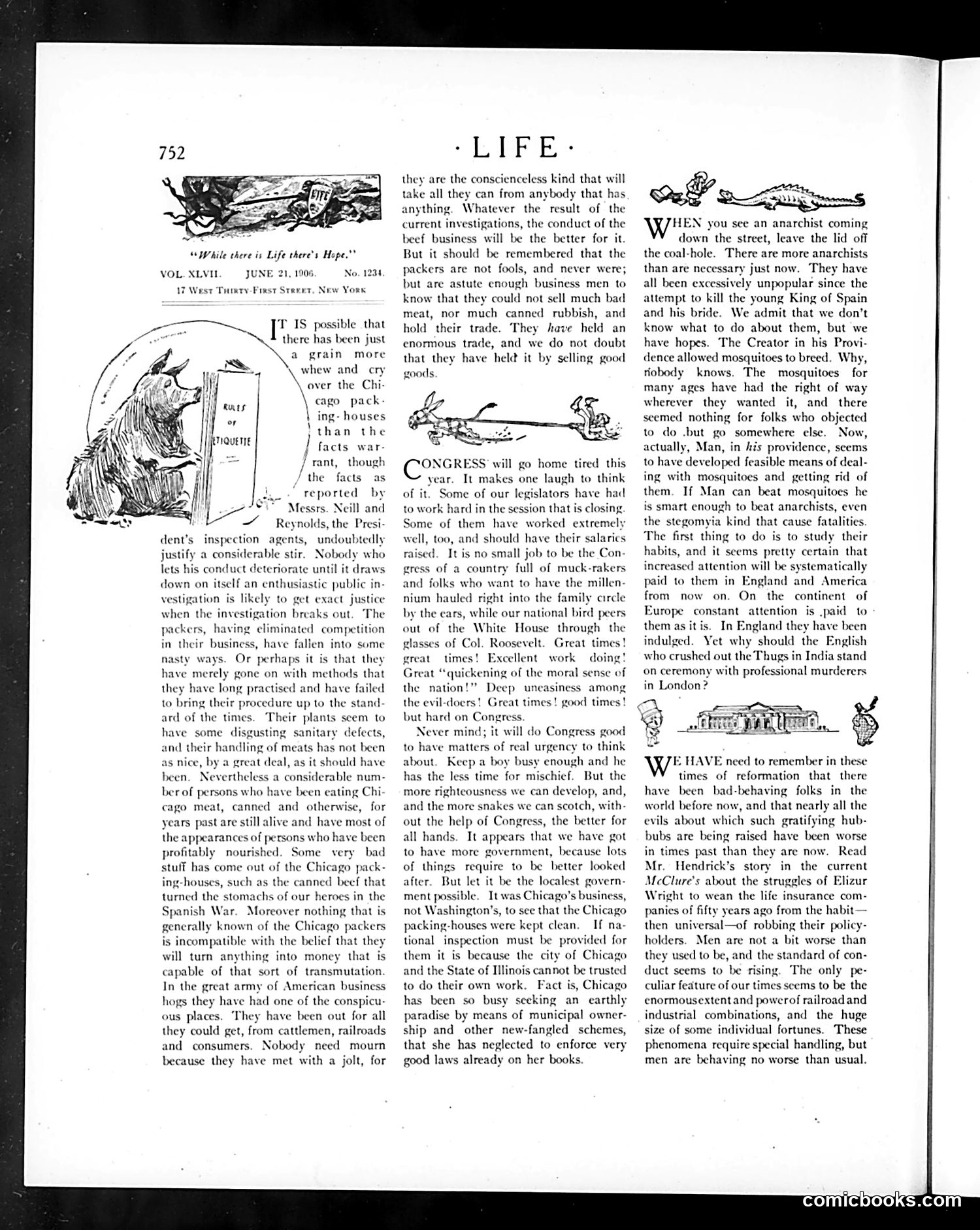
This page contains editorial commentary rather than political cartoons. The left side features a small illustration of what appears to be a dog reading a newspaper labeled "LIFE," likely satirizing how even animals might follow current events. The text discusses anarchists, Congress, and Chicago's meat-packing industry scandals. The writing criticizes anarchists as "unconscionable" and references investigations into Chicago's packing houses, likely alluding to Upton Sinclair's *The Jungle* (1906) exposé. The piece argues that while anarchists are dangerous, American business corruption is equally troubling. It suggests Congressional oversight and municipal enforcement could address sanitation violations in Chicago's meat industry—a reference to progressive-era food safety reforms. The overall tone critiques both radical extremism and corporate malfeasance.
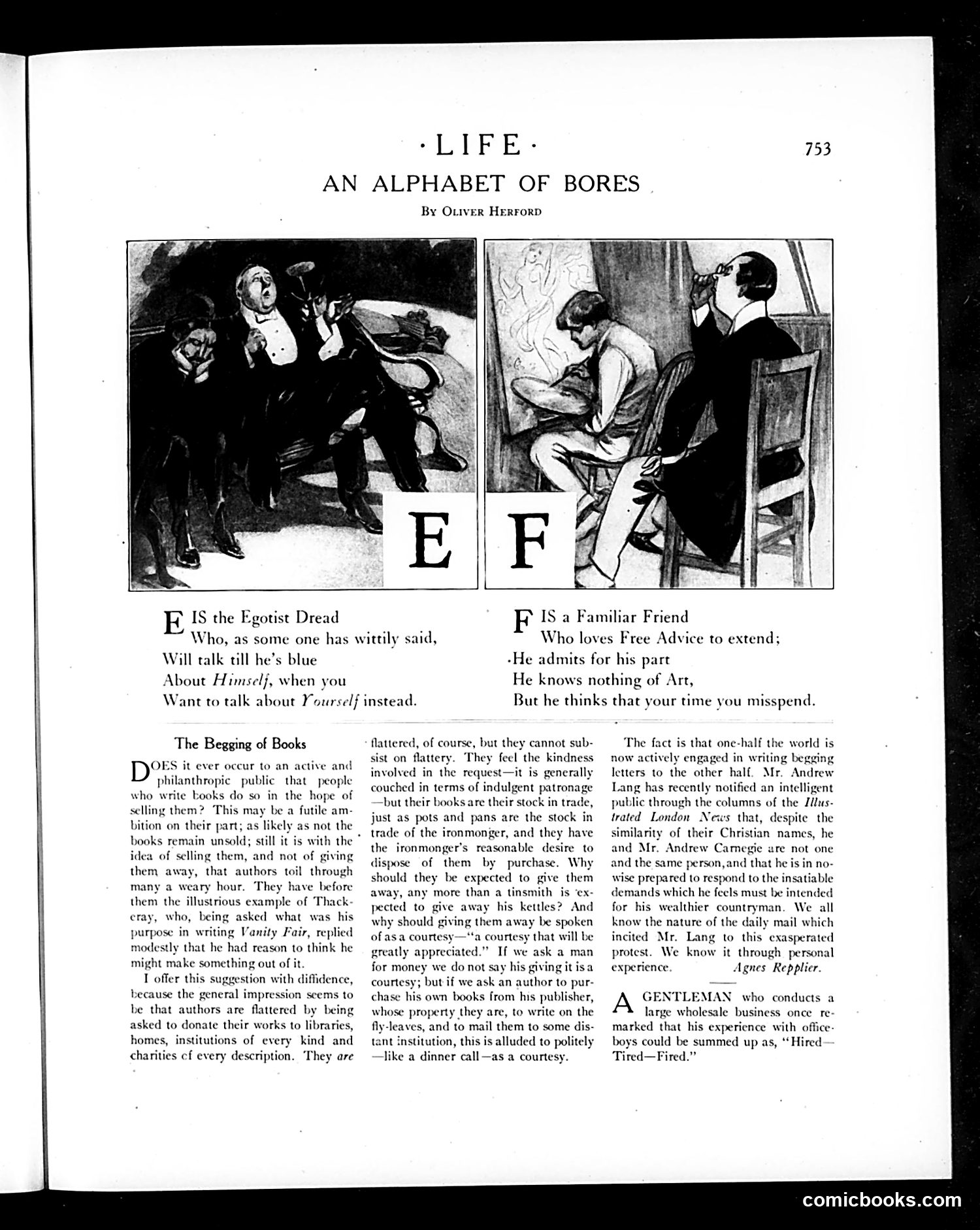
This satirical page presents two character types as social nuisances: **E - "The Egotist Dread"**: A self-centered bore who dominates conversations, constantly steering discussion back to himself ("Himself") rather than letting others speak about themselves ("Yourself"). The illustration shows him gesticulating animatedly while others listen trapped. **F - "A Familiar Friend"**: Someone who offers unsolicited advice about how the listener spends their time, despite knowing nothing about art or meaningful pursuits. He presumes to judge whether the listener's activities constitute time-wasting. Both target common social irritants of the era—the self-absorbed talker and the presumptuous know-it-all friend. The accompanying essay discusses authors' reluctance to donate books to libraries, comparing their resistance to reasonable commercial practices.
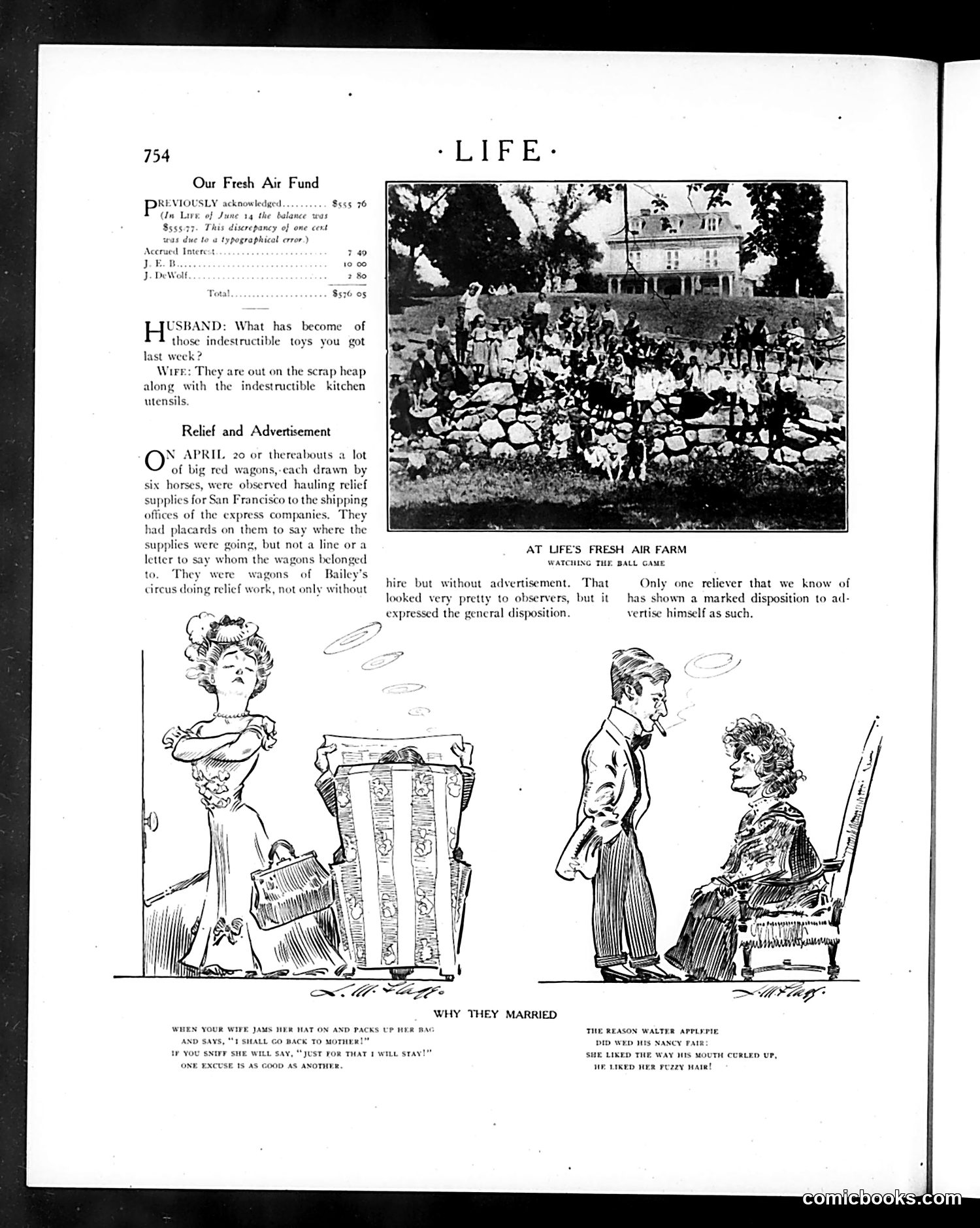
This page contains two marriage-themed cartoon jokes typical of early 20th-century humor: **"Why They Married"** (left): Shows a woman with elaborate hat and luggage declaring she'll return to mother unless the husband prevents it. The joke: he agrees to any excuse to keep her, so one excuse works as well as another—satirizing both nagging wives and hen-pecked husbands. **"The Reason Waiter Appletie Did Wed His Nancy Fair"** (right): A man explains he married Nancy because he liked how her mouth curled up and her fuzzy hair. The satire targets superficial male reasoning about marriage—reducing a wife to physical quirks rather than substantive qualities. Both cartoons mock conventional marriage dynamics through exaggeration and absurdist logic, reflecting period attitudes toward gender relations.
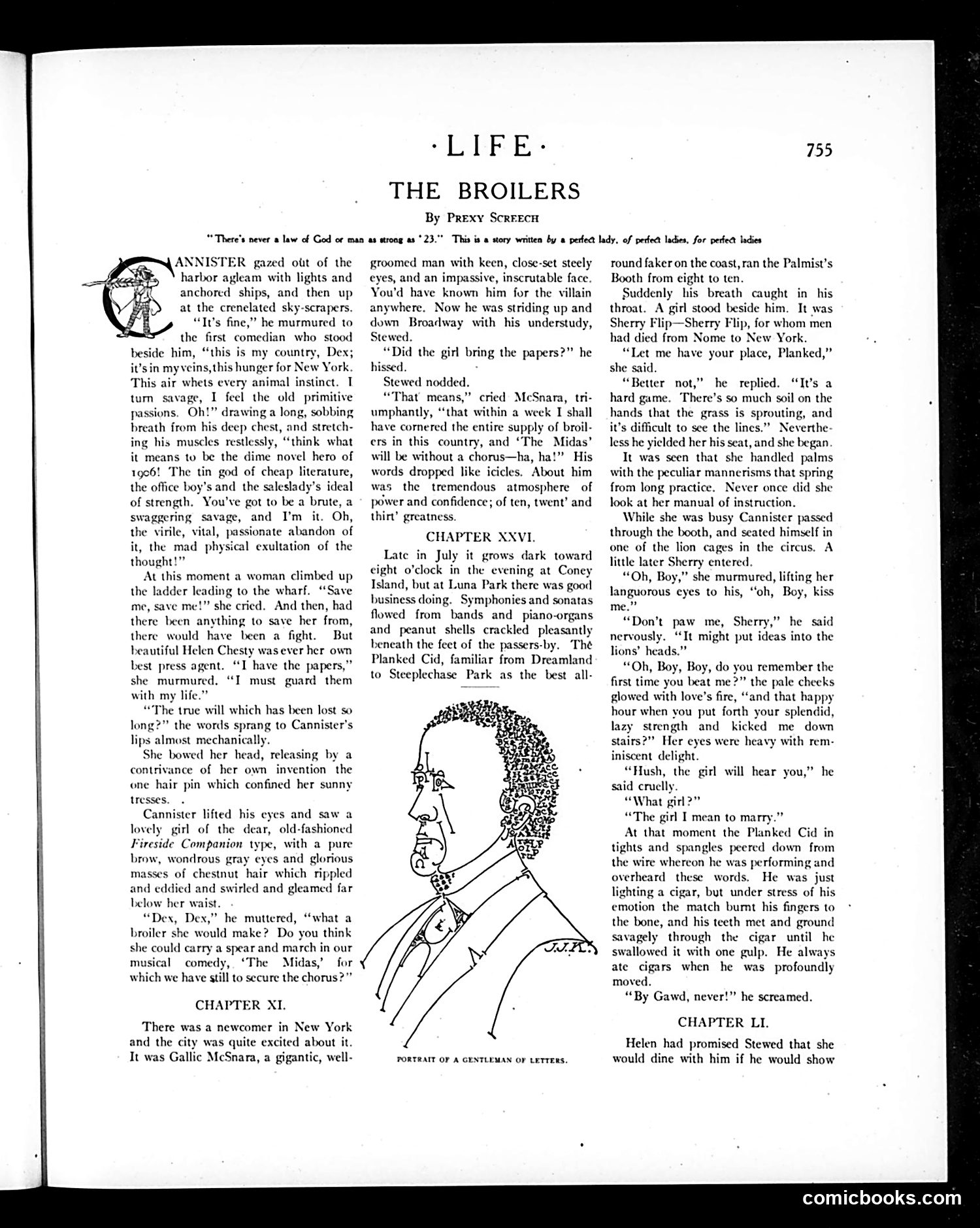
This page presents a short story titled "The Broilers" by Prexy Screech, not a political cartoon. The narrative concerns characters in New York theater and publishing circles, including a protagonist named Cannister and a woman named Helen Cheesy. The single illustration shows a profile sketch labeled "Portrait of a Gentleman of Letters"—likely a caricature of a writer or critic, given the literary context. The story itself appears to be satirical social commentary about theatrical ambition, romance, and publishing business in early 20th-century New York. The specific satire targets unnamed theater figures and industry practices, but without additional historical context, identifying particular individuals or events referenced remains unclear from this page alone.
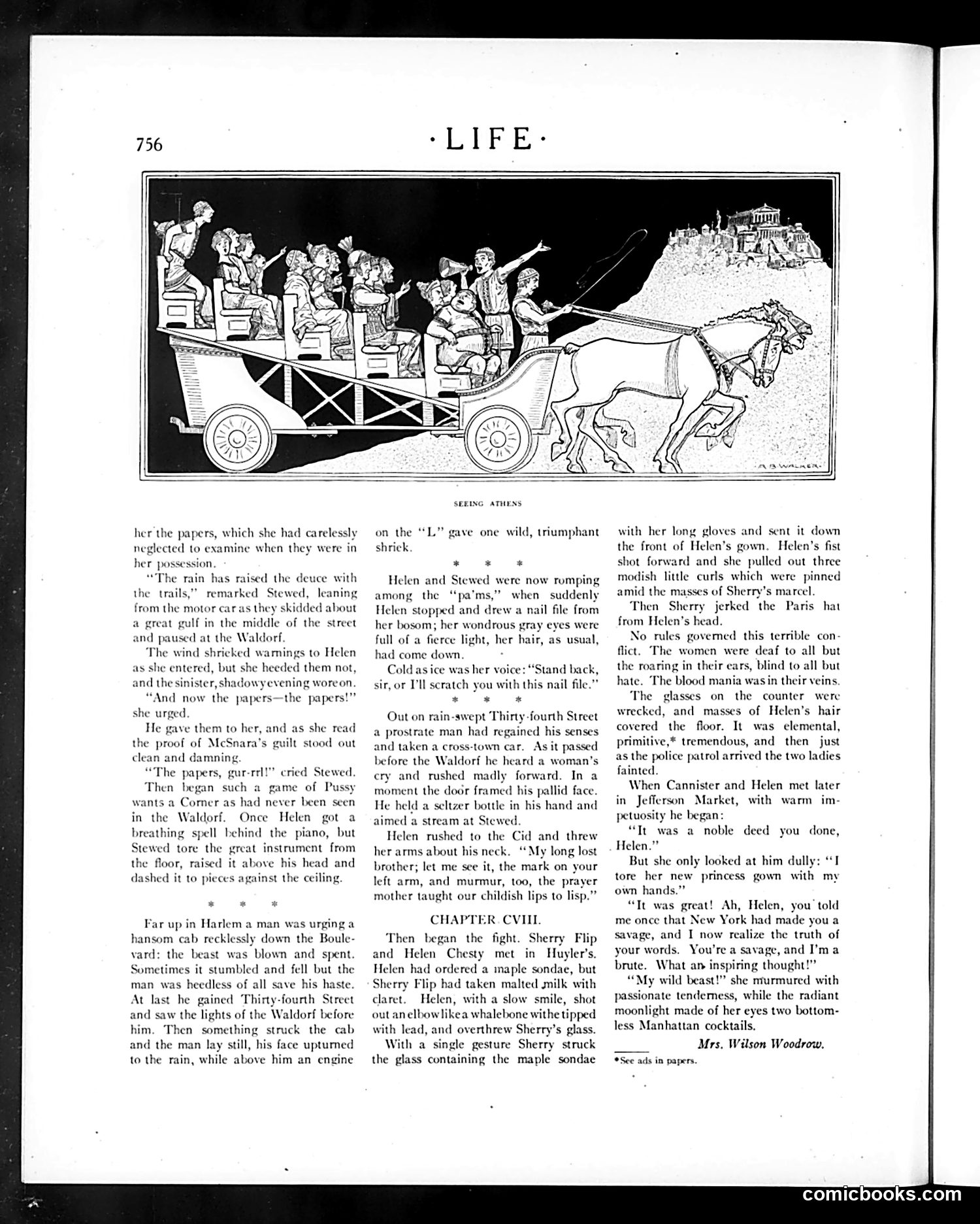
The top illustration depicts a horse-drawn wagon packed with tourists heading toward the Acropolis in Athens, Greece. The cartoon satirizes organized tour culture and the casual, superficial way wealthy travelers experienced famous historical sites. The accompanying story text discusses characters named Helen, Stewed, and Sherry Flip—apparently wealthy women on a tour who engage in frivolous behavior and romantic drama while supposedly sightseeing. The narrative mocks their preoccupation with gossip, fashion, and social conflicts rather than genuine appreciation for classical antiquity. This appears to be satirizing the Gilded Age tourist phenomenon: how the wealthy traveled to important historical sites yet remained entirely absorbed in their own social dramas, missing the actual cultural and historical significance around them.
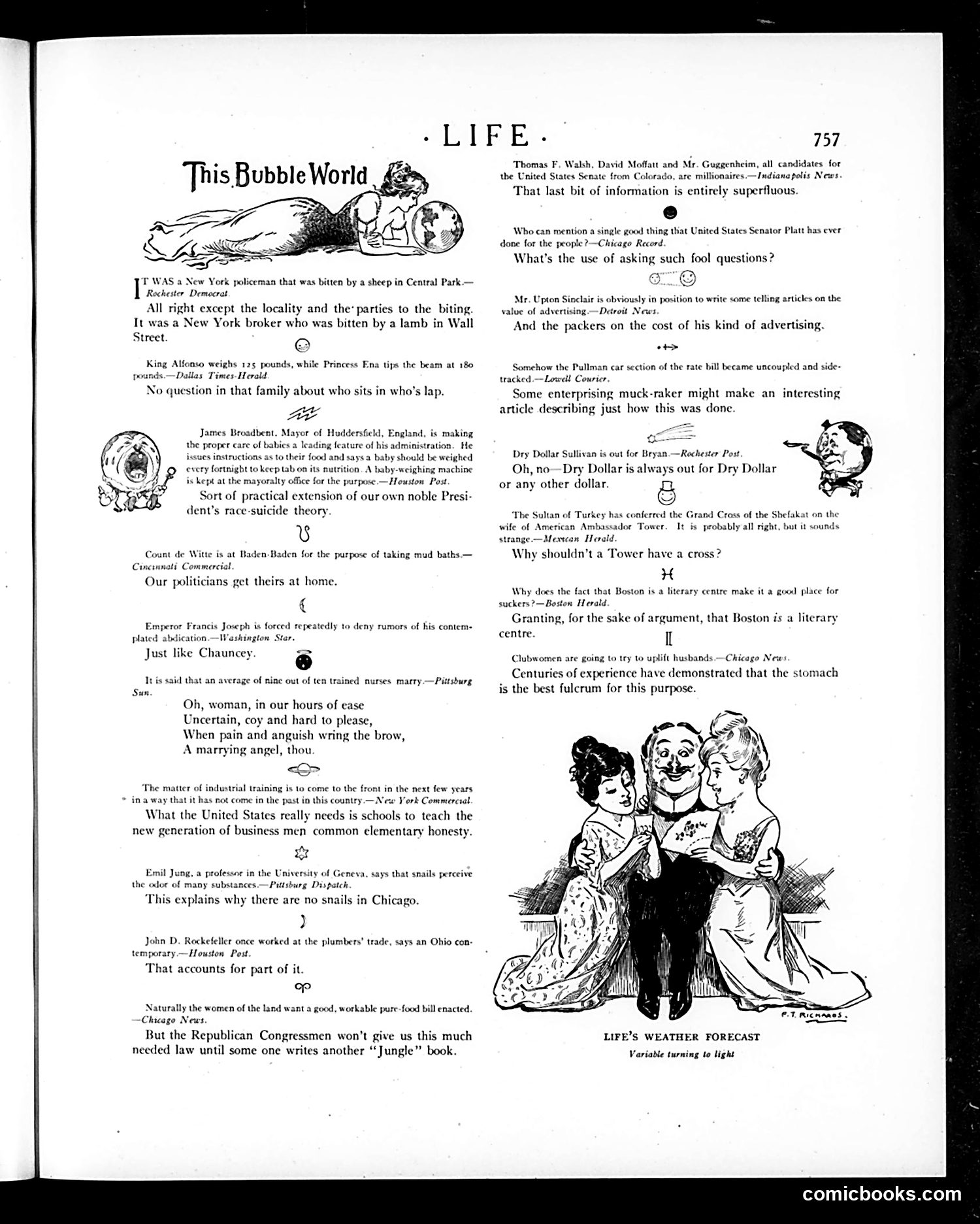
This page from *Life* magazine contains a section titled "This Bubble World" featuring short satirical observations about current events and social absurdities. The content mocks various figures and institutions: a New York broker bitten by a sheep, King Alfonso of Spain (a real historical figure), James Broadbent of Huddersfield experimenting with dog nutrition, Count de Witte's bathing habits, and Emperor Francis Joseph denying rumors. The satire targets American politicians and institutions—senators seeking millionaire status, Dry Dollar Sullivan (unclear reference), Boston's literary pretensions, and Republican Congressmen's refusal to pass "pure food" legislation. The final cartoon illustrates the stomach as women's proper concern, captioned "Life's Weather Forecast: Variable turning to light"—mocking female domesticity. The overall tone is pointed social criticism through humor and exaggeration.
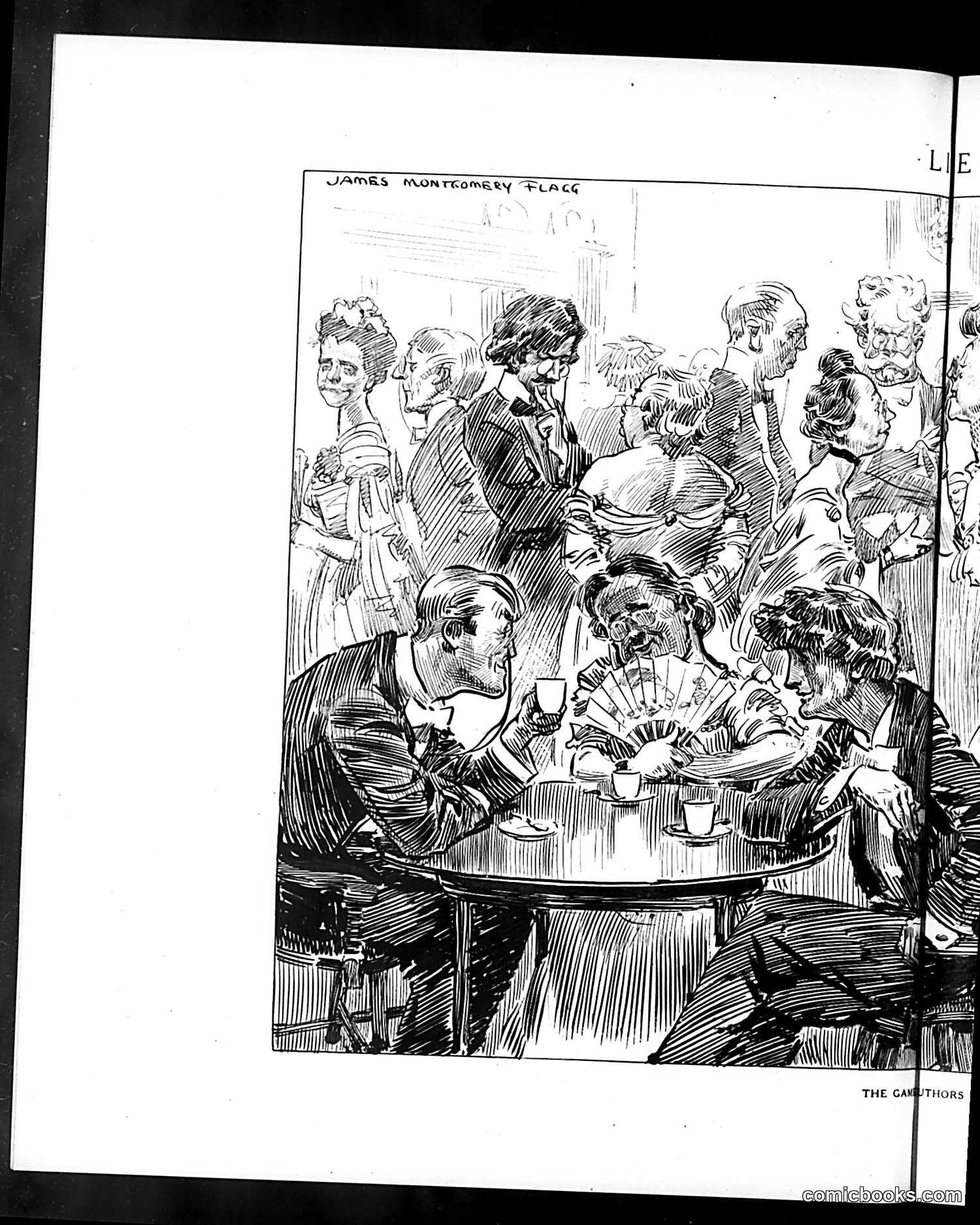
This ink sketch by renowned illustrator James Montgomery Flagg depicts a crowded social gathering with well-dressed men and women seated and standing around a table. The title "The Gamblers" suggests the scene satirizes high-society gambling or card-playing culture. The composition shows a mix of elegantly dressed figures—some seated at what appears to be a gaming table with drinks, others standing in the background observing. The style is characteristic of early 20th-century American satirical illustration, likely mocking the leisure activities and social pretensions of wealthy society figures engaged in gambling. Without additional context about the specific publication date, the precise identities of caricatured individuals remain unclear, though the drawing likely references contemporary social scandals or well-known gamblers of that era.
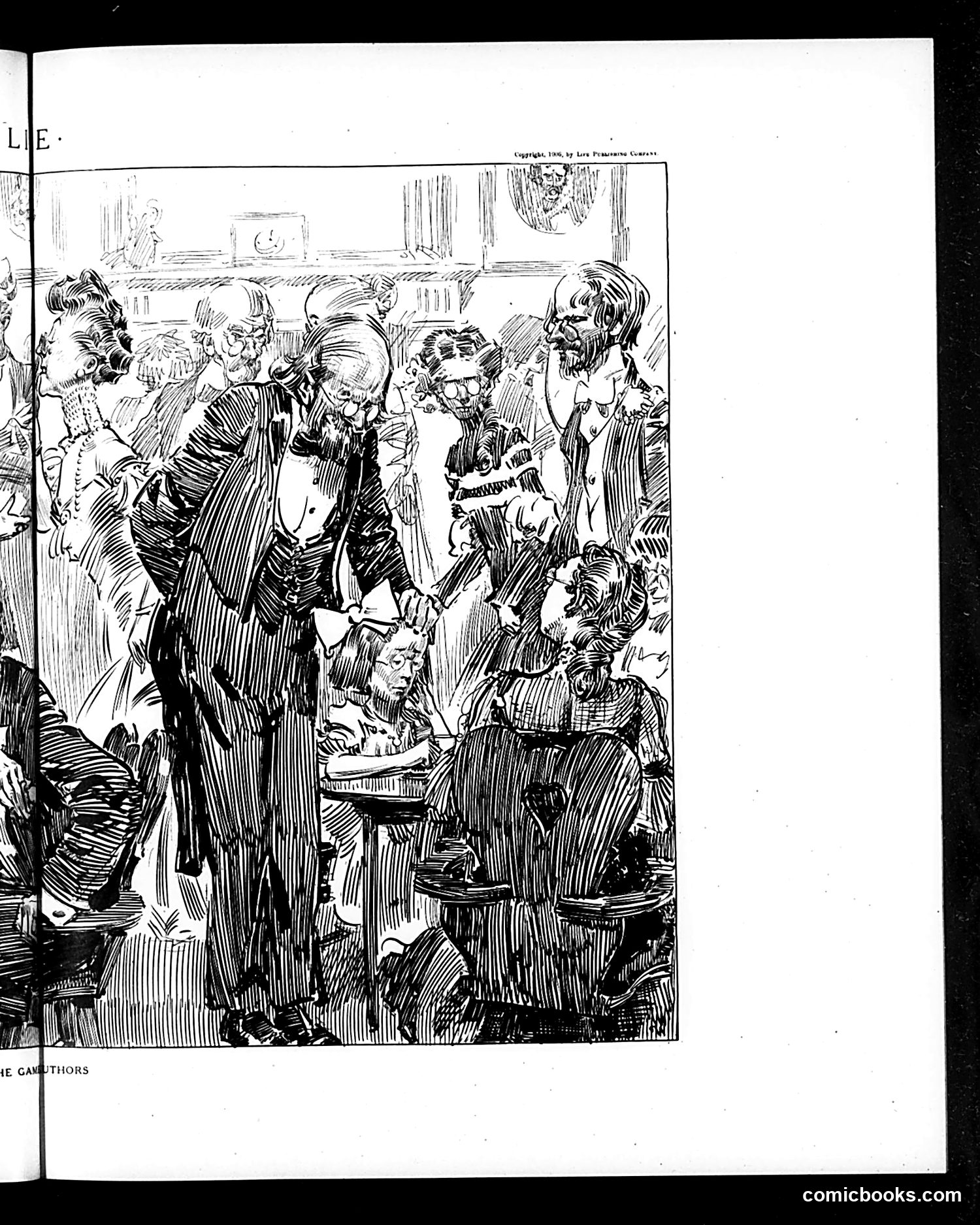
This appears to be a black and white satirical illustration from *Life* magazine showing a crowded indoor scene with well-dressed men in formal attire (suits and hats) gathered around what seems to be a central figure or event. The exaggerated facial features and caricature style are typical of early-to-mid 20th century political cartooning. However, without legible text identifying the specific figures, political figures, or event being satirized, I cannot definitively state who is depicted or what particular political or social commentary is intended. The formal dress and crowded gathering suggest this may mock a high-society event or political gathering, but the specific subjects and satirical point remain unclear from the image alone. More context would be needed for accurate interpretation.
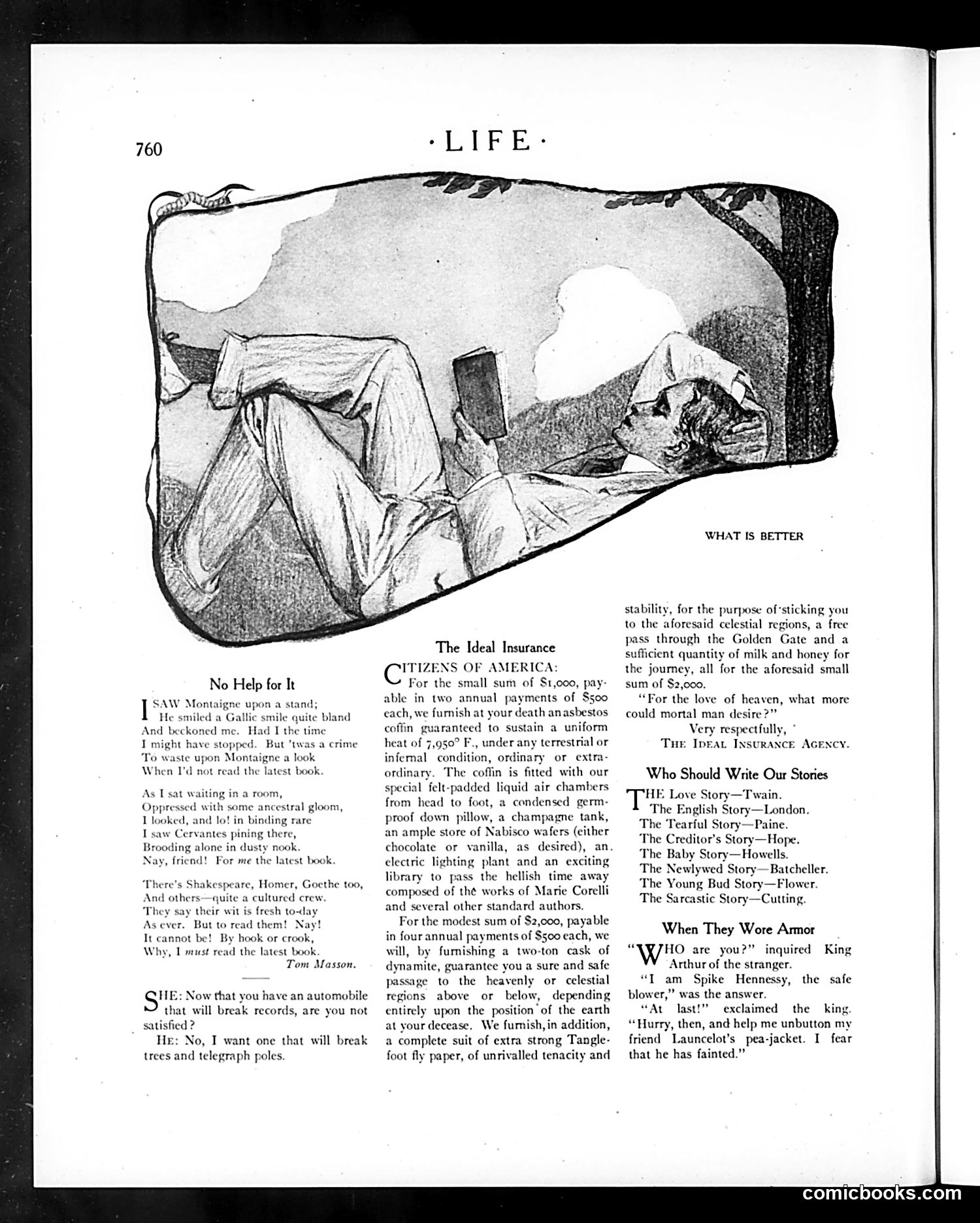
This page contains three separate satirical pieces mocking American society circa early 1900s: **"No Help for It"** (poem by Tom Masson): Ridicules intellectuals obsessed with reading the latest fashionable books while ignoring literary classics (Shakespeare, Homer, Goethe, Cervantes, Montaigne). The satire is that people prioritize current trends over actual merit. **The Automobile Joke**: A man with a record-breaking car isn't satisfied—he wants one that destroys trees and telegraph poles, mocking excessive materialism and recklessness among the wealthy. **"The Ideal Insurance"**: Parodies absurd insurance schemes with mock-serious offers of asbestos coffins and dynamite packages for the afterlife, complete with champagne tanks and Marie Corelli novels. It satirizes both over-insurance marketing and literary taste (Corelli was considered lowbrow). **"When They Wore Armor"**: A brief joke playing on names: "Spike Hennessy, the safe blower" confuses a medieval knight, creating wordplay humor. All pieces mock contemporary American pretensions and consumer culture.
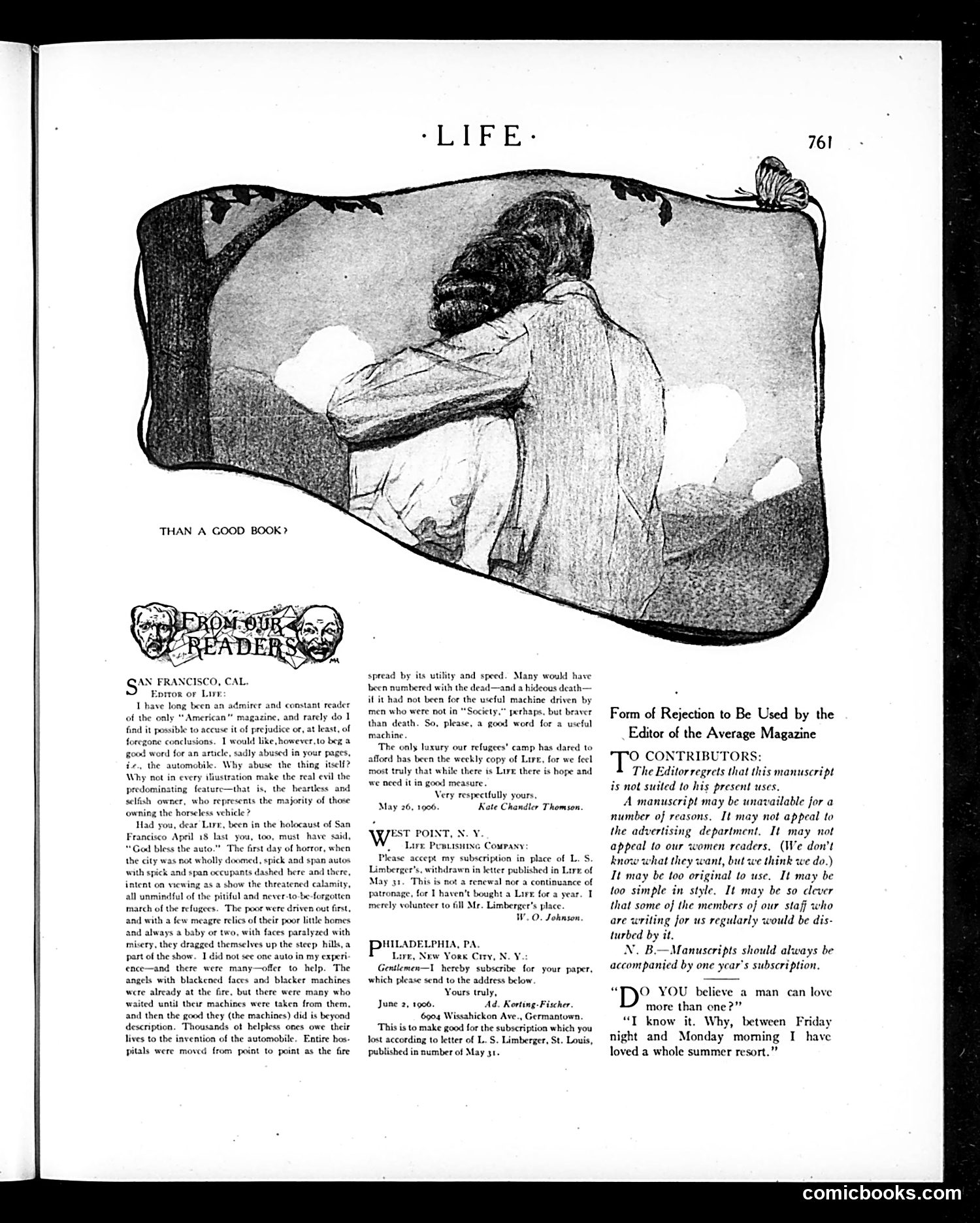
This page contains **reader letters responding to Life magazine's coverage**, primarily about automobiles following the **1906 San Francisco earthquake and fire**. **Main content:** Kate Chandler Thomson defends automobiles, arguing Life unfairly blamed "heartless" car owners rather than the machines themselves. She witnessed the disaster firsthand and credits autos—driven by working-class people, not "Society" members—with saving refugee lives and transporting hospitals. **The satire:** A "Form of Rejection" mocks magazine editors' pretentious excuses for rejecting manuscripts, suggesting they care more about advertising revenue and appealing to female readers than quality writing. **The joke at bottom:** A man admits to loving multiple women simultaneously—a dig at casual summer romance culture among the wealthy. **Context:** This reveals Life's role as a forum for public debate on modern issues (automobiles, class distinctions) while satirizing publishing industry hypocrisy. The San Francisco disaster frames discussions about technology's humanitarian value versus class-based prejudice.
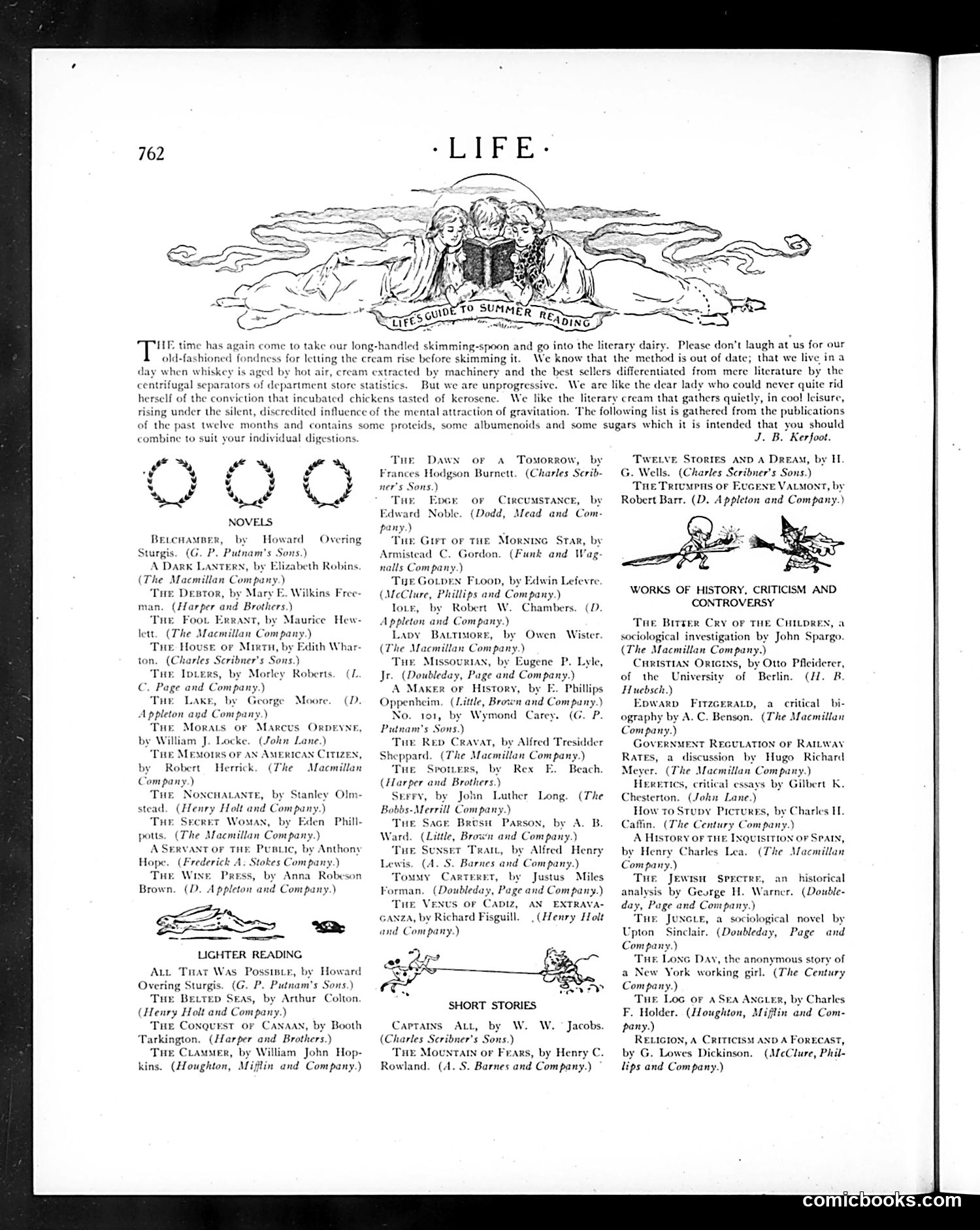
This page is primarily a **book recommendation list**, not a political cartoon. It's Life magazine's curated summer reading selections organized by category: Novels, Lighter Reading, Short Stories, and Works of History/Criticism. The decorative header features cherubs and clouds—standard turn-of-the-century ornamental design. The introductory text uses gentle self-mockery: the editors compare themselves to an old-fashioned lady who insists on quality ("literary cream") over modern mass-produced bestsellers, acknowledging they're "unprogressive" but defending their taste against commercially-driven literature separated from "mere literature by the centrifugal separators of department store statistics." The books listed are contemporary works by authors like Frances Hodgson Burnett, Owen Wister, and H.G. Wells—popular Edwardian literature. The satire is subtle: Life positions itself as a curator of refined taste against crass commercialism, a common pose for elite publications of this era.
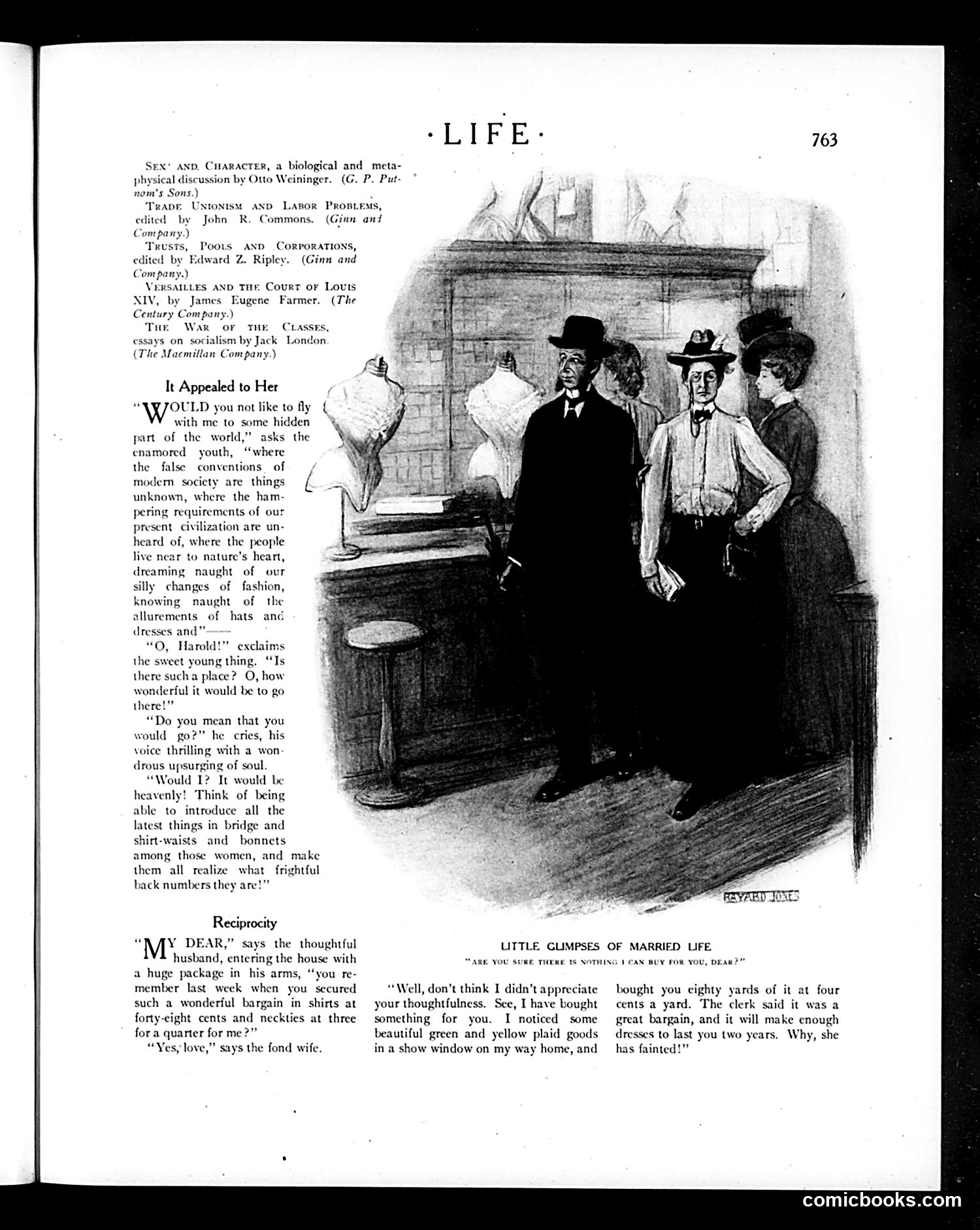
This page contains two satirical pieces mocking early 20th-century romantic and marital conventions: **"It Appealed to Her"** ridicules both naive idealism and materialism. A young man romantically proposes escaping civilization's "false conventions" to live naturally near "nature's heart." The woman eagerly agrees—but only to introduce fashionable hats, dresses, and bridge games to those "backward" people, revealing her true priorities are status and consumption, not genuine escape from society. **"Little Glimpses of Married Life"** satirizes reciprocal gift-giving within marriage. After the wife secured a bargain on men's clothing, the husband purchases 80 yards of gaudy plaid fabric as a "bargain" gift. The humor lies in the husband's obliviousness: he's essentially trapped his wife in excessive textile she didn't want, mirroring her thoughtless bargain-hunting back at her. Both pieces target shallow social pretension and the gap between romantic/domestic ideals and actual selfish behavior.
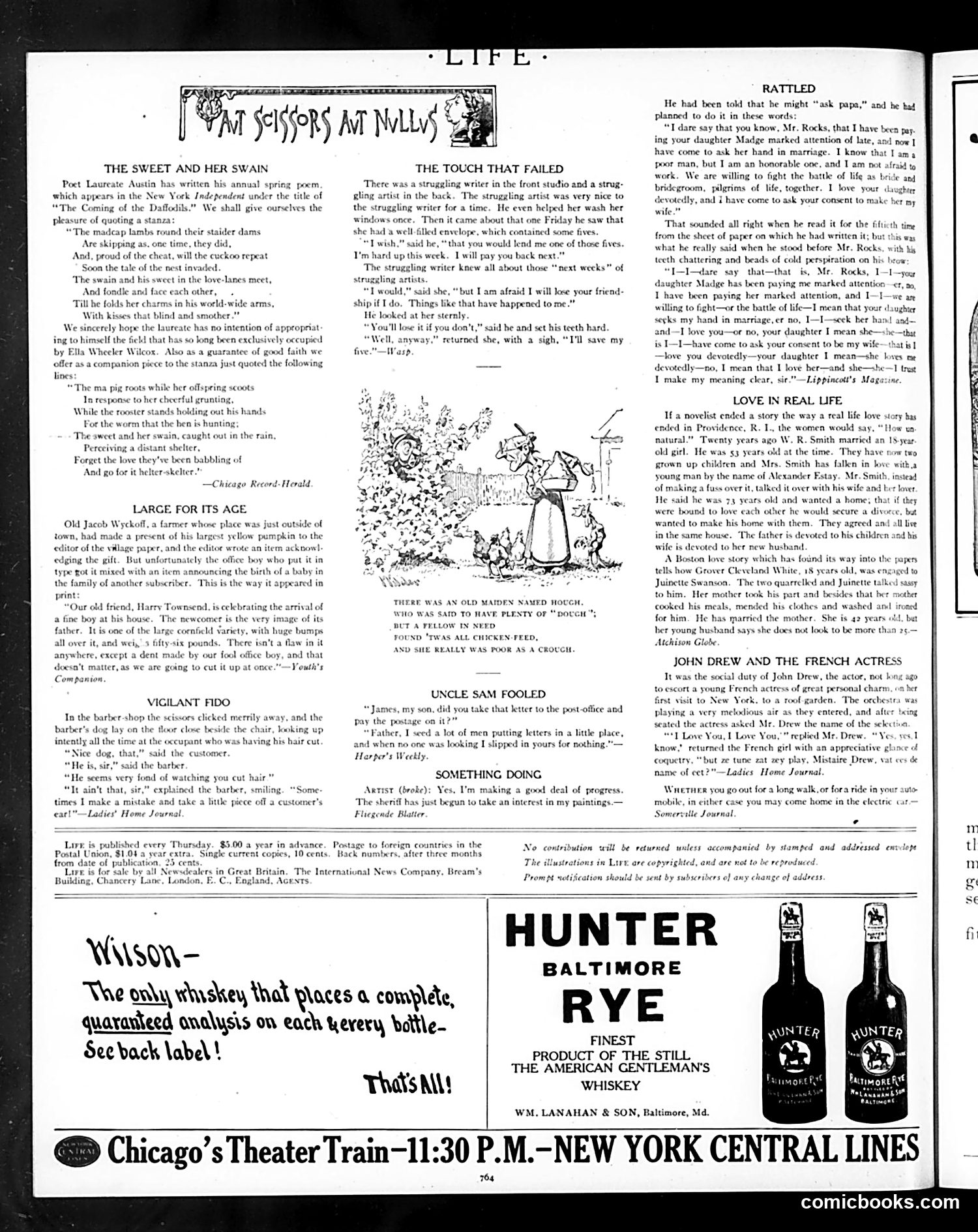
This page contains several humorous short stories satirizing romantic misadventures and social awkwardness among the middle and upper classes: **"The Touch That Failed"**: A struggling artist and writer—both poor—interact. When the artist asks to borrow money, the writer refuses, fearing it will damage their friendship. The artist responds coldly that refusing will end their friendship anyway, creating an absurd logical trap. **"Rattled"**: A young man plans an eloquent marriage proposal to his girlfriend but becomes so nervous before her father that he stammers incoherently—confusing whether he's proposing to the father, the daughter, or declaring his love for both. It satirizes the gap between planned and actual social performance. **"Love in Real Life"**: Brief anecdotes showing that real romance differs from sentimental fiction—including a 53-year-old man marrying a 15-year-old girl 20 years prior (presented as curious rather than condemned by modern standards). The satire targets Victorian romantic pretensions and social anxiety among the educated classes.
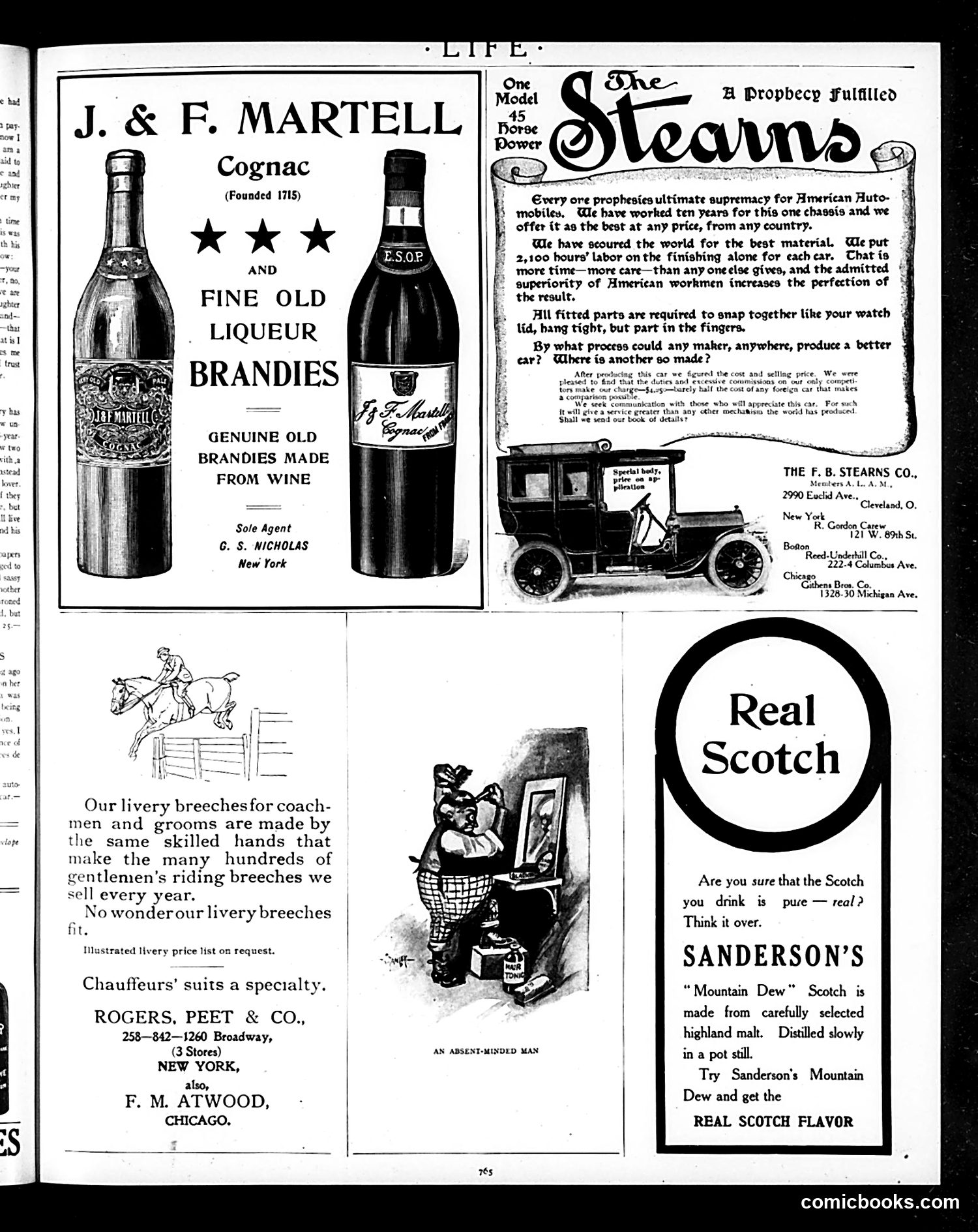
This is primarily an **advertising page** from an early 20th-century Life magazine, not a political cartoon. It contains luxury goods advertisements targeting wealthy readers: **Key advertisements:** - **J. & F. Martell Cognac** (founded 1715) and fine brandies - **F. B. Stearns automobiles** — claims American manufacturing superiority with 2,100 hours of hand labor per car, emphasizing American workmanship over foreign competitors - **Rogers, Peet & Co.** — custom livery clothing for coachmen and chauffeurs - **Sanderson's Mountain Dew Scotch** — asserting authenticity ("real Scotch flavor") **The small cartoon** labeled "An Absent-Minded Man" shows a figure examining items, likely illustrating a humorous anecdote, though the specific joke is unclear from context. The page reflects **Edwardian-era consumer culture**: emphasis on craftsmanship, imported luxury goods, and the emerging American automobile industry's competitive positioning against European manufacturers. These ads target the wealthy elite who could afford custom cars and tailored clothing.
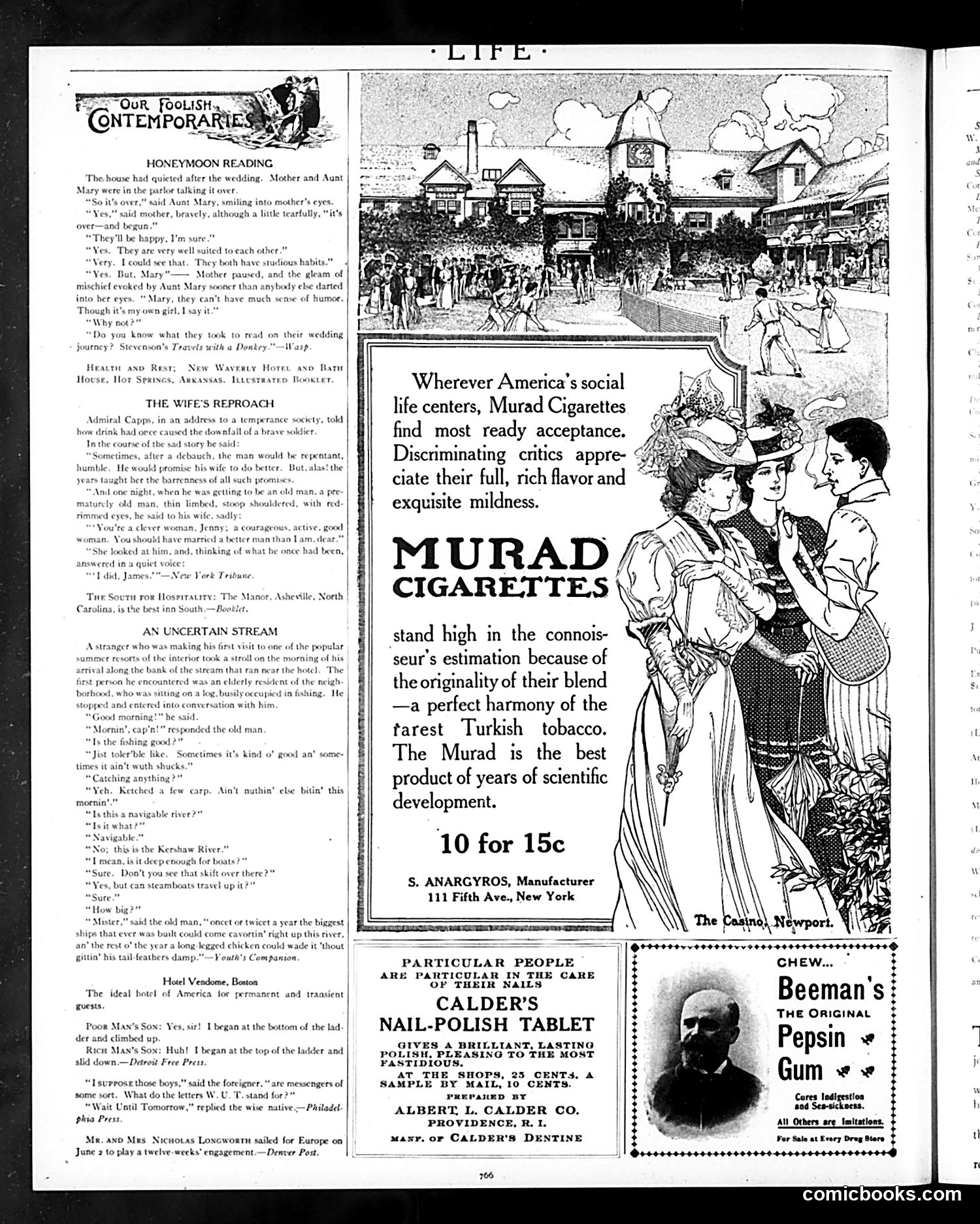
This page combines satirical short humor pieces with period advertisements. The left column contains several brief anecdotes mocking contemporary social customs: **"Honeymoon Reading"** jokes about a newlywed couple who brought a temperance tract on their honeymoon—satirizing the era's rigid moralism. **"The Wife's Reproach"** depicts a woman criticizing her husband's drinking, mocking Victorian gender dynamics around alcohol temperance. **"An Uncertain Stream"** features dialogue between a stranger and an old man about river navigation—likely satirizing rural dialect humor common to Life's era. The right side is dominated by a **Murad Cigarettes advertisement** claiming discriminating connoisseurs appreciate their Turkish tobacco blend. This reflects early 1900s advertising before tobacco health concerns were public knowledge. Below are smaller ads for **Calder's Nail-Polish Tablet** and **Beeman's Pepsin Gum**, typical consumer products of the period. The page exemplifies Life's format: light social satire targeting urbanized readers' sensibilities, paired with contemporary commercial messaging.
This page is primarily a **books section and advertisements** rather than political satire or commentary. The left column lists recently published books—a mix of literary works (Shakespeare, Mark Twain), religious texts, and practical guides typical of early 1900s publishing. The advertisements feature consumer products of the era: - **Gibbons' Record Rye Whiskey** and Abbott's Bitters (patent medicines/spirits) - **Brighton Flat-Clasp Garters** (men's hosiery) - **O'Sullivan Rubber Heels** (with dialogue between customer and salesman promoting rubber heels as a health benefit) - **The Keeley Cure** (a famous commercial treatment program for alcohol and drug addiction) There is no visible political cartoon. The content reflects *Life* magazine's typical format mixing book reviews with period advertisements—some promoting alcohol while others (Keeley) promised cures for alcohol abuse, an irony common to the era.
This page is primarily **advertising with interspersed humor columns**—typical of early 20th-century Life magazine format. The small cartoons and jokes address everyday concerns: financial hardship (coal and ice bills draining summer joy), prison conditions (women inmates described as having "no other home"), and racial dialect humor (a common, though offensive, feature of period publications depicting African American speech patterns). One anecdote satirizes a "simple" village boy who repeatedly chooses a penny over a threepenny bit—not from stupidity but strategy: taking the larger coin would end the game. It's a gentle joke about cunning disguised as foolishness. The page otherwise advertises steamship travel to Virginia, cocktail mixers, beer brewing processes, pianos, and foot powder—reflecting consumer culture of the era. The content reflects both the magazine's satirical voice and its dependence on commercial advertising.
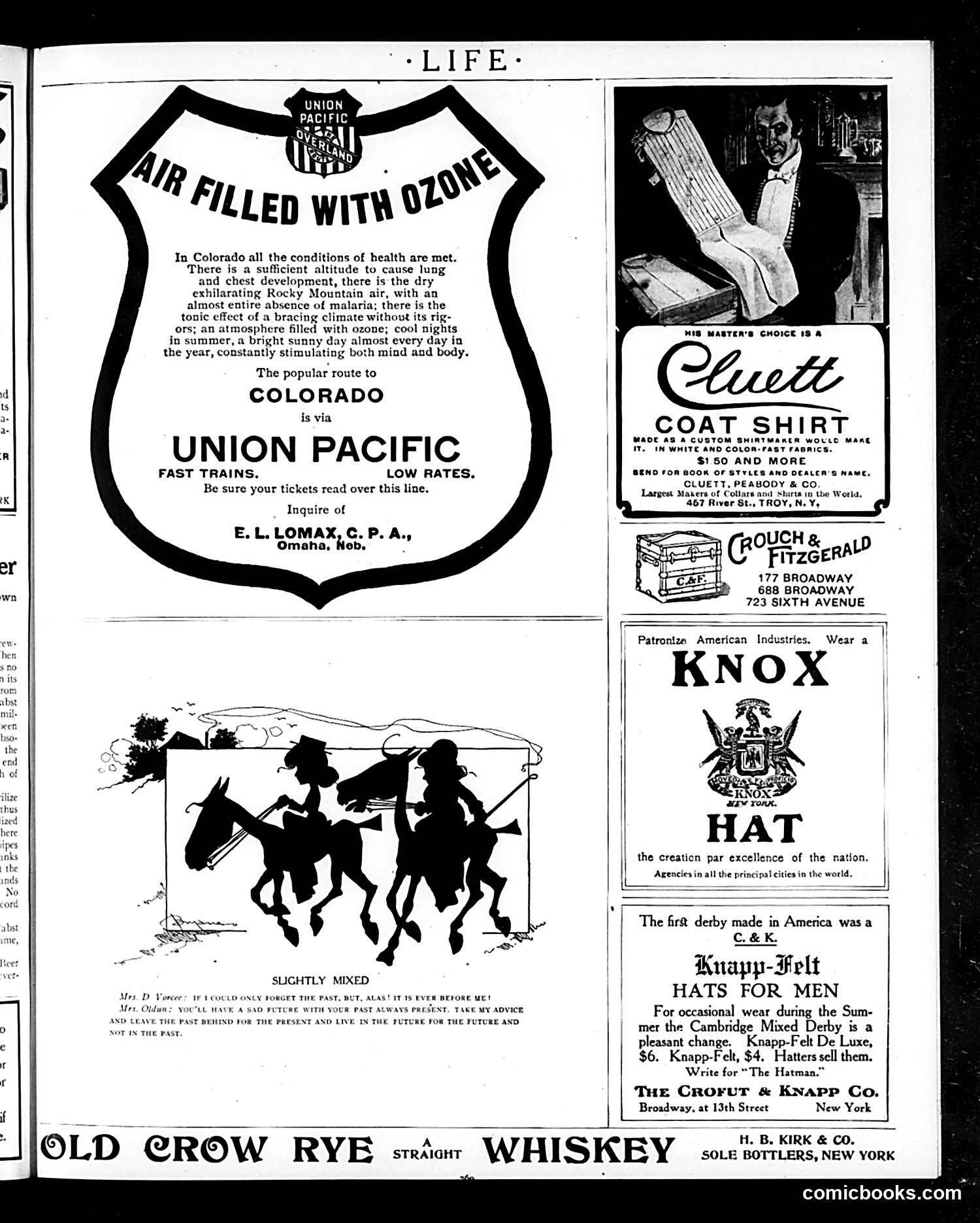
This is primarily an **advertising page** with one small cartoon. The main content promotes Union Pacific trains to Colorado, emphasizing the region's health benefits—altitude, dry air, ozone-filled atmosphere, and sunshine—typical 1910s-era wellness tourism marketing. The cartoon titled "Slightly Mixed" depicts two women in conversation. Mrs. D. Vorcee laments being haunted by her past; Mrs. Oldum advises her to forget it and focus on the present and future instead. The joke appears to be wordplay: "D. Vorcee" likely suggests "Divorce," and "Oldum" suggests "Old 'um," implying Mrs. Oldum is offering worldly advice from experience. The cartoon satirizes how people—particularly women dealing with divorce or relationship troubles—struggle to move forward emotionally. The remainder consists of period advertisements for Cluett dress shirts, Knox hats, Knapp-Felt hats, and Old Crow Rye whiskey.
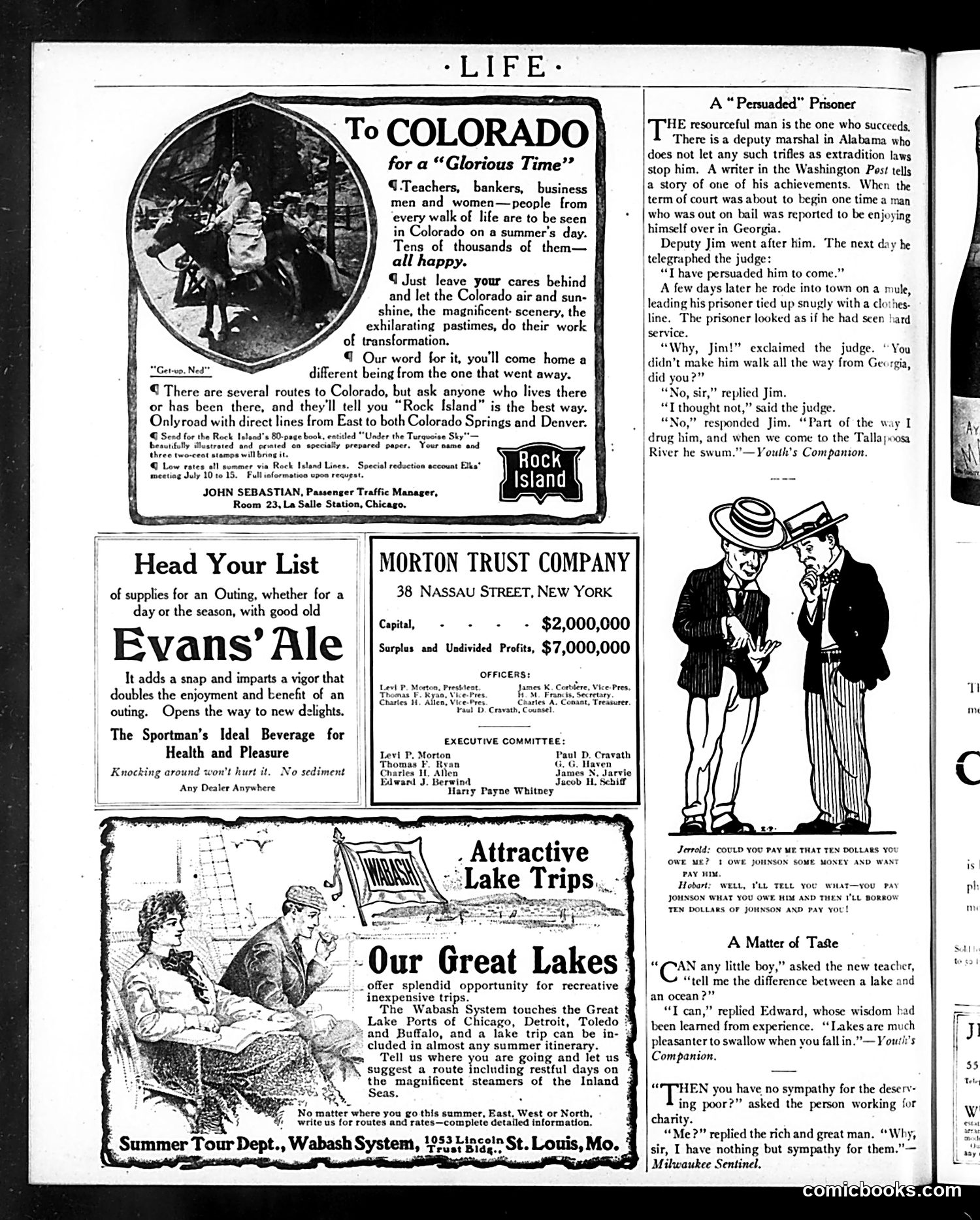
This page from *Life* magazine contains several distinct elements: **Main Feature ("A 'Persuaded' Prisoner"):** A humorous anecdote about a resourceful Alabama deputy marshal who retrieves a bail-jumper from Georgia. The joke hinges on the deputy's creative (and implicitly illegal) methods—he drags the prisoner part-way and makes him swim across a river rather than walk him back properly. The story satirizes both the deputy's cunning and the casual circumvention of legal procedures, presenting lawlessness as admirable resourcefulness. This reflects early 20th-century attitudes toward frontier justice and authority figures operating outside formal law. **Advertisements:** The page is largely commercial, featuring Colorado tourism, Evans' Ale, Morton Trust Company, and Wabash System lake trips—typical period advertising with no satirical content. **Joke Section ("A Matter of Taste"):** A brief joke about a child distinguishing lakes from oceans by experience, mildly humorous. The page reflects *Life*'s characteristic blend of social satire, humor, and advertising aimed at educated, affluent readers.
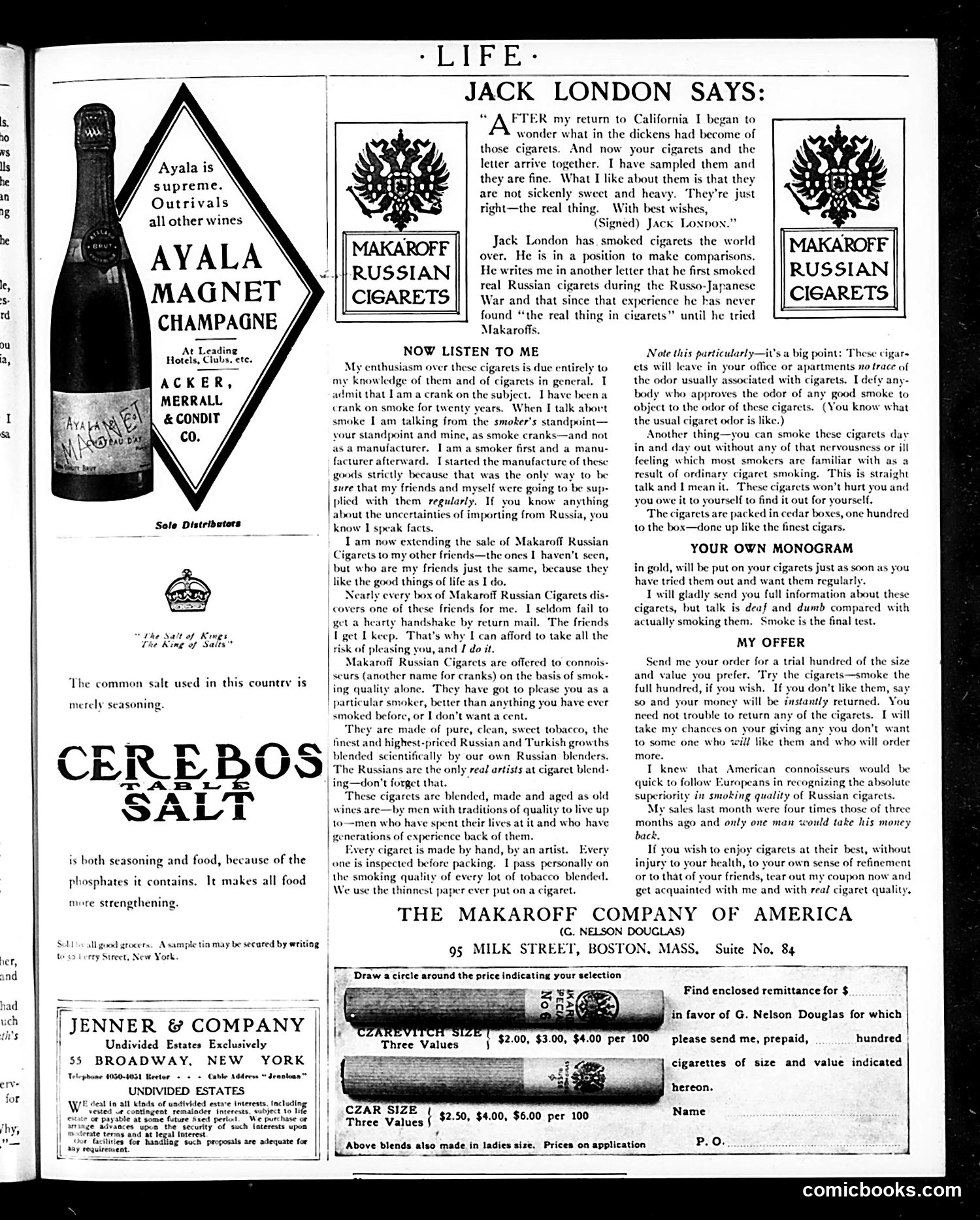
This page is primarily **advertising content** rather than political satire or cartoons. It features endorsements for luxury products aimed at wealthy consumers. The main content is a testimonial from **Jack London**, the famous American author, endorsing Makaroff Russian Cigarets. London claims he began manufacturing these cigarettes because he couldn't reliably obtain quality Russian cigarettes—he had first experienced them during the Russo-Japanese War and found Western alternatives inferior. The appeal is to **connoisseurship and exclusivity**: these cigarettes are marketed to "cranks" and "connoisseurs" who appreciate refined smoking, made with "pure, clean, sweet tobacco" and hand-blended by "Russian artists." The pitch emphasizes that London, as both a consumer and now manufacturer, stakes his reputation on quality. The page also advertises **Ayala Magnet Champagne** and **Cerebos Salt**, using similar prestige-based marketing. This reflects early-1900s advertising culture where celebrity endorsements and appeals to refined taste (rather than mass-market messaging) sold luxury goods to the affluent.
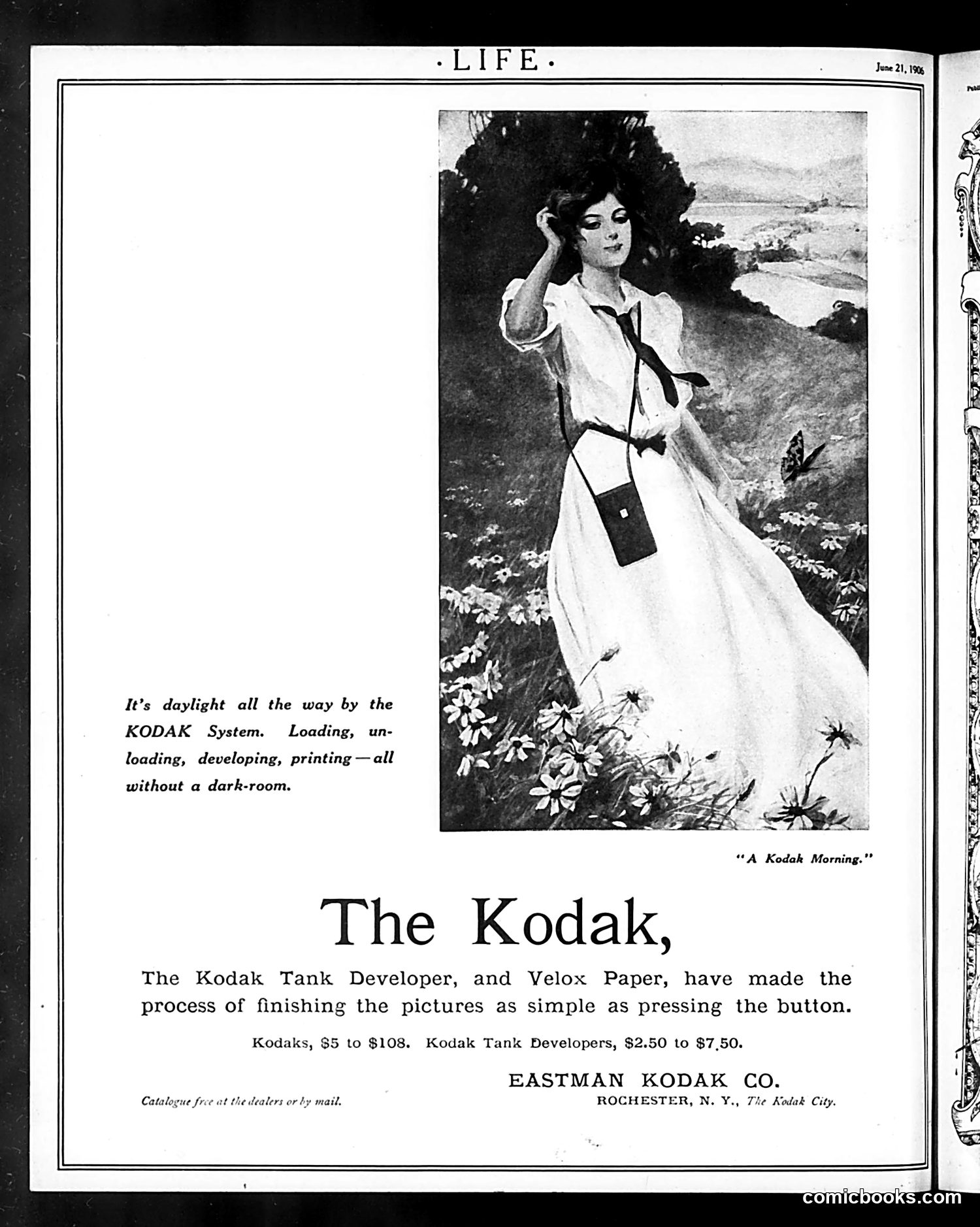
This is a **Kodak advertisement**, not political satire. The page features a romantic illustration titled "A Kodak Morning"—a woman in an elegant white dress in a pastoral landscape—to advertise Eastman Kodak's camera technology. The ad's appeal is **technological convenience**: it promises that photography no longer requires a darkroom for developing. The Kodak Tank Developer and Velox Paper made the entire process—"loading, unloading, developing, printing"—as simple as "pressing the button." This was genuinely innovative for the era (June 21, 1926). The romantic imagery suggests photography was becoming accessible to amateur consumers, particularly women, positioning it as an elegant leisure activity rather than a technical specialty. The price range ($5-$108 for cameras) indicates products for various budgets, emphasizing broad market appeal.