
Life, 1906-06-21 · page 12 of 28
Life — June 21, 1906 — page 12: what you’re looking at
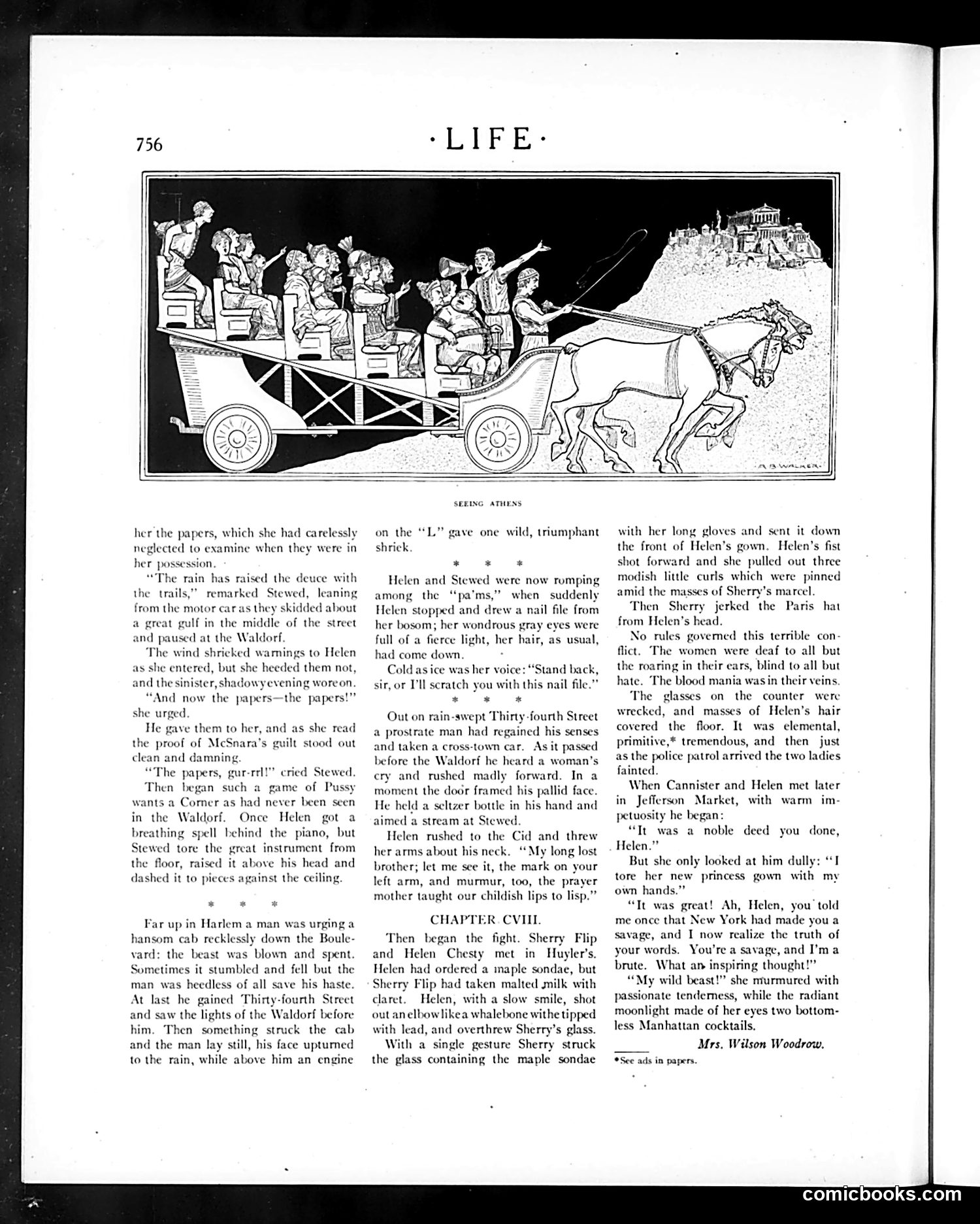
What you’re looking at
The top illustration depicts a horse-drawn wagon packed with tourists heading toward the Acropolis in Athens, Greece. The cartoon satirizes organized tour culture and the casual, superficial way wealthy travelers experienced famous historical sites. The accompanying story text discusses characters named Helen, Stewed, and Sherry Flip—apparently wealthy women on a tour who engage in frivolous behavior and romantic drama while supposedly sightseeing. The narrative mocks their preoccupation with gossip, fashion, and social conflicts rather than genuine appreciation for classical antiquity. This appears to be satirizing the Gilded Age tourist phenomenon: how the wealthy traveled to important historical sites yet remained entirely absorbed in their own social dramas, missing the actual cultural and historical significance around them.
📄 Transcribed text from this page (OCR, searchable)
Machine-transcribed from the original scan — historical spelling and the odd misread are preserved.
her the papers, which she had carelessly neglected to examine when they were in her possession e rain has raised the the trails,” remarked Stewed, leanin from the motor car as they skidded about a great gulf in the middie of the street and paused at the Waldorf. The wind shricked wamings to Helen as she entered, but she heeded them not, and the sinister, shadowy evening woreon. “And now the the papers!” she urged He gave them to her, and as she read the proof of McSnara’s guilt stood out clean and damning. “The papers, gur-rl!”” cried Stewed, Then began such a game of Pussy uce with papers wants a Comer as had never been seen in the Waldorf. Once Helen got a breathing spell behind the piano, but Stewed tore the great instrument from cd it above his head and dashed it to pieces against the ceiling, the floor, rai Far up in Harlem a man was urging hansom cab recklessly down the Boule- vard: the beast blown and spent. Sometimes it stumbled and fell but the man was heedless of all save his haste. At last he gained Thirty-fourth Street and saw the lights of the Waldorf before him. Then something struck the cab and the man lay still, his face uptumed to the rain, while above him an engine SEEING ATHENS ” gave one wild, triumphant on the “L shriek. * * * Helen and Stewed were now romping among the “pa’ms,” when suddenly Helen stopped and drew a nail file from her bosom; her wondrous gray ey full of a fierce light, her hair, as usual, had come down Cold as ice was her voice: “Stand bac sir, or I'll scratch you with this nail file + * # Out on rain-swept Thirty fourth Street a prostrate man had regained his sens and taken a cross-town car. As it passed before the Waldorf he heard a woman's cry and rushed madly forward. In a moment the door framed his pallid face. He held a seltzer bottle in his hand and aimed a stream at Stewed. Helen rushed to the Cid and threw her arms about his neck. ‘My long lost brother; let me see it, the mark on your left arm, and murmur, too, the prayer mother taught our childish lips to lisp.” CHAPTER. CVIIL Then began the fight. Sherry Flip and Helen Chesty met in Huyler’s. Helen had ordered a maple sondae, but Sherry Flip had taken malted milk with claret. Helen, with a slow smile, shot out anelbowlikea whalebone withe tipped with lead, and overthrew Sherry’s glass. With a single gesture Sherry struck the glass containing the maple sondae with her long gloves and sent it down the front of Helen’s gown. Helen's fist shot forward and she pulled out three modish little curls which were pinned amid the masses of Sherry’s marcel Then Sherry jerked the Paris hat from Helen’s head. No rules governed this terrible con- flict. The women were deaf to all but the roaring in their ears, blind to all but hate. The blood mania was in their veins. The glasses on the counter were wrecked, and masses of Helen’s hair covered the floor. It was elemental, primitive,* tremendous, and then just as the police patrol arrived the two ladies fainted When Cannister and Helen met later in Jefferson Market, with warm im- petuosity he beg: “Tt was a noble deed you done, Helen.” But she only looked at him dully: “I tore her new princess gown with my own hands.” “Tt was great! Ah, Helen, you told me once that New York had made you a savage, and I now realize the truth of your words. You're a savage, and I'ma brute. What an inspiring thought!” “My wild beast!” she murmured with passionate tendemess, while the radiant moonlight made of her eyes two bottom- less Manhattan cocktails. Mrs. Wilson Woodrow. See ads in papers. comicbooks.com