
Life, 1906-06-21 · page 9 of 28
Life — June 21, 1906 — page 9: what you’re looking at
What you’re looking at
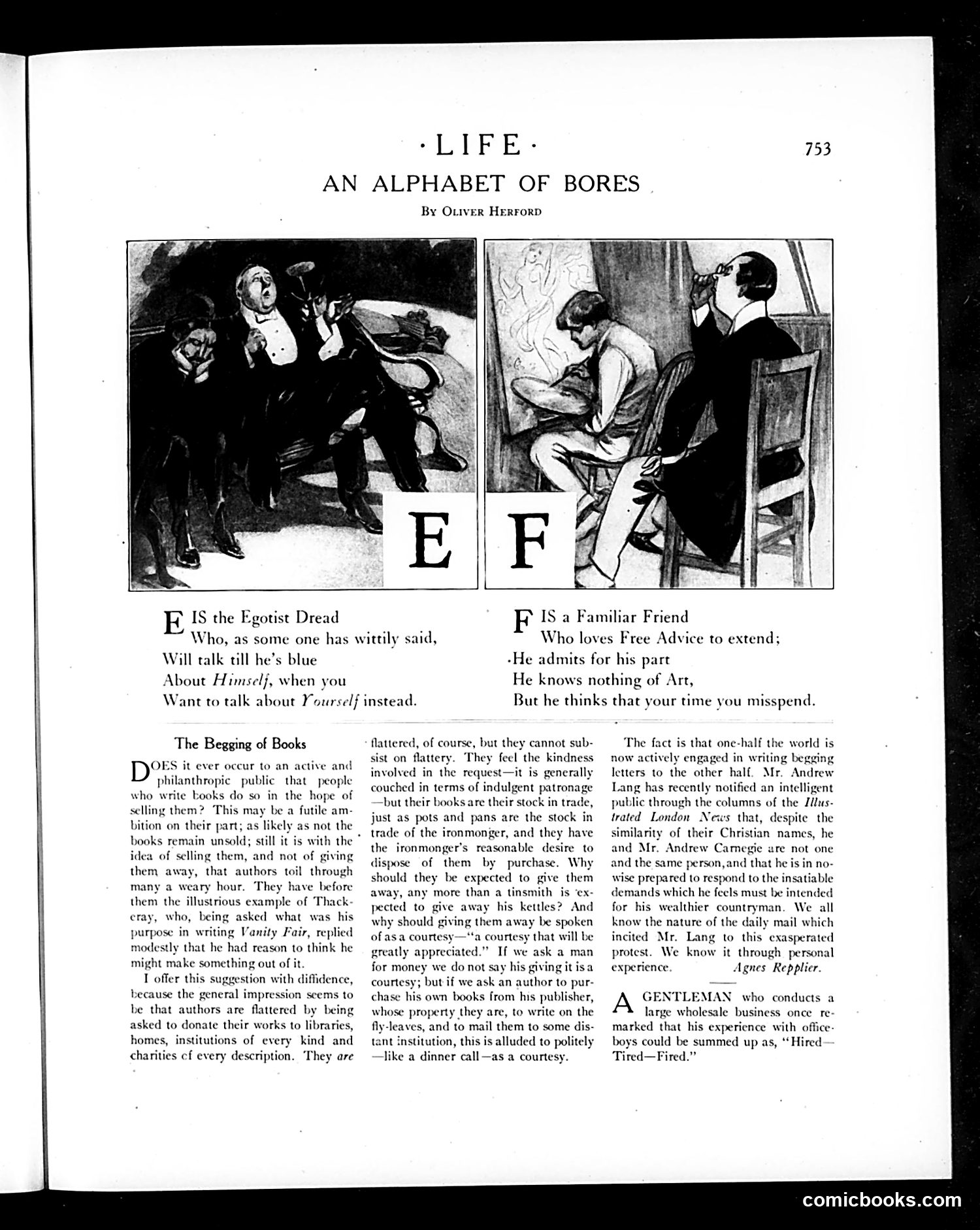
This satirical page presents two character types as social nuisances: **E - "The Egotist Dread"**: A self-centered bore who dominates conversations, constantly steering discussion back to himself ("Himself") rather than letting others speak about themselves ("Yourself"). The illustration shows him gesticulating animatedly while others listen trapped. **F - "A Familiar Friend"**: Someone who offers unsolicited advice about how the listener spends their time, despite knowing nothing about art or meaningful pursuits. He presumes to judge whether the listener's activities constitute time-wasting. Both target common social irritants of the era—the self-absorbed talker and the presumptuous know-it-all friend. The accompanying essay discusses authors' reluctance to donate books to libraries, comparing their resistance to reasonable commercial practices.
📄 Transcribed text from this page (OCR, searchable)
Machine-transcribed from the original scan — historical spelling and the odd misread are preserved.
-LIFE- 753 AN ALPHABET OF BORES HERFORD By Otive! E IS the Egotist Dread Who, a Will talk till he’s About Himself, when you Want to talk about Yours blue The Begging of Books OES it ever occur to an active and philanthropic public that people who write Looks do so in the hope of selling them? This may be a futile am- bition on their part; as likely as not the books re: idea of selling them, and not of giving them away, that authors toil through many a pre hour. They have be them the illustrious example of Thack eray, who, being asked what was his purpose in writing Vanity Fair, replied modestly that he had reason to think he might make something out of it I offer this suggestion with diffidence, because the general impression seems to be that authors are flattered by being asked to donate their works to libraries, homes, institutions of every kind and charities cf every description. They are some one has wittily said, If instead. ain unsold; still it is with the © F IS a Familiar Friend Who loves Free Advice to extend; -He admits for his part He knows nothing of Art, flattered, of course, but they cannot sub- sist on flattery. They feel the kindness involved in the request—it is generally couched in terms of indulgent patrona -but their books are their stock in trade, just as pots and pans are the stock in trade of the ironmonger, and they have the ironmonger’s reasonable desire to dispose of them by purchase. Why should they be expected to give them away, any more than a tinsmith is ‘ex- pected to give away his kettles? And why should giving them away be spoken of asa courtesy—"‘a courtesy that will be greatly appreciated.” If we ask a man for money we do not say his giving it isa but if we ask an author to pur- own books from his publisher, ¢ property they are, to write on the y , and to mail them to some dis- tant institution, this is alluded to politely like a dinner call—as a court But he thinks that your time you misspend. The fact is that one-half the world is now actively engaged in writing begging letters to the other half. Mr. Andrew as recently notified an intelligent public through the columns of the J/us- trated London News that, despite the similarity of their Chri names, he and Mr, Andrew Camegie ure not one and the same person, and that he is in no- prepared to respond to the insatiable demands which he feels must be intended for his wealthier countryman. We all know the nature of the daily mail which incited Mr. Lang to this exasperated protest. We know it through pe! experience. A TLEMAN who conducts a large wholesale business once re- marked that his experience with office boys could be summed up as, ‘‘Hired Tired—Fired.” sonal Agnes Repplier. comicbooks.com