
Life, 1906-06-21 · page 8 of 28
Life — June 21, 1906 — page 8: what you’re looking at
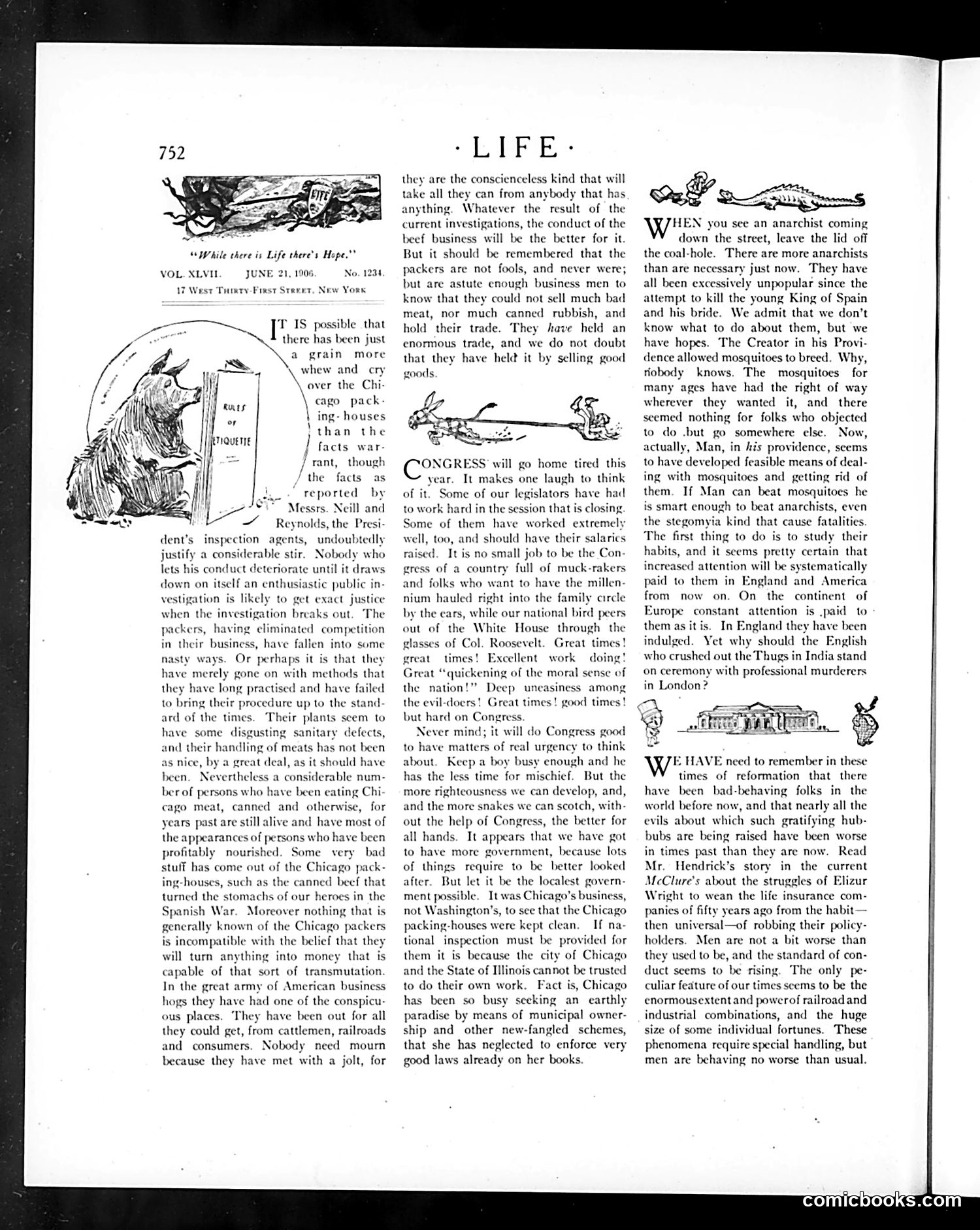
What you’re looking at
This page contains editorial commentary rather than political cartoons. The left side features a small illustration of what appears to be a dog reading a newspaper labeled "LIFE," likely satirizing how even animals might follow current events. The text discusses anarchists, Congress, and Chicago's meat-packing industry scandals. The writing criticizes anarchists as "unconscionable" and references investigations into Chicago's packing houses, likely alluding to Upton Sinclair's *The Jungle* (1906) exposé. The piece argues that while anarchists are dangerous, American business corruption is equally troubling. It suggests Congressional oversight and municipal enforcement could address sanitation violations in Chicago's meat industry—a reference to progressive-era food safety reforms. The overall tone critiques both radical extremism and corporate malfeasance.
📄 Transcribed text from this page (OCR, searchable)
Machine-transcribed from the original scan — historical spelling and the odd misread are preserved.
VOL. XLVI JUNE 21, 1906 17 West Tuiety-Frast Steent, New Yous . IS possible that there has been just a grain more A iwhee and cry over the Chi- \ ing- hous ‘than the | facts war- / rant, though / the “reported by Messrs. Neill and Reynolds, the Pres inspection agents, undoubtedly stify a considerable stir. Nobody who is conduct deteriorate until it draws down on itself an enthusiastic public in- ion is likely to get exact justice igation br The facts as when the s out packers, having eliminated competition in their business, have fallen into some nasty ways. Or perhaps it is that they have merely gone on with methods that they have long practised and have failed to bring their procedure up to the stand ard of the times. Their plants seem to have some disgusting sanitary defect and their handling of meats has not been as nice, by a great deal, as it should have been. Neverthele considerable num- ber of persons who have been eating Chi cago meat, canned and otherwise, for years past are still alive and have most of the appearances of persons who have been profitably nourished. Some very bad stulf has come out of the Chicago pack- ing-houses, such as the canned beef that turned the stomachs of our heroes in the Spanish War. Moreover nothing that is gencrally known of the Chicago packers is incompatible with the belief that they will turn anything into money that is capable of that sort of transmutation. In the great army of American busine: hogs they have had one of the conspicu- ous places. They have been out for all they could get, from cattlemen, railroads and consumers. Nobody need mourn because they have met with a jolt, for “LIF @ « they are the conscienceless kind that will take all they can from anybody that has. anything. Whatever the result of the current investigations, the conduct of the beef business will be the better for it. But it should be remembered that the packers are not fools, and never were; but are astute enough business men to know that they could not sell much bad meat, nor much canned rubbish, and hold their trade. They have held an enormous trade, and we do not doubt that they have held it by selling good goods CONGRE Swill go home tired this year. It makes one laugh to think of it. Some of our legislators have had to work hard in the session that is closing Some of them have worked extreme Il, too, and should have their salaries raised. It is no small job to be the Con gress of a country full of muck-rakers and folks who want to have the millen- nium hauled right into the family circle by the ears, while our national bird peers out of the White House through the glasses of Col. Roosevelt. Great times! great time: ellent work Great “quickening of the moral sense of the nation!” Deep uneasiness among the evil-doers! Great times! good time but hard on Congress. Never mind; it will do Congress good to have matters of real urgency to think about. Keep a boy busy enough and he has the less time for mischief. But the more righteousness we can develop, and, and the more snakes we can scotch, with- out the help of Congress, the better for all hands. It appears that we have got to have more government, because lots of things require to be better looked after. But let it be the localest govern- ment possible. It was Chicago’s business, not Washington's, to see that the Chicago packing-houses were kept clean. If na- tional inspection must be provided for them it is because the city of Chicago and the State of Illino nnot be trusted to do their own work. Fact is, Chicago has been so busy seeking an earthly paradise by means of municipal owner- ship and other new-fangled schemes, that she has neglected to enforce very good laws already on her books. doing! HEN you see an anarchist coming down the street, leave the lid off the coal-hole. There are more anarchists than are necessary just now. They have all been excessively unpopular since the attempt to kill the young King of Spain and his bride. We admit that we don’t know what to do about them, but we have hopes. The Creator in his Provi- dence allowed mosquitoes to breed. Why, riobody knows. The mosquitoes for many ages have had the right of way wherever they wanted and there seemed nothing for folks who objected to do .but go somewhere else. Now, actually, Man, in his providence, seems to have developed feasible means of deal- ing with mosquitoes and getting rid of them. If Man can beat mosquitoes he is smart enough to beat anarchists, even the stegomyia kind that cause fatalit The first thing to do is to study their habits, and it seems pretty certain that increased attention will be systematically paid to them in England and America from now on. On the continent of Europe constant attention is .paid to them as itis. In England they have been indulged. Yet why should the English who crushed out the Thugs in India stand on ceremony with professional murderers in London? @ area. E HAVE need to remember in these times of reformation that there have been bad-behaving folks in the world before now, and that nearly all the evils about which such gratifying hub- bubs are being raised have been worse in times past than they are now. Read Mr. Hendrick’s story in the current McClure’s about the struggles of Elizur Wright to wean the life insurance com- panies of fifty years ago from the habit— then universal—of robbing their policy- holders. Men are not a bit worse than they used to be, and the standard of con- duct seems to be rising. The only pe- culiar feature of our times scems to be the enormousextentand powerof railroad and industrial combinations, and the huge size of some individual fortunes. These phenomena require special handling, but men are behaving no worse than usual.