
Life, 1906-06-21 · page 11 of 28
Life — June 21, 1906 — page 11: what you’re looking at
What you’re looking at
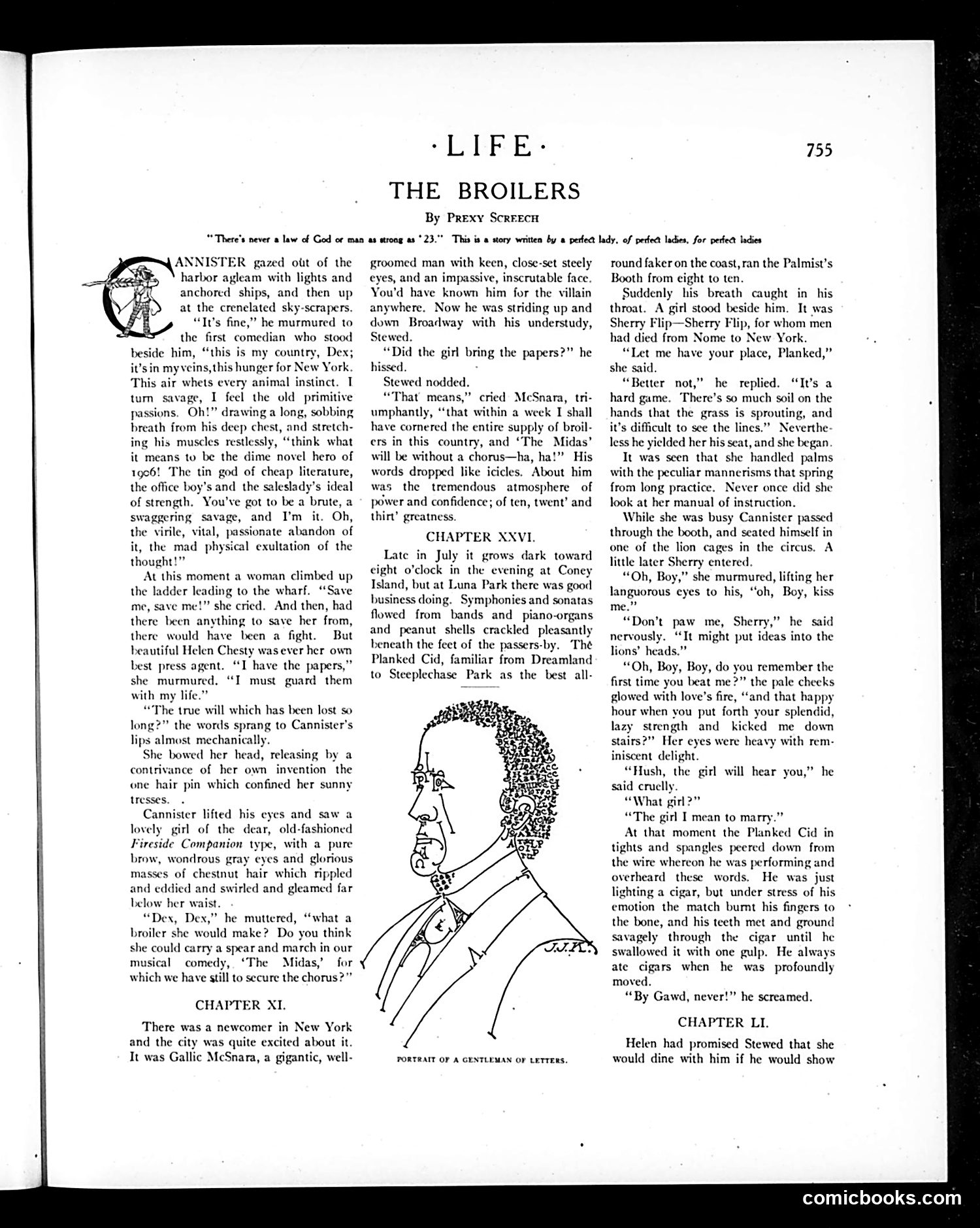
This page presents a short story titled "The Broilers" by Prexy Screech, not a political cartoon. The narrative concerns characters in New York theater and publishing circles, including a protagonist named Cannister and a woman named Helen Cheesy. The single illustration shows a profile sketch labeled "Portrait of a Gentleman of Letters"—likely a caricature of a writer or critic, given the literary context. The story itself appears to be satirical social commentary about theatrical ambition, romance, and publishing business in early 20th-century New York. The specific satire targets unnamed theater figures and industry practices, but without additional historical context, identifying particular individuals or events referenced remains unclear from this page alone.
📄 Transcribed text from this page (OCR, searchable)
Machine-transcribed from the original scan — historical spelling and the odd misread are preserved.
gazed ott of the harbor agleam with lights and anchored ships, and then up » at the crenelated sky-scrapers. “It’s fine,” he murmured to the first comedian who stood beside him, “this is my country, Dex; it’sin myveins, this hunger for New York. This air whets every animal instinct. I tur savage, I feel the old primitive passions. Oh!” drawing a long, sobbing breath from his deep chest, and stretch- ing his muscles restlessly, “think what it means to be the dime novel hero of 1906! The tin god of cheap literature, the office boy’s and the saleslady’s ideal of strength. You've got to be a brute, a swaggering savage, and I’m it. Oh, the virile, vital, passionate abandon of it, the mad physical exultation of the thought!” At this moment a woman climbed up the ladder leading to the wharf. “Save ve me!” she cried. And then, had been anything to save her from, > would have been a fight. But beautiful Helen Chesty was ever her own best press agent. “I have the papers,” she murmured, “I must guard them with my life.” “The true will which has been lost so long?” the words sprang to Cannister’s lips almost mechanically. She bowed her head, releas contrivance of her own invention one hair pin which confined her sunny tresses. Cannister lifted his eyes and saw a lov girl of the dear, old-fashioned Fireside Companion type, with a pure brow, wondrous gr and glorious masses of chestnut hair which rippled and eddied and swirled and gleamed far Lelow her waist. “Dex, Dex,” he muttered, “what a broiler she would make? Do you think she could carry a spear and march in our musical comedy, ‘The Midas, { which we have still to secure the chorus?” CHAPTER XI. There was a newcomer in New York and the city was quite excited about it. It was Gallic McSnara, a gigantic, well- “LDR E* THE BROILERS By Prexy ScrrECH “There's never a law of God or man as strong as °23."" This is a story written by a perfect lady. of perfect ladies. for perfect ladies groomed man with keen, close-set steely eyes, and an impassive, inscrutable face. You'd have known him for the villain anywhere. Now he was striding up and down Broadway with his understudy, Stewed. “Did the girl bring the papers?” he hissed. Stewed nodded “That means,” cried McSnara, tri- umphantly, “that within a week I shall have cornered the entire supply of broil- ers in this country, and ‘The Midas’ will be without a chorus—ha, ha!” His words dropped like icicles. About him was the tremendous atmosphere of power and confidence; of ten, twent’ and thirt’ greatness. CHAPTER XXVI. Late in July it grows dark toward eight o'clock in the evening at Coney Island, but at Luna Park there was good business doing. Symphonies and sonatas flowed from bands and_piano-organs and peanut shells crackled pleasantly beneath the feet of the passers-by, Thé Planked Cid, familiar from Dreamland to Steeplechase Park as the best all- PORTRAIT OF A GENTLEMAN OF LETTERS. round faker on the coast, ran the Palmi: Booth from eight to ten. Suddenly his breath caught in his throat. A girl stood beside him. It was Sherry Flip—Sherry Flip, for whom men had died from Nome to New York. “Let me have your place, Planked,” she said. “Better not,” he hard game. There’s so much soil on the hands that the grass is sprouting, and it’s difficult to see the lines.” Neverthe- less he yielded her his seat, and she began Tt was seen that she handled palms with the peculiar mannerisms that spring from long practice. Never once did she look at her manual of instruction. While she was busy Cannister passed through the booth, and seated himself in one of the lion cages in the circus. A little later Sherry entered. “Oh, Boy,” she murmured, lifting her languorous cyes to his, “oh, Boy, kiss me.” “Don’t paw me, Sherry,” he said nervously. “It might put ideas into the replied. “It’s a “Oh, Boy, Boy, do you remember the first time you beat me?” the pale cheeks glowed with love’s fire, “and that happy hour when you put forth your splendid, lazy strength and kicked me down stairs?” Her eyes were heavy with rem- iniscent delight. “Hush, the girl will hear you,” he said cruelly. “What girl?” “The girl I mean to marry.” At that moment the Planked Cid in tights and spangles peered down from the wire whereon he was performing and overheard these words. He was just lighting a cigar, but under stress of his emotion the match bumt his fingers to the bone, and his teeth met and ground savagely through the cigar until he swallowed it with one gulp. He always ate cigars when he was profoundly moved. “By Gawd, never!” he screamed. CHAPTER LI. Helen had promised Stewed that she would dine with him if he would show comicbooks.com