
A complete issue · 26 pages · 1906
Life — May 24, 1906
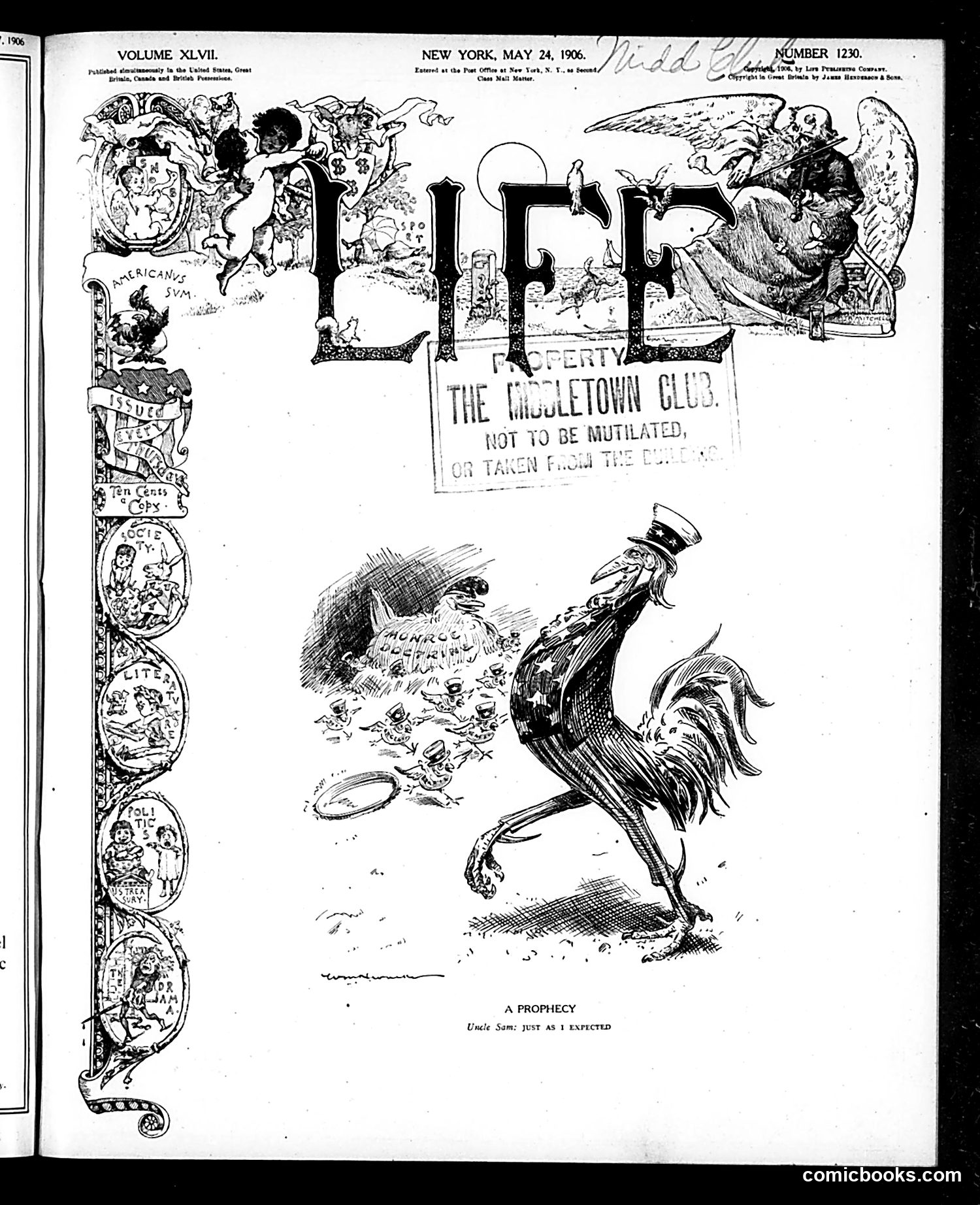
This satirical cartoon from Life magazine (May 24, 1906) depicts Uncle Sam as a rooster, kicking up debris and chaos. The title "A Prophecy" with the subtitle "Uncle Sam: Just As I Expected" suggests the cartoonist is mocking Uncle Sam's predictable behavior or foreign policy actions. The rooster imagery—traditionally representing cockiness or aggressive posturing—appears to criticize American imperial ambitions or military interventionism during the Theodore Roosevelt era. The scattered debris at his feet likely represents the consequences of American overseas expansion and military involvement. The overall tone suggests the cartoonist is sarcastically suggesting such aggressive American behavior was inevitable and unsurprising, reflecting contemporary criticism of U.S. imperialism and interventionism in this period.
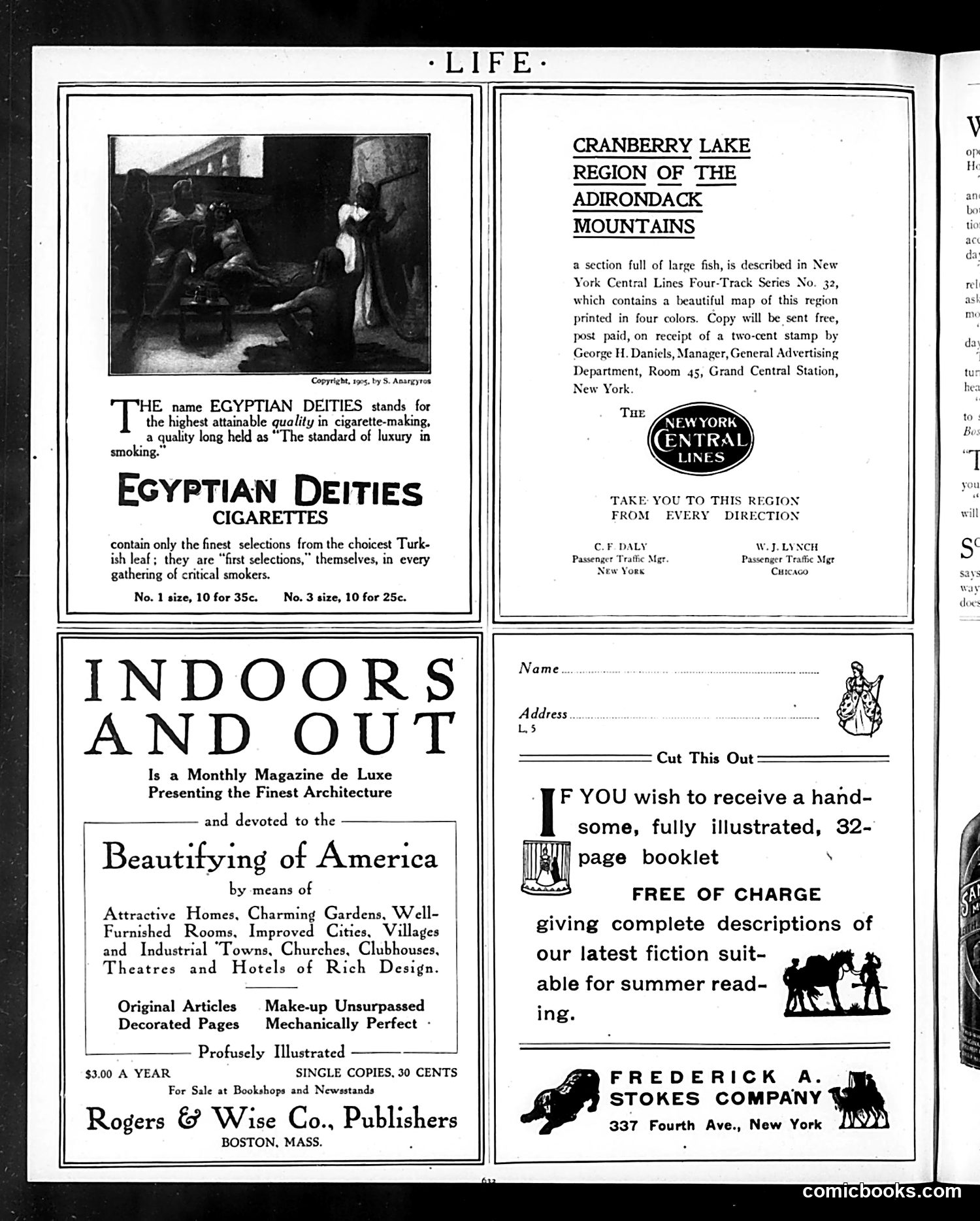
This page is primarily **advertising, not satire or political commentary**. The upper left contains a cigarette ad for "Egyptian Deities" cigarettes, featuring a dramatic historical scene (appears to be from an Orientalist painting). The upper right advertises the Cranberry Lake region of the Adirondack Mountains via New York Central Lines railroad. The lower half contains two more advertisements: one for "Indoors and Out," described as a luxury magazine about American architecture and design, and one for Frederick A. Stokes Company offering a free illustrated booklet of fiction suitable for summer reading. There is no discernible political cartoon or satirical commentary on this page—it is a standard advertising spread from the magazine.
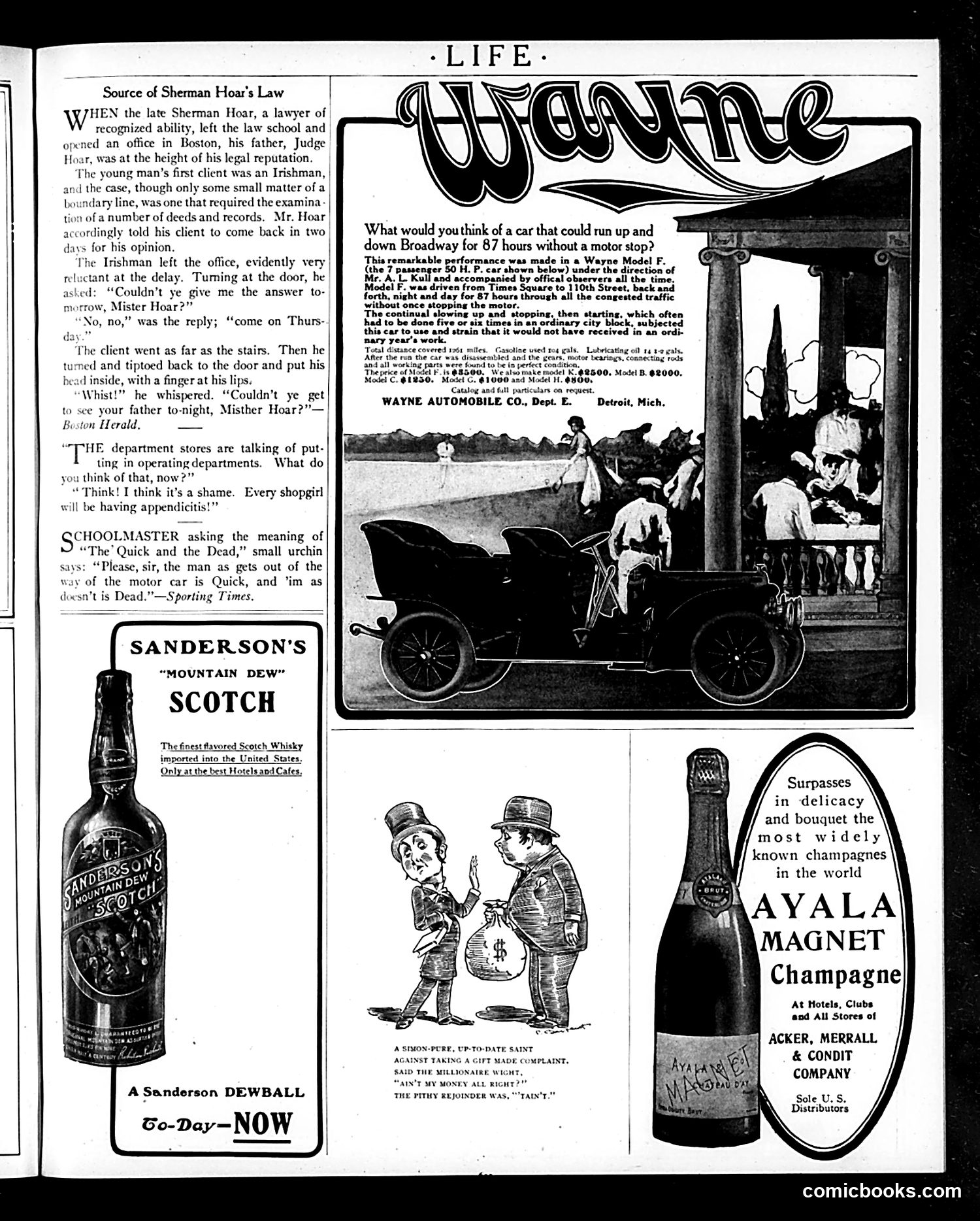
This page is primarily **advertising with minimal editorial content**. The left column contains brief humorous anecdotes about Sherman Hoar (a lawyer), department store operations, and a schoolmaster—typical filler jokes from Life magazine. The main visual is a **Wayne automobile advertisement** featuring a car completing a 87-hour Broadway endurance run. Below are ads for **Sanderson's Mountain Dew Scotch** and **Ayala Magnet Champagne**. A small cartoon depicts two men arguing over money—captioned as a "Simon-Pure, Up-to-Date Saint" debate about charity versus personal gain. This satirizes hypocrisy in philanthropic claims. The page reflects early 1900s consumer culture and period humor rather than political satire. Modern readers would note the casual alcohol advertising and the now-quaint automobile performance claims.
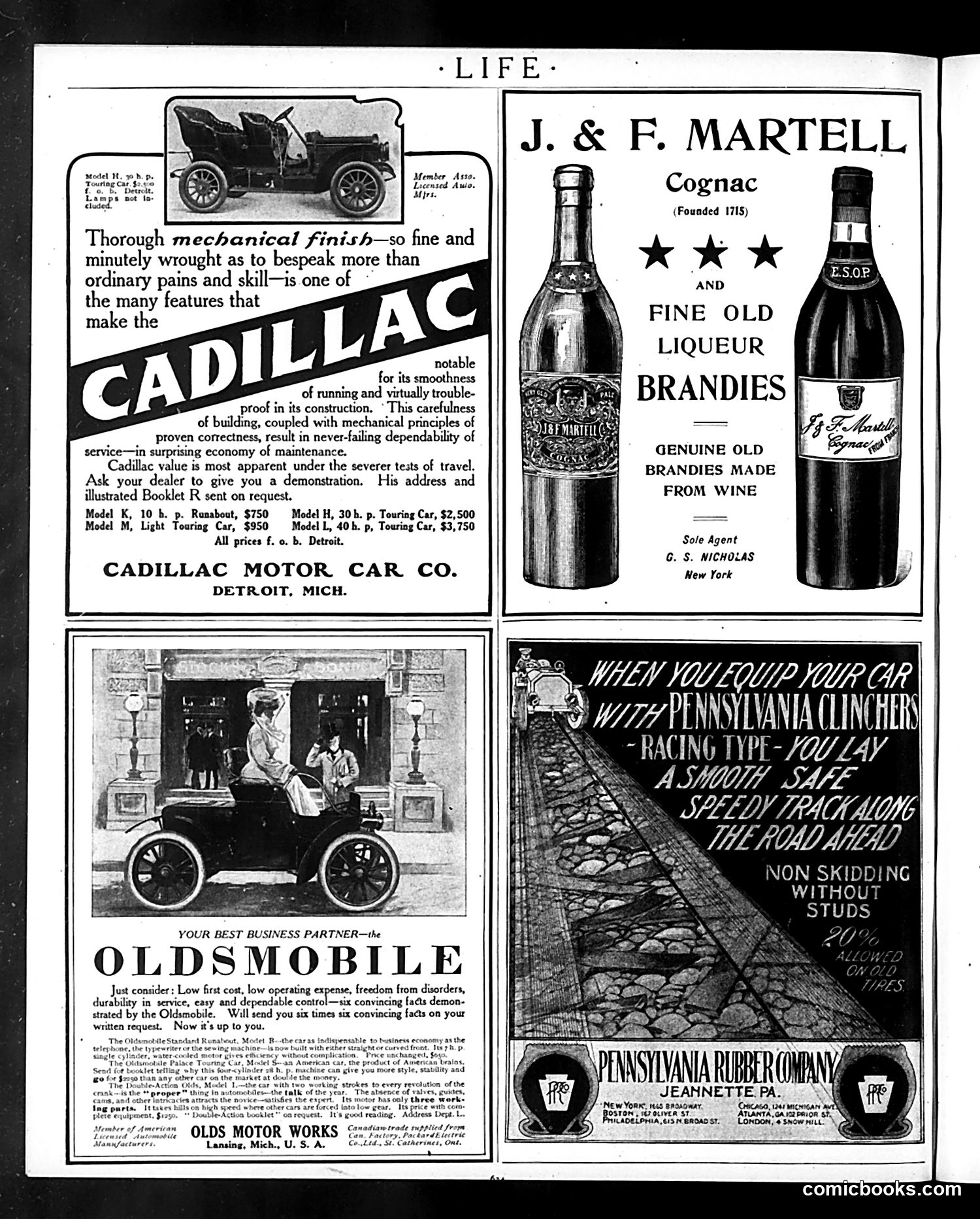
This page contains **no political cartoons or satire**—it is purely **advertising**, typical of early 20th-century Life magazine. The four ads promote: 1. **Cadillac Motor Cars** (Detroit)—emphasizing mechanical precision and reliable service 2. **J. & F. Martell Cognac** (Founded 1715)—brandy marketed as "genuine old" and made from wine 3. **Oldsmobile**—positioned as an affordable "business partner" with low operating costs 4. **Pennsylvania Clinchers** (racing-type tires)—highlighting non-skidding safety features The only visual narrative is the Oldsmobile ad's photograph showing a woman in an automobile outside a building, reinforcing the car's accessibility to middle-class consumers. These ads reflect early automotive and luxury goods marketing in America, with no satirical content present.
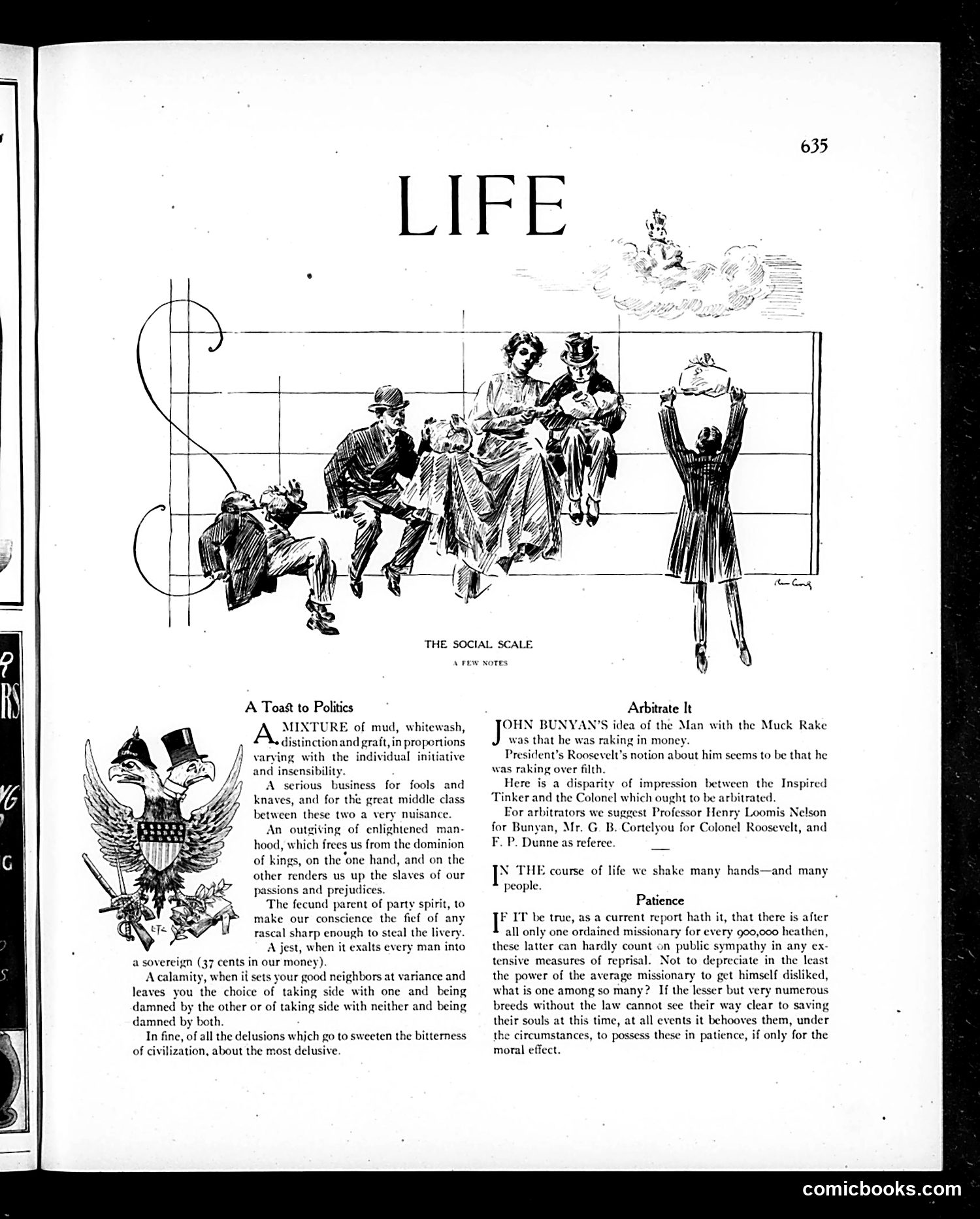
This cartoon satirizes American social hierarchy and class dynamics. The illustration shows figures climbing a social ladder, with the composition suggesting upward mobility and status competition. The accompanying text critiques political corruption and class pretension. "A Toast to Politics" mocks how wealthy elites manipulate the middle class, using rhetoric about "enlightened manhood" while exploiting workers. It references Party politics as a system where the wealthy extract money from ordinary citizens. "Arbitrate It" appears to reference a specific political dispute, possibly involving President Roosevelt, suggesting disagreement between political figures requiring mediation. The overall message satirizes how Americans chase social status while remaining economically exploited by those above them—a commentary on inequality and false promises of social advancement.
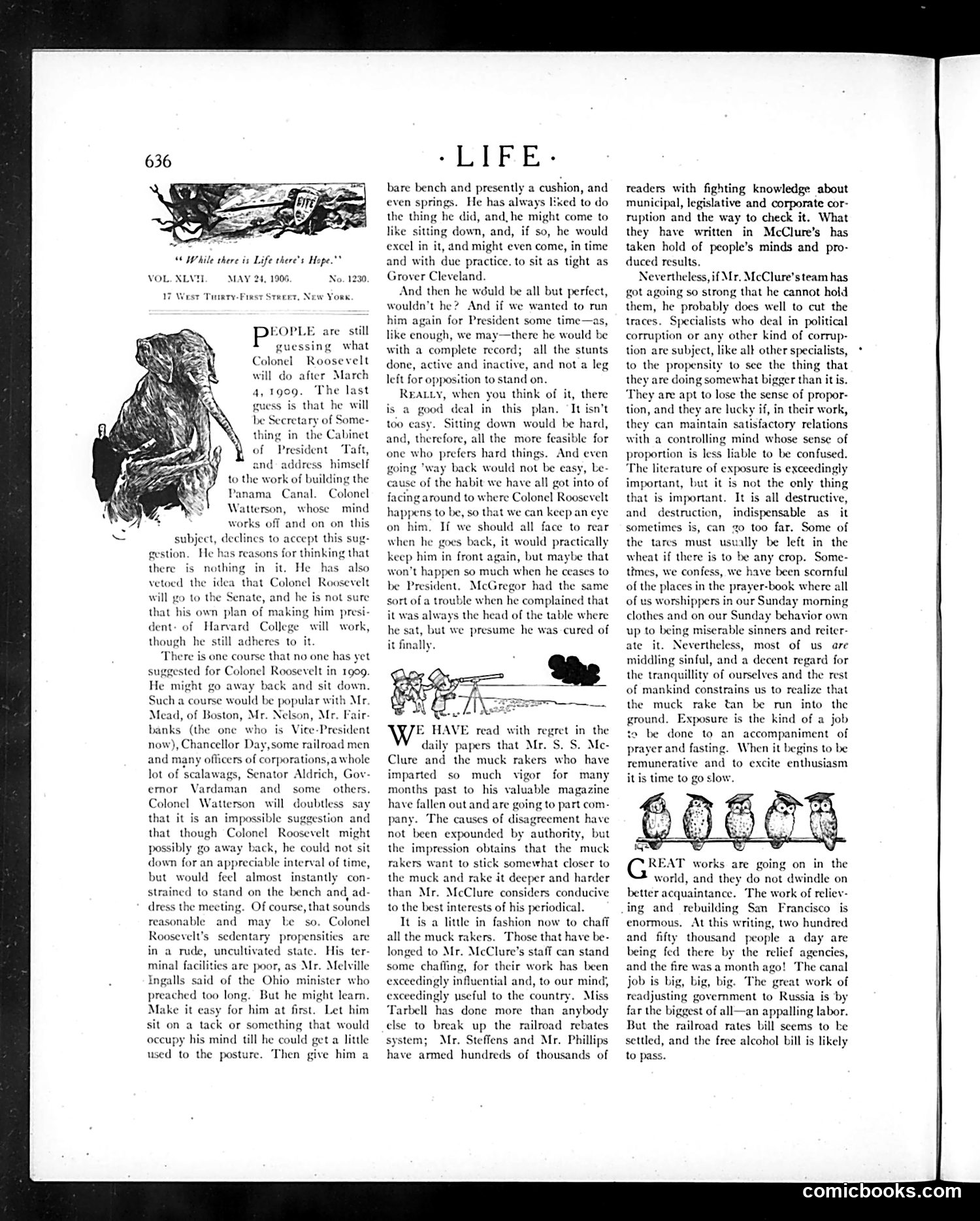
**Main Cartoon (top left):** Depicts a rotund figure labeled "Colonel Roosevelt" refusing to sit down, with text reading "While there is Life there's Hope." The satire concerns speculation about whether Theodore Roosevelt would run for President again after March 4, 1909, when his current term ends. Roosevelt claimed he wouldn't seek re-election, but observers doubted his sincerity. **Context:** The article discusses whether Roosevelt might reverse course and run again, calling such a possibility an "impossible suggestion." The cartoon mocks Roosevelt's characteristic restlessness and difficulty remaining inactive—suggesting he couldn't genuinely stay out of politics. **Bottom illustration:** Shows figures with surveying equipment, likely referencing the Panama Canal construction project, a major Roosevelt administration achievement. The page satirizes Roosevelt's dominance over American politics and public skepticism about his professed retirement plans.
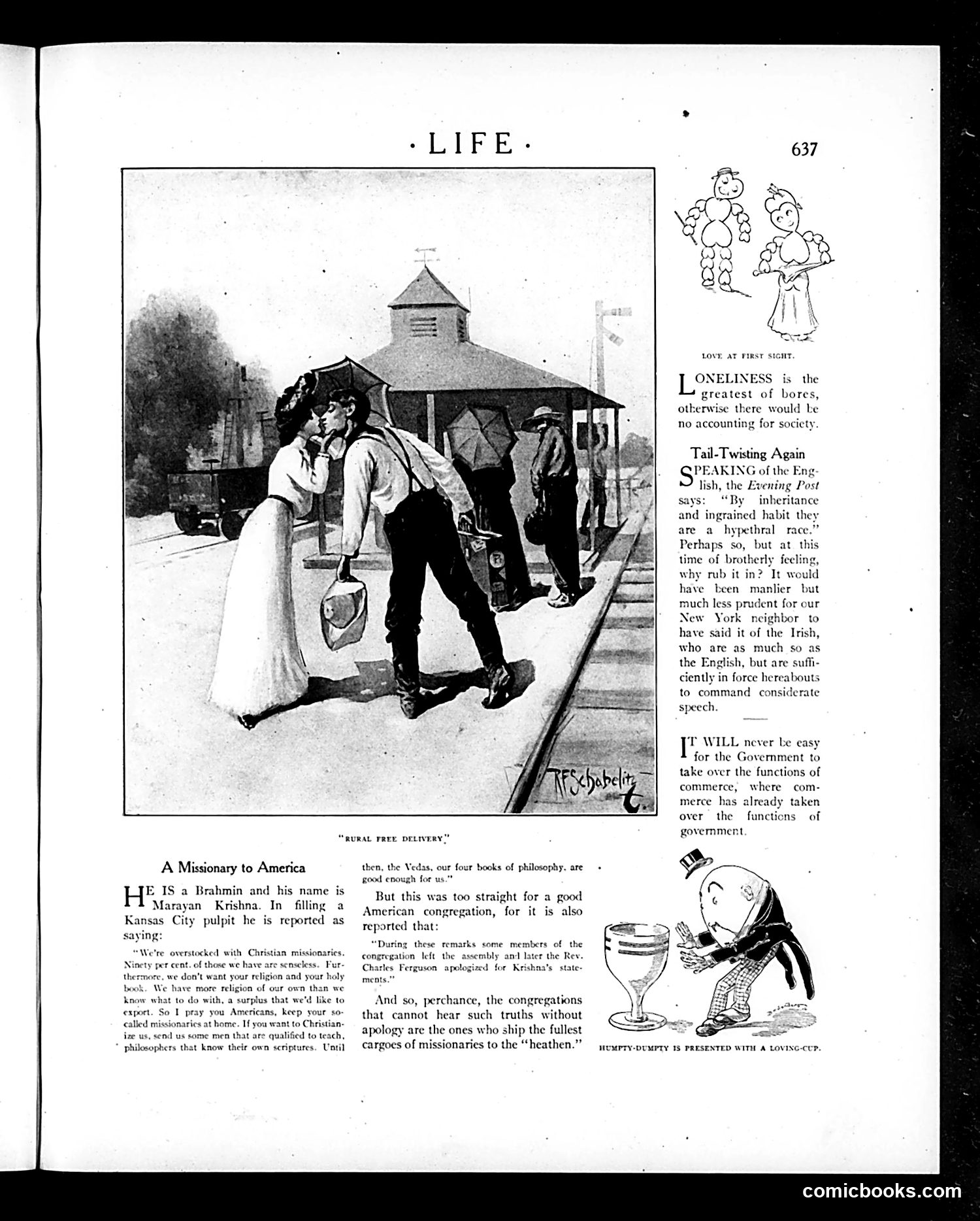
**Main Cartoon ("Rural Free Delivery"):** Shows a couple at a rural train station; the man appears to be a conductor or railway worker. The satire likely comments on rural mail delivery services—a contemporary American infrastructure issue. **"A Missionary to America" Section:** Features Ramakrishna, a Hindu spiritual figure, critiquing American Christian missionaries. The text quotes him saying Americans are "overburdened with Christian missionaries" and suggesting India has superior philosophy. The satire mocks American missionary zeal and religious presumption, while presenting non-Western perspectives as equally valid—a progressive stance for the era. **Additional Elements:** Small illustrations labeled "Love at First Sight" and "Humpty-Dumpty is Presented with a Loving Cup" appear to be separate satirical vignettes on social/domestic topics. The page targets American religious arrogance and social pretension.
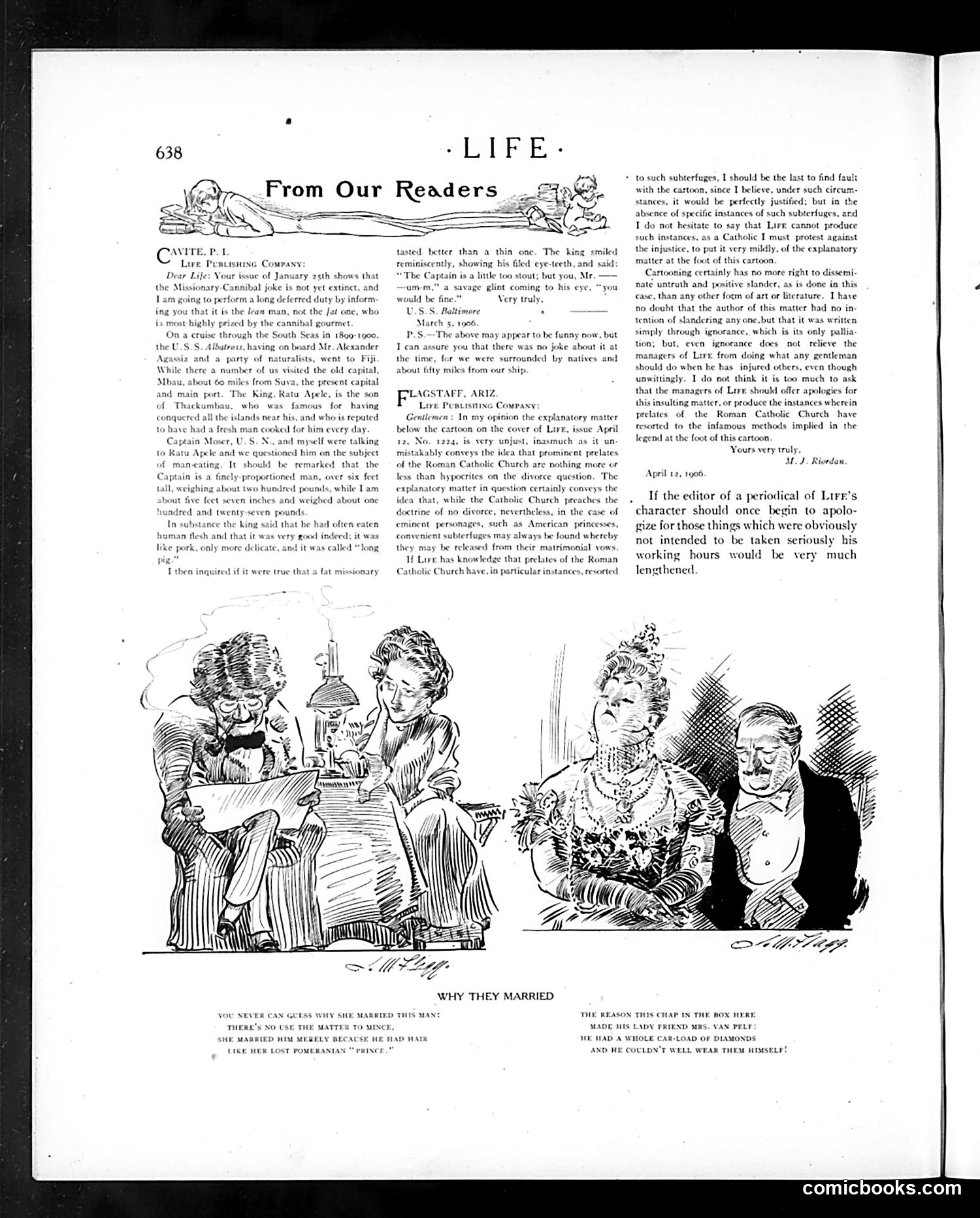
This two-panel satirical cartoon mocks marriages of convenience among the wealthy. The left panel shows a couple where the woman married the man "merely because he had hair / for he lost powderkiss 'prince.'" The right panel depicts a woman who married a man because "his lady friend Mrs. Van Pelt / had a whole car-load of diamonds / and he couldn't well wear them himself!" Both scenarios ridicule gold-digging marriages where financial gain or material wealth—rather than love—motivates matrimony. The exaggerated caricatures and formal dress emphasize the upper-class setting. The satire suggests such marriages among the wealthy are transparently transactional, with partners openly pursuing money rather than genuine affection. This reflects early 20th-century social commentary on aristocratic marriage practices.
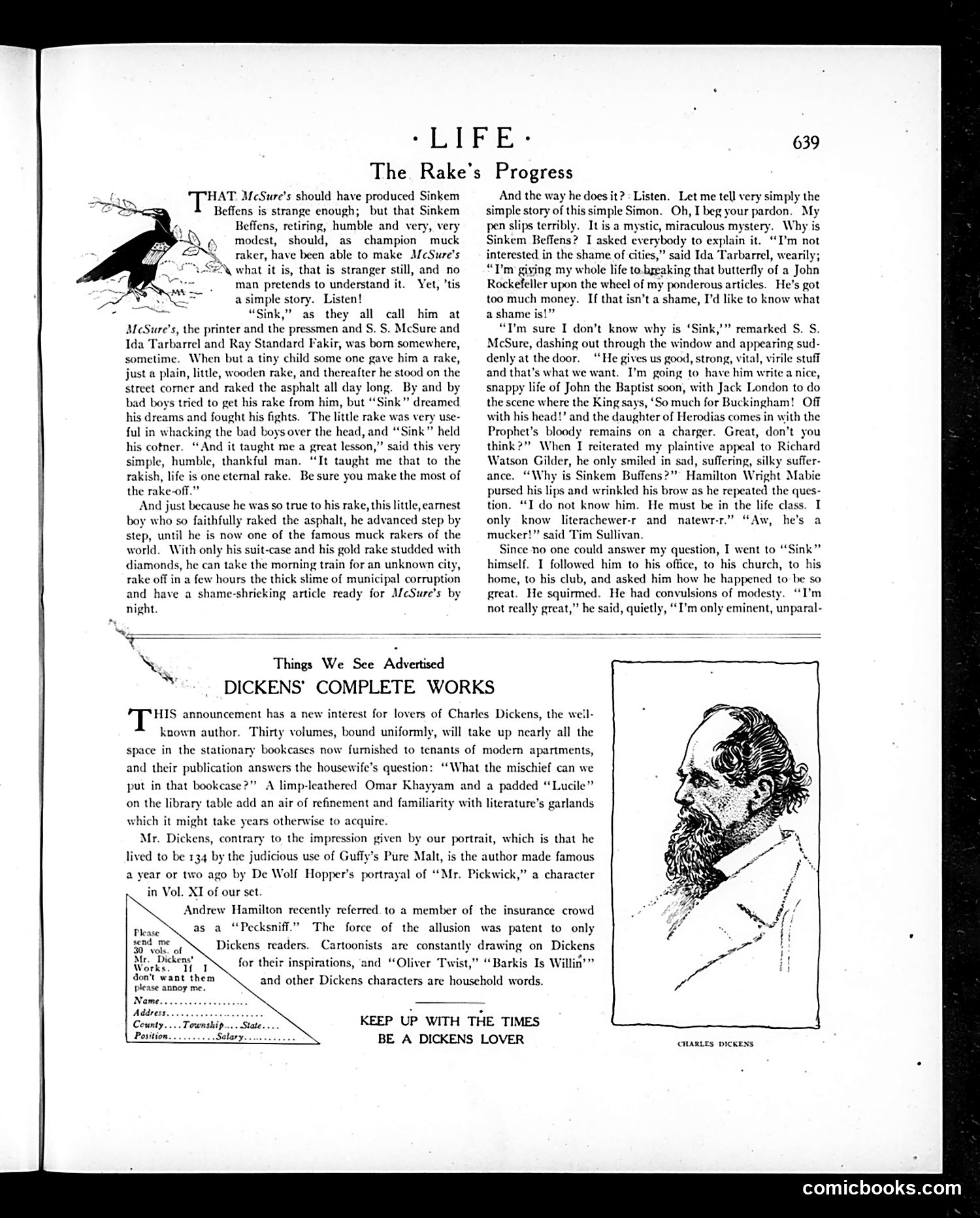
This page contains a serialized story titled "The Rake's Progress," featuring a character named Sinkem Biffens. The narrative describes how McSure (apparently a printer) and his associates discovered Sinkem—a humble wooden rake maker—and elevated him through shameless self-promotion into a famous society figure. The satire targets two things: (1) the absurdity of manufacturing celebrity from nothing, and (2) how easily the public accepts invented reputations. Sinkem's meteoric rise from obscurity to notability—despite lacking genuine accomplishments—mocks the era's sensationalism and gossip-driven society. The advertisement below promotes Dickens' Complete Works, unrelated to the story.
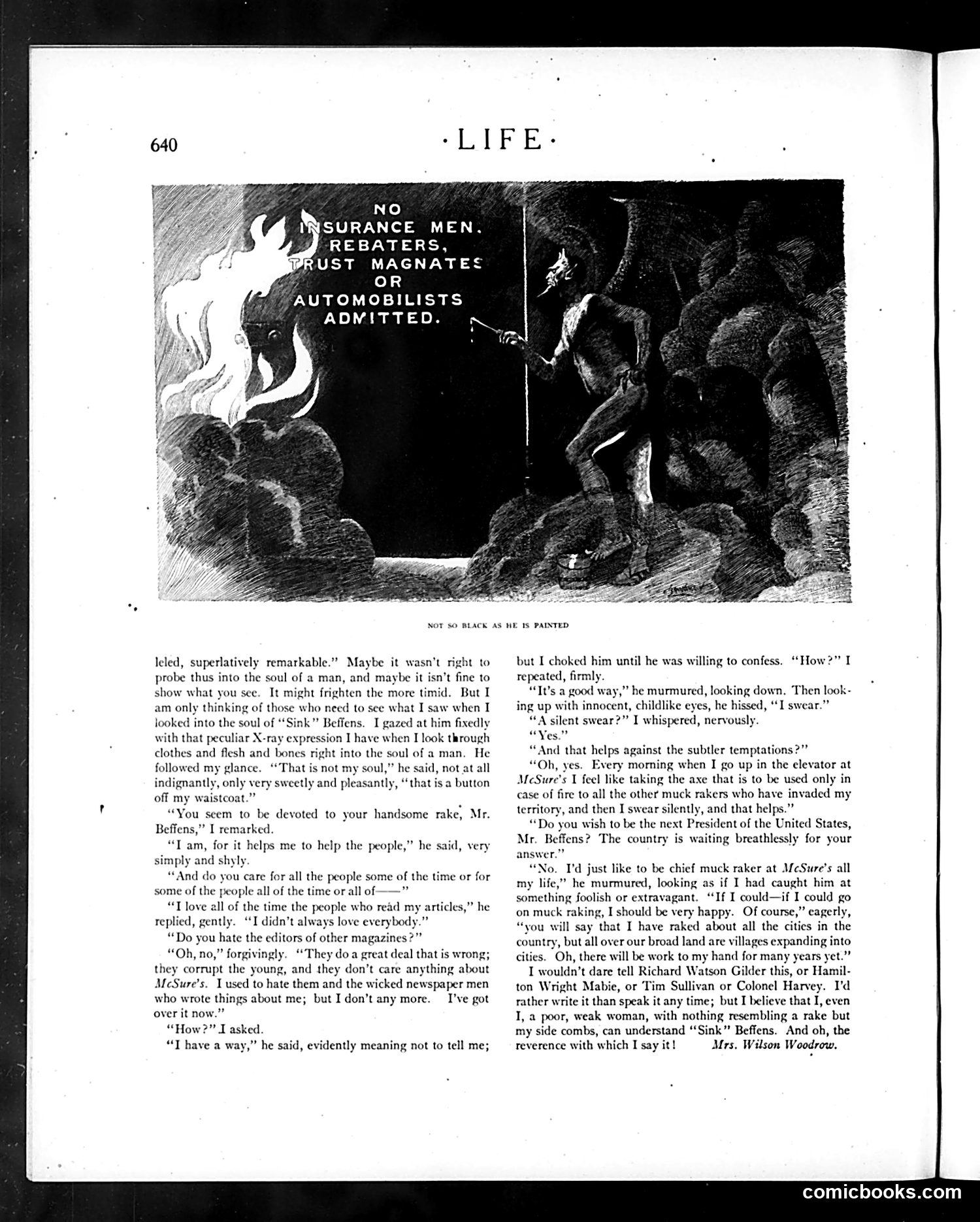
The cartoon depicts a hellish scene where a figure (appearing to be a "rake" or libertine) stands at the gates of Hell, blocked by demons. The sign reads: "NO INSURANCE MEN, REBATERS, TRUST MAGNATEES OR AUTOMOBILISTS ADMITTED." This satirizes early 1900s corporate and social figures excluded from Hell itself—suggesting they were considered *worse* than demons. "Insurance men" and "rebaters" reference insurance fraud schemes; "trust magnates" alludes to monopolistic industrialists; "automobilists" mocks the wealthy elite who drove cars. The joke inverts traditional morality: these groups are so corrupt that even Hell won't admit them. It's fierce social criticism of Gilded Age commercial excess and fraud, presented through dark humor about who belongs in the underworld.
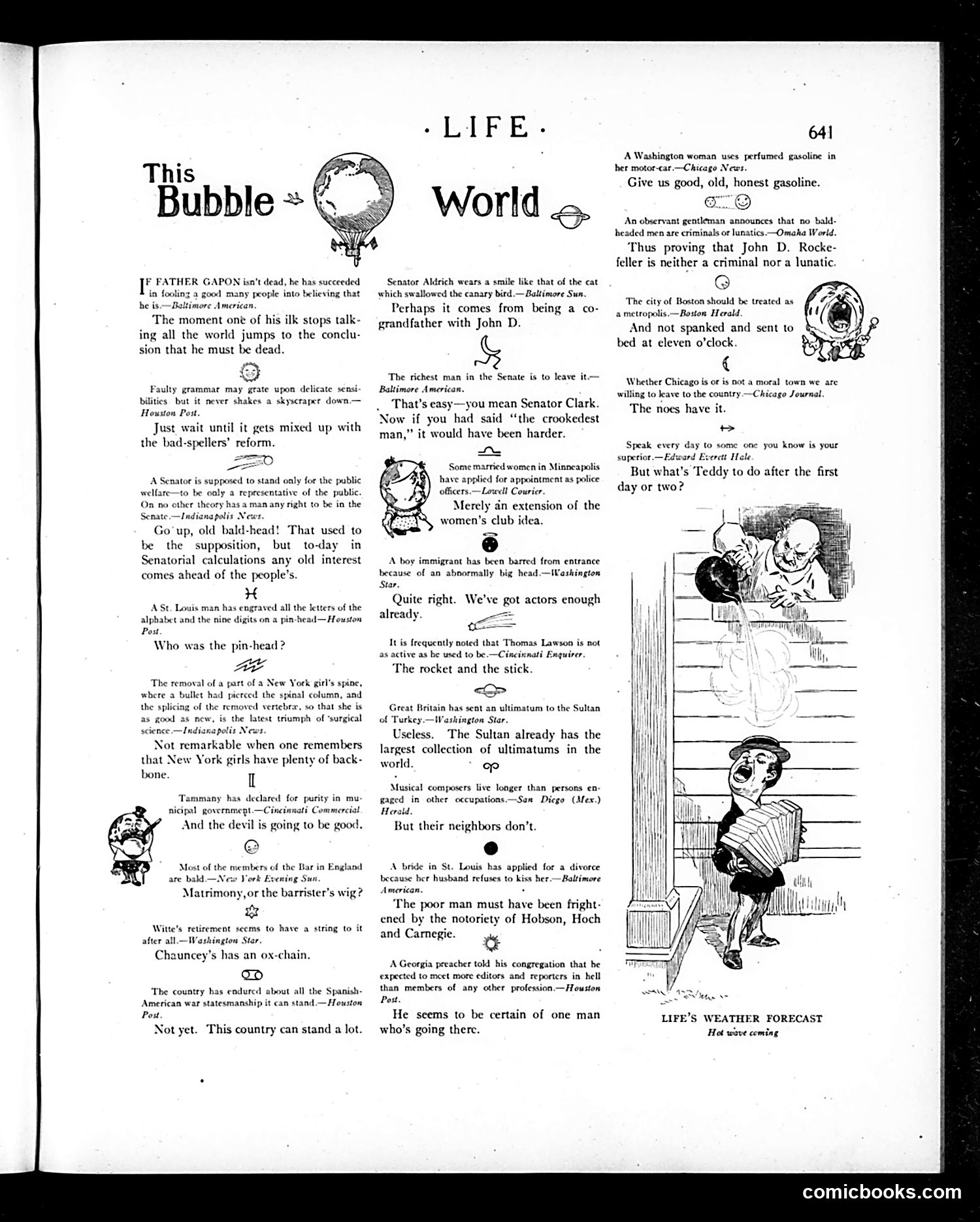
This is a satirical commentary page mixing political jabs with social humor. Key targets include: **Political figures:** Senator Aldrich (compared to a cat watching canaries), Senator Clark (called "crooked"), and John D. Rockefeller (defended against accusations of criminality). **Social commentary:** Jokes about female police officers in Minnesota, immigrant restrictions, British imperialism in India, and divorce laws. **The humor:** Typical early-20th-century satire mixing cynicism about politicians with absurdist observations—comparing senators to animals, mocking wealth disparities, and poking fun at moral hypocrisy among the powerful. The right-side illustration shows a figure climbing or falling, captioned "Life's Weather Forecast—Hot wave coming," likely commenting on political tensions. The overall tone is dismissive of politicians' pretensions while sympathetic to common citizens.
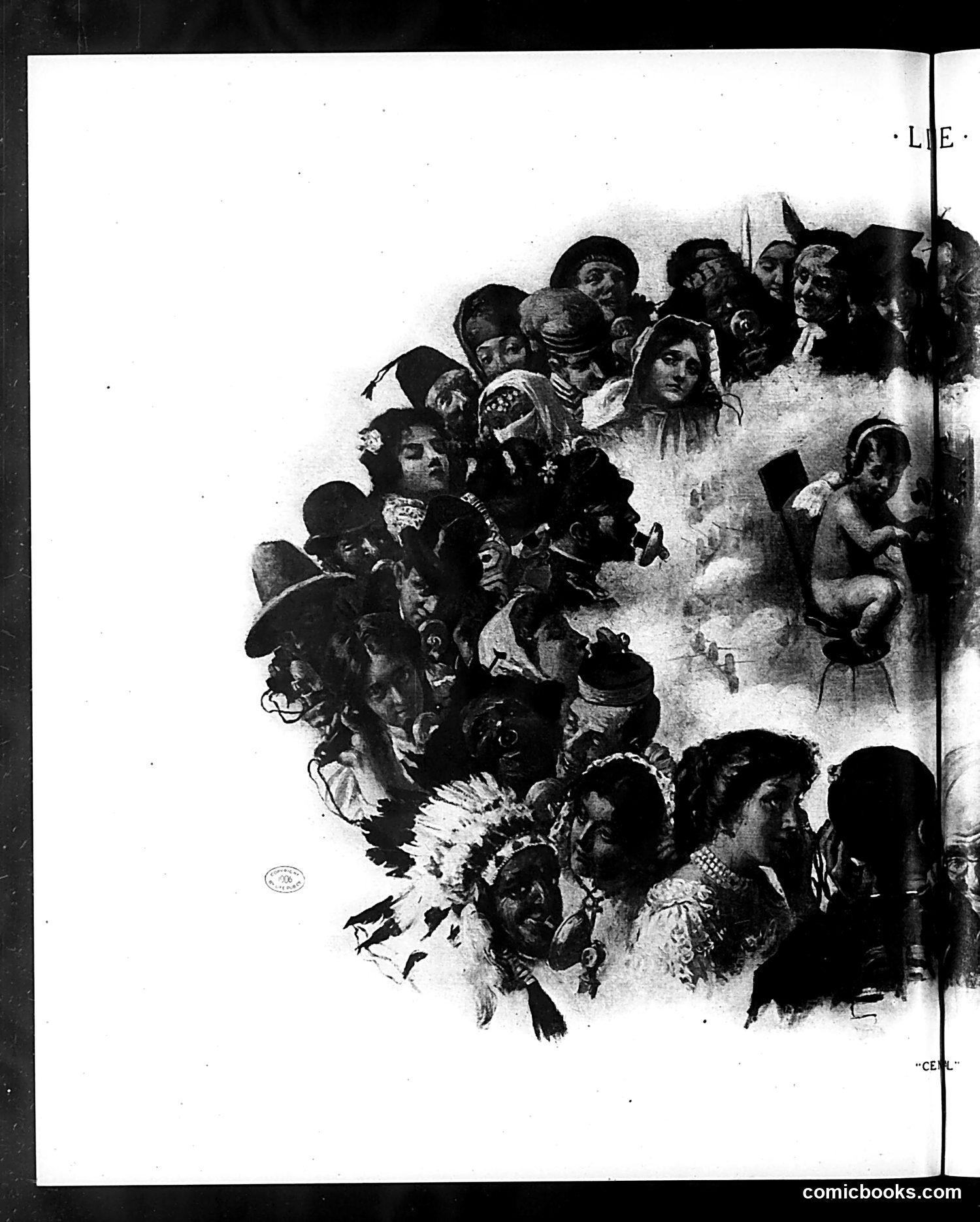
I can see this is a satirical illustration from *Life* magazine featuring a densely packed crowd of figures in period dress, rendered in black and white. The composition shows multiple faces and figures clustered together, some wearing elaborate costumes, hats, and jewelry that suggest characters from different social classes or historical periods. However, without visible text labels identifying the specific figures or a clear caption explaining the satire's subject, I cannot definitively identify who these caricatures represent or what political or social event they're mocking. The artistic style suggests late 19th or early 20th-century satirical work, but the specific targets and jokes remain unclear from the image alone. The "CEE" marking visible suggests an artist's signature.
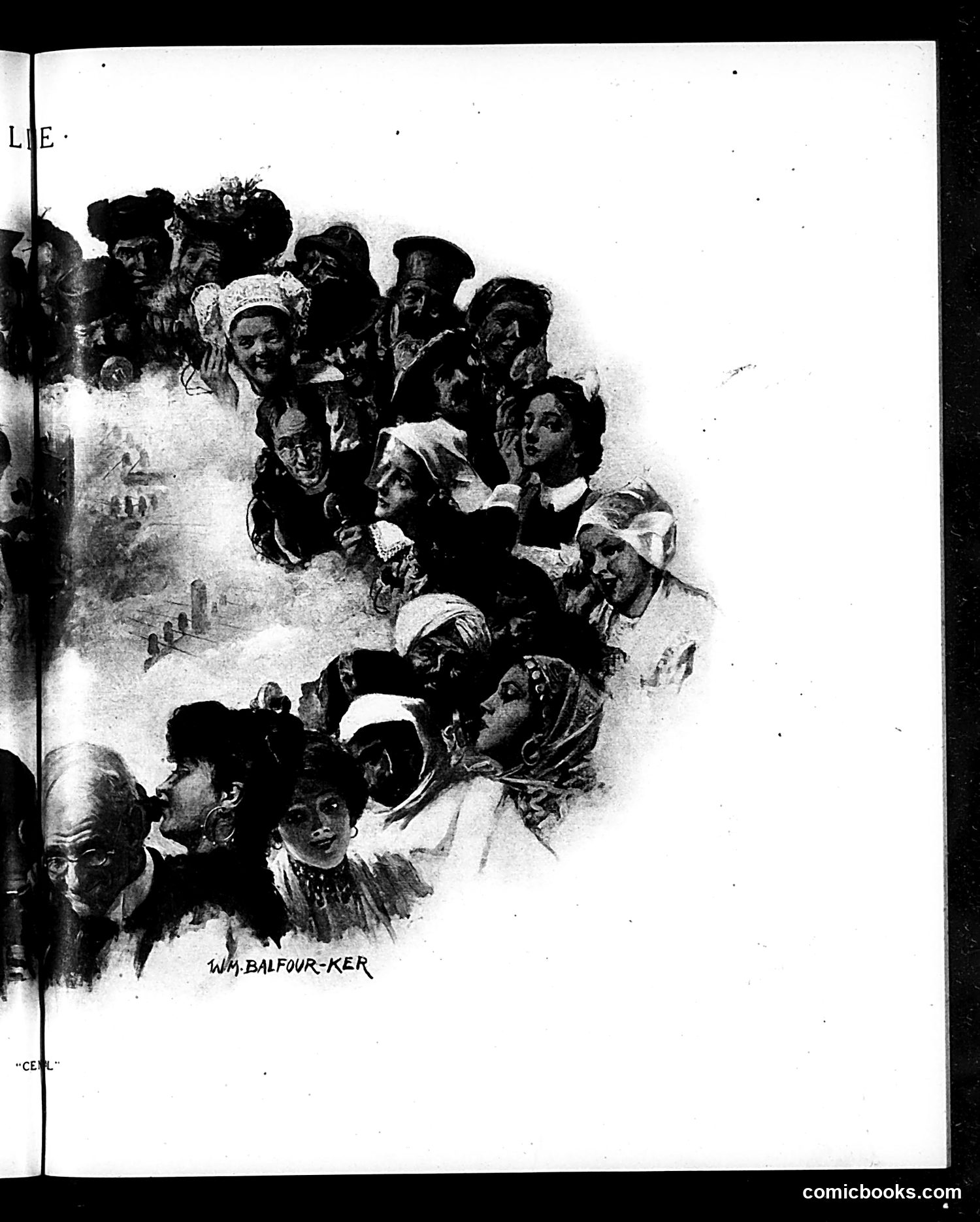
This illustration by W. Balfour-Ker depicts a group of figures in period dress (appearing to be 18th or 19th century based on the headwear and clothing styles). The crowd appears to be a satirical commentary on a gathering or assembly, though the specific historical event or political figures referenced is unclear from the image alone. The style—a crowded composition with exaggerated facial features typical of period caricature—suggests satire aimed at a contemporary event that *Life* magazine's readers would have recognized. Without additional context or visible captions identifying the figures, the precise political or social target remains uncertain, though the formal dress and gathering suggest it comments on an official proceeding or notable assembly of the era.
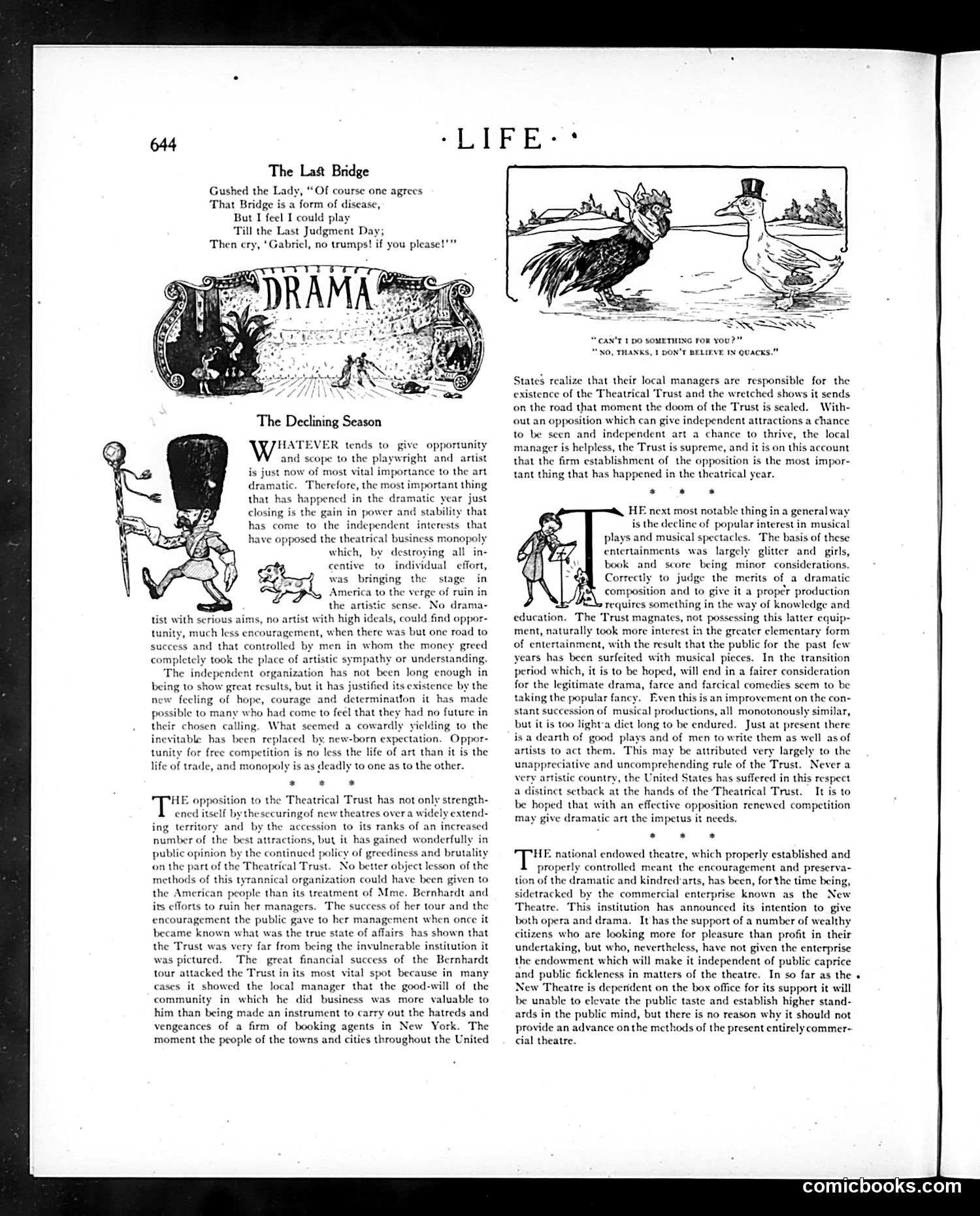
**"The Last Bridge"** (top): A light humorous poem about a woman addicted to playing bridge—a card game—comparing her obsession to a disease. She jokes she'd play bridge even until the Last Judgment Day, irreverently asking the angel Gabriel to skip his trumpet fanfare so she can continue playing. **The main article** addresses the **Theatrical Trust**, a monopoly controlling American theater distribution. The satire celebrates the recent rise of independent theatrical competition breaking the Trust's stranglehold. The accompanying cartoon (right) shows a sick-looking figure (representing theater/the Trust) refusing help from a doctor, declaring "I don't believe in quacks"—suggesting the monopoly rejects the "cure" of competition and independent theaters. **Historical context**: This reflects early 1900s American anti-monopoly sentiment. The Theatrical Trust, controlled by powerful New York booking agents, dictated which plays toured America. Independent theaters and managers (like those supporting actress Sarah Bernhardt's tour) challenged this system, and *Life* magazine celebrates their success as good for artistic freedom and local communities.
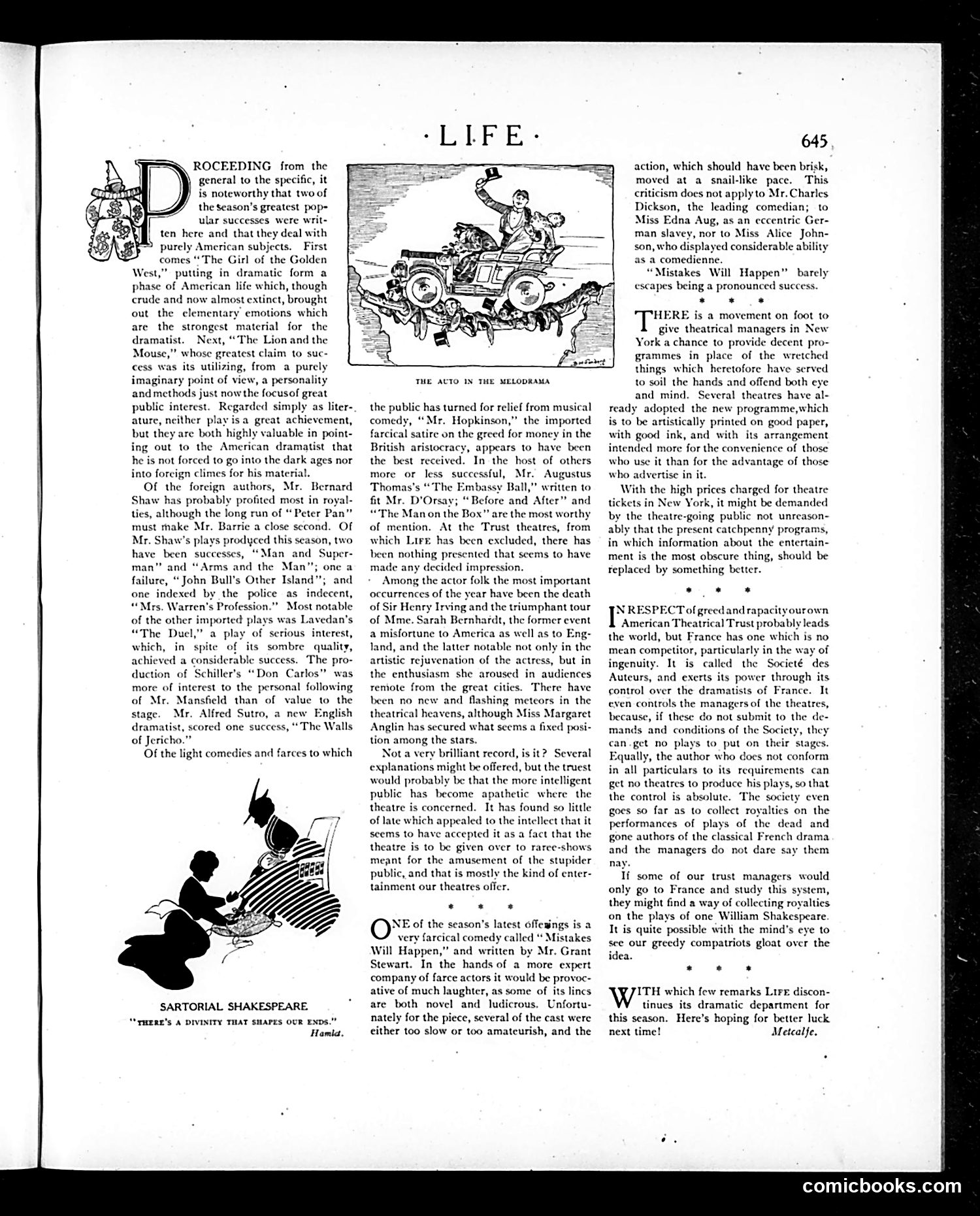
This page reviews the 1906-1907 American theatrical season. The main cartoon, titled "Sartorial Shakespeare," depicts a figure in modern dress (appearing to be an actor) striking a dramatic pose while reading from a book—a visual joke about performing classical Shakespeare in contemporary clothing rather than period costume. The text discusses successful American plays like "The Girl of the Golden West" and "The Lion and the Mouse," alongside imported works by Shaw and Barrie. It notes the deaths of actor Henry Irving and the tour of Sarah Bernhardt. The satirical point: American theater is losing intelligent audiences to apathy. The cartoon suggests theater has become superficial—dressing up Shakespeare in modern garb (literally and figuratively) rather than engaging audiences substantively. The caption references Hamlet, implying that even great literature cannot save a degraded theatrical culture focused on spectacle over substance. The second illustration shows an automobile in a melodrama—likely mocking theater's desperate attempts to modernize by incorporating trendy technology to attract audiences.
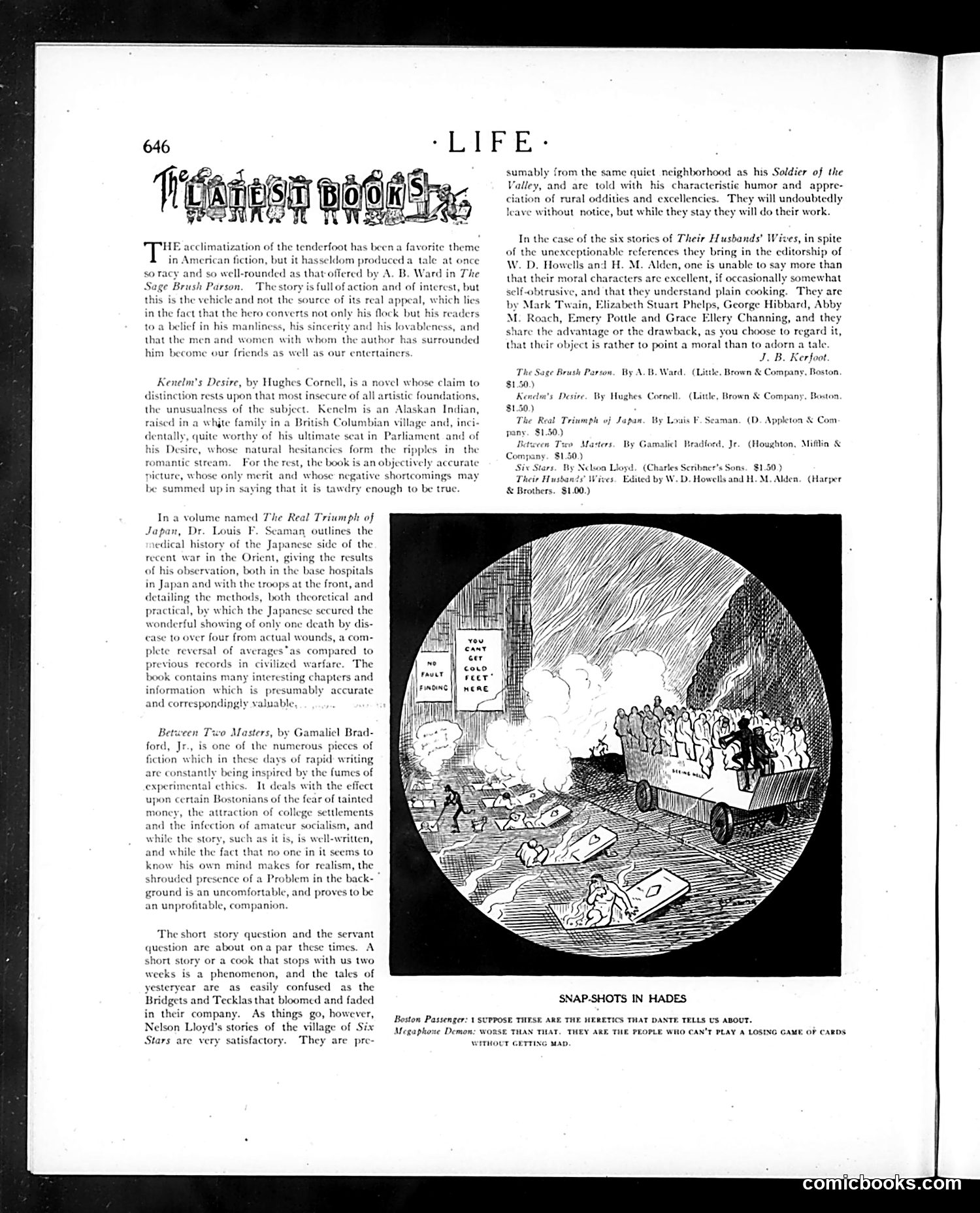
This page reviews recent books, but the cartoon "Snap-Shots in Hades" provides satire. It depicts a tour of Hell where a Boston passenger observes sinners. The caption jokes that these damned souls are worse than the heretics Dante described—they're people who cannot lose at cards gracefully without becoming angry. This mocks a specific social vice: poor sportsmanship among card players, apparently common enough in early 1900s society to warrant satirical punishment in the afterlife. The humor relies on the contrast between Dante's medieval spiritual sins and this petty modern character flaw. The cartoon suggests that losing gracefully at gambling was considered a marker of moral character and gentlemanly conduct among the magazine's audience.
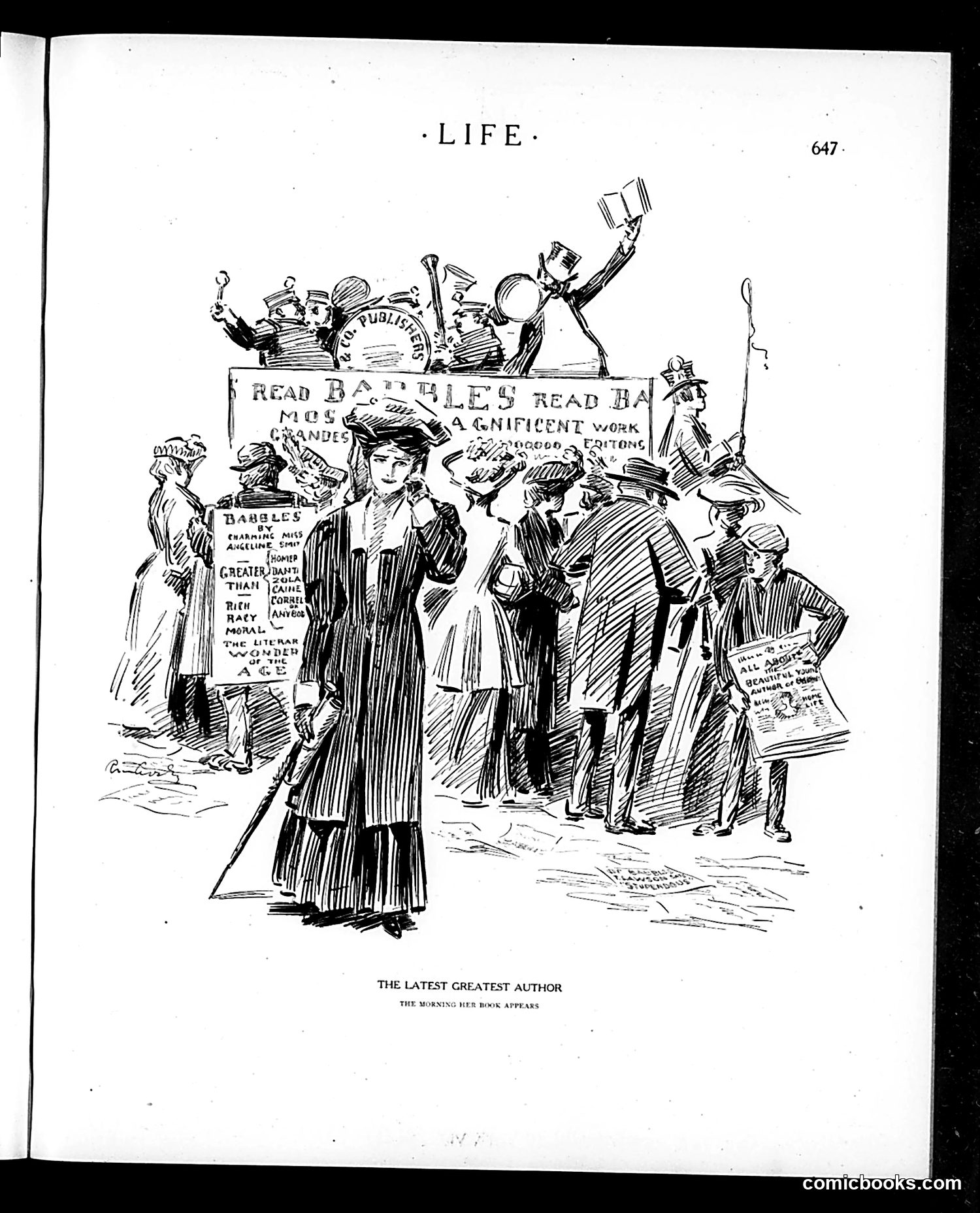
This satirical cartoon depicts the chaotic public reception of a new book's appearance. A woman in dark clothing stands center stage, apparently the newly celebrated author, surrounded by eager crowds holding promotional materials and signs reading "READ BARB[...]" and references to her work as "magnificent." The figures atop the platform wave books and promotional materials triumphantly, while various admirers cluster around below with placards touting superlatives ("GREATER THAN," "FINEST," etc.). The satire targets the publishing industry's hype machine and public gullibility—mocking how new authors are suddenly lionized with exaggerated claims regardless of actual literary merit. The frenzied crowd scene ridicules both aggressive marketing tactics and the mob mentality of popular reception.
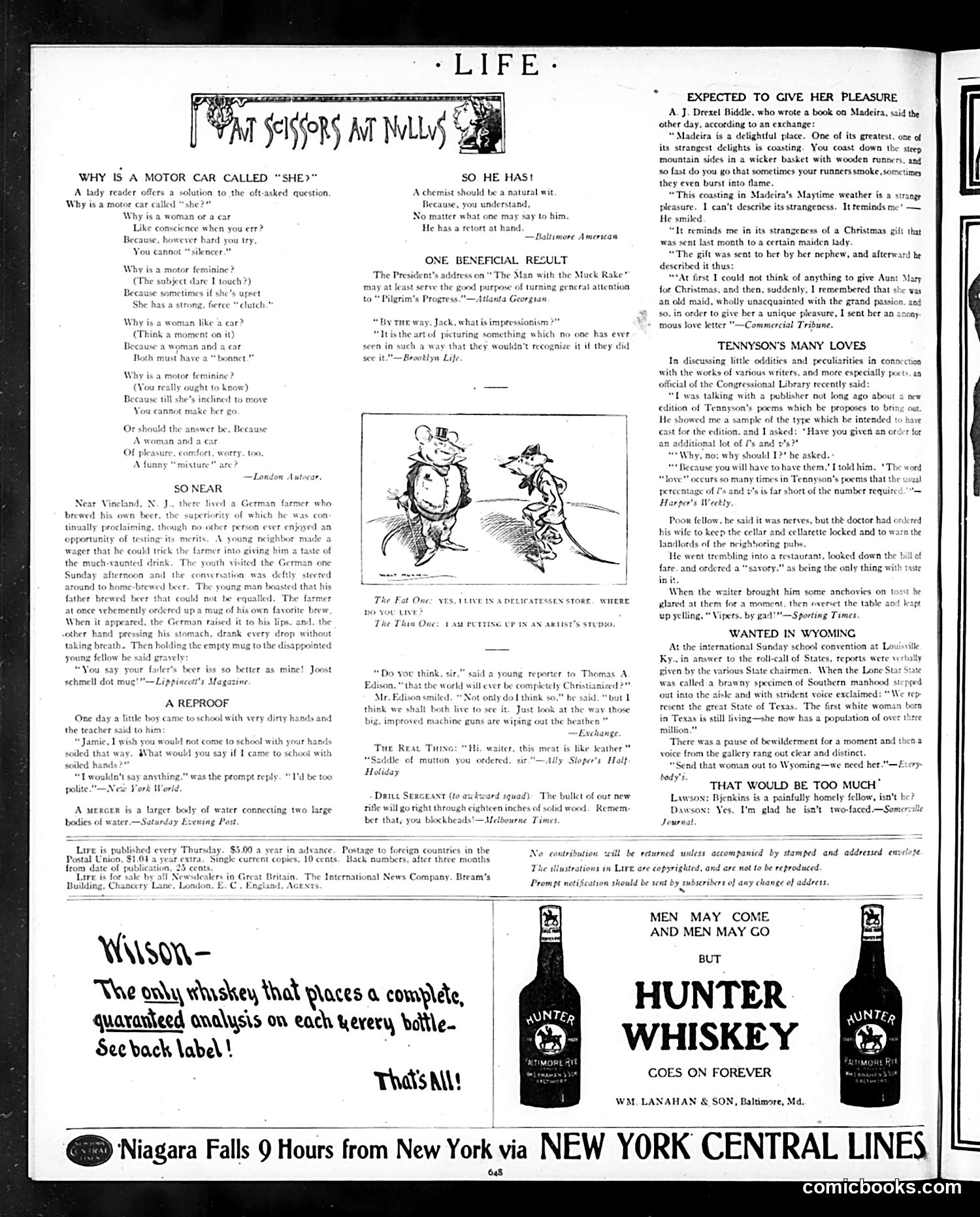
This page contains humor pieces typical of early 20th-century Life magazine. The main content includes: **"Why Is a Motor Car Called 'She?'"** - A riddle page playing on the contemporary novelty of automobiles. The jokes riff on stereotypes about women (requiring maintenance, being difficult to control, needing silencers), reflecting the era's casual sexism. **German Farmer anecdote** - A dialect-heavy story mocking German immigrants, contrasting their homemade beer with commercial varieties—common immigrant humor of the period. **Minor jokes** - Include pieces about a dirty schoolboy and definitions of terms like "merger." **Advertisements** - Hunter Whiskey and New York Central Lines dominate the lower portion. The humor is period-specific: automobile novelty, ethnic caricature, and gendered ridicule. Modern readers should recognize this reflects casual prejudices common in early 1900s American popular culture, presented without the critical distance contemporary media would apply.
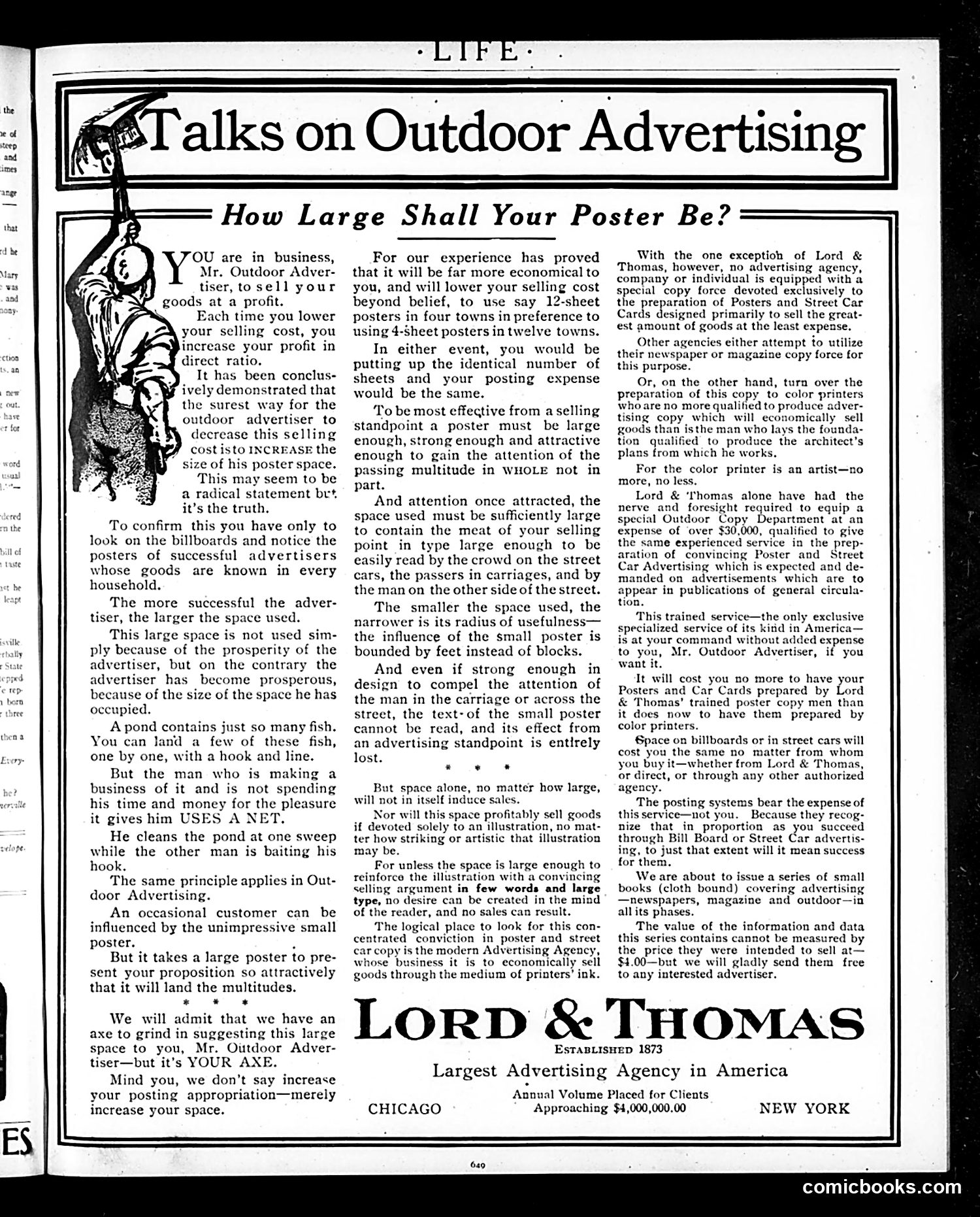
This is **advertising content**, not satire. Lord & Thomas, a major advertising agency, uses a trade publication to pitch their services to business owners. The central argument is a **metaphor about fishing**: small posters catch occasional customers (like fishing with a hook one at a time), while large posters catch masses (like using a net). The illustration shows a fisherman, reinforcing this analogy. The pitch claims that **larger poster sizes are more cost-effective**—they lower per-unit selling costs despite higher upfront expense. The agency argues for **concentrated impact in fewer locations** over scattered smaller ads. The final section positions Lord & Thomas as uniquely qualified, claiming they alone have staff dedicated exclusively to poster and street-car advertising copy. This is essentially a self-promotional argument for hiring their services. The tone is earnest business advice, not satire, characteristic of trade publication advertising in this era.
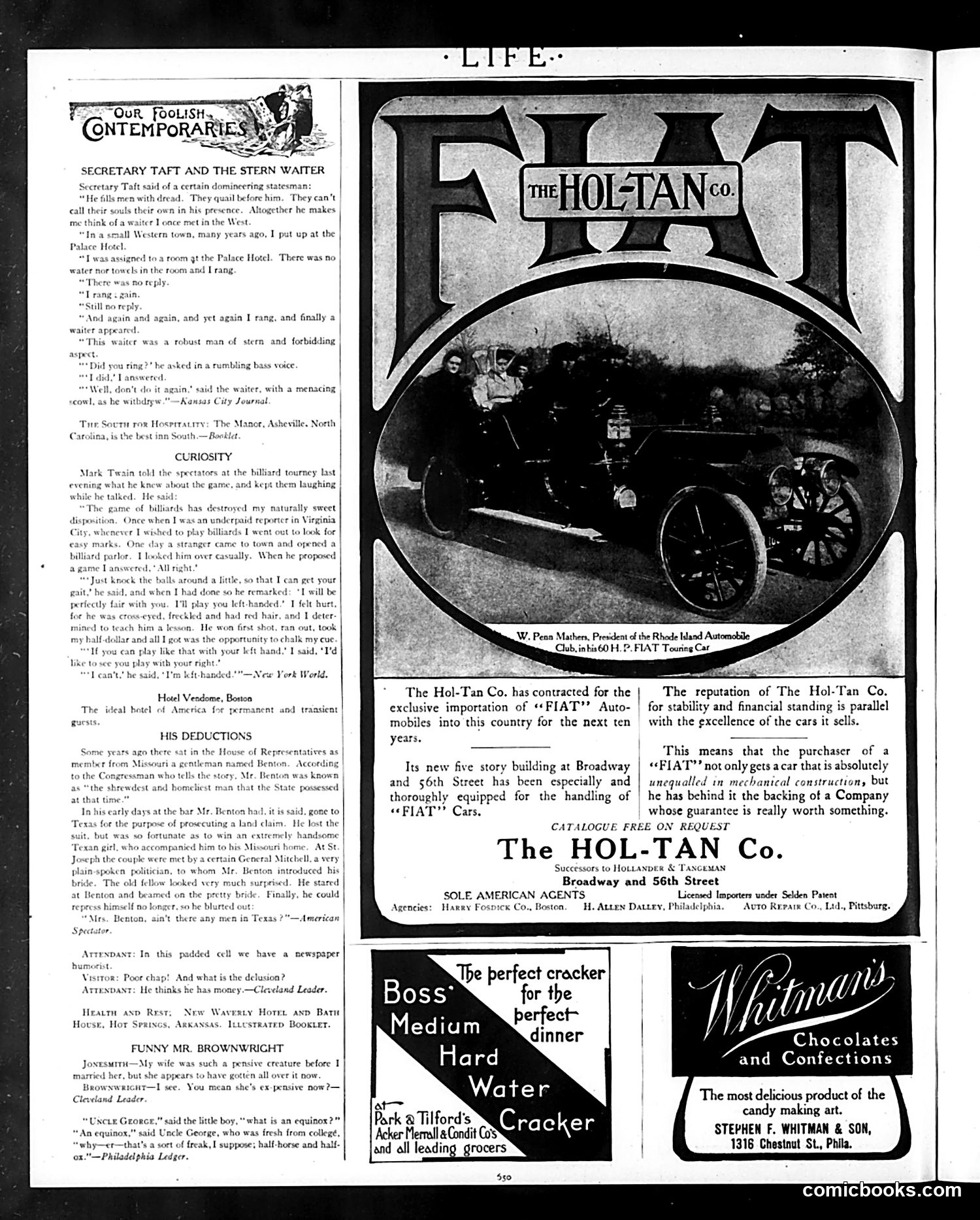
This page from *Life* magazine contains several distinct sections: **Main Content**: "Our Foolish Contemporaries" presents humorous anecdotes. One features Mark Twain recounting a billiards story about assessing opponents' character through their gait. Another concerns a Missouri congressman named Benton, whose bride's beauty prompted a general to ask incredulously if there were no men in Texas—a joke about regional backwardness. Brief comedic observations follow, including a quip about a wife becoming "pensive" after marriage. **Advertisements**: The page is dominated by large ads for the Hol-Tan Co. (importers of Fiat automobiles), Boss crackers, and Whitman's chocolates. The satire targets human folly—vanity, regional stereotypes, and marital disappointment—in the genteel tradition typical of early 20th-century American humor magazines. The content reflects *Life's* role as a satirical publication mixing social commentary with light entertainment and advertising.
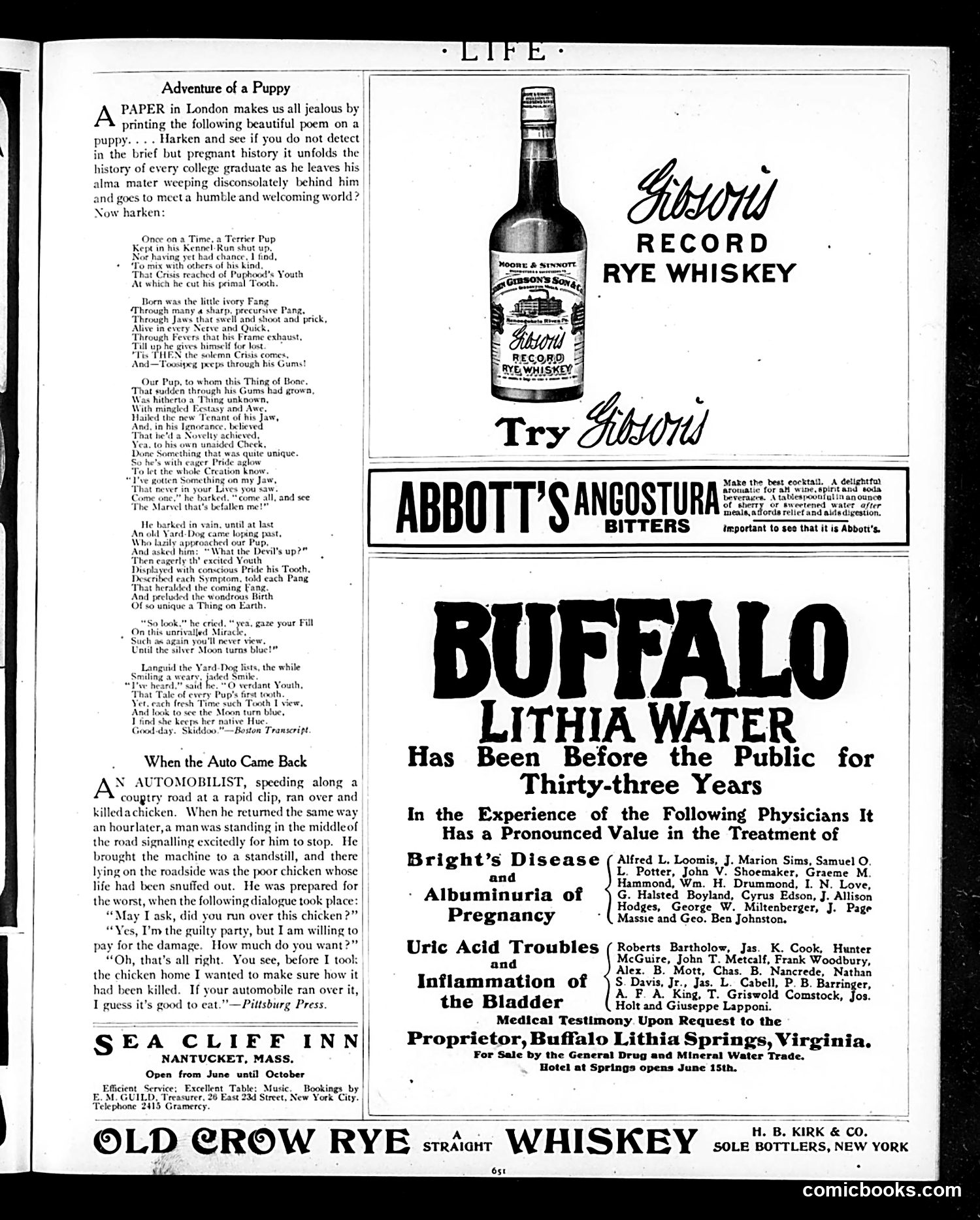
This page contains two main pieces of content: **"Adventure of a Puppy"** (left side): A satirical poem reprinted from a London publication. The editor notes it parallels a college graduate's experience—starting sheltered in an "alma mater," enduring hardships and struggles ("sharp, precursive" trials, "Fevers"), emerging transformed with newfound confidence (displaying his "Tooth" with "conscious Pride"), then facing an indifferent world. The satire suggests the shock of leaving protected academic life for harsh reality. **"When the Auto Came Back"**: A humorous anecdote about an automobile driver who hits a chicken. When he returns to compensate the owner, the man reveals he merely wanted to verify *how* the chicken died—implying he planned to eat it regardless. The joke satirizes opportunistic logic and rural practicality. **The advertisements** (Gibbons' Record Rye Whiskey, Abbott's Bitters, Buffalo Lithia Water, Old Crow Rye) are period medical/alcoholic remedies claiming to treat various ailments—typical early-20th-century patent medicine marketing.
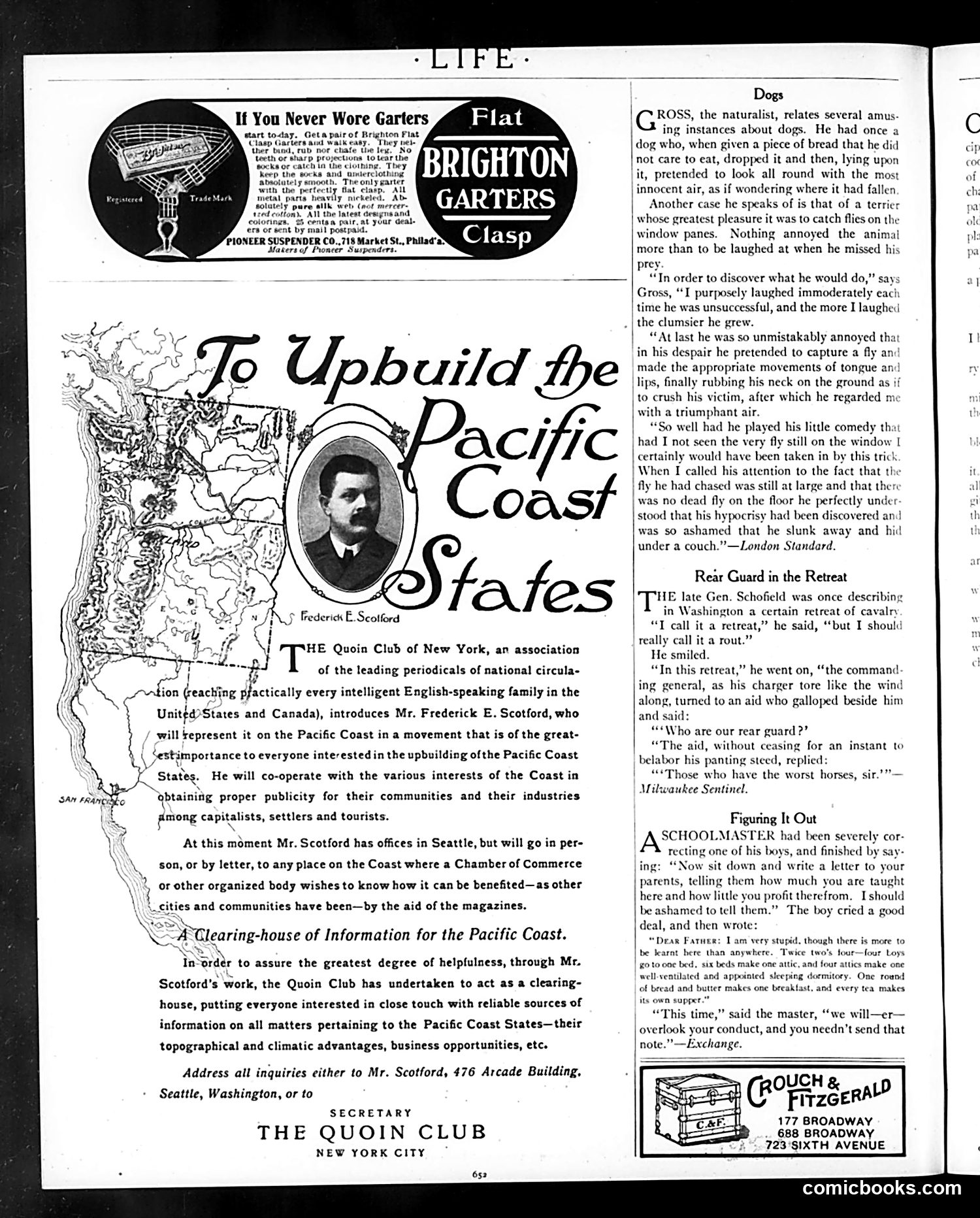
This page contains three distinct pieces of content: **1. Advertisement (top):** A "Flat Brighton Garters Clasp" ad from Pioneer Suspender Co., a utilitarian product common in the era when men wore garters to hold up socks. **2. Main Article (center-left):** A promotional piece introducing Frederick E. Scotford, representing the Quoin Club of New York on the Pacific Coast. The Quoin Club was an association of major periodicals aimed at promoting development and tourism in Pacific Coast states. This appears to be informational content, not satire. **3. Three Humorous Anecdotes (right):** - A naturalist's story about a dog's ability to fake emotions (feigning interest in fallen bread, pretending to catch a fly to avoid mockery) - A General Schofield anecdote about cavalry retreat terminology - A schoolmaster tale about a boy's letter home These stories emphasize animal/human deception and clever wordplay rather than political satire. They're genteel humor typical of *Life* magazine's early 20th-century style.
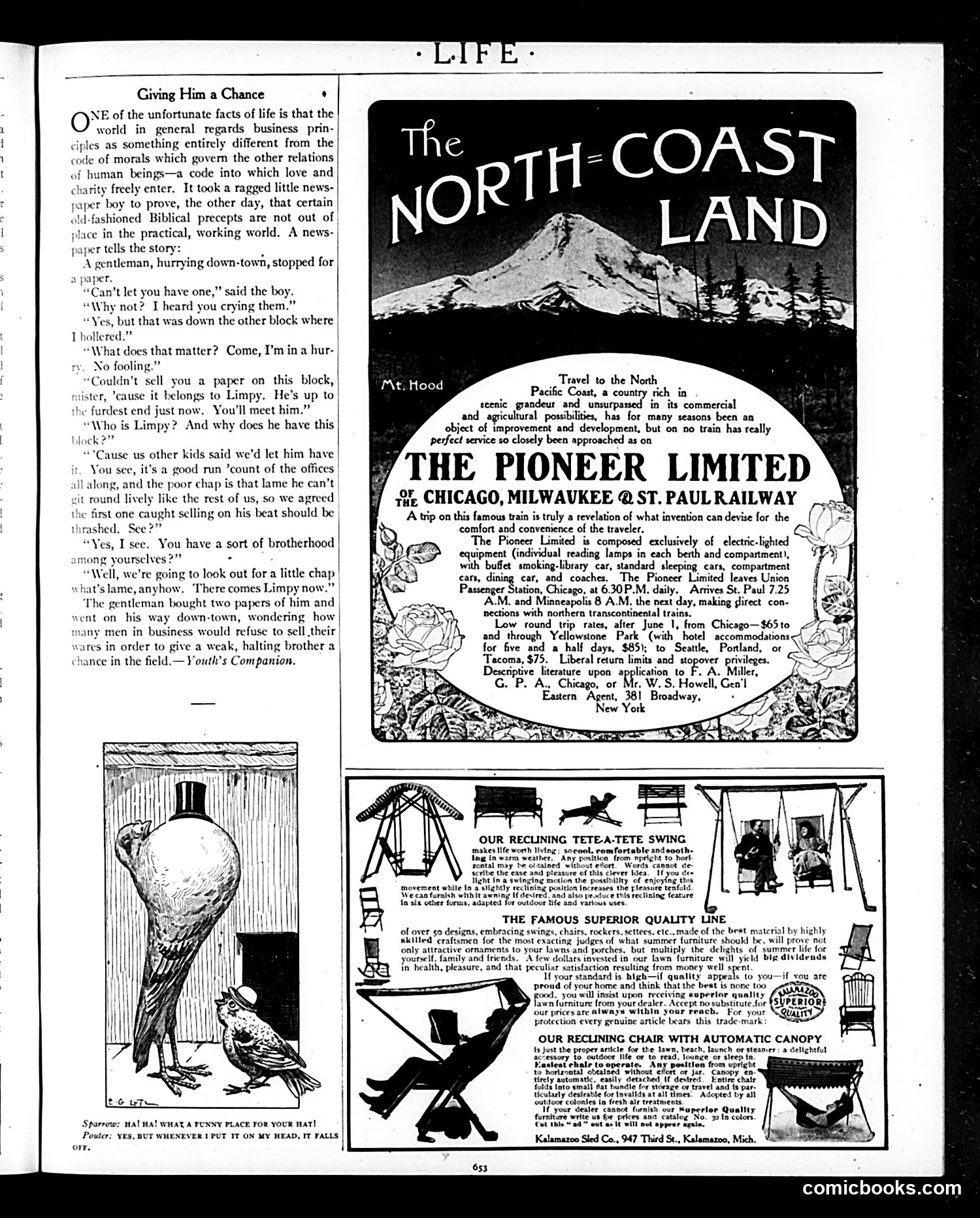
**Left side - "Giving Him a Chance":** This is a moral anecdote about newsboys operating in urban neighborhoods. A gentleman encounters a young vendor who refuses to sell him a newspaper because that street "belongs to Limpy," a disabled (lame) boy. The other newsboys have voluntarily given Limpy the most profitable territory so he can earn a living despite his physical handicap. The story celebrates this informal "brotherhood" among working-class children who practice Christian charity in business—treating a vulnerable peer fairly rather than exploiting him competitively. The implicit message: even poor children understand brotherhood better than many adult businessmen do. **Bottom left cartoon:** A man's hat falls off repeatedly when he puts it on his head—a simple visual gag with the punchline "Yes, but whenever I put it on my head, it falls off." **Right side:** Primarily advertisements for train travel (the Pioneer Limited) and outdoor furniture (reclining chairs/swings), reflecting period consumer goods.
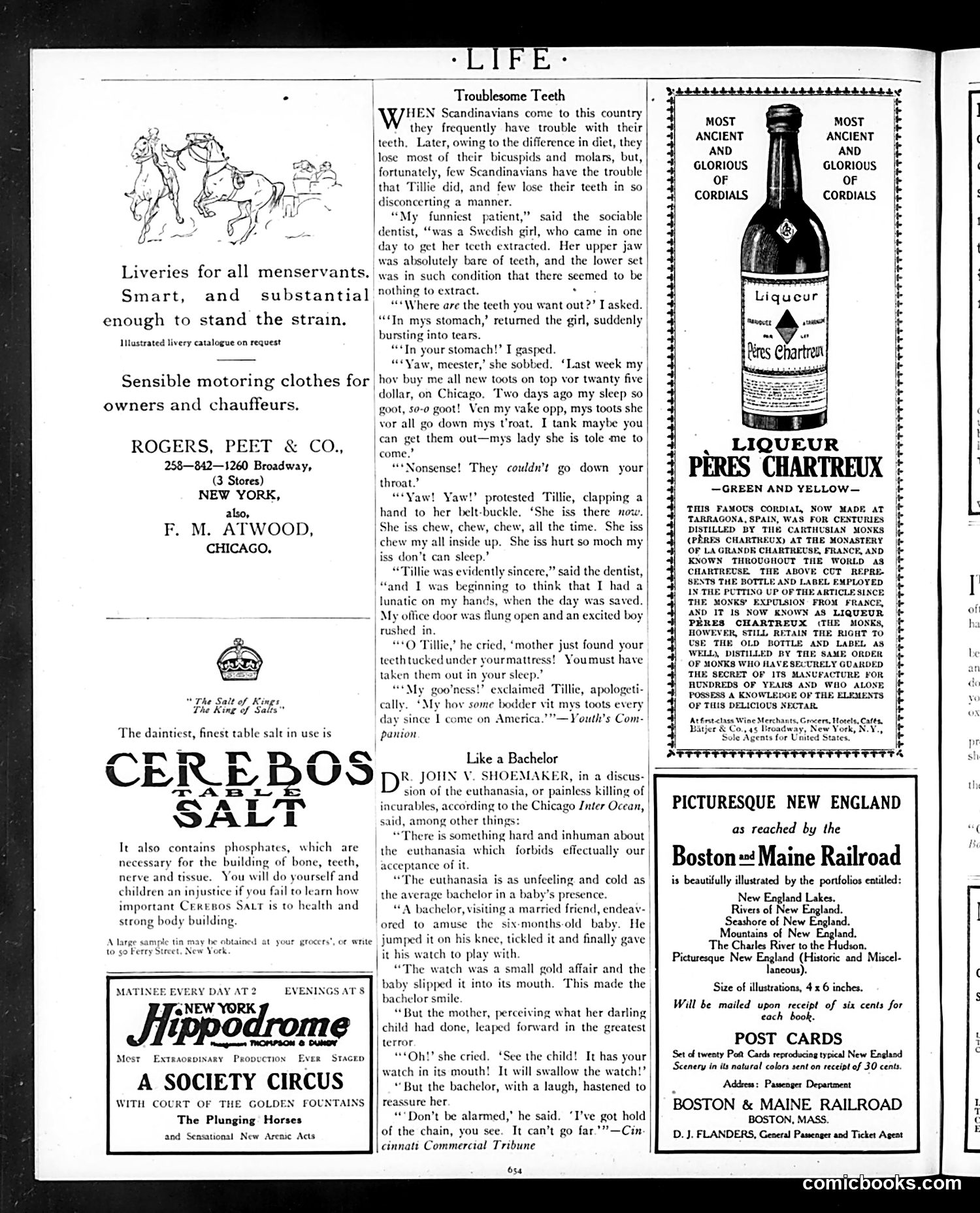
This page contains a humorous short story about a Swedish immigrant named Tillie, exploiting period stereotypes through heavy dialect humor. The joke hinges on a literal misunderstanding: Tillie has swallowed her newly-purchased false teeth down her throat, but mistakenly believes they've become lodged permanently. The humor operates on multiple levels typical of early 20th-century Life magazine: 1. **Ethnic caricature**: Scandinavian immigrants were mocked for poor English, making Tillie's phonetic speech ("Yaw, meester," "vake opp") the primary comedic vehicle. 2. **Immigration social commentary**: The story references Scandinavians losing teeth due to diet changes and new food in America—a real observation about immigrant health—but exaggerates it absurdly. 3. **Class comedy**: The dentist's bemused reaction to working-class confusion and superstition. The punchline—teeth found under the mattress where she unconsciously removed them—suggests immigrant naiveté and unfamiliarity with her own body's actions. The remaining page content is advertising, unrelated to the cartoon.
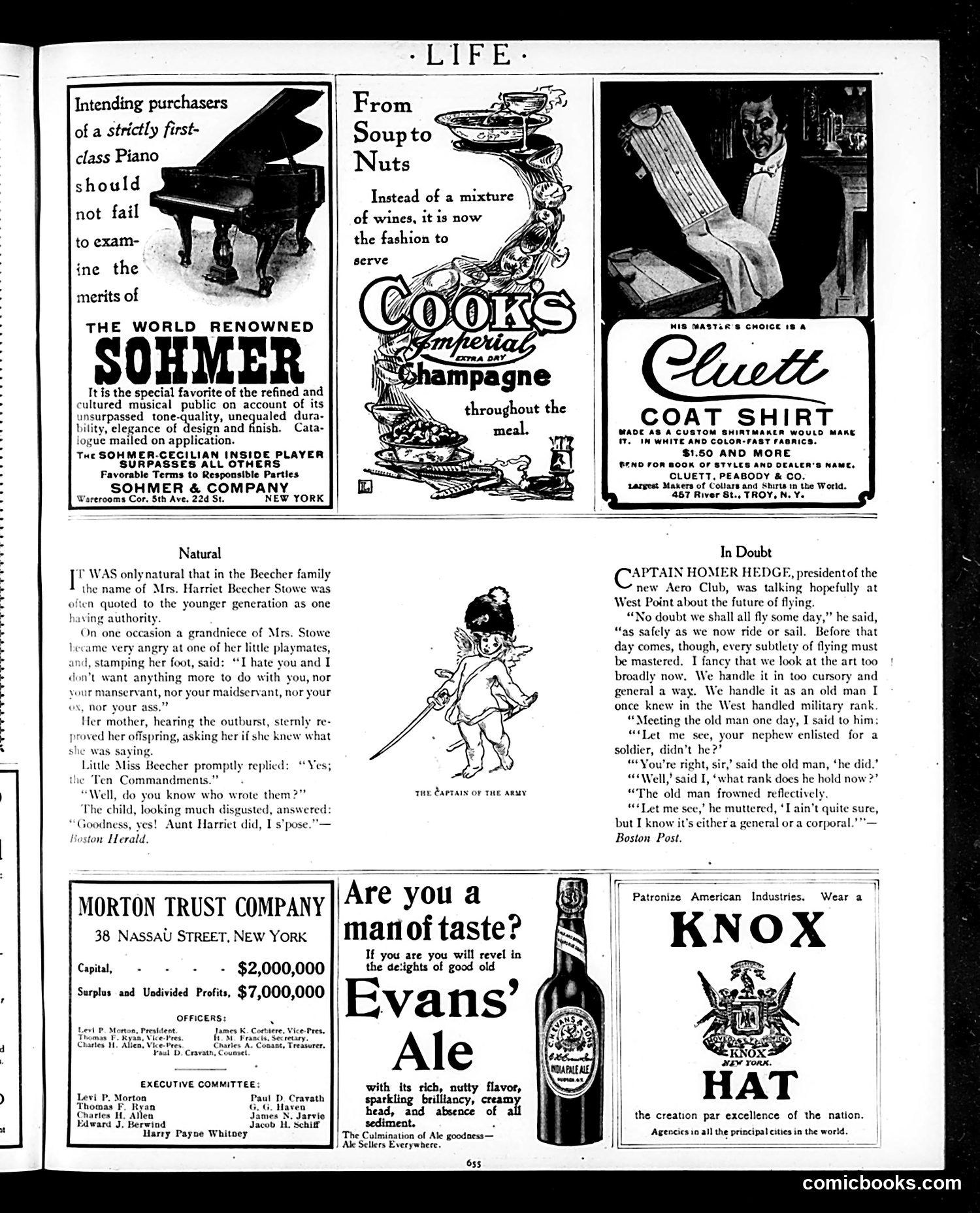
This page is primarily **advertisements and humor pieces** rather than political satire. The main content includes: **Advertisements** for pianos (Sohmer), dress shirts (Cluett), banking (Morton Trust Company), and beverages (Evans' Ale and Knox Hats). **Two humor pieces:** 1. **"Natural"** — A joke about the Beecher family (famous 19th-century intellectuals). A young Beecher relative, told her ancestor Harriet Beecher Stowe wrote the Ten Commandments, angrily replies she has nothing to do with someone so presumptuous. The humor plays on family pride and misattribution of authority. 2. **"In Doubt"** — A story about Captain Homer Hedge discussing aviation safety. He recalls an old man uncertain whether his nephew held the rank of "general or corporal"—illustrating confusion about military hierarchy. The joke mocks vague understanding of formal distinctions. Both pieces use gentle, domestic humor typical of early 20th-century Life magazine rather than sharp political commentary.
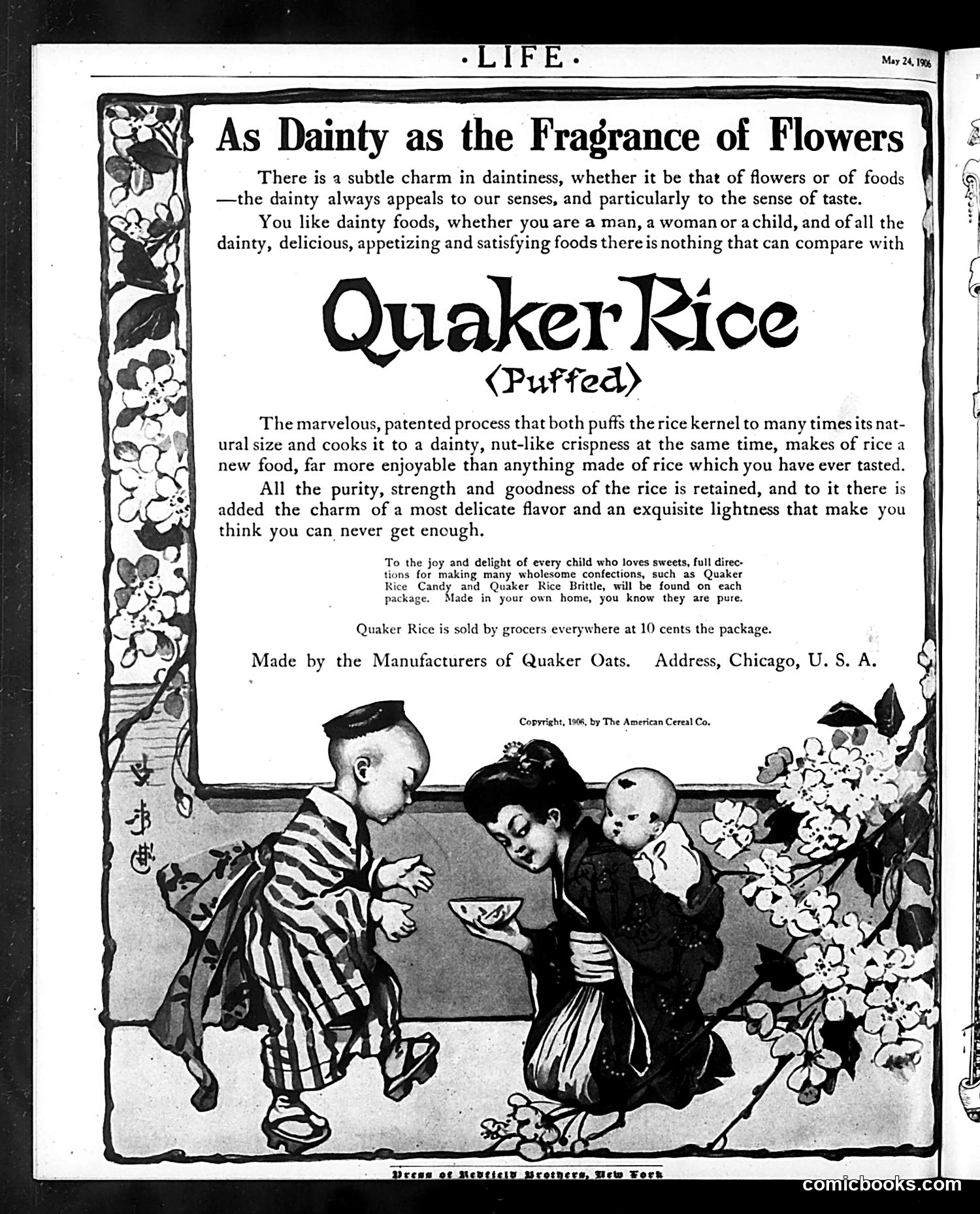
This is primarily a **food advertisement**, not political satire. It promotes Quaker Rice (Puffed), a breakfast cereal made by The American Cereal Company of Chicago. The illustration shows three children in early 1900s clothing enjoying the product in a garden setting surrounded by flowers—reinforcing the ad's opening comparison of the rice's "daintiness" to flower fragrance. The decorative floral border frames the page. Key marketing appeals: - Emphasizes refinement and delicacy ("dainty," "exquisite lightness") - Highlights the patented puffing process as novel technology - Appeals to mothers by stressing purity and wholesomeness - Includes recipes for homemade candy/brittle made with the rice - Price point: 10 cents This represents typical early-20th-century advertising strategy: associating an affordable mass-produced food with elegance, natural beauty, and family wholesomeness—positioning a cheap breakfast cereal as a refined, healthful choice for all family members.