
Life, 1906-05-24 · page 14 of 26
Life — May 24, 1906 — page 14: what you’re looking at
What you’re looking at
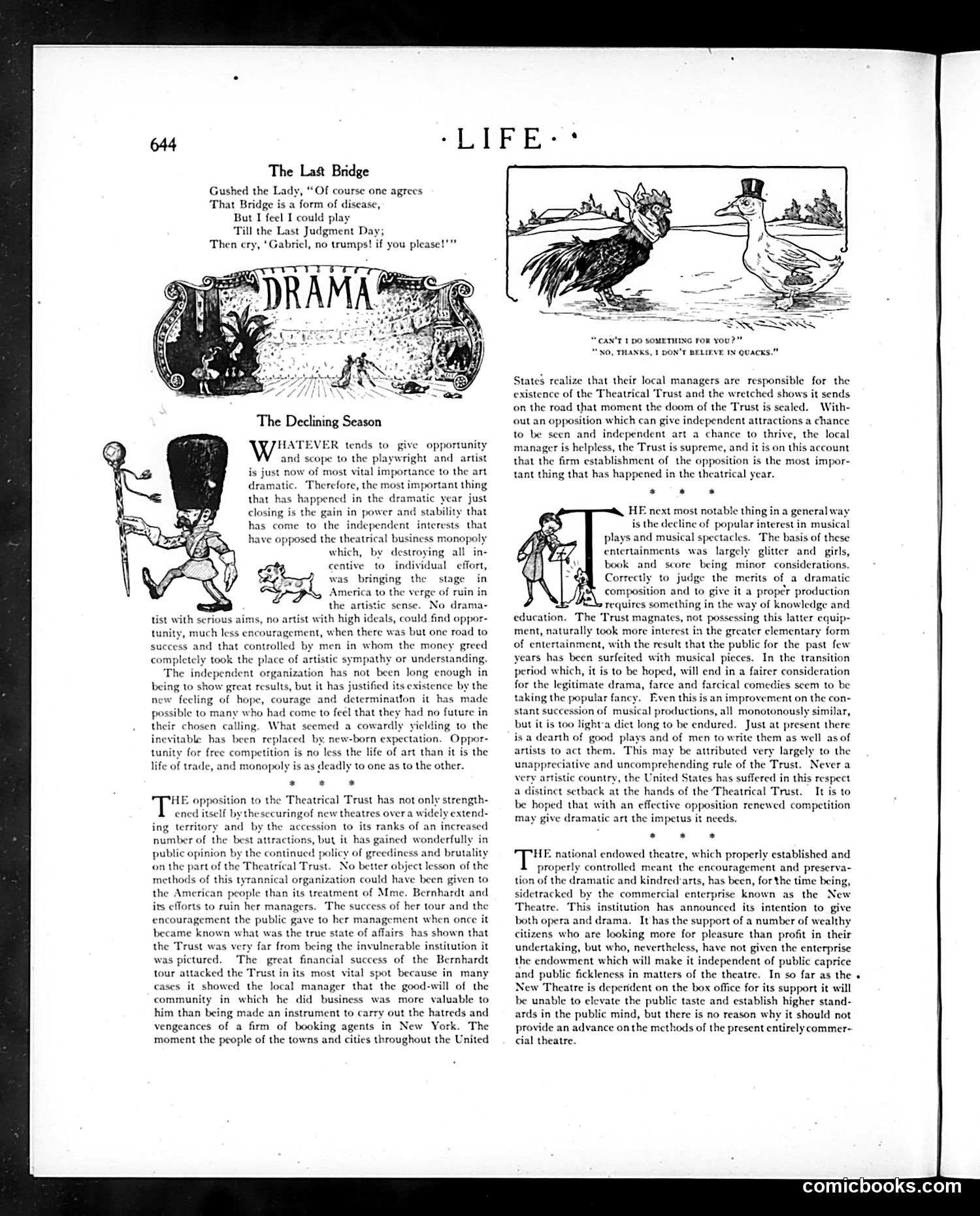
**"The Last Bridge"** (top): A light humorous poem about a woman addicted to playing bridge—a card game—comparing her obsession to a disease. She jokes she'd play bridge even until the Last Judgment Day, irreverently asking the angel Gabriel to skip his trumpet fanfare so she can continue playing. **The main article** addresses the **Theatrical Trust**, a monopoly controlling American theater distribution. The satire celebrates the recent rise of independent theatrical competition breaking the Trust's stranglehold. The accompanying cartoon (right) shows a sick-looking figure (representing theater/the Trust) refusing help from a doctor, declaring "I don't believe in quacks"—suggesting the monopoly rejects the "cure" of competition and independent theaters. **Historical context**: This reflects early 1900s American anti-monopoly sentiment. The Theatrical Trust, controlled by powerful New York booking agents, dictated which plays toured America. Independent theaters and managers (like those supporting actress Sarah Bernhardt's tour) challenged this system, and *Life* magazine celebrates their success as good for artistic freedom and local communities.
📄 Transcribed text from this page (OCR, searchable)
Machine-transcribed from the original scan — historical spelling and the odd misread are preserved.
The Last Bridge Gushed the Lady, “Of course one agrees That Bridge is a form of disease, But I feel I could play Till the Last Judgment Day; Then cry, ‘Gabricl, no trumps! if you please!” The Declining Season HATEVER tends to. give opportunity and scope to the playwright and artist is just now of most vital importance to the art dramatic. Therefore, the most important thing that has happened in the dramatic year just closing is the gain in power and stability that has come to the independent interests that have opposed the theatrical business monopoly which, by destroying all in- centive to individual effort, ~ was bringing the stage in Ok America to the verge of ruin in the artistic sense. No drama- tist with serious aims, no artist with high ideals, could find oppor- tunity, much less encouragement, when there was but one road to success and that controlled by men in whom the money greed completely took the place of artistic sympathy or understanding. The independent organization has not been long enough in being to show great results, but it has justified its existence by the new fecling of hope, courage and determination it has made possible to many who had come to feél that they had no future in their chosen calling. What seemed a cowardly yielding to the inevitable has been replaced by new-born expectation. Oppor- tunity for free competition is no less the life of art than it is the life of trade, and monopoly is as deadly to one as to the other. * 2 * HE opposition to th ened itself by thesecuringof new theatres over a wid Theatrical Trust has not only strength- extend- ing territory and by the accession to its ranks of an increased number of the best attractions, but it has gained wonderfully in public opinion by the continued policy of greediness and brutality on the part of the Theatrical Trust. No better object lesson of the methods of this tyrannical organization could have been given to the American people than its treatment of Mme. Bernhardt and its efforts to ruin her managers. The success of her tour and the encouragement the public gave to her management when once it became known what was the true state of affairs has shown that the Trust was very far from being the invulnerable institution it was pictured. The great financial success of the Bernhardt tour attacked the Trust in its most vital spot because in many cases it showed the local manager that the good-will of the community in which he did business was more valuable to him than being made an instrument to carry out the hatreds and vengeances of a firm of booking agents in New York. The moment the people of the towns and cities throughout the United SSS “CAN'T 1 D0 SOMETHING For You?" “NO, THANKS, 1 DON'T BELIEVE IN QUACKS.”” States realize that their local managers are responsible for the existence of the Theatrical ‘Trust and the wretched shows it sends on the road that moment the doom of the Trust is sealed. With- out an opposition which can give independent attractions a chance to be seen and independent art a chance to thrive, the local manager is helpless, the Trust is supreme, and it is on this account that the firm establishment of the opposition is the most impor- tant thing that has happened in the theatrical year. * 8 * HE next most notable thing in a general way is the decline of popular interest in musical plays and musical spectacles. ‘The basis of these entertainments was largely glitter and_ girls, book and score being minor considerations. GY Correctly to judge the merits of a dran FS composition and to give it a proper production & requires something in the way of knowledge and education. The Trust magnates, not possessing this latter equip- ment, naturally took more interest in the greater elementary form of entertainment, with the result that the public for the past few years has been surfeited with musical pieces. In the transition period which, it is to be hoped, will end in a fairer consideration for the legitimate drama, farce and farcical comedies seem to be taking the popular fancy. Even this isan improvement on the con- stant succession of musical productions, all monotonously similar, but it is too light-a dict long to be endured. Just at present there is a dearth of good plays and of men to write them as well as of artists to act them. This may be attributed very largely to the unappreciative and uncomprehending rule of the Trust. Never a very artistic country, the United States has suffered in this respect a distinct setback at the hands of the ‘Theatrical Trust. It is to be hoped that with an effective opposition renewed competition may give dramatic art the impetus it n HE national endowed theatre, which properly established and properly controlled meant the encouragement and preserva- tion of the dramatic and kindred-arts, has been, for the time being, sidetracked by the commercial enterprise known as the New ‘Theatre. This institution has announced its intention to give both opera and drama. It has the support of a number of wealthy citizens who are looking more for pleasure than profit in their undertaking, but who, nevertheless, have not given the enterprise the endowment which will make it independent of public caprice and public fickleness in matters of the theatre. In so far as the « New Theatre is depenident on the box office for its support it will be unable to elevate the public taste and establish higher stand- ards in the public mind, but there is no reason why it should not provide an advance on the methods of the present entirely commer- cial theatre. comicbooks.com