
Life, 1906-05-24 · page 10 of 26
Life — May 24, 1906 — page 10: what you’re looking at
What you’re looking at
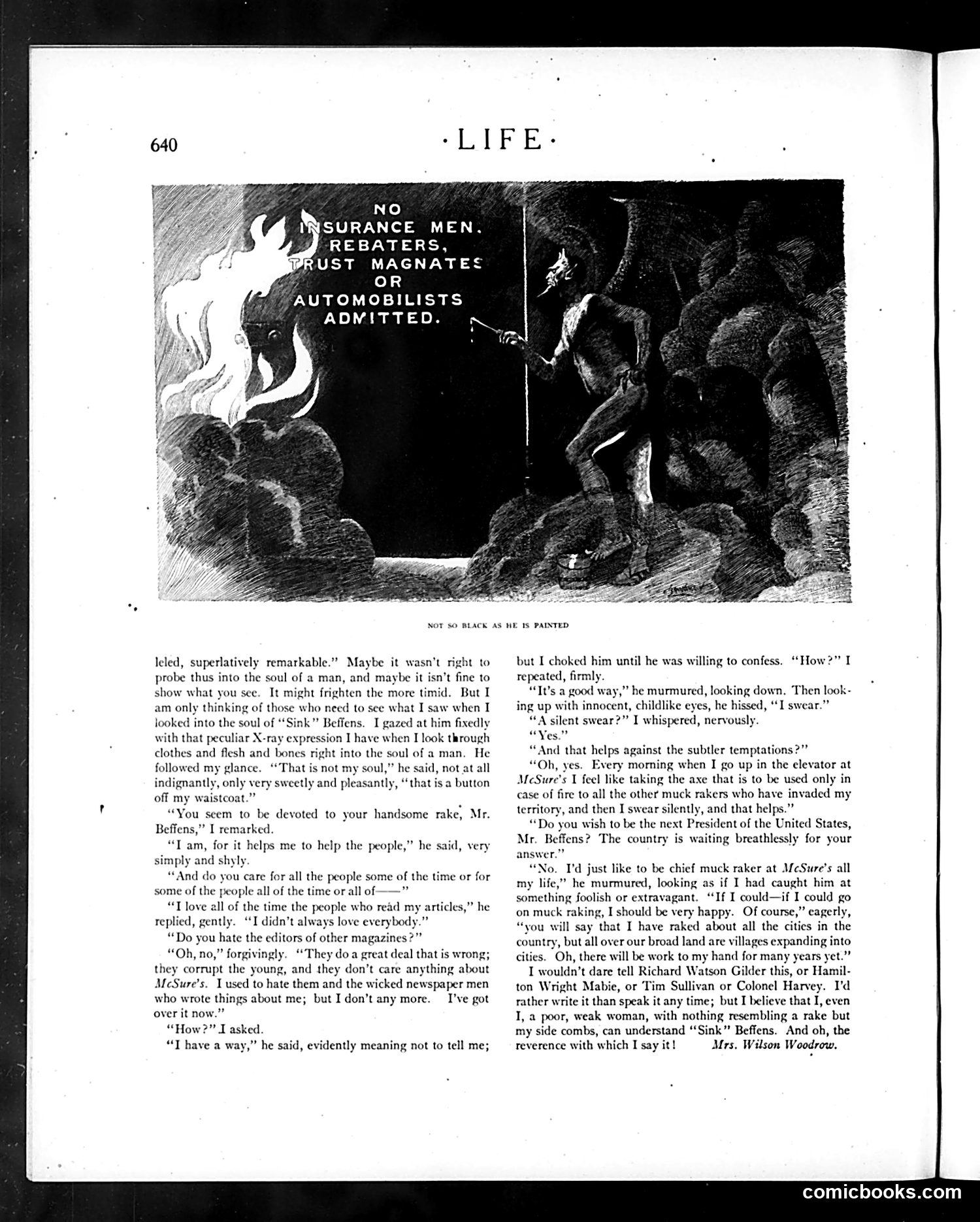
The cartoon depicts a hellish scene where a figure (appearing to be a "rake" or libertine) stands at the gates of Hell, blocked by demons. The sign reads: "NO INSURANCE MEN, REBATERS, TRUST MAGNATEES OR AUTOMOBILISTS ADMITTED." This satirizes early 1900s corporate and social figures excluded from Hell itself—suggesting they were considered *worse* than demons. "Insurance men" and "rebaters" reference insurance fraud schemes; "trust magnates" alludes to monopolistic industrialists; "automobilists" mocks the wealthy elite who drove cars. The joke inverts traditional morality: these groups are so corrupt that even Hell won't admit them. It's fierce social criticism of Gilded Age commercial excess and fraud, presented through dark humor about who belongs in the underworld.
📄 Transcribed text from this page (OCR, searchable)
Machine-transcribed from the original scan — historical spelling and the odd misread are preserved.
NO SURANCE MEN. REBATERS, RUST MAGNATES OR “AUTOMOBILISTS ADMITTED. x NOT SO BLACK AS HE IS PAINTED leled, superlatively remarkable.” Maybe it wasn’t right to probe thus into the soul of a man, and maybe it isn’t fine to show what you see. It might frighten the more But I am only th hinking of those who need to see what I saw when I looked into the soul of “Sink” Beffens. I gazed at him fixedly ion IT have when I look through clothes and flesh and bones right into the soul of a man. He followed my glance. “That is not my soul,” he said, not at all indignantly, only very sweetly and pleasantly, “that is a button off my waistcoat.” “You seem to be devoted to your handsome rake, Mr. Beffens,” I remarked. “Tam, for it helps me to help the people,” he s simply and shyly “And do you care for all the people some of the time or for some of the people all of the time or all of —” “T love all of the time the people who read my articles, replied, gently. ‘I didn’t always love everybody.” “Do you hate the editors of other magazines?” “Oh, no,” forgivingly. “They do a great deal that is wrong; they corrupt the young, and they don’t care anything about McSure’s. L used to hate them and the wicked newspaper men who wrote things about me; but I don’t any more. I’ve got over it now.” “How?” I asked. “T have a way,” he said, evidently meaning not to tell me; id, very but I choked him until he was willing to confess. ‘‘How?” I repeated, firmly. “Tt’s a good way,” he murmured, looking down. Then look- ing up with innocent, childlike eyes, he hissed, “I swear.” “A silent swear?” I whispered, nervously. Nes? “And that helps against the subtler temptations?” “Oh, yes. Every morning when I go up in the elevator at McSure's 1 feel like taking the axe that is to be used only in case of fire to all the other muck rakers who have invaded my territory, and then I swear “Do you wish to be the next President of the United States, Mr. Beffens? The country is waiting breathlessly for your answer.” . I'd just like to be chief muck raker at McSure’s all my life,” he murmured, looking as if I had caught him at something foolish or extravagant. “If I could—if I could go on muck raking, I should be very happy. Of course,” eagerly, “you will say that I have raked about all the cities in the country, but all over our broad land are villages expanding into cities. Oh, there will be work to my hand for many years yet.”” I wouldn’t dare tell Richard Watson Gilder this, or Hamil- ton Wright Mabie, or Tim Sullivan or Colonel Harvey. I'd rather write it than speak it any time; but I believe that I, even I, a poor, weak woman, with nothing resembling a rake but my side combs, can understand ‘‘Sink” Beffens. And oh, the reverence with which I say it! Mrs. Wilson Woodrow. comicbooks.com