
Life, 1906-05-24 · page 16 of 26
Life — May 24, 1906 — page 16: what you’re looking at
What you’re looking at
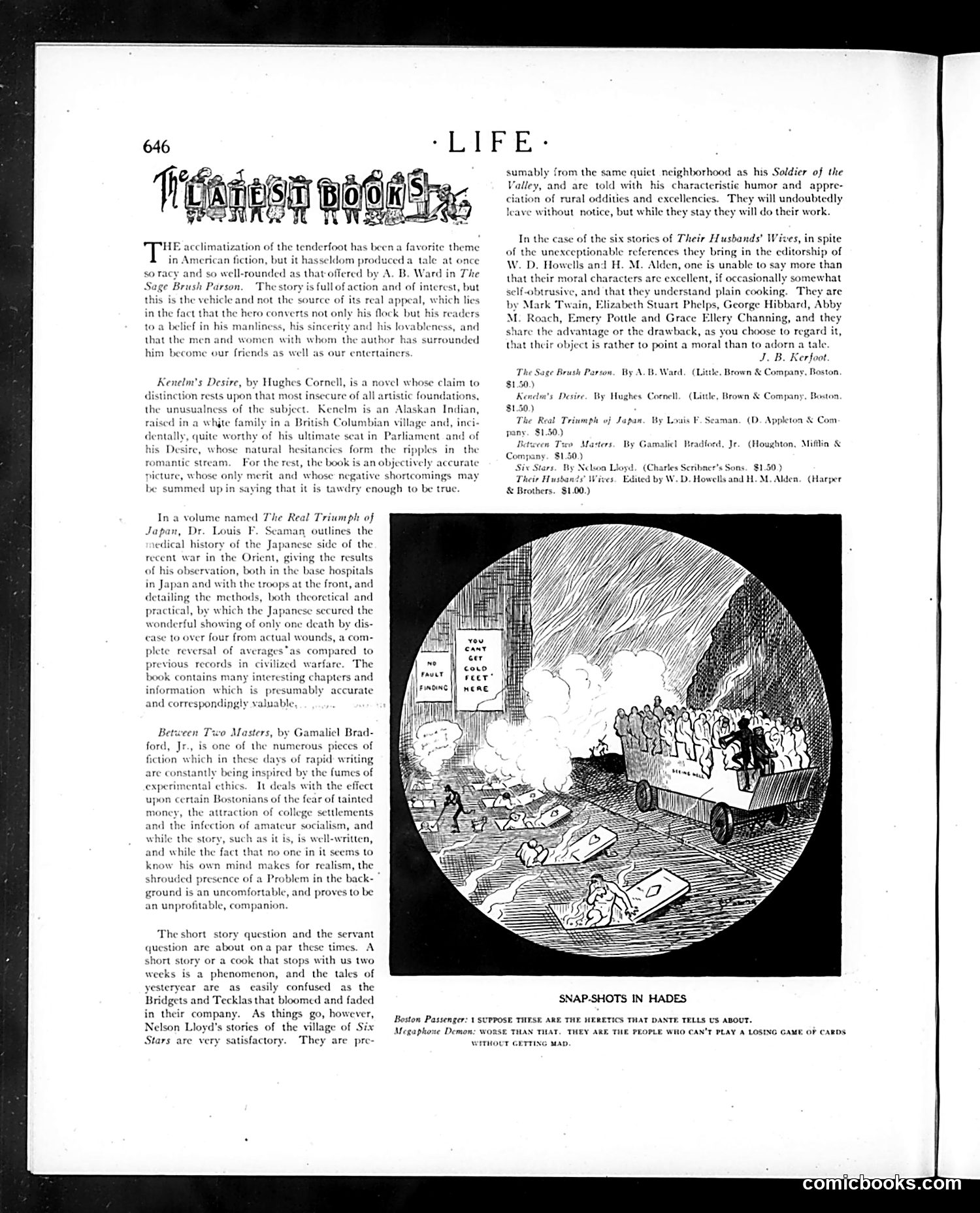
This page reviews recent books, but the cartoon "Snap-Shots in Hades" provides satire. It depicts a tour of Hell where a Boston passenger observes sinners. The caption jokes that these damned souls are worse than the heretics Dante described—they're people who cannot lose at cards gracefully without becoming angry. This mocks a specific social vice: poor sportsmanship among card players, apparently common enough in early 1900s society to warrant satirical punishment in the afterlife. The humor relies on the contrast between Dante's medieval spiritual sins and this petty modern character flaw. The cartoon suggests that losing gracefully at gambling was considered a marker of moral character and gentlemanly conduct among the magazine's audience.
📄 Transcribed text from this page (OCR, searchable)
Machine-transcribed from the original scan — historical spelling and the odd misread are preserved.
atization of the tenderfoot has been a favorite theme iction, but it hasseldom produced a tale at once so well-rounded as that offered by A. B. Ward in The The story is full of action and of interest, but vehicle and not the source of its real appeal, wt so racy an ¢ Brush Parson in the fac to a belief ii that the n him become our friend: the hero converts not only his flock but his r his manliness, his sincerit nand women with \ the al as well as our entertainers. Kenelm's Desire, by Hughes Cornell, is a novel whose distinction rests upon that most insecure of all artistic foundations, the unusualness of the subject. Kenelm is an Alaskan Indian, raised in a whjte £ Columbian vi his ultim ural hesitar seat in P3 the ripples in the jectively accurate rtcomings may ptally, quite worthy o ies forn n00k is a nly merit and whose negati whose ic stream. For the rest, the whose saying that it is tawdry enough to be truc be summed up in Ina volume named The Real Triumph of Japan, Dr. Louis F. Seaman outlines the al history of the Japanese side of the recent war in the Orient, giving the re n, both in the base hospitals nand with the the metho by which th 1 showing of o! oops at the fi both theor vanese secured the ath by dis- \ case to over four from actual wounds, a com- reversal as compared to ed warfare. ‘The esting chapters and mably accurate plete f averages previous records in civil book contains sters, by Gamalicl Brad- s one of the numerous pieces of fiction w are constantly being ich in these days of rapid: writing he fumes of s with the effect of tainted nents experiment upon cert mone and ¢ while the story, such as it is, is well-written, and while the know his own mind makes for realism, the rouded presence of a Problem in the back- ound is an uncomfortable, and proves to be an unprofitable, companion. infection of amatcur socialism, and 3 to The short story question and the servant question are about ona par these times. A short story or a cook that stops with us two weeks is a phenomenon, and the tales of yesteryear are as easily confused as the Bridgets and Tecklas that bloomed and faded in their company. As things go, however, Nelson Lloyd's stories of the village of Six Megaphoe Demon: w Stars are ve They are pre- y satisfactory. rom the same quiet neighborhood as his Soldier of the and are told with his characteristic humor and appre- of rural oddities and excellencies. They will undoubtedly notice, but while they stay they will do their work. In the case of the six stories of Their Husbands’ Wives, in spite of the unexceptionable references they bring in the editorship of W. D. Howells and H. M. Alden, one is unable to say more than that their moral characters are excellent, if occasionally somewhat f-obtrusive, and that they understand plain cooking. They are by Mark Twain, Elizabeth Stuart Phelps, George Hibbard M. Roach, Emery Pottle and Grace are the advantage or the drawback, as y that their object is rather to point a moral than to adorn a JBLK (Little, Brown & Company, Boston. ou choose to regard i The Sage Brush Parson. By A.B. Ward. m's Desire. By Hughes Cornell. (Little, Brown & Company, Boston, Triumph oj Japan. By Louis F 1.50.) Seaman. (D. Appleton & Com: Masters. By Gamal Je. (Houghton, Mifflin & Sons. $1.50) and H.M. Alden. (4 SNAP-SHOTS IN HADES Boston Passenger: 1 SUPPOSE, THYSS. ARE THE HERETICS THAT DANTE TELLS US ABOUT. © THAN THAT, THEY ARE THE PEOPLE WHO CAN'T PLAY A LOSING CAME OF CARDS WITHOUT GETTING MAD.