
Life, 1906-05-24 · page 9 of 26
Life — May 24, 1906 — page 9: what you’re looking at
What you’re looking at
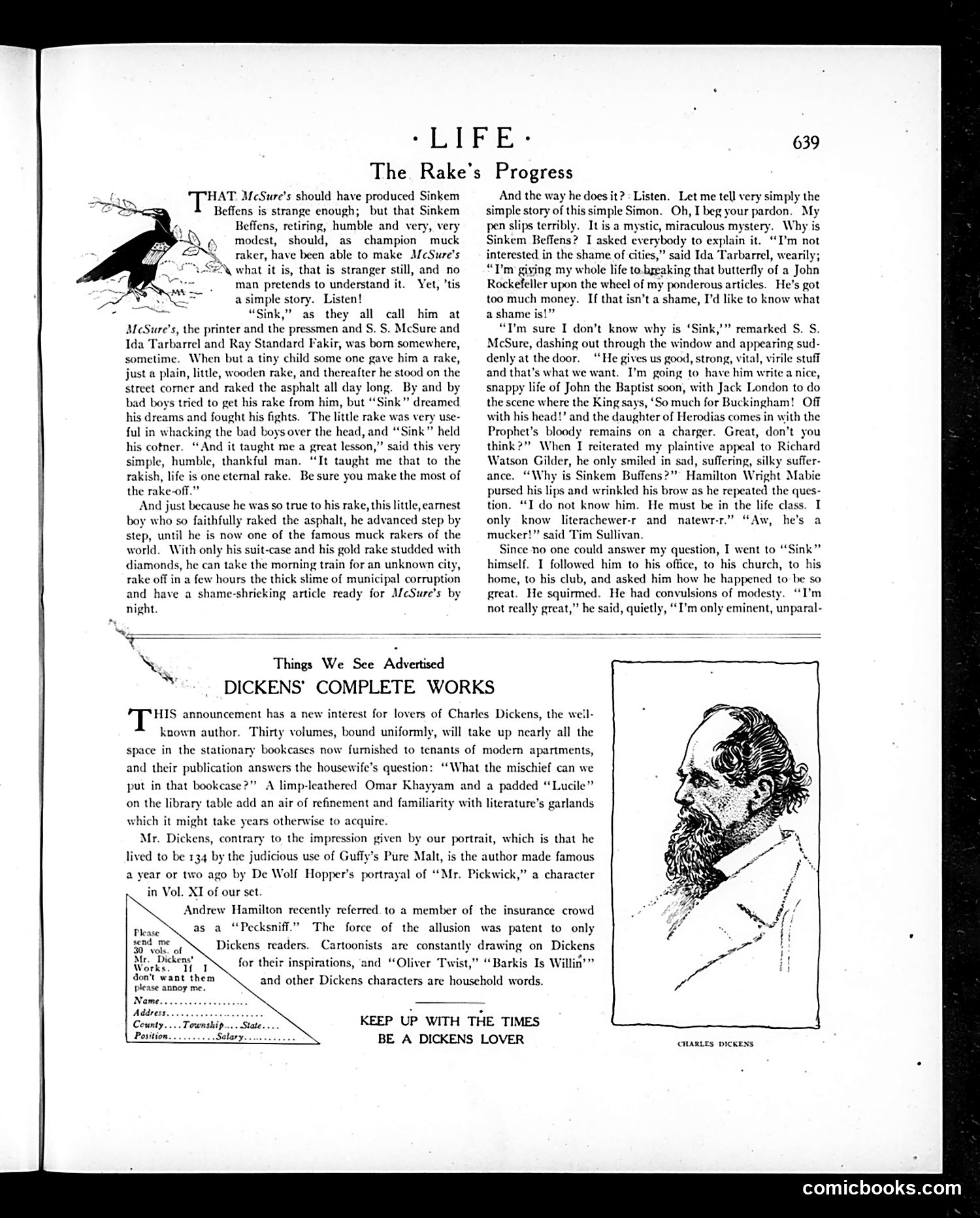
This page contains a serialized story titled "The Rake's Progress," featuring a character named Sinkem Biffens. The narrative describes how McSure (apparently a printer) and his associates discovered Sinkem—a humble wooden rake maker—and elevated him through shameless self-promotion into a famous society figure. The satire targets two things: (1) the absurdity of manufacturing celebrity from nothing, and (2) how easily the public accepts invented reputations. Sinkem's meteoric rise from obscurity to notability—despite lacking genuine accomplishments—mocks the era's sensationalism and gossip-driven society. The advertisement below promotes Dickens' Complete Works, unrelated to the story.
📄 Transcribed text from this page (OCR, searchable)
Machine-transcribed from the original scan — historical spelling and the odd misread are preserved.
EGESE: 639 The Rake’s Progress sd Bua McSure’s should have produced Sinkem Beffens is strange enough; but that Sinkem Beffens, retiring, humble and very, very modest, should, as champion muck raker, have been able to make McSure’s ‘what it is, that is stranger still, and no man pretends to understand it. Yet, ’tis a simple story. Listen! “Sink,” as they all call him at McSure’s, the printer and the pressmen and S. S. McSure and barrel and Ray Standard Fakir, was born somewhere, sometime. a tiny child some one gave him a rake, just a plain, little, wooden ral ind thereafter he stood on the street corner and raked the asphalt all day long. By and by bad boys tried to get his rake from him, but “Sink” dreamed his dreams and fought his fights. The little rake was very use- ful in whacking the bad boys over the head, and “Sink” held his cotner. “And it taught me a great lesson,” said this very simple, humble, thankful man. “It taught me that to the rakish, life is one eternal rake. Be sure you make the most of the rake-off.” And just because he was so true to his rake, this little, earnest boy who so faithfully raked the asphalt, he advanced step by step, until he is now one of the famous muck rakers of the world. With only his suit-case and his gold rake studded with diamonds, he can take the morning train for an unknown city, rake off in a few hours the thick slime of municipal corruption and have a shame-shricking article ready for McSure’s by night. And the way he does it? Listen. Let me tell very simply the simple story of this simple Simon. Ob, I beg your pardon. My pen slips terribly. It is a mystic, miraculous mystery. Why is Sinkem Beffens? I asked everybody to explain it. “I'm not interested in the shame of cities,” said Ida Tarbarrel, wearily; “T'm giving my whole life tobgeaking that butterfly of a John Rockefeller upon the wheel of my ponderous articles. He’s got too much money. If that isn’t a shame, I’d like to know what ashame is!” “I’m sure I don’t know why is ‘Sink,’” remarked S. S. McSure, dashing out through the window and appearing sud- denly at the door. “He gives us good, strong, vital, virile stuff and that’s what we want. I’m going to have him write a nice, snappy life of John the Baptist soon, with Jack London to do the scene where the King says, ‘So much for Buckingham! Off with his head!’ and the daughter of Herodias comes in with the Prophet’s bloody remains on a charger. Great, don’t you think?” When I reiterated my plaintive appeal to Richard Watson Gilder, he only smiled in sad, suffering, silky suffer- ance. “Why is Sinkem Bufiens?” Hamilton W right Mabie pursed his lips and wrinkled his brow as he repeated the ques- tion. “I do not know him. He must be in the life class. I only know literachewer-r and natewr-r.” “Aw, he's a mucker!” said Tim Sullivan. Since no one could answer my question, I went to “Sink” himself. I followed him to his office, to his church, to his home, to his club, and asked him how he happened to be so great. He squirmed. He had convulsions of modesty. “I’m not really great,” he said, quietly, ‘I’m only eminent, unparal- X : - Things We Sce Advertised bas known author. DICKENS’ COMPLETE WORKS HIS announcement has a new interest for lovers of Charles Dickens, the weil- Thirty volumes, bound uniformly, will take up nearly all the space in the stationary bookcases now furnished to tenants of modern apartments, and their publication answers the housewife’s question: ‘‘What the mischief can we put in that bookcase?” A limp-leathered Omar Khayyam and a padded “Lucile” on the library table add an air of refinement and familiarity with literature’s garlands which it might take years otherwise to acquire. Mr. Dickens, contrary to the impression given by our portrait, which is that he lived to be 134 by the judicious use of Gufly’s Pure Malt, is the author made famous a year or two ago by De Wolf Hopper’s portrayal of “Mr. Pickwick,” in Vol. XI of our set. Andrew Hamilton recently referred. to a member of the insurance crowd a character Peas X. a8 a “Pecksniff.”” The force of the allusion was patent to only send me 30 vols. of Mr Dickens’ “for their inspirations, and “Oliver Twi don’t want them please annoy me. Dickens readers. Cartoonists are constantly drawing on Dickens .” “Barkis Is Willin’” and other Dickens characters are household words. KEEP UP WITH THE TIMES BE A DICKENS LOVER -Township. CHARLES DICKENS comicbooks.com