
A complete issue · 26 pages · 1906
Life — May 10, 1906
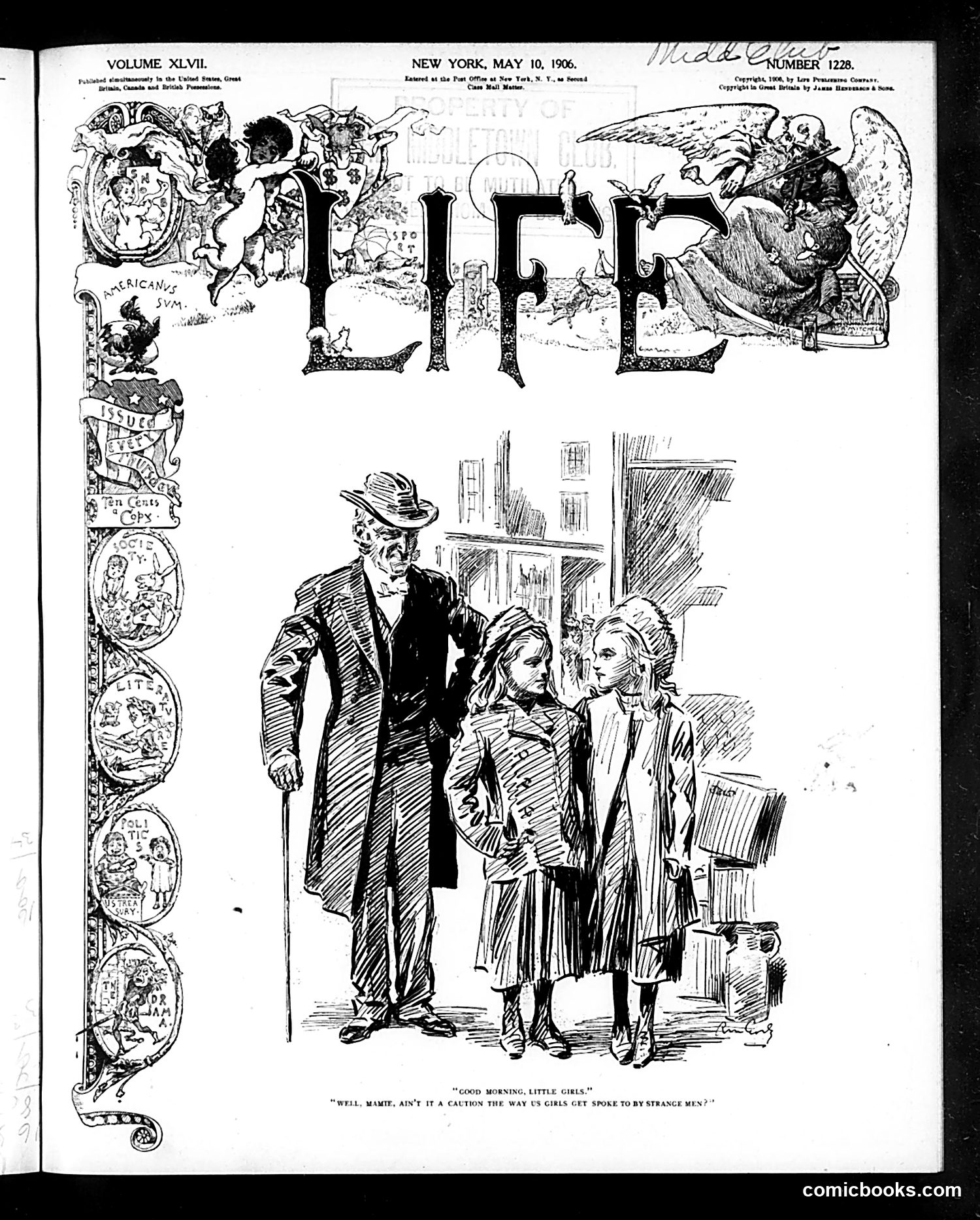
This page features a satirical cartoon about child safety and stranger danger. The main illustration shows a well-dressed gentleman with two young girls on a city street, with the caption: "Good morning, little girls." "Well, mame, ain't it a caution the way us girls get spoke to by strange men?" The joke plays on contemporary anxiety about children's vulnerability in urban environments and the prevalence of unsolicited interactions from strangers. The girls' casual acceptance of being addressed by an unknown man—described as a "caution" (surprising occurrence)—suggests both the frequency of such encounters and societal concern about protecting children in public spaces. This reflects early 1900s urban social anxieties about proper conduct and children's safety.
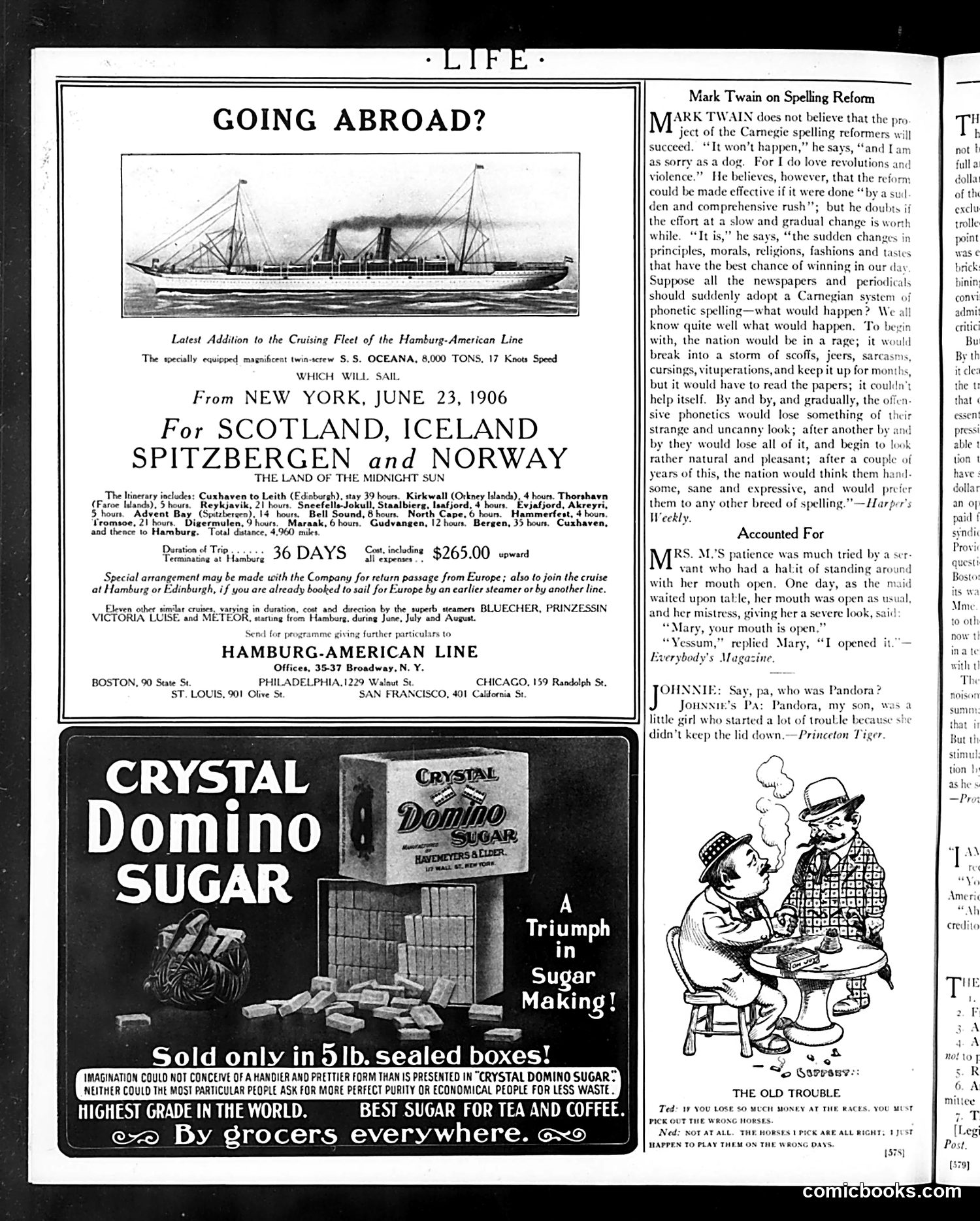
This page is primarily **advertising and travel content** rather than political satire. The top half features a Hamburg-American Line cruise advertisement for a June 1906 voyage from New York to Scotland, Iceland, Spitzbergen, and Norway—luxury travel for affluent readers. Below is a Crystal Domino Sugar advertisement emphasizing product purity and convenience (5lb sealed boxes). The only cartoon appears bottom-right: **"The Old Trouble,"** a domestic humor sketch showing what appears to be a married couple at a table, with a joke about a husband named Pandora whose wife didn't "keep the lid down." This is a light domestic gag playing on the Pandora's Box mythology—not political satire, but rather the gentle, family-oriented humor typical of Life magazine's lighter content.
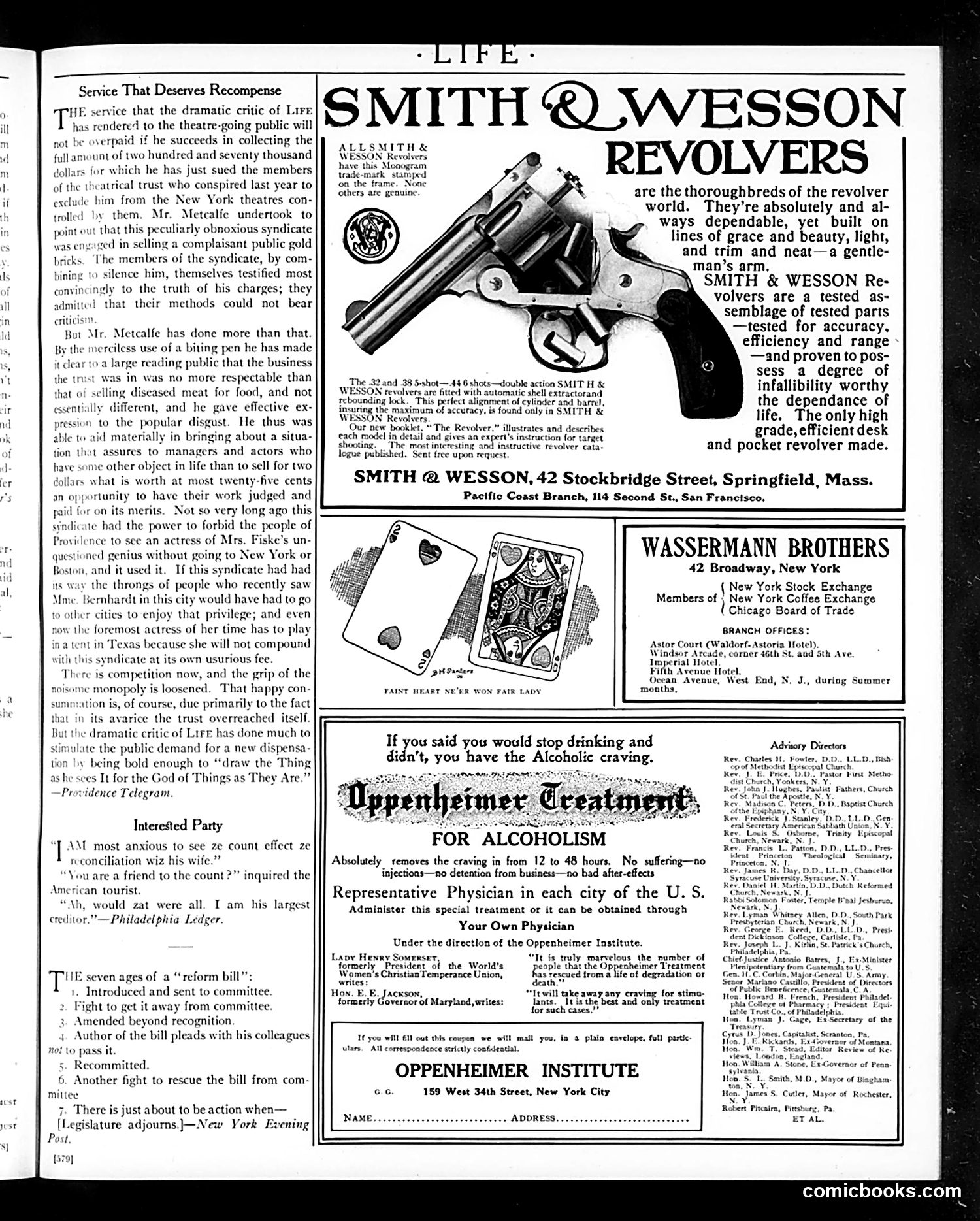
This page is **primarily advertising** with minimal satirical content. The main advertisements are: 1. **Smith & Wesson Revolvers** - promoting their reliability and quality as "a gentleman's arm" 2. **Wassermann Brothers** - a New York business listing 3. **Oppenheimer Treatment for Alcoholism** - claiming to remove alcohol cravings in 12-18 hours with no suffering or business disruption The left column contains an article praising a dramatic critic named Metcalfe for exposing a theatrical syndicate's unethical practices. The only cartoon visible is small, showing playing cards labeled "Faint Heart Ne'er Won Fair Lady." The "Oppenheimer" ad is notable as a period example of dubious medical claims about addiction treatment—something modern readers would recognize as pseudoscientific marketing typical of early-20th-century patent medicine advertising.
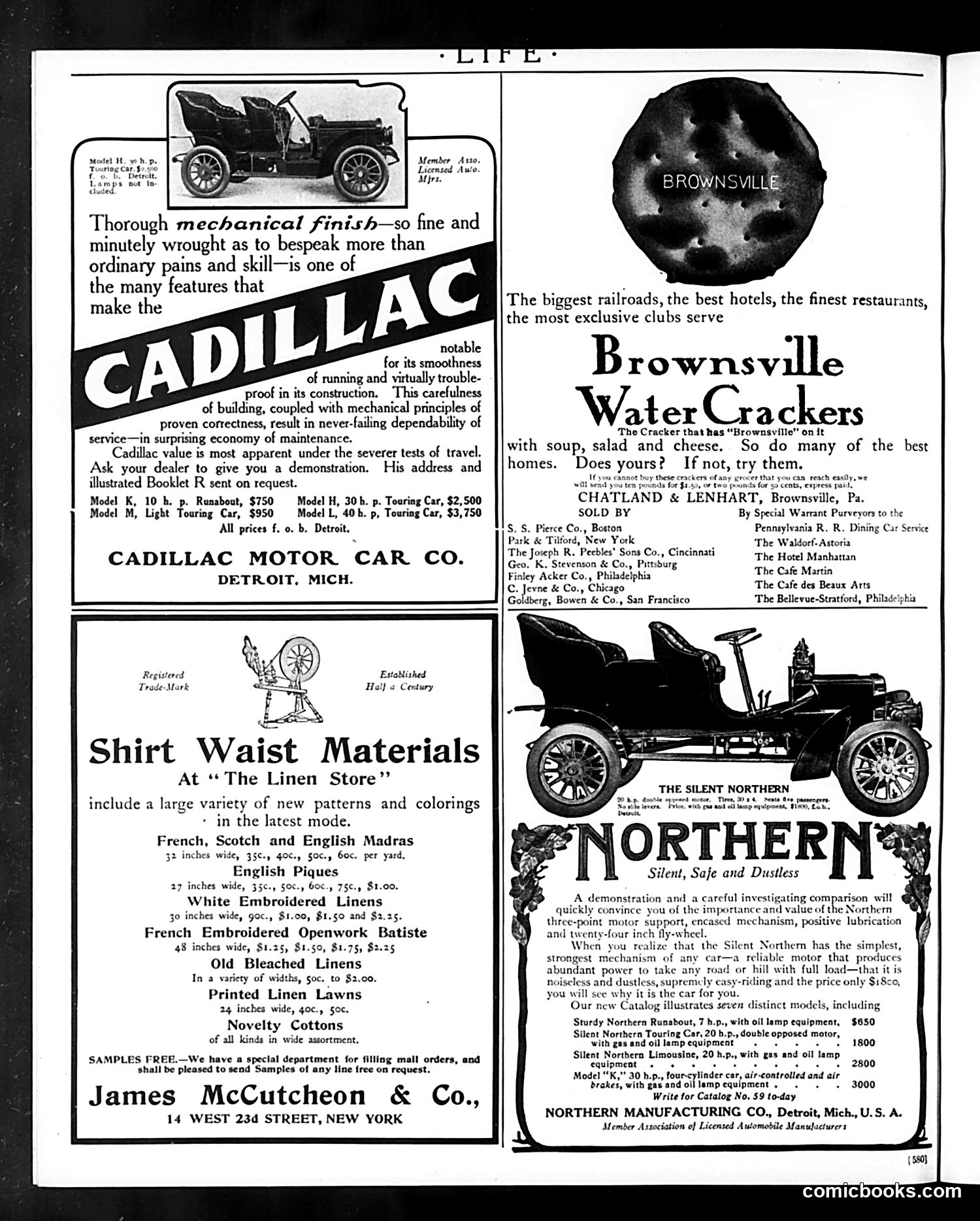
This page is **primarily advertising** from what appears to be an early 1900s issue of Life magazine. It contains no political cartoons or satirical commentary. The ads feature: 1. **Cadillac automobiles** — emphasizing mechanical precision and reliability for travel 2. **Brownsville Water Crackers** — a food product advertised to upscale establishments (railroads, hotels, restaurants, clubs) 3. **Shirt waist materials** — fabric for women's clothing from James McCutcheon & Co. 4. **Northern automobiles** — marketed as "Silent, Safe and Dustless" The only visual reference approaching satire is the large moon image labeled "BROWNSVILLE," but this appears to be decorative branding rather than commentary. This is a straightforward commercial page targeting affluent early-1900s readers interested in automobiles, quality goods, and fashionable textiles.
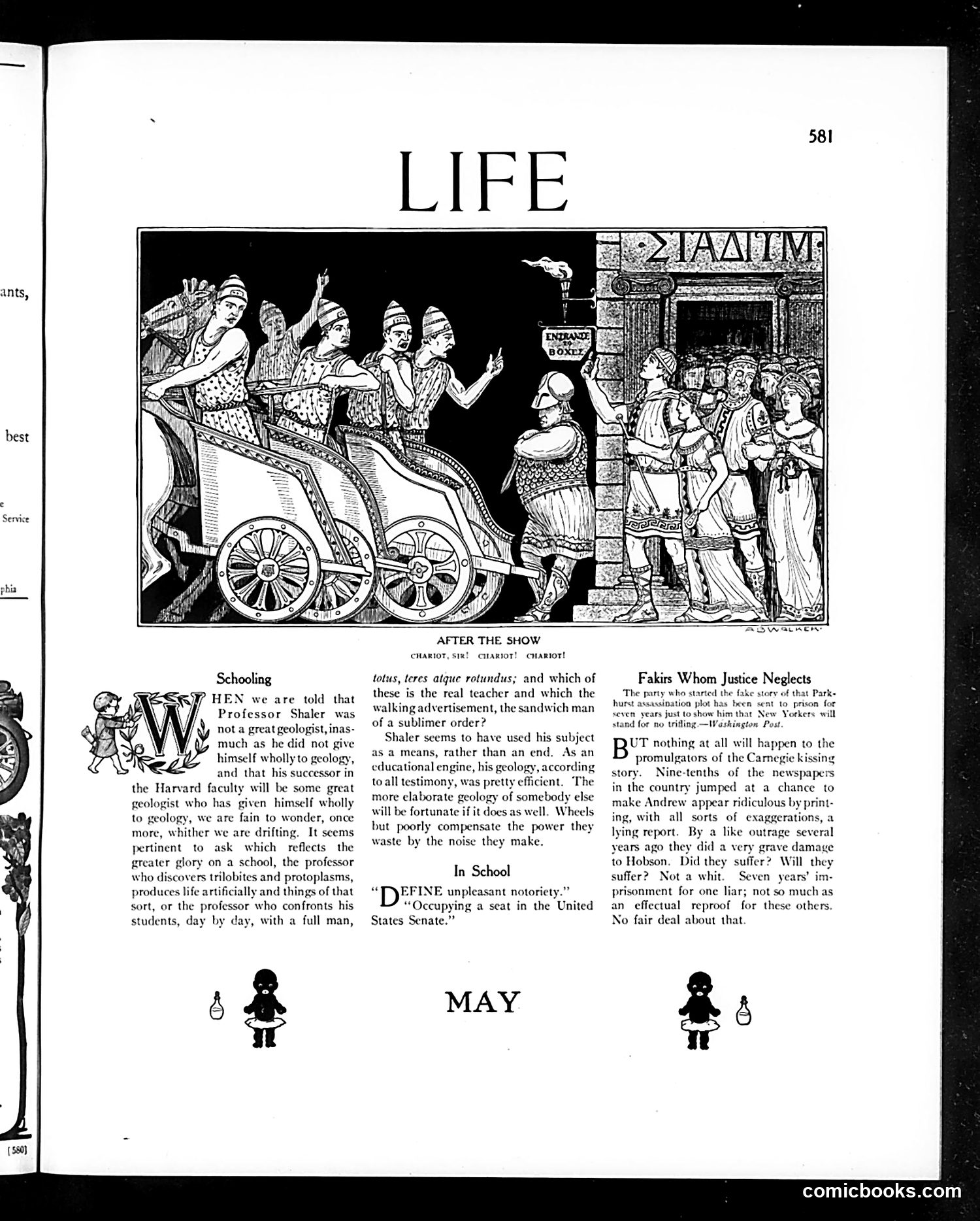
This page contains satirical commentary on American education and politics from an unspecified early 20th-century date. The top illustration "After the Show" depicts a Roman chariot scene labeled "Chariot, Sir! Chariot! Chariot!"—likely satirizing theatrical excess or pretentious cultural displays. The "Schooling" section mocks Professor Shaler's geology teaching at Harvard, suggesting he focuses more on walking advertisements than actual education. The text humorously questions whether an engaging personality makes an effective teacher. The "In School" section includes a definition joke about "unpleasant notoriety" using a U.S. Senate reference—appearing to mock ineffective or notorious senators. "Fakirs Whom Justice Neglects" criticizes Carnegie's kissing story and newspapers' exaggeration of minor incidents while ignoring serious injustices. The piece expresses skepticism about fair justice.
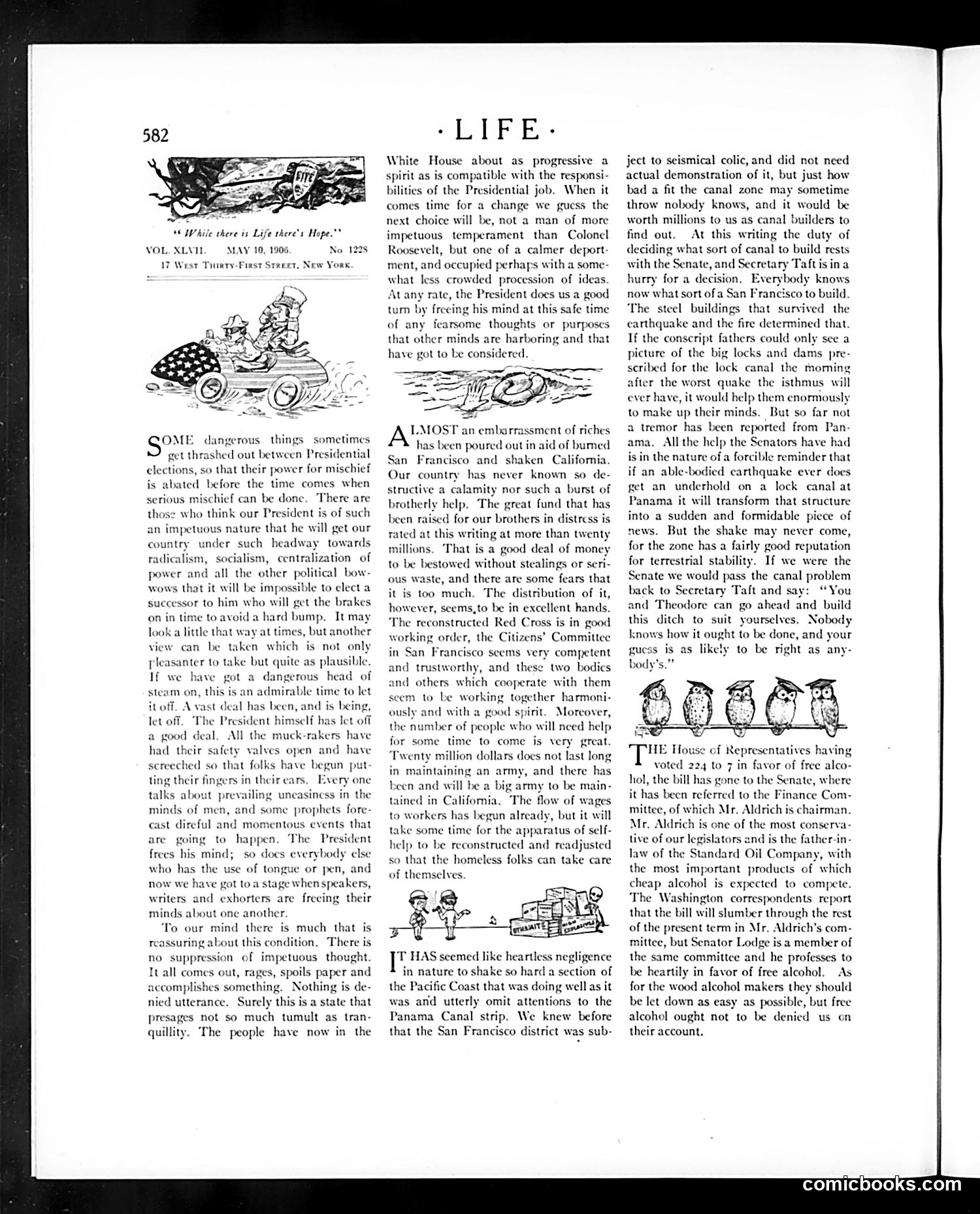
**Date & Context:** May 19, 1906 issue, following the San Francisco earthquake and fire. **Main Cartoon (top):** Shows a car overflowing with wealthy figures amid chaos, satirizing how "dangerous things sometimes get thrashed out between Presidential elections." The image mocks how crises—here, natural disaster—force political reconsideration of normally contentious issues. **Central Theme:** The article addresses relief efforts for earthquake victims and debates over reconstruction funding. It critiques both political inaction and proposed solutions, including canal-building at Panama and alcohol taxation. **Satirical Point:** The cartoons mock political gridlock and self-interest during national crisis. Figures appear to represent competing political interests squabbling while San Francisco burns—suggesting politicians prioritize ideology over humanitarian response to disaster.
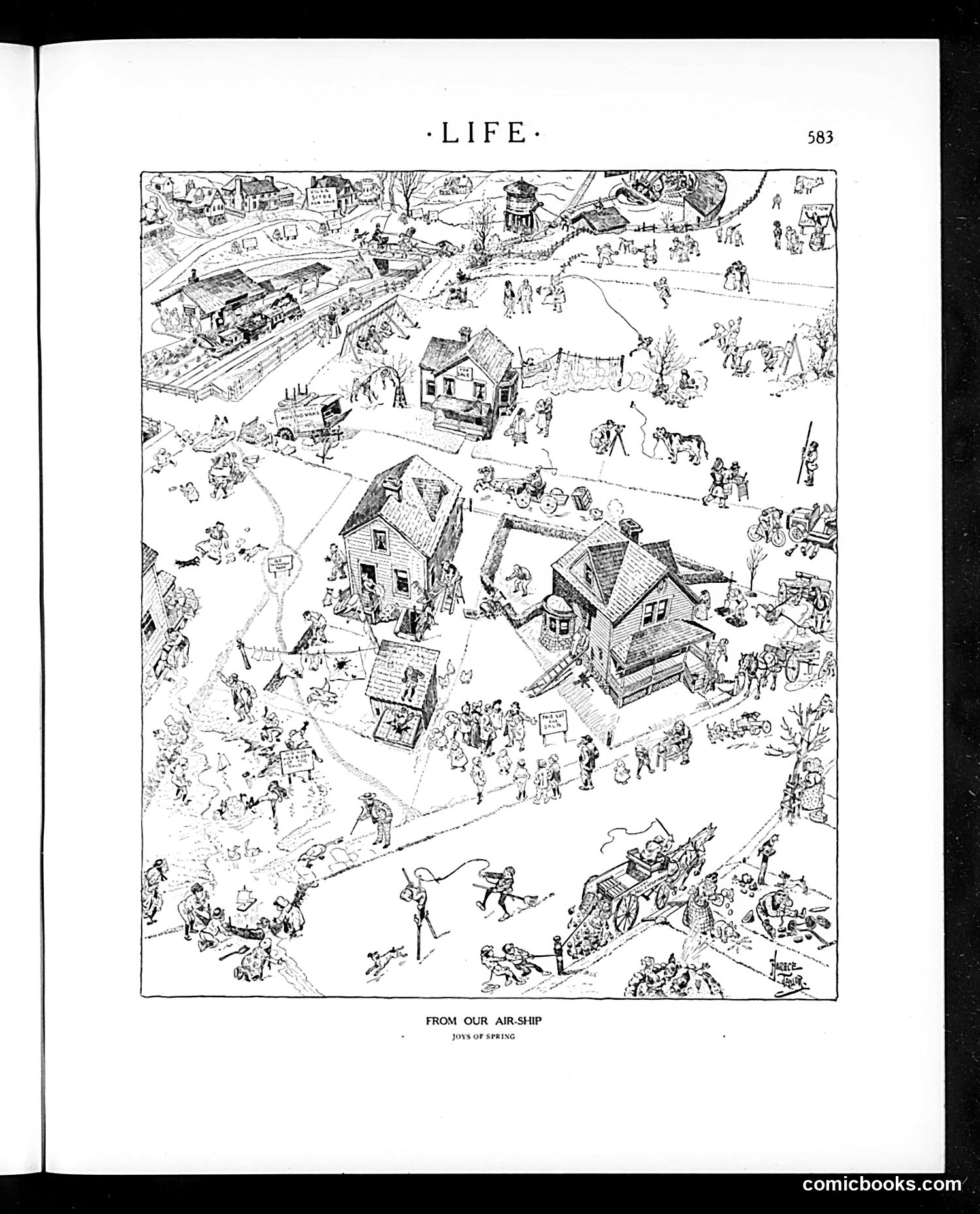
This is a bird's-eye view illustration depicting a rural American village during springtime. The cartoon shows a bustling community scene viewed from above, as if from an airship, capturing various spring activities: people emerging outdoors, children playing, farming activities, and social gatherings around houses and a train station. The humor appears gentle and observational rather than political—it's a celebration of small-town American life awakening after winter. The detailed, crowded composition invites viewers to spot numerous human activities and interactions. This reflects Life magazine's common use of whimsical aerial perspectives to showcase everyday American scenes with gentle satire about community life and seasonal routines.
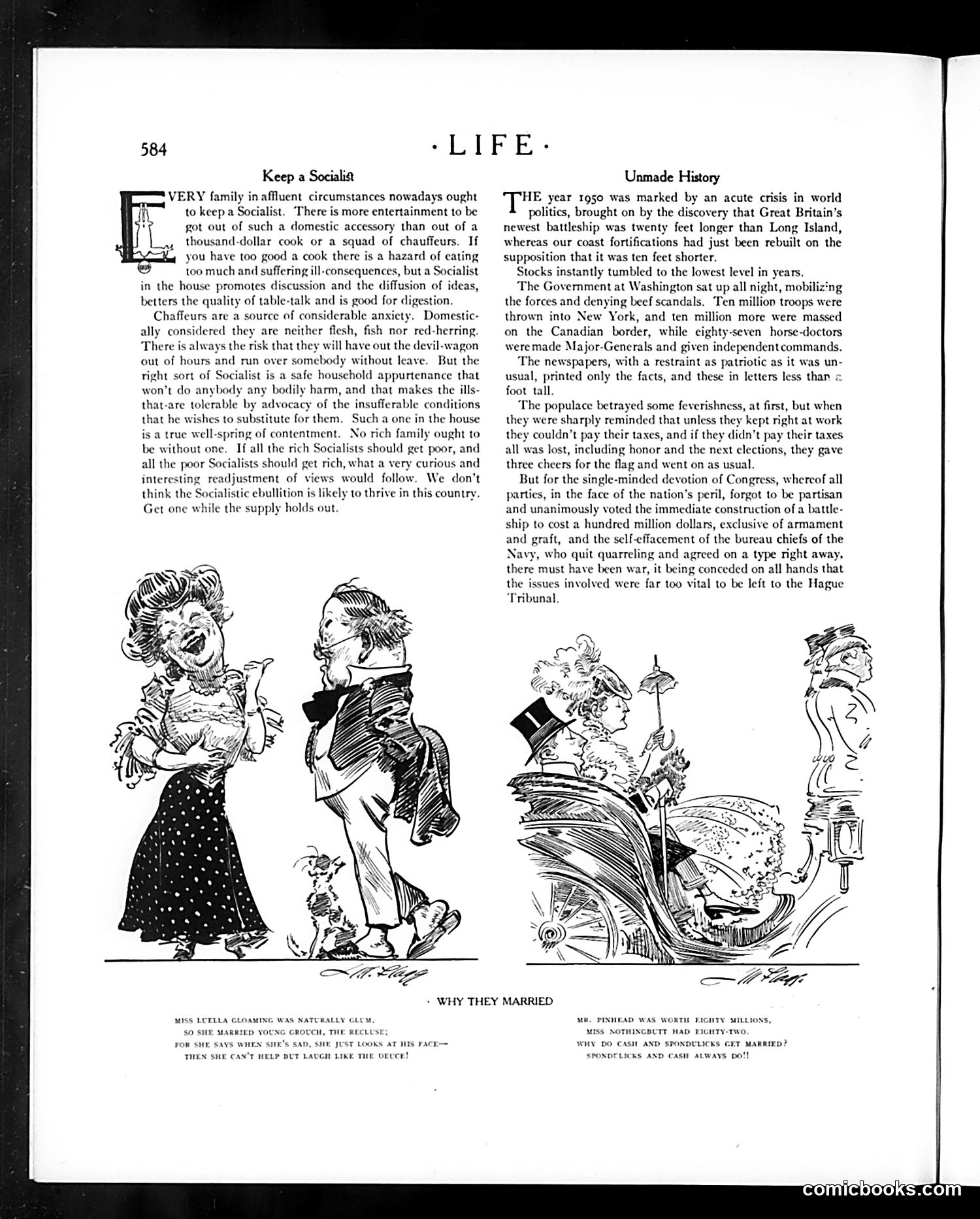
This page contains two distinct pieces of social commentary: **"Keep a Socialist"** (left): A satirical argument against employing socialist domestic servants. The piece warns wealthy families that hired help with socialist views pose a threat—they promote radical discussion, diffuse dangerous ideas, and may steal or cause trouble. The tone is darkly humorous, mocking upper-class anxieties about working-class political radicalism during the Red Scare era. **"Unmade History"** (right): Commentary on the 1950 naval crisis (likely the USS Long Island dispute), criticizing Congress's swift, bipartisan approval of battleship construction spending while ignoring larger strategic issues. The accompanying cartoons mock wealthy marriages of convenience—satirizing how money, not love, motivates society marriages. The page reflects Cold War-era anxieties about communism and class conflict alongside critiques of government spending and elite social values.
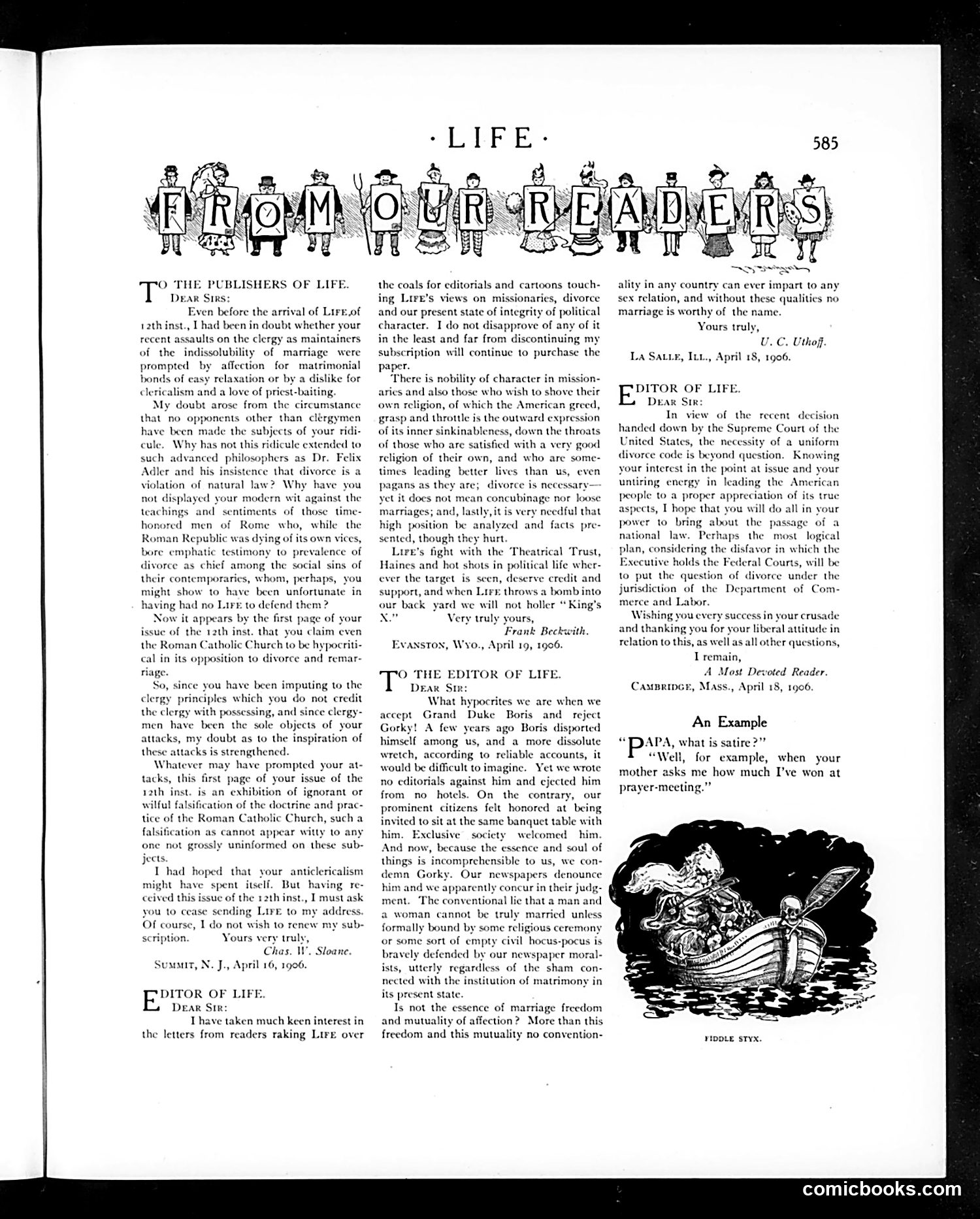
This page is primarily **reader letters to Life's editor** about divorce and marriage. The single cartoon titled "An Example" (lower right) illustrates a joke about marital misunderstanding. The cartoon shows a child asking their father "Papa, what is satire?" The father responds by using the mother's prayer-meeting attendance as an example of satire—implying her pious religiosity is false or hypocritical. The joke relies on early 1900s gender stereotypes: wives who attended prayer meetings were culturally expected to be virtuous, yet the cartoon suggests this respectability masks something insincere. It's satirizing both religious hypocrisy and marital discord, using "satire" itself (saying one thing while meaning another) as the humorous device.
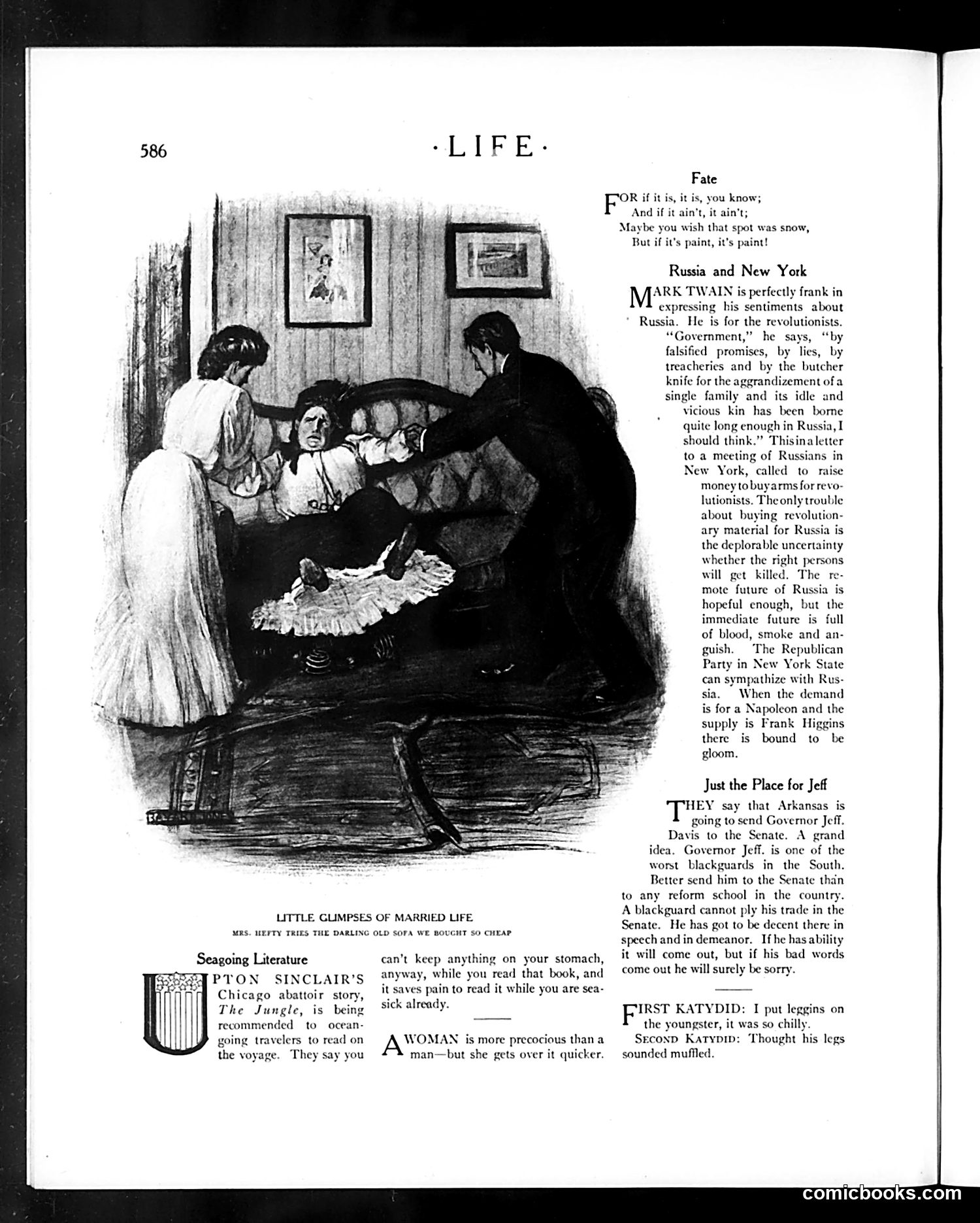
The main cartoon, titled "Little Glimpses of Married Life," depicts a domestic scene where a wife (labeled "Mrs. Hefty") attempts to sell a sofa to her husband, who appears skeptical about the purchase price. The satire mocks the common marital tension over household spending and domestic decisions—specifically, the husband's resistance to expensive furniture acquisitions and the wife's persuasive tactics. The surrounding text includes three separate opinion pieces: commentary on Mark Twain's pro-revolutionary Russian stance, criticism of Governor Jeff Davis's potential Senate appointment, and brief jokes about seasickness and gender differences. The page functions as a typical *Life* magazine format mixing visual satire with sharp political and social commentary for educated American readers.
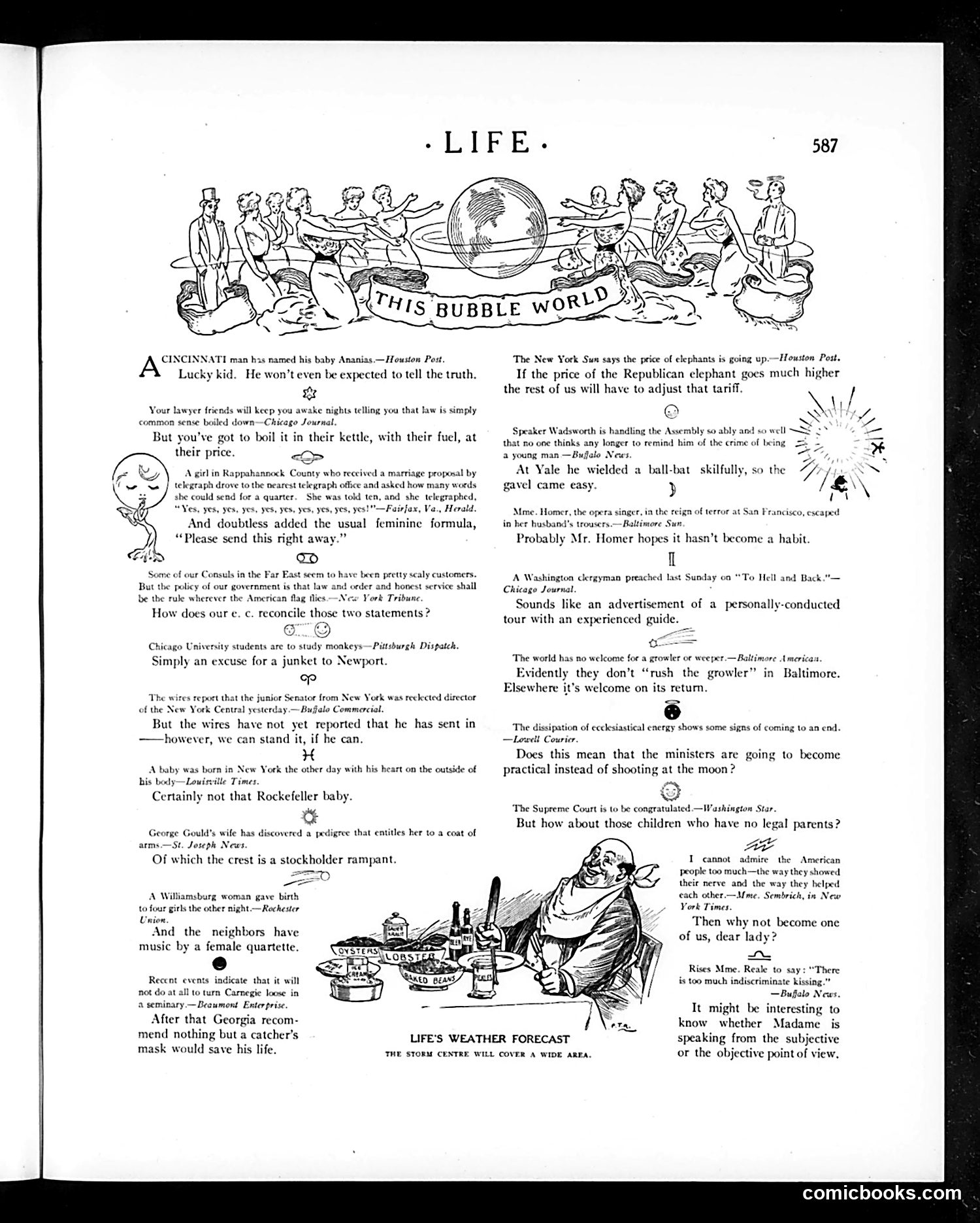
This page satirizes contemporary absurdities through brief jokes and observations. Key targets include: **Political/Social commentary:** - Republican vs. Democratic elephant pricing (editorial bias joke) - A clergyman preaching "To Hell and Back" (clergy hypocrisy) - Supreme Court decisions affecting children without legal parents (legal system failures) - Ministers becoming "practical" rather than principled **Recurring joke format:** Each item cites a newspaper source, suggesting Life is mocking widespread American news stories as ridiculous or contradictory. **The bottom cartoon** depicts a wealthy man at a lavish lobster dinner—"Life's Weather Forecast"—likely satirizing economic inequality or indulgence amid social problems discussed above. The overall tone suggests early 20th-century skepticism toward institutions (law, religion, politics) and their disconnect from ordinary people's realities.
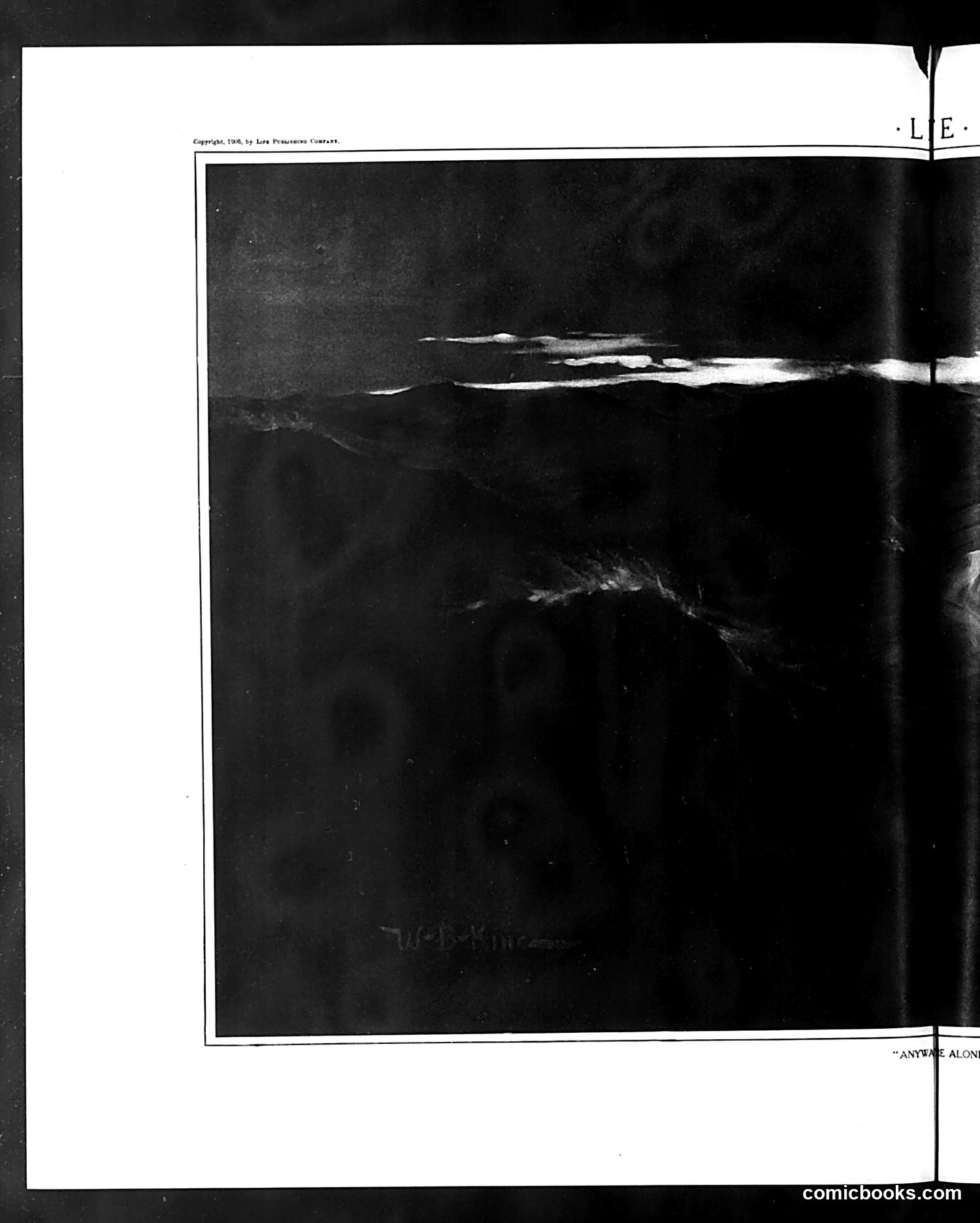
I can see this is a page from Life magazine with a black and white photograph, but the image quality is too poor for me to discern clear details about what is depicted. The photograph appears to show some kind of scene with figures and landscape elements, but I cannot make out sufficient detail to identify specific people, objects, or activities with confidence. The partial text visible at the bottom appears to say "ANYWAY ALONE" but is cut off and unclear. Without being able to read the OCR text clearly or see the photograph's details distinctly, I cannot reliably explain what political, social, or satirical point this page makes. To provide accurate historical context for a modern reader, I would need either a clearer image or the complete, legible OCR text from the page.
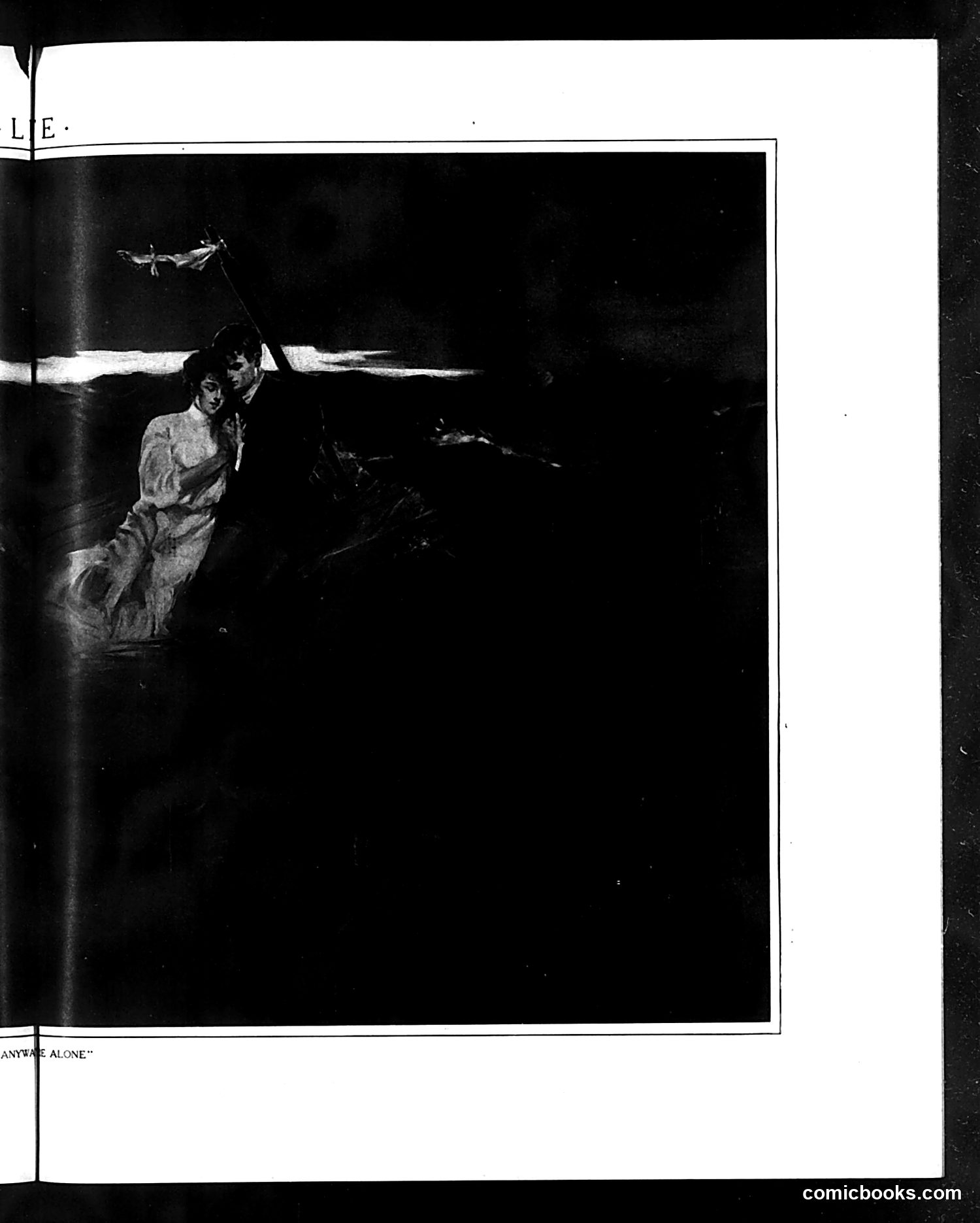
This appears to be a dramatic black and white photograph or illustration from Life magazine, not a political cartoon. The image shows two figures in an interior setting—a woman in light-colored clothing on the left and what appears to be another figure in darker clothing. A light source (possibly a lamp) is visible above them. The partial caption visible reads "ANYONE ALONE" (though the full text is cut off). Without the complete caption and surrounding article text, the specific meaning remains unclear. This could be illustrating a story, social commentary, or editorial piece about isolation, relationships, or a contemporary social issue, but the exact context and intended message cannot be determined from the image alone.
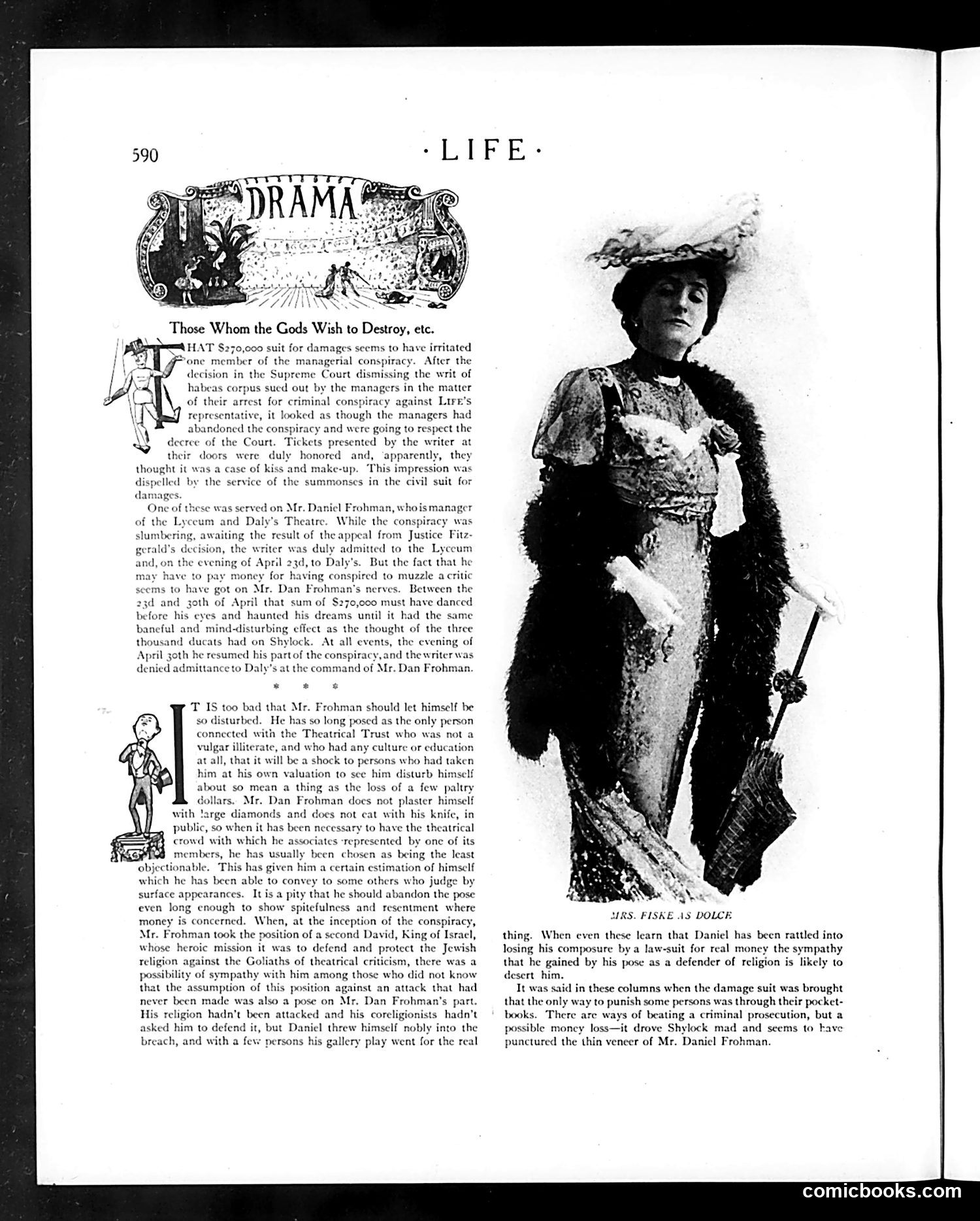
This satirical article concerns a legal dispute between *Life* magazine and theater managers, particularly **Daniel Frohman** (manager of the Lyceum and Daly's Theatre). The text reveals: **The Situation:** Life's theater critic was denied entry to Daly's Theatre as retaliation for the magazine's lawsuit. Frohman and other theatrical managers had previously conspired to prevent the critic's access, leading to criminal conspiracy charges dismissed by the Supreme Court. A $270,000 damages suit followed. **The Satire:** Life mocks Frohman's pretension to cultural refinement. He had positioned himself as nobly defending Jewish religion against "theatrical criticism" (presented as Goliaths), but his petty revenge over a lawsuit exposes this as mere posturing. The comparison to Shylock suggests his real concern is money, not principle. **The Point:** Financial consequences—not legal ones—effectively punish wrongdoing. Frohman's "thin veneer" of respectability crumbles under monetary pressure, revealing his true character.
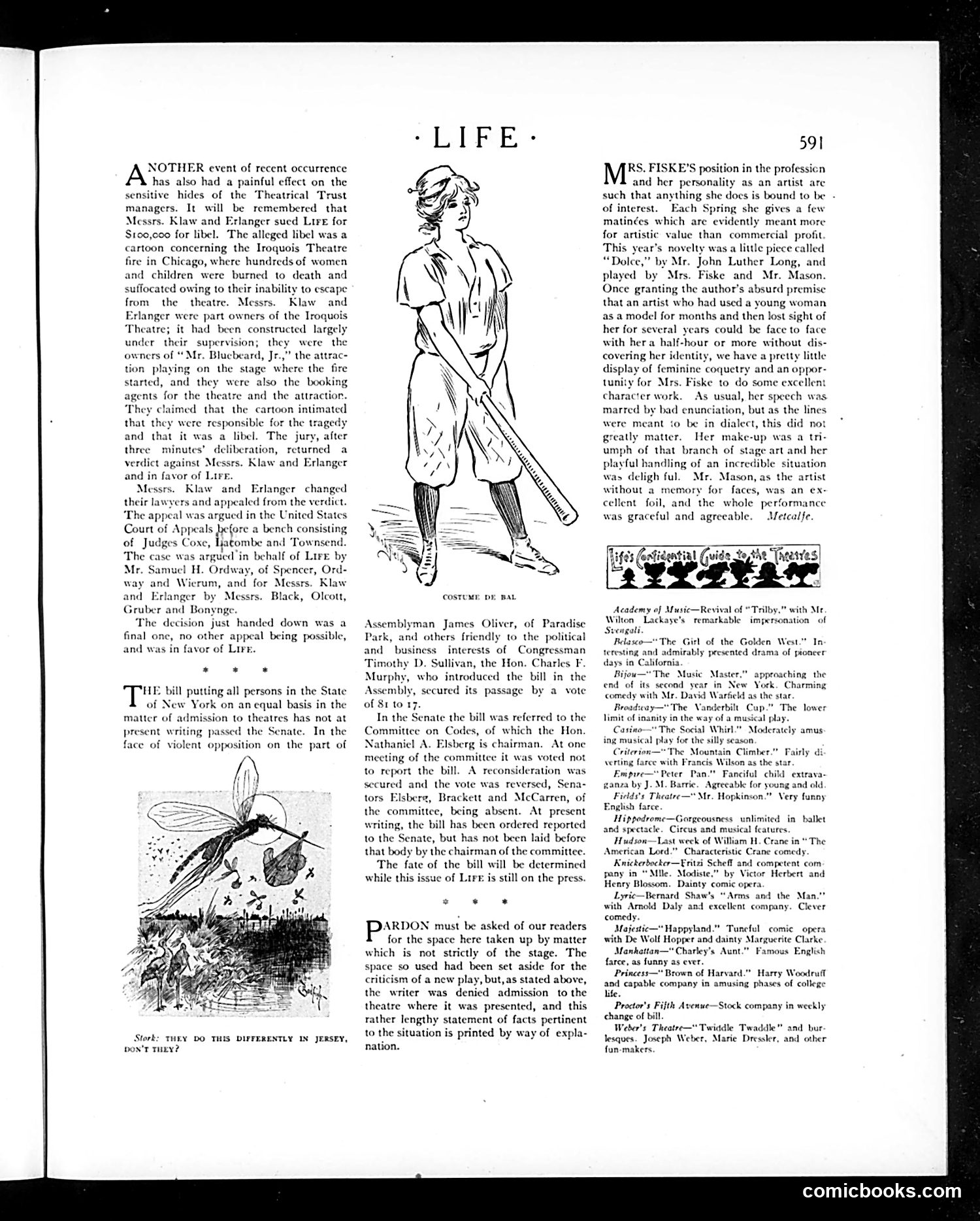
This page contains two distinct items: **The Iroquois Theatre Lawsuit:** The main article discusses Klaw and Erlanger, powerful theatre managers who owned the Iroquois Theatre in Chicago, where a devastating fire killed hundreds in 1903. They sued *Life* magazine for $500,000 libel over a cartoon suggesting their responsibility for the tragedy (poor construction/supervision enabled the death toll). A jury sided with *Life*; the appeals court upheld this verdict. The article celebrates this legal victory for press freedom against powerful theatrical monopolists. **The Political Cartoon ("Stork"):** The bottom illustration, captioned "They do this differently in Jersey, don't they?" appears to satirize political corruption in New York versus New Jersey regarding theatre admission equality bills. It references Congressman Timothy Sullivan and political operatives manipulating legislative committees—suggesting backroom dealing prevents the bill's passage. Both items critique abuse of power by wealthy theatre interests and corrupt politicians.
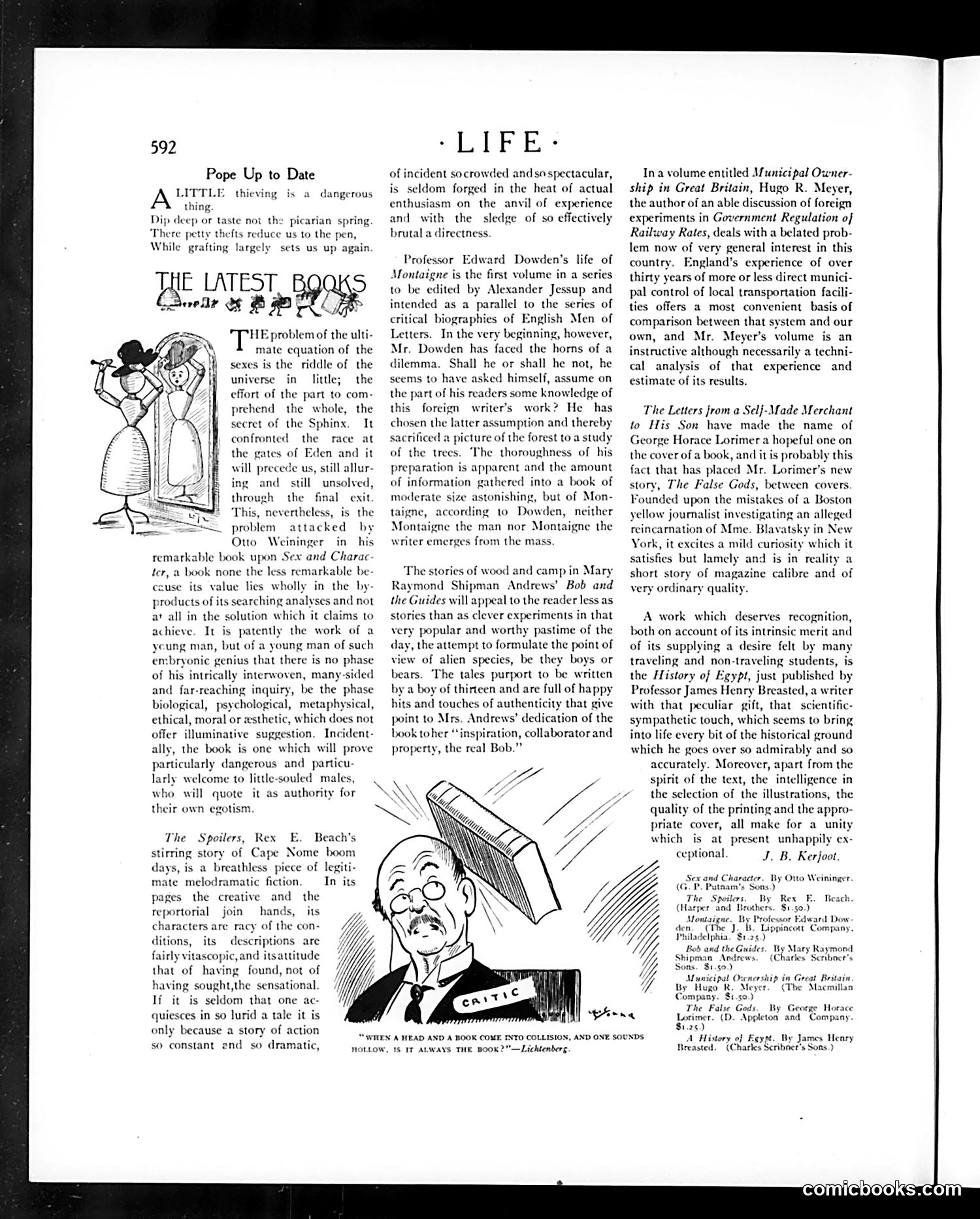
This page reviews recent books rather than presenting political cartoons. The main illustration shows a caricatured critic being struck by a book, accompanying a Lichtenberg quote: "When a head and a book come into collision, is it always the book?" This appears to jest that books are harder than critics' heads. The reviews discuss Otto Weininger's *Sex and Character* (warned as dangerous to "little-souled males"), Rex Beach's *The Spoilers* (about the Cape Nome gold rush), Edward Dowden's biography of Montaigne, and Mary Raymond Shipman Andrews' *Bob and the Guides*. The "Pope Up to Date" epigram at top warns against literary theft and plagiarism ("petty thefts reduce us to the pen"), suggesting contemporary concern about journalistic integrity. This is primarily a book review section rather than political satire, focusing on literary merit and intellectual trends of the era.
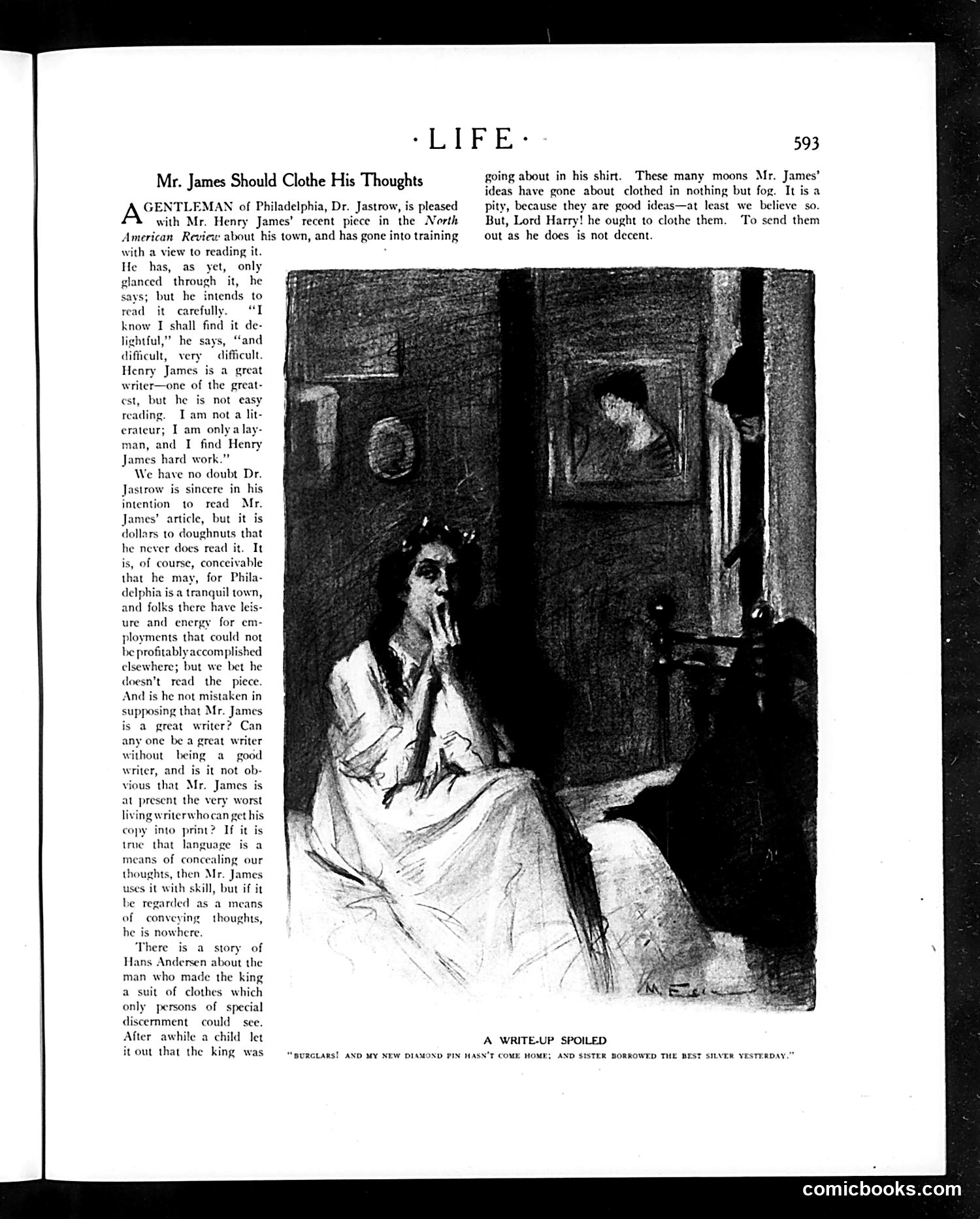
This *Life* magazine piece satirizes novelist Henry James for deliberately obscure prose. The main article mocks Dr. Jastrow's earnest intention to read James's recent *North American Review* essay—suggesting he likely won't, given James's difficulty. The critique claims James's writing actively *conceals* rather than conveys thought, making him "the very worst living writer who can get his copy into print." The comparison to Hans Andersen's "Emperor's New Clothes" reinforces this: James's complexity is presented as pretentious obfuscation masquerading as sophistication. The cartoon "A Write-Up Spoiled" (caption unclear) appears to satirize social pretension or gossip—a woman's attempted boasting about jewelry and borrowed silver undermines itself through the admission itself. The piece represents the contemporary American literary debate over James's deliberately complex, psychological style versus demands for clarity and accessibility.
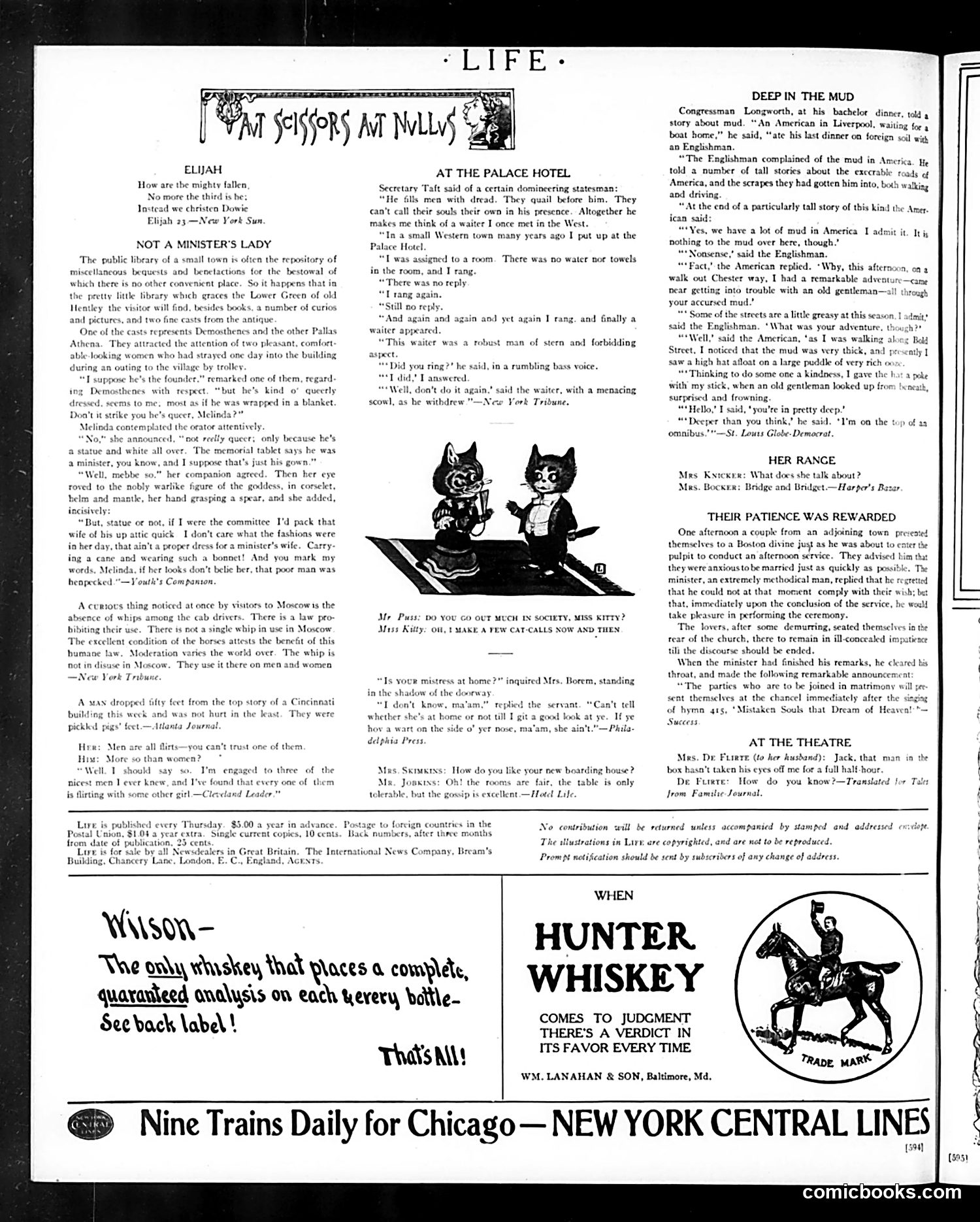
This page from *Life* magazine contains several brief satirical pieces typical of early 20th-century American humor: **Main Cartoons:** - "Am Scissors at Nully's" and "At the Palace Hotel" feature anecdotes mocking pretentious or domineering figures through humorous dialogues - A cartoon shows two cats in conversation, satirizing human social pretense ("Do you go out much in society, Miss Kitty?") **Social Satire:** The humor targets: - Pedantic behavior (women misidentifying classical statues as people) - Imperious personalities (a threatening waiter) - Class anxieties and social climbing - Gender dynamics (women described as gossipy, men as flirts) **Context for Modern Readers:** These jokes rely on observational humor about manners, social hierarchy, and domestic life. The comedy assumes readers recognize certain behaviors as ridiculous—pretension, servile rudeness, and class-conscious anxiety. The cartoons and brief anecdotes were *Life*'s signature format: accessible, contemporary social commentary wrapped in light comedy rather than explicit political critique.
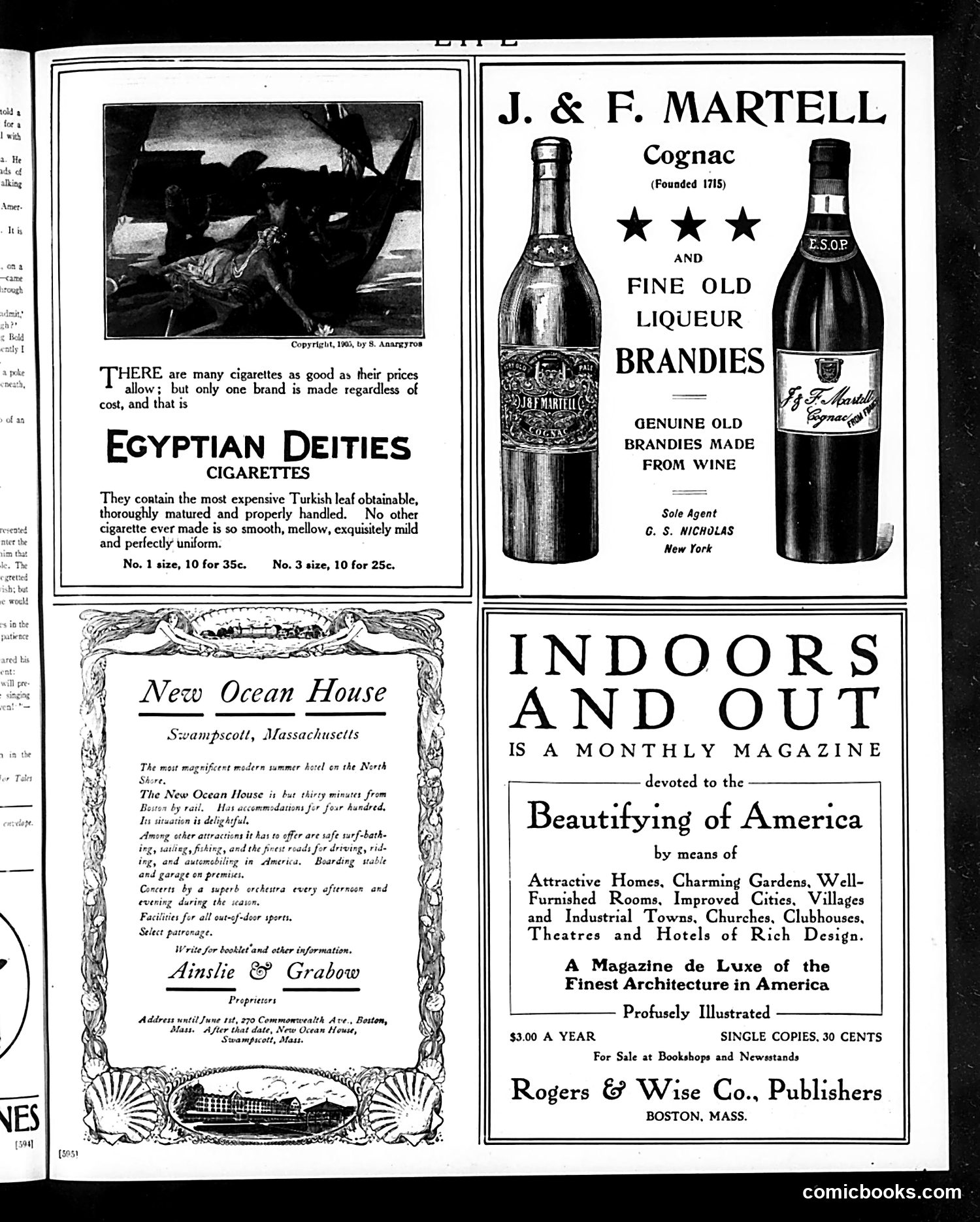
This is primarily an **advertising page** from Life magazine, not a political cartoon. It contains four distinct advertisements: 1. **Egyptian Deities Cigarettes** - A luxury cigarette brand emphasizing expensive Turkish tobacco and superior quality, priced at 35¢-25¢ per pack. 2. **J. & F. Martell Cognac** - A French brandy founded in 1715, marketed as fine old liqueur through sole agent G.S. Nicholas in New York. 3. **New Ocean House** - A luxury summer resort hotel in Swampscott, Massachusetts, offering accommodations for 400 guests with orchestras, sports facilities, and upscale amenities. 4. **Indoors and Out Magazine** - A monthly publication ($3/year) dedicated to American architectural beauty, featuring homes, gardens, cities, and high-design establishments. The page reflects **Gilded Age consumer culture**, targeting wealthy audiences with luxury goods and leisure destinations. There is no political satire present—this is straightforward commercial messaging typical of early 20th-century Life magazine content.
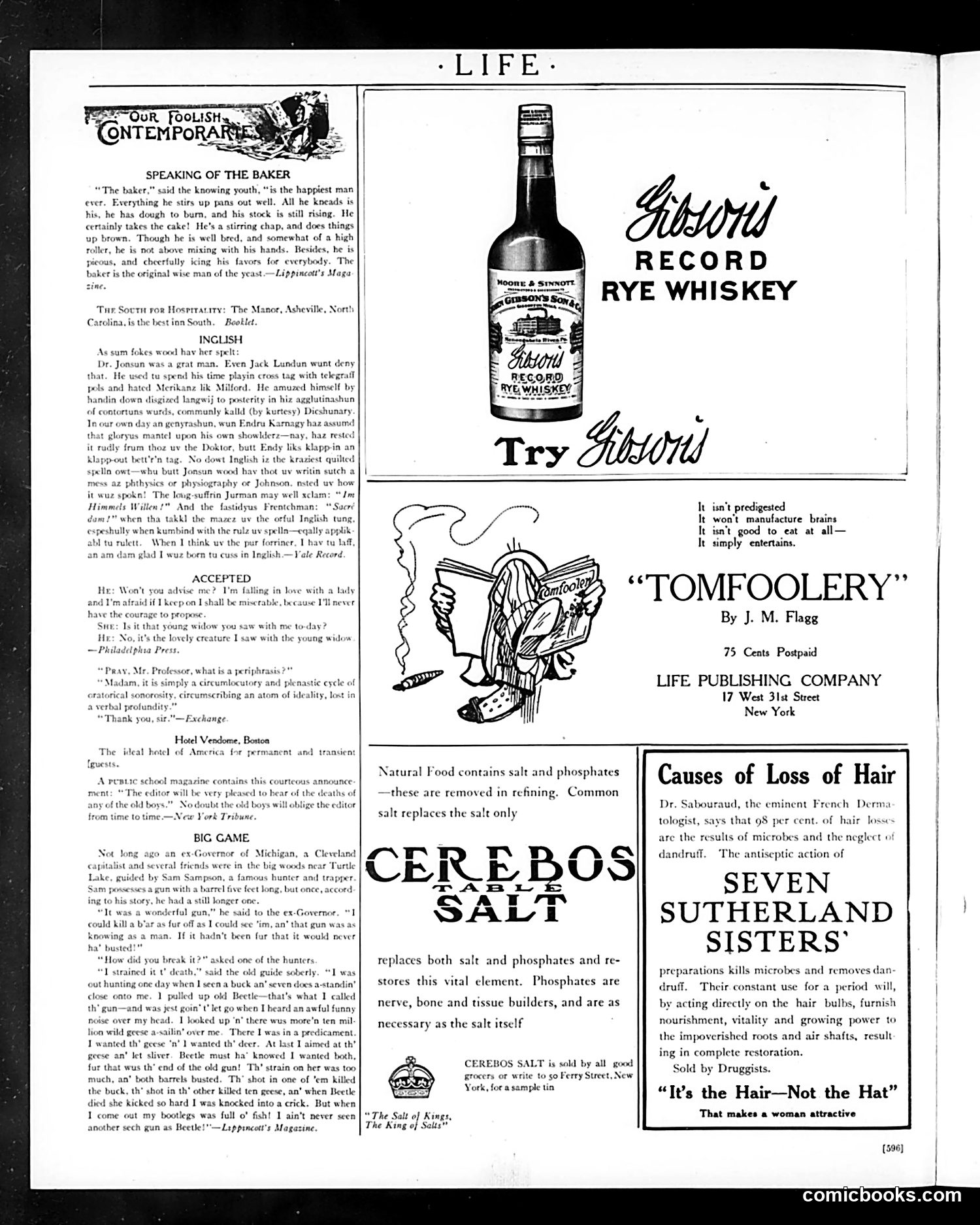
This page contains several distinct pieces of content from *Life* magazine (likely early 1900s): **"Speaking of the Baker"** is a light pun-filled joke celebrating bakers' success, using bread-related wordplay ("kneads," "dough," "rising," "takes the cake"). **"Inglish"** is satirical commentary on English spelling inconsistencies, written in deliberately mangled phonetic spelling to mock the illogic of English orthography. It references Dr. Johnson and contrasts English speakers' struggles learning the language with foreigners' frustration. **"Big Game"** is a tall tale about a hunter who kills a deer, geese, *and* catches fish simultaneously when his gun explodes—absurdist humor playing on exaggerated frontier stories. The remainder consists of period advertisements (whiskey, salt) and a hair-loss remedy claiming to kill microbes causing dandruff—typical medical advertising of the era, when such claims were unregulated. The page is primarily entertainment and advertising rather than political commentary.
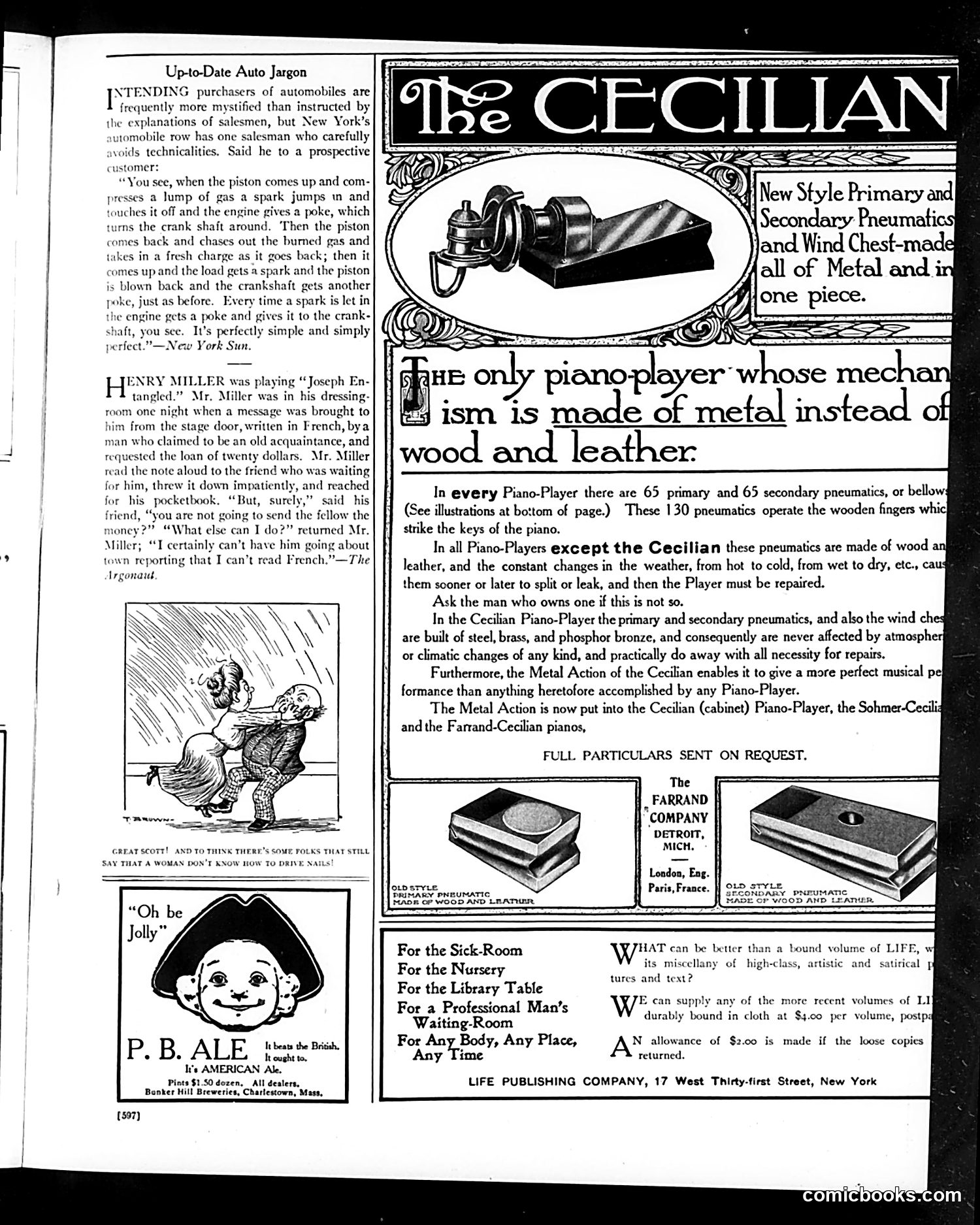
This page contains three distinct humorous pieces: 1. **"Up-to-Date Auto Jargon"**: A joke mocking automobile salesmen's overwrought technical explanations. A salesman describes engine mechanics using repetitive "poke" language, making simple mechanics sound needlessly complex—satirizing the pretentious jargon used to impress and confuse car buyers. 2. **Henry Miller anecdote**: An actor throws money at a French-speaking stranger rather than admit he can't read French, prioritizing social reputation over sense. The humor targets vanity and the fear of appearing ignorant. 3. **Woman driving cartoon**: The caption "Great Scott! And to think there's some folks that still say that a woman don't know how to drive nails!" is ironic—showing a woman hammering nails, not driving a car. It satirizes gender stereotypes about women's competence, using wordplay to mock those who doubt women's abilities. The page is primarily advertising (Cecilian pianos, P.B. ale, Life magazine subscriptions), typical of early 20th-century periodicals.
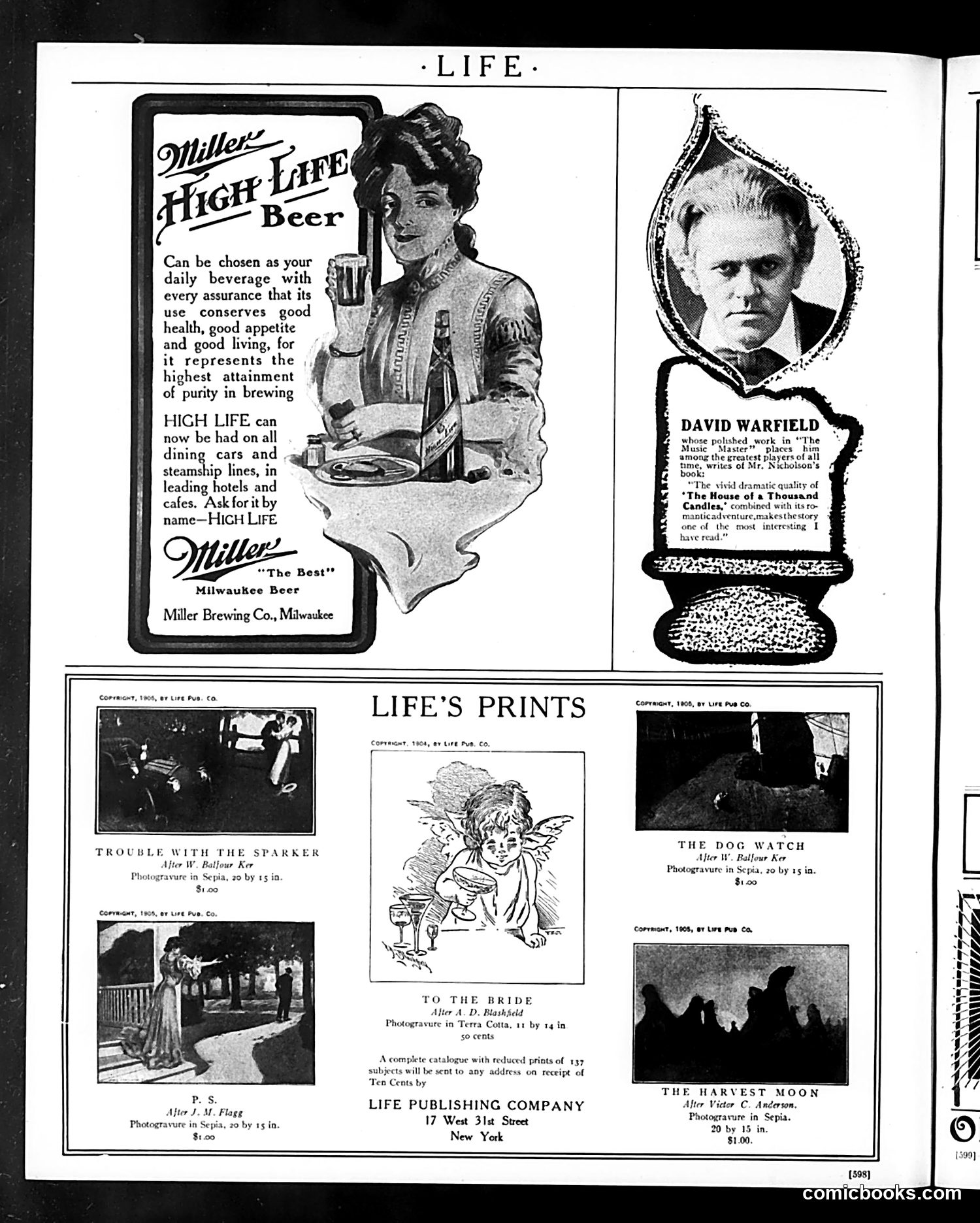
This page is primarily **advertising and product promotion** rather than political satire. It contains: **Left side:** A Miller High Life Beer advertisement featuring an illustrated woman, emphasizing the product's "purity" and availability on dining cars and in hotels—reflecting early-1900s marketing that associated beer with respectability and good health. **Right side:** A testimonial from actor David Warfield endorsing a book called "The House of a Thousand Candles," a common promotional strategy of the era. **Bottom section:** "Life's Prints"—advertisements for photogravure reproductions available for purchase, including works titled "Trouble with the Sparker," "P.S.," "To the Bride," "The Dog Watch," and "The Harvest Moon," priced between 50 cents and $1.00. The page demonstrates how Life Publishing Company used its magazine platform to sell both advertising space and reproductions of artwork, monetizing multiple revenue streams typical of early-20th-century magazine publishing.
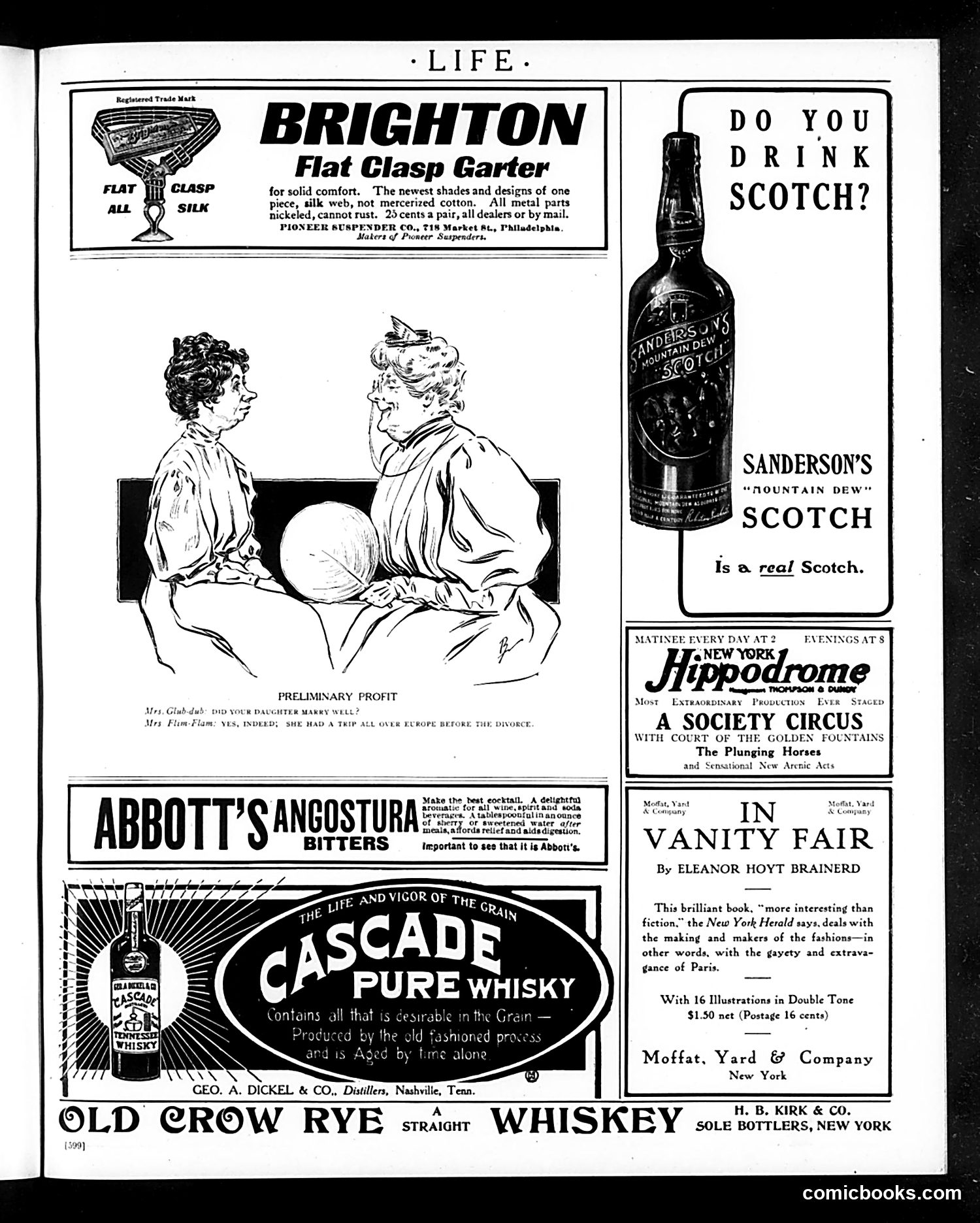
The central cartoon depicts two wealthy women discussing a third woman's advantageous marriage. Mrs. Glub-dub asks if the daughter "married well"; Mrs. Flim-Flam responds affirmatively, noting she took "a trip all over Europe before the divorce." The satire targets the matrimonial practices of the wealthy leisure class. The joke is cynical: a young woman's "preliminary profit" from marriage consists of a European vacation funded by her husband, with divorce anticipated as the inevitable endpoint. This mocks both the transactional nature of upper-class marriages and the assumption that divorce was an expected consequence rather than an aberration. The cartoon reflects early 20th-century anxieties about divorce becoming more common among the wealthy, and satirizes how financial gain (the trip) rather than genuine companionship motivated such unions. The casual tone underscores the moral criticism—what should be a serious commitment is reduced to vacation funding.
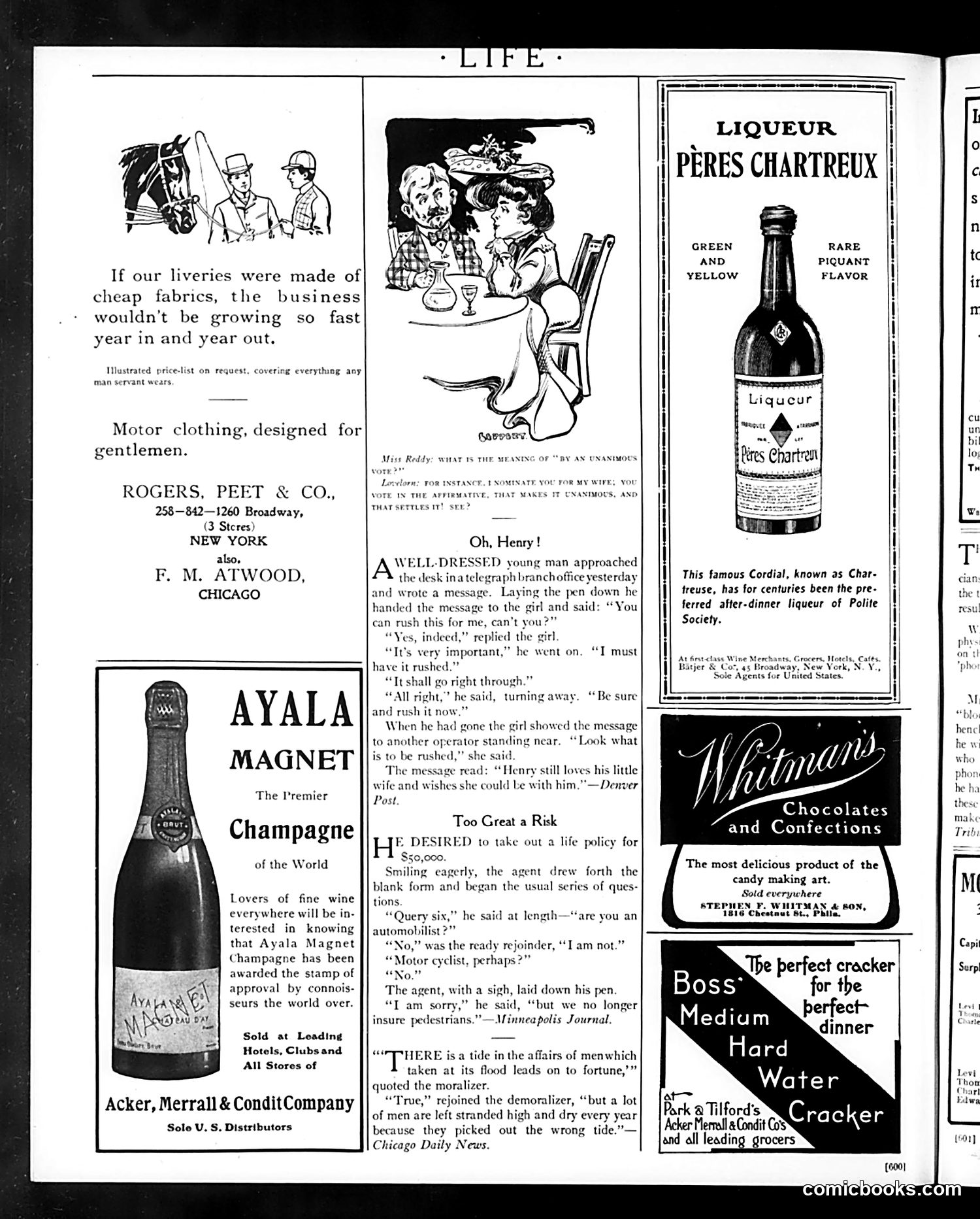
This page is primarily **advertising with humorous short stories**, typical of Life magazine's format. The main cartoon depicts a man at a telegraph office sending an urgent message to his wife declaring his love. The humor lies in the ironic contrast: he rushes to send a romantic telegram, yet the operator's comment—"Look what is to be rushed"—suggests the message's sentimental urgency is comically overwrought for such a simple domestic sentiment. The page also includes three brief comedic anecdotes: 1. **"Oh, Henry!"** plays on marital sentimentality 2. **"Too Great a Risk"** satirizes insurance companies refusing life policies to anyone engaging in the "dangerous" activity of automobile or motorcycle use—reflecting early 20th-century anxiety about automobiles as death traps 3. A moralizing tale about timing and fate The remainder consists of period advertisements for livery services, champagne, liqueur, and chocolates—typical luxury goods marketed to affluent readers of this era.
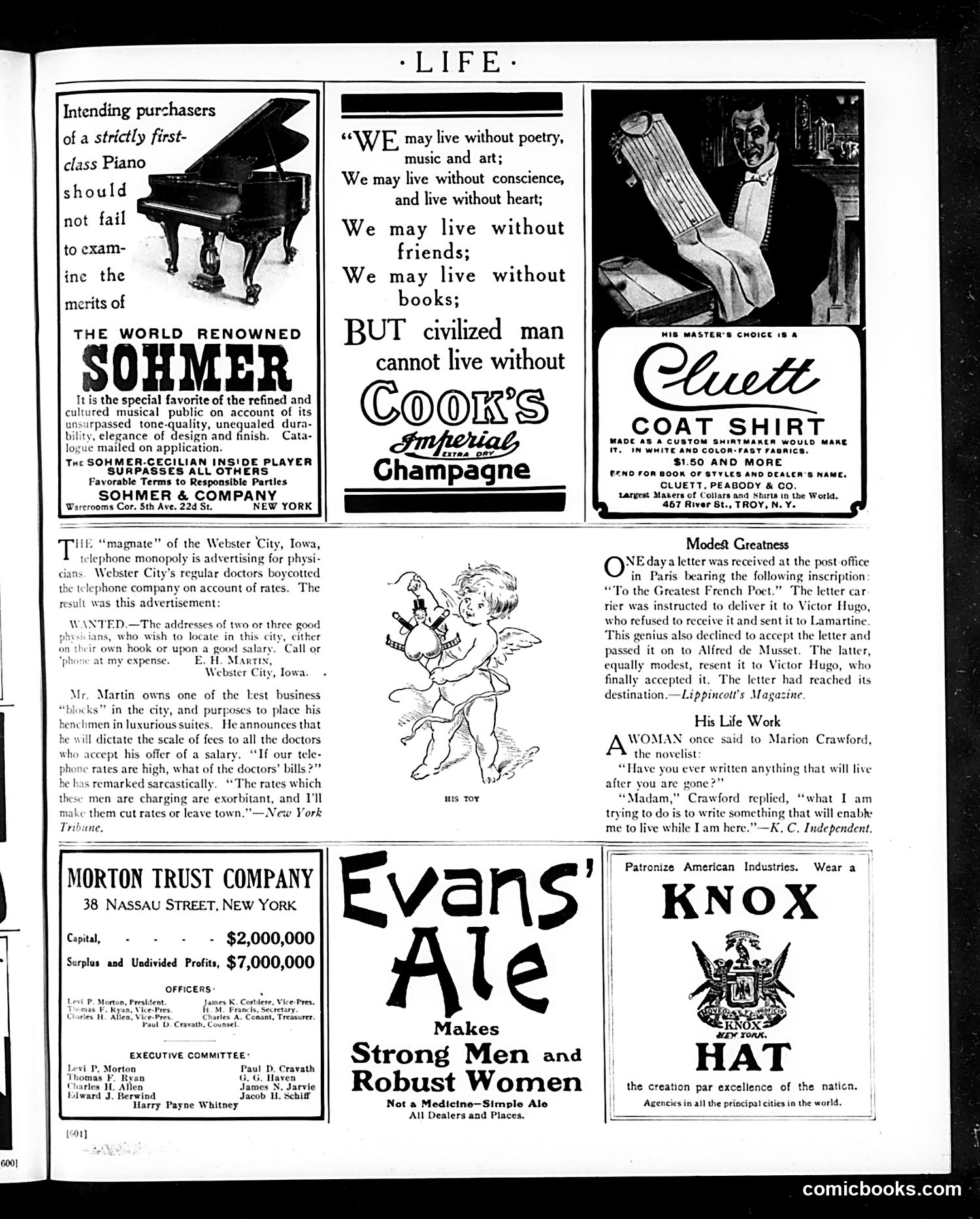
This is primarily an **advertising page** with minimal editorial content. The few satirical items are: 1. **Webster City Telephone Monopoly**: A brief news item mocking a Iowa telephone company owner who, facing doctor boycotts over high rates, advertises for cheaper physicians—then threatens to control their fees just as he does his phone rates. The irony: he complains about doctors' "exorbitant" charges while defending his own. 2. **"Modest Greatness"**: A humorous anecdote about a Paris letter addressed to "the Greatest French Poet." It passes between Victor Hugo, Lamartine, and Alfred de Musset, each too modest to claim the title, until Hugo finally accepts it by default. 3. **Marion Crawford quote**: A novelist's pragmatic answer about legacy—he writes to earn money to live *now*, not for posterity. The rest is commercial advertising for pianos, champagne, shirts, and ale—typical of Life's revenue model. No political satire is evident on this page.
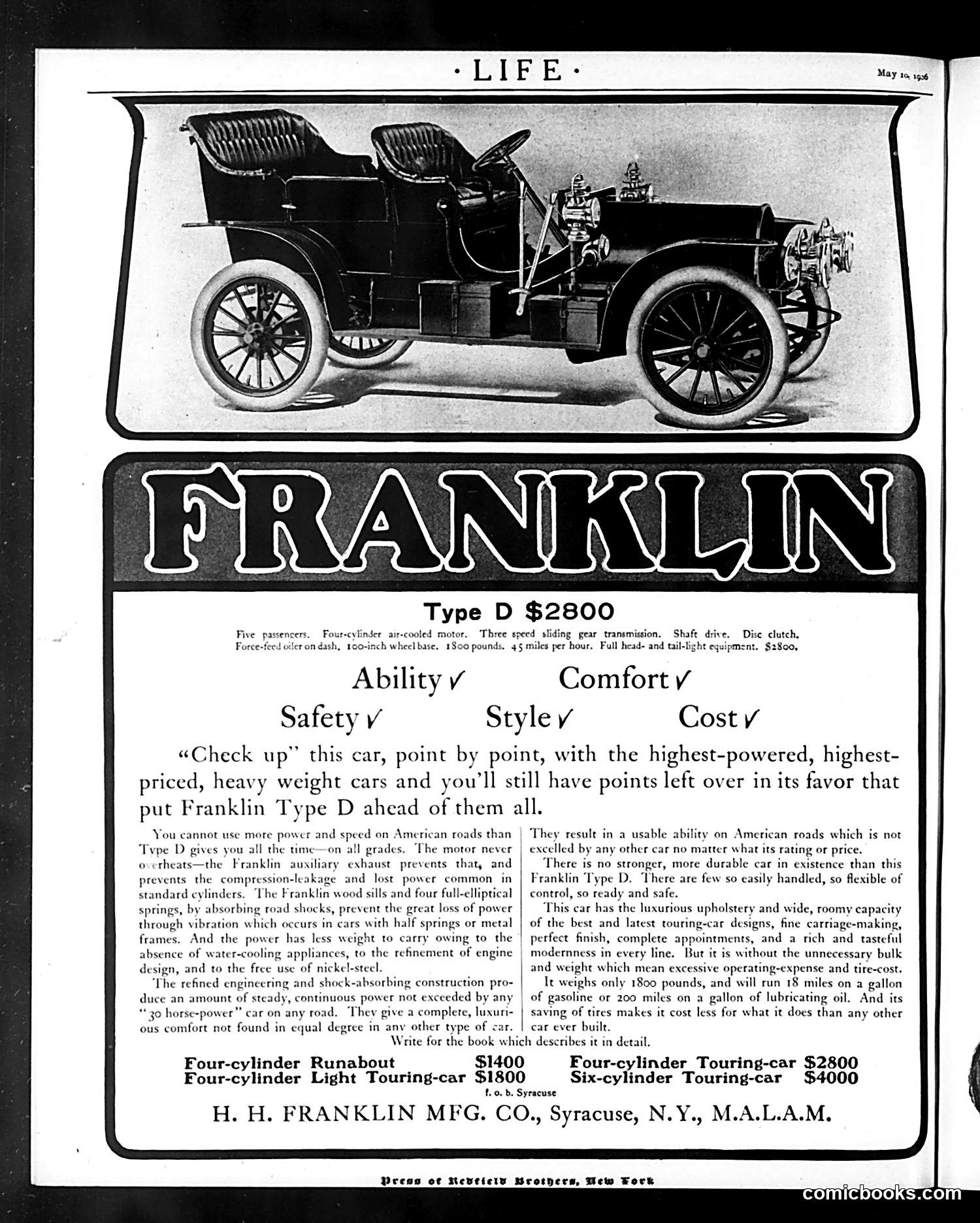
This is not satirical content but a straightforward automobile advertisement for the Franklin Type D automobile, manufactured in Syracuse, New York. The page features a detailed illustration of the open-air touring car and promotional text emphasizing its engineering advantages. The ad argues that Franklin's air-cooled engine design outperforms heavier, more expensive competitors. Key selling points include: superior power-to-weight ratio, better fuel economy (18 miles per gallon), lower tire costs, and refined handling. The five checkmarks ("Ability," "Comfort," "Safety," "Style," "Cost") highlight claimed advantages. The pricing ranges from $1,400 to $4,000 depending on model. This represents mainstream automotive marketing of the 1920s, when competing engine technologies (air-cooled versus water-cooled) were actively debated among manufacturers and consumers.