
Life, 1906-05-10 · page 16 of 26
Life — May 10, 1906 — page 16: what you’re looking at
What you’re looking at
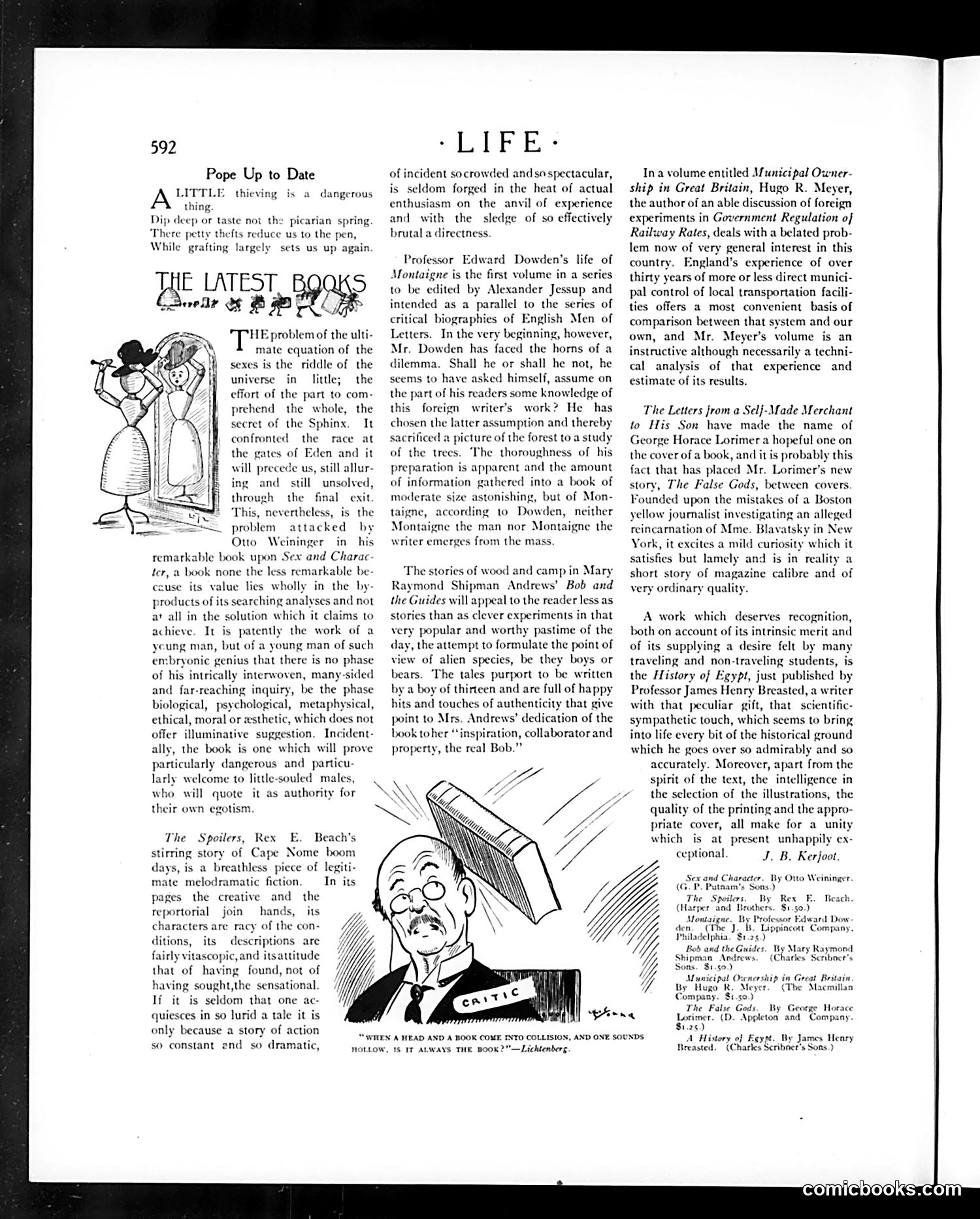
This page reviews recent books rather than presenting political cartoons. The main illustration shows a caricatured critic being struck by a book, accompanying a Lichtenberg quote: "When a head and a book come into collision, is it always the book?" This appears to jest that books are harder than critics' heads. The reviews discuss Otto Weininger's *Sex and Character* (warned as dangerous to "little-souled males"), Rex Beach's *The Spoilers* (about the Cape Nome gold rush), Edward Dowden's biography of Montaigne, and Mary Raymond Shipman Andrews' *Bob and the Guides*. The "Pope Up to Date" epigram at top warns against literary theft and plagiarism ("petty thefts reduce us to the pen"), suggesting contemporary concern about journalistic integrity. This is primarily a book review section rather than political satire, focusing on literary merit and intellectual trends of the era.
📄 Transcribed text from this page (OCR, searchable)
Machine-transcribed from the original scan — historical spelling and the odd misread are preserved.
592 Pope Up to Date LITTLE thing Dip deep or taste not the picarian spring There petty thefts reduce us to the pen, While grafting largely sets us up aj He LATEST. S CSeellr ot peery 477 =o TT HEpreblem of the ulti- “uo \\ mate equation of the ? }) sexes is the riddle of the j universe in little; the effort of the part to com- prehend the whole, the secret of the Sphinx. It confronted the race at the gates of Eden and it will precede us, still allur- ing and still unsolved, through the final exit This, nevertheless, is the problem attacked by Otto Weininger in his remarkable book upon Sex and Charac ter, a book none the less remarkable be- ceuse its value lies wholly in the by- products of its searching analyses and not at all in the solution which it claims to achieve. It is patently the work of a yeung man, but of a young man of such embryonic genius that there is no phase of his intrically interwoven, many-sided and far-reaching inquiry, be the ph biological, psychological, metaphysical, ethical, moral or xsthetic, which does not offer illuminative suggestion. Incident- ally, the book is one which will prove particularly dangerous and_particu- larly welcome to little-souled males, who will quote it as authority for their own egotism. thieving is a dangerous The Spoilers, Rex E. Beach's stirring story of Cape Nome days, is a breathless piece of mate melodramatic fiction pages the creative and the reportorial join hands, its characters are racy of the con- ditions, its descriptions are fairly vitascopic,and itsattitude that of having found, not of having sought,the sensational. If it is seldom that one a quiesces in so lurid a tale it is only because a story of action so constant end so dramatic, ~LIFE- of incident socrowded and so spectacular, is seldom forged in the heat of actual enthusiasm on the anvil of experience and with the sledge of so effectively brutal a directness. Professor Edward Dowden’s life of Montaigne is the first volume in a series to be edited by Alexander Jessup and intended as a parallel to the series of critical biographies of English Men of Letters. In the very beginning, however, Mr. Dowden has faced the horns of a dilemma. Shall he or shall he not, he seems to have asked himself, assume on the part of his readers some knowledge of this foreign writer’s work? He has chosen the latter assumption and thereby sacrificed a picture of the forest toa study of the trees. The thoroughness of his preparation is apparent and the amount of information gathered into a book of moderate size astonishing, but of Mon- taigne, according to Dowden, neither Montaigne the man nor Montaigne the writer emerges from the mass. The stories of wood and camp in Mary Raymond Shipman Andrews’ Bob and the Guides will appeal to the reader less as stories than as clever experiments in that very popular and worthy pastime of the day, the attempt to formulate the point of view of alien species, be they boys or bears. The tales purport to be written by a boy of thirteen and are full of happy hits and touches of authenticity that give point to Mrs. Andrews’ dedication of the book toher “inspiration, collaborator and property, the real Bob.” “WHEN A HEAD AND A BOOK COME Hottow, 18 IT ALWAYS THE BoOK?”"—Lichtenberg. Ina volume entitled Municipal Owner- ship in Great Britain, Hugo R. Meyer, the author of an able discussion of foreign experiments in Government Regulation of Railway Rates, deals with a belated prob- lem now of very general interest in this country. England’s experience of over thirty years of more or less direct munici- pal control of local transportation facili- ties offers a most convenient basis of comparison between that system and our own, and Mr. Meyer’s volume is an instructive although necessarily a techni- cal analysis of that experience and estimate of its results. The Letters from a Self-Made Merchant to His Son have made the name of George Horace Lorimer a hopeful one on the cover of a book, and it is probably this. fact that has placed Mr. Lorimer’s new story, The False Gods, between covers. Founded upon the mistakes of a Boston yellow journalist investigating an alleged reincarnation of Mme. Blavatsky in New York, it excites a mild curiosity which it satisfies but lamely and is in re: short story of magazine calibre and of very ordinary quality. A work which deserves recognition, both on account of its intrinsic merit and of its supplying a desire felt by many traveling and non-traveling students, is the History of Egypt, just published by Professor James Henry Breasted, a writer with that peculiar gift, that scientific- sympathetic touch, which seems to bring into life every bit of the historical ground which he goes over so admirably and so accurately. Moreover, apart from the spirit of the text, the intelligence in the selection of the illustrations, the quality of the printing and the appro- priate cover, all make for a unity which is at present unhappily ex- ceptional J. B. Kerjoot. Sex and Character. By Oto Weininger (G. P. Putnam's Sons.) The Spoiters cx F. (Harper and Brothers. $1.50.) Montaigne. den. (The J.B. Lip Iphia” $1.25.) Bob and the Guides. Shipman Andrews. S $1.50.) Municipal Ownership in Great Britain By Hugo R. Meyer. (The Macmillan Company. $1.50.) he False Gods. By C Horace Lorimer. (D. Appleton and Company. $t3s) A History of Egypt. By James Henry Breasted. (Charles Scribner's Sons.) Beach. ssor Edward Dow By Mary R. (Charles: Sertboce’s