
Life, 1906-05-10 · page 15 of 26
Life — May 10, 1906 — page 15: what you’re looking at
What you’re looking at
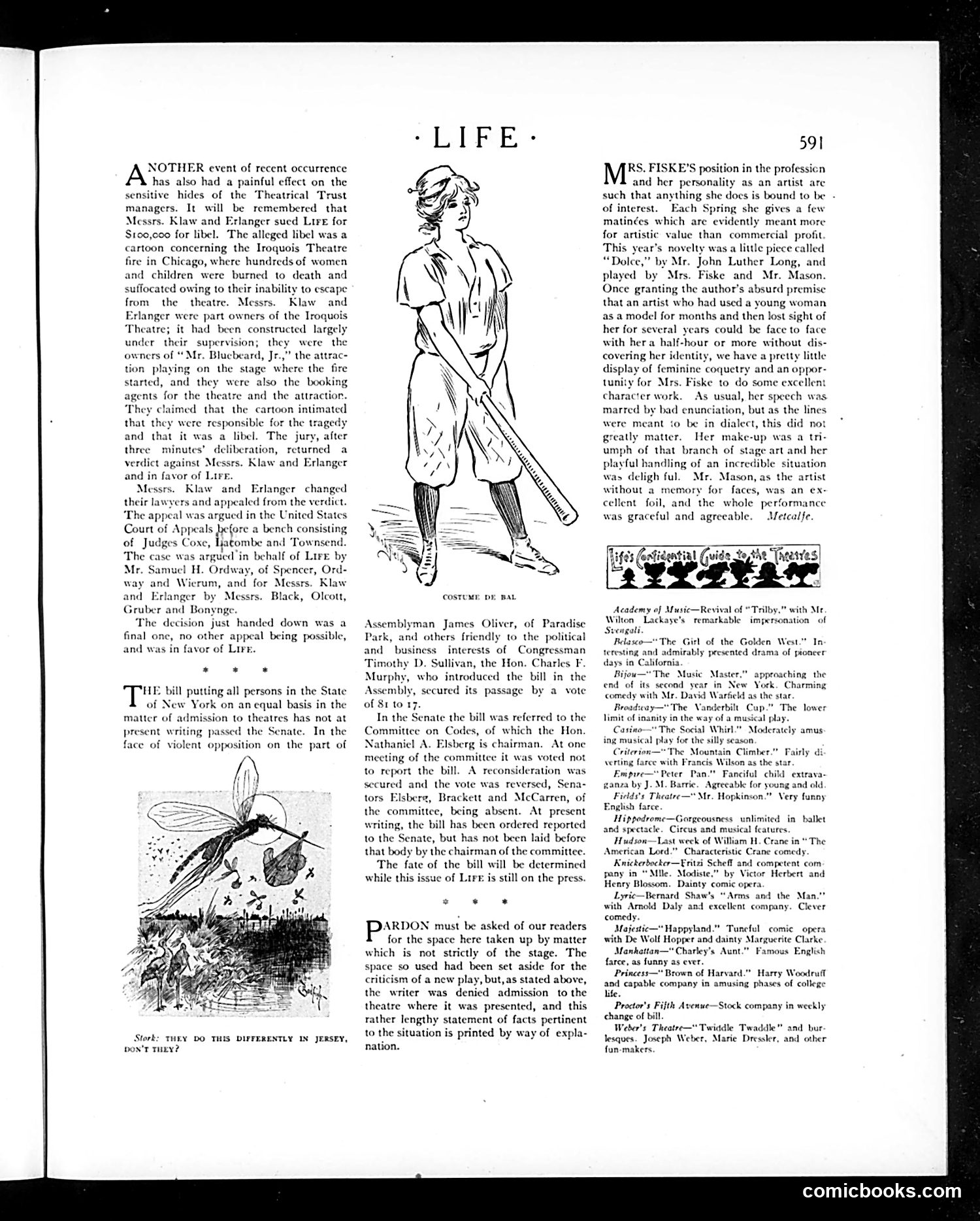
This page contains two distinct items: **The Iroquois Theatre Lawsuit:** The main article discusses Klaw and Erlanger, powerful theatre managers who owned the Iroquois Theatre in Chicago, where a devastating fire killed hundreds in 1903. They sued *Life* magazine for $500,000 libel over a cartoon suggesting their responsibility for the tragedy (poor construction/supervision enabled the death toll). A jury sided with *Life*; the appeals court upheld this verdict. The article celebrates this legal victory for press freedom against powerful theatrical monopolists. **The Political Cartoon ("Stork"):** The bottom illustration, captioned "They do this differently in Jersey, don't they?" appears to satirize political corruption in New York versus New Jersey regarding theatre admission equality bills. It references Congressman Timothy Sullivan and political operatives manipulating legislative committees—suggesting backroom dealing prevents the bill's passage. Both items critique abuse of power by wealthy theatre interests and corrupt politicians.
📄 Transcribed text from this page (OCR, searchable)
Machine-transcribed from the original scan — historical spelling and the odd misread are preserved.
NOTHER event of recent occurrence has also had a painful effect on the sensitive hides of the Theatrical Trust managers. It will be remembered that Messrs. Klaw and Erlanger sucd Ltre for Sto0,coo for libel. The alleged libel was a cartoon concerning the Iroquois Theatre fire in Chicago, where hundreds of women and children were burned to death and suffocated owing to their inability to escape from the theatre. Messrs. Klaw and Erlanger were part owners of the Iroquois Theatre; it had been constructed largely under their supervision; they were the owners of “Mr, Blacbeard, Jr.," the attrac- tion playing on the stage where the fire started, and they were also the booking agents for the theatre and the attraction. They claimed that the cartoon intimated that they were responsible for the tragedy and that it was a libel. The jury, after three verdict against Messrs. Klaw and Erlanger and in favor of Lire. Messrs. Klaw and Erlanger changed their lawyers and appealed from the verdict. ‘The appeal was argued in the United States Court of Appeals before a bench consisting of Judges Coxe, Tatombe and ‘Townsend. The case was argued’in behalf of Lire by Mr. Samucl H. Ordw of Spencer, Ord- way and Wierum, anc Klaw rlanger by Messrs. Black, Olcott, Gruber and Bonynge. The decision just handed down was a final one, no other appeal being possible, and was in favor of Lire. inutes’ deliberation, returned a for Messrs. and * * « HE; bill putting all persons in the St of New York on an equal basis in the matter of admission to theatres has not at In the face of violent opposition on the part of present writing passed the Se Stork: THEY DO THIS DIFFERENTLY IN JERSEY, DON'T THEY? cosTeME Dr BAL Assemblyman James Oliver, of Paradise Park, and others friendly to the political and business interests of Congressman Timothy D. Sullivan, the Hon. Charles F. Murphy, who introduced the bill in the Assembly, secured its passage by a vote of 81 to 17. In the Senate the bill was referred to the Committee on Codes, of which the Hon. Nathaniel A. Elsberg is chairman. At one mecting of the committee it was voted not to report the bill secured and the vote was reversed, Sena- tors Elsbere, Brackett and McCarren, of the committee, being absent. At present writing, the bill has been ordered reported to the Senate, but has not been laid before that body by the chairman of the committee. The fate of the bill will be determined while this issue of Lirr. is still on the press. A reconsideration was Pn RDON must be asked of our readers for the space here taken up by matter which is not strictly of the stage. The space so used had been set aside for the criticism of a new play, but, as stated abov the writer was denied admission to the theatre where it was presented, and this rather lengthy statement of facts pertinent to the situation is printed by way of expla- nation. 591 RS. FISKE’S position in the professicn and her personality as an artist are such that anything she docs is bound to be - of interest. Each Spring she gives a few matinées which are evidently meant more for artistic value than commercial profit This year's novelty was a little piece called “Dolce,” by Mr. John Luther Long, and played by Mrs. Fiske and Mr. Mason. Once granting the author's absurd premise that an artist who had used a young woman as a model for months and then lost sight of her for several years could be face to face with hera half-hour or more without dis- covering her identity, we have a pretty little display of feminine coquetry and an oppor- for Mrs. Fiske to do some excellent character work. As usual, her speech was marred by bad enunciation, but as the lines nt to be in dialect, this did not greatly matter. Her make-up was a tri- umph of that branch of stage art and her playful handling of an incredible situation was deligh ful. Mr. Mason, as the artist without a memory for faces, was an ex- cellent foil, and the whole performance was graceful and agreeable. Metcalfe. lifes ey (vise oP “[htetves| Academy of Music—Revival of “Trilby.” with Me Wilton Lackaye’s remarkable impersonation of Svengati Retasco— Girl of the Golden West.” In: teresting and admirably pecsented drama of pioneer days in California Bijou—"The Music Master." approaching the end of its second year in New York. Charming comedy with Mr. David Warfield as the st Broadieay—"'The Vanderbilt Cup. limit of inanity in the way of a musical play. Casino—"The Social Whirl.” Moderately amus ing musical play for the silly season. Criterion—"The Mountain Climber.” Fairly di verting farce with Francis Wilson as the star. Empire—*Peter Pan." Fanciful child exteava- anza by J. M. Barrie. Agreeable for young and old Firlds's Theatre" Mr. Hopkinson.” Very funny English farce Hippodrome—Gorgcousness unlimited in ballet and spectacle. Circus and musical features Hudson—Last week of William H. Crane in “The American Lord.” Characteristic Crane comedy Knickerbocker—Eritzi Scheff and competent com pany in “Mile. Modiste,” by Victor Herbert and Henry Blossom. Dainty comic opera Lyric—Bernard Shaw's “Arms and the Man." with Amold Daly and excellent company. comedy. Majestic—" Happyland.” Tuneful comic opera with De Wolf Hopper and dainty Marguerite Clarke Manhattan—"Charley’s Aunt." Famous English farce, as funny as ever. Princess—" Brown of Harvard.” Harry Woodru(f and capable company in amusing phases of college life. Proctor's Fijth Avenue—Stock company in weekly change of bill. Weber's Theatre—" Twiddle Twaddle” and bur lesques. Joseph Weber, Marie Dressler, and other fun-makers. were me 1 lower lever comicbooks.com